
OPTIMIZED EXECUTION OF PARALLEL LOOPS VIA USERDEFINED SCHEDULING

- Slides: 16
OPTIMIZED EXECUTION OF PARALLEL LOOPS VIA USER-DEFINED SCHEDULING POLICIES SEONMYEONG BAK, YANFEI GUO*, PAVAN BALAJI*, VIVEK SARKAR GEORGIA INSTITUTE OF TECHNOLOGY *ARGONNE NATIONAL LABORATORY
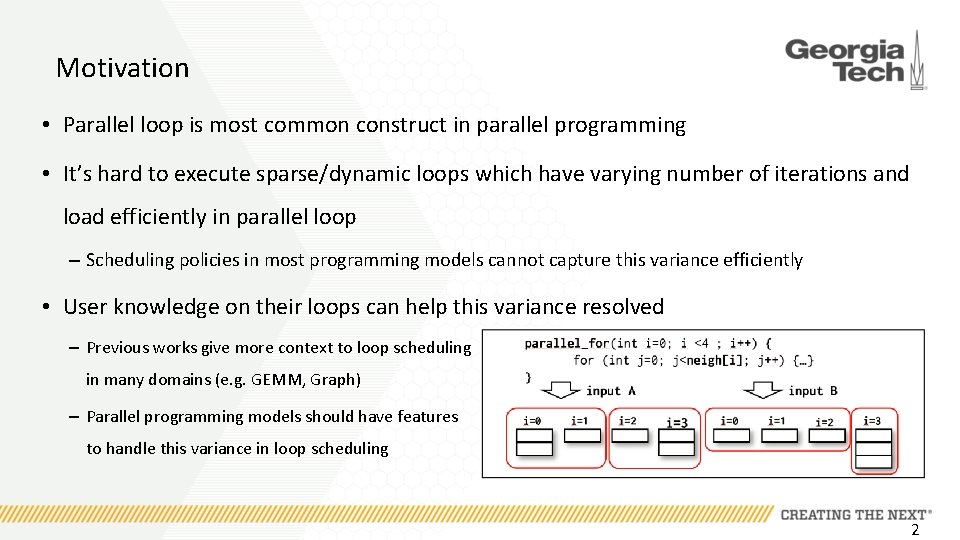
Motivation • Parallel loop is most common construct in parallel programming • It’s hard to execute sparse/dynamic loops which have varying number of iterations and load efficiently in parallel loop – Scheduling policies in most programming models cannot capture this variance efficiently • User knowledge on their loops can help this variance resolved – Previous works give more context to loop scheduling in many domains (e. g. GEMM, Graph) – Parallel programming models should have features to handle this variance in loop scheduling 2
Past Work • Open. MP has implemented many common loop scheduling policies – static, dynamic(P. Tang et al, ICPP 1986) and guided (C. D. Polychronopoulos et al, TC 1987) • Many efforts for both locality and load balancing have been proposed – The most common approach is to mix of static and dynamic: Each thread starts with some subspace where some of iterations are stealable by other workers (V. Kale et al, Euro. MPI 2014) • These works couldn’t resolve some load balancing issue with locality completely – Each chunk may have different amount of load determined at runtime • This load imbalance is handled by unnecessary migration in the previous approaches 3
This paper • Our work enables more optimal scheduling of loops with user information through our proposed API and runtime – A user function is used to decompose the iteration space of the target loop into subspaces – The other user function is used to create chunks within the subspace considering computation for each iteration – The created chunks are stored and retrieved for the future invocations of the target loop • We achieved up to 1. 24 x speed up in Mini. MD, 1. 47 x in Page. Rank and 1. 23 x in Connected Components of GAP Benchmark suite 4
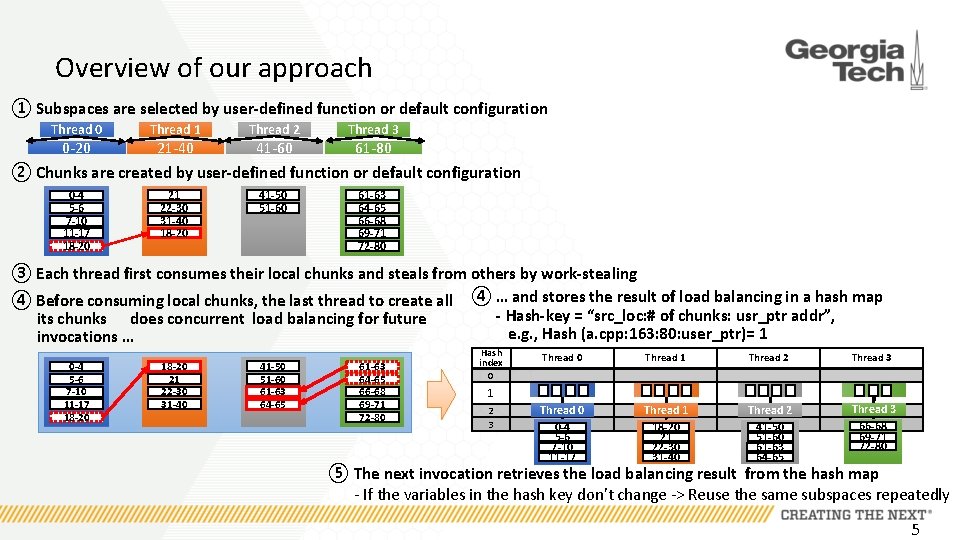
Overview of our approach ① Subspaces are selected by user-defined function or default configuration Thread 0 0 -20 Thread 1 Thread 2 Thread 3 21 -40 41 -60 61 -80 ② Chunks are created by user-defined function or default configuration 0 -4 5 -6 7 -10 G 11 -17 18 -20 21 22 -30 31 -40 18 -20 41 -50 51 -60 61 -63 64 -65 66 -68 69 -71 72 -80 ③ Each thread first consumes their local chunks and steals from others by work-stealing ④ Before consuming local chunks, the last thread to create all ④ … and stores the result of load balancing in a hash map - Hash-key = “src_loc: # of chunks: usr_ptr addr”, its chunks does concurrent load balancing for future e. g. , Hash (a. cpp: 163: 80: user_ptr)= 1 invocations … 0 -4 5 -6 7 -10 G 11 -17 18 -20 21 22 -30 31 -40 41 -50 51 -60 61 -63 64 -65 66 -68 69 -71 72 -80 Hash index 0 Thread 1 Thread 2 Thread 3 Thread 0 0 -4 5 -6 7 -10 11 -17 Thread 1 18 -20 21 22 -30 31 -40 Thread 2 41 -50 51 -60 61 -63 64 -65 Thread 3 66 -68 69 -71 72 -80 1 2 3 ⑤ The next invocation retrieves the load balancing result from the hash map - If the variables in the hash key don’t change -> Reuse the same subspaces repeatedly 5
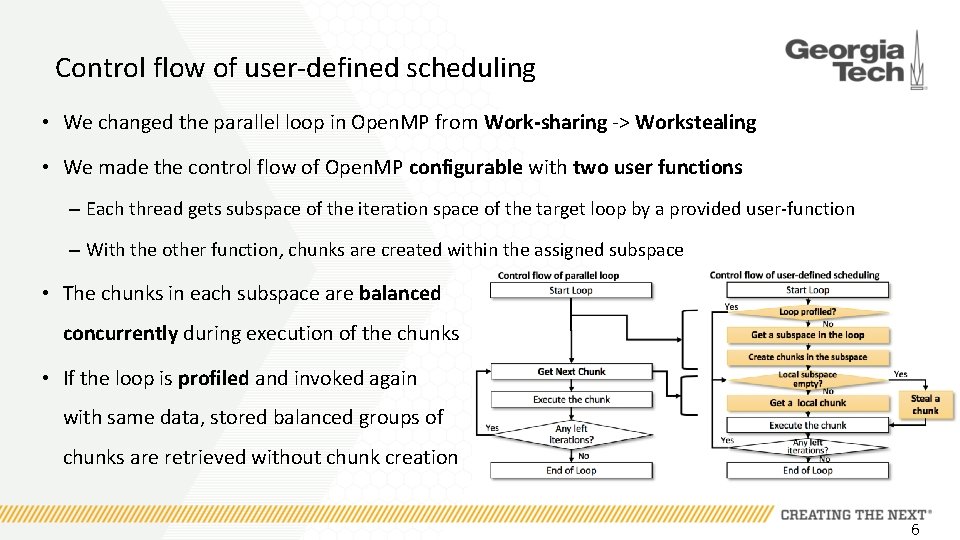
Control flow of user-defined scheduling • We changed the parallel loop in Open. MP from Work-sharing -> Workstealing • We made the control flow of Open. MP configurable with two user functions – Each thread gets subspace of the iteration space of the target loop by a provided user-function – With the other function, chunks are created within the assigned subspace • The chunks in each subspace are balanced concurrently during execution of the chunks • If the loop is profiled and invoked again with same data, stored balanced groups of chunks are retrieved without chunk creation 6
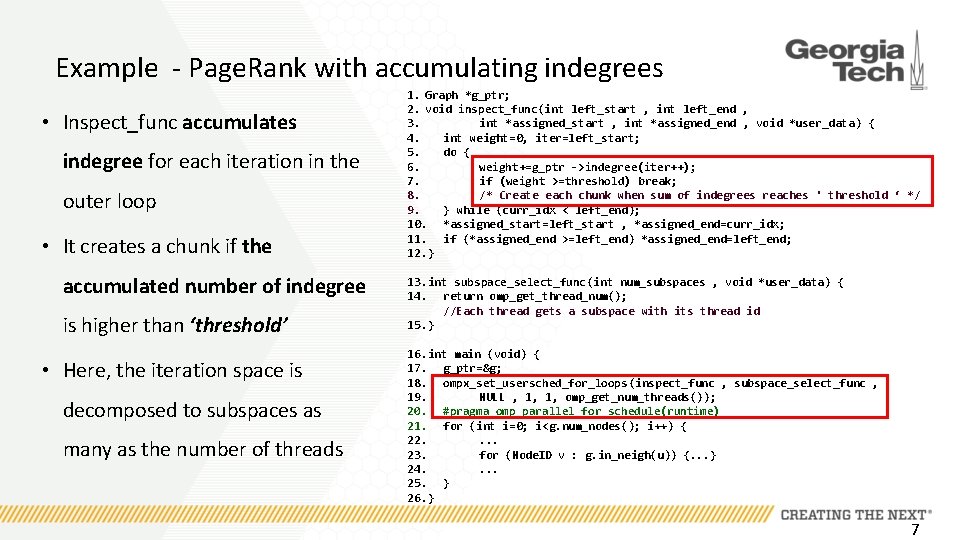
Example - Page. Rank with accumulating indegrees • Inspect_func accumulates indegree for each iteration in the outer loop • It creates a chunk if the accumulated number of indegree is higher than ‘threshold’ • Here, the iteration space is decomposed to subspaces as many as the number of threads 1. Graph *g_ptr; 2. void inspect_func(int left_start , int left_end , 3. int *assigned_start , int *assigned_end , void *user_data) { 4. int weight=0, iter=left_start; 5. do { 6. weight+=g_ptr ->indegree(iter++); 7. if (weight >=threshold) break; 8. /* Create each chunk when sum of indegrees reaches ' threshold ‘ */ 9. } while (curr_idx < left_end); 10. *assigned_start=left_start , *assigned_end=curr_idx; 11. if (*assigned_end >=left_end) *assigned_end=left_end; 12. } 13. int subspace_select_func(int num_subspaces , void *user_data) { 14. return omp_get_thread_num(); //Each thread gets a subspace with its thread id 15. } 16. int main (void) { 17. g_ptr=&g; 18. ompx_set_usersched_for_loops(inspect_func , subspace_select_func , 19. NULL , 1, 1, omp_get_num_threads()); 20. #pragma omp parallel for schedule(runtime) 21. for (int i=0; i<g. num_nodes(); i++) { 22. . 23. for (Node. ID v : g. in_neigh(u)) {. . . } 24. . 25. } 26. } 7
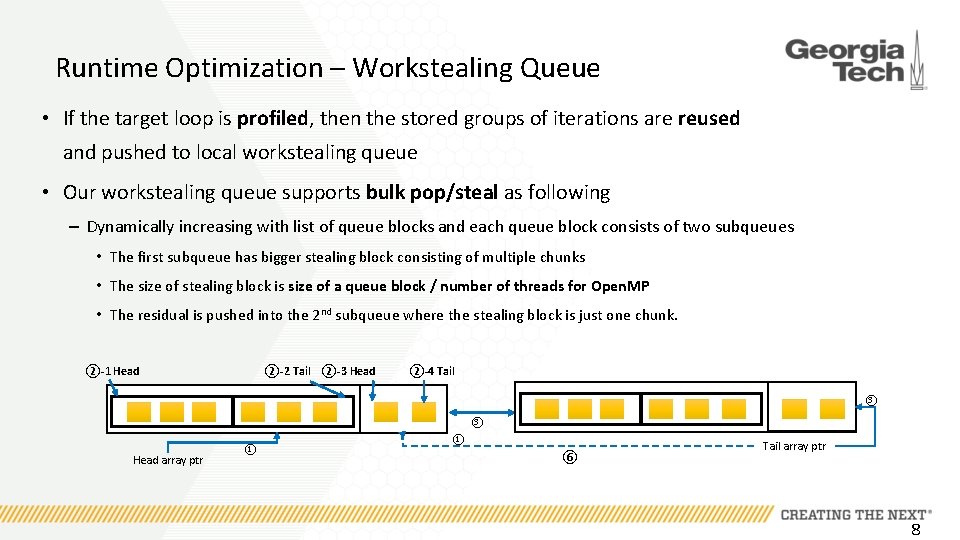
Runtime Optimization – Workstealing Queue • If the target loop is profiled, then the stored groups of iterations are reused and pushed to local workstealing queue • Our workstealing queue supports bulk pop/steal as following – Dynamically increasing with list of queue blocks and each queue block consists of two subqueues • The first subqueue has bigger stealing block consisting of multiple chunks • The size of stealing block is size of a queue block / number of threads for Open. MP • The residual is pushed into the 2 nd subqueue where the stealing block is just one chunk. ②-1 Head ②-2 Tail ②-3 Head ②-4 Tail ③ ③ Head array ptr ① ① ⑥ Tail array ptr 8
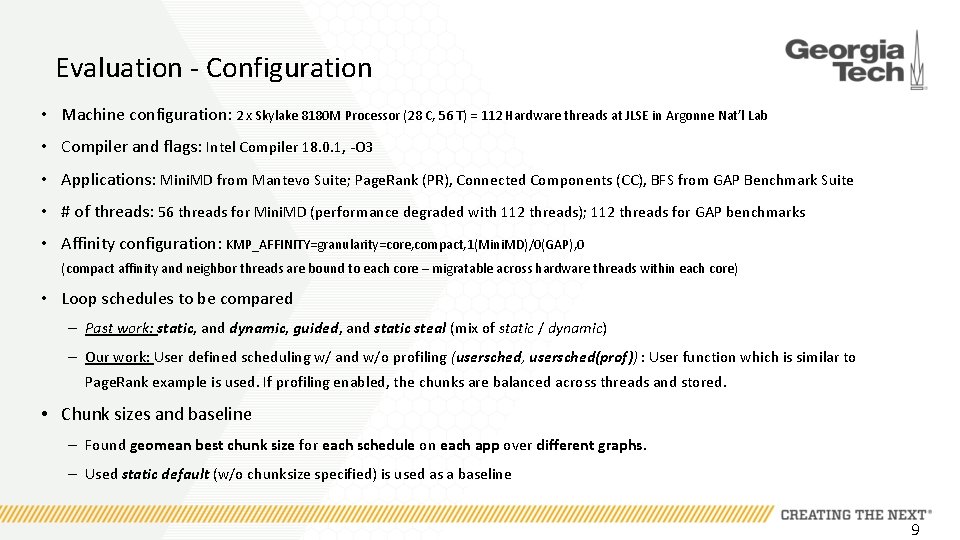
Evaluation - Configuration • Machine configuration: 2 x Skylake 8180 M Processor (28 C, 56 T) = 112 Hardware threads at JLSE in Argonne Nat’l Lab • Compiler and flags: Intel Compiler 18. 0. 1, -O 3 • Applications: Mini. MD from Mantevo Suite; Page. Rank (PR), Connected Components (CC), BFS from GAP Benchmark Suite • # of threads: 56 threads for Mini. MD (performance degraded with 112 threads); 112 threads for GAP benchmarks • Affinity configuration: KMP_AFFINITY=granularity=core, compact, 1(Mini. MD)/0(GAP), 0 (compact affinity and neighbor threads are bound to each core – migratable across hardware threads within each core) • Loop schedules to be compared – Past work: static, and dynamic, guided, and static steal (mix of static / dynamic) – Our work: User defined scheduling w/ and w/o profiling (usersched, usersched(prof)) : User function which is similar to Page. Rank example is used. If profiling enabled, the chunks are balanced across threads and stored. • Chunk sizes and baseline – Found geomean best chunk size for each schedule on each app over different graphs. – Used static default (w/o chunksize specified) is used as a baseline 9
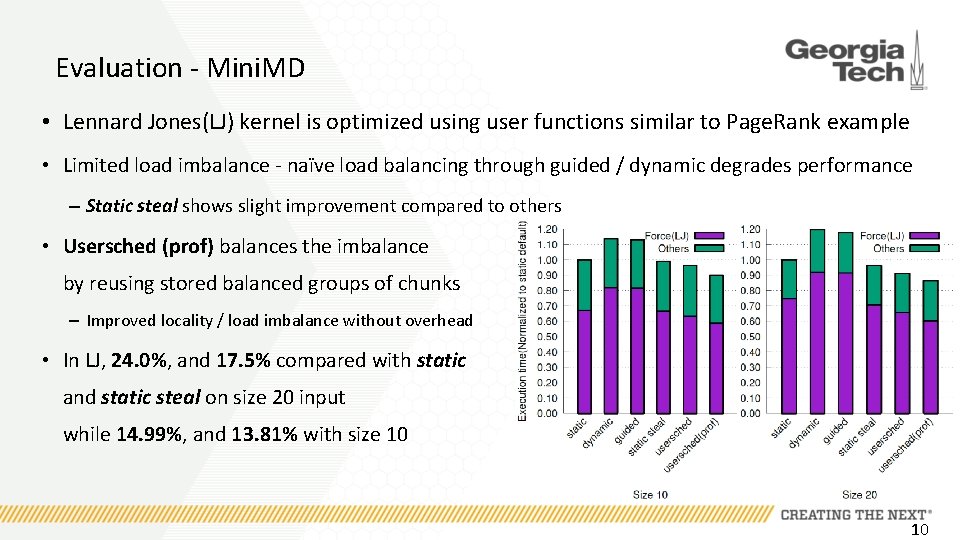
Evaluation - Mini. MD • Lennard Jones(LJ) kernel is optimized using user functions similar to Page. Rank example • Limited load imbalance - naïve load balancing through guided / dynamic degrades performance – Static steal shows slight improvement compared to others • Usersched (prof) balances the imbalance by reusing stored balanced groups of chunks – Improved locality / load imbalance without overhead • In LJ, 24. 0%, and 17. 5% compared with static and static steal on size 20 input while 14. 99%, and 13. 81% with size 10 10
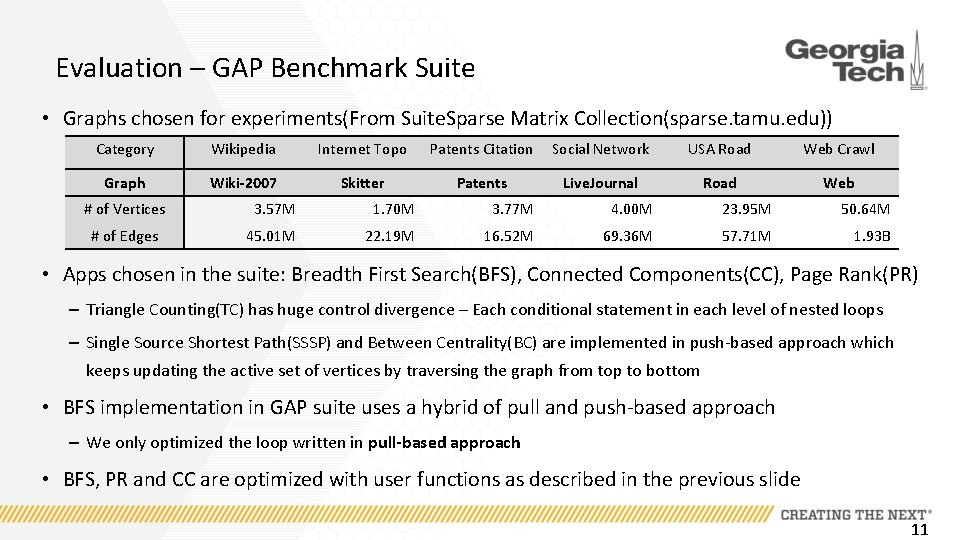
Evaluation – GAP Benchmark Suite • Graphs chosen for experiments(From Suite. Sparse Matrix Collection(sparse. tamu. edu)) Category Wikipedia Internet Topo Patents Citation Social Network USA Road Web Crawl Graph Wiki-2007 Skitter Patents Live. Journal Road Web # of Vertices 3. 57 M 1. 70 M 3. 77 M 4. 00 M 23. 95 M 50. 64 M # of Edges 45. 01 M 22. 19 M 16. 52 M 69. 36 M 57. 71 M 1. 93 B • Apps chosen in the suite: Breadth First Search(BFS), Connected Components(CC), Page Rank(PR) – Triangle Counting(TC) has huge control divergence – Each conditional statement in each level of nested loops – Single Source Shortest Path(SSSP) and Between Centrality(BC) are implemented in push-based approach which keeps updating the active set of vertices by traversing the graph from top to bottom • BFS implementation in GAP suite uses a hybrid of pull and push-based approach – We only optimized the loop written in pull-based approach • BFS, PR and CC are optimized with user functions as described in the previous slide 11
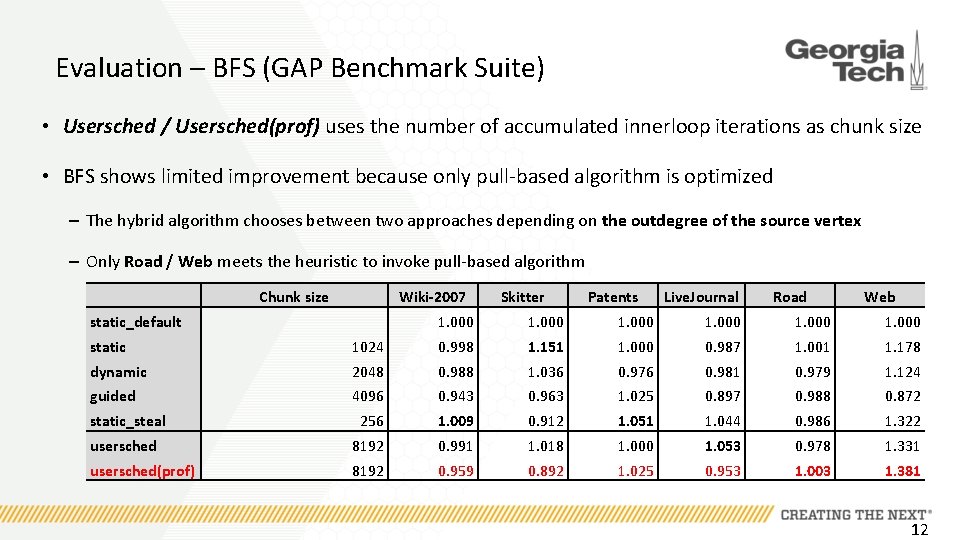
Evaluation – BFS (GAP Benchmark Suite) • Usersched / Usersched(prof) uses the number of accumulated innerloop iterations as chunk size • BFS shows limited improvement because only pull-based algorithm is optimized – The hybrid algorithm chooses between two approaches depending on the outdegree of the source vertex – Only Road / Web meets the heuristic to invoke pull-based algorithm Chunk size Wiki-2007 static_default Skitter Patents Live. Journal Road Web 1. 000 static 1024 0. 998 1. 151 1. 000 0. 987 1. 001 1. 178 dynamic 2048 0. 988 1. 036 0. 976 0. 981 0. 979 1. 124 guided 4096 0. 943 0. 963 1. 025 0. 897 0. 988 0. 872 static_steal 256 1. 009 0. 912 1. 051 1. 044 0. 986 1. 322 usersched 8192 0. 991 1. 018 1. 000 1. 053 0. 978 1. 331 usersched(prof) 8192 0. 959 0. 892 1. 025 0. 953 1. 003 1. 381 12
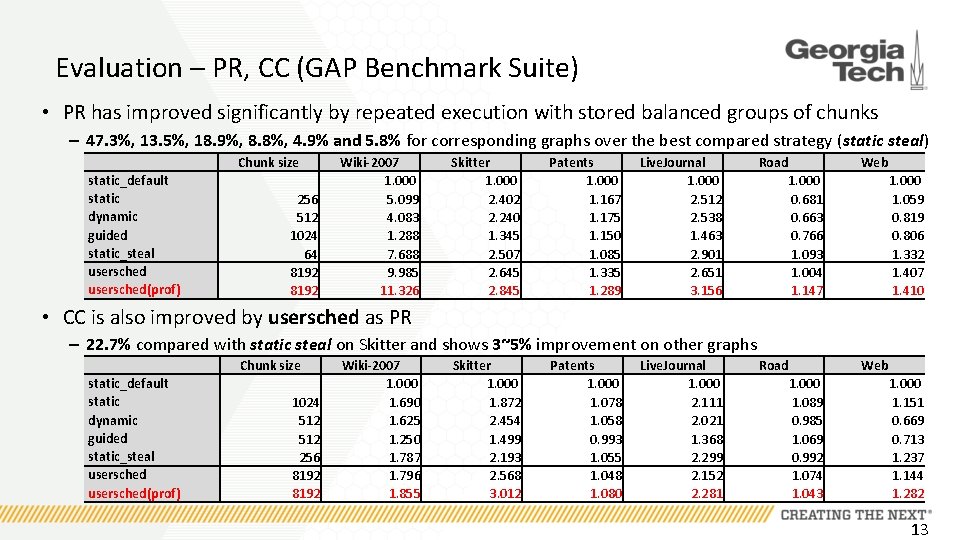
Evaluation – PR, CC (GAP Benchmark Suite) • PR has improved significantly by repeated execution with stored balanced groups of chunks – 47. 3%, 13. 5%, 18. 9%, 8. 8%, 4. 9% and 5. 8% for corresponding graphs over the best compared strategy (static steal) Chunk size static_default static dynamic guided static_steal usersched(prof) 256 512 1024 64 8192 Wiki-2007 1. 000 5. 099 4. 083 1. 288 7. 688 9. 985 11. 326 Skitter 1. 000 2. 402 2. 240 1. 345 2. 507 2. 645 2. 845 Patents 1. 000 1. 167 1. 175 1. 150 1. 085 1. 335 1. 289 Live. Journal 1. 000 2. 512 2. 538 1. 463 2. 901 2. 651 3. 156 Road Web 1. 000 0. 681 0. 663 0. 766 1. 093 1. 004 1. 147 1. 000 1. 059 0. 819 0. 806 1. 332 1. 407 1. 410 • CC is also improved by usersched as PR – 22. 7% compared with static steal on Skitter and shows 3~5% improvement on other graphs Chunk size static_default static dynamic guided static_steal usersched(prof) 1024 512 256 8192 Wiki-2007 1. 000 1. 690 1. 625 1. 250 1. 787 1. 796 1. 855 Skitter 1. 000 1. 872 2. 454 1. 499 2. 193 2. 568 3. 012 Patents 1. 000 1. 078 1. 058 0. 993 1. 055 1. 048 1. 080 Live. Journal 1. 000 2. 111 2. 021 1. 368 2. 299 2. 152 2. 281 Road 1. 000 1. 089 0. 985 1. 069 0. 992 1. 074 1. 043 Web 1. 000 1. 151 0. 669 0. 713 1. 237 1. 144 1. 282 13
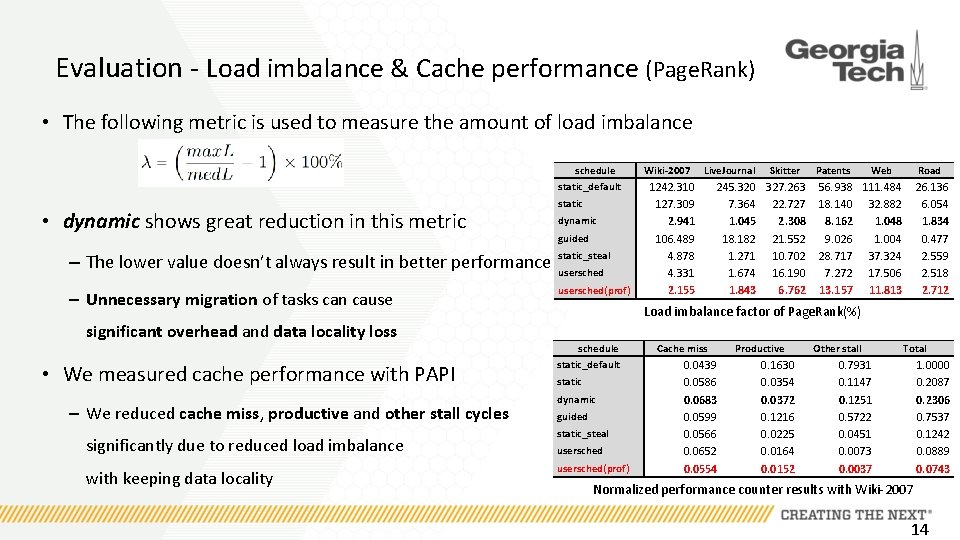
Evaluation - Load imbalance & Cache performance (Page. Rank) • The following metric is used to measure the amount of load imbalance schedule static_default • dynamic shows great reduction in this metric static dynamic guided – The lower value doesn’t always result in better performance static_steal – Unnecessary migration of tasks can cause usersched(prof) significant overhead and data locality loss • We measured cache performance with PAPI – We reduced cache miss, productive and other stall cycles significantly due to reduced load imbalance with keeping data locality usersched Wiki-2007 Live. Journal 1242. 310 127. 309 2. 941 106. 489 4. 878 4. 331 2. 155 Skitter 245. 320 327. 263 7. 364 22. 727 1. 045 2. 308 18. 182 21. 552 1. 271 10. 702 1. 674 16. 190 1. 843 6. 762 Patents Web Road 56. 938 111. 484 18. 140 32. 882 8. 162 1. 048 9. 026 1. 004 28. 717 37. 324 7. 272 17. 506 13. 157 11. 813 26. 136 6. 054 1. 834 0. 477 2. 559 2. 518 2. 712 Load imbalance factor of Page. Rank(%) schedule static_default static dynamic guided static_steal usersched(prof) Cache miss 0. 0439 0. 0586 0. 0683 0. 0599 0. 0566 0. 0652 0. 0554 Productive 0. 1630 0. 0354 0. 0372 0. 1216 0. 0225 0. 0164 0. 0152 Other stall Total 0. 7931 0. 1147 0. 1251 0. 5722 0. 0451 0. 0073 0. 0037 1. 0000 0. 2087 0. 2306 0. 7537 0. 1242 0. 0889 0. 0743 Normalized performance counter results with Wiki-2007 14
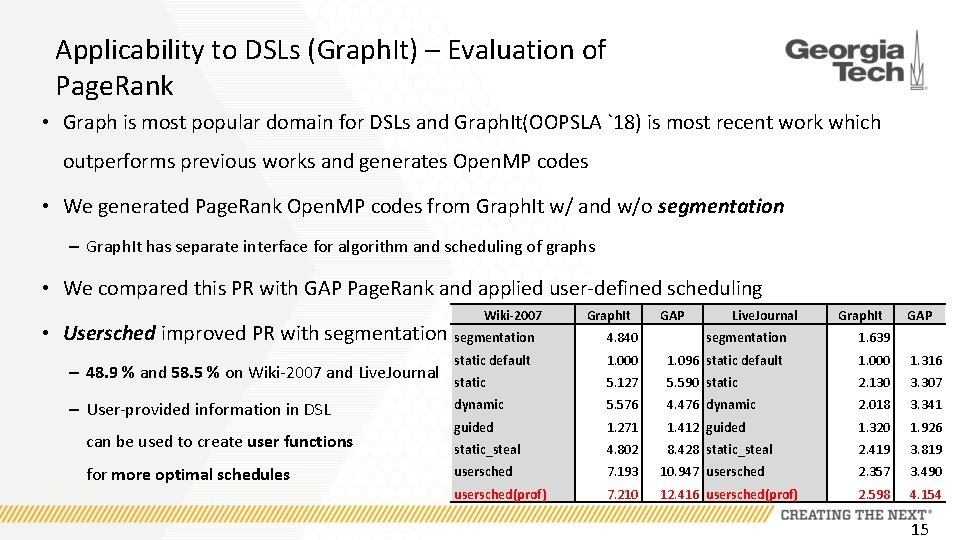
Applicability to DSLs (Graph. It) – Evaluation of Page. Rank • Graph is most popular domain for DSLs and Graph. It(OOPSLA `18) is most recent work which outperforms previous works and generates Open. MP codes • We generated Page. Rank Open. MP codes from Graph. It w/ and w/o segmentation – Graph. It has separate interface for algorithm and scheduling of graphs • We compared this PR with GAP Page. Rank and applied user-defined scheduling Wiki-2007 • Usersched improved PR with segmentation – 48. 9 % and 58. 5 % on Wiki-2007 and Live. Journal – User-provided information in DSL can be used to create user functions for more optimal schedules Graph. It GAP Live. Journal Graph. It GAP 4. 840 segmentation 1. 639 static default 1. 000 1. 096 static default 1. 000 1. 316 static 5. 127 5. 590 static 2. 130 3. 307 dynamic 5. 576 4. 476 dynamic 2. 018 3. 341 guided 1. 271 1. 412 guided 1. 320 1. 926 static_steal 4. 802 8. 428 static_steal 2. 419 3. 819 usersched 7. 193 10. 947 usersched 2. 357 3. 490 usersched(prof) 7. 210 12. 416 usersched(prof) 2. 598 4. 154 15
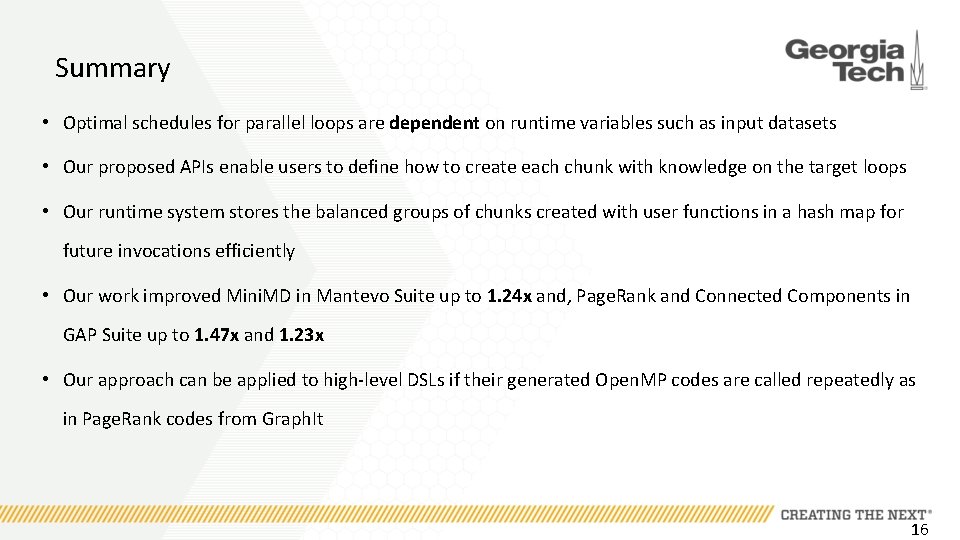
Summary • Optimal schedules for parallel loops are dependent on runtime variables such as input datasets • Our proposed APIs enable users to define how to create each chunk with knowledge on the target loops • Our runtime system stores the balanced groups of chunks created with user functions in a hash map for future invocations efficiently • Our work improved Mini. MD in Mantevo Suite up to 1. 24 x and, Page. Rank and Connected Components in GAP Suite up to 1. 47 x and 1. 23 x • Our approach can be applied to high-level DSLs if their generated Open. MP codes are called repeatedly as in Page. Rank codes from Graph. It 16