
Optimization The min and max of a function
![Brent’s Con’t It then resets the initial points [a, b, c] based on the](https://slidetodoc.com/presentation_image_h2/a065b08e56398faf6a7ebc328941be69/image-11.jpg "Brent’s Con’t It then resets the initial points [a, b, c] based on the")
- Slides: 20
Optimization : The min and max of a function Michael Sedivy Daniel Eiland
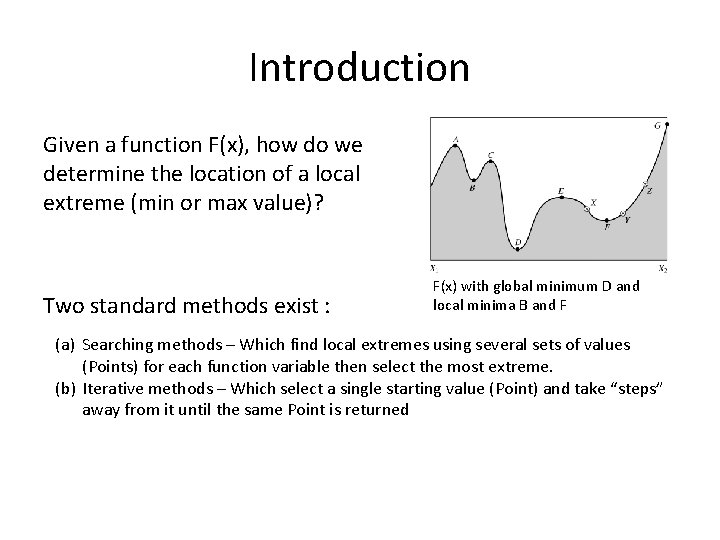
Introduction Given a function F(x), how do we determine the location of a local extreme (min or max value)? Two standard methods exist : F(x) with global minimum D and local minima B and F (a) Searching methods – Which find local extremes using several sets of values (Points) for each function variable then select the most extreme. (b) Iterative methods – Which select a single starting value (Point) and take “steps” away from it until the same Point is returned
Algorithm Selection Calculation of an extreme is not a perfect thing and is highly dependant upon the input function and available constraints. For basic one-dimensional functions [F(x)] choices include : 1. Brent’s method – For calculation with or without the derivative 2. Golden Section Search – For functions with multiple values for a given point
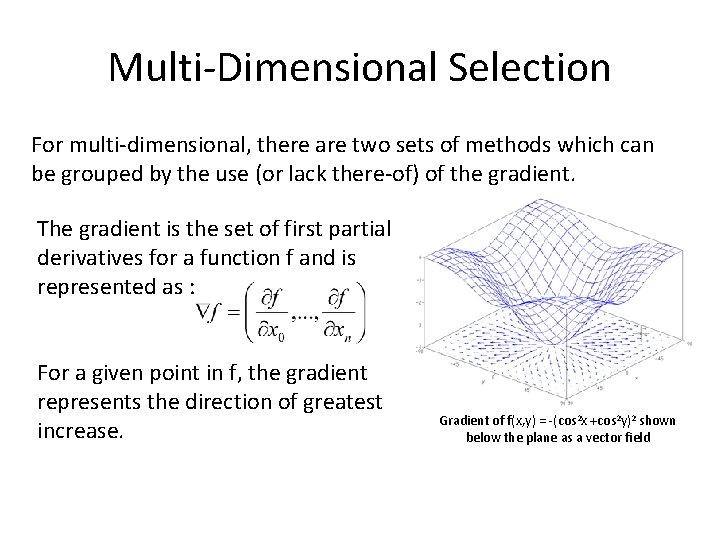
Multi-Dimensional Selection For multi-dimensional, there are two sets of methods which can be grouped by the use (or lack there-of) of the gradient. The gradient is the set of first partial derivatives for a function f and is represented as : For a given point in f, the gradient represents the direction of greatest increase. Gradient of f(x, y) = -(cos 2 x +cos 2 y)2 shown below the plane as a vector field
Multi-Dimensional Methods Gradient Independent Methods : 1. Downhill Simplex Method – “Slow but sure”. A general purpose algorithm that requires O(N 2) of storage 2. Direction Set Method (Powell’s Method) – Much faster than the Downhill method but requires a smooth function Gradient Dependent Methods : 1. Conjugate Gradient Method – The gradient of the function must be known but only requires O(~3 N) storage 2. Quasi-Newton (or variable metric) methods – Requires O(N 2) storage but calculates the gradient automatically
Line Minimization The first step for many one-dimensional and multi-dimensional methods is to determine the general location of the minimum. This based on ability to bracket a minimum between a triplet of points [a, b, c] such that f(a) > f(b) and f(c) > f(b).
Bracketing Calculation of this bracket is straightforward assuming points a and b are supplied. Simply scale the value of b such that is moves further away from a until a point c is found such that f(c) > f(b).
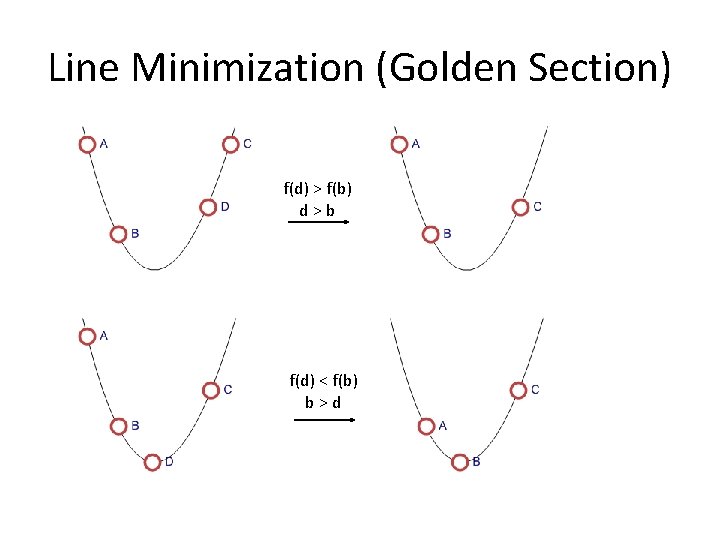
Line Minimization (Con’t) Once c is calculated, the final search for a minimum can be begin. The simplest method (Golden Section Search) is to evaluate a point d, halfway between b & c. If f(d) > f(b), then set c to d otherwise set b to d and a to b. This then process then repeats alternating between the a-b line segment and b-c line segment until the points converge (f(a) == f(b) == f(c)).
Line Minimization (Golden Section) f(d) > f(b) d>b f(d) < f(b) b>d
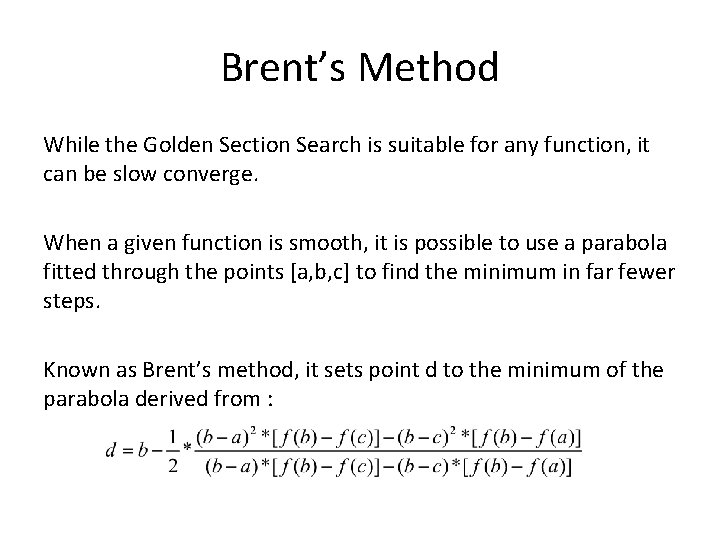
Brent’s Method While the Golden Section Search is suitable for any function, it can be slow converge. When a given function is smooth, it is possible to use a parabola fitted through the points [a, b, c] to find the minimum in far fewer steps. Known as Brent’s method, it sets point d to the minimum of the parabola derived from :
Brent’s Con’t It then resets the initial points [a, b, c] based on the value of f(d) similar to Golden Section Search. f(d) < f(b) b>d Of course, there is still the matter of the initial points a and b before any method can be applied…
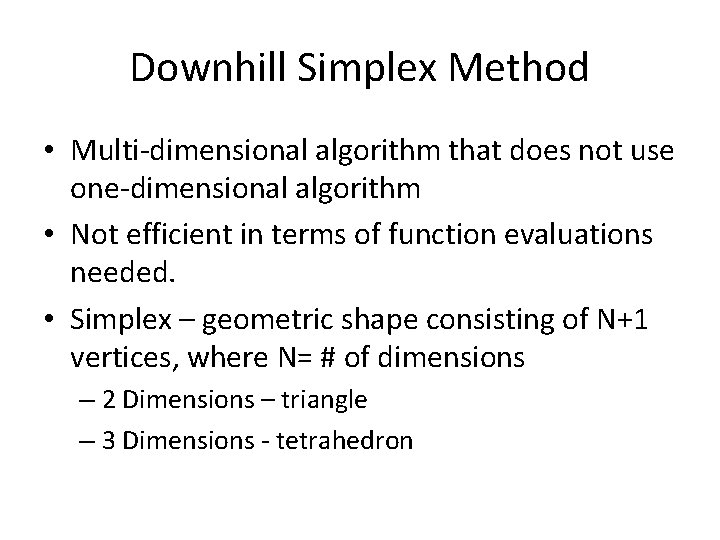
Downhill Simplex Method • Multi-dimensional algorithm that does not use one-dimensional algorithm • Not efficient in terms of function evaluations needed. • Simplex – geometric shape consisting of N+1 vertices, where N= # of dimensions – 2 Dimensions – triangle – 3 Dimensions - tetrahedron
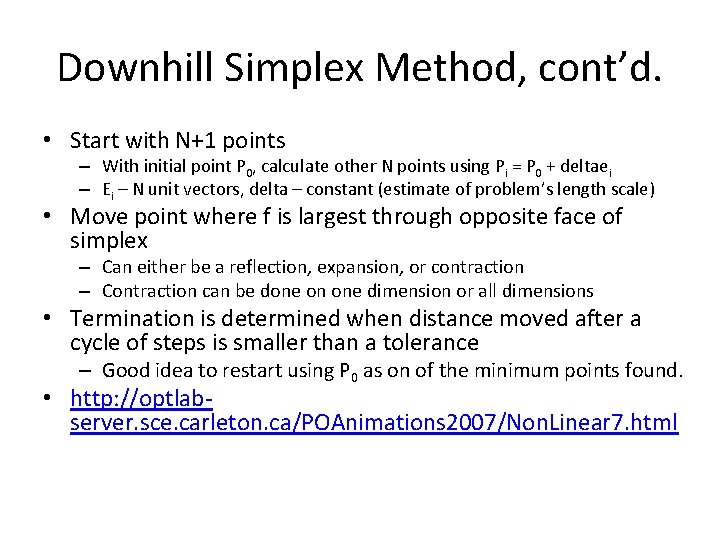
Downhill Simplex Method, cont’d. • Start with N+1 points – With initial point P 0, calculate other N points using Pi = P 0 + deltaei – Ei – N unit vectors, delta – constant (estimate of problem’s length scale) • Move point where f is largest through opposite face of simplex – Can either be a reflection, expansion, or contraction – Contraction can be done on one dimension or all dimensions • Termination is determined when distance moved after a cycle of steps is smaller than a tolerance – Good idea to restart using P 0 as on of the minimum points found. • http: //optlabserver. sce. carleton. ca/POAnimations 2007/Non. Linear 7. html
Direction Set/Powell’s Method • Basic Method - Alternates Directions while finding minimums – Inefficient for functions where 2 nd derivative is larger in magnitude than other 2 nd derivatives. – Need to find alternative for choosing direction
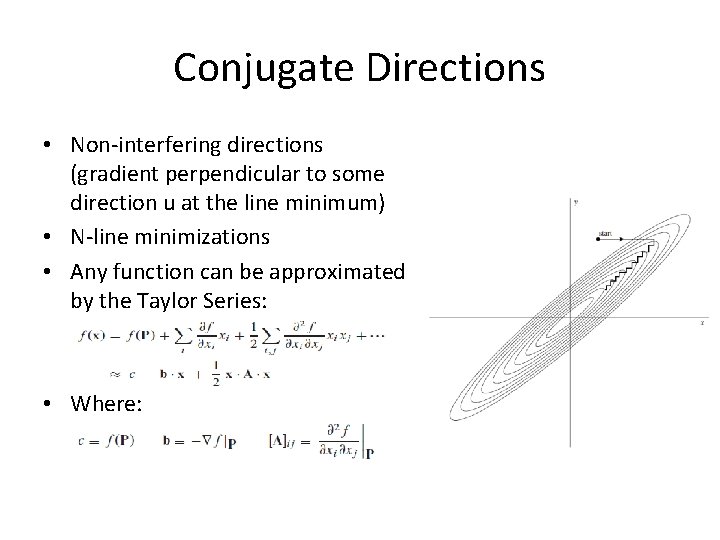
Conjugate Directions • Non-interfering directions (gradient perpendicular to some direction u at the line minimum) • N-line minimizations • Any function can be approximated by the Taylor Series: • Where:
Quadratically Convergent Method • Powell’s procedure – can exactly minimize quadratic form • Can have directions become linearly dependent (finds minimum over subset of f) • Three ways to fix problem: – Re-initialize direction set to basis vectors after N or N+1 iterations of basic procedure – Reset of directions to columns of any orthogonal matrix – Drop quadratic convergence in favor of finding a few good directions along narrow valleys
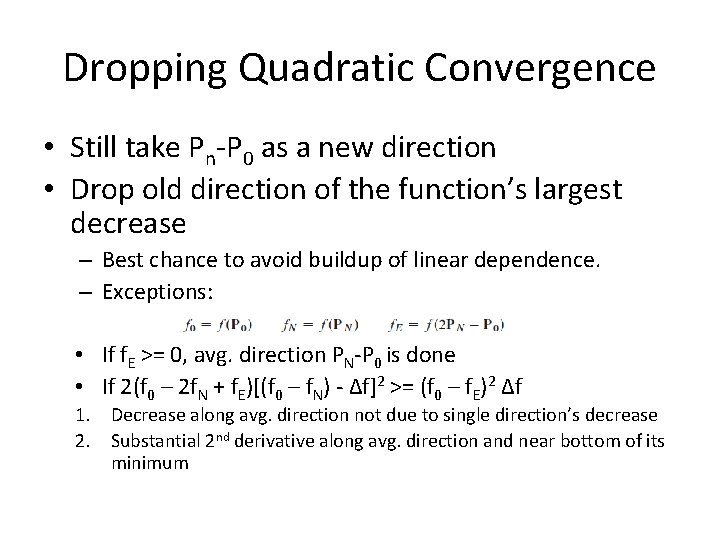
Dropping Quadratic Convergence • Still take Pn-P 0 as a new direction • Drop old direction of the function’s largest decrease – Best chance to avoid buildup of linear dependence. – Exceptions: • If f. E >= 0, avg. direction PN-P 0 is done • If 2(f 0 – 2 f. N + f. E)[(f 0 – f. N) - Δf]2 >= (f 0 – f. E)2 Δf 1. Decrease along avg. direction not due to single direction’s decrease 2. Substantial 2 nd derivative along avg. direction and near bottom of its minimum
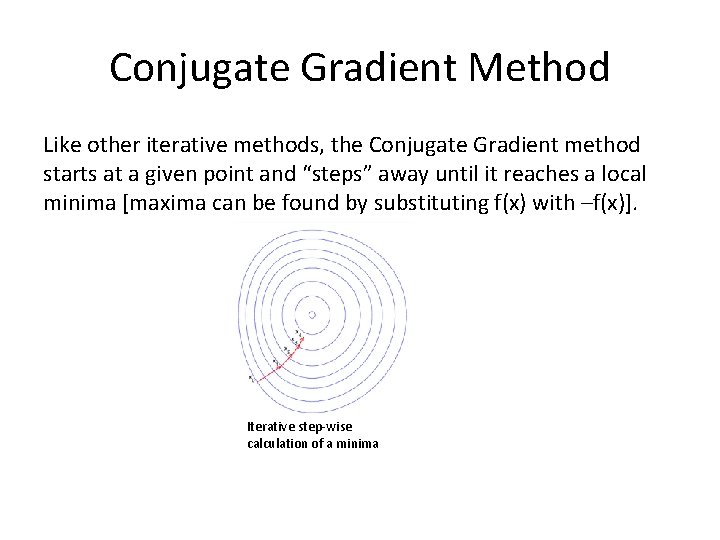
Conjugate Gradient Method Like other iterative methods, the Conjugate Gradient method starts at a given point and “steps” away until it reaches a local minima [maxima can be found by substituting f(x) with –f(x)]. Iterative step-wise calculation of a minima
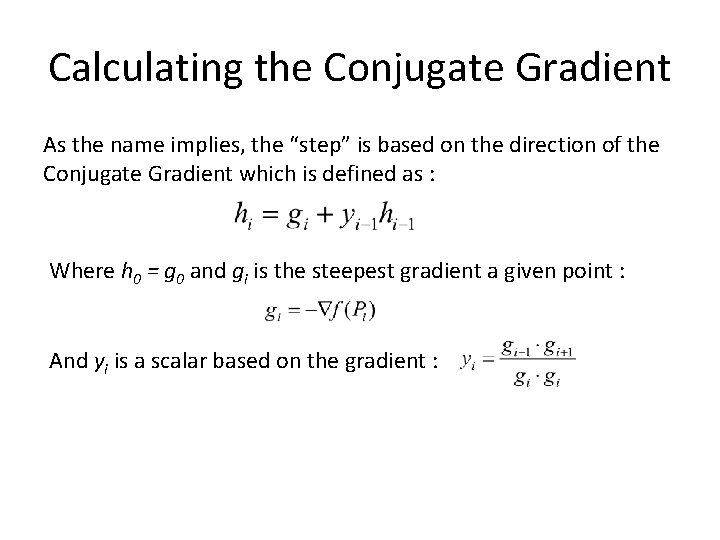
Calculating the Conjugate Gradient As the name implies, the “step” is based on the direction of the Conjugate Gradient which is defined as : Where h 0 = g 0 and gi is the steepest gradient a given point : And yi is a scalar based on the gradient :
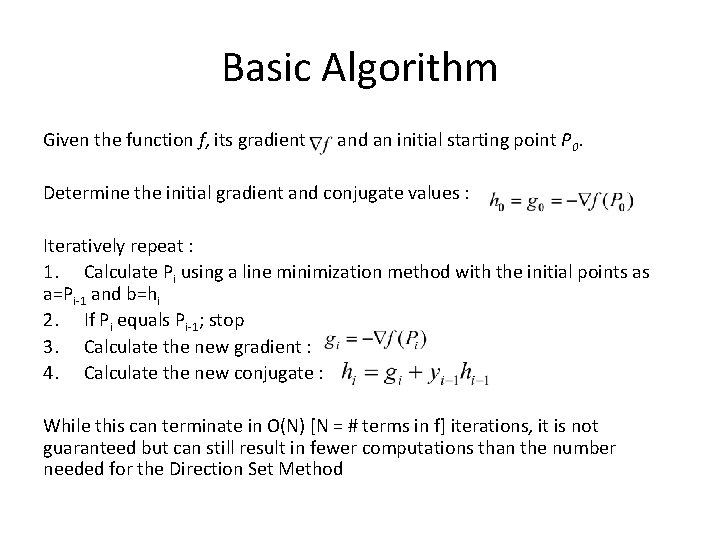
Basic Algorithm Given the function f, its gradient and an initial starting point P 0. Determine the initial gradient and conjugate values : Iteratively repeat : 1. Calculate Pi using a line minimization method with the initial points as a=Pi-1 and b=hi 2. If Pi equals Pi-1; stop 3. Calculate the new gradient : 4. Calculate the new conjugate : While this can terminate in O(N) [N = # terms in f] iterations, it is not guaranteed but can still result in fewer computations than the number needed for the Direction Set Method