
Optimization Techniques For Maximizing Application Performance on MultiCore

![Parallelism: machine code execution [Out-of-order execution engine in Duo Core] sequential machine code Execution](https://slidetodoc.com/presentation_image_h2/d72a812d88c9af8869b7f0a58d393a85/image-16.jpg "Parallelism: machine code execution [Out-of-order execution engine in Duo Core] sequential machine code Execution")
![Open. MP* [www. openmp. org] An Application Program Interface (API) for multithreaded, shared memory](https://slidetodoc.com/presentation_image_h2/d72a812d88c9af8869b7f0a58d393a85/image-24.jpg "Open. MP* [www. openmp. org] An Application Program Interface (API) for multithreaded, shared memory")
![Open. MP* - Example [Prime Number Gen. ] • Serial Exec. i factor 3](https://slidetodoc.com/presentation_image_h2/d72a812d88c9af8869b7f0a58d393a85/image-29.jpg "Open. MP* - Example [Prime Number Gen. ] • Serial Exec. i factor 3")
![Open. MP* - Example [Prime Number Gen. ] -> With Open. MP* #pragma omp](https://slidetodoc.com/presentation_image_h2/d72a812d88c9af8869b7f0a58d393a85/image-30.jpg "Open. MP* - Example [Prime Number Gen. ] -> With Open. MP* #pragma omp")
![Auto-parallelism - Example for (i=1; i<100; i++) { a[i] = a[i] + b[i] *](https://slidetodoc.com/presentation_image_h2/d72a812d88c9af8869b7f0a58d393a85/image-32.jpg "Auto-parallelism - Example for (i=1; i<100; i++) { a[i] = a[i] + b[i] *")

- Slides: 47
Optimization Techniques For Maximizing Application Performance on Multi-Core Processors Kittur Ganesh 1 10/20/2021 Copyright © 2006, Intel Corporation. All rights reserved. *Other brands and names are the property of their respective owners
Agenda • Multi-core processors – Overview • Parallelism – impact on multi-core? • Optimization techniques • OS Support / SW tools • Summary 2 10/20/2021 Copyright © 2006, Intel Corporation. All rights reserved. *Other brands and names are the property of their respective owners
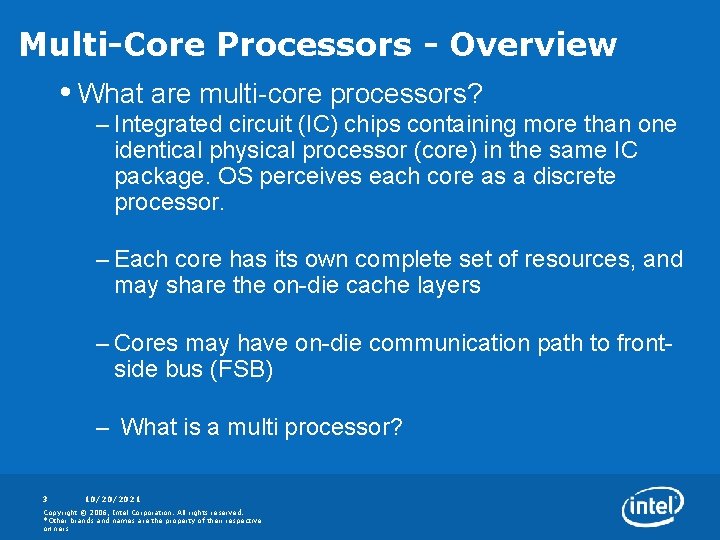
Multi-Core Processors - Overview • What are multi-core processors? – Integrated circuit (IC) chips containing more than one identical physical processor (core) in the same IC package. OS perceives each core as a discrete processor. – Each core has its own complete set of resources, and may share the on-die cache layers – Cores may have on-die communication path to frontside bus (FSB) – What is a multi processor? 3 10/20/2021 Copyright © 2006, Intel Corporation. All rights reserved. *Other brands and names are the property of their respective owners
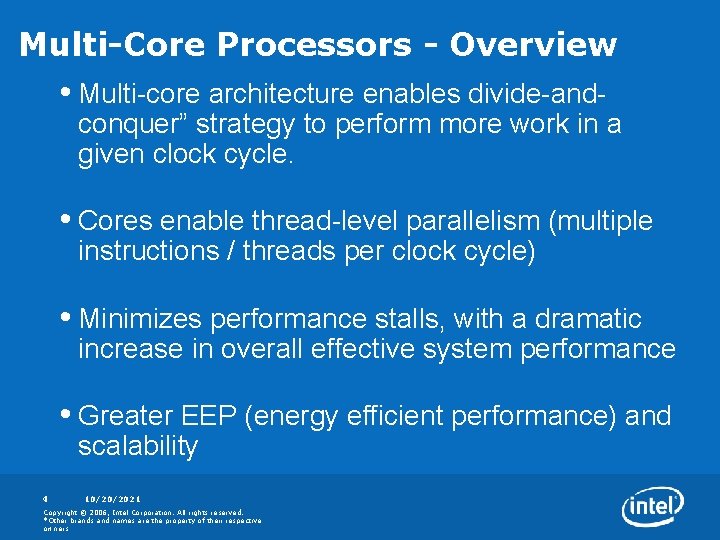
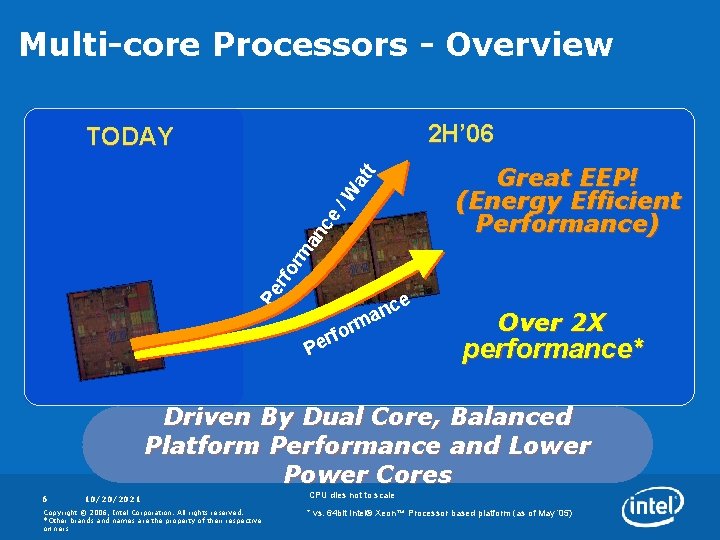
Multi-Core Processors - Overview • Multi-core architecture enables divide-and- conquer” strategy to perform more work in a given clock cycle. • Cores enable thread-level parallelism (multiple instructions / threads per clock cycle) • Minimizes performance stalls, with a dramatic increase in overall effective system performance • Greater EEP (energy efficient performance) and scalability 4 10/20/2021 Copyright © 2006, Intel Corporation. All rights reserved. *Other brands and names are the property of their respective owners
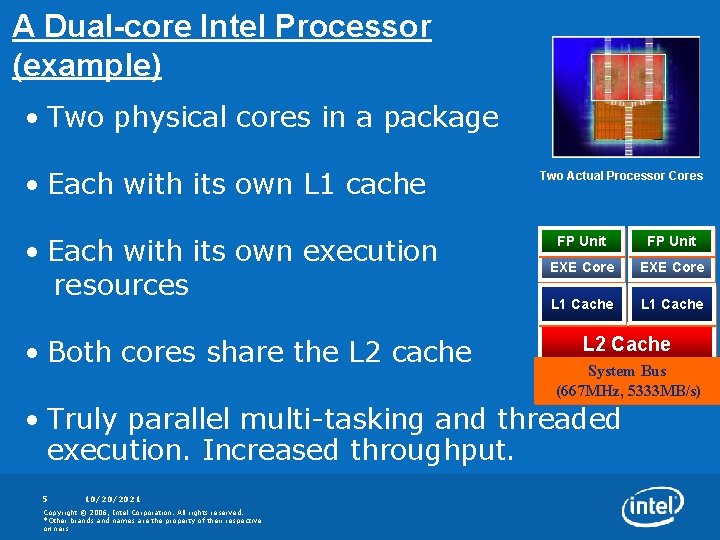
A Dual-core Intel Processor (example) • Two physical cores in a package • Each with its own L 1 cache • Each with its own execution resources • Both cores share the L 2 cache Two Actual Processor Cores FP Unit EXE Core L 1 Cache L 2 Cache System Bus (667 MHz, 5333 MB/s) • Truly parallel multi-tasking and threaded execution. Increased throughput. 5 10/20/2021 Copyright © 2006, Intel Corporation. All rights reserved. *Other brands and names are the property of their respective owners
Multi-core Processors - Overview 2 H’ 06 TODAY Pe rfo rm an ce /W at t Great EEP! (Energy Efficient Performance) e c an rm o f er P Over 2 X performance* Driven By Dual Core, Balanced Platform Performance and Lower Power Cores 6 10/20/2021 Copyright © 2006, Intel Corporation. All rights reserved. *Other brands and names are the property of their respective owners CPU dies not to scale * vs. 64 bit Intel® Xeon™ Processor based platform (as of May ’ 05)
Parallelism • Power / impact on Multi-core • Key concepts – Processes / Threads – Threading – when, why and how? – Functional Decomposition – Data Decomposition – Shared Memory Parallelism – Keys to parallelism 7 10/20/2021 Copyright © 2006, Intel Corporation. All rights reserved. *Other brands and names are the property of their respective owners
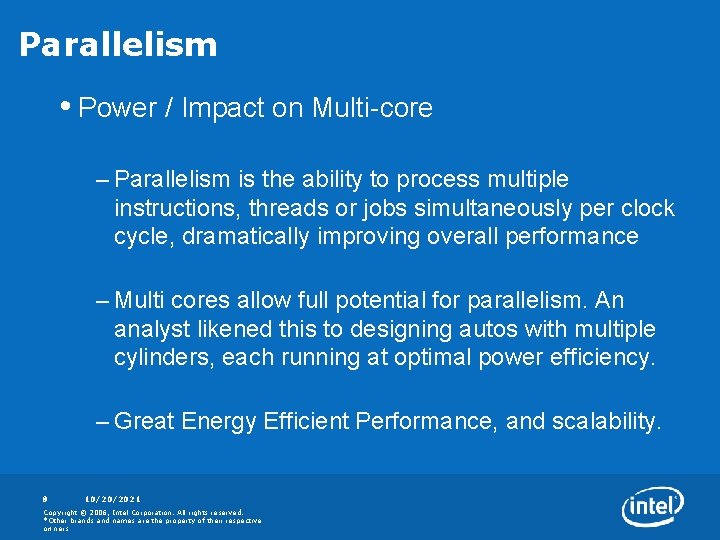
Parallelism • Power / Impact on Multi-core – Parallelism is the ability to process multiple instructions, threads or jobs simultaneously per clock cycle, dramatically improving overall performance – Multi cores allow full potential for parallelism. An analyst likened this to designing autos with multiple cylinders, each running at optimal power efficiency. – Great Energy Efficient Performance, and scalability. 8 10/20/2021 Copyright © 2006, Intel Corporation. All rights reserved. *Other brands and names are the property of their respective owners
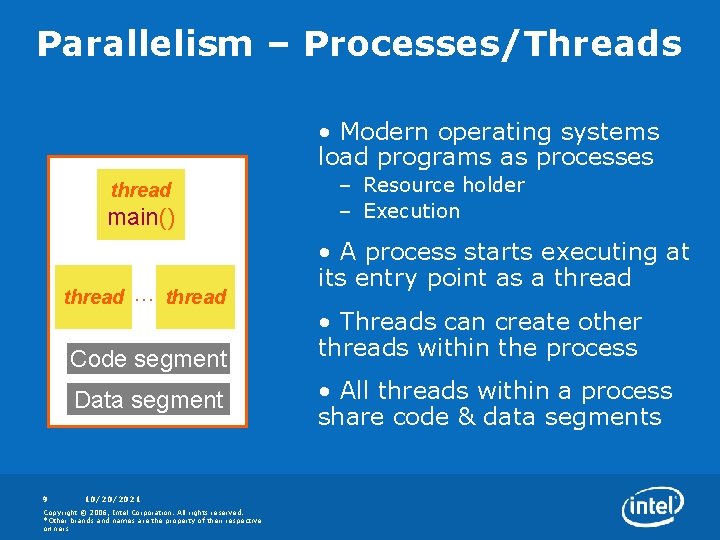
Parallelism – Processes/Threads • Modern operating systems load programs as processes thread main() thread … thread Code segment Data segment 9 10/20/2021 Copyright © 2006, Intel Corporation. All rights reserved. *Other brands and names are the property of their respective owners – Resource holder – Execution • A process starts executing at its entry point as a thread • Threads can create other threads within the process • All threads within a process share code & data segments
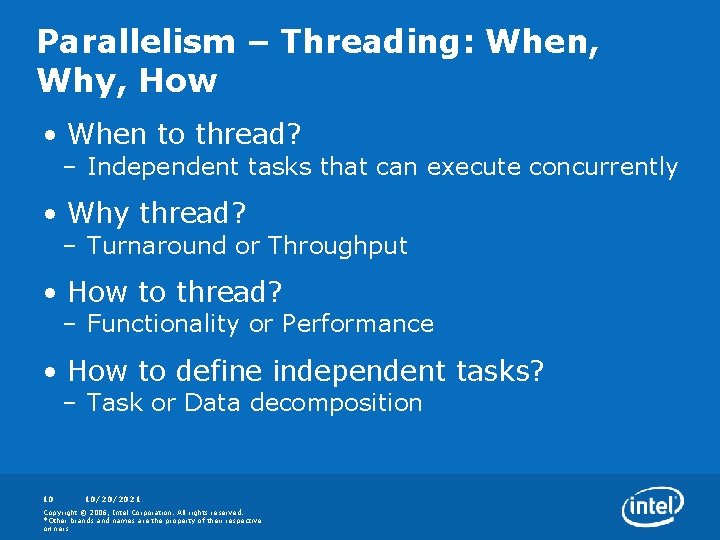
Parallelism – Threading: When, Why, How • When to thread? – Independent tasks that can execute concurrently • Why thread? – Turnaround or Throughput • How to thread? – Functionality or Performance • How to define independent tasks? – Task or Data decomposition 10 10/20/2021 Copyright © 2006, Intel Corporation. All rights reserved. *Other brands and names are the property of their respective owners
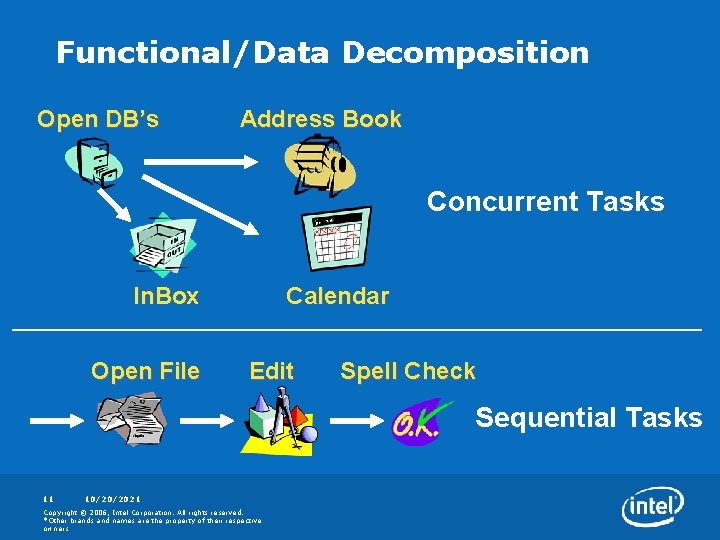
Functional/Data Decomposition Open DB’s Address Book Concurrent Tasks In. Box Open File Calendar Edit Spell Check Sequential Tasks 11 10/20/2021 Copyright © 2006, Intel Corporation. All rights reserved. *Other brands and names are the property of their respective owners
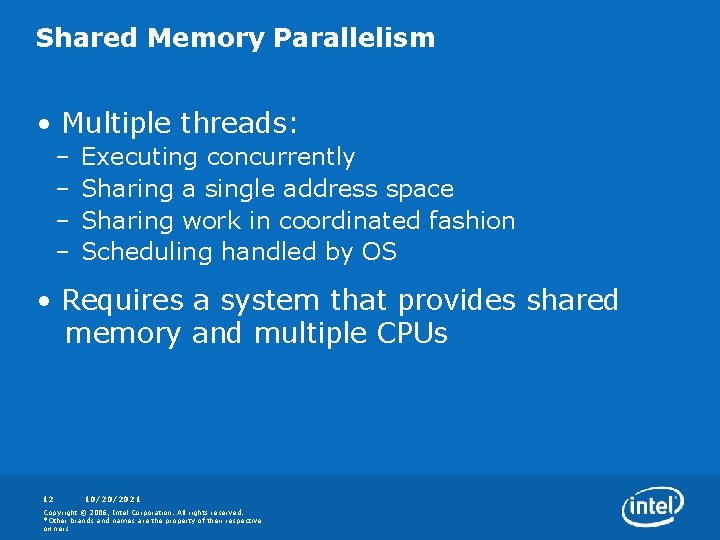
Shared Memory Parallelism • Multiple threads: – – Executing concurrently Sharing a single address space Sharing work in coordinated fashion Scheduling handled by OS • Requires a system that provides shared memory and multiple CPUs 12 10/20/2021 Copyright © 2006, Intel Corporation. All rights reserved. *Other brands and names are the property of their respective owners
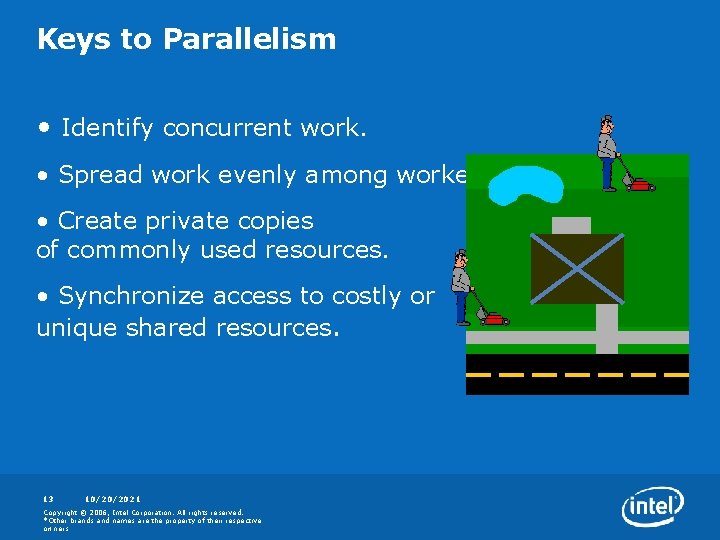
Keys to Parallelism • Identify concurrent work. • Spread work evenly among workers. • Create private copies of commonly used resources. • Synchronize access to costly or unique shared resources. 13 10/20/2021 Copyright © 2006, Intel Corporation. All rights reserved. *Other brands and names are the property of their respective owners
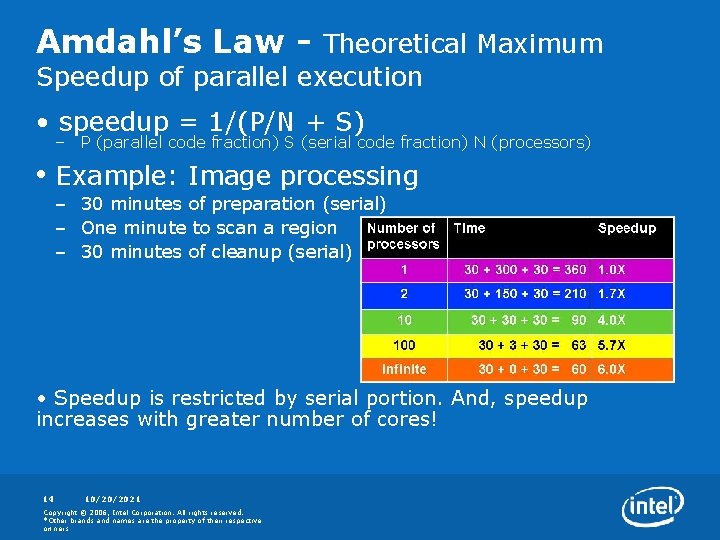
Amdahl’s Law - Theoretical Maximum Speedup of parallel execution • speedup = 1/(P/N + S) – P (parallel code fraction) S (serial code fraction) N (processors) • Example: Image processing – 30 minutes of preparation (serial) – One minute to scan a region – 30 minutes of cleanup (serial) • Speedup is restricted by serial portion. And, speedup increases with greater number of cores! 14 10/20/2021 Copyright © 2006, Intel Corporation. All rights reserved. *Other brands and names are the property of their respective owners
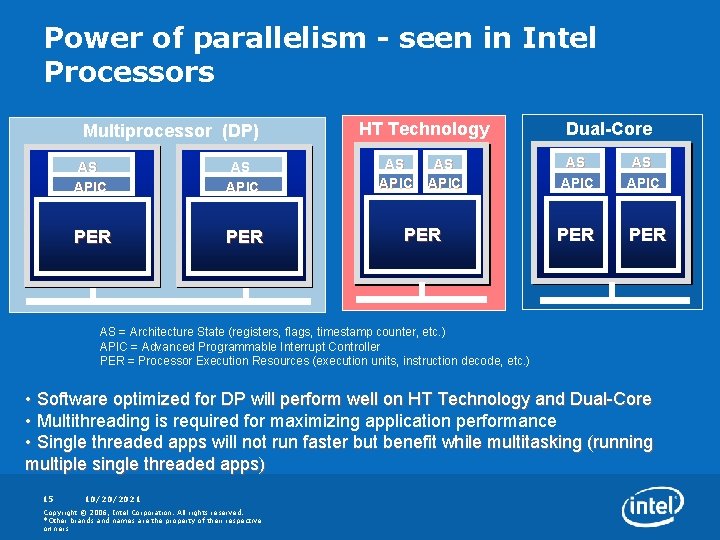
Power of parallelism - seen in Intel Processors Multiprocessor (DP) AS APIC PER HT Technology AS APIC PER Dual-Core AS APIC PER AS = Architecture State (registers, flags, timestamp counter, etc. ) APIC = Advanced Programmable Interrupt Controller PER = Processor Execution Resources (execution units, instruction decode, etc. ) • Software optimized for DP will perform well on HT Technology and Dual-Core • Multithreading is required for maximizing application performance • Single threaded apps will not run faster but benefit while multitasking (running multiple single threaded apps) 15 10/20/2021 Copyright © 2006, Intel Corporation. All rights reserved. *Other brands and names are the property of their respective owners
Parallelism: machine code execution [Out-of-order execution engine in Duo Core] sequential machine code Execution Pipe (Engine) Next First Instructions are sequential, most instructions depend on completion of the previous instructions 16 10/20/2021 Copyright © 2006, Intel Corporation. All rights reserved. *Other brands and names are the property of their respective owners Sequential events loaded into the execution pipe cannot be executed in parallel due to dependencies Run time reordering can overcome the dependencies by changing the execution sequence and enable more parallelism
Optimization Techniques • Multi-core processor implementation (inherent parallelism) has significant impact on software applications – Full potential harnessed by programs that migrate to a threaded software model – Efficient use of threads (kernel or system / user threads) is KEY to dramatically increase effective system performance 17 10/20/2021 Copyright © 2006, Intel Corporation. All rights reserved. *Other brands and names are the property of their respective owners
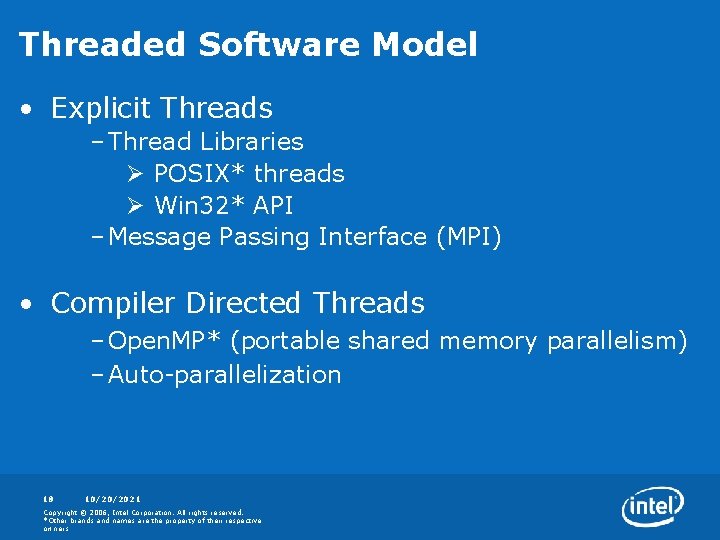
Threaded Software Model • Explicit Threads – Thread Libraries Ø POSIX* threads Ø Win 32* API – Message Passing Interface (MPI) • Compiler Directed Threads – Open. MP* (portable shared memory parallelism) – Auto-parallelization 18 10/20/2021 Copyright © 2006, Intel Corporation. All rights reserved. *Other brands and names are the property of their respective owners
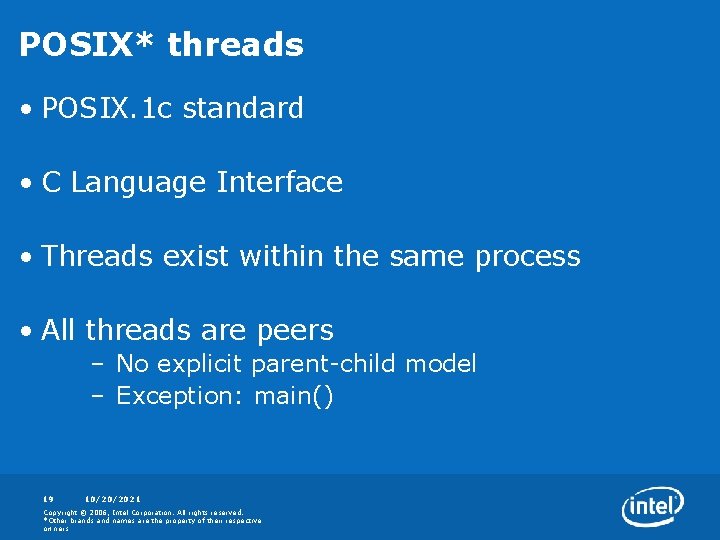
POSIX* threads • POSIX. 1 c standard • C Language Interface • Threads exist within the same process • All threads are peers – No explicit parent-child model – Exception: main() 19 10/20/2021 Copyright © 2006, Intel Corporation. All rights reserved. *Other brands and names are the property of their respective owners
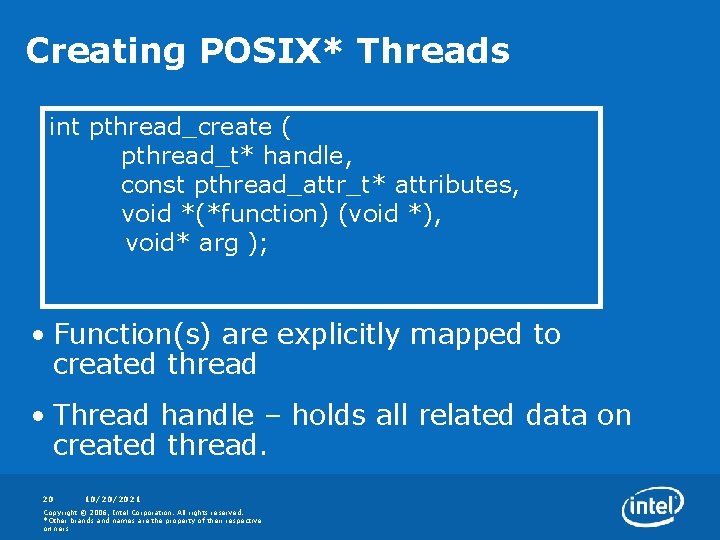
Creating POSIX* Threads int pthread_create ( pthread_t* handle, const pthread_attr_t* attributes, void *(*function) (void *), void* arg ); • Function(s) are explicitly mapped to created thread • Thread handle – holds all related data on created thread. 20 10/20/2021 Copyright © 2006, Intel Corporation. All rights reserved. *Other brands and names are the property of their respective owners
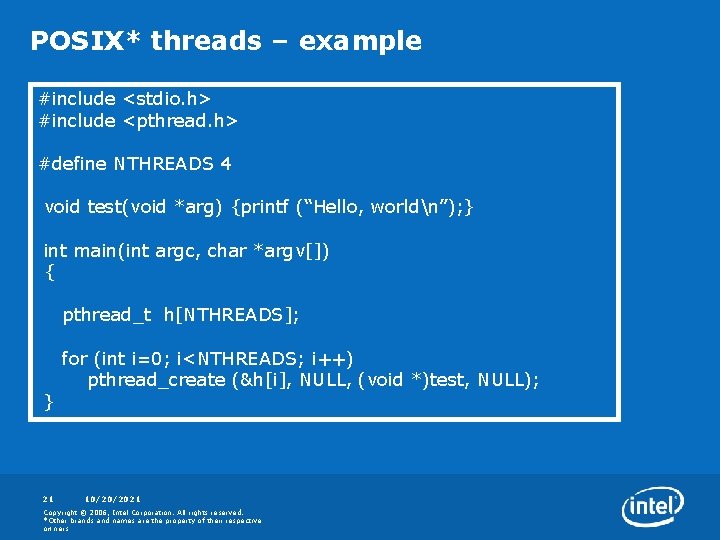
POSIX* threads – example #include <stdio. h> #include <pthread. h> #define NTHREADS 4 void test(void *arg) {printf (“Hello, worldn”); } int main(int argc, char *argv[]) { pthread_t h[NTHREADS]; } 21 for (int i=0; i<NTHREADS; i++) pthread_create (&h[i], NULL, (void *)test, NULL); 10/20/2021 Copyright © 2006, Intel Corporation. All rights reserved. *Other brands and names are the property of their respective owners
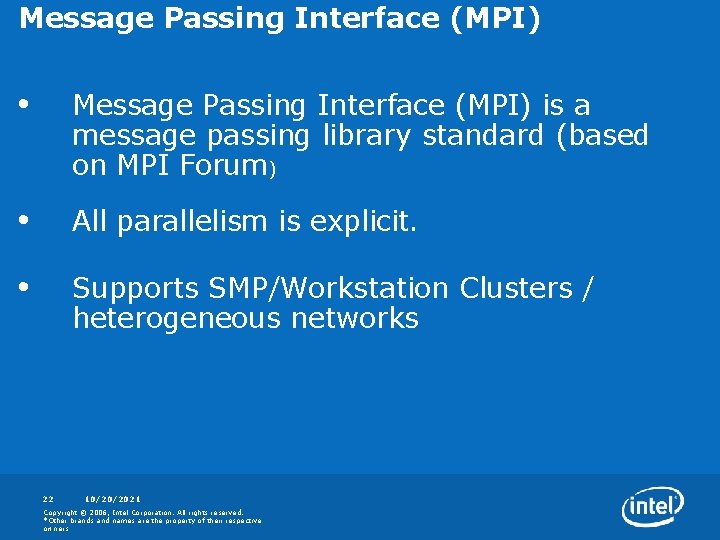
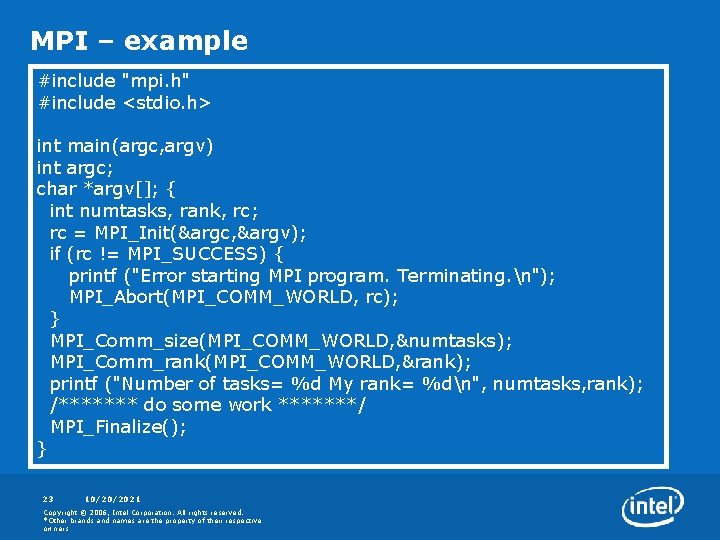
Message Passing Interface (MPI) • Message Passing Interface (MPI) is a message passing library standard (based on MPI Forum) • All parallelism is explicit. • Supports SMP/Workstation Clusters / heterogeneous networks 22 10/20/2021 Copyright © 2006, Intel Corporation. All rights reserved. *Other brands and names are the property of their respective owners
MPI – example #include "mpi. h" #include <stdio. h> int main(argc, argv) int argc; char *argv[]; { int numtasks, rank, rc; rc = MPI_Init(&argc, &argv); if (rc != MPI_SUCCESS) { printf ("Error starting MPI program. Terminating. n"); MPI_Abort(MPI_COMM_WORLD, rc); } MPI_Comm_size(MPI_COMM_WORLD, &numtasks); MPI_Comm_rank(MPI_COMM_WORLD, &rank); printf ("Number of tasks= %d My rank= %dn", numtasks, rank); /******* do some work *******/ MPI_Finalize(); } 23 10/20/2021 Copyright © 2006, Intel Corporation. All rights reserved. *Other brands and names are the property of their respective owners
Open. MP* [www. openmp. org] An Application Program Interface (API) for multithreaded, shared memory parallelism • Portable – API for Fortran 77, Fortran 90, C, and C++, on all architectures, including Unix* and Windows* • Standardized – Jointly developed by major SW/HW vendors. – Standardizes the last 15 years of symmetric multiprocessing (SMP) experience • Major API components – Compiler Directives – Runtime Library Routines – Environment Variables 24 10/20/2021 Copyright © 2006, Intel Corporation. All rights reserved. *Other brands and names are the property of their respective owners
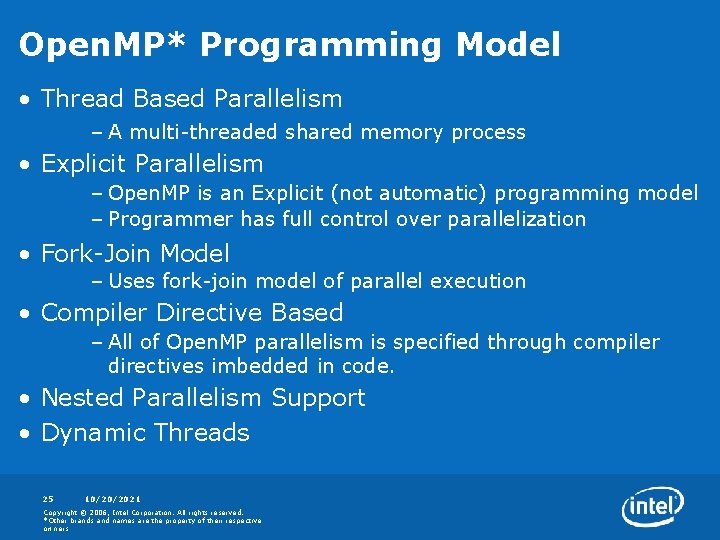
Open. MP* Programming Model • Thread Based Parallelism – A multi-threaded shared memory process • Explicit Parallelism – Open. MP is an Explicit (not automatic) programming model – Programmer has full control over parallelization • Fork-Join Model – Uses fork-join model of parallel execution • Compiler Directive Based – All of Open. MP parallelism is specified through compiler directives imbedded in code. • Nested Parallelism Support • Dynamic Threads 25 10/20/2021 Copyright © 2006, Intel Corporation. All rights reserved. *Other brands and names are the property of their respective owners
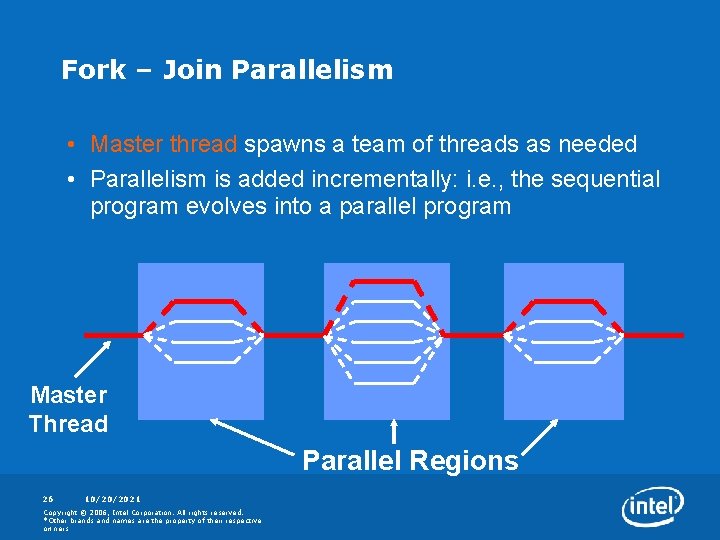
Fork – Join Parallelism • Master thread spawns a team of threads as needed • Parallelism is added incrementally: i. e. , the sequential program evolves into a parallel program Master Thread Parallel Regions 26 10/20/2021 Copyright © 2006, Intel Corporation. All rights reserved. *Other brands and names are the property of their respective owners
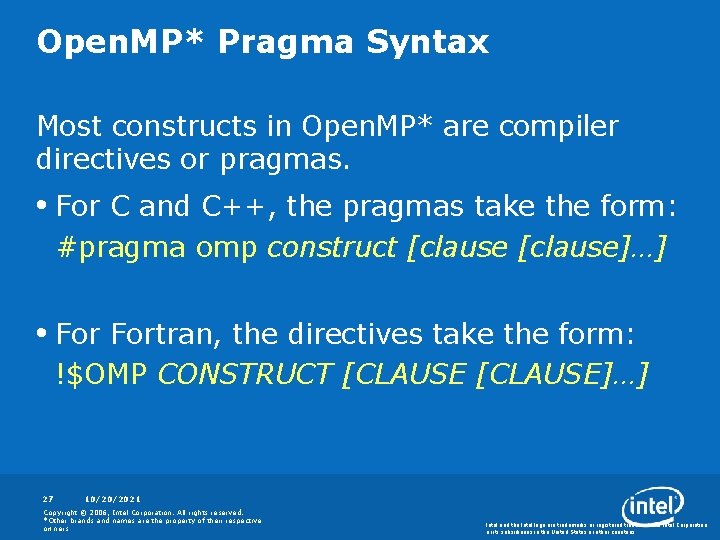
Open. MP* Pragma Syntax Most constructs in Open. MP* are compiler directives or pragmas. • For C and C++, the pragmas take the form: #pragma omp construct [clause]…] • Fortran, the directives take the form: !$OMP CONSTRUCT [CLAUSE]…] 27 10/20/2021 Copyright © 2006, Intel Corporation. All rights reserved. *Other brands and names are the property of their respective owners Intel and the Intel logo are trademarks or registered trademarks of Intel Corporation or its subsidiaries in the United States or other countries.
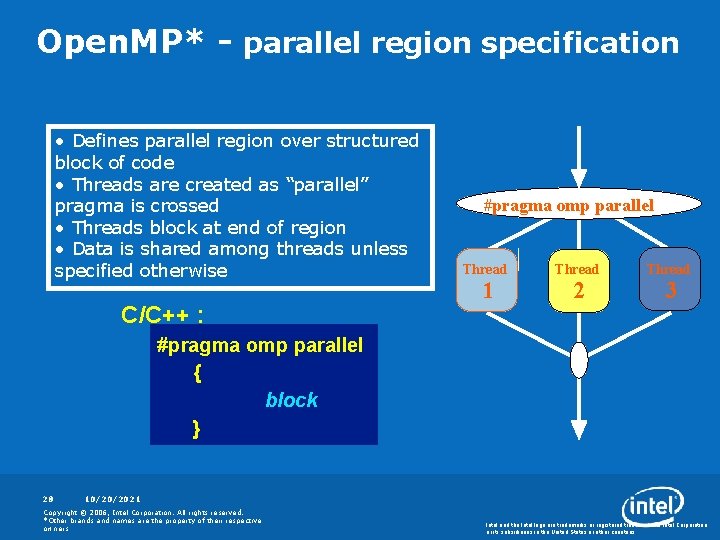
Open. MP* - parallel region specification • Defines parallel region over structured block of code • Threads are created as “parallel” pragma is crossed • Threads block at end of region • Data is shared among threads unless specified otherwise C/C++ : #pragma omp parallel Thread 1 Thread 2 Thread 3 #pragma omp parallel { block } 28 10/20/2021 Copyright © 2006, Intel Corporation. All rights reserved. *Other brands and names are the property of their respective owners Intel and the Intel logo are trademarks or registered trademarks of Intel Corporation or its subsidiaries in the United States or other countries.
Open. MP* - Example [Prime Number Gen. ] • Serial Exec. i factor 3 5 7 9 11 13 15 17 19 2 2 23 234 return (factor > limit); } for( } 29 bool Test. For. Prime(int val) { // let’s start checking from 3 int limit, factor = 3; limit = (long)(sqrtf((float)val)+0. 5 f); while( (factor <= limit) && (val % factor) ) factor ++; void Find. Primes(int start, int end) { = end - start + 1; intint i range = start; i <= end; i+= 2 ){ for( int i = start; i <= end; i += 2 ) if({ Test. For. Prime(i) ) global. Primes[g. Primes. Found++] = i; if( Test. For. Prime(i) ) global. Primes[g. Primes. Found++] = i; Show. Progress(i, range); } } 10/20/2021 Copyright © 2006, Intel Corporation. All rights reserved. *Other brands and names are the property of their respective owners
Open. MP* - Example [Prime Number Gen. ] -> With Open. MP* #pragma omp parallel for( int i = start; i <= end; i+= 2 ){ Defined by the Open. MP if( Test. For. Prime(i) ) for loop global. Primes[g. Primes. Found++] = i; Create threads here for Show. Progress(i, range); this parallel region } 30 10/20/2021 Copyright © 2006, Intel Corporation. All rights reserved. *Other brands and names are the property of their respective owners
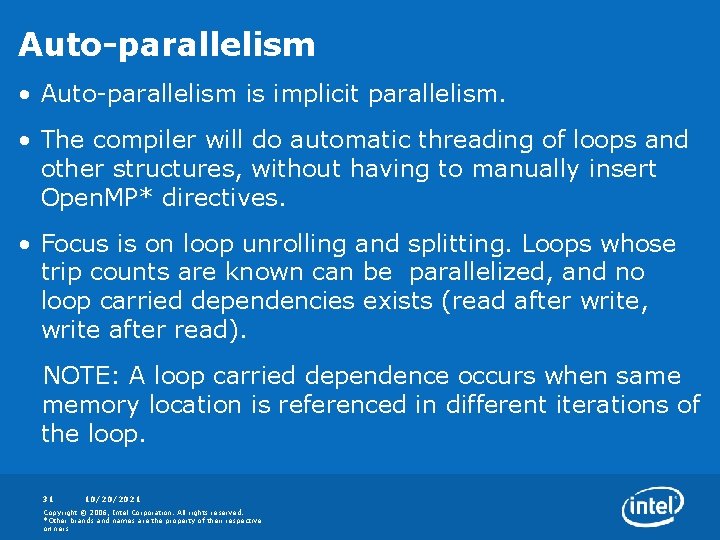
Auto-parallelism • Auto-parallelism is implicit parallelism. • The compiler will do automatic threading of loops and other structures, without having to manually insert Open. MP* directives. • Focus is on loop unrolling and splitting. Loops whose trip counts are known can be parallelized, and no loop carried dependencies exists (read after write, write after read). NOTE: A loop carried dependence occurs when same memory location is referenced in different iterations of the loop. 31 10/20/2021 Copyright © 2006, Intel Corporation. All rights reserved. *Other brands and names are the property of their respective owners
Auto-parallelism - Example for (i=1; i<100; i++) { a[i] = a[i] + b[i] * c[i]; } Auto-parallelize 32 10/20/2021 Copyright © 2006, Intel Corporation. All rights reserved. *Other brands and names are the property of their respective owners // Thread 1 for (i=1; i<50; i++) { a[i] = a[i] + b[i] * c[i]; } // Thread 2 for (i=50; i<100; i++) { a[i] = a[i] + b[i] * c[i]; }
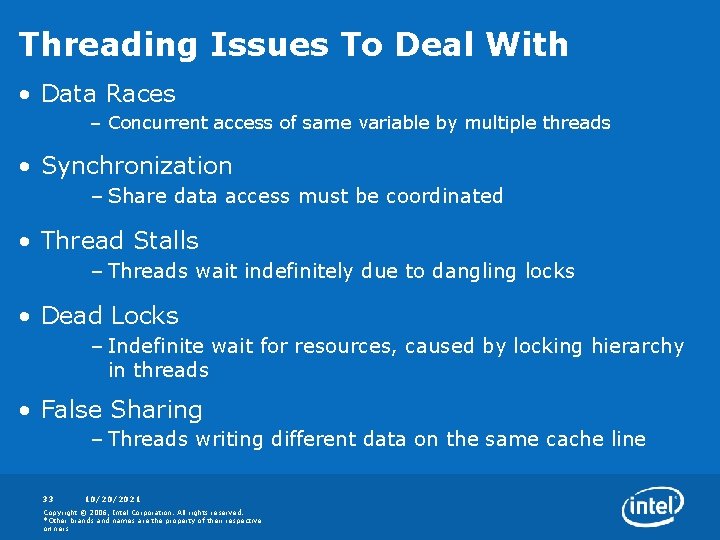
Threading Issues To Deal With • Data Races – Concurrent access of same variable by multiple threads • Synchronization – Share data access must be coordinated • Thread Stalls – Threads wait indefinitely due to dangling locks • Dead Locks – Indefinite wait for resources, caused by locking hierarchy in threads • False Sharing – Threads writing different data on the same cache line 33 10/20/2021 Copyright © 2006, Intel Corporation. All rights reserved. *Other brands and names are the property of their respective owners
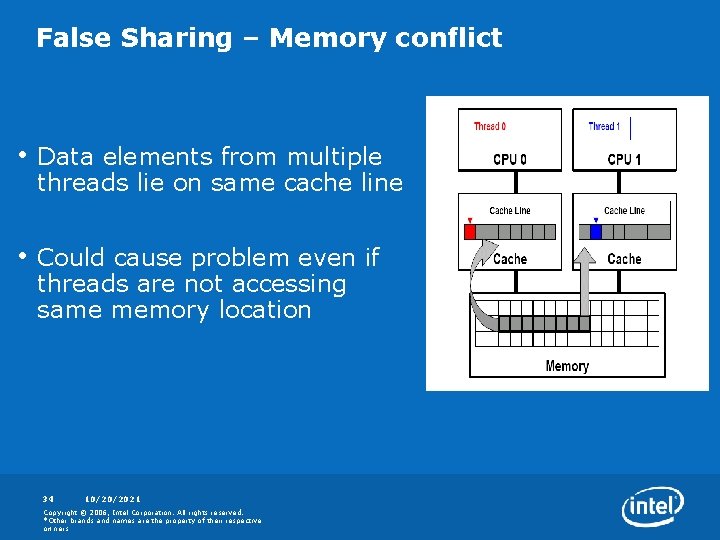
False Sharing – Memory conflict • Data elements from multiple threads lie on same cache line • Could cause problem even if threads are not accessing same memory location 34 10/20/2021 Copyright © 2006, Intel Corporation. All rights reserved. *Other brands and names are the property of their respective owners
Common Performance Issues • Parallel Overhead – Due to thread creation, scheduling • Synchronization – Excessive use of global data, contention for the same synchronization object • Load Imbalance – Improper distribution of parallel work • Granularity – No sufficient parallel work 35 10/20/2021 Copyright © 2006, Intel Corporation. All rights reserved. *Other brands and names are the property of their respective owners
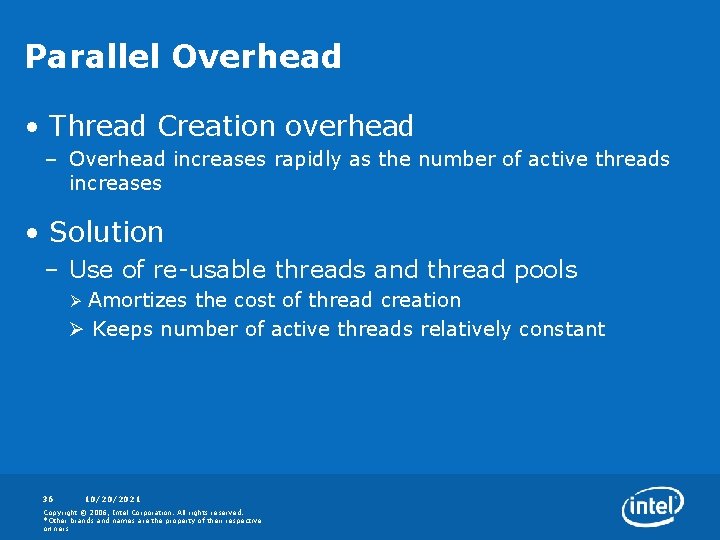
Parallel Overhead • Thread Creation overhead – Overhead increases rapidly as the number of active threads increases • Solution – Use of re-usable threads and thread pools Amortizes the cost of thread creation Ø Keeps number of active threads relatively constant Ø 36 10/20/2021 Copyright © 2006, Intel Corporation. All rights reserved. *Other brands and names are the property of their respective owners
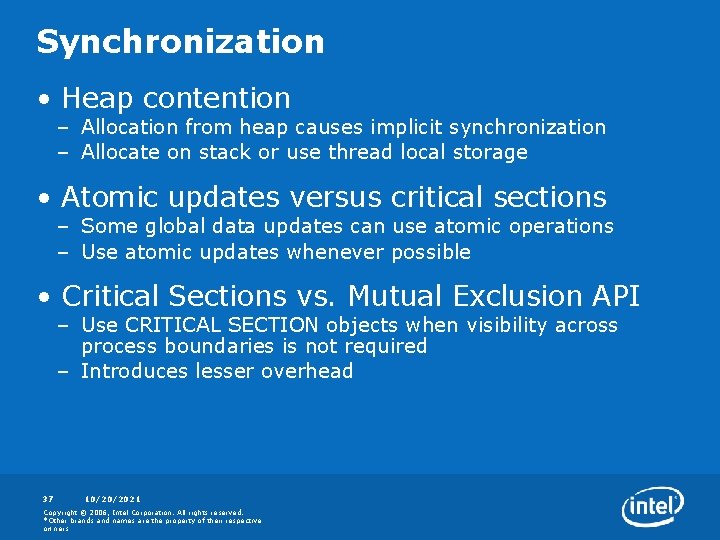
Synchronization • Heap contention – Allocation from heap causes implicit synchronization – Allocate on stack or use thread local storage • Atomic updates versus critical sections – Some global data updates can use atomic operations – Use atomic updates whenever possible • Critical Sections vs. Mutual Exclusion API – Use CRITICAL SECTION objects when visibility across process boundaries is not required – Introduces lesser overhead 37 10/20/2021 Copyright © 2006, Intel Corporation. All rights reserved. *Other brands and names are the property of their respective owners
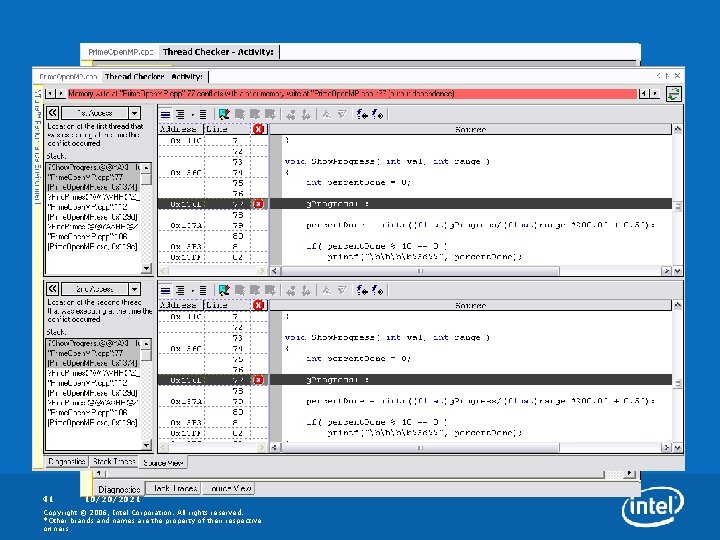
Threading tools • Thread Checker tools – Can be used to help debug for correctness of threaded applications – Can pin-point notorious threading bugs like data races, thread stalls, deadlocks etc. • Thread Profiler tools – Used for performance tuning to maximize code performance – Can pinpoint performance bottlenecks in threaded applications like load imbalance, granularity, load imbalance and synchronization 38 10/20/2021 Copyright © 2006, Intel Corporation. All rights reserved. *Other brands and names are the property of their respective owners
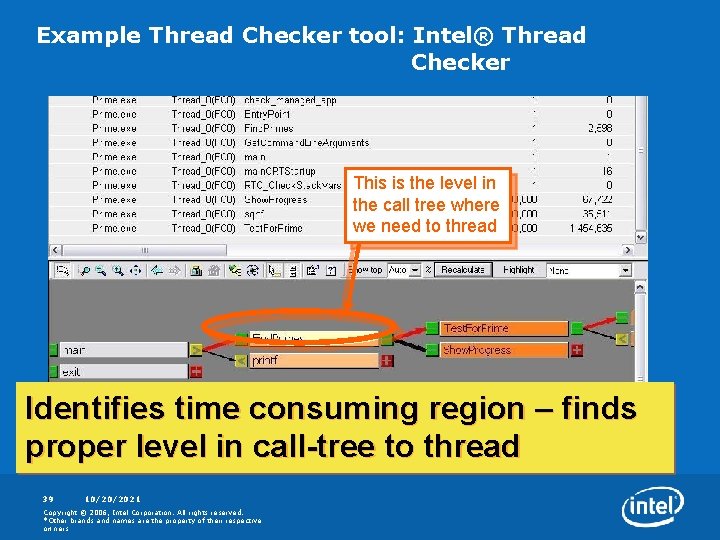
Example Thread Checker tool: Intel® Thread Checker This is the level in the call tree where we need to thread Identifies time consuming region – finds proper level in call-tree to thread 39 10/20/2021 Copyright © 2006, Intel Corporation. All rights reserved. *Other brands and names are the property of their respective owners
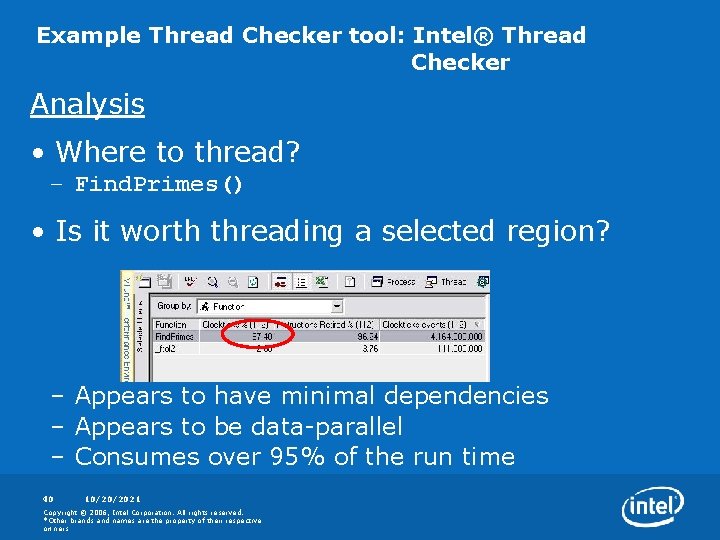
Example Thread Checker tool: Intel® Thread Checker Analysis • Where to thread? – Find. Primes() • Is it worth threading a selected region? – Appears to have minimal dependencies – Appears to be data-parallel – Consumes over 95% of the run time 40 10/20/2021 Copyright © 2006, Intel Corporation. All rights reserved. *Other brands and names are the property of their respective owners
41 10/20/2021 Copyright © 2006, Intel Corporation. All rights reserved. *Other brands and names are the property of their respective owners
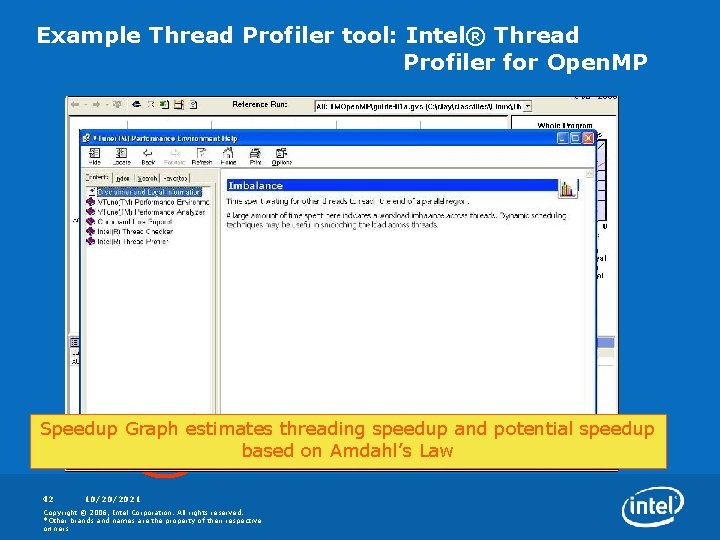
Example Thread Profiler tool: Intel® Thread Profiler for Open. MP Speedup Graph estimates threading speedup and potential speedup based on Amdahl’s Law 42 10/20/2021 Copyright © 2006, Intel Corporation. All rights reserved. *Other brands and names are the property of their respective owners
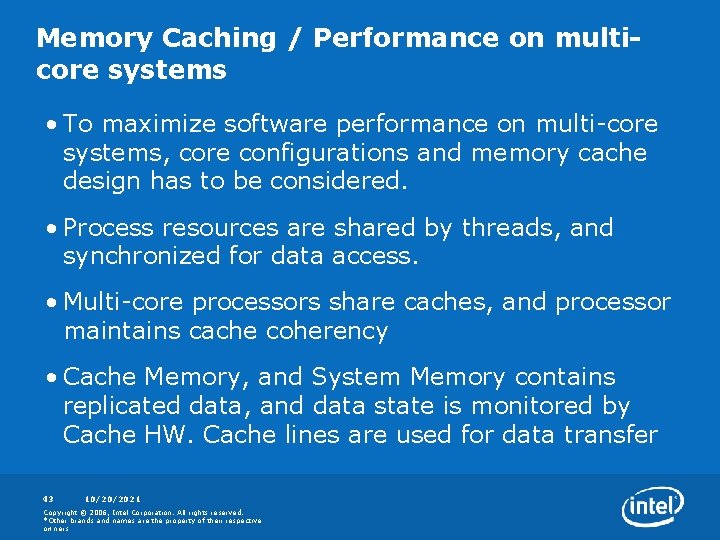
Memory Caching / Performance on multicore systems • To maximize software performance on multi-core systems, core configurations and memory cache design has to be considered. • Process resources are shared by threads, and synchronized for data access. • Multi-core processors share caches, and processor maintains cache coherency • Cache Memory, and System Memory contains replicated data, and data state is monitored by Cache HW. Cache lines are used for data transfer 43 10/20/2021 Copyright © 2006, Intel Corporation. All rights reserved. *Other brands and names are the property of their respective owners
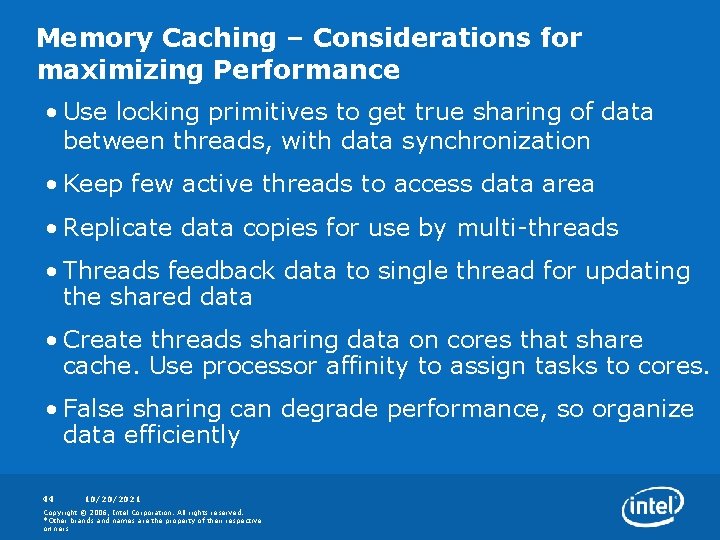
Memory Caching – Considerations for maximizing Performance • Use locking primitives to get true sharing of data between threads, with data synchronization • Keep few active threads to access data area • Replicate data copies for use by multi-threads • Threads feedback data to single thread for updating the shared data • Create threads sharing data on cores that share cache. Use processor affinity to assign tasks to cores. • False sharing can degrade performance, so organize data efficiently 44 10/20/2021 Copyright © 2006, Intel Corporation. All rights reserved. *Other brands and names are the property of their respective owners
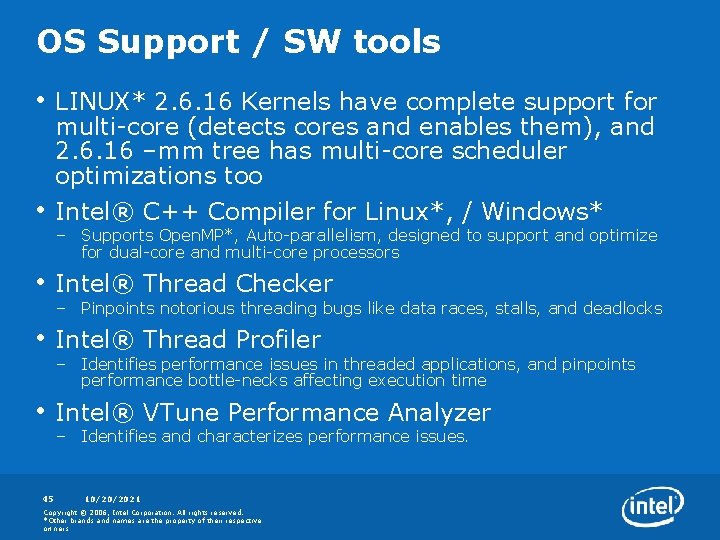
OS Support / SW tools • LINUX* 2. 6. 16 Kernels have complete support for • multi-core (detects cores and enables them), and 2. 6. 16 –mm tree has multi-core scheduler optimizations too Intel® C++ Compiler for Linux*, / Windows* – Supports Open. MP*, Auto-parallelism, designed to support and optimize for dual-core and multi-core processors • Intel® Thread Checker – Pinpoints notorious threading bugs like data races, stalls, and deadlocks • Intel® Thread Profiler – Identifies performance issues in threaded applications, and pinpoints performance bottle-necks affecting execution time • Intel® VTune Performance Analyzer – Identifies and characterizes performance issues. 45 10/20/2021 Copyright © 2006, Intel Corporation. All rights reserved. *Other brands and names are the property of their respective owners
Summary • Multi-Core processors enable true thread level parallelism with great Energy Efficient Performance, and Scalability • To utilize the full potential of multi-core processors, SW applications will need to move from a single to a multithreaded model. • Optimization techniques like Open. MP*, Auto-parallelization, cache coherency are key to maximizing performance • A SW application should not just be threaded, but should be designed to be a well-threaded application for maximizing performance on multi-core processors. Unleash the power of multi-core! 46 10/20/2021 Copyright © 2006, Intel Corporation. All rights reserved. *Other brands and names are the property of their respective owners
BACK-UP 47 10/20/2021 Copyright © 2006, Intel Corporation. All rights reserved. *Other brands and names are the property of their respective owners