
Optimization problems subexponential time Lasserre algorithms Featuring work
Optimization problems, subexponential time, & Lasserre algorithms Featuring work by: Ryan O’Donnell CMU Venkat Guruswami Ali K. Sinop David Witmer John Wright Yuan Zhou Boaz Barak David Steurer CMU CMU CMU MSRNE

Fundamental Algorithms Problems Polynomial time Not polynomial time 2Ω(n) Õ(n) — truly efficient — truly inefficient Another A problem

Fundamental Algorithms Problems Polynomial time Õ(n) — truly efficient Not polynomial time 1/3 n 2 2Ω(n) Factoring 3 Sat (probably)
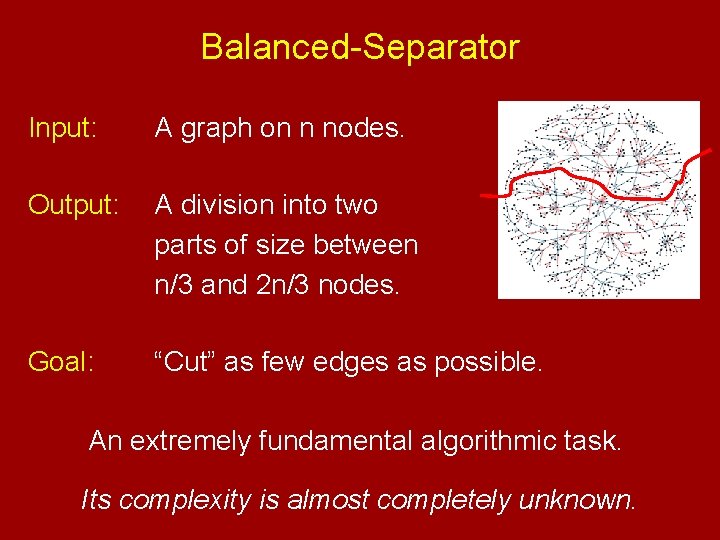
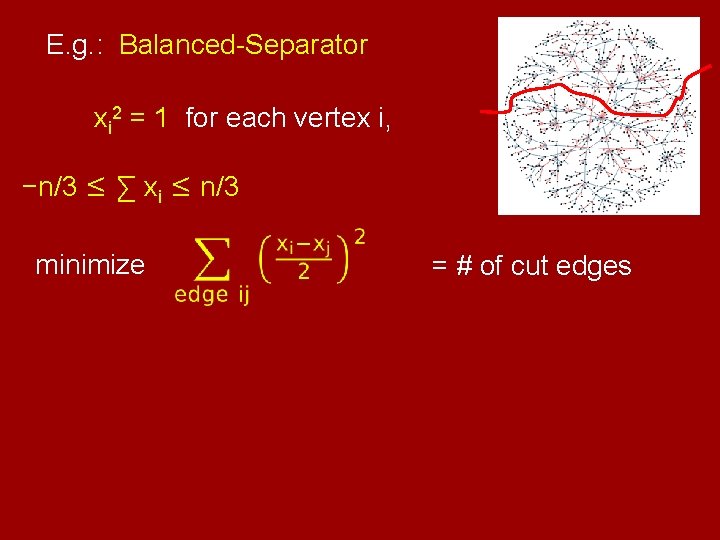
Balanced-Separator Input: A graph on n nodes. Output: A division into two parts of size between n/3 and 2 n/3 nodes. Goal: “Cut” as few edges as possible. An extremely fundamental algorithmic task. Its complexity is almost completely unknown.
Balanced-Separator Finding the exact optimal solution is NP-hard, (probably) time 2Ω(n). Perfectly possible that there is an O(n log n) algorithm which gets within 1% of the optimal solution. Perfectly possible that getting a solution which is at most 100 times worse than optimal requires time 2Ω(n). [2011]: (Probably) no poly-time algorithm which gets within 0. 0000000001% of optimum.
Similarly embarrassing situation for… Coloring 3 -colorable graphs 2 Sat Finding the maximum cut in a graph Finding the smallest ‘vertex cover’ in a graph Many other fundamental CSP and graph probs.
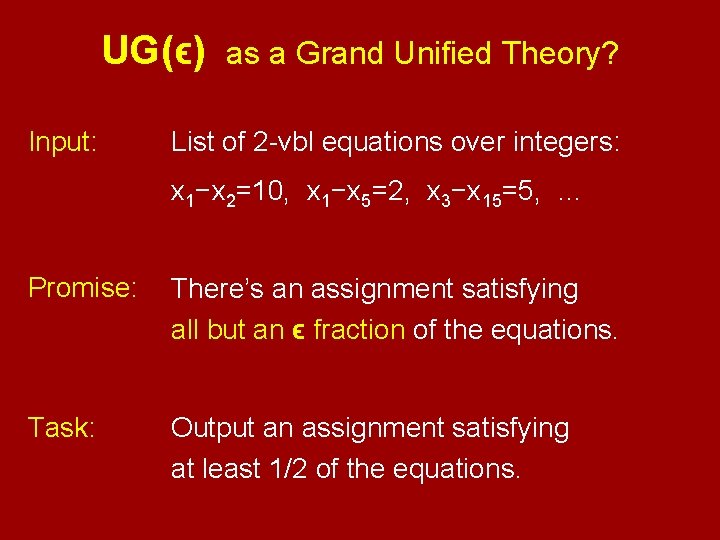
UG(ϵ) Input: as a Grand Unified Theory? List of 2 -vbl equations over integers: x 1−x 2=10, x 1−x 5=2, x 3−x 15=5, … Promise: There’s an assignment satisfying all but an ϵ fraction of the equations. Task: Output an assignment satisfying at least 1/2 of the equations.
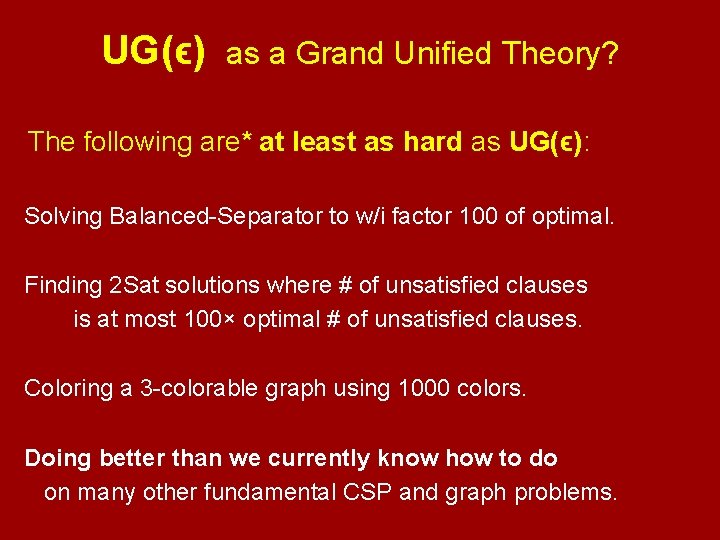
UG(ϵ) as a Grand Unified Theory? The following are* at least as hard as UG(ϵ): Solving Balanced-Separator to w/i factor 100 of optimal. Finding 2 Sat solutions where # of unsatisfied clauses is at most 100× optimal # of unsatisfied clauses. Coloring a 3 -colorable graph using 1000 colors. Doing better than we currently know how to do on many other fundamental CSP and graph problems.
![So how hard (or easy) is UG(ϵ)? [Khot ’ 02]: Conjectured that ∀ϵ, it’s](http://slidetodoc.com/presentation_image_h/750f1cb4e0a9e0ec3f8e796d29cda24e/image-9.jpg "So how hard (or easy) is UG(ϵ)? [Khot ’ 02]: Conjectured that ∀ϵ, it’s")
So how hard (or easy) is UG(ϵ)? [Khot ’ 02]: Conjectured that ∀ϵ, it’s NP-hard. [ABS’ 10]: Solvable in time 2 1/6 O(ϵ ) n . (Basically about as easy as an NP-hard problem could possibly be. ) [O Wr’ 12]: Showed UG(. 4) is NP-hard, and (probably) requires 2Ω(n) time. [O Wi’ 12]: Improved some analysis in [ABS’ 10].
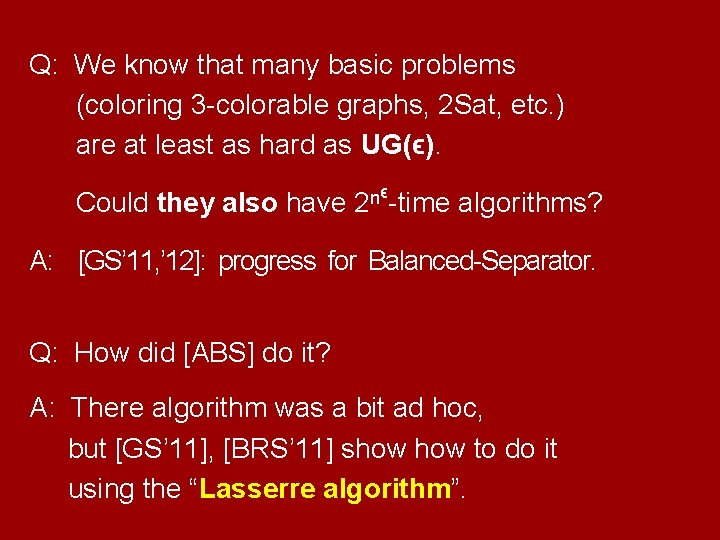
Q: We know that many basic problems (coloring 3 -colorable graphs, 2 Sat, etc. ) are at least as hard as UG(ϵ). Could they also have ϵ n 2 -time algorithms? A: [GS’ 11, ’ 12]: progress for Balanced-Separator. Q: How did [ABS] do it? A: There algorithm was a bit ad hoc, but [GS’ 11], [BRS’ 11] show to do it using the “Lasserre algorithm”.
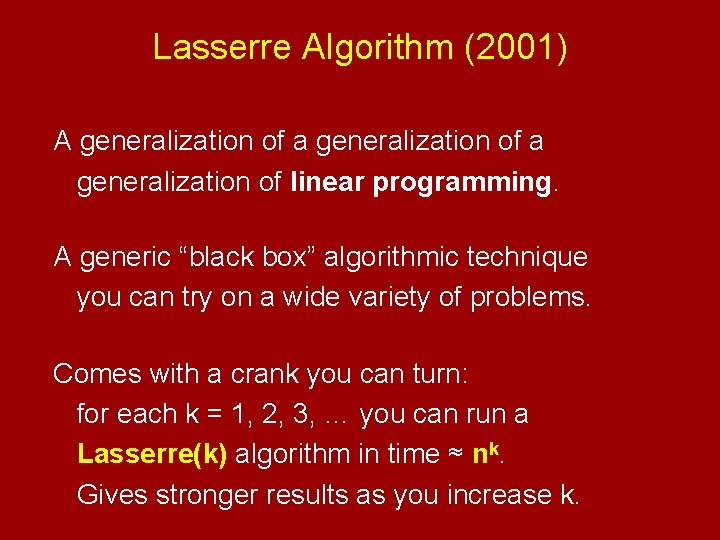
Lasserre Algorithm (2001) A generalization of a a generalization of linear programming. A generic “black box” algorithmic technique you can try on a wide variety of problems. Comes with a crank you can turn: for each k = 1, 2, 3, … you can run a Lasserre(k) algorithm in time ≈ nk. Gives stronger results as you increase k.
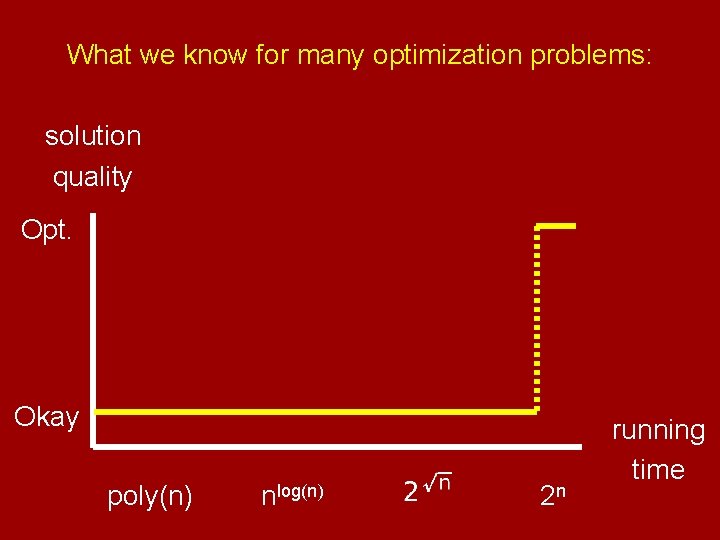
What we know for many optimization problems: solution quality Opt. Okay poly(n) nlog(n) 2 n running time

What could be the case using Lasserre(k): solution quality Opt. Okay poly(n) nlog(n) 2 n running time
So how well does Lasserre(k) do? Problem 1: It’s hard to understand. Problem 2: It’s hard to analyze. Big progress by [BBHKSZ’ 12]: • Develops new understanding of Lasserre. • Shows Lasserre(8) solves all known hard instances of UG(ϵ). Perhaps Lasserre(8) actually solves UG(ϵ)!
The latest (as of Thursday) Joint followup work with Yuan Zhou: • Develops (dare I say? ) an even better understanding of Lasserre. • Shows Lasserre(4) solves known hard instances of Balanced-Separator. • Gives a little evidence that Lasserre might not solve all of our optimization problems.

To Be Continued…

What is the Lasserre algorithm? Write the problem with polynomial inequalities. E. g. : Balanced-Separator Have variable xi for each vertex. Supposed to be ± 1, so add the polynomial constraints xi 2 = 1 Supposed to be between n/3 and 2 n/3 vertices on each side, so add the polynomial constraint −n/3 ≤ ∑ xi ≤ n/3
What is the Lasserre algorithm? Suppose I give you a multivariate polynomial, P(x 1, x 2, x 3, …, xn) and I want to prove to you that P(x) ≥ 18 whenever Q(x 1, x 2, …, xn) ≥ 0, where Q(x) is another multivariate polynomial. It’s NP-hard, but…
E. g. : Balanced-Separator xi 2 = 1 for each vertex i, −n/3 ≤ ∑ xi ≤ n/3 minimize = # of cut edges
- Slides: 19