
Optimization of the configuration of a supply chain
- Slides: 39
Optimization of the configuration of a supply chain and impact of a supplier disruption Prof. Matsukawa , MARC Seiji Keio University, Graduate School of Science and Technology
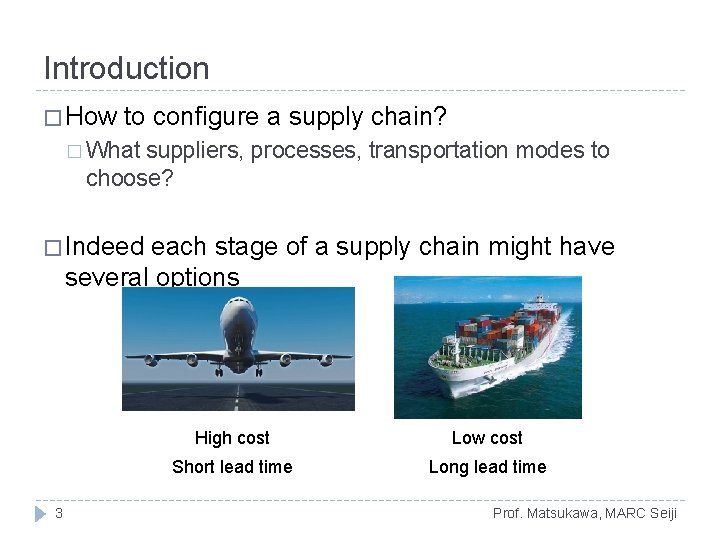
Introduction � How to configure a supply chain? � What suppliers, processes, transportation modes to choose? � Indeed each stage of a supply chain might have several options 3 High cost Low cost Short lead time Long lead time Prof. Matsukawa, MARC Seiji
Introduction � Graves and Willems (2005) explore the supply chain configuration issue � Minimization of the supply chain cost with a dynamic program � Goal of this research: � Compare single and dual sourcing � Analyze the effects of a supplier disruption � Adapt the model to take into account fixed ordering costs 4 Prof. Matsukawa, MARC Seiji
Table 4. Supply chain configuration model Single and dual sourcing Impact of a disruption Inventory policies 5. Conclusion 1. 2. 3. 5 Prof. Matsukawa, MARC Seiji
Supply chain configuration model 6 Prof. Matsukawa, MARC Seiji
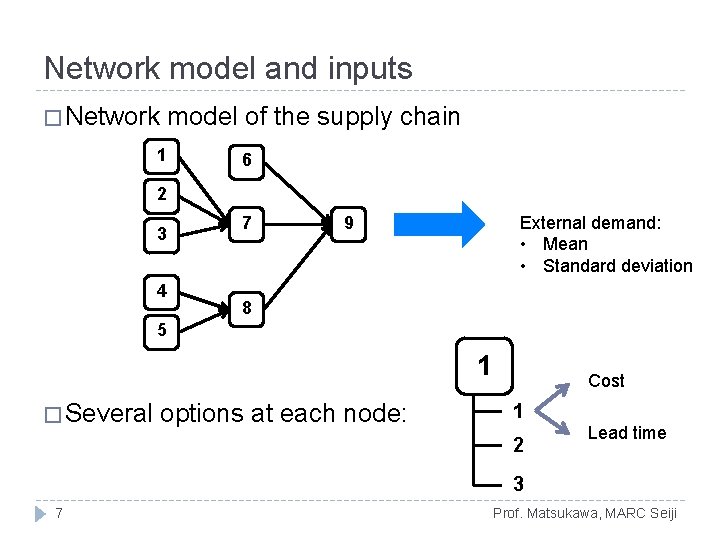
Network model and inputs � Network model of the supply chain 1 6 2 3 4 7 External demand: • Mean • Standard deviation 9 8 5 1 � Several options at each node: Cost 1 2 Lead time 3 7 Prof. Matsukawa, MARC Seiji
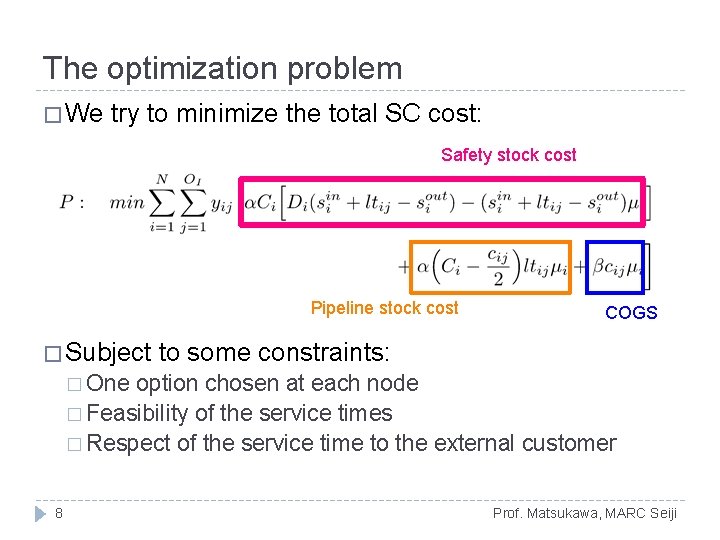
The optimization problem � We try to minimize the total SC cost: Safety stock cost Pipeline stock cost � Subject COGS to some constraints: � One option chosen at each node � Feasibility of the service times � Respect of the service time to the external customer 8 Prof. Matsukawa, MARC Seiji
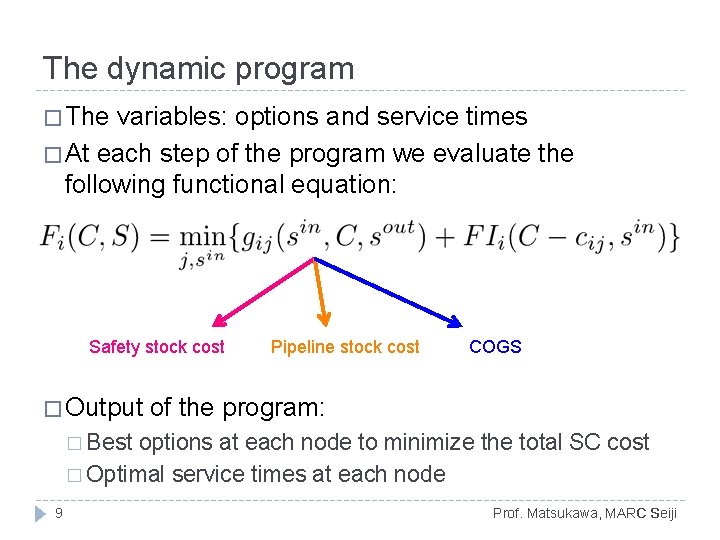
The dynamic program � The variables: options and service times � At each step of the program we evaluate the following functional equation: Safety stock cost � Output Pipeline stock cost COGS of the program: � Best options at each node to minimize the total SC cost � Optimal service times at each node 9 Prof. Matsukawa, MARC Seiji
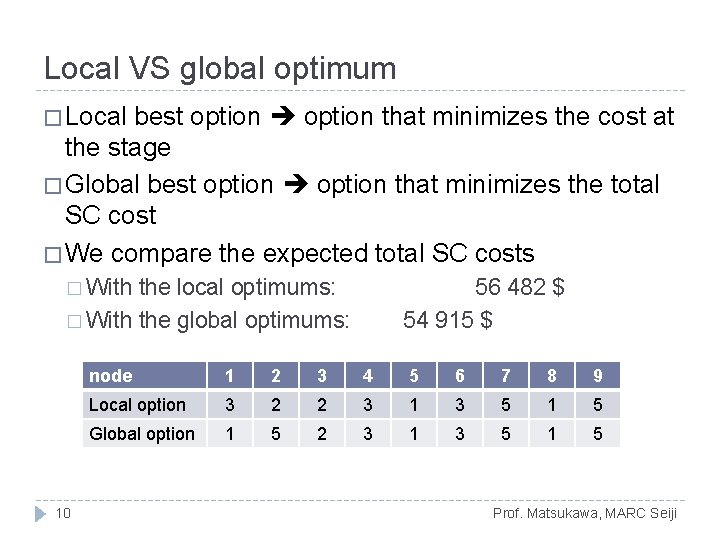
Local VS global optimum � Local best option that minimizes the cost at the stage � Global best option that minimizes the total SC cost � We compare the expected total SC costs � With the local optimums: � With the global optimums: 10 56 482 $ 54 915 $ node 1 2 3 4 5 6 7 8 9 Local option 3 2 2 3 1 3 5 1 5 Global option 1 5 2 3 1 3 5 1 5 Prof. Matsukawa, MARC Seiji
Single and dual sourcing 11 Prof. Matsukawa, MARC Seiji
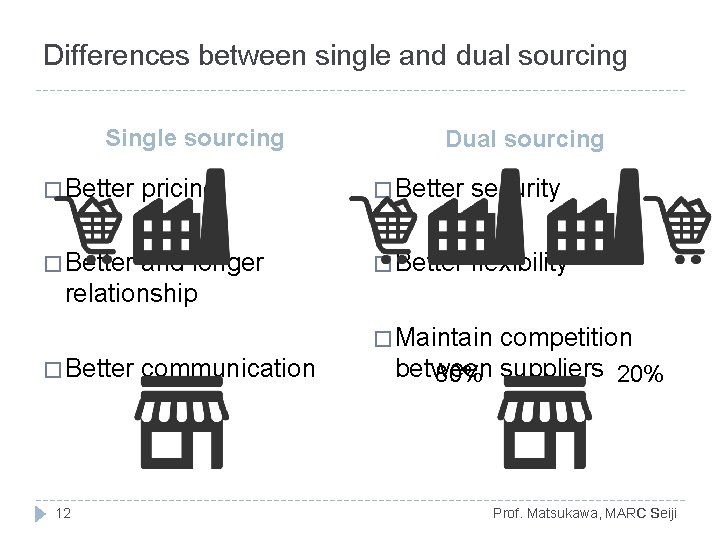
Differences between single and dual sourcing Single sourcing � Better pricing � Better and longer relationship Dual sourcing � Better security � Better flexibility � Maintain � Better 12 communication competition between 80% suppliers 20% Prof. Matsukawa, MARC Seiji
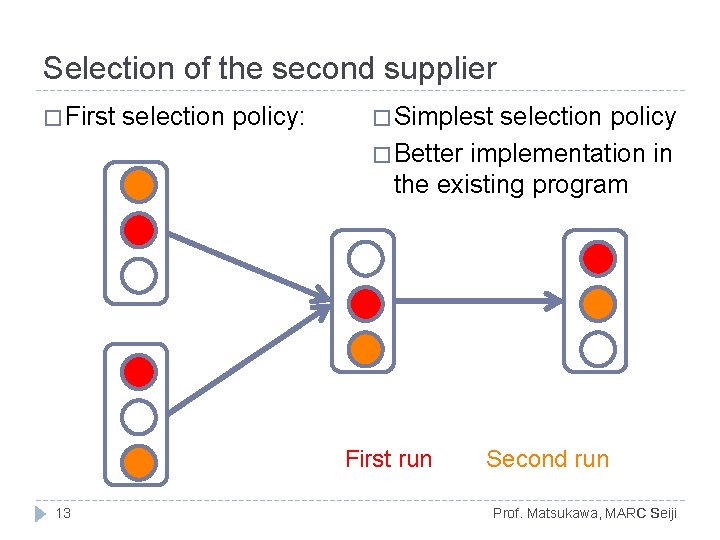
Selection of the second supplier � First selection policy: � Simplest selection policy � Better implementation in the existing program First run 13 Second run Prof. Matsukawa, MARC Seiji
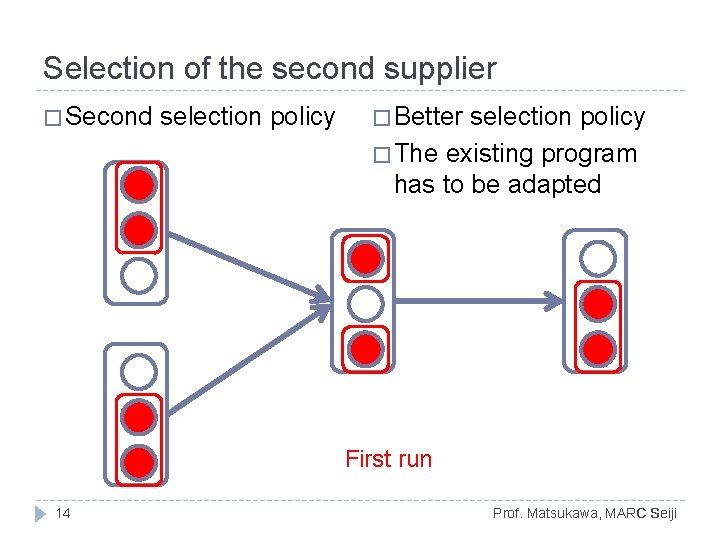
Selection of the second supplier � Second selection policy � Better selection policy � The existing program has to be adapted First run 14 Prof. Matsukawa, MARC Seiji
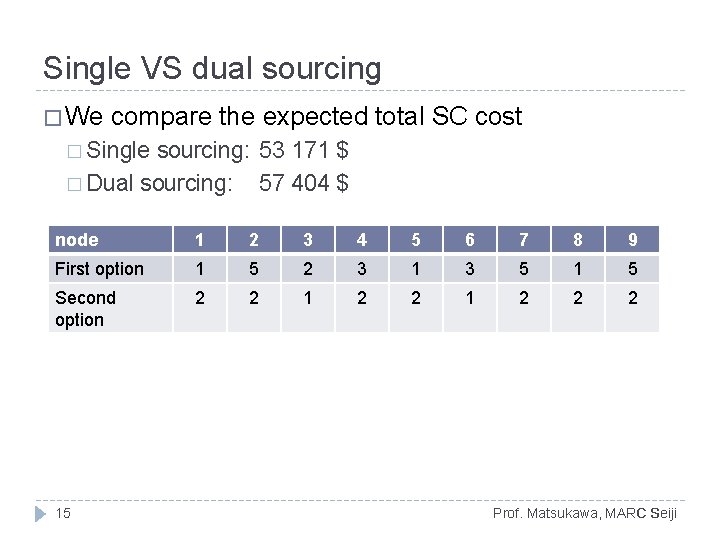
Single VS dual sourcing � We compare the expected total SC cost � Single sourcing: 53 171 $ � Dual sourcing: 57 404 $ node 1 2 3 4 5 6 7 8 9 First option 1 5 2 3 1 3 5 1 5 Second option 2 2 1 2 2 2 15 Prof. Matsukawa, MARC Seiji
Impact of a disruption 16 Prof. Matsukawa, MARC Seiji
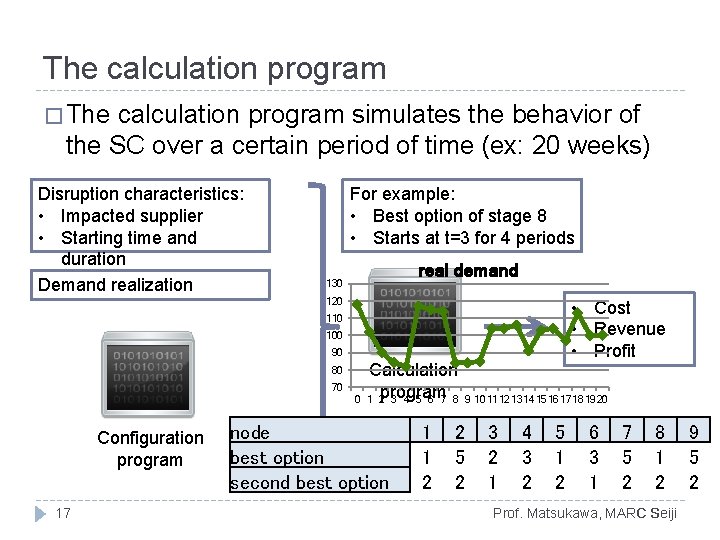
The calculation program � The calculation program simulates the behavior of the SC over a certain period of time (ex: 20 weeks) Disruption characteristics: • Impacted supplier • Starting time and duration Demand realization For example: • Best option of stage 8 • Starts at t=3 for 4 periods real demand 130 120 • Cost • Revenue • Profit 110 100 90 80 70 0 Configuration program 17 Calculation program 1 2 3 4 5 6 7 8 node best option second best option 1 1 2 2 5 2 9 10 11 12 13 14 15 16 17 18 19 20 3 2 1 4 3 2 5 1 2 6 3 1 7 5 2 8 1 2 Prof. Matsukawa, MARC Seiji 9 5 2
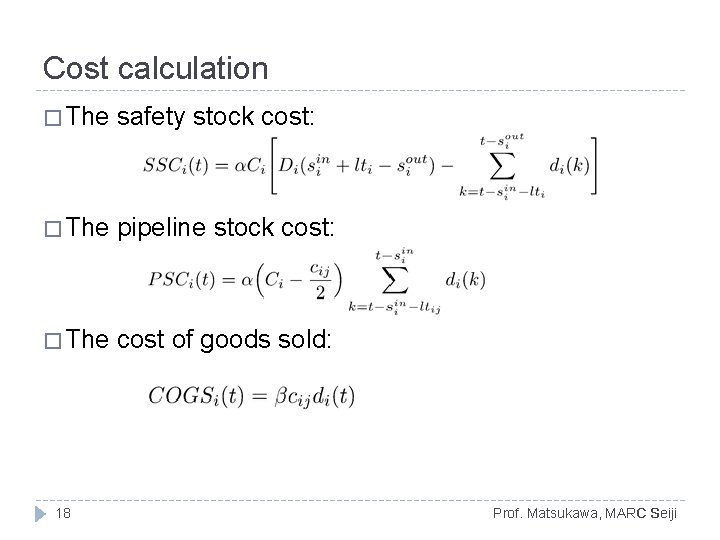
Cost calculation � The safety stock cost: � The pipeline stock cost: � The cost of goods sold: 18 Prof. Matsukawa, MARC Seiji
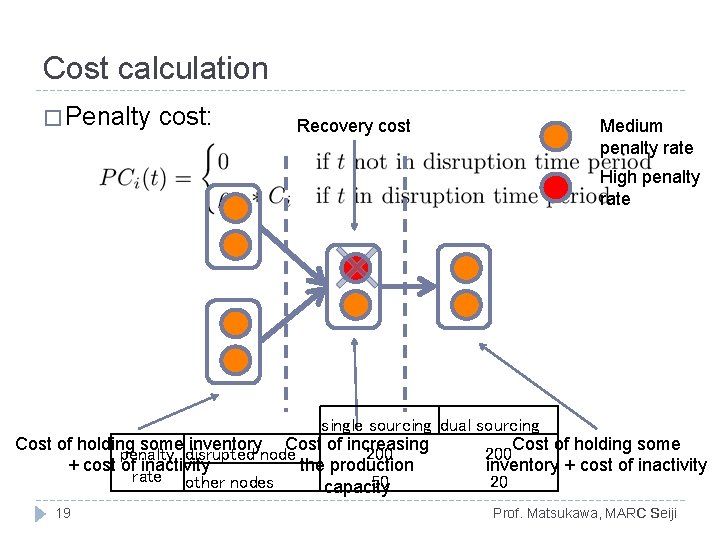
Cost calculation � Penalty cost: Recovery cost Medium penalty rate High penalty rate single sourcing dual sourcing Cost of holding some inventory Cost of increasing Cost of holding some 200 penalty disrupted node + cost of inactivity the production inventory + cost of inactivity rate other nodes 50 20 capacity 19 Prof. Matsukawa, MARC Seiji
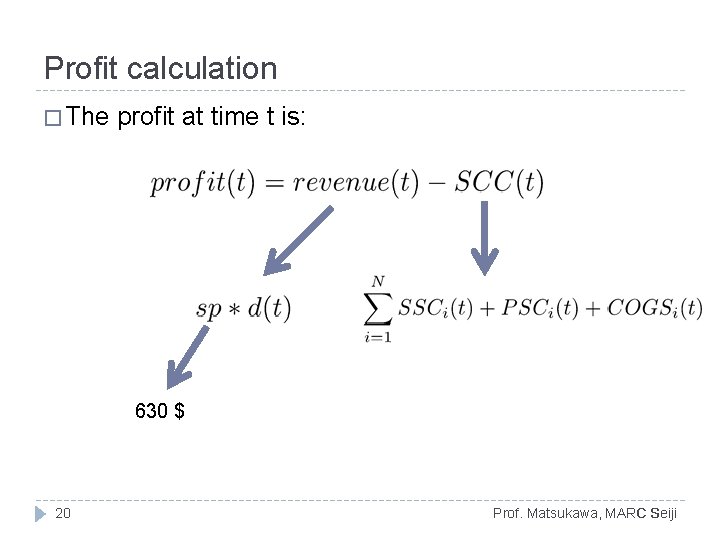
Profit calculation � The profit at time t is: 630 $ 20 Prof. Matsukawa, MARC Seiji
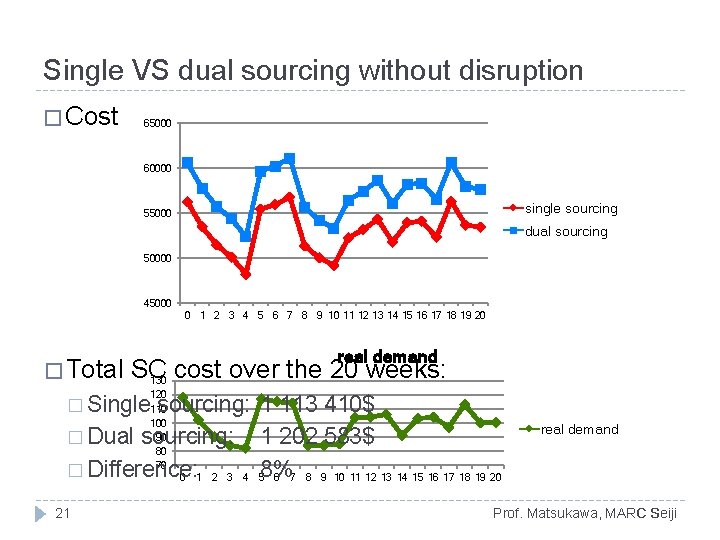
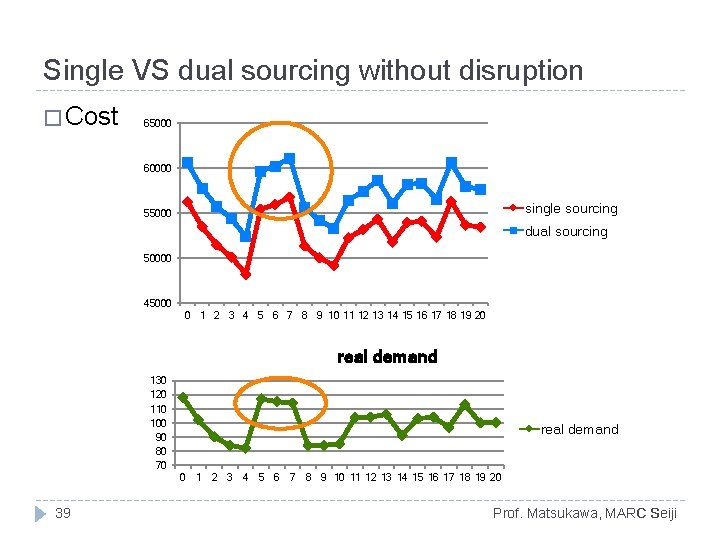
Single VS dual sourcing without disruption � Cost 65000 60000 single sourcing 55000 dual sourcing 50000 45000 0 1 2 3 4 5 6 7 8 9 10 11 12 13 14 15 16 17 18 19 20 � Total real demand SC cost over the 20 weeks: 130 120 110 100 90 80 70 � Single sourcing: 1 113 410$ � Dual sourcing: 1 202 583$ � Difference: 0 1 2 3 4 58% 6 7 8 9 10 11 12 13 14 15 16 17 18 19 20 21 real demand Prof. Matsukawa, MARC Seiji
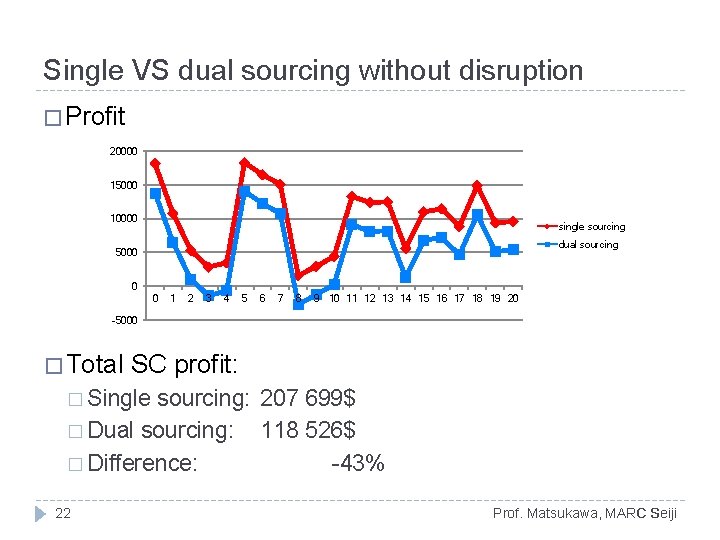
Single VS dual sourcing without disruption � Profit 20000 15000 10000 single sourcing dual sourcing 5000 0 0 1 2 3 4 5 6 7 8 9 10 11 12 13 14 15 16 17 18 19 20 -5000 � Total SC profit: � Single sourcing: 207 699$ � Dual sourcing: 118 526$ � Difference: -43% 22 Prof. Matsukawa, MARC Seiji
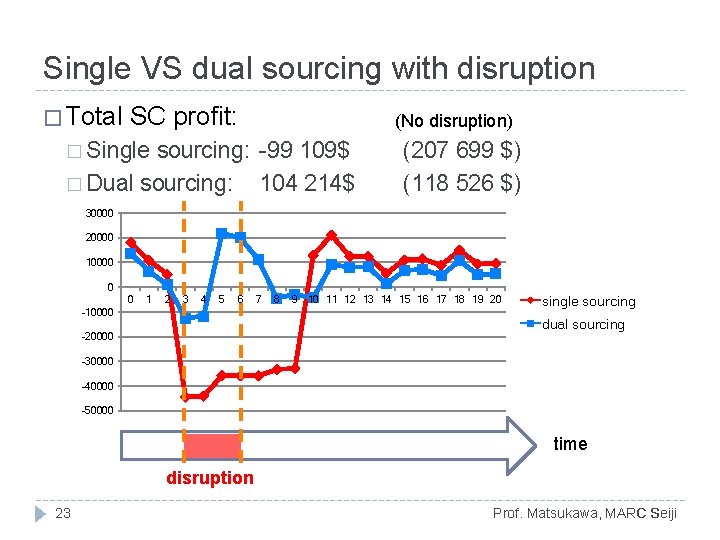
Single VS dual sourcing with disruption � Total SC profit: (No disruption) � Single sourcing: -99 109$ � Dual sourcing: 104 214$ (207 699 $) (118 526 $) 30000 20000 10000 0 0 1 2 3 4 5 6 -10000 7 8 9 10 11 12 13 14 15 16 17 18 19 20 single sourcing dual sourcing -20000 -30000 -40000 -50000 time disruption 23 Prof. Matsukawa, MARC Seiji
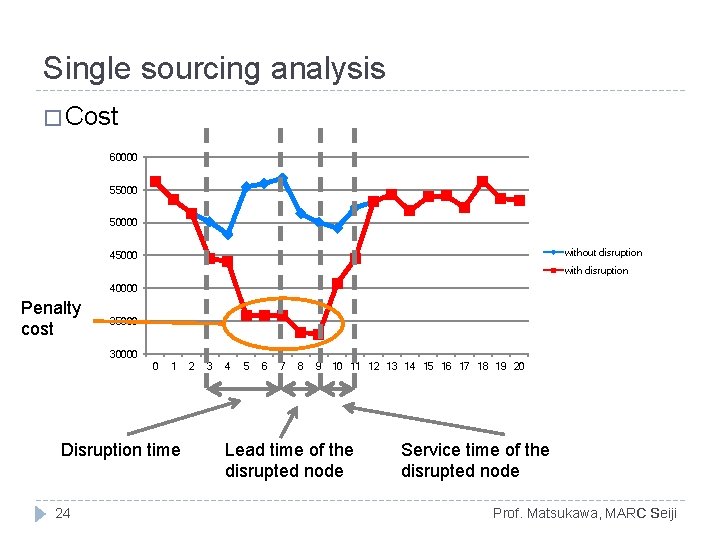
Single sourcing analysis � Cost 60000 550000 without disruption 45000 with disruption 40000 Penalty cost 35000 30000 0 1 Disruption time 24 2 3 4 5 6 7 8 9 10 11 12 13 14 15 16 17 18 19 20 Lead time of the disrupted node Service time of the disrupted node Prof. Matsukawa, MARC Seiji
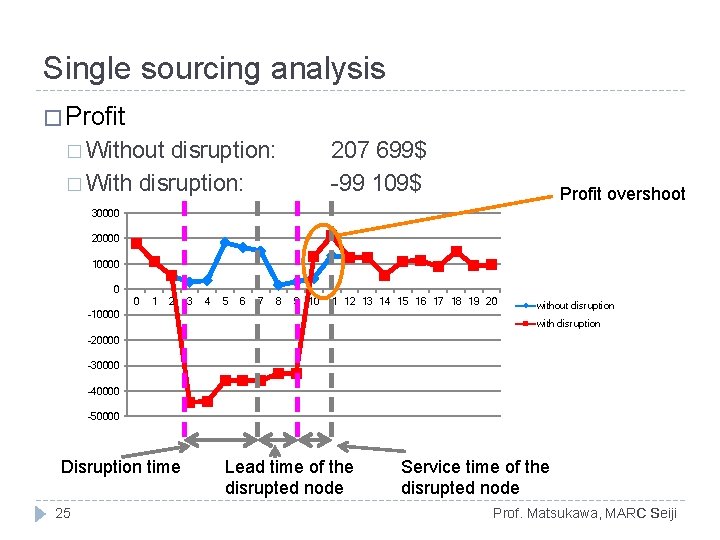
Single sourcing analysis � Profit � Without disruption: � With disruption: 207 699$ -99 109$ Profit overshoot 30000 20000 10000 0 0 1 2 3 4 5 6 7 8 9 10 11 12 13 14 15 16 17 18 19 20 -10000 without disruption with disruption -20000 -30000 -40000 -50000 Disruption time 25 Lead time of the disrupted node Service time of the disrupted node Prof. Matsukawa, MARC Seiji
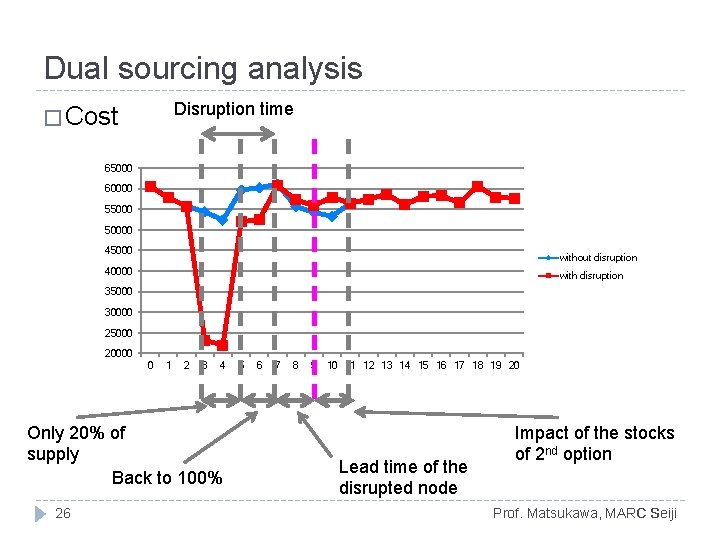
Dual sourcing analysis Disruption time � Cost 65000 60000 550000 45000 without disruption 40000 with disruption 35000 30000 25000 20000 0 1 2 3 4 Only 20% of supply Back to 100% 26 5 6 7 8 9 10 11 12 13 14 15 16 17 18 19 20 Lead time of the disrupted node Impact of the stocks of 2 nd option Prof. Matsukawa, MARC Seiji
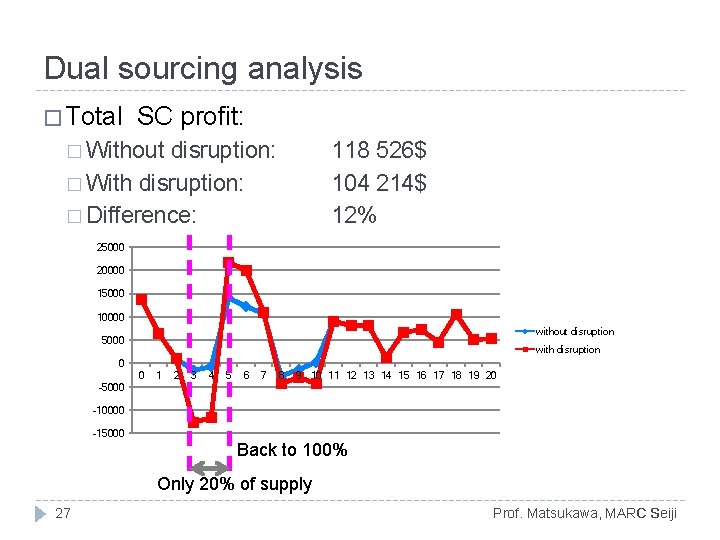
Dual sourcing analysis � Total SC profit: � Without disruption: � With disruption: � Difference: 118 526$ 104 214$ 12% 25000 20000 15000 10000 without disruption 5000 with disruption 0 -5000 0 1 2 3 4 5 6 7 8 9 10 11 12 13 14 15 16 17 18 19 20 -10000 -15000 Back to 100% Only 20% of supply 27 Prof. Matsukawa, MARC Seiji
Inventory policy 28 Prof. Matsukawa, MARC Seiji
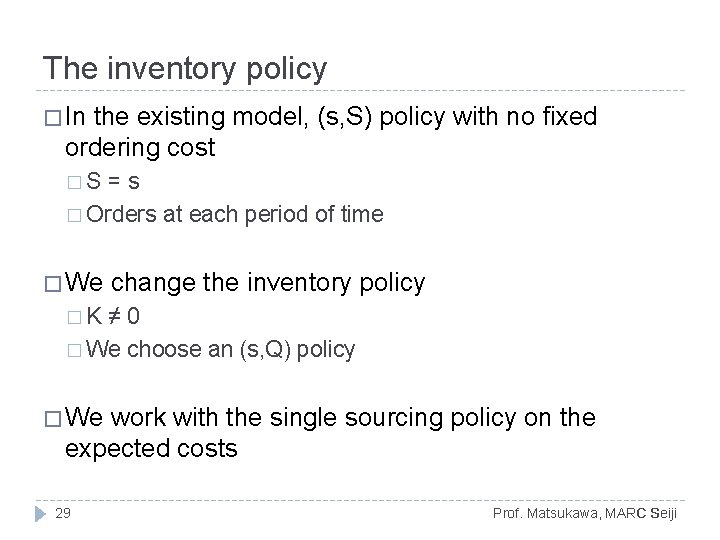
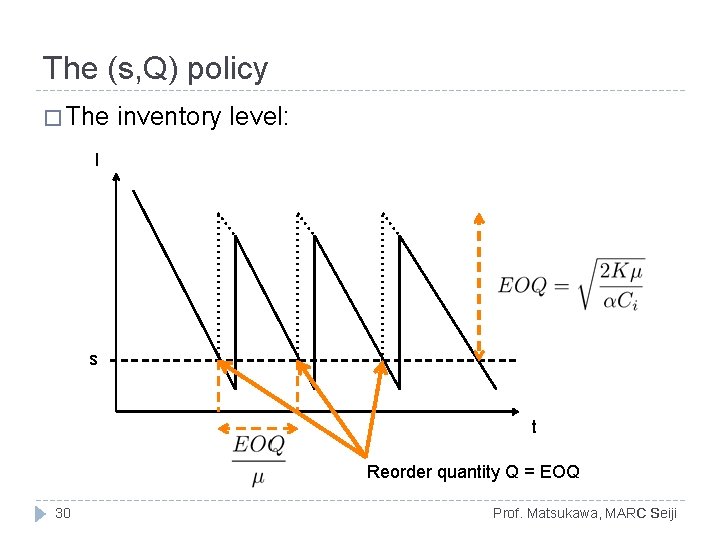
The inventory policy � In the existing model, (s, S) policy with no fixed ordering cost �S =s � Orders at each period of time � We change the inventory policy �K ≠ 0 � We choose an (s, Q) policy � We work with the single sourcing policy on the expected costs 29 Prof. Matsukawa, MARC Seiji
The (s, Q) policy � The inventory level: I s t Reorder quantity Q = EOQ 30 Prof. Matsukawa, MARC Seiji
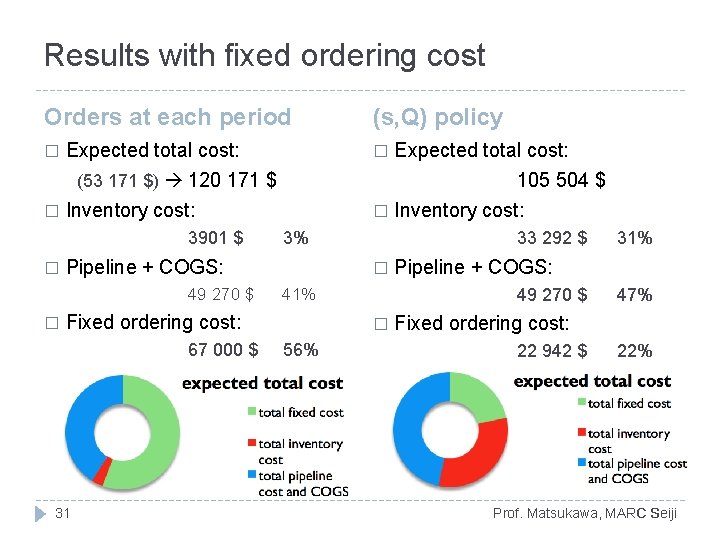
Results with fixed ordering cost Orders at each period (s, Q) policy � Expected total cost: (53 171 $) 120 171 $ � Expected total cost: 105 504 $ � Inventory cost: 3901 $ � Pipeline + COGS: 49 270 $ � � 41% Fixed ordering cost: 67 000 $ 31 33 292 $ 3% 56% Pipeline + COGS: 49 270 $ � 31% 47% Fixed ordering cost: 22 942 $ 22% Prof. Matsukawa, MARC Seiji
Conclusion 32 Prof. Matsukawa, MARC Seiji
Conclusion � Single VS dual sourcing: � Single sourcing more efficient if no disruption � In case of disruption, dual sourcing is way better � With fixed ordering cost: � (s, Q) ordering policy has better results than every period ordering policy � The balance of the different types of cost is different 33 Prof. Matsukawa, MARC Seiji
Conclusion � This research produced: �A configuration tool that works with different sourcing and inventory policies � A quantitative analysis of different types of SC configuration � A comparison between the different types of SC configuration 34 Prof. Matsukawa, MARC Seiji
Further research developments � Improve � Take into account a disruption risk � Improve 35 the risk management approach: the model to optimize more general SC Prof. Matsukawa, MARC Seiji
References � Optimizing the supply chain configuration for new products S. C. Graves, S. P. Willems, Management Science, 2005 � Optimal supply chain configuration strategies for new products S. P. Willems, Ph. D thesis, MIT, 1999 � Managing risks of supply chains disruptions: dual sourcing as a real option S. Pochard, master thesis, MIT, 2000 � Trial by fire: a blaze in Albuquerque sets off major crisis for cellphone giants A. Latour, Wall Street Journal, 29 Jan 2001 � To the rescue: Toyota’s fast rebound after fire at supplier shows why it is tough V. Reitman, Wall Street Journal, 08 May 1997 � The power of flexibility for mitigating supply chain risks C. Tang, B. Tomlin, International Journal of Production Economics, 2008 � Single or dual sourcing: decision-making in the presence of supply chain disruption risks H. Yu, A. Z. Zeng, L. Zhao, Omega, 2009 � Competition in multiechelon assembly supply chains S. M. Carr, U. S. Karmarkar, Management Science, 2005 36 Prof. Matsukawa, MARC Seiji
Thank you for your attention � Question 37 or remark ? Prof. Matsukawa, MARC Seiji
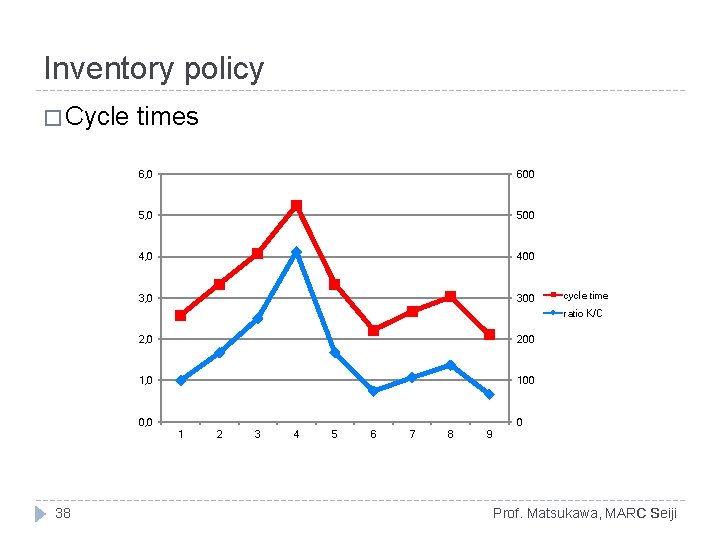
Inventory policy � Cycle times 6, 0 600 5, 0 500 4, 0 400 3, 0 300 cycle time ratio K/C 2, 0 200 1, 0 100 0, 0 0 1 38 2 3 4 5 6 7 8 9 Prof. Matsukawa, MARC Seiji
Single VS dual sourcing without disruption � Cost 65000 60000 single sourcing 55000 dual sourcing 50000 45000 0 1 2 3 4 5 6 7 8 9 10 11 12 13 14 15 16 17 18 19 20 real demand 130 120 110 100 90 80 70 real demand 0 39 1 2 3 4 5 6 7 8 9 10 11 12 13 14 15 16 17 18 19 20 Prof. Matsukawa, MARC Seiji