
Optimization of Rocket Model Parameters for Team America
- Slides: 6
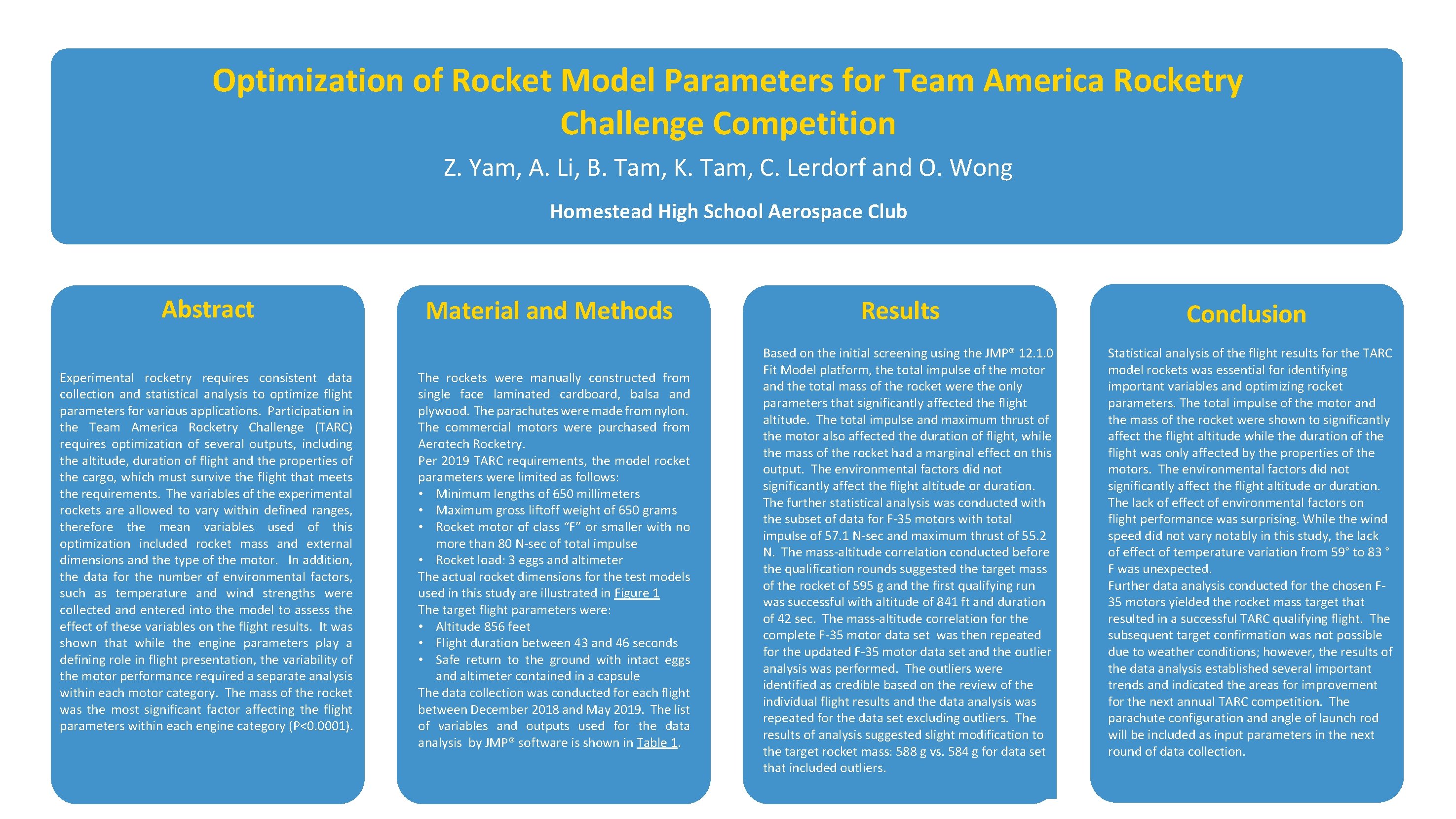
Optimization of Rocket Model Parameters for Team America Rocketry Challenge Competition Z. Yam, A. Li, B. Tam, K. Tam, C. Lerdorf and O. Wong Homestead High School Aerospace Club Abstract Experimental rocketry requires consistent data collection and statistical analysis to optimize flight parameters for various applications. Participation in the Team America Rocketry Challenge (TARC) requires optimization of several outputs, including the altitude, duration of flight and the properties of the cargo, which must survive the flight that meets the requirements. The variables of the experimental rockets are allowed to vary within defined ranges, therefore the mean variables used of this optimization included rocket mass and external dimensions and the type of the motor. In addition, the data for the number of environmental factors, such as temperature and wind strengths were collected and entered into the model to assess the effect of these variables on the flight results. It was shown that while the engine parameters play a defining role in flight presentation, the variability of the motor performance required a separate analysis within each motor category. The mass of the rocket was the most significant factor affecting the flight parameters within each engine category (P<0. 0001). Material and Methods The rockets were manually constructed from single face laminated cardboard, balsa and plywood. The parachutes were made from nylon. The commercial motors were purchased from Aerotech Rocketry. Per 2019 TARC requirements, the model rocket parameters were limited as follows: • Minimum lengths of 650 millimeters • Maximum gross liftoff weight of 650 grams • Rocket motor of class “F” or smaller with no more than 80 N-sec of total impulse • Rocket load: 3 eggs and altimeter The actual rocket dimensions for the test models used in this study are illustrated in Figure 1 The target flight parameters were: • Altitude 856 feet • Flight duration between 43 and 46 seconds • Safe return to the ground with intact eggs and altimeter contained in a capsule The data collection was conducted for each flight between December 2018 and May 2019. The list of variables and outputs used for the data analysis by JMP® software is shown in Table 1. Results Based on the initial screening using the JMP® 12. 1. 0 Fit Model platform, the total impulse of the motor and the total mass of the rocket were the only parameters that significantly affected the flight altitude. The total impulse and maximum thrust of the motor also affected the duration of flight, while the mass of the rocket had a marginal effect on this output. The environmental factors did not significantly affect the flight altitude or duration. The further statistical analysis was conducted with the subset of data for F-35 motors with total impulse of 57. 1 N-sec and maximum thrust of 55. 2 N. The mass-altitude correlation conducted before the qualification rounds suggested the target mass of the rocket of 595 g and the first qualifying run was successful with altitude of 841 ft and duration of 42 sec. The mass-altitude correlation for the complete F-35 motor data set was then repeated for the updated F-35 motor data set and the outlier analysis was performed. The outliers were identified as credible based on the review of the individual flight results and the data analysis was repeated for the data set excluding outliers. The results of analysis suggested slight modification to the target rocket mass: 588 g vs. 584 g for data set that included outliers. Conclusion Statistical analysis of the flight results for the TARC model rockets was essential for identifying important variables and optimizing rocket parameters. The total impulse of the motor and the mass of the rocket were shown to significantly affect the flight altitude while the duration of the flight was only affected by the properties of the motors. The environmental factors did not significantly affect the flight altitude or duration. The lack of effect of environmental factors on flight performance was surprising. While the wind speed did not vary notably in this study, the lack of effect of temperature variation from 59° to 83 ° F was unexpected. Further data analysis conducted for the chosen F 35 motors yielded the rocket mass target that resulted in a successful TARC qualifying flight. The subsequent target confirmation was not possible due to weather conditions; however, the results of the data analysis established several important trends and indicated the areas for improvement for the next annual TARC competition. The parachute configuration and angle of launch rod will be included as input parameters in the next round of data collection.
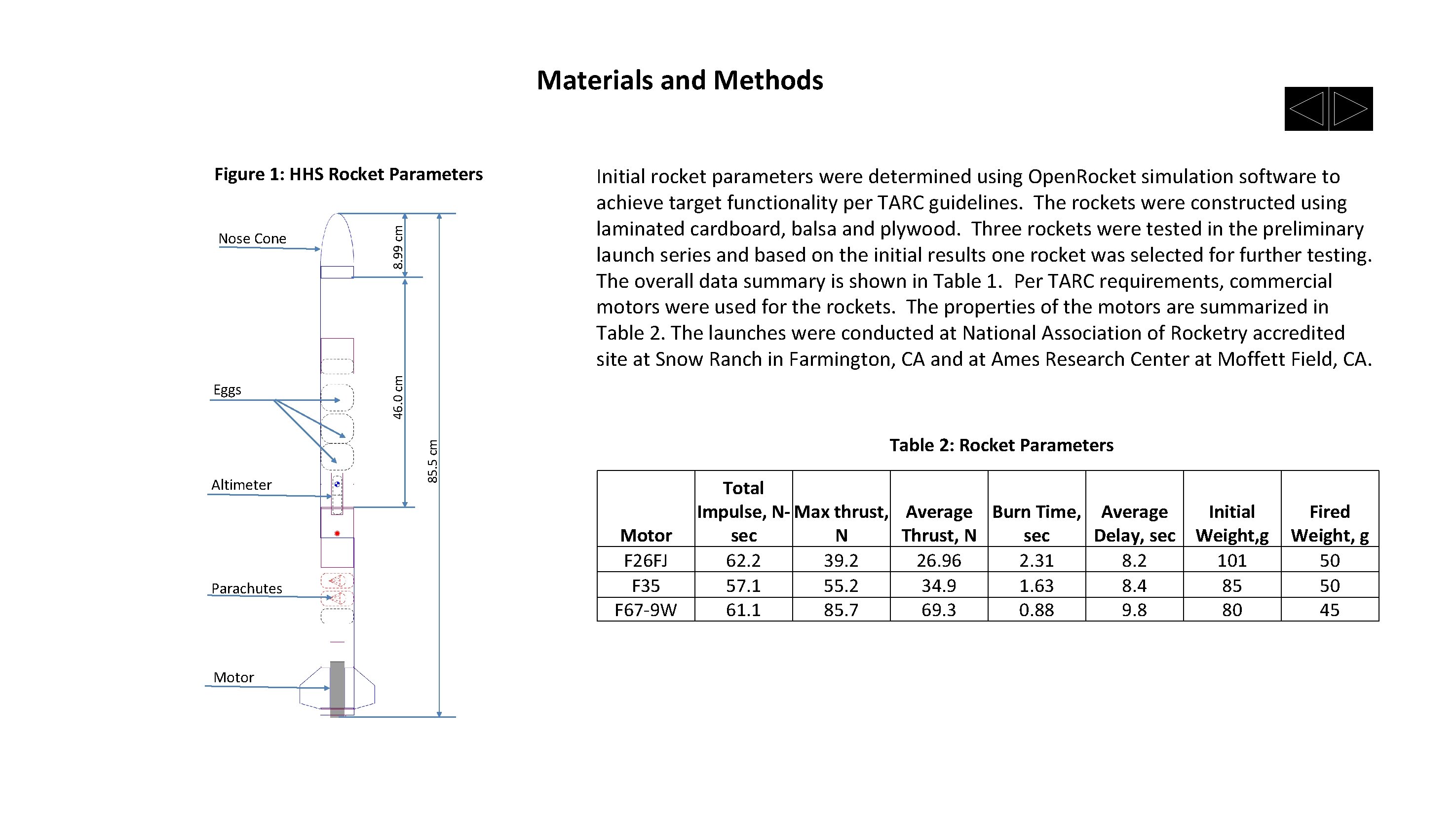
Materials and Methods Altimeter Parachutes Motor 85. 5 cm Eggs Initial rocket parameters were determined using Open. Rocket simulation software to achieve target functionality per TARC guidelines. The rockets were constructed using laminated cardboard, balsa and plywood. Three rockets were tested in the preliminary launch series and based on the initial results one rocket was selected for further testing. The overall data summary is shown in Table 1. , Per TARC requirements, commercial motors were used for the rockets. The properties of the motors are summarized in Table 2. The launches were conducted at National Association of Rocketry accredited site at Snow Ranch in Farmington, CA and at Ames Research Center at Moffett Field, CA. 46. 0 cm Nose Cone 8. 99 cm Figure 1: HHS Rocket Parameters Table 2: Rocket Parameters Total Impulse, N- Max thrust, Average Burn Time, Average Motor sec N Thrust, N sec Delay, sec F 26 FJ 62. 2 39. 2 26. 96 2. 31 8. 2 F 35 57. 1 55. 2 34. 9 1. 63 8. 4 F 67 -9 W 61. 1 85. 7 69. 3 0. 88 9. 8 Initial Weight, g 101 85 80 Fired Weight, g 50 50 45
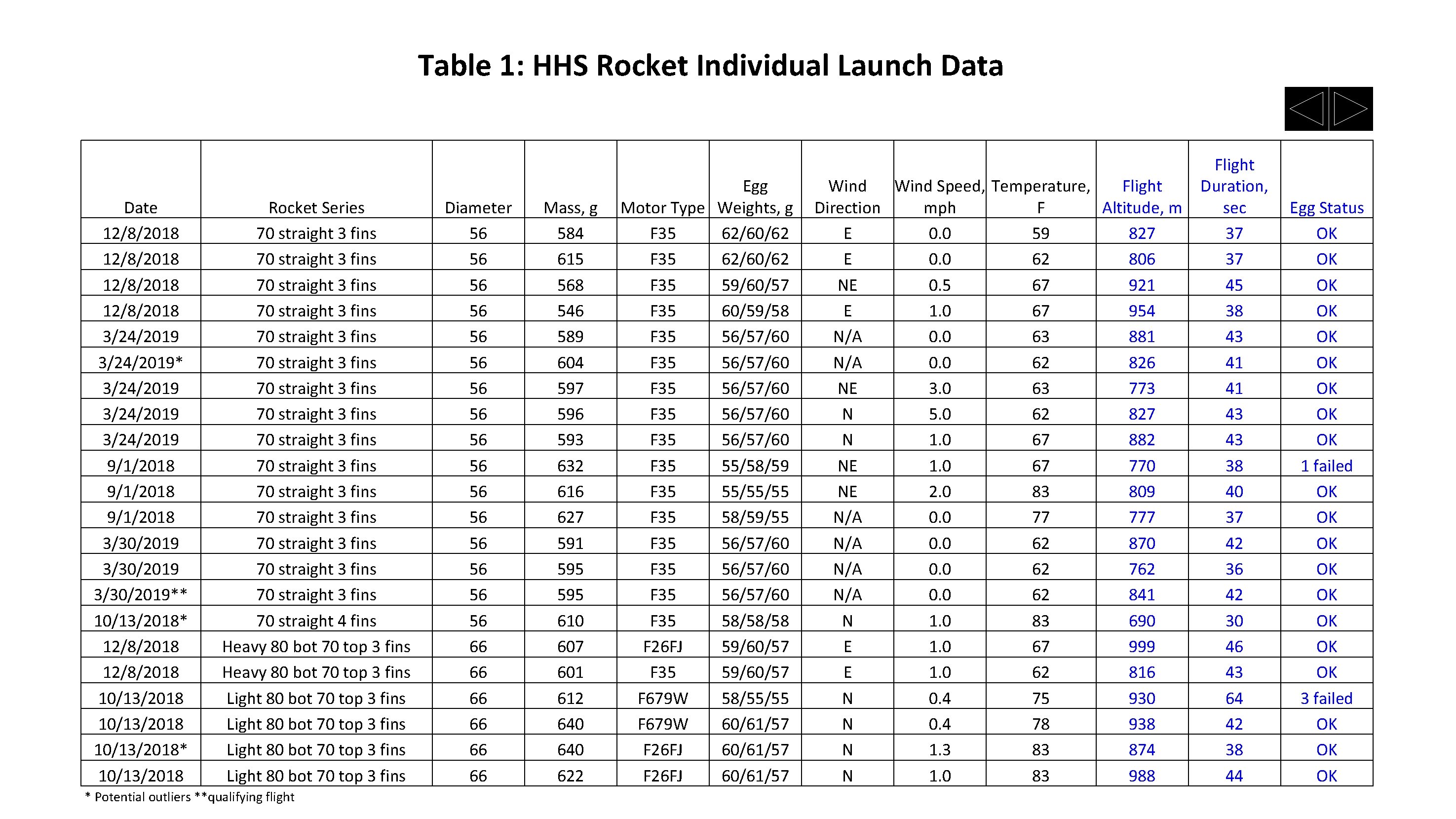
Table 1: HHS Rocket Individual Launch Data Date 12/8/2018 3/24/2019* 3/24/2019 9/1/2018 3/30/2019** 10/13/2018* 12/8/2018 10/13/2018* 10/13/2018 Rocket Series 70 straight 3 fins 70 straight 3 fins 70 straight 3 fins 70 straight 3 fins 70 straight 4 fins Heavy 80 bot 70 top 3 fins Light 80 bot 70 top 3 fins * Potential outliers **qualifying flight Diameter 56 56 56 56 66 66 66 Mass, g 584 615 568 546 589 604 597 596 593 632 616 627 591 595 610 607 601 612 640 622 Egg Motor Type Weights, g F 35 62/60/62 F 35 59/60/57 F 35 60/59/58 F 35 56/57/60 F 35 56/57/60 F 35 55/58/59 F 35 55/55/55 F 35 58/59/55 F 35 56/57/60 F 35 58/58/58 F 26 FJ 59/60/57 F 35 59/60/57 F 679 W 58/55/55 F 679 W 60/61/57 F 26 FJ 60/61/57 Wind Speed, Temperature, Flight Direction mph F Altitude, m E 0. 0 59 827 E 0. 0 62 806 NE 0. 5 67 921 E 1. 0 67 954 N/A 0. 0 63 881 N/A 0. 0 62 826 NE 3. 0 63 773 N 5. 0 62 827 N 1. 0 67 882 NE 1. 0 67 770 NE 2. 0 83 809 N/A 0. 0 77 777 N/A 0. 0 62 870 N/A 0. 0 62 762 N/A 0. 0 62 841 N 1. 0 83 690 E 1. 0 67 999 E 1. 0 62 816 N 0. 4 75 930 N 0. 4 78 938 N 1. 3 83 874 N 1. 0 83 988 Flight Duration, sec 37 37 45 38 43 41 41 43 43 38 40 37 42 36 42 30 46 43 64 42 38 44 Egg Status OK OK OK 1 failed OK OK 3 failed OK OK OK
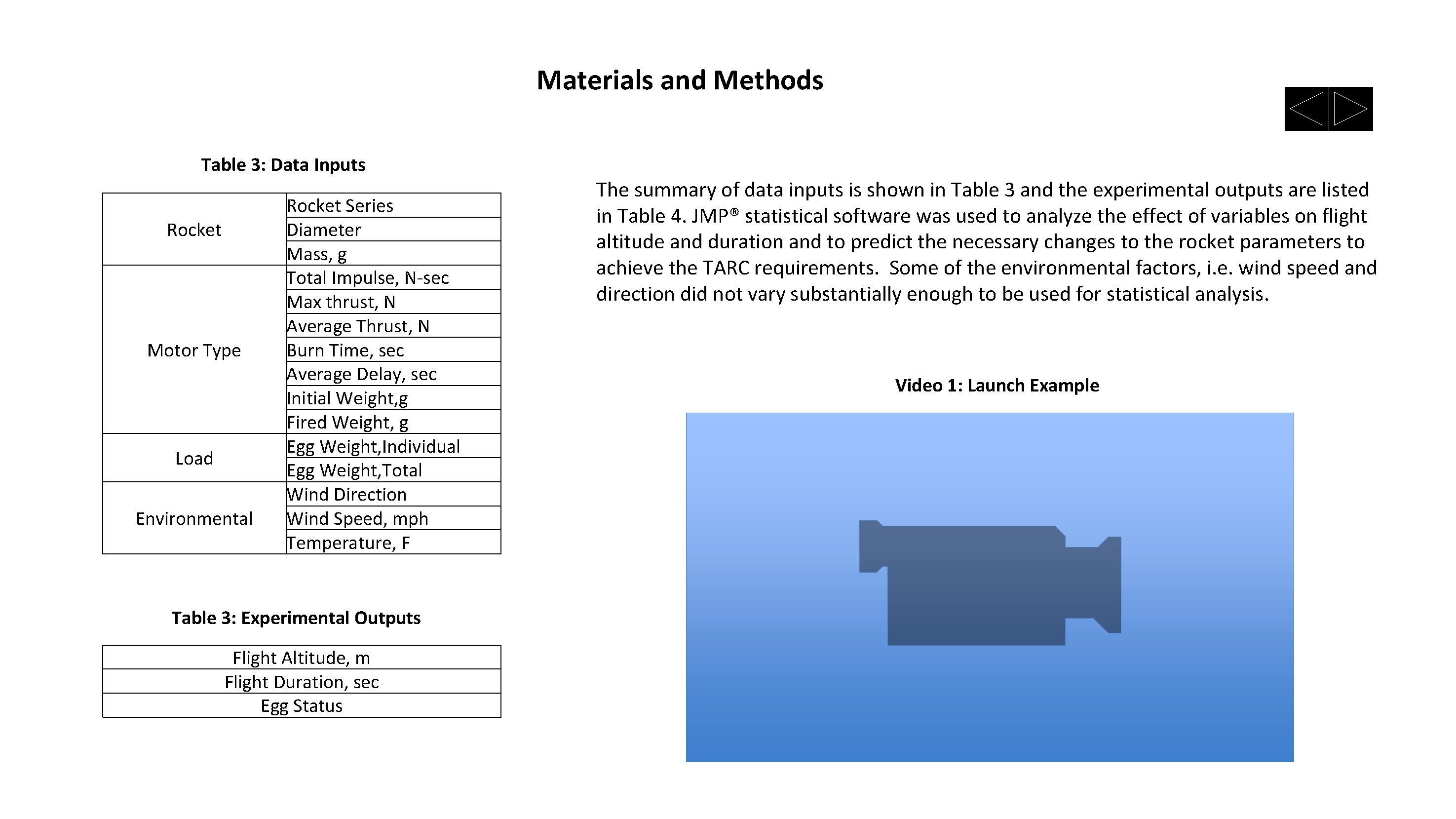
Materials and Methods Table 3: Data Inputs Rocket Motor Type Load Environmental Rocket Series Diameter Mass, g Total Impulse, N-sec Max thrust, N Average Thrust, N Burn Time, sec Average Delay, sec Initial Weight, g Fired Weight, g Egg Weight, Individual Egg Weight, Total Wind Direction Wind Speed, mph Temperature, F Table 3: Experimental Outputs Flight Altitude, m Flight Duration, sec Egg Status The summary of data inputs is shown in Table 3 and the experimental outputs are listed in Table 4. JMP® statistical software was used to analyze the effect of variables on flight altitude and duration and to predict the necessary changes to the rocket parameters to achieve the TARC requirements. Some of the environmental factors, i. e. wind speed and direction did not vary substantially enough to be used for statistical analysis. Video 1: Launch Example
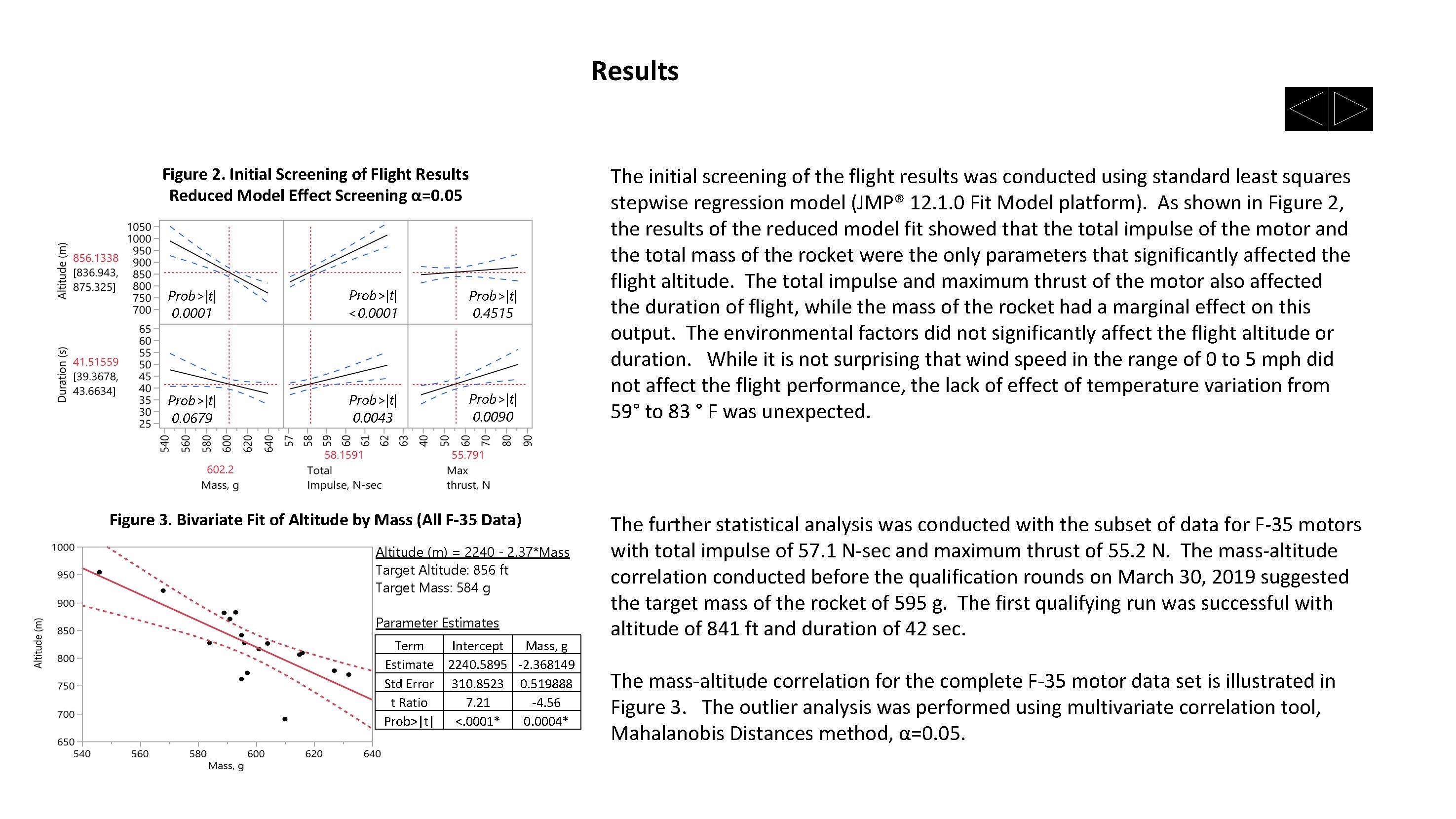
Results Figure 2. Initial Screening of Flight Results Reduced Model Effect Screening α=0. 05 Prob>|t| 0. 0001 Prob>|t| <0. 0001 Prob>|t| 0. 4515 Prob>|t| 0. 0679 Prob>|t| 0. 0043 Prob>|t| 0. 0090 Figure 3. Bivariate Fit of Altitude by Mass (All F-35 Data) Altitude (m) = 2240 - 2. 37*Mass Target Altitude: 856 ft Target Mass: 584 g Parameter Estimates Term Intercept Mass, g Estimate 2240. 5895 -2. 368149 Std Error 310. 8523 0. 519888 t Ratio 7. 21 -4. 56 Prob>|t| <. 0001* 0. 0004* The initial screening of the flight results was conducted using standard least squares stepwise regression model (JMP® 12. 1. 0 Fit Model platform). As shown in Figure 2, the results of the reduced model fit showed that the total impulse of the motor and the total mass of the rocket were the only parameters that significantly affected the flight altitude. The total impulse and maximum thrust of the motor also affected the duration of flight, while the mass of the rocket had a marginal effect on this output. The environmental factors did not significantly affect the flight altitude or duration. While it is not surprising that wind speed in the range of 0 to 5 mph did not affect the flight performance, the lack of effect of temperature variation from 59° to 83 ° F was unexpected. The further statistical analysis was conducted with the subset of data for F-35 motors with total impulse of 57. 1 N-sec and maximum thrust of 55. 2 N. The mass-altitude correlation conducted before the qualification rounds on March 30, 2019 suggested the target mass of the rocket of 595 g. The first qualifying run was successful with altitude of 841 ft and duration of 42 sec. The mass-altitude correlation for the complete F-35 motor data set is illustrated in Figure 3. The outlier analysis was performed using multivariate correlation tool, Mahalanobis Distances method, α=0. 05.
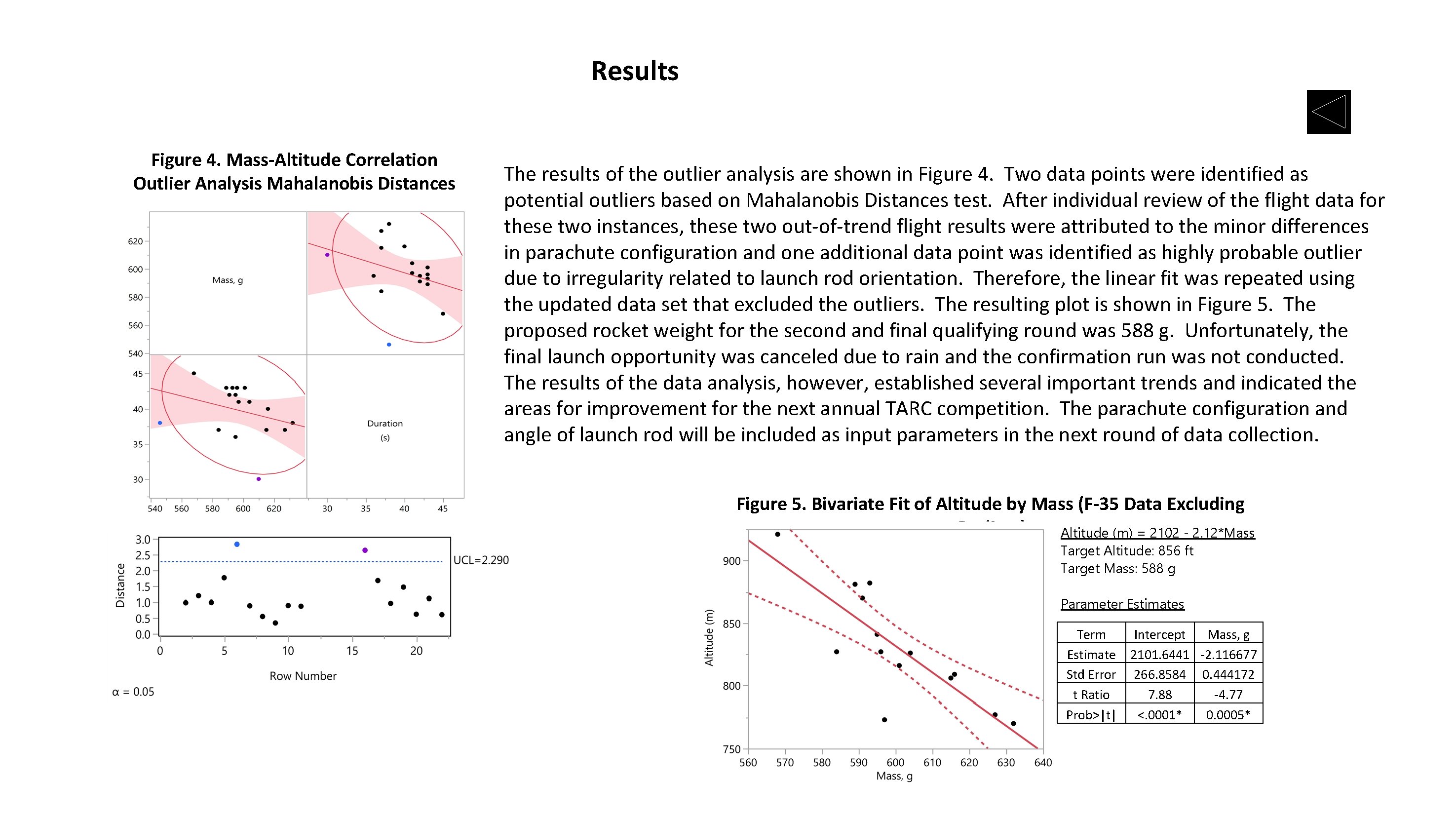
Results Figure 4. Mass-Altitude Correlation Outlier Analysis Mahalanobis Distances The results of the outlier analysis are shown in Figure 4. Two data points were identified as potential outliers based on Mahalanobis Distances test. After individual review of the flight data for these two instances, these two out-of-trend flight results were attributed to the minor differences in parachute configuration and one additional data point was identified as highly probable outlier due to irregularity related to launch rod orientation. Therefore, the linear fit was repeated using the updated data set that excluded the outliers. The resulting plot is shown in Figure 5. The proposed rocket weight for the second and final qualifying round was 588 g. Unfortunately, the final launch opportunity was canceled due to rain and the confirmation run was not conducted. The results of the data analysis, however, established several important trends and indicated the areas for improvement for the next annual TARC competition. The parachute configuration and angle of launch rod will be included as input parameters in the next round of data collection. Figure 5. Bivariate Fit of Altitude by Mass (F-35 Data Excluding Outliers) Altitude (m) = 2102 - 2. 12*Mass Target Altitude: 856 ft Target Mass: 588 g Parameter Estimates Term Intercept Mass, g Estimate 2101. 6441 -2. 116677 Std Error 266. 8584 0. 444172 t Ratio 7. 88 -4. 77 Prob>|t| <. 0001* 0. 0005*