
Optimization of NextGeneration FastSpectrum Self Powered Neutron Detectors


- Slides: 21
Optimization of Next-Generation Fast-Spectrum Self. Powered Neutron Detectors Callie Goetz, Cihangir Celik Oak Ridge National Laboratory Sacit Cetiner Idaho National Laboratory/Massachusetts Institute of Technology Advancements in Nuclear Instrumentation Measurement Methods and their Applications June 23, 2021 ORNL is managed by UT-Battelle, LLC for the US Department of Energy
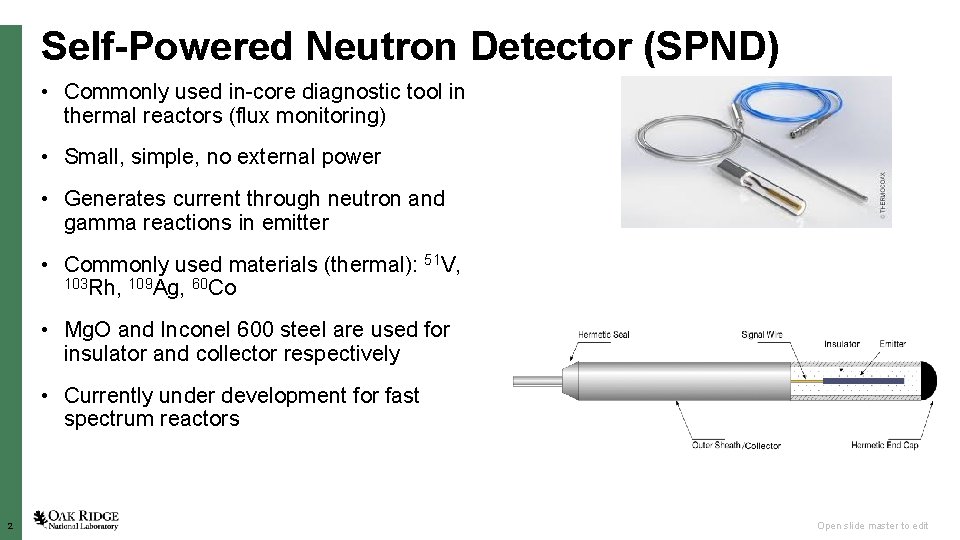
Self-Powered Neutron Detector (SPND) • Commonly used in-core diagnostic tool in thermal reactors (flux monitoring) • Small, simple, no external power • Generates current through neutron and gamma reactions in emitter • Commonly used materials (thermal): 103 Rh, 109 Ag, 60 Co 51 V, • Mg. O and Inconel 600 steel are used for insulator and collector respectively • Currently under development for fast spectrum reactors 2 Open slide master to edit
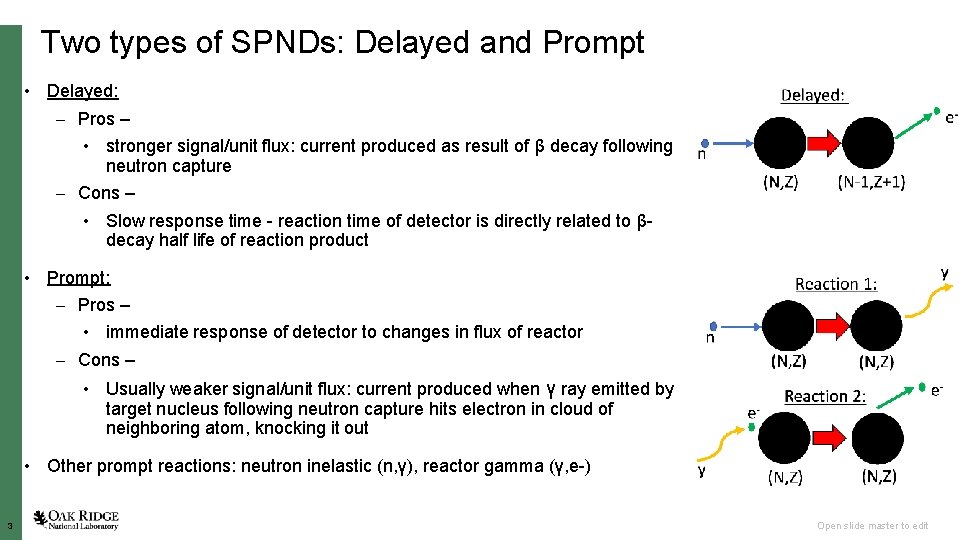
Two types of SPNDs: Delayed and Prompt • Delayed: – Pros – • stronger signal/unit flux: current produced as result of β decay following neutron capture – Cons – • • Slow response time - reaction time of detector is directly related to βdecay half life of reaction product Prompt: – Pros – • immediate response of detector to changes in flux of reactor – Cons – • • 3 Usually weaker signal/unit flux: current produced when γ ray emitted by target nucleus following neutron capture hits electron in cloud of neighboring atom, knocking it out Other prompt reactions: neutron inelastic (n, γ), reactor gamma (γ, e-) Open slide master to edit
Why FS-SPND? • SFR spectrum peaks around 0. 5 Me. V • Significant shift compared to light water reactor • Likelihood of interaction with neutrons (cross section) can drop by orders of magnitude at high energies • 59 Co Many current SPNDS do NOT have required sensitivity! 4 Open slide master to edit
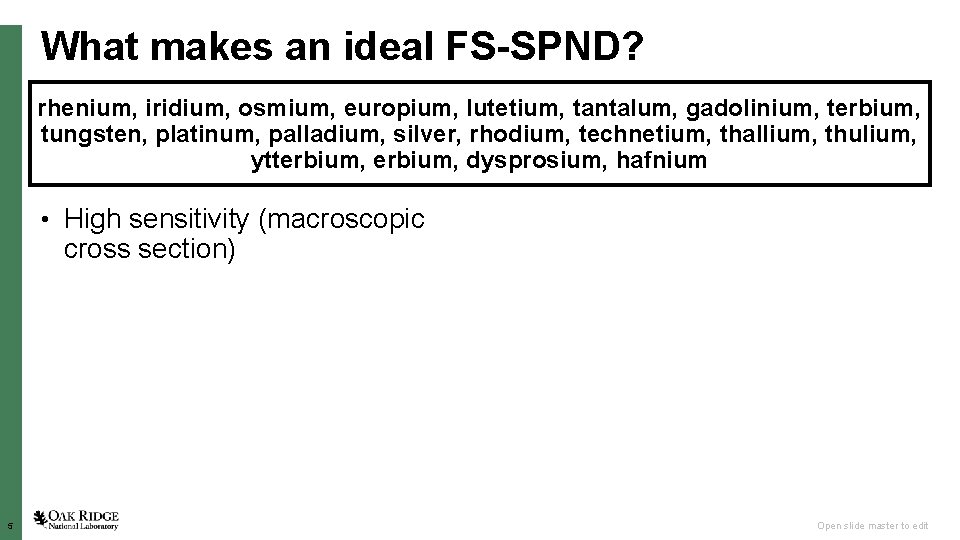
What makes an ideal FS-SPND? rhenium, iridium, osmium, europium, lutetium, tantalum, gadolinium, terbium, tungsten, platinum, palladium, silver, rhodium, technetium, thallium, thulium, ytterbium, dysprosium, hafnium • High sensitivity (macroscopic cross section) 5 Open slide master to edit
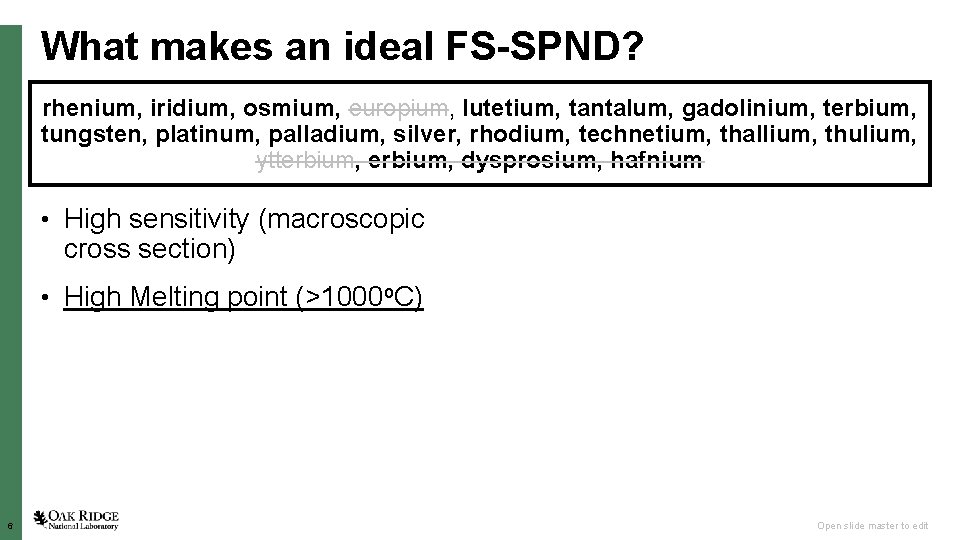
What makes an ideal FS-SPND? rhenium, iridium, osmium, europium, lutetium, tantalum, gadolinium, terbium, tungsten, platinum, palladium, silver, rhodium, technetium, thallium, thulium, ytterbium, dysprosium, hafnium • High sensitivity (macroscopic cross section) • High Melting point (>1000 o. C) 6 Open slide master to edit
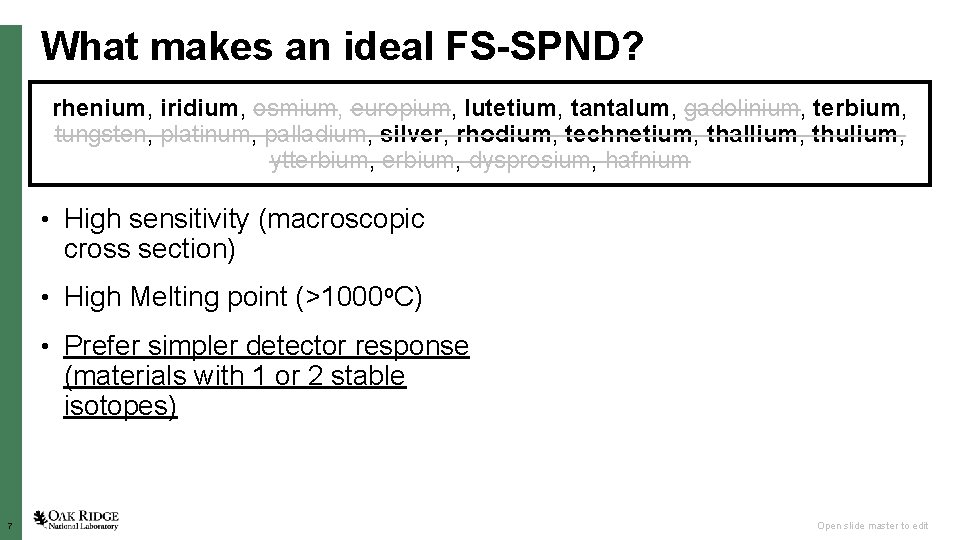
What makes an ideal FS-SPND? rhenium, iridium, osmium, europium, lutetium, tantalum, gadolinium, terbium, tungsten, platinum, palladium, silver, rhodium, technetium, thallium, thulium, ytterbium, dysprosium, hafnium • High sensitivity (macroscopic cross section) • High Melting point (>1000 o. C) • Prefer simpler detector response (materials with 1 or 2 stable isotopes) 7 Open slide master to edit
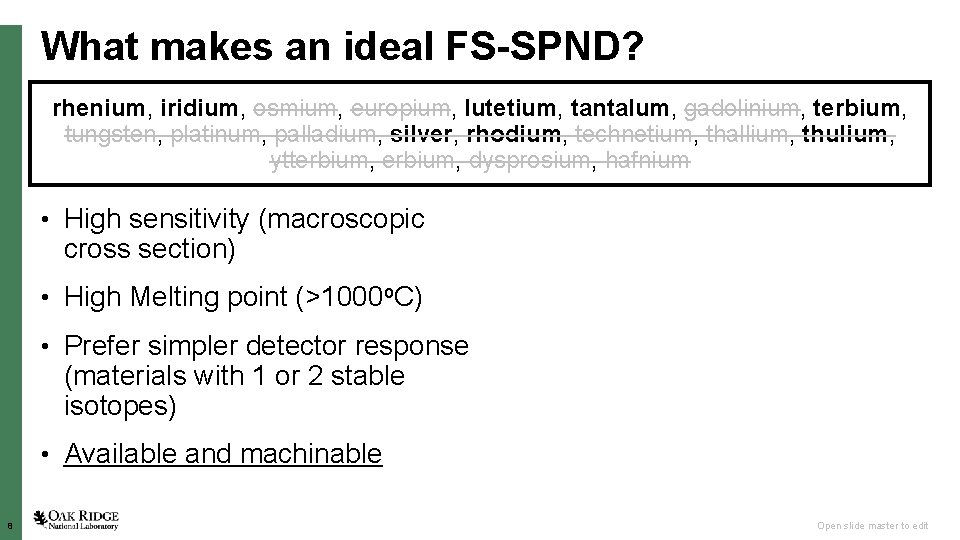
What makes an ideal FS-SPND? rhenium, iridium, osmium, europium, lutetium, tantalum, gadolinium, terbium, tungsten, platinum, palladium, silver, rhodium, technetium, thallium, thulium, ytterbium, dysprosium, hafnium • High sensitivity (macroscopic cross section) • High Melting point (>1000 o. C) • Prefer simpler detector response (materials with 1 or 2 stable isotopes) • Available and machinable 8 Open slide master to edit
What makes an ideal PROMPT FS-SPND? • Low background – LONG β- decay half life • Large number of carriers - High proton number (Z) 9 Open slide master to edit
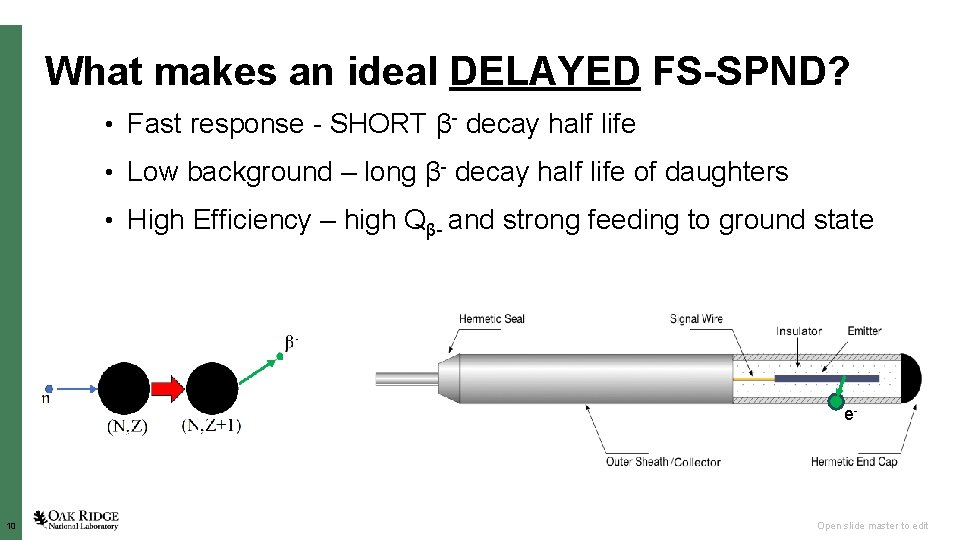
What makes an ideal DELAYED FS-SPND? • Fast response - SHORT β- decay half life • Low background – long β- decay half life of daughters • High Efficiency – high Qβ- and strong feeding to ground state e- 10 Open slide master to edit
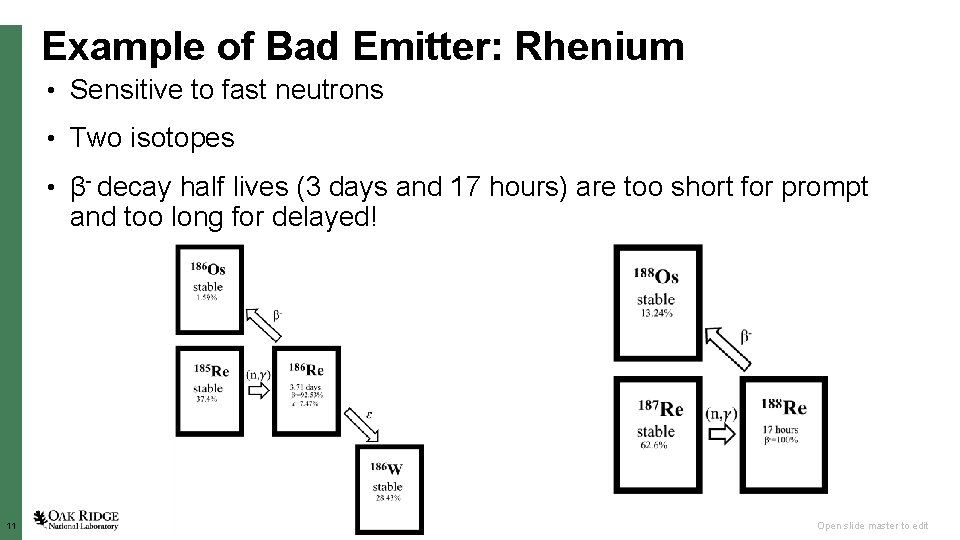
Example of Bad Emitter: Rhenium • Sensitive to fast neutrons • Two isotopes • β- decay half lives (3 days and 17 hours) are too short for prompt and too long for delayed! 11 Open slide master to edit
Example of Good Emitter: Tantalum • Sensitive to fast neutrons • Single isotope • Long lived reaction product – 114 days! 12 Open slide master to edit
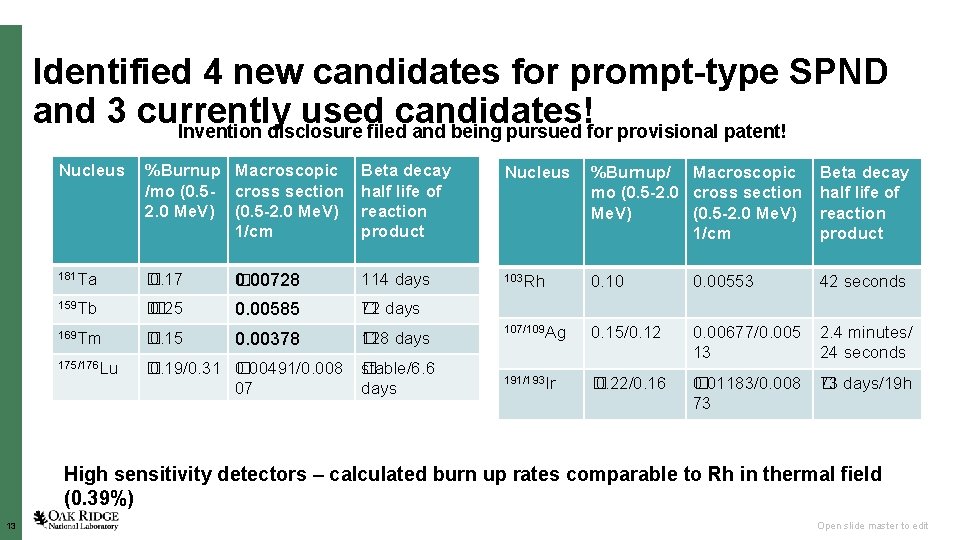
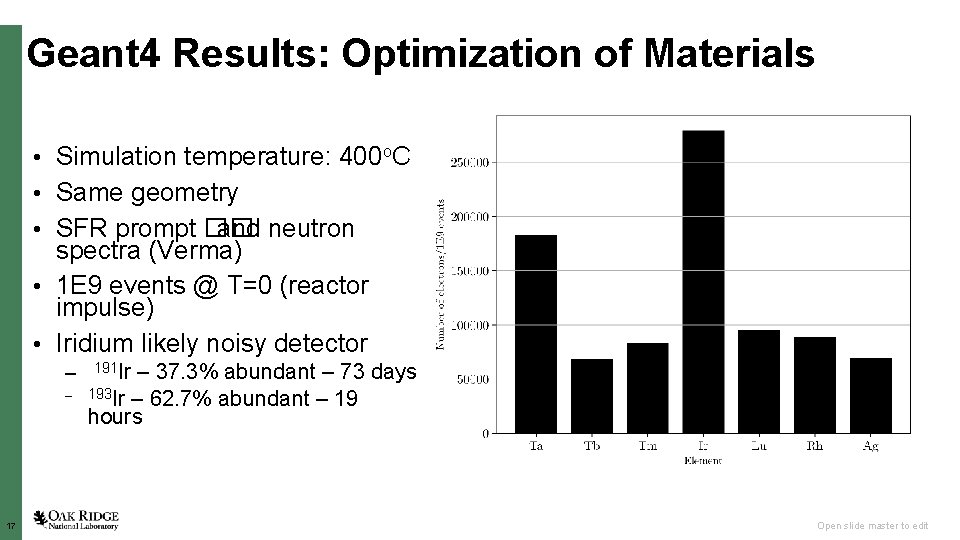
Identified 4 new candidates for prompt-type SPND and 3 currently used candidates! Invention disclosure filed and being pursued for provisional patent! Nucleus %Burnup Macroscopic /mo (0. 5 - cross section 2. 0 Me. V) (0. 5 -2. 0 Me. V) 1/cm Beta decay half life of reaction product Nucleus %Burnup/ Macroscopic mo (0. 5 -2. 0 cross section Me. V) (0. 5 -2. 0 Me. V) 1/cm Beta decay half life of reaction product 181 Ta � 0. 17 0. 00728 � 114 days 103 Rh 0. 10 0. 00553 42 seconds 159 Tb � 0. 25 � 0. 00585 72 days � 169 Tm � 0. 15 0. 00378 128 days � 107/109 Ag 0. 15/0. 12 175/176 Lu � 0. 19/0. 31 0 �. 00491/0. 008 07 0. 00677/0. 005 13 2. 4 minutes/ 24 seconds 191/193 Ir � 0. 22/0. 16 �. 01183/0. 008 0 73 73 days/19 h � s�table/6. 6 days High sensitivity detectors – calculated burn up rates comparable to Rh in thermal field (0. 39%) 13 Open slide master to edit
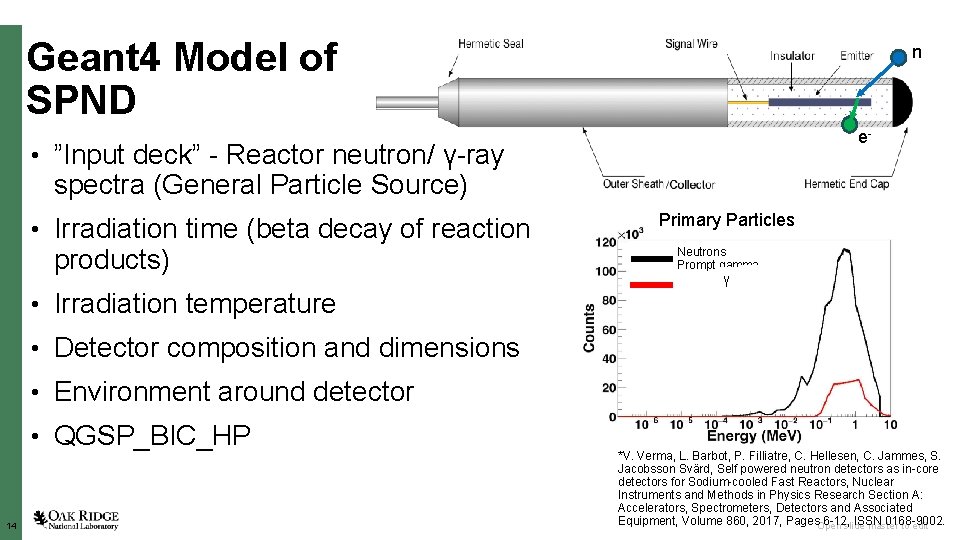
Geant 4 Model of SPND n e- • ”Input deck” - Reactor neutron/ γ-ray spectra (General Particle Source) • Irradiation time (beta decay of reaction products) Primary Particles Neutrons Prompt gamma γ • Irradiation temperature • Detector composition and dimensions • Environment around detector • QGSP_BIC_HP 14 *V. Verma, L. Barbot, P. Filliatre, C. Hellesen, C. Jammes, S. Jacobsson Svärd, Self powered neutron detectors as in-core detectors for Sodium-cooled Fast Reactors, Nuclear Instruments and Methods in Physics Research Section A: Accelerators, Spectrometers, Detectors and Associated Equipment, Volume 860, 2017, Pages. Open 6 -12, ISSN 0168 -9002. slide master to edit
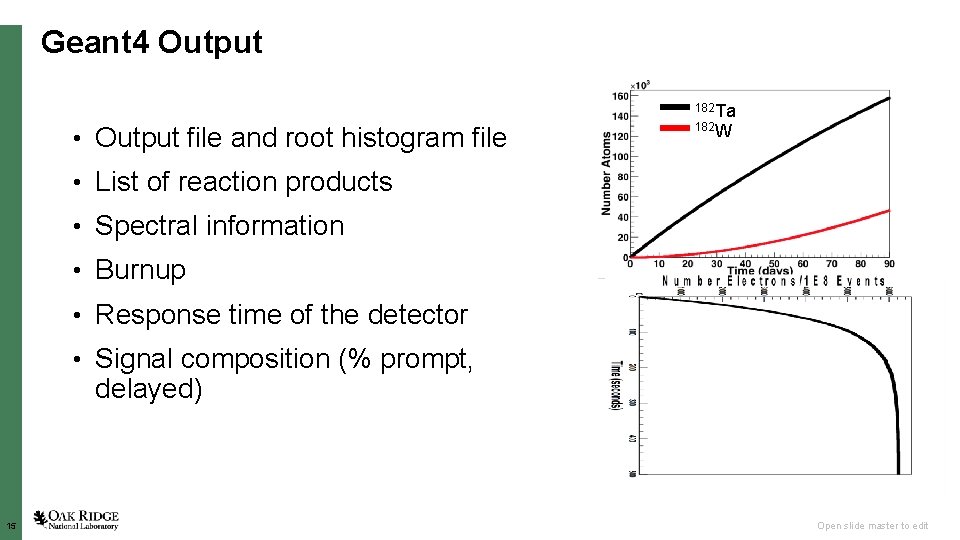
Geant 4 Output 182 Ta • Output file and root histogram file 182 W • List of reaction products • Spectral information • Burnup • Response time of the detector • Signal composition (% prompt, delayed) 15 Open slide master to edit
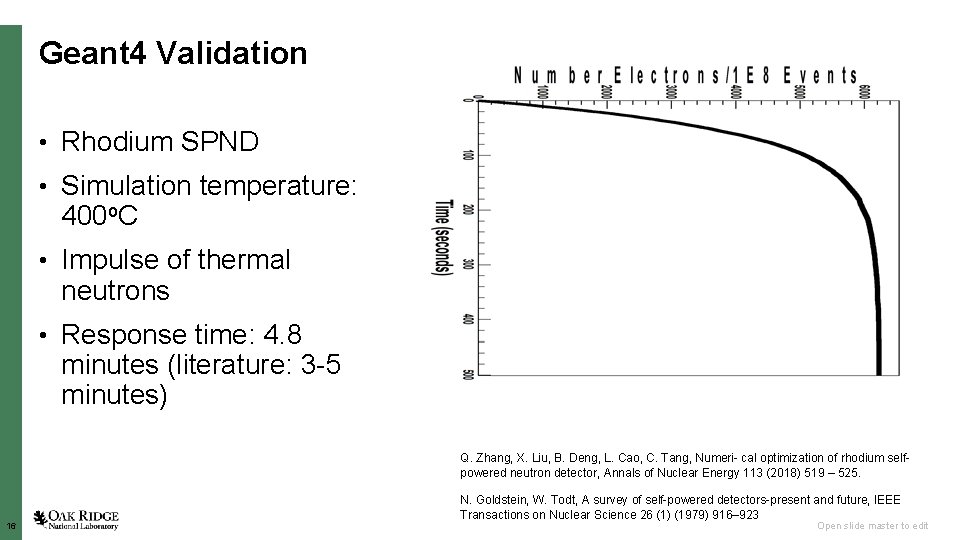
Geant 4 Validation • Rhodium SPND • Simulation temperature: 400 o. C • Impulse of thermal neutrons • Response time: 4. 8 minutes (literature: 3 -5 minutes) Q. Zhang, X. Liu, B. Deng, L. Cao, C. Tang, Numeri- cal optimization of rhodium selfpowered neutron detector, Annals of Nuclear Energy 113 (2018) 519 – 525. 16 N. Goldstein, W. Todt, A survey of self-powered detectors-present and future, IEEE Transactions on Nuclear Science 26 (1) (1979) 916– 923 Open slide master to edit
Geant 4 Results: Optimization of Materials • Simulation temperature: 400 o. C • Same geometry • SFR prompt �� and neutron spectra (Verma) • 1 E 9 events @ T=0 (reactor impulse) • Iridium likely noisy detector – – 17 191 Ir – 37. 3% abundant – 73 days 193 Ir – 62. 7% abundant – 19 hours Open slide master to edit
Questions? 18 Open slide master to edit
Extra Slides 19 Open slide master to edit
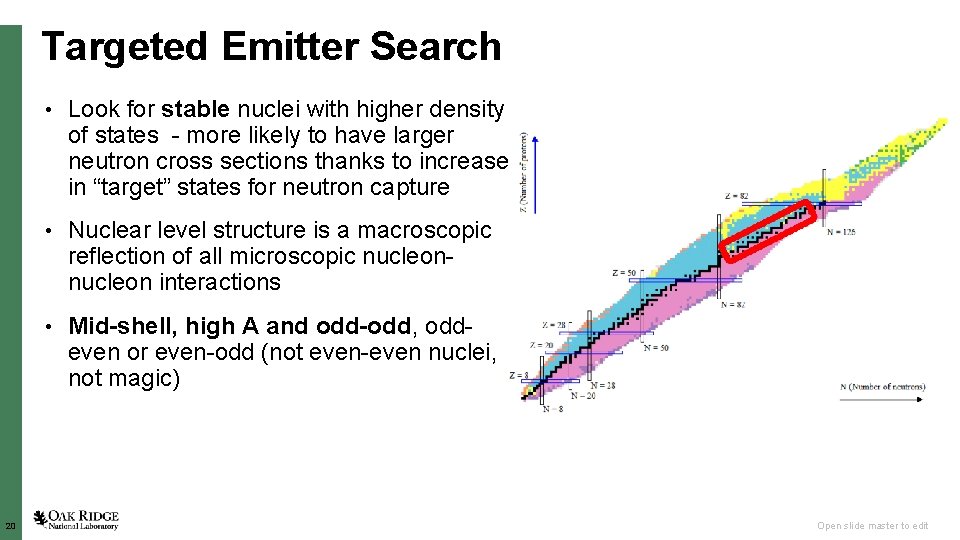
Targeted Emitter Search • Look for stable nuclei with higher density of states - more likely to have larger neutron cross sections thanks to increase in “target” states for neutron capture • Nuclear level structure is a macroscopic reflection of all microscopic nucleon interactions • Mid-shell, high A and odd-odd, odd- even or even-odd (not even-even nuclei, not magic) 20 Open slide master to edit
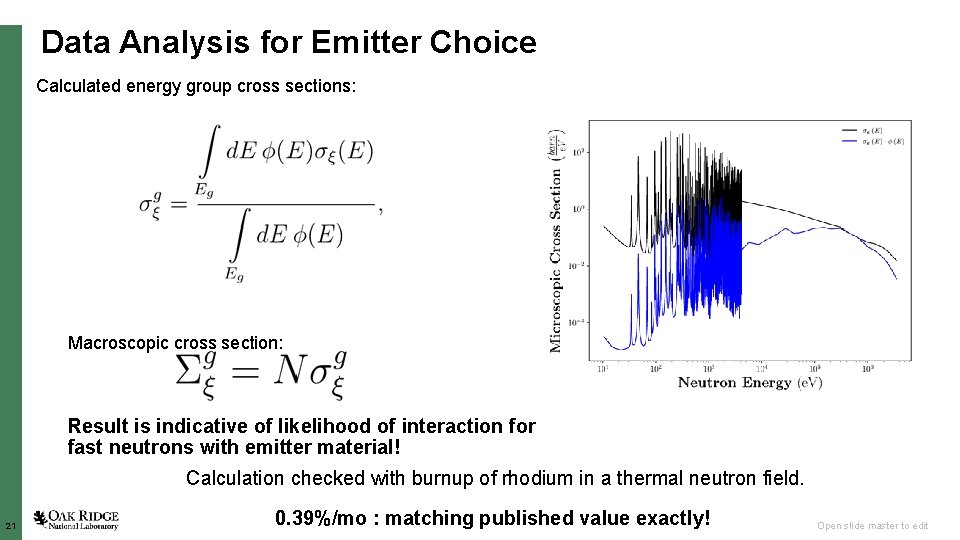
Data Analysis for Emitter Choice Calculated energy group cross sections: Macroscopic cross section: Result is indicative of likelihood of interaction for fast neutrons with emitter material! Calculation checked with burnup of rhodium in a thermal neutron field. 21 0. 39%/mo : matching published value exactly! Open slide master to edit