
Optimization Approaches for Product Family Design ME 546

- Slides: 55
Optimization Approaches for Product Family Design ME 546 - Designing Product Families - IE 546 Timothy W. Simpson Professor of Mechanical & Industrial Engineering and Engineering Design The Pennsylvania State University Park, PA 16802 USA phone: (814) 863 -7136 email: tws 8@psu. edu http: //www. mne. psu. edu/simpson/courses/me 546 PENNSTATE © T. W. SIMPSON
Optimization in Product Family Design • Optimization can be a helpful tool to support design decision-making • Optimization is frequently used in product design to help determine values of design variables, x, that minimize (or maximize) one or more objectives, f(x), with satisfying a set of constraints, {g(x), h(x)} • In product family design, optimization can be used to help balance the tradeoff between commonality and individual product performance in the family • Let’s consider a motivating example to define key terms and introduce different optimization formulations PENNSTATE © T. W. SIMPSON
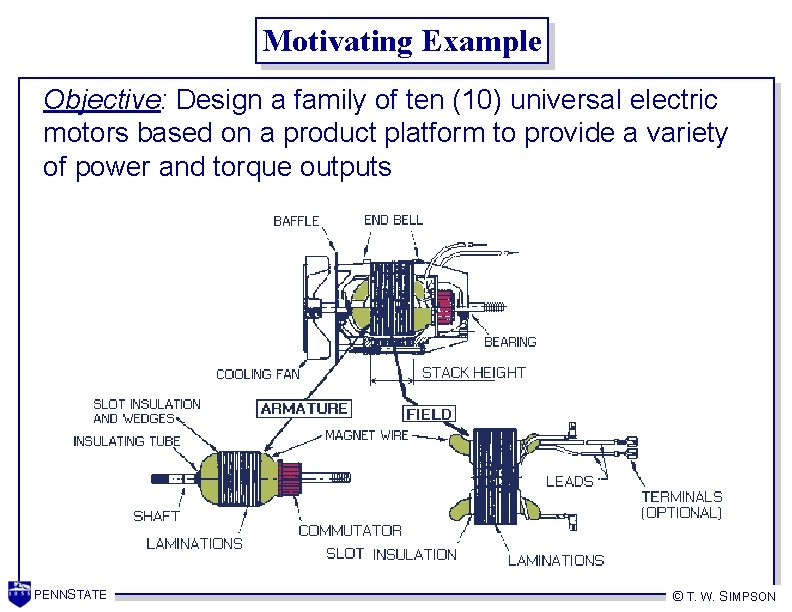
Motivating Example Objective: Design a family of ten (10) universal electric motors based on a product platform to provide a variety of power and torque outputs PENNSTATE © T. W. SIMPSON
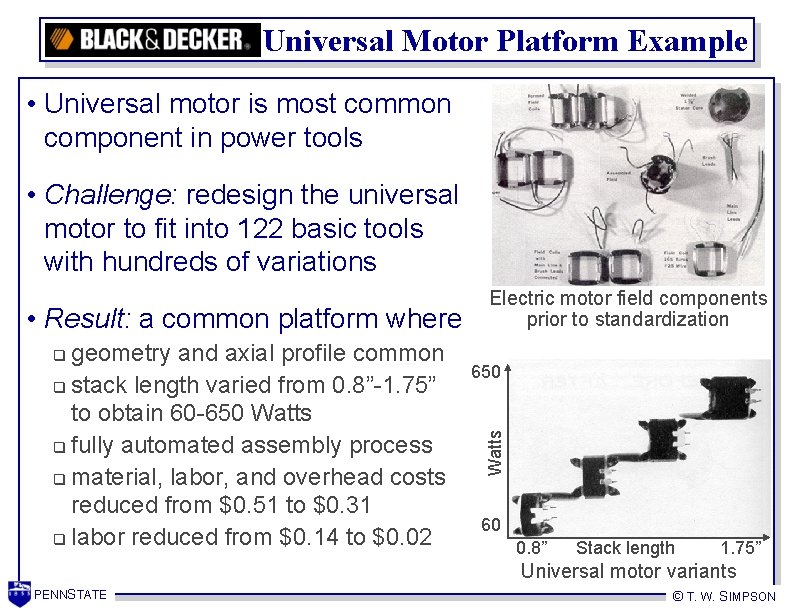
Universal Motor Platform Example • Universal motor is most common component in power tools • Challenge: redesign the universal motor to fit into 122 basic tools with hundreds of variations geometry and axial profile common q stack length varied from 0. 8”-1. 75” to obtain 60 -650 Watts q fully automated assembly process q material, labor, and overhead costs reduced from $0. 51 to $0. 31 q labor reduced from $0. 14 to $0. 02 q 650 Watts • Result: a common platform where Electric motor field components prior to standardization 60 0. 8” Stack length 1. 75” Universal motor variants PENNSTATE © T. W. SIMPSON
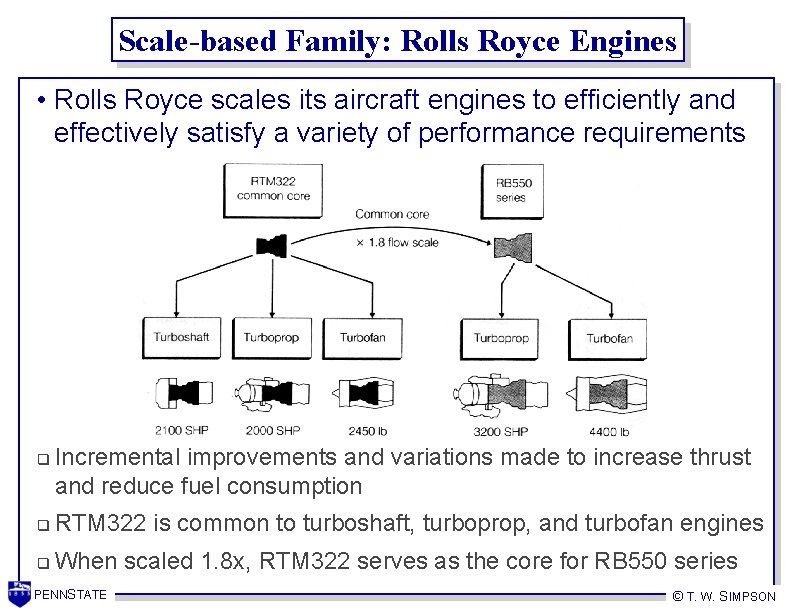
Scale-based Family: Rolls Royce Engines • Rolls Royce scales its aircraft engines to efficiently and effectively satisfy a variety of performance requirements q Incremental improvements and variations made to increase thrust and reduce fuel consumption q RTM 322 is common to turboshaft, turboprop, and turbofan engines q When scaled 1. 8 x, RTM 322 serves as the core for RB 550 series PENNSTATE © T. W. SIMPSON
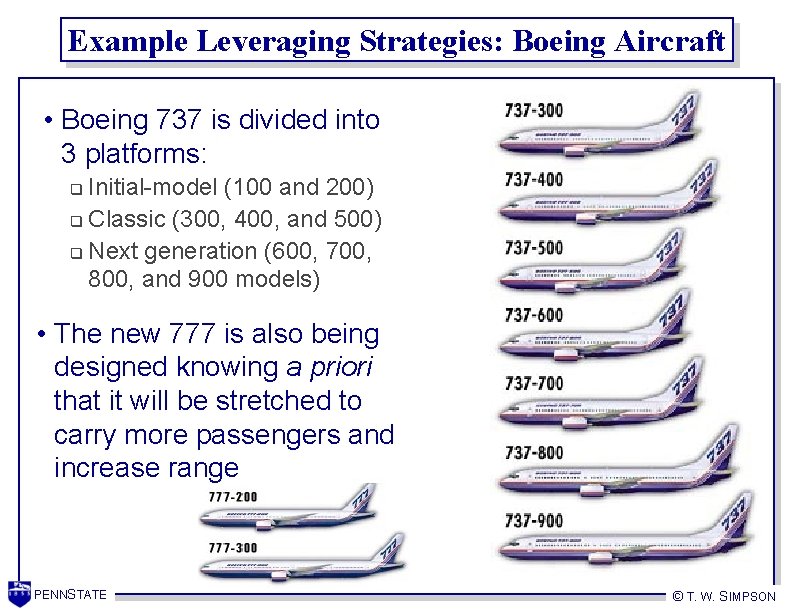
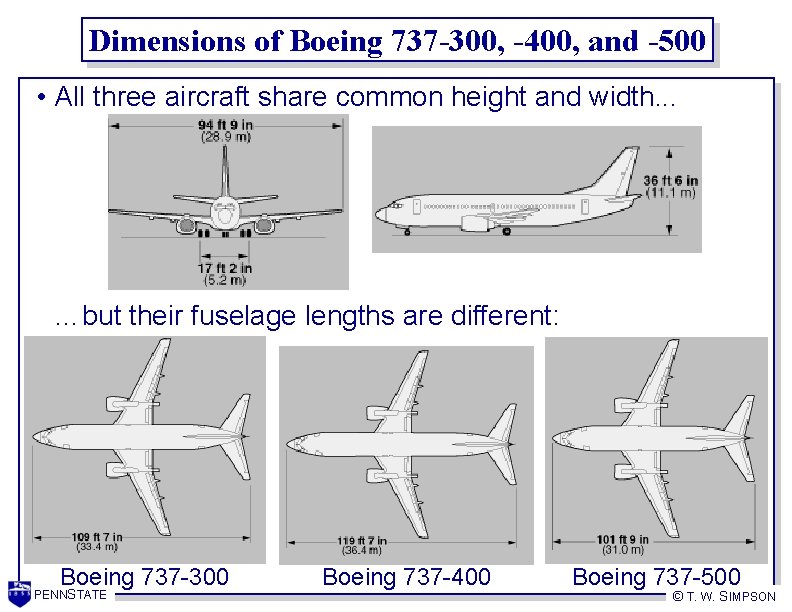
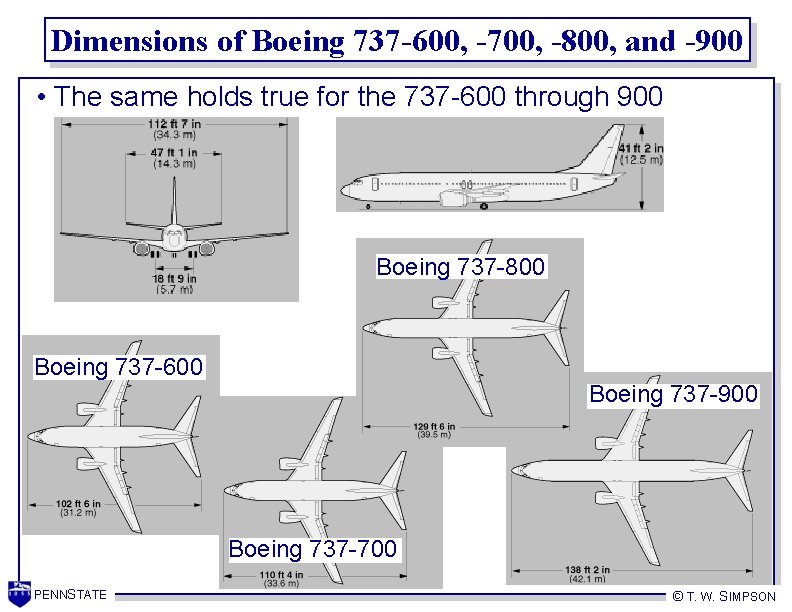
Example Leveraging Strategies: Boeing Aircraft • Boeing 737 is divided into 3 platforms: Initial-model (100 and 200) q Classic (300, 400, and 500) q Next generation (600, 700, 800, and 900 models) q • The new 777 is also being designed knowing a priori that it will be stretched to carry more passengers and increase range PENNSTATE © T. W. SIMPSON
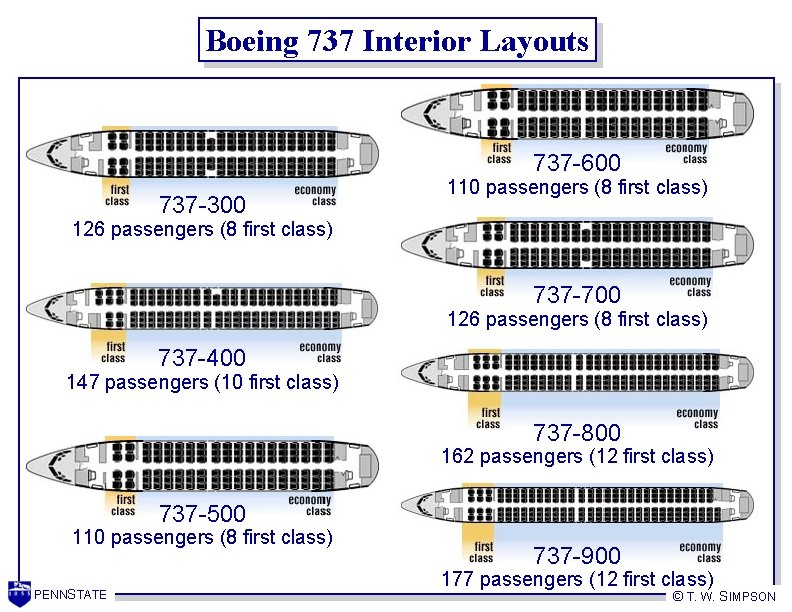
Boeing 737 Interior Layouts 737 -600 737 -300 110 passengers (8 first class) 126 passengers (8 first class) 737 -700 126 passengers (8 first class) 737 -400 147 passengers (10 first class) 737 -800 162 passengers (12 first class) 737 -500 110 passengers (8 first class) PENNSTATE 737 -900 177 passengers (12 first class) © T. W. SIMPSON
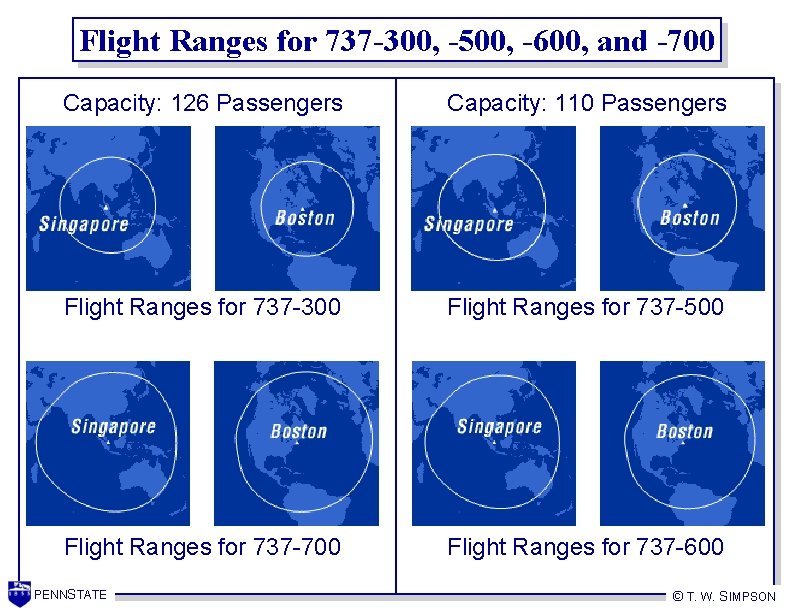
Flight Ranges for 737 -300, -500, -600, and -700 Capacity: 126 Passengers Capacity: 110 Passengers Flight Ranges for 737 -300 Flight Ranges for 737 -500 Flight Ranges for 737 -700 Flight Ranges for 737 -600 PENNSTATE © T. W. SIMPSON
Dimensions of Boeing 737 -300, -400, and -500 • All three aircraft share common height and width. . . …but their fuselage lengths are different: Boeing 737 -300 PENNSTATE Boeing 737 -400 Boeing 737 -500 © T. W. SIMPSON
Dimensions of Boeing 737 -600, -700, -800, and -900 • The same holds true for the 737 -600 through 900 Boeing 737 -800 Boeing 737 -600 Boeing 737 -900 Boeing 737 -700 PENNSTATE © T. W. SIMPSON
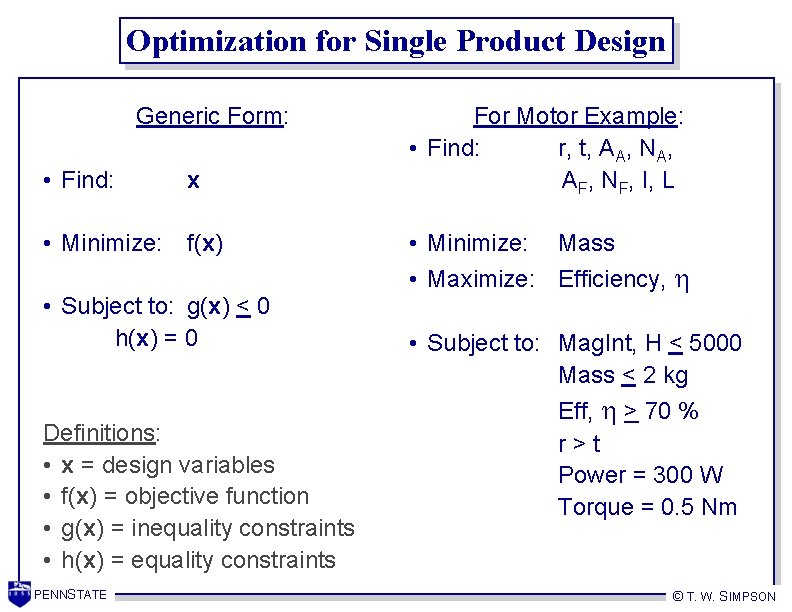
Optimization for Single Product Design Generic Form: • Find: x • Minimize: f(x) • Subject to: g(x) < 0 h(x) = 0 Definitions: • x = design variables • f(x) = objective function • g(x) = inequality constraints • h(x) = equality constraints PENNSTATE For Motor Example: • Find: r, t, AA, NA, AF, NF, I, L • Minimize: Mass • Maximize: Efficiency, h • Subject to: Mag. Int, H < 5000 Mass < 2 kg Eff, h > 70 % r>t Power = 300 W Torque = 0. 5 Nm © T. W. SIMPSON
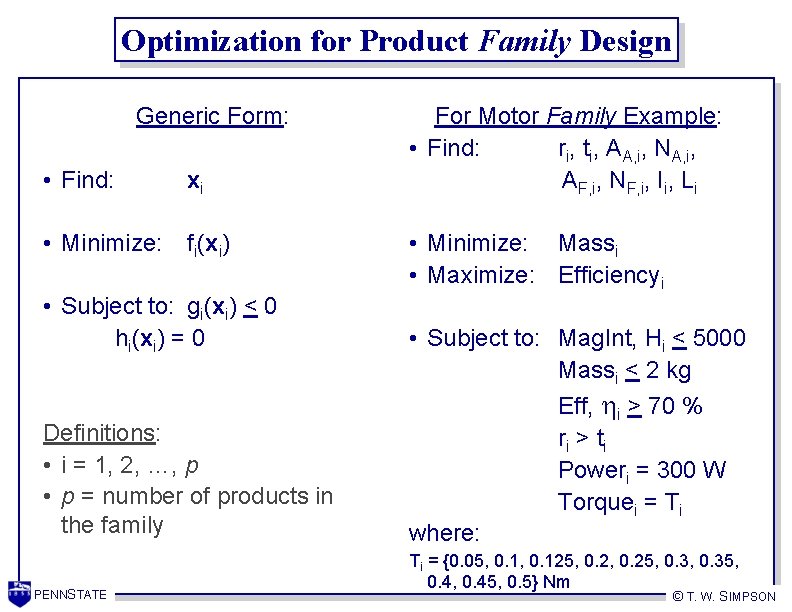
Optimization for Product Family Design Generic Form: • Find: xi • Minimize: fi(xi) • Subject to: gi(xi) < 0 hi(xi) = 0 Definitions: • i = 1, 2, …, p • p = number of products in the family PENNSTATE For Motor Family Example: • Find: ri, ti, AA, i, NA, i, AF, i, NF, i, Ii, Li • Minimize: Massi • Maximize: Efficiencyi • Subject to: Mag. Int, Hi < 5000 Massi < 2 kg Eff, hi > 70 % ri > t i Poweri = 300 W Torquei = Ti where: Ti = {0. 05, 0. 125, 0. 35, 0. 45, 0. 5} Nm © T. W. SIMPSON
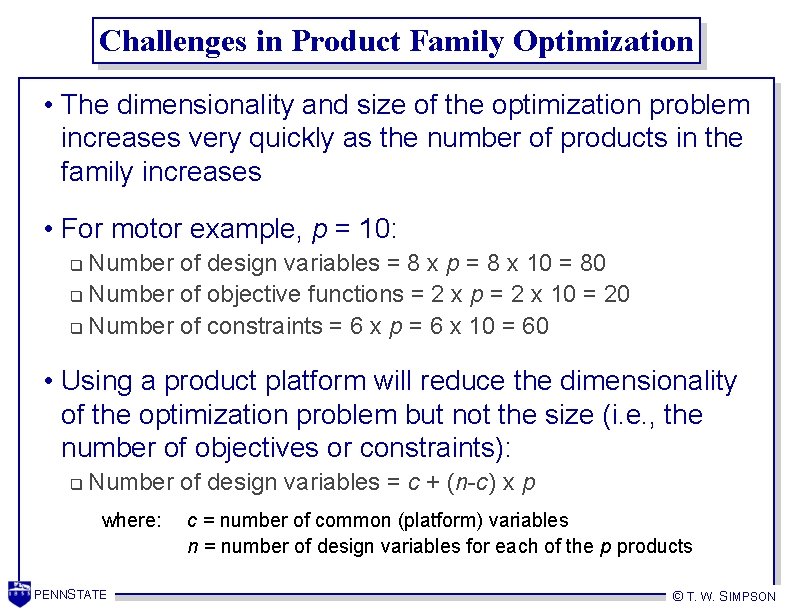
Challenges in Product Family Optimization • The dimensionality and size of the optimization problem increases very quickly as the number of products in the family increases • For motor example, p = 10: Number of design variables = 8 x p = 8 x 10 = 80 q Number of objective functions = 2 x p = 2 x 10 = 20 q Number of constraints = 6 x p = 6 x 10 = 60 q • Using a product platform will reduce the dimensionality of the optimization problem but not the size (i. e. , the number of objectives or constraints): q Number of design variables = c + (n-c) x p where: PENNSTATE c = number of common (platform) variables n = number of design variables for each of the p products © T. W. SIMPSON
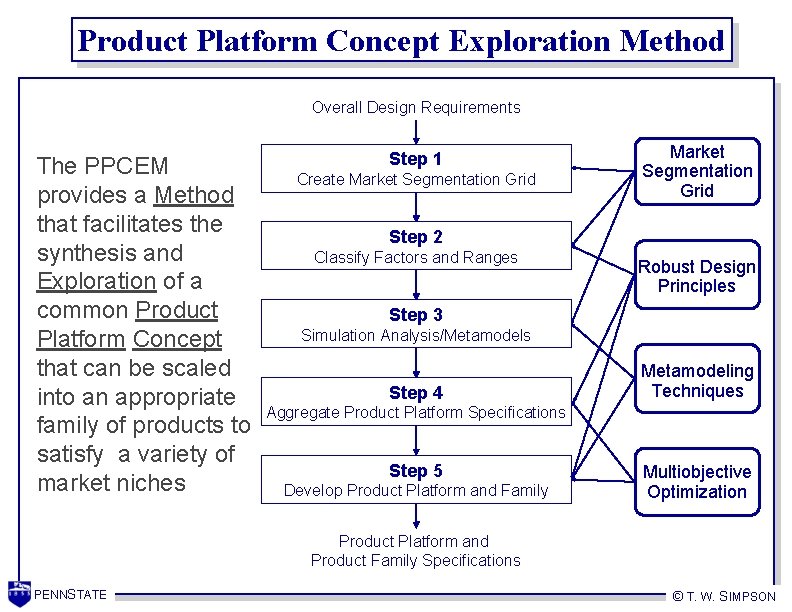
Product Platform Concept Exploration Method Overall Design Requirements The PPCEM provides a Method that facilitates the synthesis and Exploration of a common Product Platform Concept that can be scaled into an appropriate family of products to satisfy a variety of market niches Step 1 Create Market Segmentation Grid Step 2 Classify Factors and Ranges Robust Design Principles Step 3 Simulation Analysis/Metamodels Step 4 Metamodeling Techniques Aggregate Product Platform Specifications Step 5 Develop Product Platform and Family Multiobjective Optimization Product Platform and Product Family Specifications PENNSTATE © T. W. SIMPSON
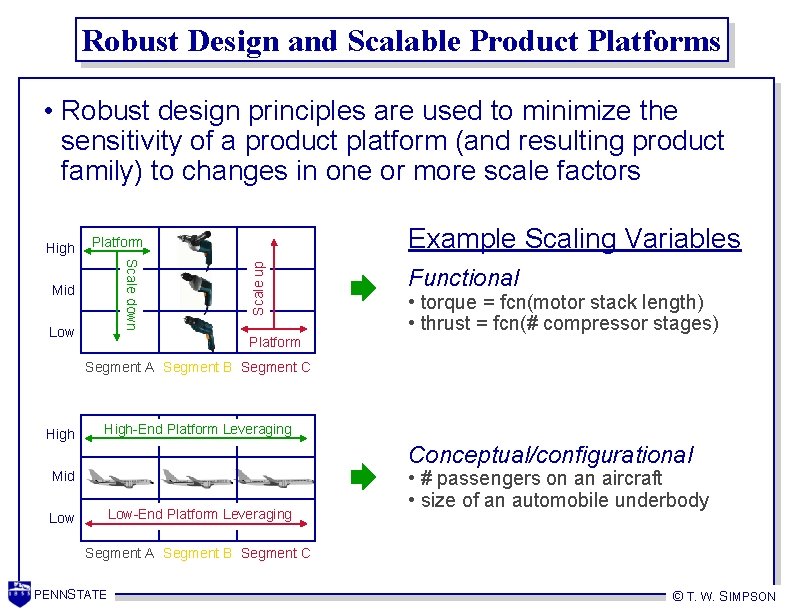
Robust Design and Scalable Product Platforms • Robust design principles are used to minimize the sensitivity of a product platform (and resulting product family) to changes in one or more scale factors Example Scaling Variables Platform Scale down Mid Low Scale up High Functional • torque = fcn(motor stack length) • thrust = fcn(# compressor stages) Platform Segment A Segment B Segment C High-End Platform Leveraging Conceptual/configurational Mid Low-End Platform Leveraging Low • # passengers on an aircraft • size of an automobile underbody Segment A Segment B Segment C PENNSTATE © T. W. SIMPSON
Compromise Decision Support Problem A hybrid of Goal Programming and Math Programming used to determine the values of design variables that satisfy a set of constraints and achieve as closely as possible a set of conflicting goals Deviation Function x 2 Find Xi i = 1, …, n di-, di+ Bounds Constraints Goals i = 1, …, m Satisfy System constraints (linear, nonlinear) gi(X) = 0 ; i = 1, . . , p gi(X) < 0 ; i = p+1, . . , p+q System goals (linear, nonlinear) Ai(X) + di- + di+ = Gi ; i = 1, …, m Bounds Xjmin < Xjmin; j = 1, …, n di-, di+ < 0 ; di- • di+ = 0 ; i Feasible Design Space x 1 PENNSTATE Aspiration Space Given Assumptions to model domain of interest Simulation and analyses to relate X and Y = 1, …, m Minimize Deviation Function Z = { f 1(di-, di+), . . . , fk(dk-, dk+) } Reference: (Mistree, et al. , 1993) © T. W. SIMPSON
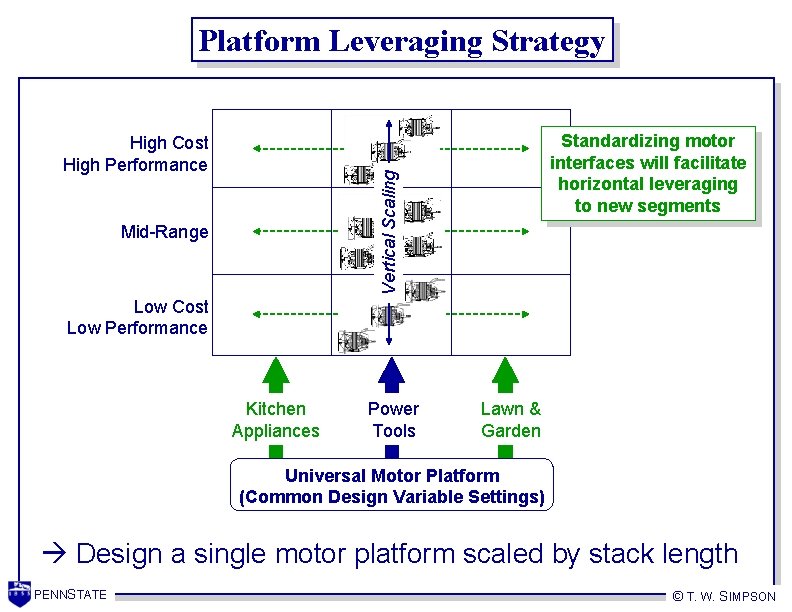
Platform Leveraging Strategy Standardizing motor interfaces will facilitate horizontal leveraging to new segments Vertical Scaling High Cost High Performance Mid-Range Low Cost Low Performance Kitchen Appliances Power Tools Lawn & Garden Universal Motor Platform (Common Design Variable Settings) Design a single motor platform scaled by stack length PENNSTATE © T. W. SIMPSON
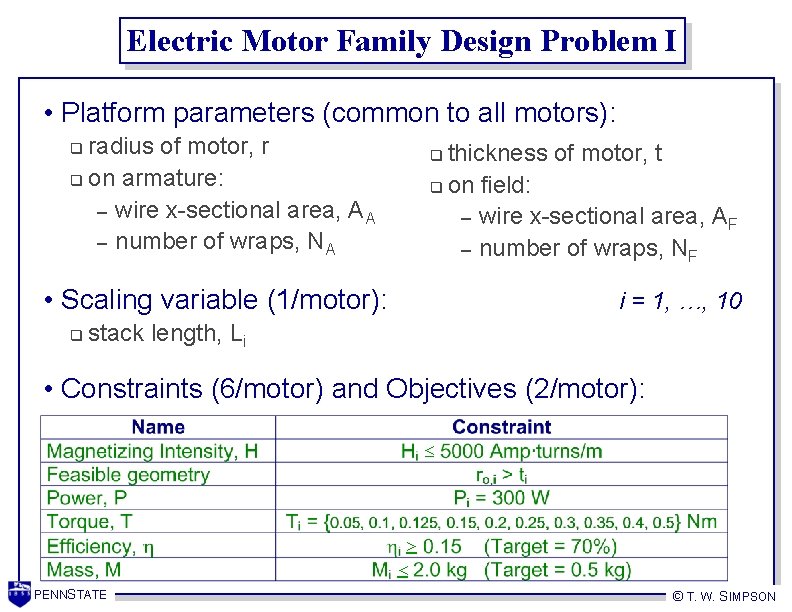
Electric Motor Family Design Problem I • Platform parameters (common to all motors): radius of motor, r q on armature: – wire x-sectional area, AA – number of wraps, NA thickness of motor, t q on field: – wire x-sectional area, AF – number of wraps, NF q q • Scaling variable (1/motor): q i = 1, …, 10 stack length, Li • Constraints (6/motor) and Objectives (2/motor): £ > < PENNSTATE © T. W. SIMPSON
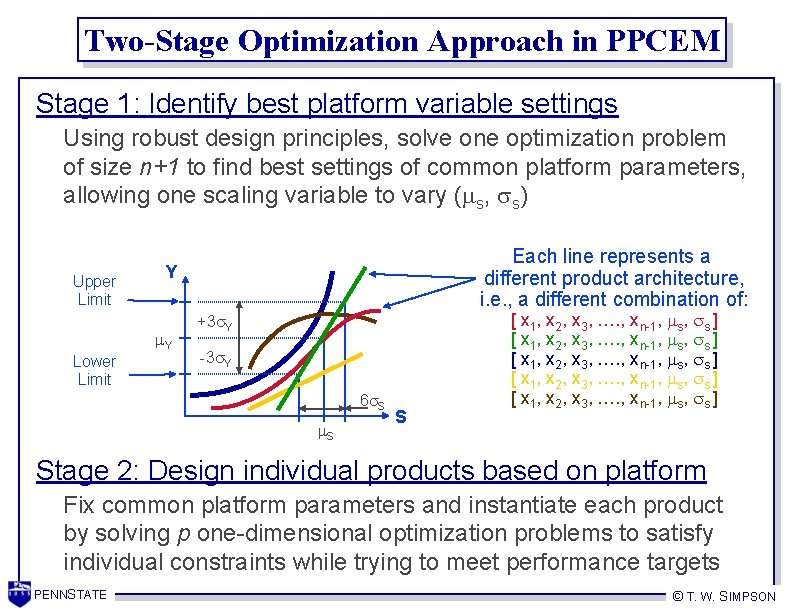
Two-Stage Optimization Approach in PPCEM Stage 1: Identify best platform variable settings Using robust design principles, solve one optimization problem of size n+1 to find best settings of common platform parameters, allowing one scaling variable to vary ( s, s) Upper Limit Y Y Lower Limit Each line represents a different product architecture, i. e. , a different combination of: +3 Y -3 Y 6 S S S [ x 1, x 2, x 3, …. , xn-1, s, s ] [ x 1, x 2, x 3, …. , xn-1, s ] Stage 2: Design individual products based on platform Fix common platform parameters and instantiate each product by solving p one-dimensional optimization problems to satisfy individual constraints while trying to meet performance targets PENNSTATE © T. W. SIMPSON
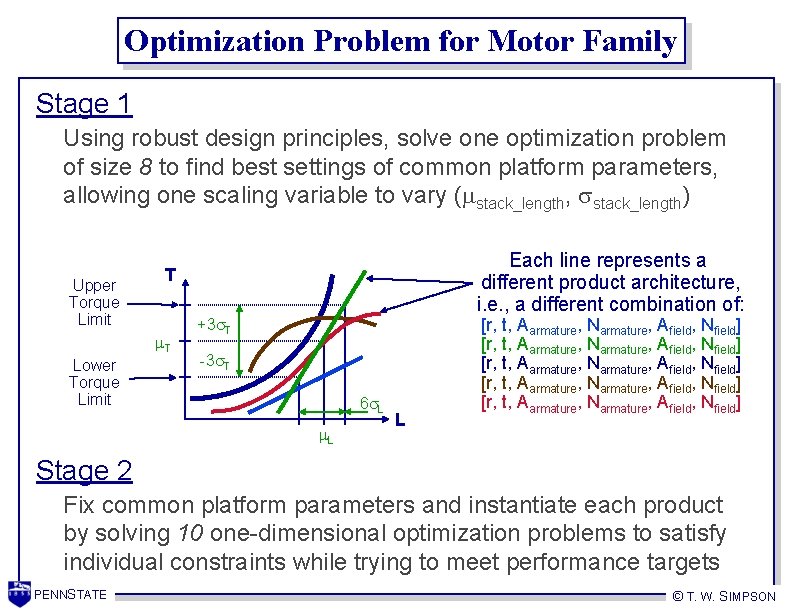
Optimization Problem for Motor Family Stage 1 Using robust design principles, solve one optimization problem of size 8 to find best settings of common platform parameters, allowing one scaling variable to vary ( stack_length, stack_length) Upper Torque Limit T T Lower Torque Limit Each line represents a different product architecture, i. e. , a different combination of: +3 T -3 T 6 L L L [r, t, Aarmature, Narmature, Afield, Nfield] [r, t, Aarmature, Narmature, Afield, Nfield] Stage 2 Fix common platform parameters and instantiate each product by solving 10 one-dimensional optimization problems to satisfy individual constraints while trying to meet performance targets PENNSTATE © T. W. SIMPSON
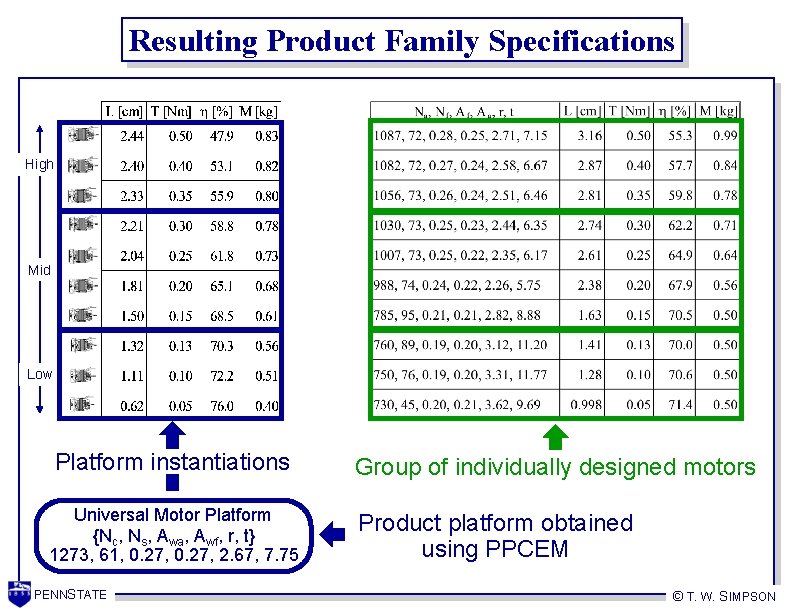
Resulting Product Family Specifications High Mid Low Platform instantiations Universal Motor Platform {Nc, Ns, Awa, Awf, r, t} 1273, 61, 0. 27, 2. 67, 7. 75 PENNSTATE Group of individually designed motors Product platform obtained using PPCEM © T. W. SIMPSON
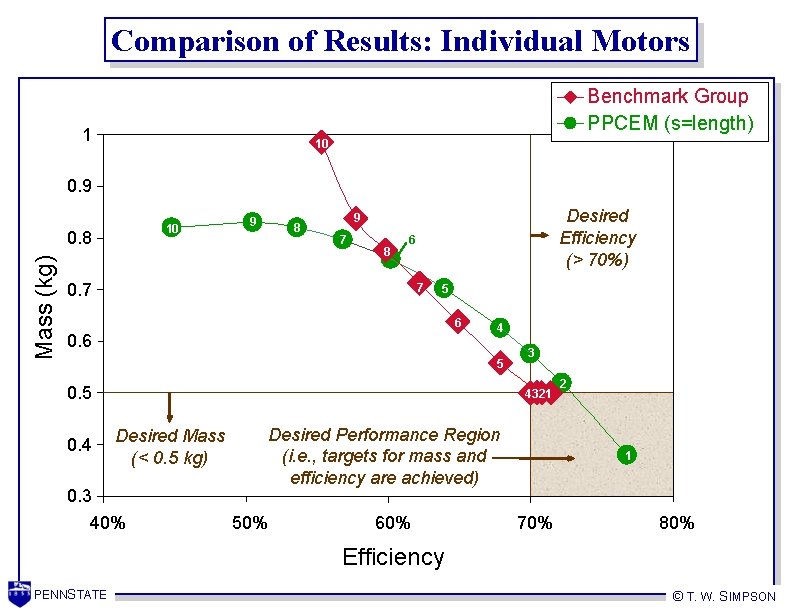
Comparison of Results: Individual Motors Benchmark Group PPCEM (s=length) 1 10 0. 9 10 Mass (kg) 0. 8 9 8 Desired Efficiency (> 70%) 9 7 8 6 0. 7 7 5 6 0. 6 4 5 0. 4 3 4321 Desired Mass (< 0. 5 kg) 0. 3 40% Desired Performance Region (i. e. , targets for mass and efficiency are achieved) 50% 60% 2 1 70% 80% Efficiency PENNSTATE © T. W. SIMPSON
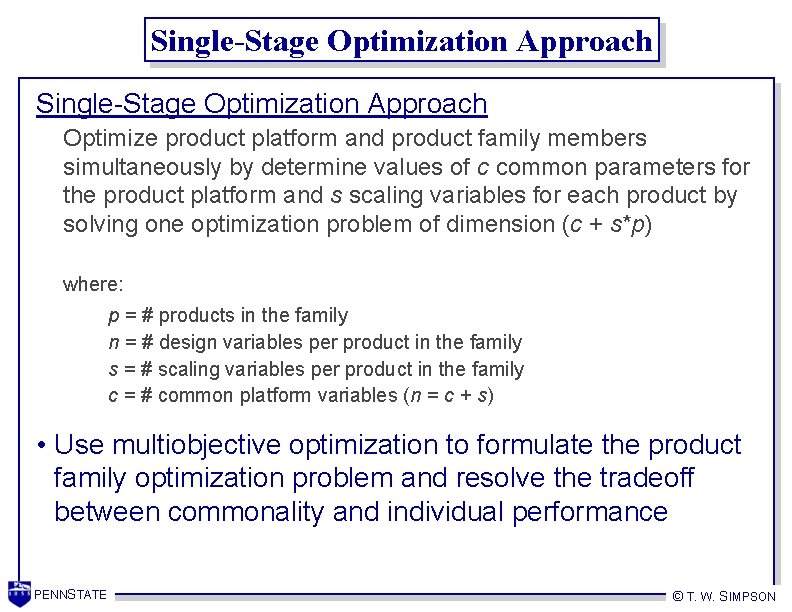
Single-Stage Optimization Approach Optimize product platform and product family members simultaneously by determine values of c common parameters for the product platform and s scaling variables for each product by solving one optimization problem of dimension (c + s*p) where: p = # products in the family n = # design variables per product in the family s = # scaling variables per product in the family c = # common platform variables (n = c + s) • Use multiobjective optimization to formulate the product family optimization problem and resolve the tradeoff between commonality and individual performance PENNSTATE © T. W. SIMPSON
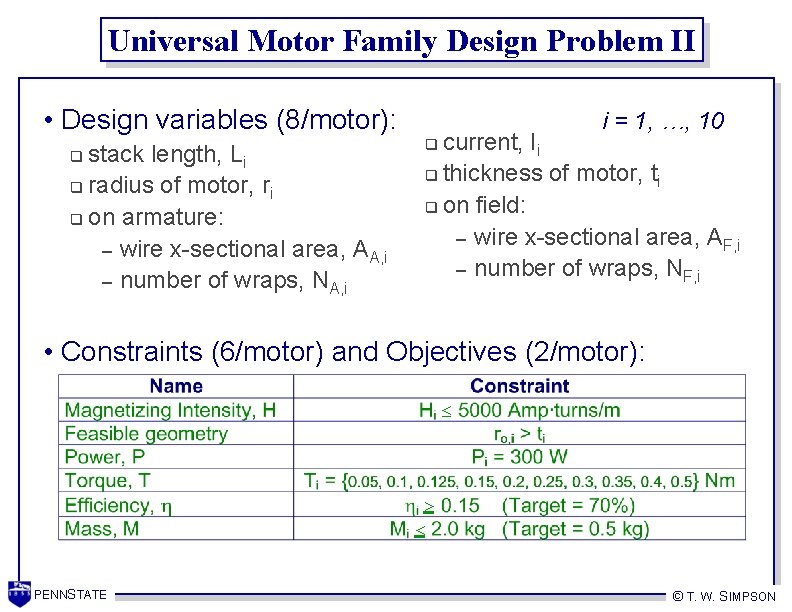
Universal Motor Family Design Problem II • Design variables (8/motor): stack length, Li q radius of motor, ri q on armature: – wire x-sectional area, AA, i – number of wraps, NA, i q i = 1, …, 10 current, Ii q thickness of motor, ti q on field: – wire x-sectional area, AF, i – number of wraps, NF, i q • Constraints (6/motor) and Objectives (2/motor): £ > < PENNSTATE © T. W. SIMPSON
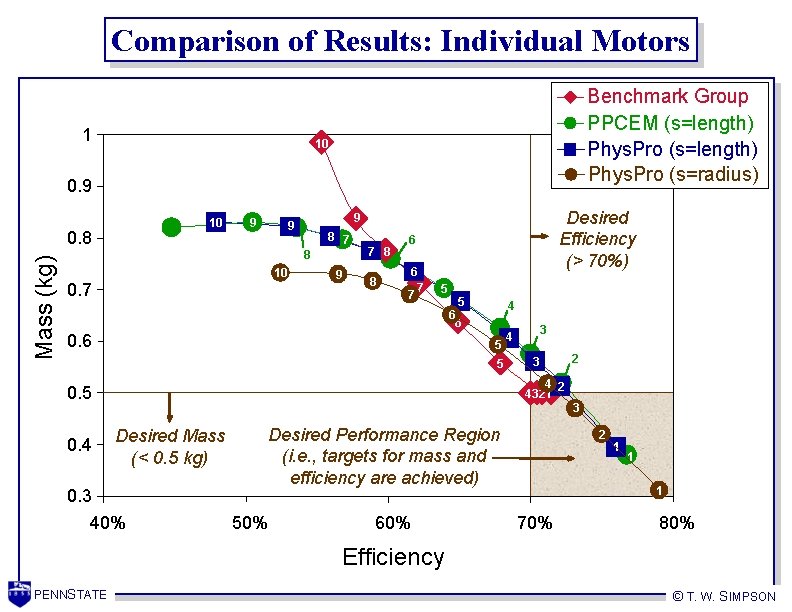
Comparison of Results: Individual Motors 1 Benchmark Group PPCEM (s=length) Phys. Pro (s=radius) 10 0. 9 10 Mass (kg) 0. 8 10 9 8 7 8 10 0. 7 Desired Efficiency (> 70%) 9 9 9 7 8 8 6 6 7 7 5 0. 6 5 6 6 4 5 5 3 2 4321 0. 5 0. 4 3 Desired Mass (< 0. 5 kg) 0. 3 40% Desired Performance Region (i. e. , targets for mass and efficiency are achieved) 50% 60% 2 1 1 1 70% 80% Efficiency PENNSTATE © T. W. SIMPSON
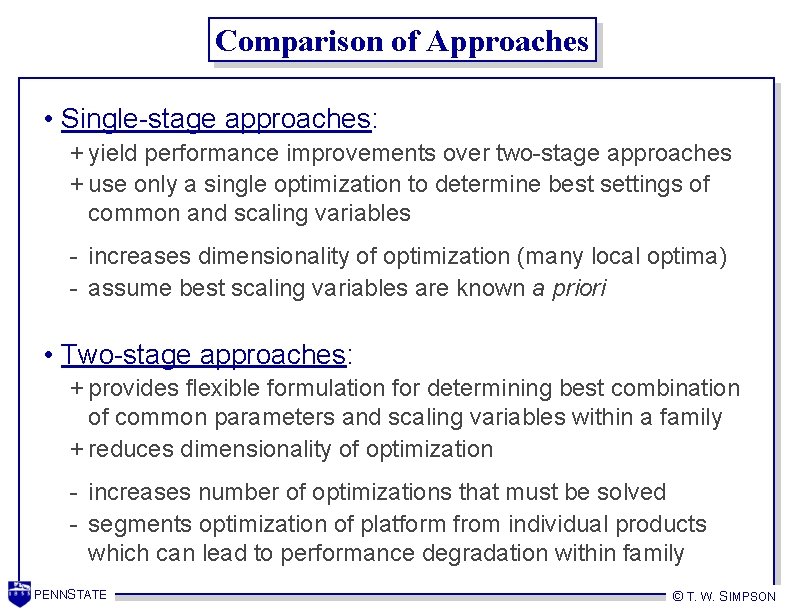
Comparison of Approaches • Single-stage approaches: + yield performance improvements over two-stage approaches + use only a single optimization to determine best settings of common and scaling variables - increases dimensionality of optimization (many local optima) - assume best scaling variables are known a priori • Two-stage approaches: + provides flexible formulation for determining best combination of common parameters and scaling variables within a family + reduces dimensionality of optimization - increases number of optimizations that must be solved - segments optimization of platform from individual products which can lead to performance degradation within family PENNSTATE © T. W. SIMPSON
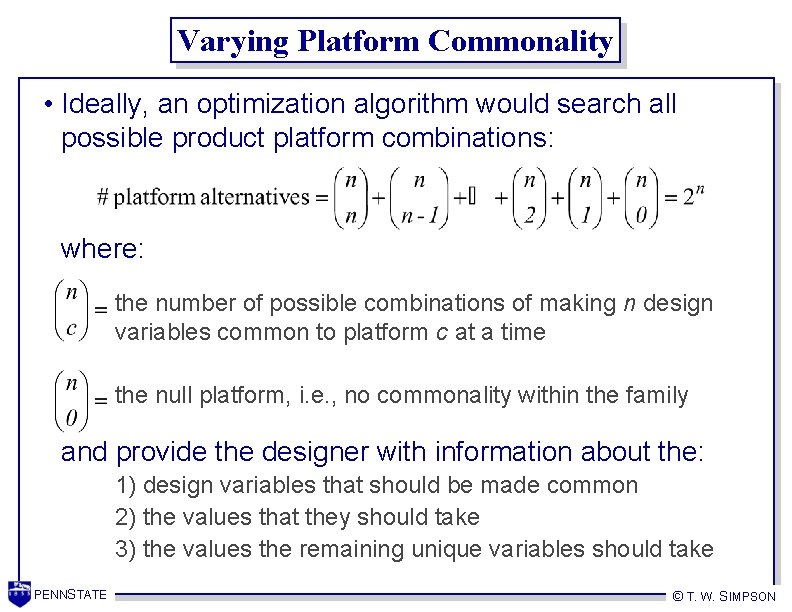
Varying Platform Commonality • Ideally, an optimization algorithm would search all possible product platform combinations: where: the number of possible combinations of making n design variables common to platform c at a time the null platform, i. e. , no commonality within the family and provide the designer with information about the: 1) design variables that should be made common 2) the values that they should take 3) the values the remaining unique variables should take PENNSTATE © T. W. SIMPSON
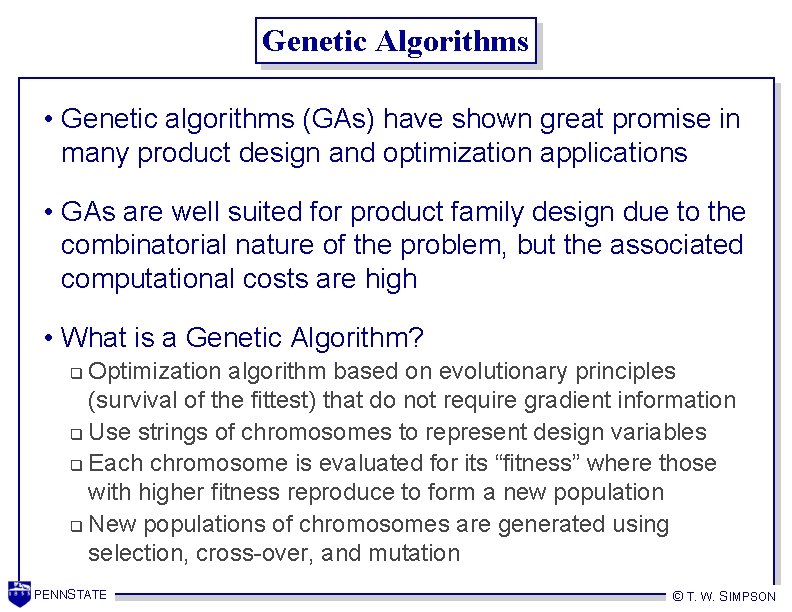
Genetic Algorithms • Genetic algorithms (GAs) have shown great promise in many product design and optimization applications • GAs are well suited for product family design due to the combinatorial nature of the problem, but the associated computational costs are high • What is a Genetic Algorithm? Optimization algorithm based on evolutionary principles (survival of the fittest) that do not require gradient information q Use strings of chromosomes to represent design variables q Each chromosome is evaluated for its “fitness” where those with higher fitness reproduce to form a new population q New populations of chromosomes are generated using selection, cross-over, and mutation q PENNSTATE © T. W. SIMPSON
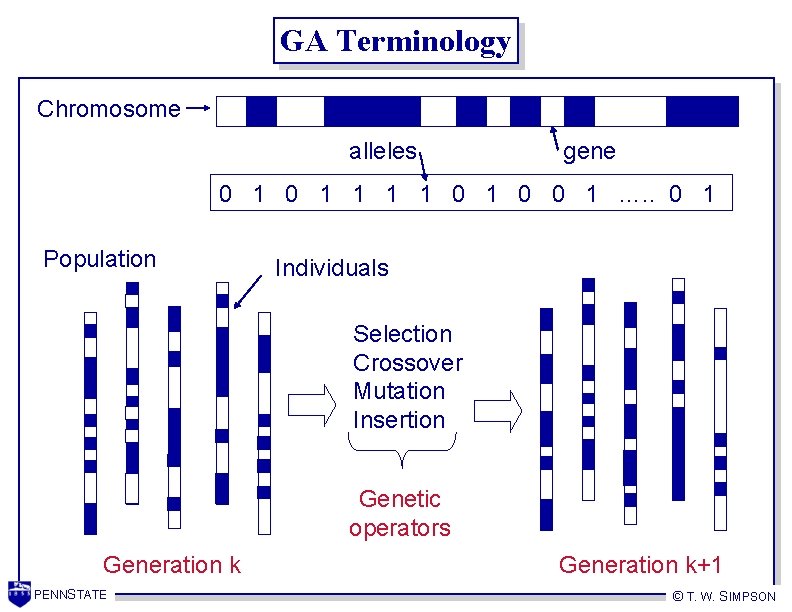
GA Terminology Chromosome alleles gene 0 1 1 1 1 0 0 1 …. . 0 1 Population Individuals Selection Crossover Mutation Insertion Genetic operators Generation k PENNSTATE Generation k+1 © T. W. SIMPSON
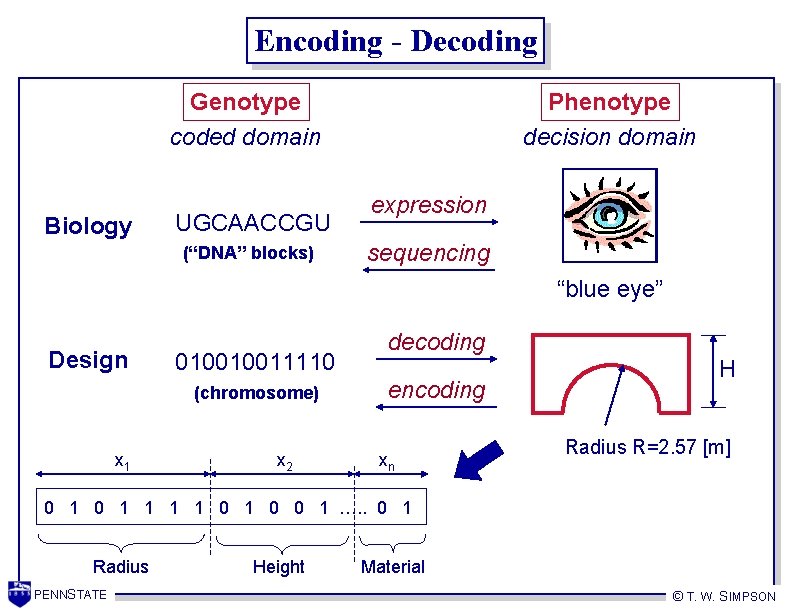
Encoding - Decoding Genotype coded domain Biology UGCAACCGU (“DNA” blocks) Phenotype decision domain expression sequencing “blue eye” Design 010010011110 (chromosome) x 1 x 2 decoding encoding xn H Radius R=2. 57 [m] 0 1 1 1 1 0 0 1 …. . 0 1 Radius PENNSTATE Height Material © T. W. SIMPSON
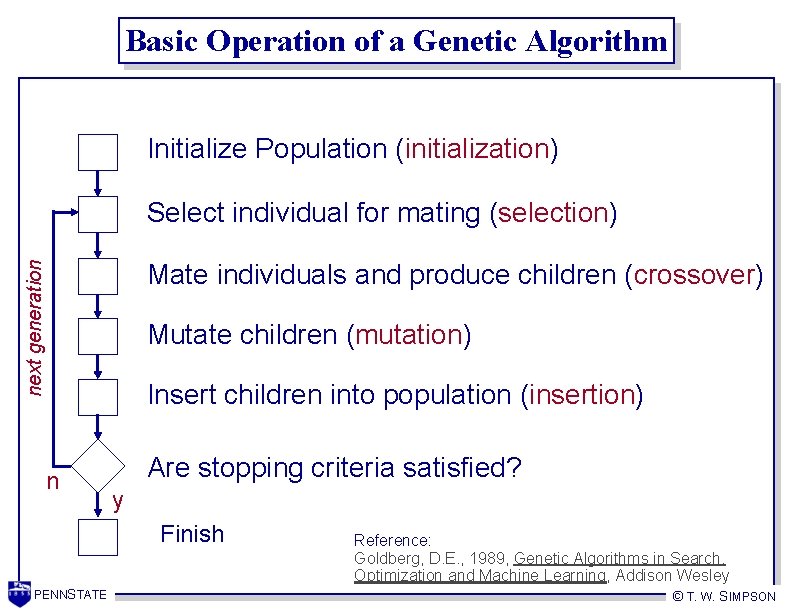
Basic Operation of a Genetic Algorithm Initialize Population (initialization) Select individual for mating (selection) next generation Mate individuals and produce children (crossover) Mutate children (mutation) Insert children into population (insertion) n Are stopping criteria satisfied? y Finish PENNSTATE Reference: Goldberg, D. E. , 1989, Genetic Algorithms in Search, Optimization and Machine Learning, Addison Wesley © T. W. SIMPSON
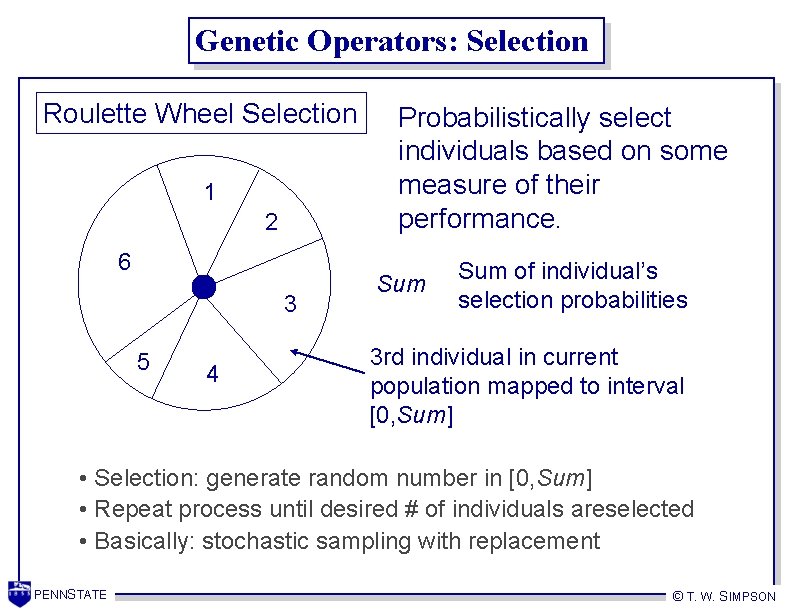
Genetic Operators: Selection Roulette Wheel Selection 1 2 6 3 5 4 Probabilistically select individuals based on some measure of their performance. Sum of individual’s selection probabilities 3 rd individual in current population mapped to interval [0, Sum] • Selection: generate random number in [0, Sum] • Repeat process until desired # of individuals areselected • Basically: stochastic sampling with replacement PENNSTATE © T. W. SIMPSON
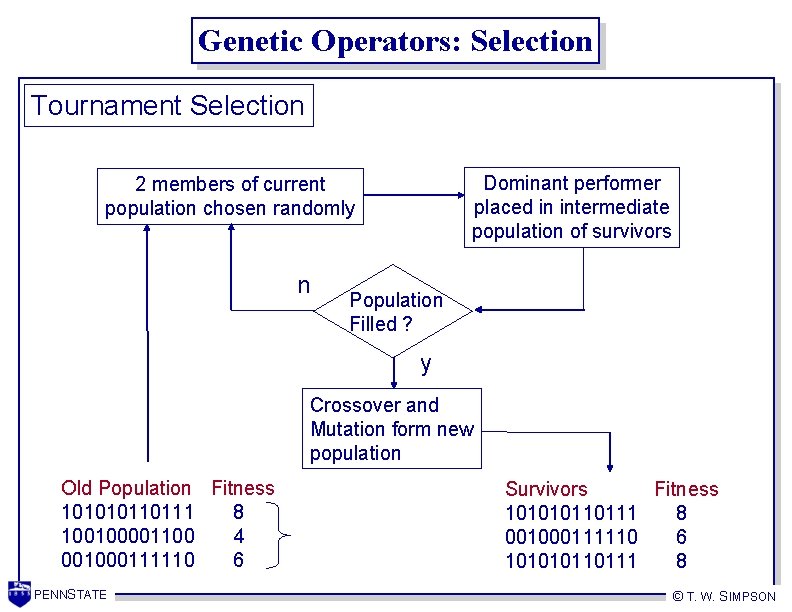
Genetic Operators: Selection Tournament Selection Dominant performer placed in intermediate population of survivors 2 members of current population chosen randomly n Population Filled ? y Crossover and Mutation form new population Old Population Fitness 101010110111 8 100100001100 4 001000111110 6 PENNSTATE Survivors Fitness 101010110111 8 001000111110 6 101010110111 8 © T. W. SIMPSON
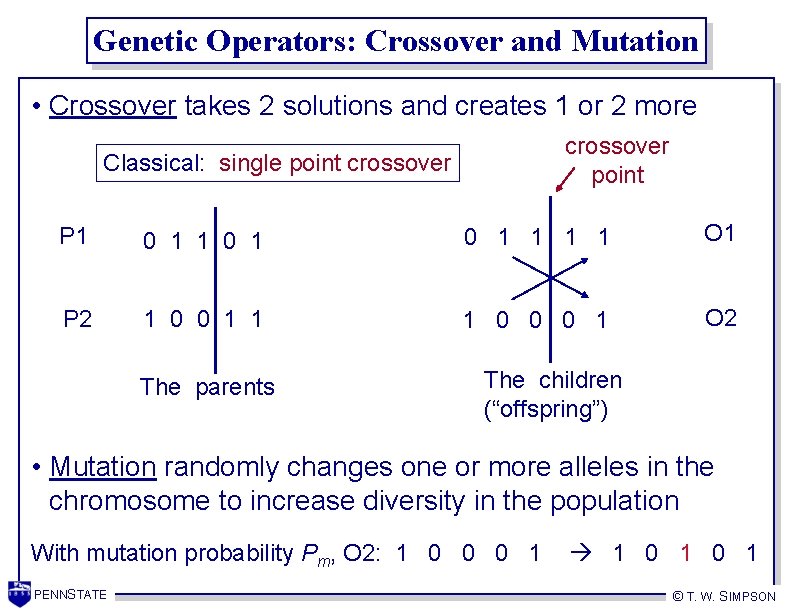
Genetic Operators: Crossover and Mutation • Crossover takes 2 solutions and creates 1 or 2 more crossover point Classical: single point crossover P 1 0 1 0 1 1 O 1 P 2 1 0 0 1 1 1 0 0 0 1 O 2 The parents The children (“offspring”) • Mutation randomly changes one or more alleles in the chromosome to increase diversity in the population With mutation probability Pm, O 2: 1 0 0 0 1 PENNSTATE 1 0 1 © T. W. SIMPSON
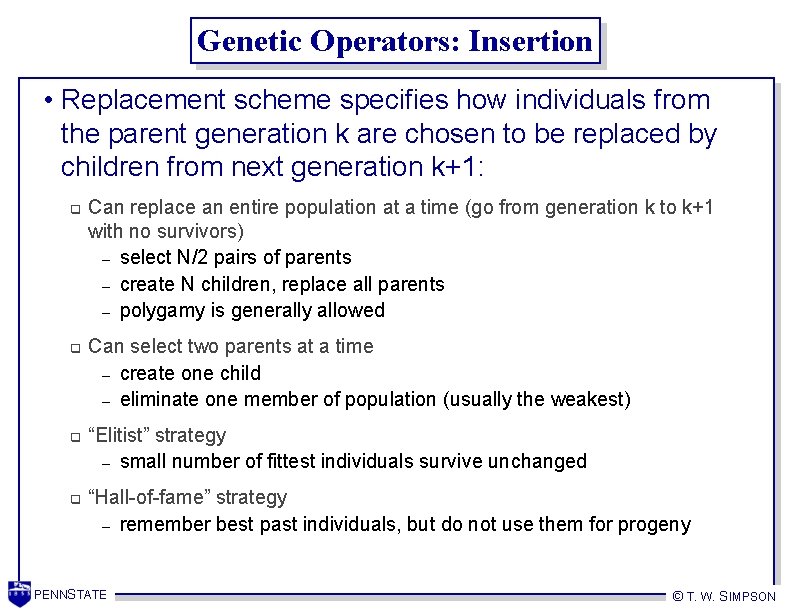
Genetic Operators: Insertion • Replacement scheme specifies how individuals from the parent generation k are chosen to be replaced by children from next generation k+1: q q Can replace an entire population at a time (go from generation k to k+1 with no survivors) – select N/2 pairs of parents – create N children, replace all parents – polygamy is generally allowed Can select two parents at a time – create one child – eliminate one member of population (usually the weakest) “Elitist” strategy – small number of fittest individuals survive unchanged “Hall-of-fame” strategy – remember best past individuals, but do not use them for progeny PENNSTATE © T. W. SIMPSON
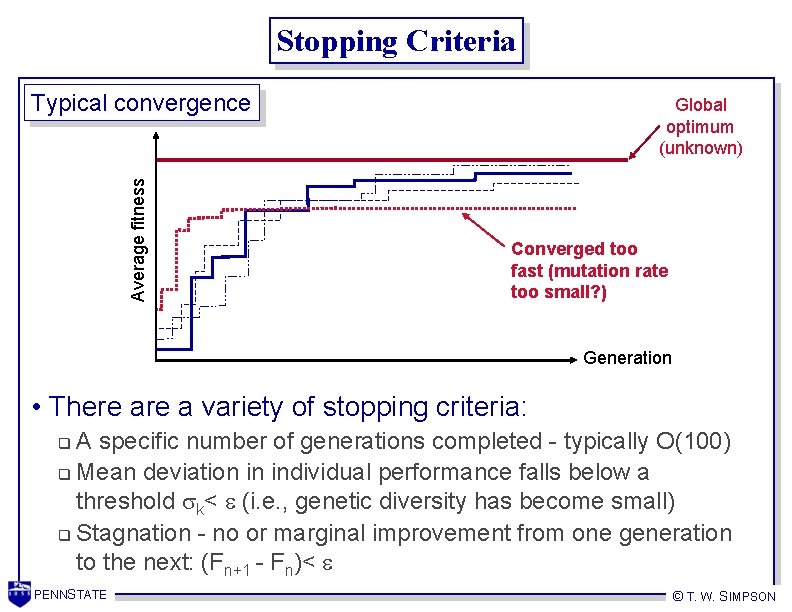
Stopping Criteria Average fitness Typical convergence Global optimum (unknown) Converged too fast (mutation rate too small? ) Generation • There a variety of stopping criteria: A specific number of generations completed - typically O(100) q Mean deviation in individual performance falls below a threshold k< e (i. e. , genetic diversity has become small) q Stagnation - no or marginal improvement from one generation to the next: (Fn+1 - Fn)< e q PENNSTATE © T. W. SIMPSON
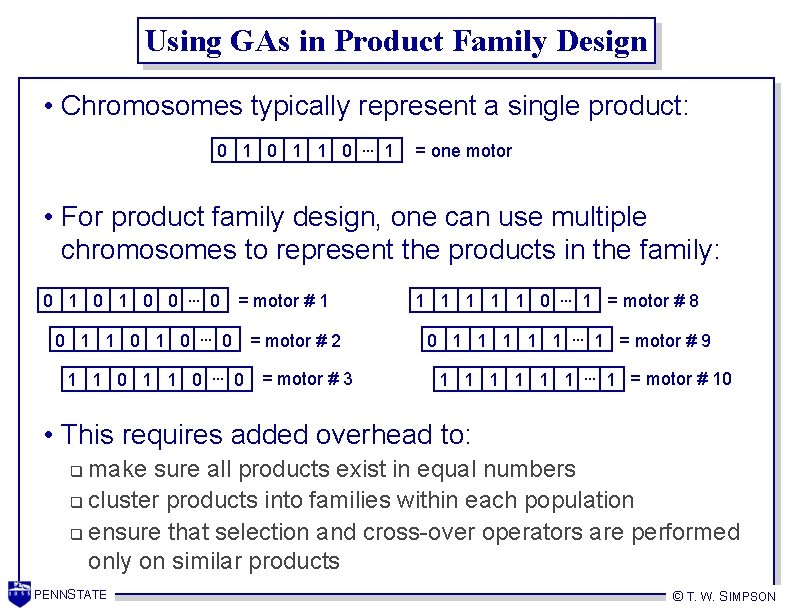
Using GAs in Product Family Design • Chromosomes typically represent a single product: 0 1 1 0 … 1 = one motor • For product family design, one can use multiple chromosomes to represent the products in the family: 0 1 0 0 0 = motor # 1 … 0 1 1 0 … 1 1 0 0 = motor # 2 … 0 = motor # 3 1 1 1 0 1 = motor # 8 … 0 1 1 1 … 1 1 1 1 = motor # 9 … 1 = motor # 10 • This requires added overhead to: make sure all products exist in equal numbers q cluster products into families within each population q ensure that selection and cross-over operators are performed only on similar products q PENNSTATE © T. W. SIMPSON
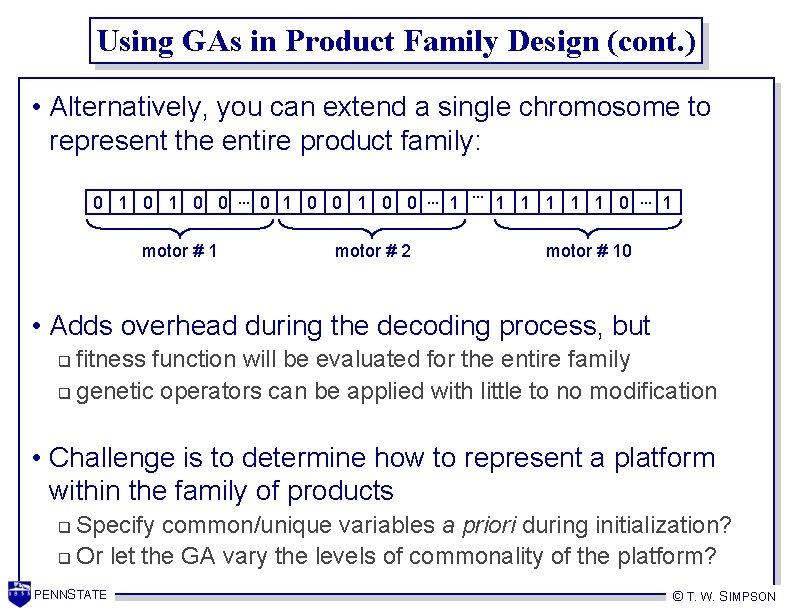
Using GAs in Product Family Design (cont. ) • Alternatively, you can extend a single chromosome to represent the entire product family: 0 1 0 0 motor # 1 … 0 1 0 0 motor # 2 … 1 1 1 0 … 1 motor # 10 • Adds overhead during the decoding process, but fitness function will be evaluated for the entire family q genetic operators can be applied with little to no modification q • Challenge is to determine how to represent a platform within the family of products Specify common/unique variables a priori during initialization? q Or let the GA vary the levels of commonality of the platform? q PENNSTATE © T. W. SIMPSON
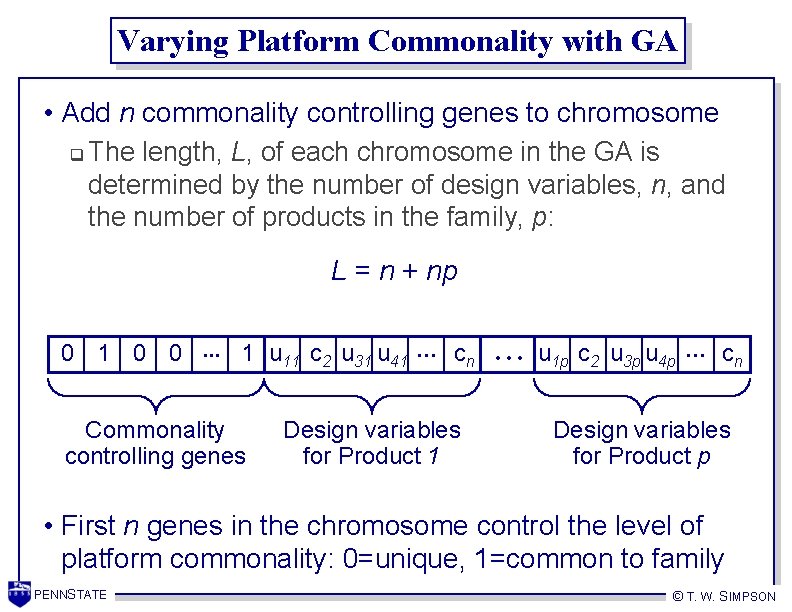
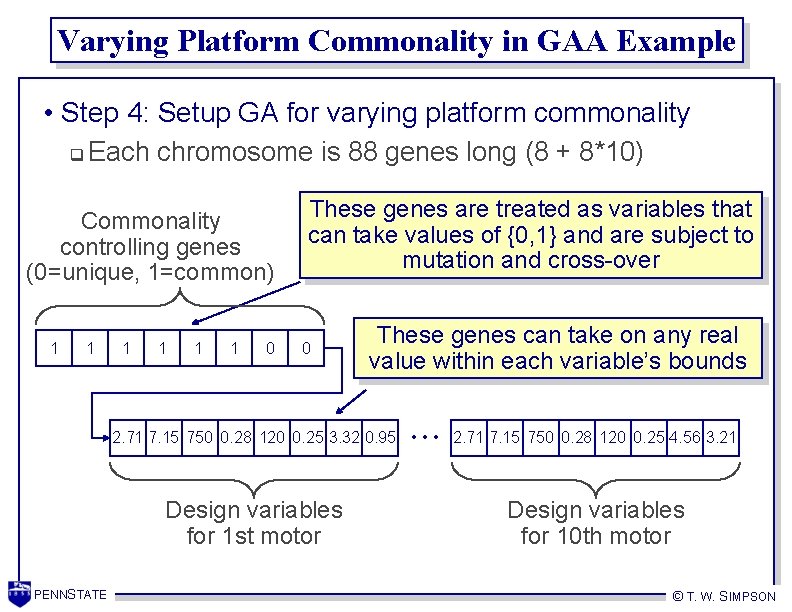
Varying Platform Commonality with GA • Add n commonality controlling genes to chromosome q The length, L, of each chromosome in the GA is determined by the number of design variables, n, and the number of products in the family, p: L = n + np 0 1 0 0. . . 1 u 11 c 2 u 31 u 41 … cn Commonality controlling genes Design variables for Product 1 . . . u 1 p c 2 u 3 p u 4 p … cn Design variables for Product p • First n genes in the chromosome control the level of platform commonality: 0=unique, 1=common to family PENNSTATE © T. W. SIMPSON
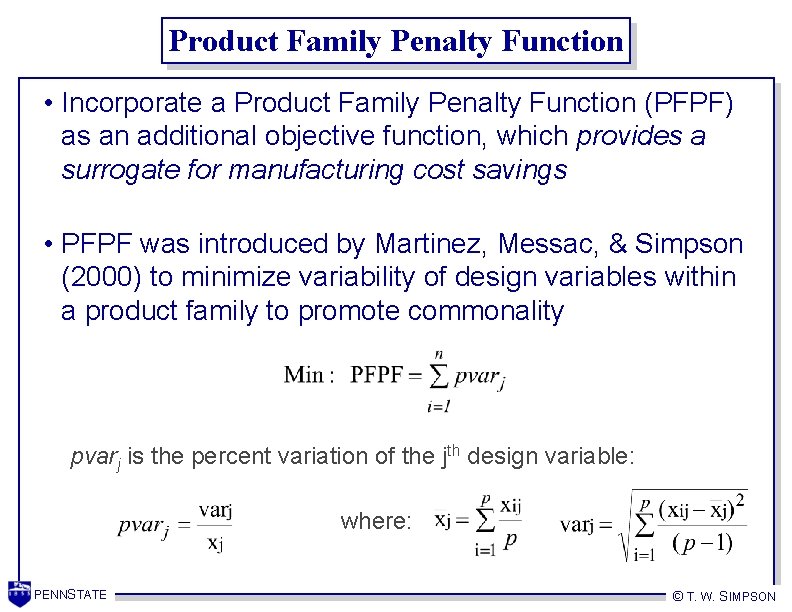
Product Family Penalty Function • Incorporate a Product Family Penalty Function (PFPF) as an additional objective function, which provides a surrogate for manufacturing cost savings • PFPF was introduced by Martinez, Messac, & Simpson (2000) to minimize variability of design variables within a product family to promote commonality pvarj is the percent variation of the jth design variable: where: PENNSTATE © T. W. SIMPSON
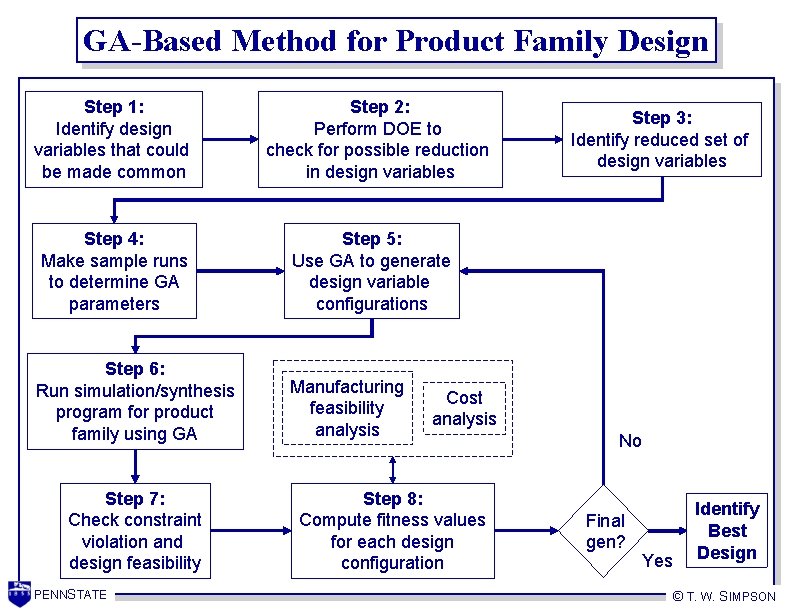
GA-Based Method for Product Family Design Step 1: Identify design variables that could be made common Step 2: Perform DOE to check for possible reduction in design variables Step 4: Make sample runs to determine GA parameters Step 5: Use GA to generate design variable configurations Step 6: Run simulation/synthesis program for product family using GA Manufacturing feasibility analysis Step 7: Check constraint violation and design feasibility PENNSTATE Step 3: Identify reduced set of design variables Cost analysis Step 8: Compute fitness values for each design configuration No Final gen? Yes Identify Best Design © T. W. SIMPSON
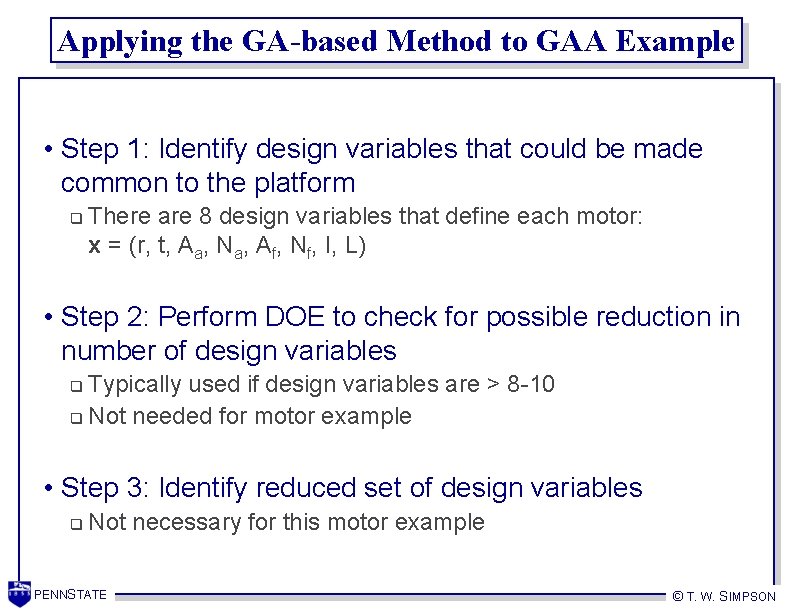
Applying the GA-based Method to GAA Example • Step 1: Identify design variables that could be made common to the platform q There are 8 design variables that define each motor: x = (r, t, Aa, Na, Af, Nf, I, L) • Step 2: Perform DOE to check for possible reduction in number of design variables Typically used if design variables are > 8 -10 q Not needed for motor example q • Step 3: Identify reduced set of design variables q Not necessary for this motor example PENNSTATE © T. W. SIMPSON
Varying Platform Commonality in GAA Example • Step 4: Setup GA for varying platform commonality q Each chromosome is 88 genes long (8 + 8*10) Commonality controlling genes (0=unique, 1=common) 1 1 1 0 These genes are treated as variables that can take values of {0, 1} and are subject to mutation and cross-over 0 These genes can take on any real value within each variable’s bounds 2. 71 7. 15 750 0. 28 120 0. 25 3. 32 0. 95 Design variables for 1 st motor PENNSTATE . . . 2. 71 7. 15 750 0. 28 120 0. 25 4. 56 3. 21 Design variables for 10 th motor © T. W. SIMPSON
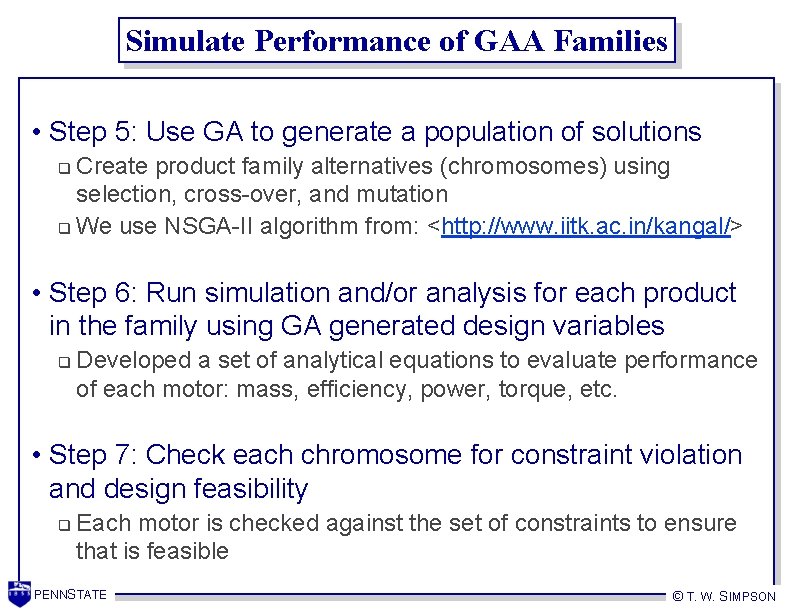
Simulate Performance of GAA Families • Step 5: Use GA to generate a population of solutions Create product family alternatives (chromosomes) using selection, cross-over, and mutation q We use NSGA-II algorithm from: <http: //www. iitk. ac. in/kangal/> q • Step 6: Run simulation and/or analysis for each product in the family using GA generated design variables q Developed a set of analytical equations to evaluate performance of each motor: mass, efficiency, power, torque, etc. • Step 7: Check each chromosome for constraint violation and design feasibility q Each motor is checked against the set of constraints to ensure that is feasible PENNSTATE © T. W. SIMPSON
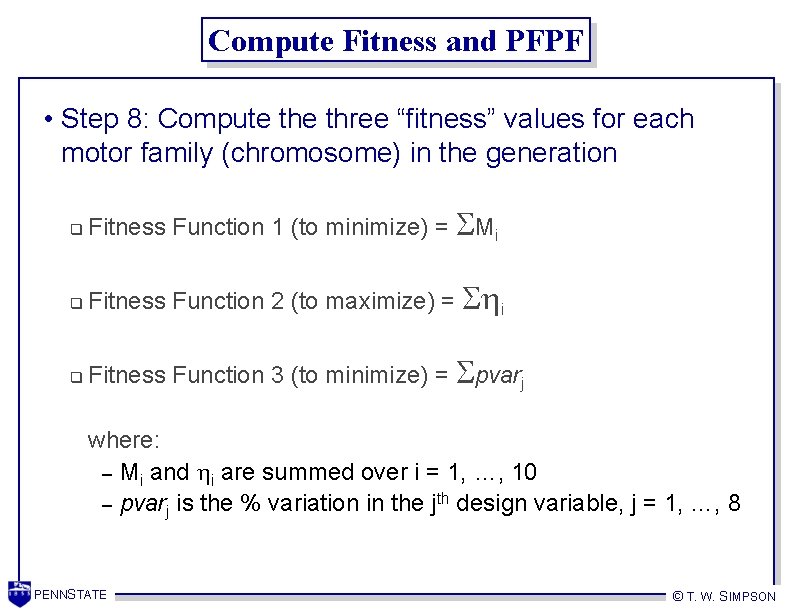
Compute Fitness and PFPF • Step 8: Compute three “fitness” values for each motor family (chromosome) in the generation q Fitness Function 1 (to minimize) = SMi q Fitness Function 2 (to maximize) = Shi q Fitness Function 3 (to minimize) = Spvarj where: – Mi and hi are summed over i = 1, …, 10 – pvarj is the % variation in the jth design variable, j = 1, …, 8 PENNSTATE © T. W. SIMPSON
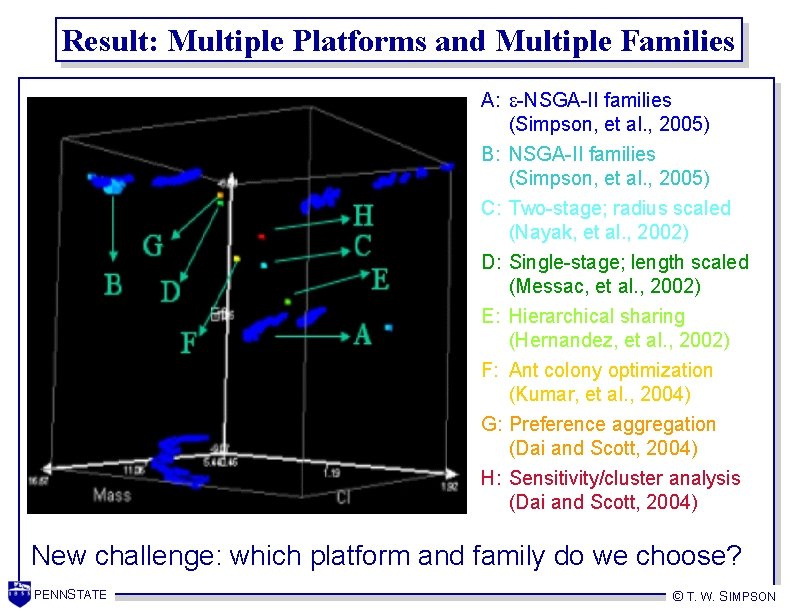
Result: Multiple Platforms and Multiple Families A: e-NSGA-II families (Simpson, et al. , 2005) B: NSGA-II families (Simpson, et al. , 2005) C: Two-stage; radius scaled (Nayak, et al. , 2002) D: Single-stage; length scaled (Messac, et al. , 2002) E: Hierarchical sharing (Hernandez, et al. , 2002) F: Ant colony optimization (Kumar, et al. , 2004) G: Preference aggregation (Dai and Scott, 2004) H: Sensitivity/cluster analysis (Dai and Scott, 2004) New challenge: which platform and family do we choose? PENNSTATE © T. W. SIMPSON
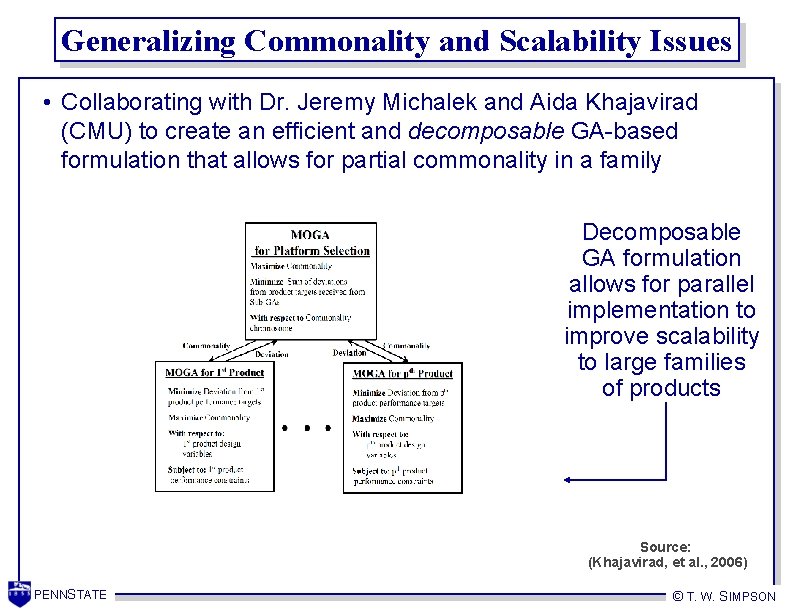
Generalizing Commonality and Scalability Issues • Collaborating with Dr. Jeremy Michalek and Aida Khajavirad (CMU) to create an efficient and decomposable GA-based formulation that allows for partial commonality in a family Decomposable GA formulation allows for parallel implementation to improve scalability to large families of products Source: (Khajavirad, et al. , 2006) PENNSTATE © T. W. SIMPSON
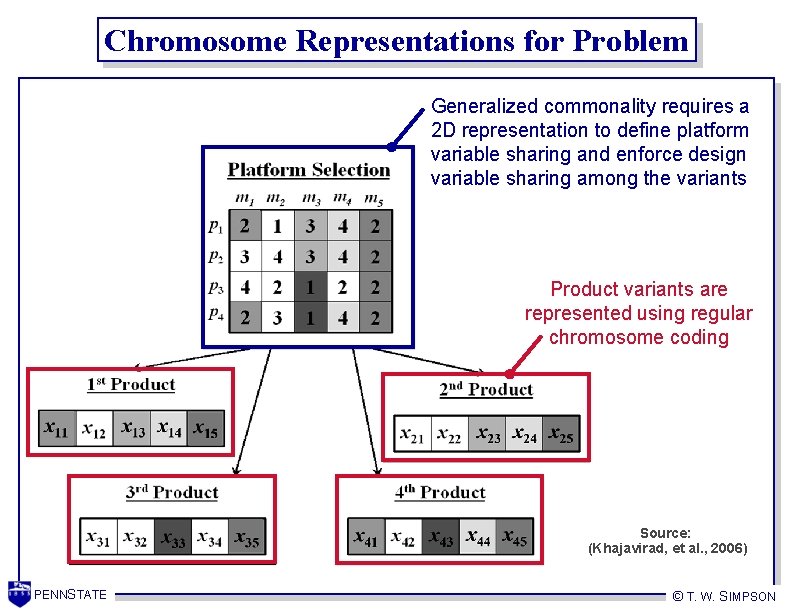
Chromosome Representations for Problem Generalized commonality requires a 2 D representation to define platform variable sharing and enforce design variable sharing among the variants Product variants are represented using regular chromosome coding Source: (Khajavirad, et al. , 2006) PENNSTATE © T. W. SIMPSON
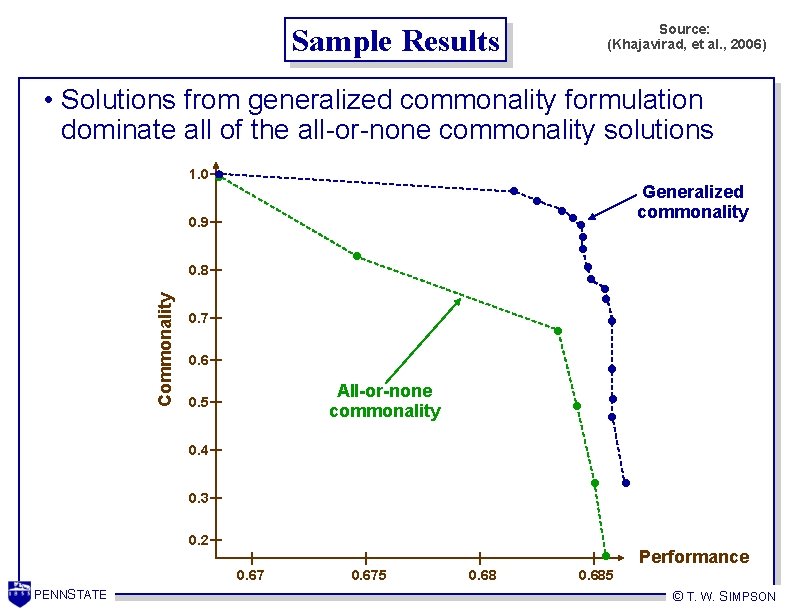
Sample Results Source: (Khajavirad, et al. , 2006) • Solutions from generalized commonality formulation dominate all of the all-or-none commonality solutions 1. 0 Generalized commonality 0. 9 Commonality 0. 8 0. 7 0. 6 All-or-none commonality 0. 5 0. 4 0. 3 0. 2 Performance 0. 67 PENNSTATE 0. 675 0. 685 © T. W. SIMPSON
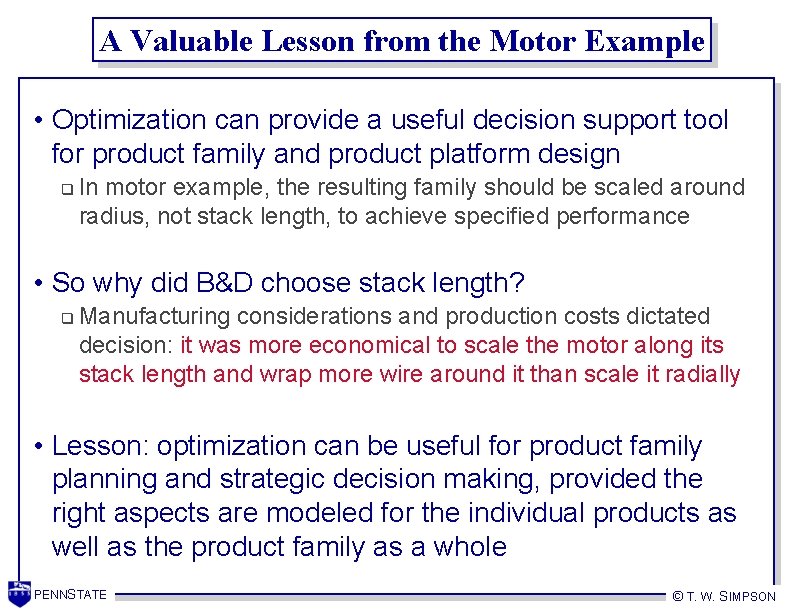
A Valuable Lesson from the Motor Example • Optimization can provide a useful decision support tool for product family and product platform design q In motor example, the resulting family should be scaled around radius, not stack length, to achieve specified performance • So why did B&D choose stack length? q Manufacturing considerations and production costs dictated decision: it was more economical to scale the motor along its stack length and wrap more wire around it than scale it radially • Lesson: optimization can be useful for product family planning and strategic decision making, provided the right aspects are modeled for the individual products as well as the product family as a whole PENNSTATE © T. W. SIMPSON
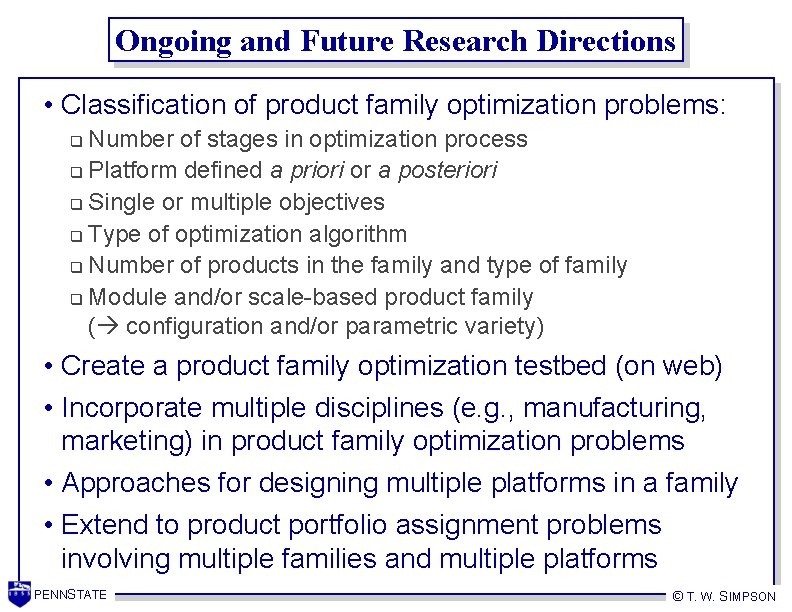
Ongoing and Future Research Directions • Classification of product family optimization problems: Number of stages in optimization process q Platform defined a priori or a posteriori q Single or multiple objectives q Type of optimization algorithm q Number of products in the family and type of family q Module and/or scale-based product family ( configuration and/or parametric variety) q • Create a product family optimization testbed (on web) • Incorporate multiple disciplines (e. g. , manufacturing, marketing) in product family optimization problems • Approaches for designing multiple platforms in a family • Extend to product portfolio assignment problems involving multiple families and multiple platforms PENNSTATE © T. W. SIMPSON
PENNSTATE © T. W. SIMPSON
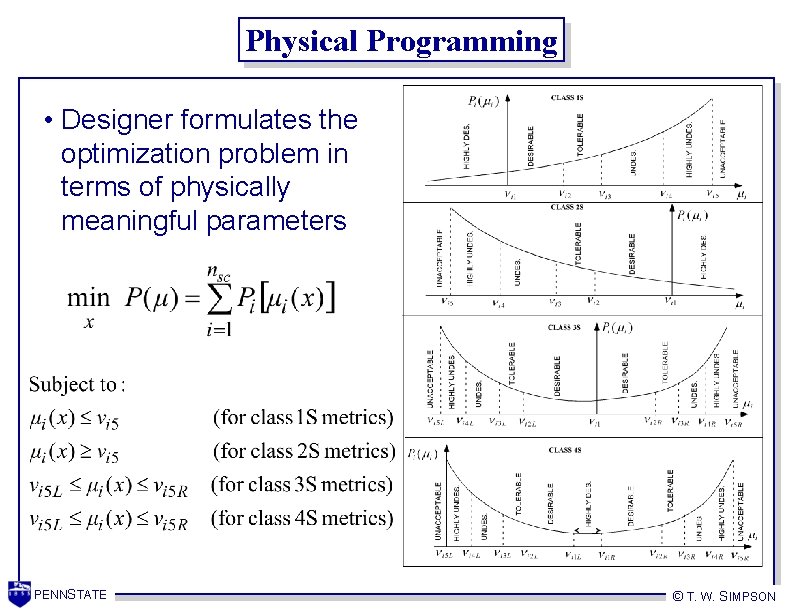
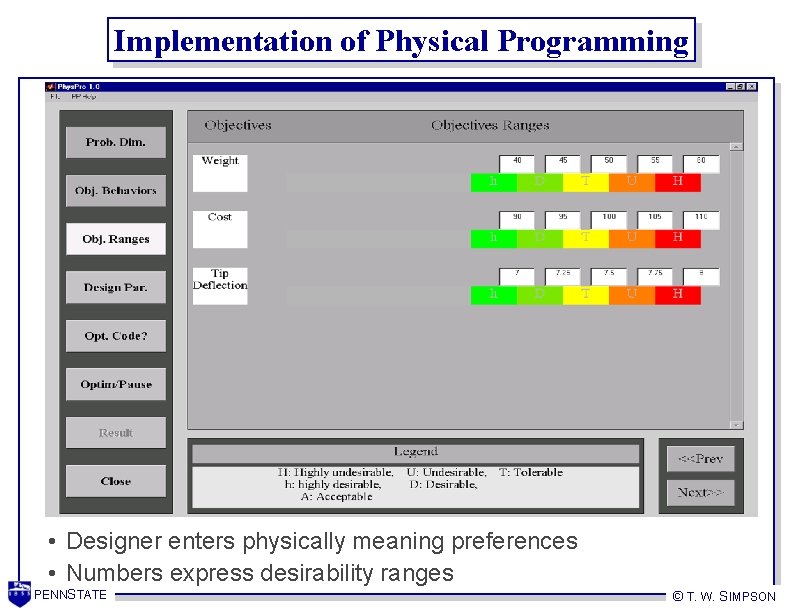
Physical Programming • Designer formulates the optimization problem in terms of physically meaningful parameters PENNSTATE © T. W. SIMPSON
Implementation of Physical Programming • Designer enters physically meaning preferences • Numbers express desirability ranges PENNSTATE © T. W. SIMPSON
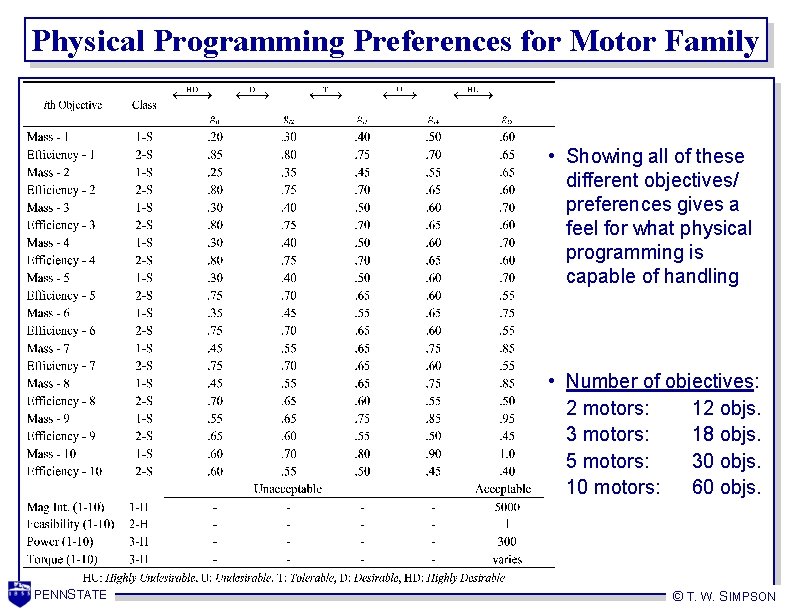
Physical Programming Preferences for Motor Family • Showing all of these different objectives/ preferences gives a feel for what physical programming is capable of handling • Number of objectives: 2 motors: 12 objs. 3 motors: 18 objs. 5 motors: 30 objs. 10 motors: 60 objs. PENNSTATE © T. W. SIMPSON