
Optimistic or realistic Hes a dying man to

- Slides: 10
“Optimistic or realistic? He’s a dying man to me. ” Incorporating patient and relative views in the design of a complex intervention for managing clinically uncertain recovery Emel Yorganci, Dr Catherine Evans, Dr Deokhee Yi, Dr Wei Gao, Dr Stephen Barclay, Professor Andrew Pickles, Professor Fliss Murtagh, Halle Johnson, Dr Rebecca Wilson, Professor Irene Higginson, Dr Jonathan Koffman Cicely Saunders Institute of Palliative Care, Policy and Rehabilitation 28/05/2019 The authors report no conflict of interest. 1
Aim Background Explore hospital patients’ and relatives’ views and understanding around clinically uncertain recovery and identify key areas of care which should be incorporated to the intervention.
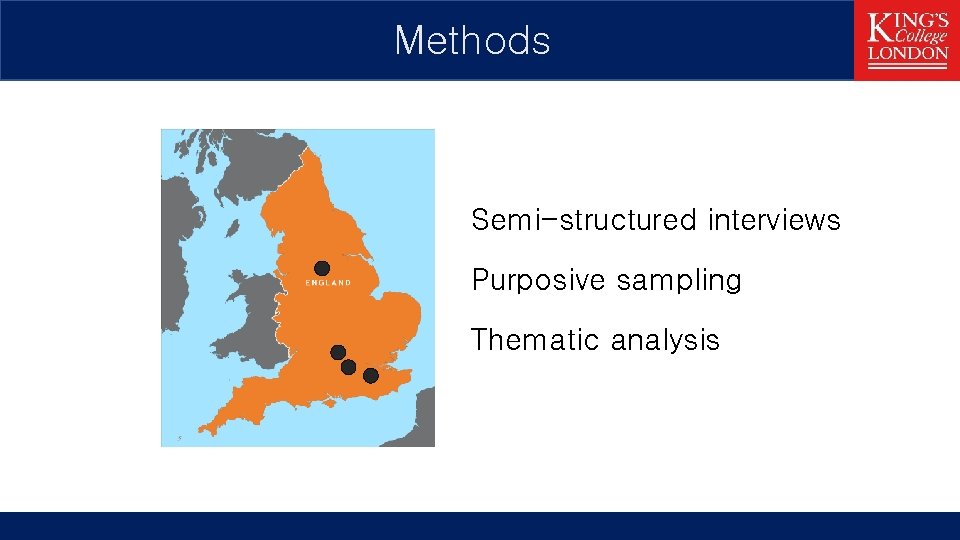
Methods Semi-structured interviews Purposive sampling Thematic analysis
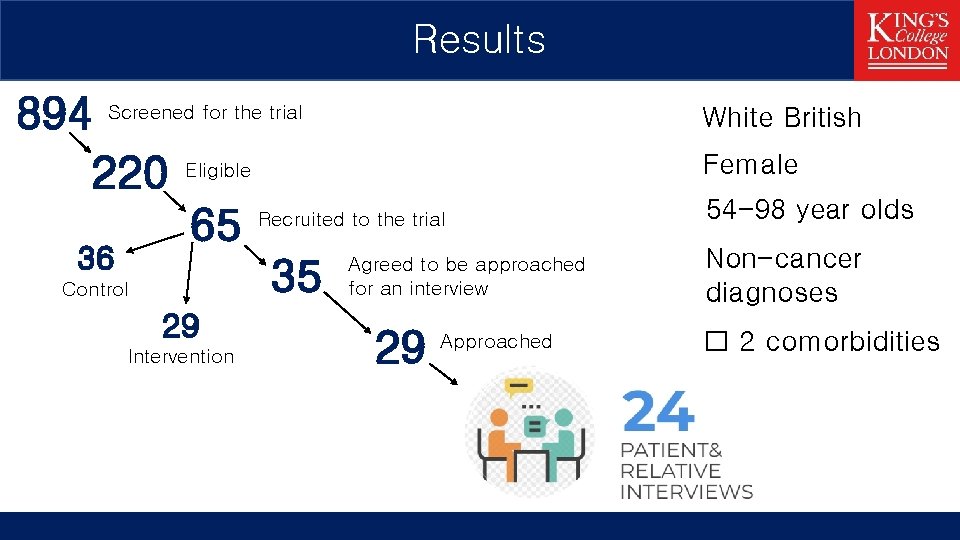
Results 894 Screened for the trial 220 Eligible Recruited to the trial 65 36 Agreed to be approached 35 for an interview Control 29 Intervention 29 Approached White British Female 54 -98 year olds Non-cancer diagnoses � 2 comorbidities
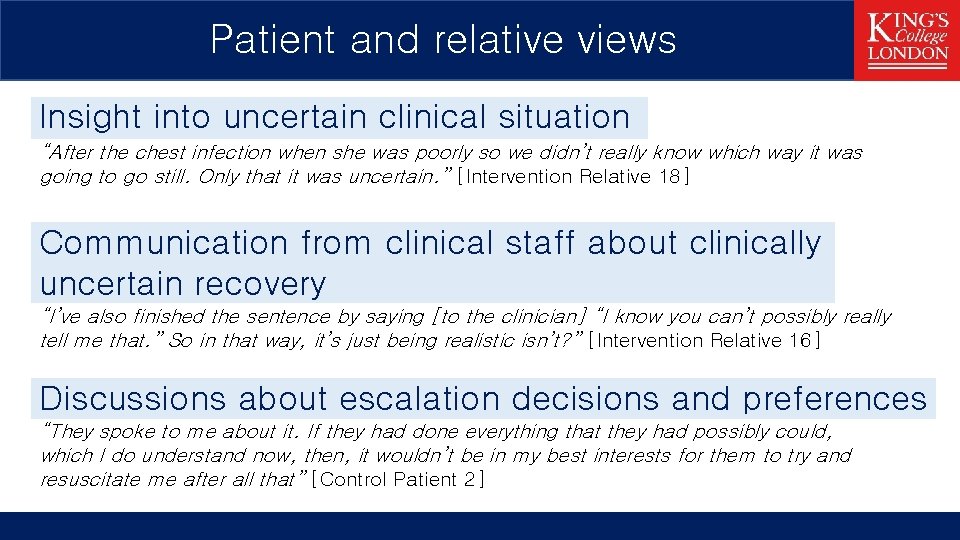
Patient and relative views Insight into uncertain clinical situation “After the chest infection when she was poorly so we didn’t really know which way it was going to go still. Only that it was uncertain. ” [Intervention Relative 18] Communication from clinical staff about clinically uncertain recovery “I’ve also finished the sentence by saying [to the clinician] “I know you can’t possibly really tell me that. ” So in that way, it’s just being realistic isn’t? ” [Intervention Relative 16] Discussions about escalation decisions and preferences “They spoke to me about it. If they had done everything that they had possibly could, which I do understand now, then, it wouldn’t be in my best interests for them to try and resuscitate me after all that” [Control Patient 2]
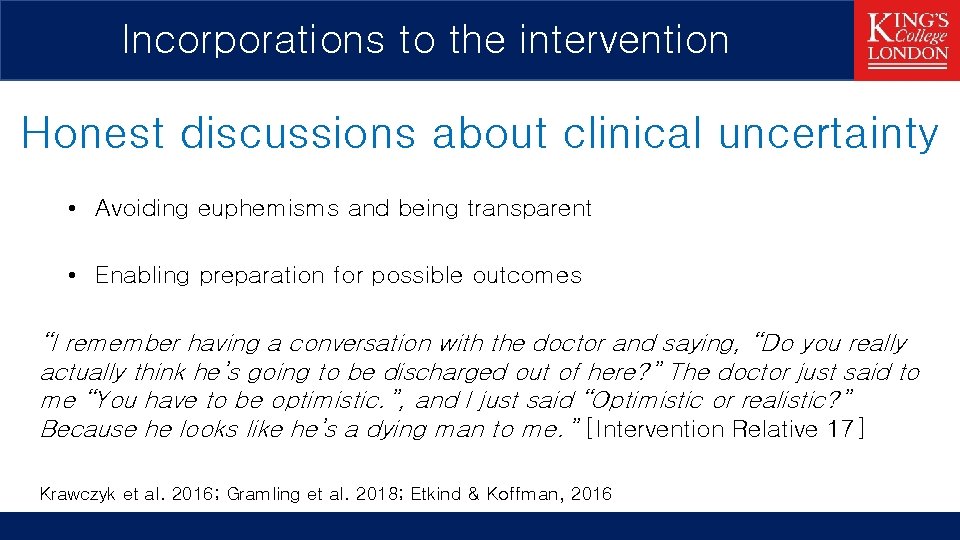
Incorporations to the intervention Honest discussions about clinical uncertainty • Avoiding euphemisms and being transparent • Enabling preparation for possible outcomes “I remember having a conversation with the doctor and saying, “Do you really actually think he’s going to be discharged out of here? ” The doctor just said to me “You have to be optimistic. ”, and I just said “Optimistic or realistic? ” Because he looks like he’s a dying man to me. ” [Intervention Relative 17] Krawczyk et al. 2016; Gramling et al. 2018; Etkind & Koffman, 2016
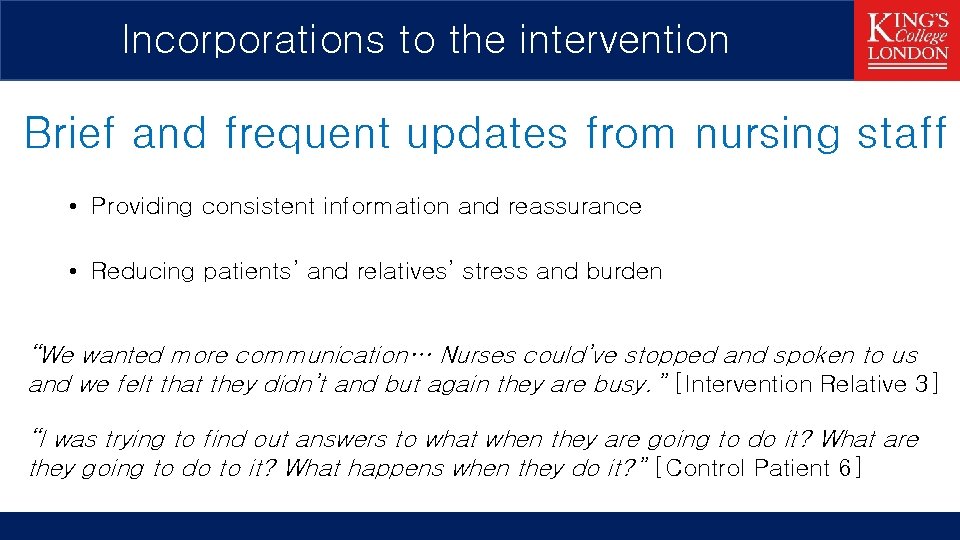
Incorporations to the intervention Brief and frequent updates from nursing staff • Providing consistent information and reassurance • Reducing patients’ and relatives’ stress and burden “We wanted more communication… Nurses could’ve stopped and spoken to us and we felt that they didn’t and but again they are busy. ” [Intervention Relative 3] “I was trying to find out answers to what when they are going to do it? What are they going to do to it? What happens when they do it? ” [Control Patient 6]
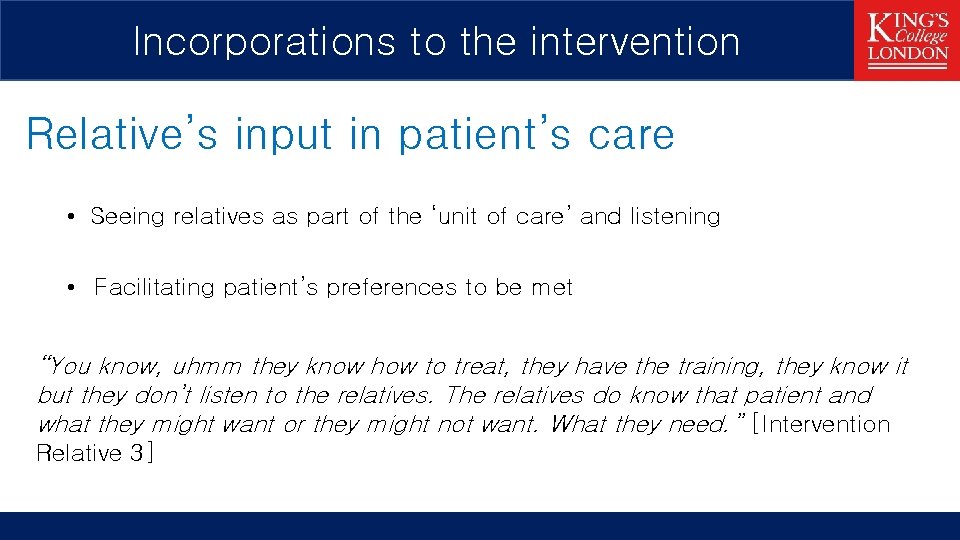
Incorporations to the intervention Relative’s input in patient’s care • Seeing relatives as part of the ‘unit of care’ and listening • Facilitating patient’s preferences to be met “You know, uhmm they know how to treat, they have the training, they know it but they don’t listen to the relatives. The relatives do know that patient and what they might want or they might not want. What they need. ” [Intervention Relative 3]
Conclusions Communication with patients and relatives – transparency, empowering ward staff, avoiding euphemisms, and listening Communication within the multidisciplinary team and access to up-to-date information Importance of co-producing interventions with patient and relative input at early stages of development
Acknowledgements Thank you to all patients, relatives, healthcare and research professionals at all study sites, our patient public representatives Colleen Ewart & Sylvia Bailey, Improve. Care project team, our funder National Institute for Health Research, and Collaboration for Leadership in Applied Health Research and Care @emelasml @csi_kcl emel. yorganci@kcl. ac. uk www. kcl. ac. uk/cicelysaunders