
Optimism Motivation Healthy Ageing KAREN MORGAN Optimism an
- Slides: 34
Optimism, Motivation & Healthy Ageing KAREN MORGAN
Optimism ‘an inclination to put the most favorable construction upon actions and events or to anticipate the best possible outcome’ - Merriam-Webster Image from https: //www. australianunity. com. au/about-us/jointheoptimists
Optimism • Dispositional, situational • Adaptiveness well established in those with poorer health • ↑ functional and psychological health • ↑ healthy behaviours including physical activity • ↑ sense of control over health • ↑ health care management (longitudinally) • Better physiological adjustment to stress
Motivation ‘A reason or reasons for acting or behaving in a particular way. ’ - oxford dictionary Image from https: //www. theodysseyonline. com/motivation-
Motivation • Driving force for behaviour • Internal/external • Huge challenge • Impacted by past experiences, other attitudes and other people
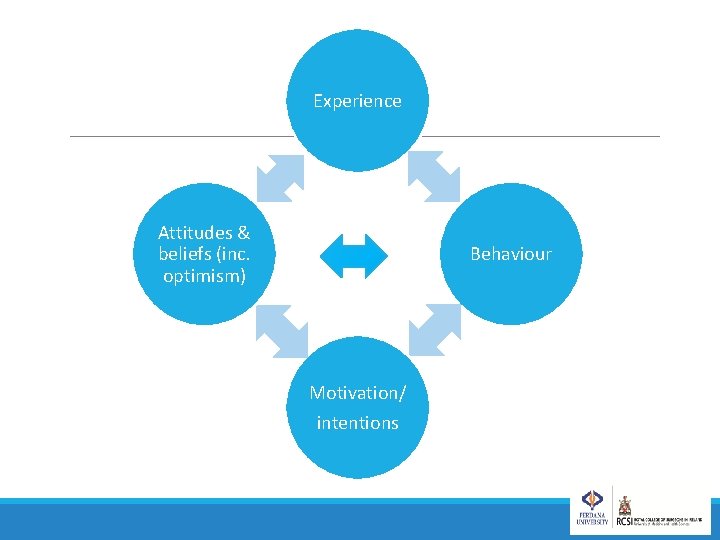
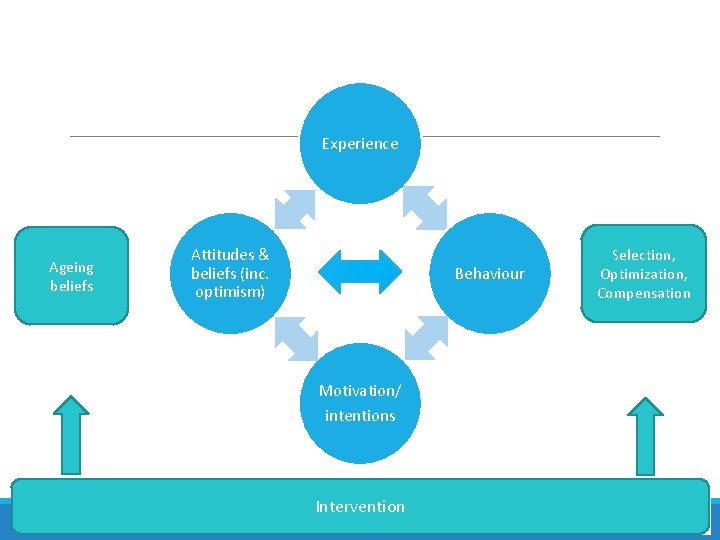
Experience Attitudes & beliefs (inc. optimism) Behaviour Motivation/ intentions
Ageing beliefs
Ageing beliefs/perceptions • How we think about our own ageing • Shaped over time, influenced by experience and environment • Can be categorised as positive or negative • Believed to reflect adaptation/coping • Positive perceptions indicate adaptation/coping • Negative perception indicating difficulties of adaptation
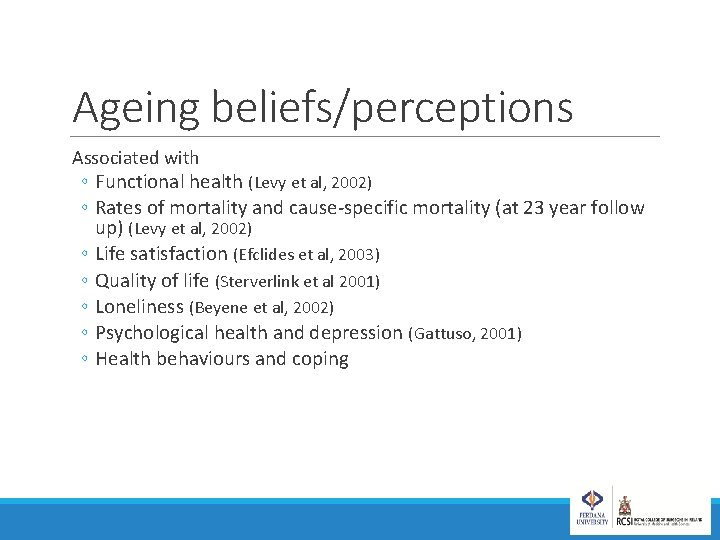
Ageing beliefs/perceptions Associated with ◦ Functional health (Levy et al, 2002) ◦ Rates of mortality and cause-specific mortality (at 23 year follow up) (Levy et al, 2002) ◦ Life satisfaction (Efclides et al, 2003) ◦ Quality of life (Sterverlink et al 2001) ◦ Loneliness (Beyene et al, 2002) ◦ Psychological health and depression (Gattuso, 2001) ◦ Health behaviours and coping
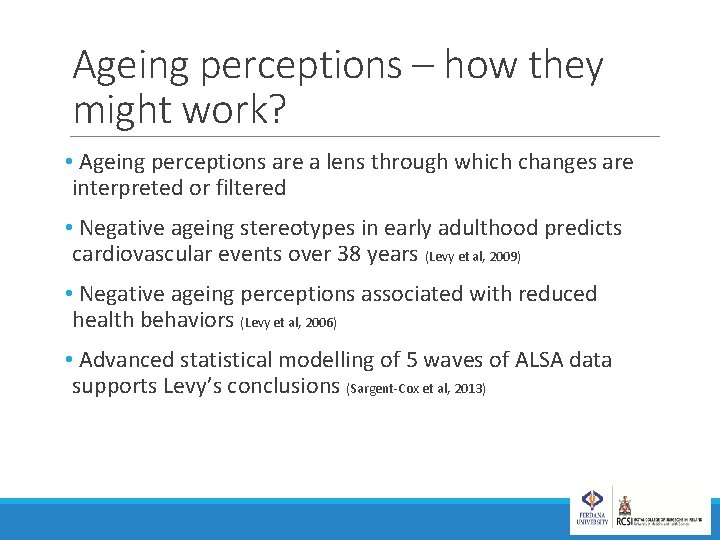
Ageing perceptions – how they might work? • Ageing perceptions are a lens through which changes are interpreted or filtered • Negative ageing stereotypes in early adulthood predicts cardiovascular events over 38 years (Levy et al, 2009) • Negative ageing perceptions associated with reduced health behaviors (Levy et al, 2006) • Advanced statistical modelling of 5 waves of ALSA data supports Levy’s conclusions (Sargent-Cox et al, 2013)
Ageing perceptions • We know they are important • We know how they work But… • How are they formed? • If we understand this could we change them? Image: www. collegeofmedicine. org. uk
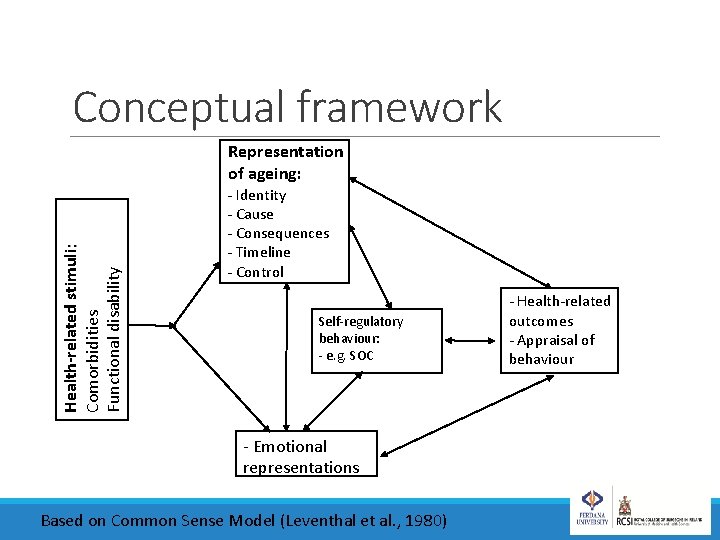
Conceptual framework Health-related stimuli: Comorbidities Functional disability Representation of ageing: - Identity - Cause - Consequences - Timeline - Control Self-regulatory behaviour: - e. g. SOC - Emotional representations Based on Common Sense Model (Leventhal et al. , 1980) - Health-related outcomes - Appraisal of behaviour
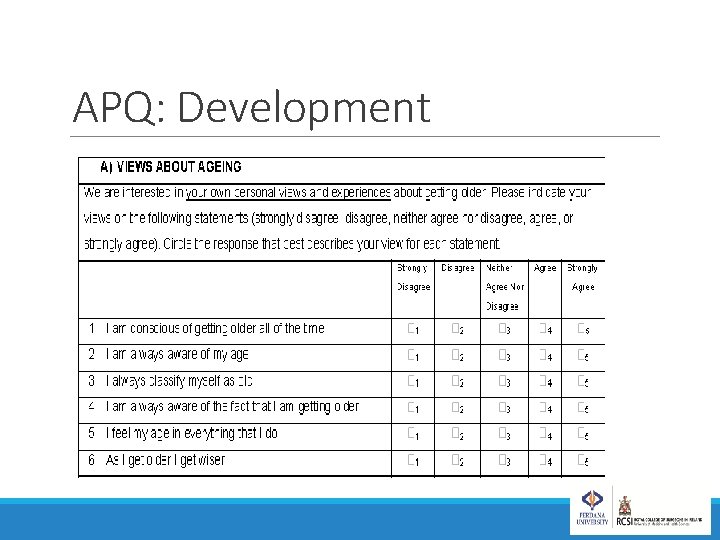
APQ: Development
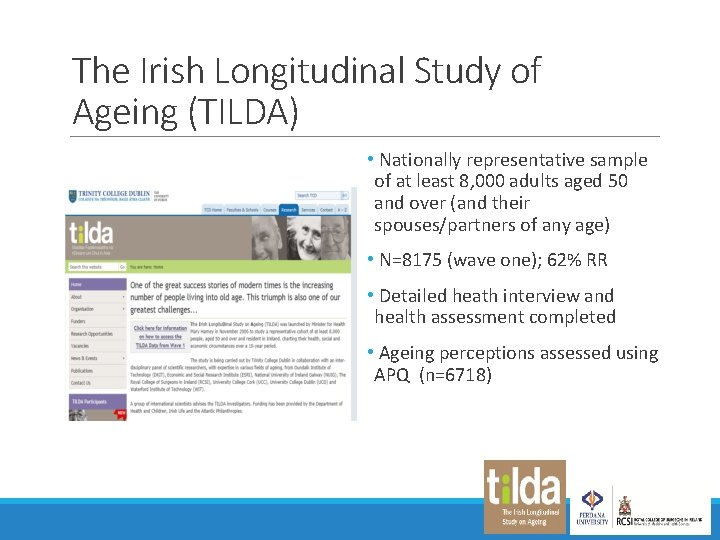
The Irish Longitudinal Study of Ageing (TILDA) • Nationally representative sample of at least 8, 000 adults aged 50 and over (and their spouses/partners of any age) • N=8175 (wave one); 62% RR • Detailed heath interview and health assessment completed • Ageing perceptions assessed using APQ (n=6718)
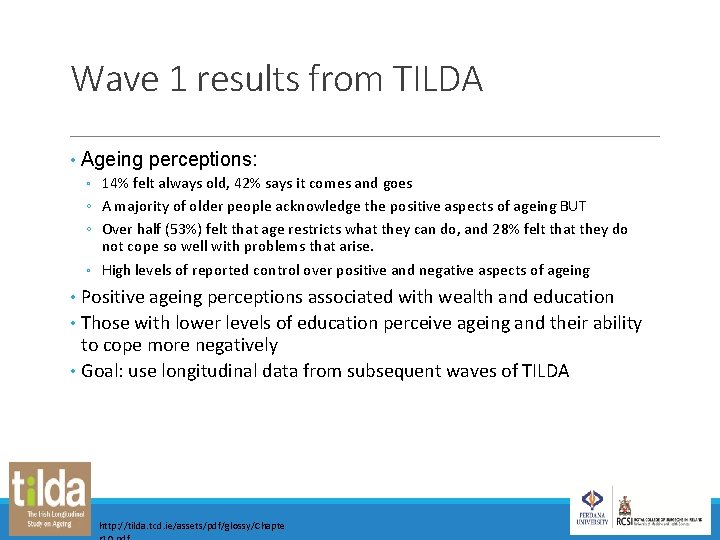
Wave 1 results from TILDA • Ageing perceptions: ◦ 14% felt always old, 42% says it comes and goes ◦ A majority of older people acknowledge the positive aspects of ageing BUT ◦ Over half (53%) felt that age restricts what they can do, and 28% felt that they do not cope so well with problems that arise. ◦ High levels of reported control over positive and negative aspects of ageing • Positive ageing perceptions associated with wealth and education • Those with lower levels of education perceive ageing and their ability to cope more negatively • Goal: use longitudinal data from subsequent waves of TILDA http: //tilda. tcd. ie/assets/pdf/glossy/Chapte
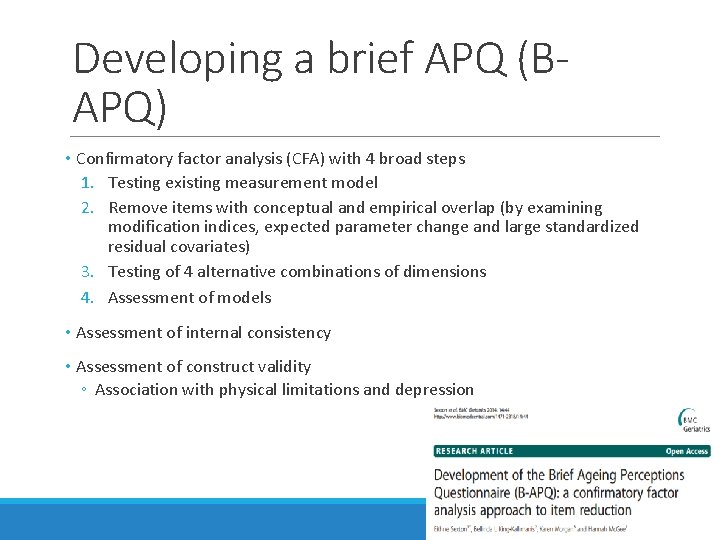
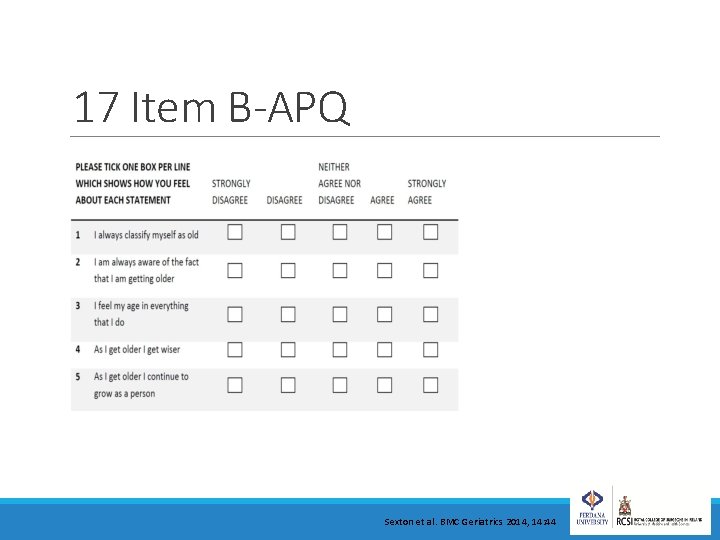
Developing a brief APQ (BAPQ) • Confirmatory factor analysis (CFA) with 4 broad steps 1. Testing existing measurement model 2. Remove items with conceptual and empirical overlap (by examining modification indices, expected parameter change and large standardized residual covariates) 3. Testing of 4 alternative combinations of dimensions 4. Assessment of models • Assessment of internal consistency • Assessment of construct validity ◦ Association with physical limitations and depression
17 Item B-APQ Sexton et al. BMC Geriatrics 2014, 14: 44
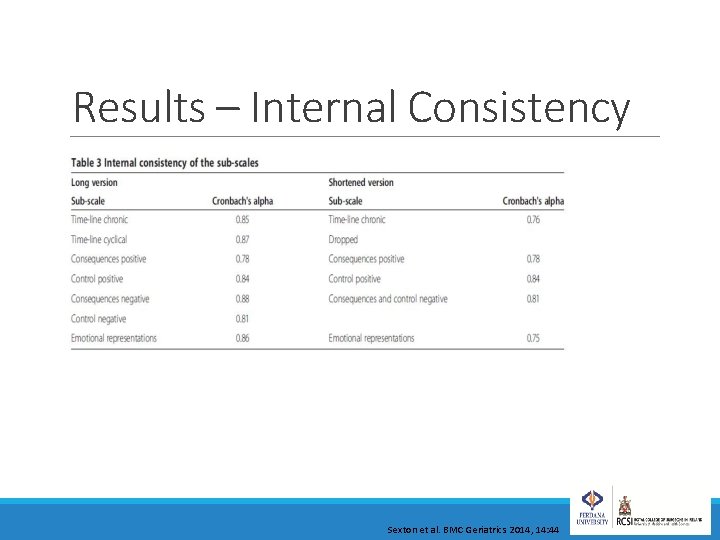
Results – Internal Consistency Sexton et al. BMC Geriatrics 2014, 14: 44
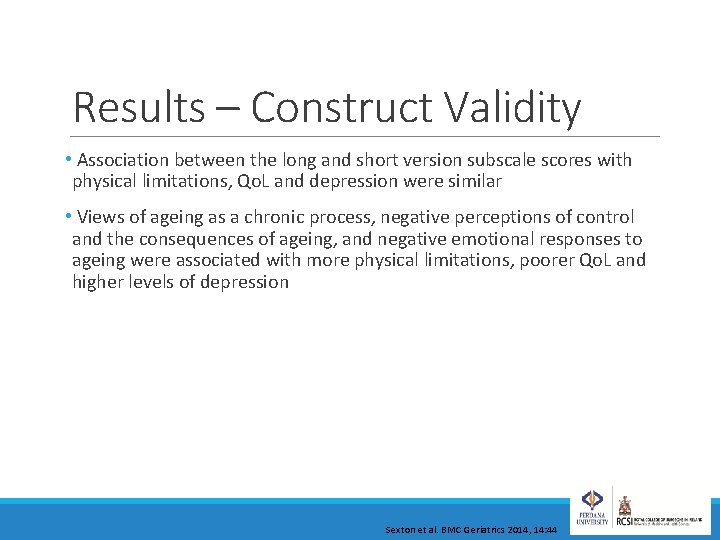
Results – Construct Validity • Association between the long and short version subscale scores with physical limitations, Qo. L and depression were similar • Views of ageing as a chronic process, negative perceptions of control and the consequences of ageing, and negative emotional responses to ageing were associated with more physical limitations, poorer Qo. L and higher levels of depression Sexton et al. BMC Geriatrics 2014, 14: 44
B-APQ: Validation in Malaysia • Data collected from 200+ • CFA completed • Good internal consistency and validity • Association between negative domains and more reported depressive symptoms • Association between positive domains and higher Qo. L • No ethnic differences https: //www. reference. com/education/questionnai re-a 9 b 1 e 176 b 0524 a 4
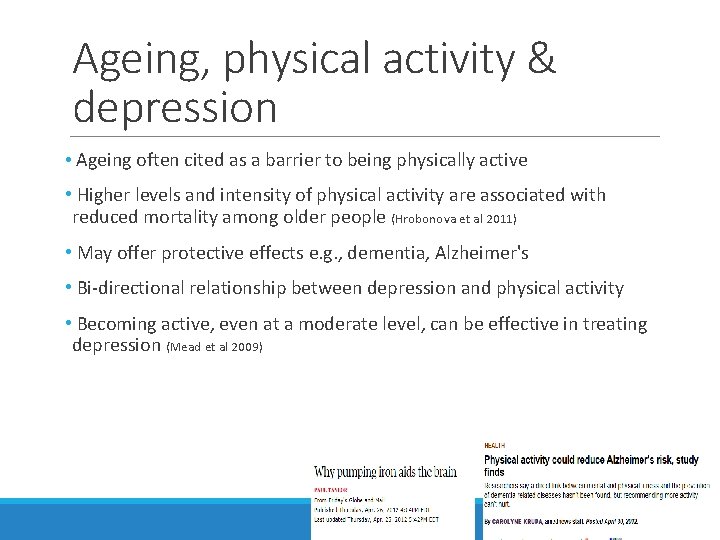
Ageing, physical activity & depression • Ageing often cited as a barrier to being physically active • Higher levels and intensity of physical activity are associated with reduced mortality among older people (Hrobonova et al 2011) • May offer protective effects e. g. , dementia, Alzheimer's • Bi-directional relationship between depression and physical activity • Becoming active, even at a moderate level, can be effective in treating depression (Mead et al 2009)
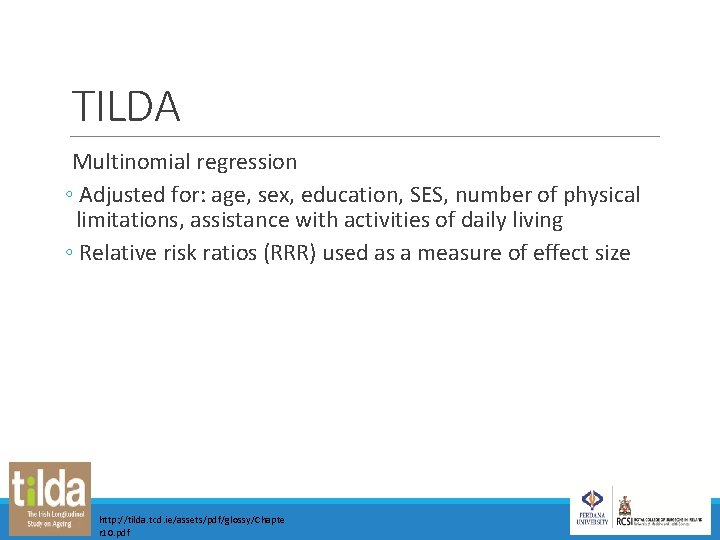
TILDA Multinomial regression ◦ Adjusted for: age, sex, education, SES, number of physical limitations, assistance with activities of daily living ◦ Relative risk ratios (RRR) used as a measure of effect size http: //tilda. tcd. ie/assets/pdf/glossy/Chapte r 10. pdf
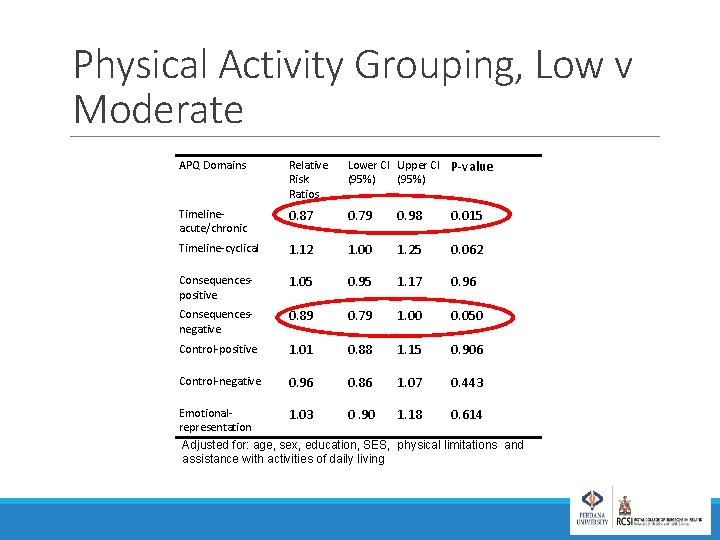
Physical Activity Grouping, Low v Moderate APQ Domains Relative Risk Ratios Lower CI Upper CI P-value (95%) Timelineacute/chronic 0. 87 0. 79 0. 98 0. 015 Timeline-cyclical 1. 12 1. 00 1. 25 0. 062 Consequencespositive 1. 05 0. 95 1. 17 0. 96 Consequencesnegative 0. 89 0. 79 1. 00 0. 050 Control-positive 1. 01 0. 88 1. 15 0. 906 Control-negative 0. 96 0. 86 1. 07 0. 443 Emotional 1. 03 0. 90 1. 18 0. 614 representation Adjusted for: age, sex, education, SES, physical limitations and assistance with activities of daily living
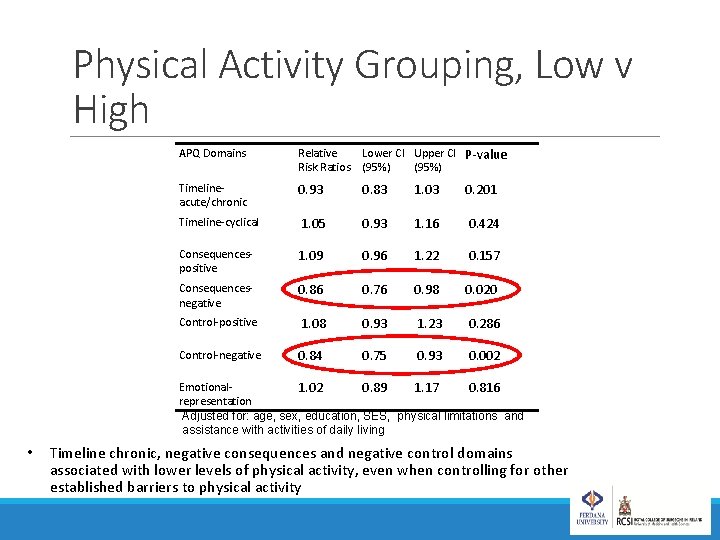
Physical Activity Grouping, Low v High APQ Domains Relative Risk Ratios Lower CI Upper CI P-value (95%) Timelineacute/chronic 0. 93 0. 83 1. 03 0. 201 Timeline-cyclical 1. 05 0. 93 1. 16 0. 424 Consequencespositive 1. 09 0. 96 1. 22 0. 157 Consequencesnegative 0. 86 0. 76 0. 98 0. 020 Control-positive 1. 08 0. 93 1. 23 0. 286 Control-negative 0. 84 0. 75 0. 93 0. 002 Emotional 1. 02 0. 89 1. 17 0. 816 representation Adjusted for: age, sex, education, SES, physical limitations and assistance with activities of daily living • Timeline chronic, negative consequences and negative control domains associated with lower levels of physical activity, even when controlling for other established barriers to physical activity
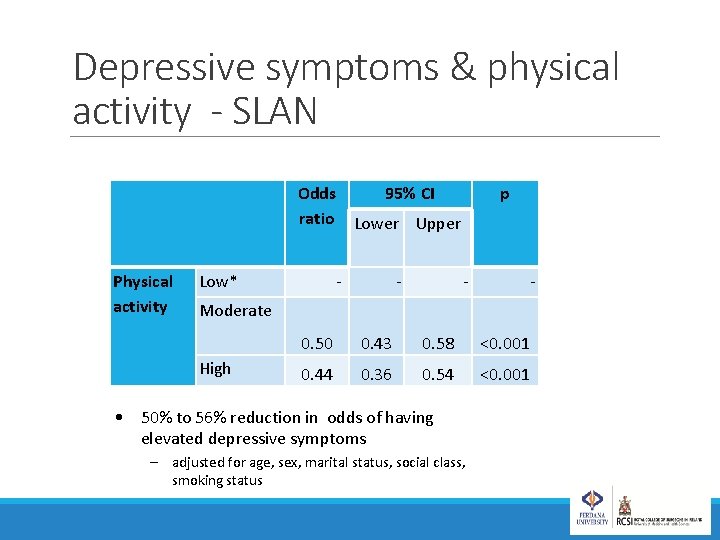
Depressive symptoms & physical activity - SLAN Odds 95% CI ratio Lower Upper Physical activity Low* - - p - - Moderate High 0. 50 0. 43 0. 58 <0. 001 0. 44 0. 36 0. 54 <0. 001 • 50% to 56% reduction in odds of having elevated depressive symptoms – adjusted for age, sex, marital status, social class, smoking status
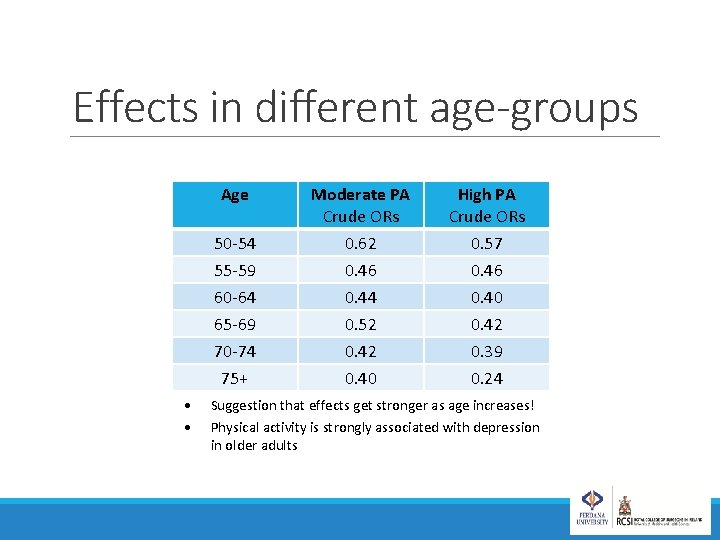
Effects in different age-groups Age • • 50 -54 55 -59 60 -64 Moderate PA Crude ORs 0. 62 0. 46 0. 44 High PA Crude ORs 0. 57 0. 46 0. 40 65 -69 70 -74 75+ 0. 52 0. 40 0. 42 0. 39 0. 24 Suggestion that effects get stronger as age increases! Physical activity is strongly associated with depression in older adults
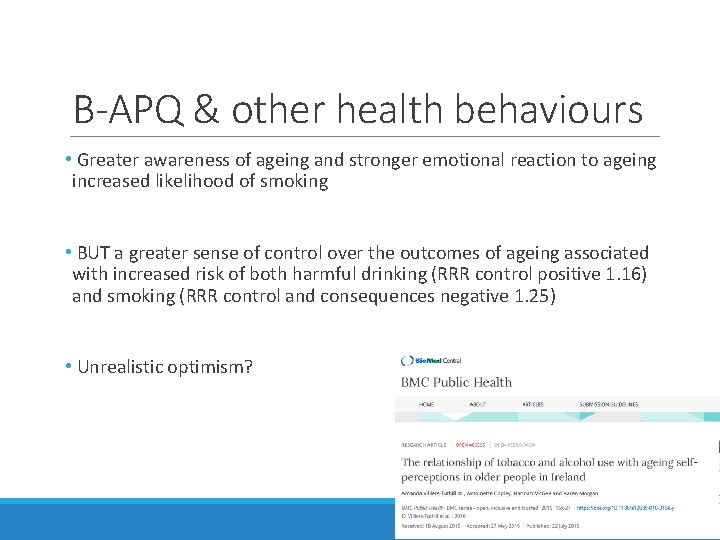
B-APQ & other health behaviours • Greater awareness of ageing and stronger emotional reaction to ageing increased likelihood of smoking • BUT a greater sense of control over the outcomes of ageing associated with increased risk of both harmful drinking (RRR control positive 1. 16) and smoking (RRR control and consequences negative 1. 25) • Unrealistic optimism?
Adaptation to ageing: selection, optimisation & compensation (SOC) • SOC model developed by Baltes & colleagues (Berlin Ageing Study) (Baltes & Baltes, 1990+) • Developmental/ lifespan psychology perspective • Recognises losses and limitations that can occur and strategies needed to overcome these • Inform about strategies to achieve favourable outcomes in (later) life 25/02/2021
Model of selection optimisation and compensation (SOC) • Selection: focusing attention on the experiences or activities deemed most important • Optimisation: modifying environment to create more favourable or desired outcomes • Compensation: recognising constraints or challenges and the need for action to reduce potential impairment. 25/02/2021
SOC • lack of agitation and lower levels of loneliness (Freund and Baltes, 1998) • better physical health (Freund & Baltes, 1999) • higher levels of psychological well-being, self-esteem, selfacceptance and environmental mastery (Freund and Baltes, 2002; Wiese et al. , 2000) • Greater personal growth, purpose in life and autonomy (Freund and Baltes, 2002)
Experience Ageing beliefs Attitudes & beliefs (inc. optimism) Behaviour Motivation/ intentions Intervention Selection, Optimization, Compensation
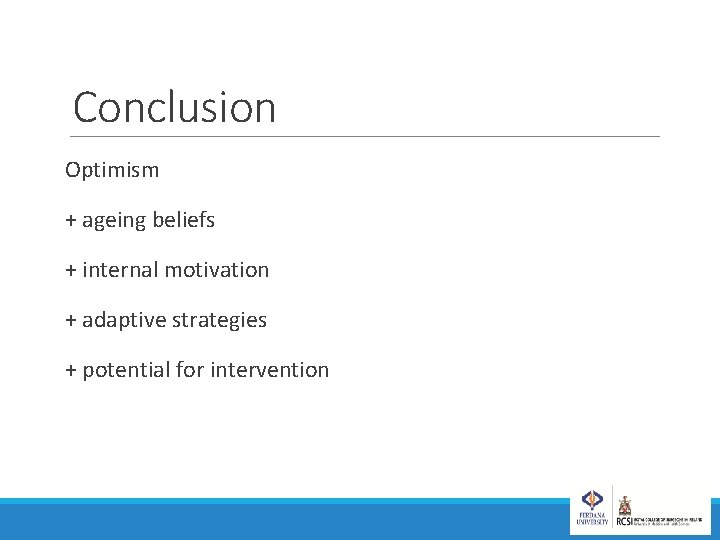
Conclusion Optimism + ageing beliefs + internal motivation + adaptive strategies + potential for intervention
Go raibh míle maith agaibh Terima Kasih karenmorgan@perdanauniversity. edu. my kmorgan@rcsi. ie
Acknowledgments & further information Colleagues and funders: HARP (funded by Health Research Board, Ireland) SLAN 2007 consortium (funded by Irish Dept Health & Children) CARDI team (funded by CARDI data mining programme) TILDA UM Ageing & Age-associated Disorders Research Group All questionnaires and scoring are available for use by researchers Datasets have been archived and are available for use