
Optimism and Individualism Thanatopsis by William Cullen Bryant
Optimism and Individualism “Thanatopsis” by William Cullen Bryant 1794 -1878
Agree or Disagree? • Respond the following questions in your notes. • Minimum two complete sentences per question. 1. Death is the beginning of loneliness. I agree / disagree because. . . 2. Death is compared to sleep. I agree / disagree because. . . 3. The young and the old will have the same fate. I agree / disagree because. . . 4. All mankind should dread death. I agree / disagree because. . .
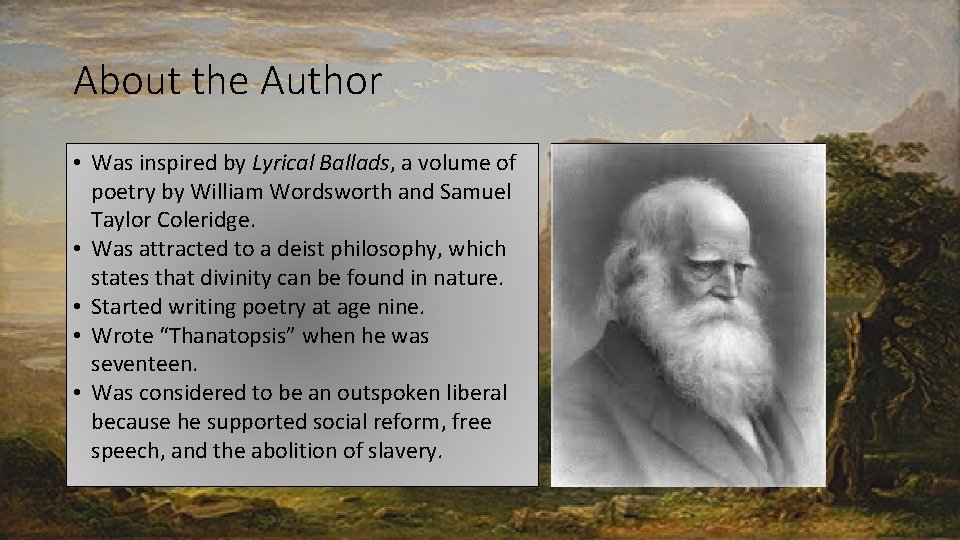
About the Author • Was inspired by Lyrical Ballads, a volume of poetry by William Wordsworth and Samuel Taylor Coleridge. • Was attracted to a deist philosophy, which states that divinity can be found in nature. • Started writing poetry at age nine. • Wrote “Thanatopsis” when he was seventeen. • Was considered to be an outspoken liberal because he supported social reform, free speech, and the abolition of slavery.
Vocabulary • communion - the sharing of intimate thoughts and feelings • musings - deep thoughts or contemplations • shroud - a garment a dead person is wrapped in for burial • blight - a thing that spoils or damages something • elements - one of four substances, earth, air, fire, or water, formerly regarded as a fundamental constituent of the universe
More Vocabulary • pensive - thinking deeply or seriously • quarry - a place, usually a large deep pit from which stone or other materials have been extracted • Rude swain- an uneducated youth • Pall- coffin cover • Hoary-seers- white haired prophets

Thanatopsis Bryant created the word “thanatopsis” by combining two Greek words. thanatos - means death opsis - means sight * a new way of thinking about and seeing the concept of death*
Respond to the following question in your notes: • Based on the title and the information presented, what do you think this poem is going to be about?
In your notes… • Write the names and definitions of the following literary devices: 1. Personification – giving human characteristics to non-human things 2. Simile – comparing two similar things using like or as 3. Metaphor – using one thing or idea to directly represent another 4. Imagery – descriptive language that appeals to the senses 5. Caesura – a break or pause within a line of verse 6. Enjambment – running from one line to the next without pause 7. Irony – the use of words to convey the opposite of the literal meaning
Time to read. • Quietly read through the poem once on your own. Don’t rush through the poem, but don’t worry if you don’t understand everything. We will discuss it further. While you read, consider these ideas: • What is the subject of the poem? • What is the mood of the poem? • What examples from the poem help support your idea? • Is there anywhere in the poem where the mood shifts? • What is theme of this poem? • This may differ from the subject.
Group work • In groups of 3 -4, you will be assigned a section of “Thanatopsis. ” • Re-read your section. You should be able to: • Summarize the content of your section & • Identify poetic devices used by Bryant in your section: • Pay specific attention to the imagery he uses
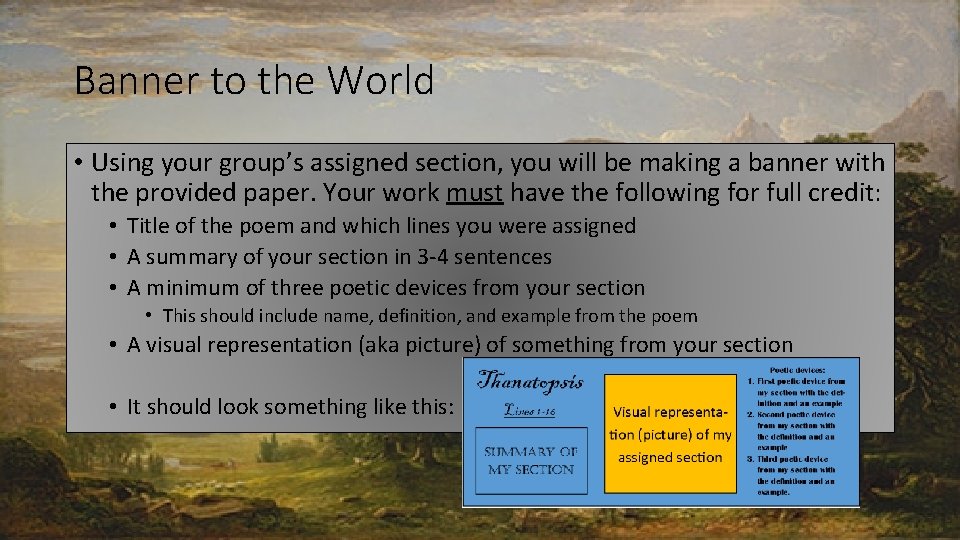
Banner to the World • Using your group’s assigned section, you will be making a banner with the provided paper. Your work must have the following for full credit: • Title of the poem and which lines you were assigned • A summary of your section in 3 -4 sentences • A minimum of three poetic devices from your section • This should include name, definition, and example from the poem • A visual representation (aka picture) of something from your section • It should look something like this:
- Slides: 11