
Optimisation Based Clearance of Nonlinear Flight Control Laws
Optimisation Based Clearance of Nonlinear Flight Control Laws Prathyush P. Menon Jongrae Kim Declan G. Bates Ian Postlethwaite Control & Instrumentation Research Group, Department of Engineering, University of Leicester, Leicester LE 1 7 RH, UK. Department of Engineering, Control & Instrumentation Research Group 22 – Mar – 2006
Overview • Nonlinear flight clearance • A general optimisation framework • Worst case uncertainty evaluation • Clearance over regions of the flight envelope • Worst case input identification • Summary Department of Engineering, Control & Instrumentation Research Group 22 – Mar – 2006
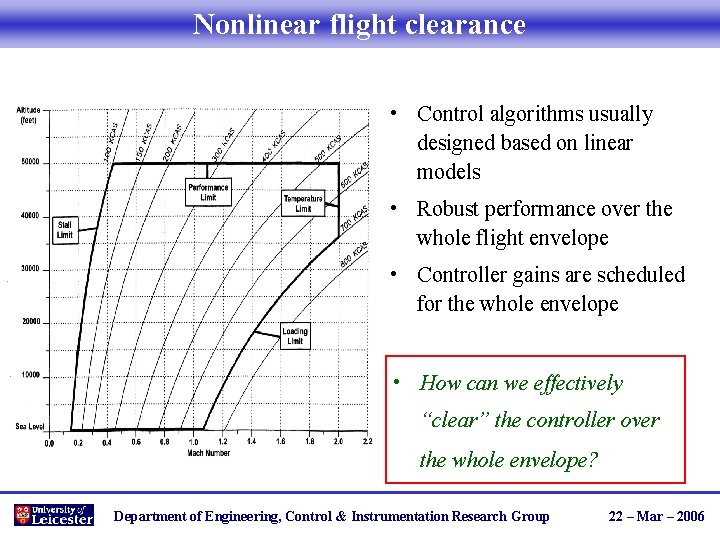
Nonlinear flight clearance • Control algorithms usually designed based on linear models • Robust performance over the whole flight envelope • Controller gains are scheduled for the whole envelope • How can we effectively “clear” the controller over the whole envelope? Department of Engineering, Control & Instrumentation Research Group 22 – Mar – 2006
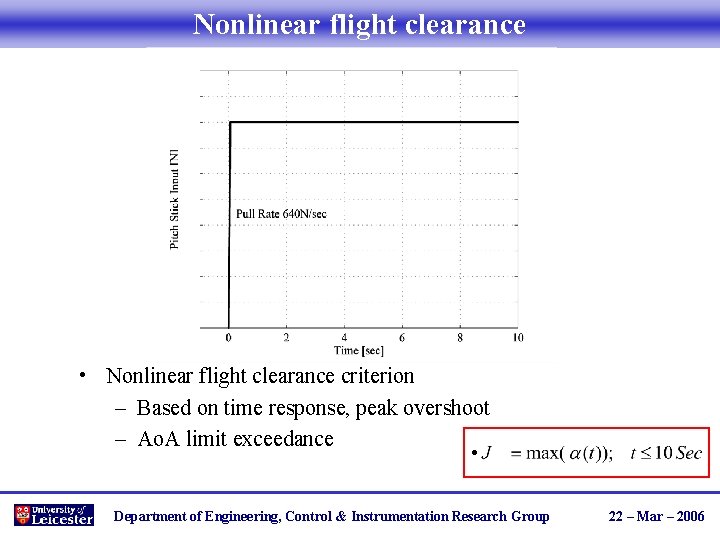
Nonlinear flight clearance • Nonlinear flight clearance criterion – Based on time response, peak overshoot – Ao. A limit exceedance • Department of Engineering, Control & Instrumentation Research Group 22 – Mar – 2006
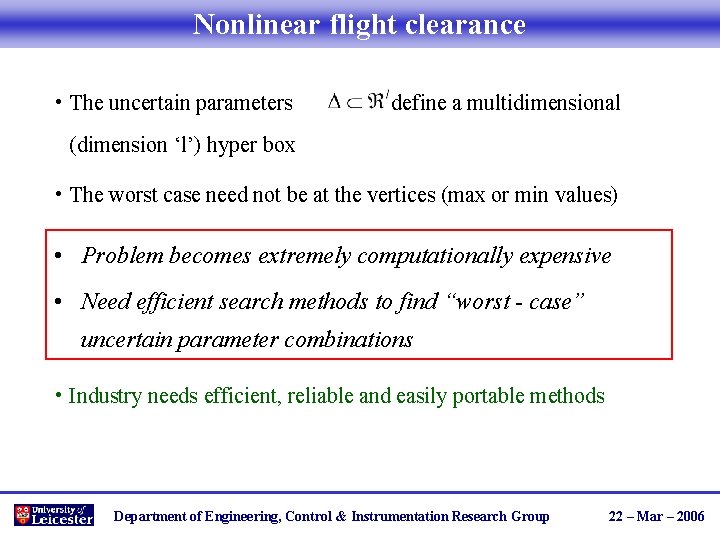
Nonlinear flight clearance • The uncertain parameters define a multidimensional (dimension ‘l’) hyper box • The worst case need not be at the vertices (max or min values) • Problem becomes extremely computationally expensive • Need efficient search methods to find “worst - case” uncertain parameter combinations • Industry needs efficient, reliable and easily portable methods Department of Engineering, Control & Instrumentation Research Group 22 – Mar – 2006

ADMIRE model • Dynamics Department of Engineering, Control & Instrumentation Research Group …(1) 22 – Mar – 2006
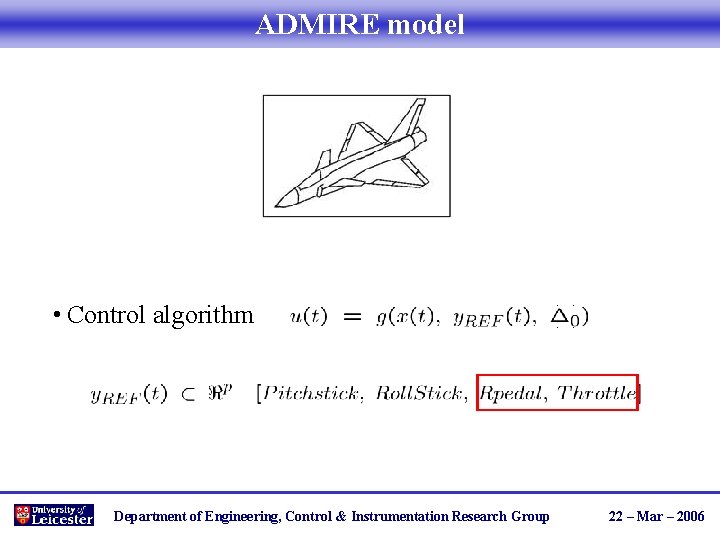
ADMIRE model • Control algorithm …(2) Department of Engineering, Control & Instrumentation Research Group 22 – Mar – 2006
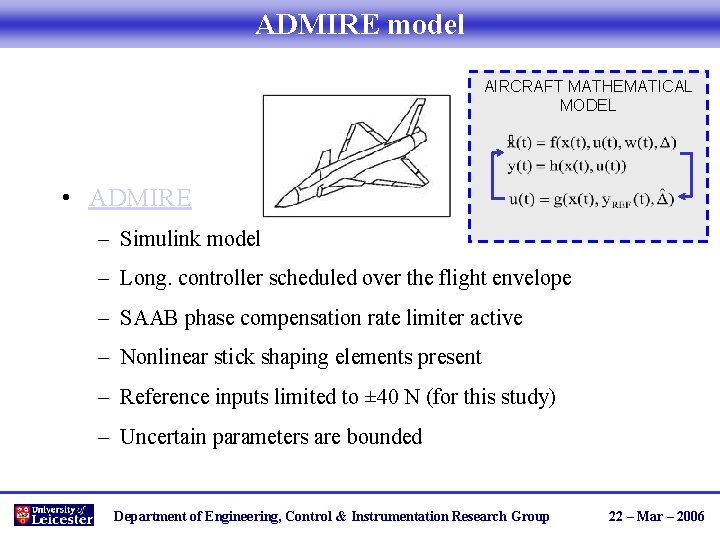
ADMIRE model AIRCRAFT MATHEMATICAL MODEL • ADMIRE – Simulink model – Long. controller scheduled over the flight envelope – SAAB phase compensation rate limiter active – Nonlinear stick shaping elements present – Reference inputs limited to ± 40 N (for this study) – Uncertain parameters are bounded Department of Engineering, Control & Instrumentation Research Group 22 – Mar – 2006
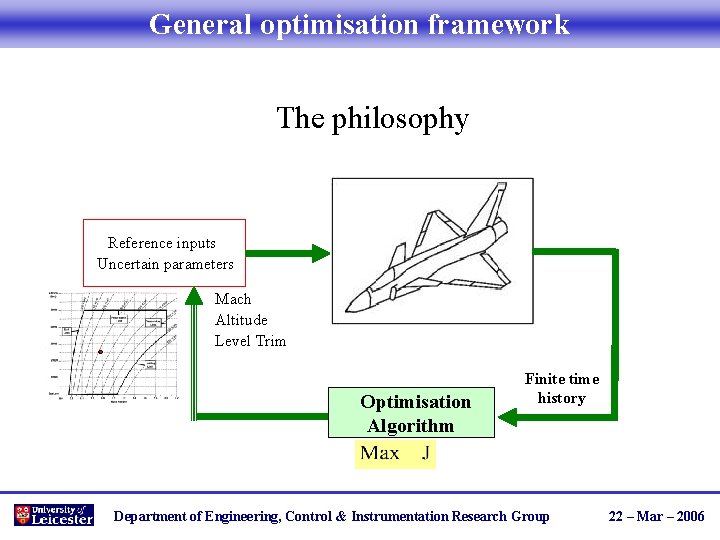
General optimisation framework The philosophy Reference inputs Uncertain parameters Mach Altitude Level Trim Optimisation Algorithm Finite time history Department of Engineering, Control & Instrumentation Research Group 22 – Mar – 2006
Global Optimisation Schemes • Several algorithms evaluated: – Genetic algorithms (GA) – Differential evolution (DE) – Hybrid GA / Hybrid DE – Dividing Rectangles (DIRECT) Department of Engineering, Control & Instrumentation Research Group 22 – Mar – 2006
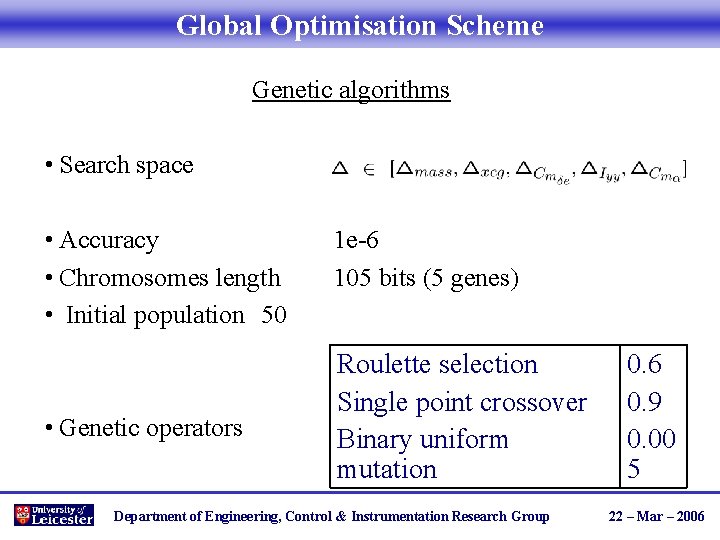
Global Optimisation Scheme Genetic algorithms • Search space • Accuracy • Chromosomes length • Initial population 50 • Genetic operators 1 e-6 105 bits (5 genes) Roulette selection Single point crossover Binary uniform mutation Department of Engineering, Control & Instrumentation Research Group 0. 6 0. 9 0. 00 5 22 – Mar – 2006
Global Optimisation Scheme Genetic algorithms (cont. ) • Termination criteria – improvement on the solution accuracy ≤ 1 e-6 – for a defined number of generations, fixed at 15 – stop iteration • Each trial gives different total number of simulations Department of Engineering, Control & Instrumentation Research Group 22 – Mar – 2006
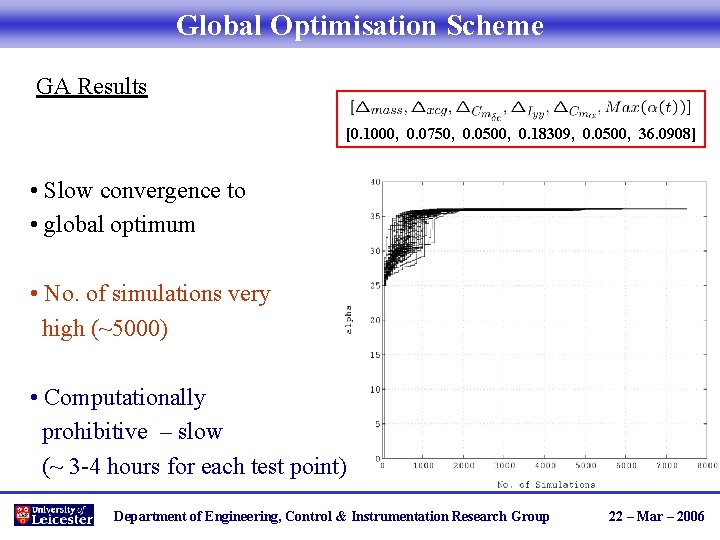
Global Optimisation Scheme GA Results [0. 1000, 0. 0750, 0. 0500, 0. 18309, 0. 0500, 36. 0908] • Slow convergence to • global optimum • No. of simulations very high (~5000) • Computationally prohibitive – slow (~ 3 -4 hours for each test point) Department of Engineering, Control & Instrumentation Research Group 22 – Mar – 2006
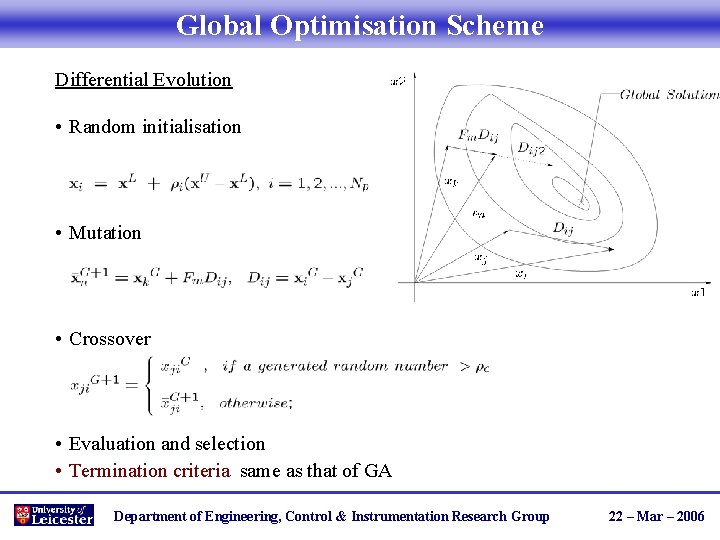
Global Optimisation Scheme Differential Evolution • Random initialisation • Mutation • Crossover • Evaluation and selection • Termination criteria same as that of GA Department of Engineering, Control & Instrumentation Research Group 22 – Mar – 2006
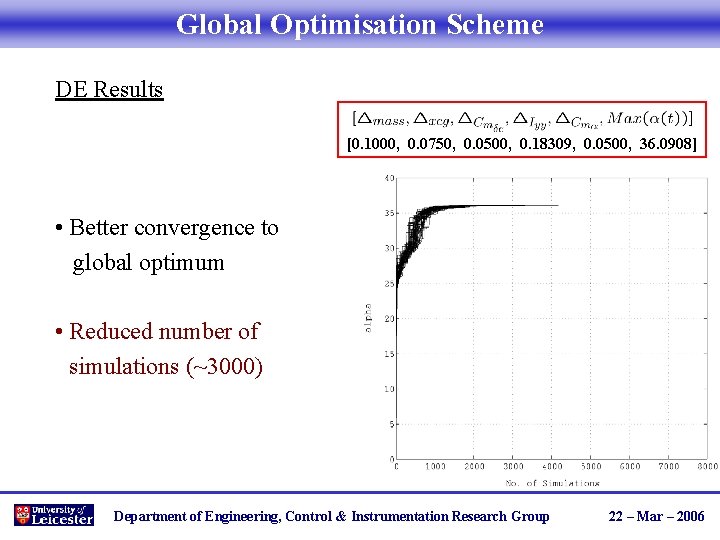
Global Optimisation Scheme DE Results [0. 1000, 0. 0750, 0. 0500, 0. 18309, 0. 0500, 36. 0908] • Better convergence to global optimum • Reduced number of simulations (~3000) Department of Engineering, Control & Instrumentation Research Group 22 – Mar – 2006
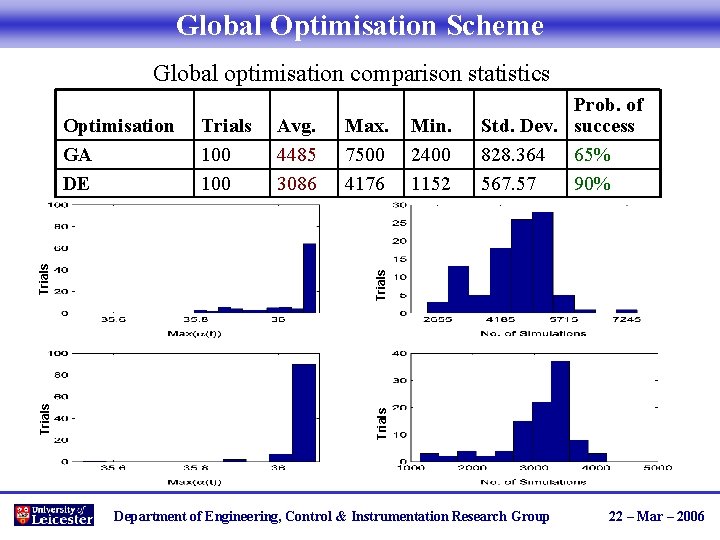
Global Optimisation Scheme Global optimisation comparison statistics Avg. 4485 3086 Max. 7500 4176 Min. 2400 1152 Trials 100 Trials Optimisation GA DE Prob. of Std. Dev. success 828. 364 65% 567. 57 90% Department of Engineering, Control & Instrumentation Research Group 22 – Mar – 2006
Hybrid Optimisation Scheme • Hybrid global and local optimisation schemes • Exploit the advantages of both schemes • Question: When to switch between the schemes? • Standard approach: run global algorithm, then run local algorithm • We use a more sophisticated decision making scheme based on one proposed by Lobo and Goldberg, 1996 Department of Engineering, Control & Instrumentation Research Group 22 – Mar – 2006
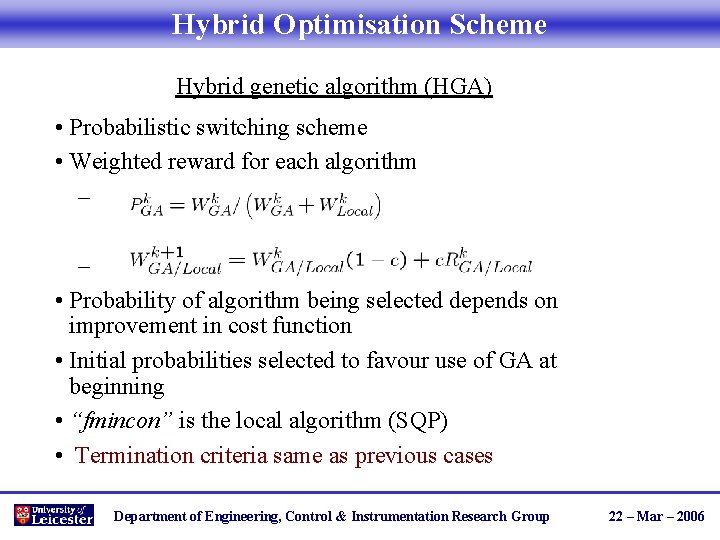
Hybrid Optimisation Scheme Hybrid genetic algorithm (HGA) • Probabilistic switching scheme • Weighted reward for each algorithm – – • Probability of algorithm being selected depends on improvement in cost function • Initial probabilities selected to favour use of GA at beginning • “fmincon” is the local algorithm (SQP) • Termination criteria same as previous cases Department of Engineering, Control & Instrumentation Research Group 22 – Mar – 2006
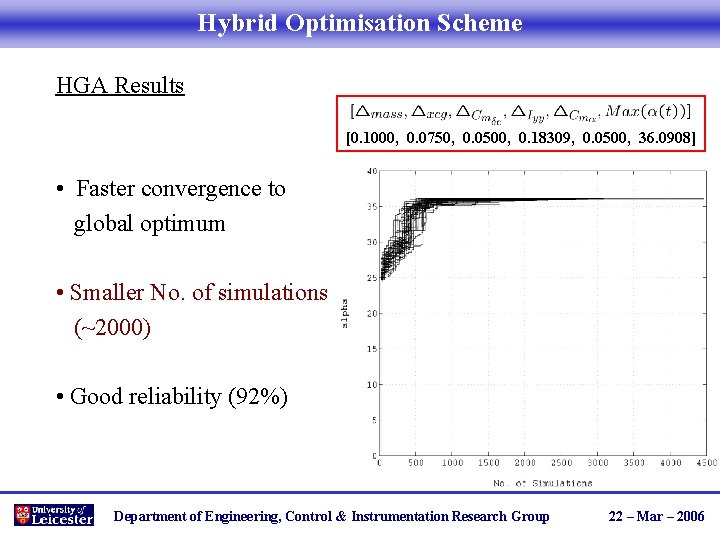
Hybrid Optimisation Scheme HGA Results [0. 1000, 0. 0750, 0. 0500, 0. 18309, 0. 0500, 36. 0908] • Faster convergence to global optimum • Smaller No. of simulations (~2000) • Good reliability (92%) Department of Engineering, Control & Instrumentation Research Group 22 – Mar – 2006
Hybrid Optimisation Scheme Hybrid differential evolution • Global optimisation used is DE • Local optimisation is “fmincon” (SQP) • Switching scheme – Simple method; Starts with DE – When there is no improvement from successive iterations: – choose a random initial solution from the current iteration set – apply local optimisation – replace solution from local if improvement occurs • Termination criteria: same as previous cases Department of Engineering, Control & Instrumentation Research Group 22 – Mar – 2006
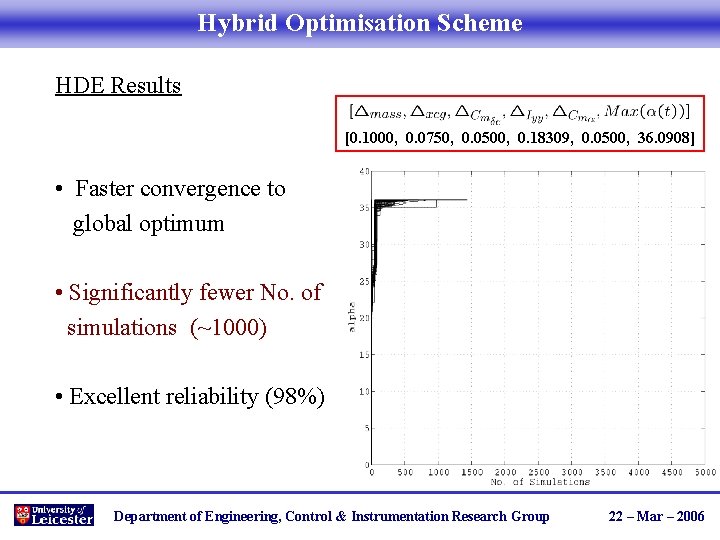
Hybrid Optimisation Scheme HDE Results [0. 1000, 0. 0750, 0. 0500, 0. 18309, 0. 0500, 36. 0908] • Faster convergence to global optimum • Significantly fewer No. of simulations (~1000) • Excellent reliability (98%) Department of Engineering, Control & Instrumentation Research Group 22 – Mar – 2006
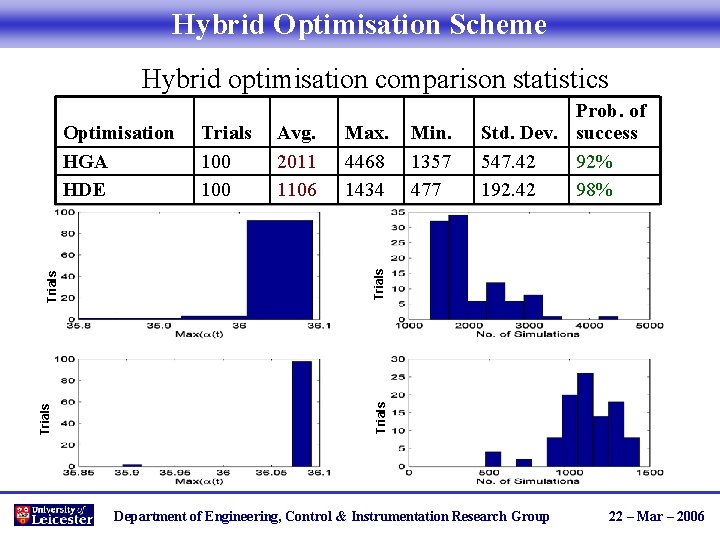
Hybrid Optimisation Scheme Hybrid optimisation comparison statistics Avg. 2011 1106 Max. 4468 1434 Min. 1357 477 Trials 100 Trials Optimisation HGA HDE Prob. of Std. Dev. success 547. 42 92% 192. 42 98% Department of Engineering, Control & Instrumentation Research Group 22 – Mar – 2006
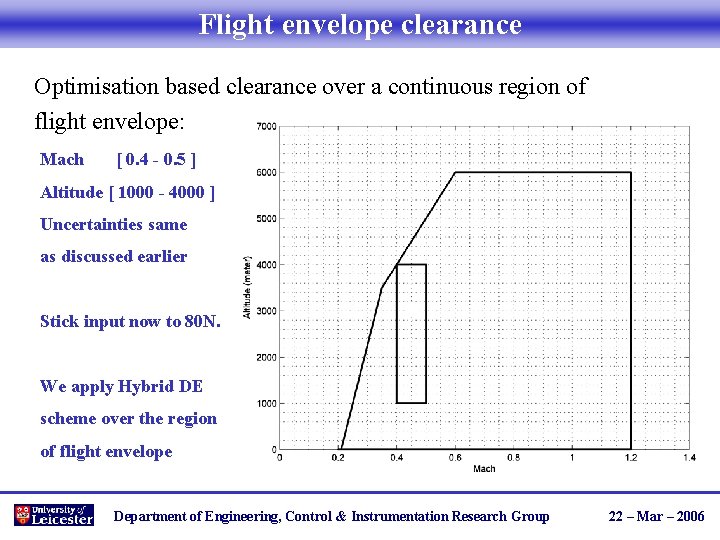
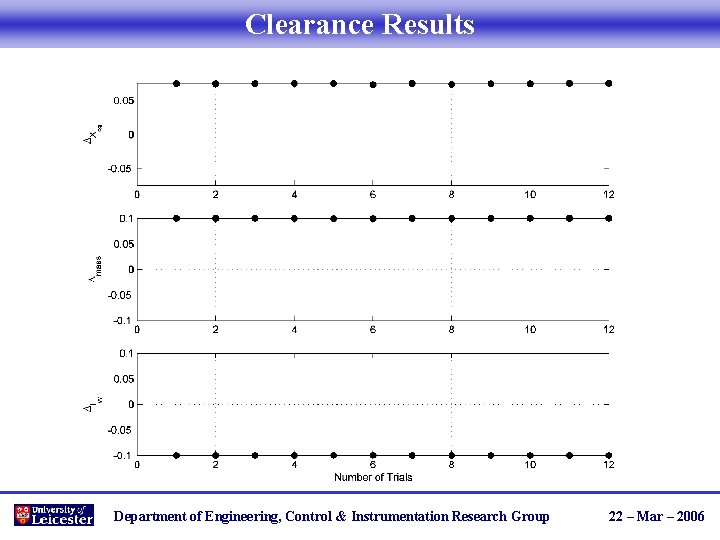
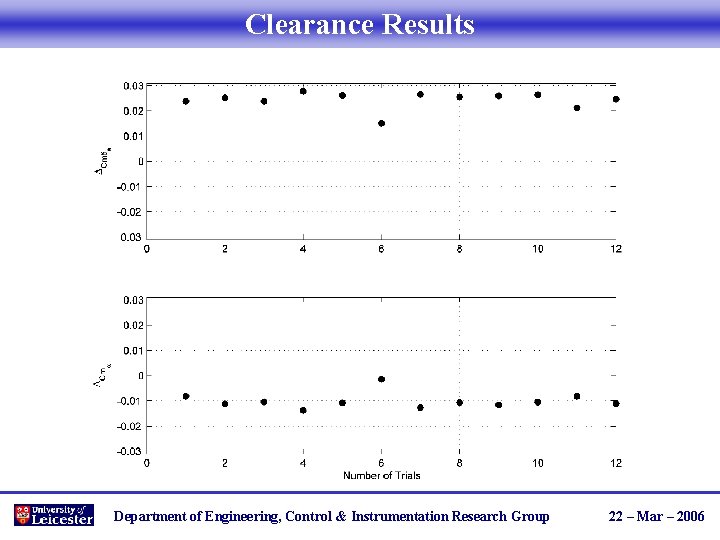
Flight envelope clearance Optimisation based clearance over a continuous region of flight envelope: Mach [ 0. 4 - 0. 5 ] Altitude [ 1000 - 4000 ] Uncertainties same as discussed earlier Stick input now to 80 N. We apply Hybrid DE scheme over the region of flight envelope Department of Engineering, Control & Instrumentation Research Group 22 – Mar – 2006
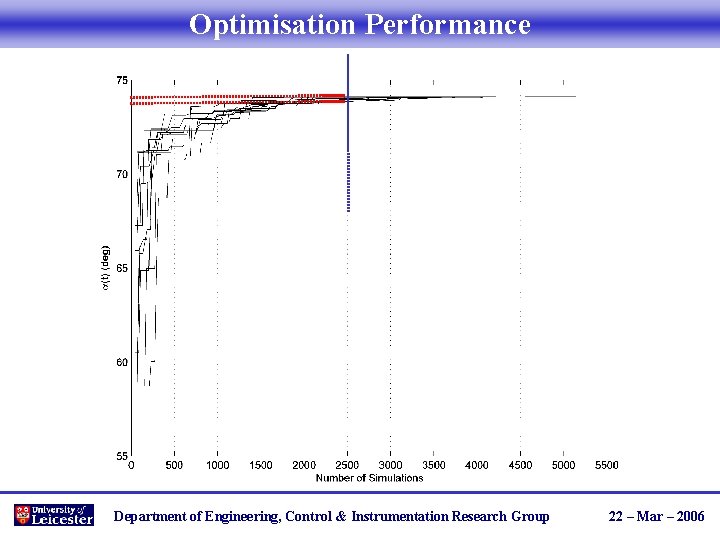
Optimisation Performance Department of Engineering, Control & Instrumentation Research Group 22 – Mar – 2006
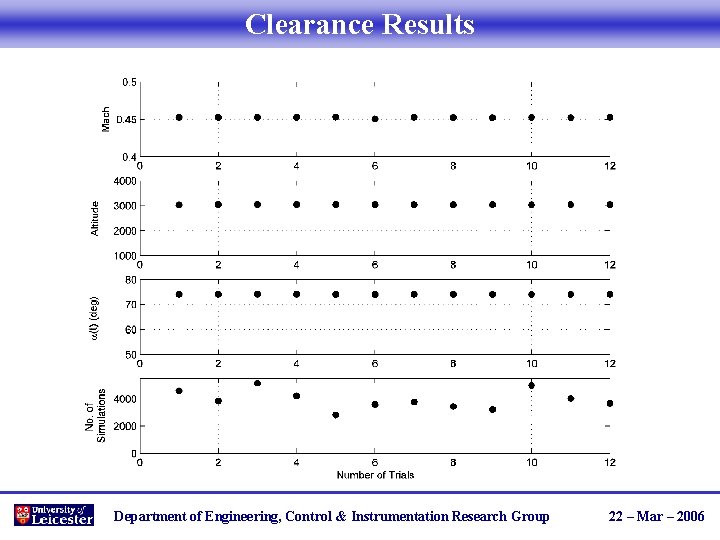
Clearance Results Department of Engineering, Control & Instrumentation Research Group 22 – Mar – 2006
Clearance Results Department of Engineering, Control & Instrumentation Research Group 22 – Mar – 2006
Clearance Results Department of Engineering, Control & Instrumentation Research Group 22 – Mar – 2006
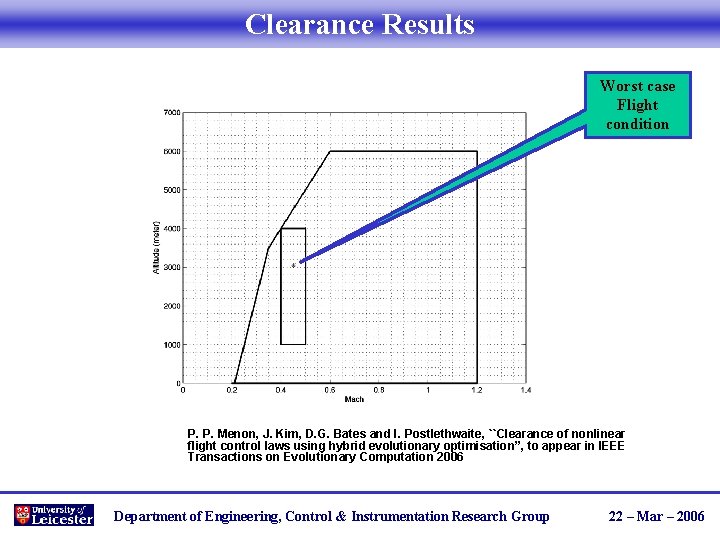
Clearance Results Worst case Flight condition P. P. Menon, J. Kim, D. G. Bates and I. Postlethwaite, ``Clearance of nonlinear flight control laws using hybrid evolutionary optimisation”, to appear in IEEE Transactions on Evolutionary Computation 2006 Department of Engineering, Control & Instrumentation Research Group 22 – Mar – 2006
Deterministic global optimisation • Disadvantages of stochastic optimisation for flight clearance: No guaranteed proof of convergence Require statistical analysis of performance Non-repeatability of results • DIviding RECTangles (DIRECT) is a deterministic global optimisation algorithm with a proof of convergence • Initial results of application of this method for flight clearance are very promising: P. P. Menon, D. G. Bates and I. Postlethwaite, ``A Hybrid Deterministic Optimisation Algorithm for Nonlinear Flight Clearance”, to appear in the proceedings of the American Control Conference, Boston, 2006 Department of Engineering, Control & Instrumentation Research Group 22 – Mar – 2006
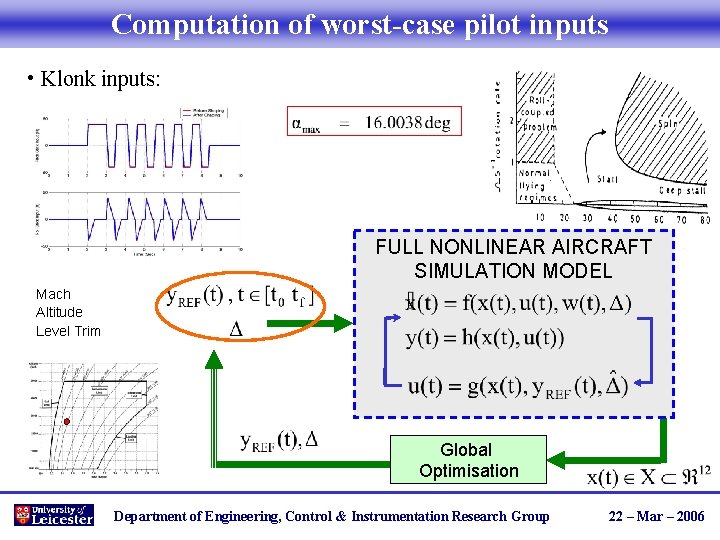
Computation of worst-case pilot inputs • Klonk inputs: FULL NONLINEAR AIRCRAFT SIMULATION MODEL Mach Altitude Level Trim Global Optimisation Department of Engineering, Control & Instrumentation Research Group 22 – Mar – 2006
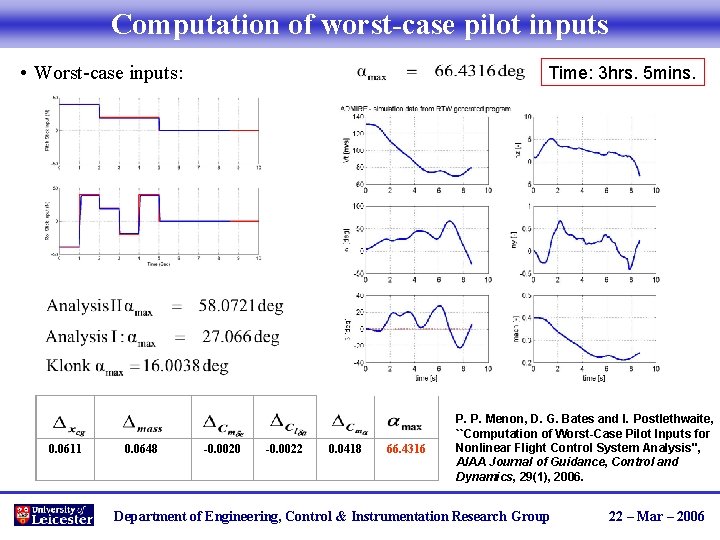
Computation of worst-case pilot inputs • Worst-case inputs: 0. 0611 0. 0648 Time: 3 hrs. 5 mins. -0. 0020 -0. 0022 0. 0418 66. 4316 P. P. Menon, D. G. Bates and I. Postlethwaite, ``Computation of Worst-Case Pilot Inputs for Nonlinear Flight Control System Analysis'', AIAA Journal of Guidance, Control and Dynamics, 29(1), 2006. Department of Engineering, Control & Instrumentation Research Group 22 – Mar – 2006
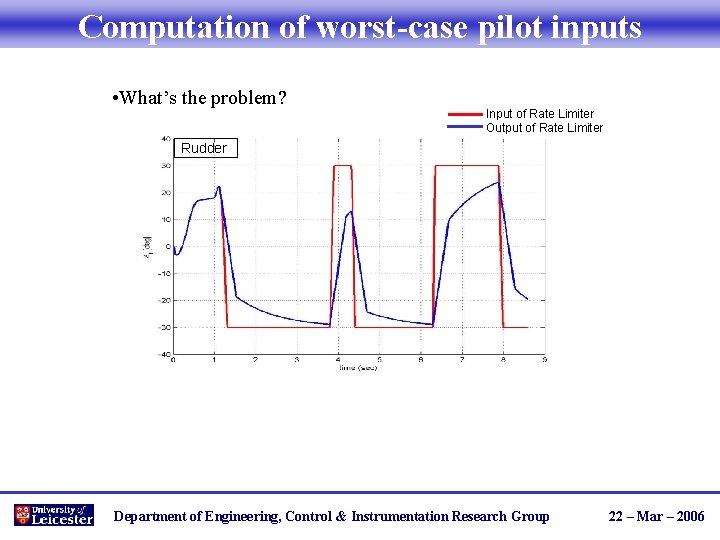
Computation of worst-case pilot inputs • What’s the problem? Input of Rate Limiter Output of Rate Limiter Rudder Department of Engineering, Control & Instrumentation Research Group 22 – Mar – 2006
Conclusions • Results demonstrate that the uncertain parameter combination resulting in worst behaviour need not be at extremum bounds • Hybrid optimisations schemes successfully applied to a nonlinear flight clearance problem over a continuous region of the flight envelope • Flexibility of the framework also allows robust computation of worst case pilot inputs • Improved accuracy and faster convergence due to hybridisation could allow the use of such methods in the industrial flight clearance process Department of Engineering, Control & Instrumentation Research Group 22 – Mar – 2006
- Slides: 33