
Optimal PID control of double integrating processes Chriss
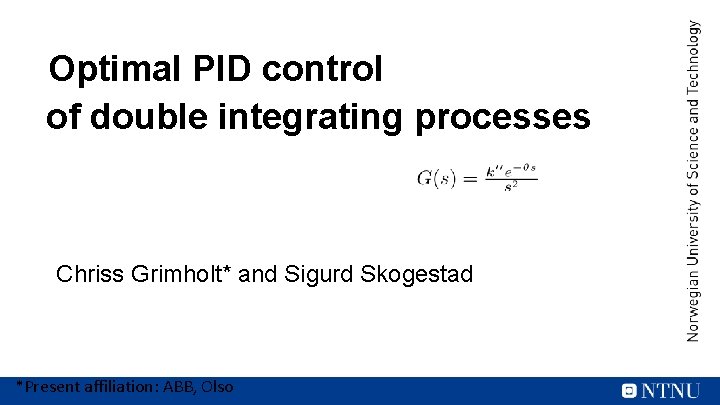
Optimal PID control of double integrating processes Chriss Grimholt* and Sigurd Skogestad *Present affiliation: ABB, Olso
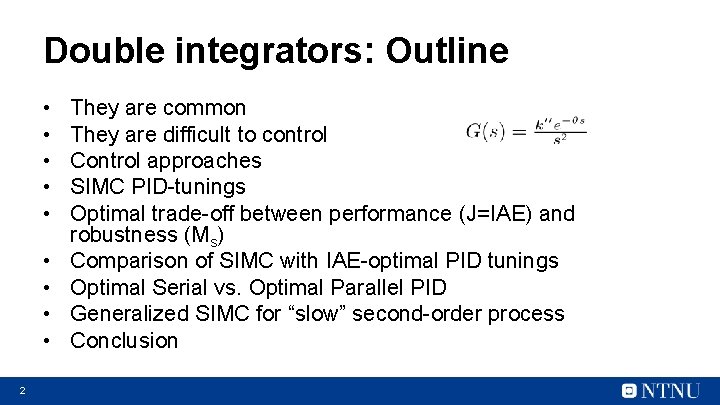
Double integrators: Outline • • • 2 They are common They are difficult to control Control approaches SIMC PID-tunings Optimal trade-off between performance (J=IAE) and robustness (Ms) Comparison of SIMC with IAE-optimal PID tunings Optimal Serial vs. Optimal Parallel PID Generalized SIMC for “slow” second-order process Conclusion
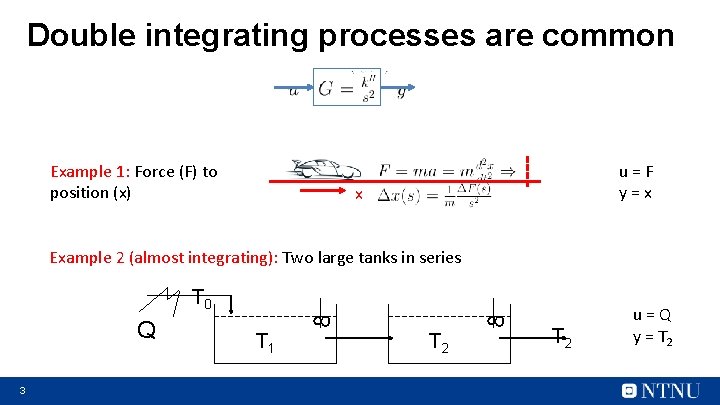
Double integrating processes are common Example 1: Force (F) to position (x) u=F y=x x Example 2 (almost integrating): Two large tanks in series 3 T 1 8 Q 8 T 0 T 2 u=Q y = T 2
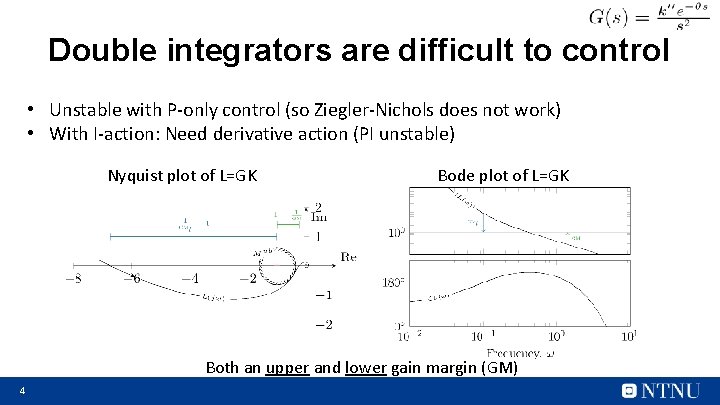
Double integrators are difficult to control • Unstable with P-only control (so Ziegler-Nichols does not work) • With I-action: Need derivative action (PI unstable) Nyquist plot of L=GK Bode plot of L=GK Both an upper and lower gain margin (GM) 4
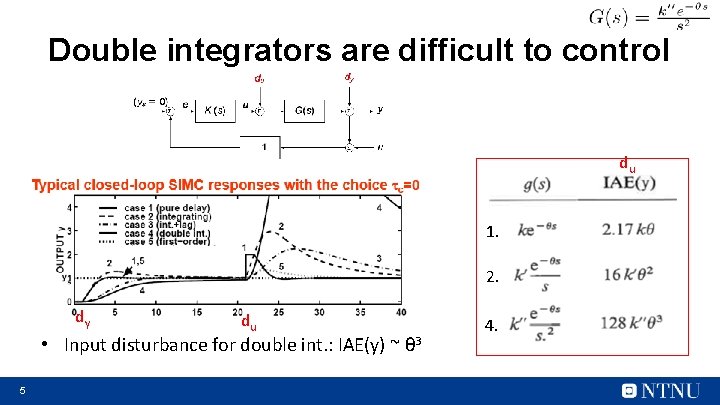
Double integrators are difficult to control du 1. 2. dy du • Input disturbance for double int. : IAE(y) ~ θ 3 5 4.
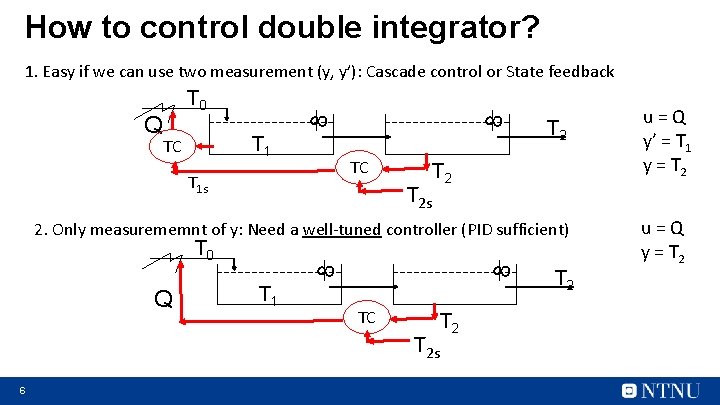
How to control double integrator? 1. Easy if we can use two measurement (y, y’): Cascade control or State feedback 8 8 Q T 0 T 1 TC TC T 1 s T 2 T 2 s 2. Only measurememnt of y: Need a well-tuned controller (PID sufficient) 8 8 T 0 Q T 1 TC T 2 s 6 u=Q y’ = T 1 y = T 2 u=Q y = T 2
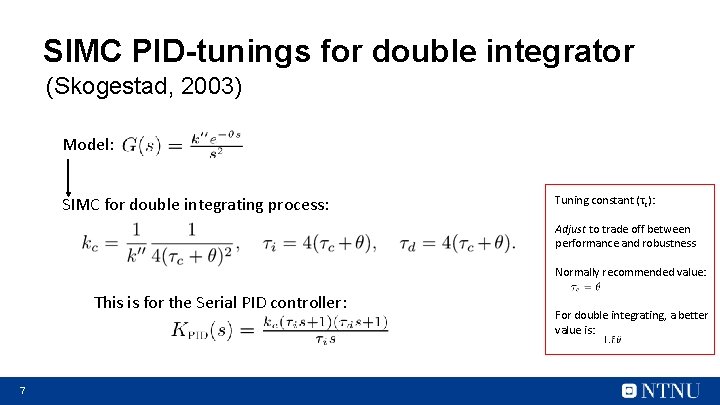
SIMC PID-tunings for double integrator (Skogestad, 2003) Model: SIMC for double integrating process: Tuning constant (τc): Adjust to trade off between performance and robustness Normally recommended value: This is for the Serial PID controller: 7 For double integrating, a better value is:
Optimal PID control Many issues to consider, including: • Output Performance • Stability robustness • Input usage • Noise sensitivity Consider only the main trade-off (high-gain versus low gain) 1. Output Performance (IAE) 2. Robustness (Ms-value) 8
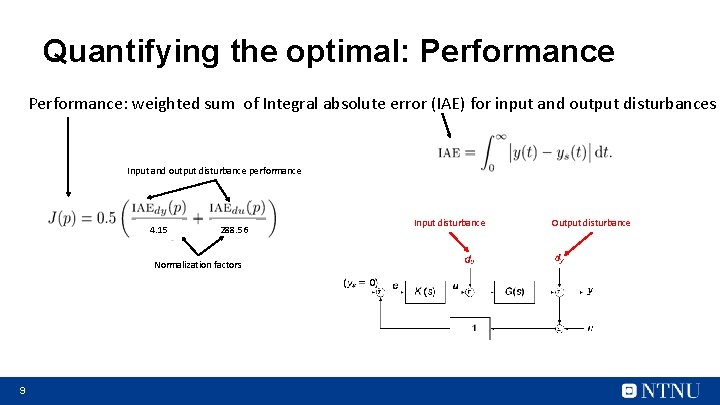
Quantifying the optimal: Performance: weighted sum of Integral absolute error (IAE) for input and output disturbances Input and output disturbance performance 4. 15 288. 56 Normalization factors 9 Input disturbance Output disturbance
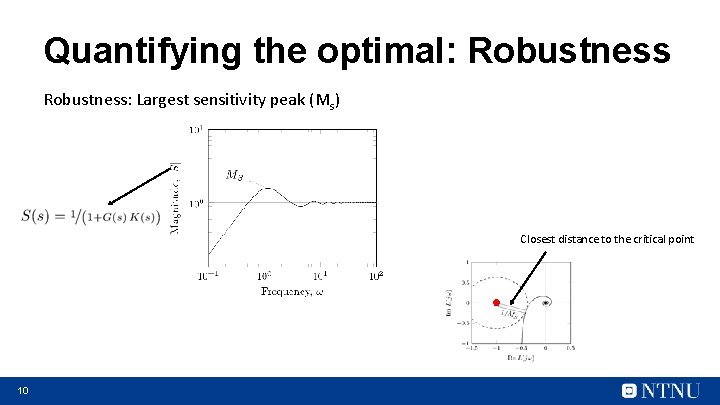
Quantifying the optimal: Robustness: Largest sensitivity peak (MS) Closest distance to the critical point 10
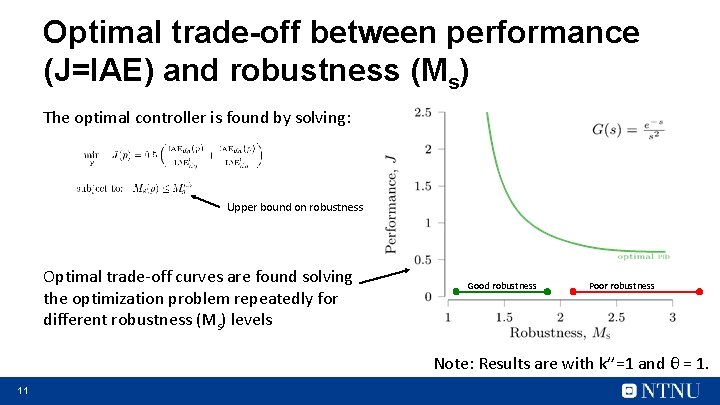
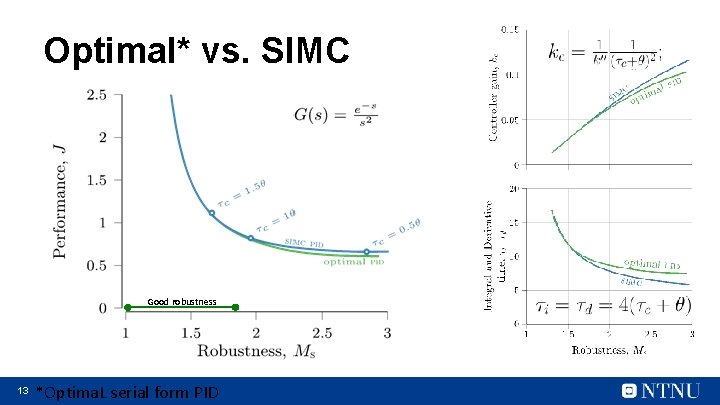
Optimal trade-off between performance (J=IAE) and robustness (Ms) The optimal controller is found by solving: Upper bound on robustness Optimal trade-off curves are found solving the optimization problem repeatedly for different robustness (Ms) levels Good robustness Poor robustness Note: Results are with k’’=1 and θ = 1. 11
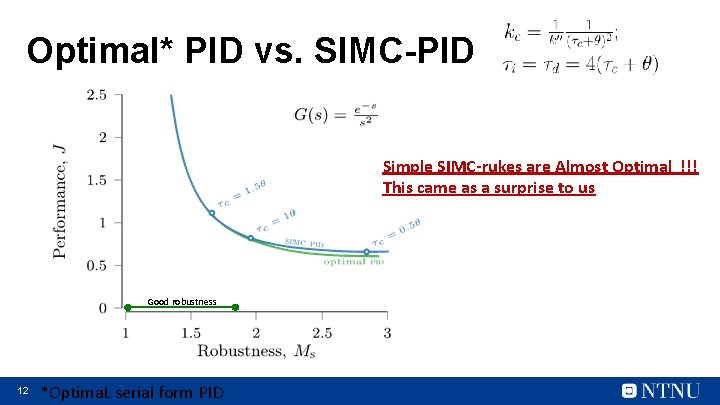
Optimal* PID vs. SIMC-PID Simple SIMC-rukes are Almost Optimal !!! This came as a surprise to us Good robustness 12 *Optima. L serial form PID
Optimal* vs. SIMC Good robustness 13 *Optima. L serial form PID
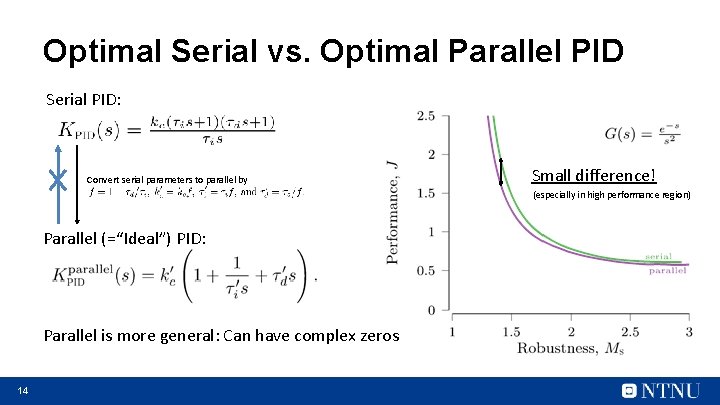
Optimal Serial vs. Optimal Parallel PID Serial PID: Convert serial parameters to parallel by Small difference! (especially in high performance region) Parallel (=“Ideal”) PID: Parallel is more general: Can have complex zeros 14
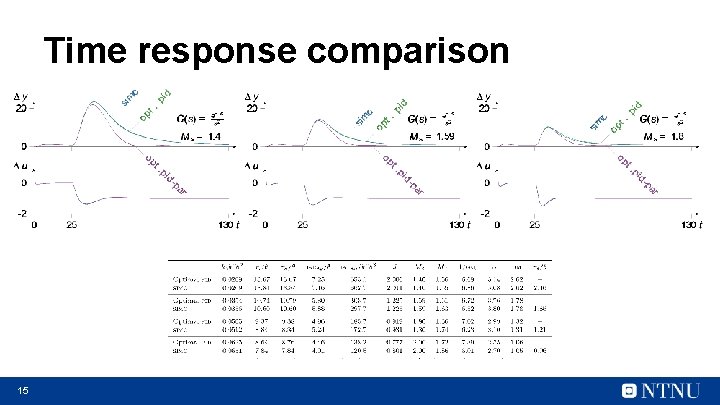
Time response comparison 15
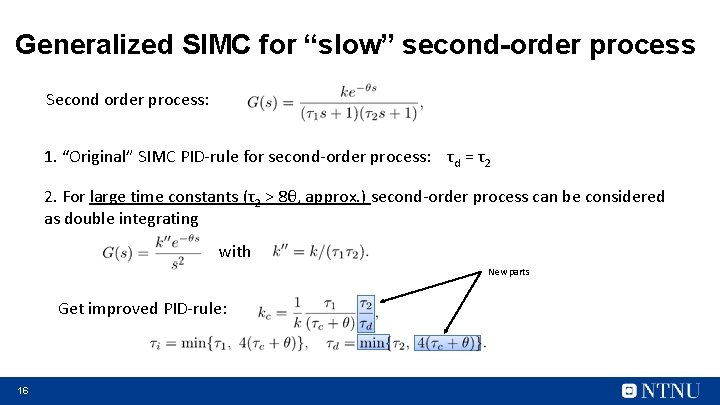
Generalized SIMC for “slow” second-order process Second order process: 1. “Original” SIMC PID-rule for second-order process: τd = τ2 2. For large time constants (τ2 > 8θ, approx. ) second-order process can be considered as double integrating with New parts Get improved PID-rule: 16
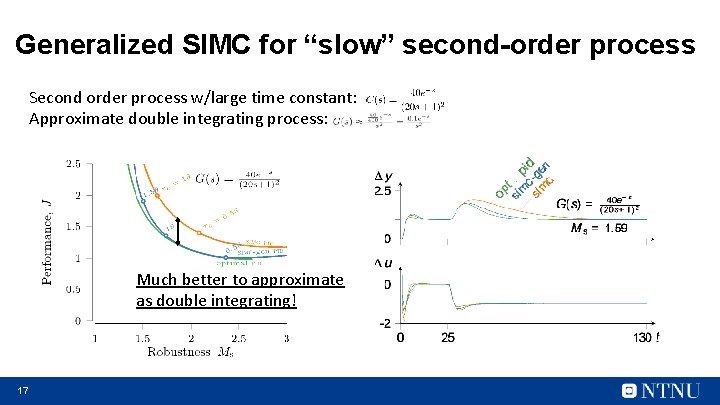
Generalized SIMC for “slow” second-order process Second order process w/large time constant: Approximate double integrating process: Much better to approximate as double integrating! 17
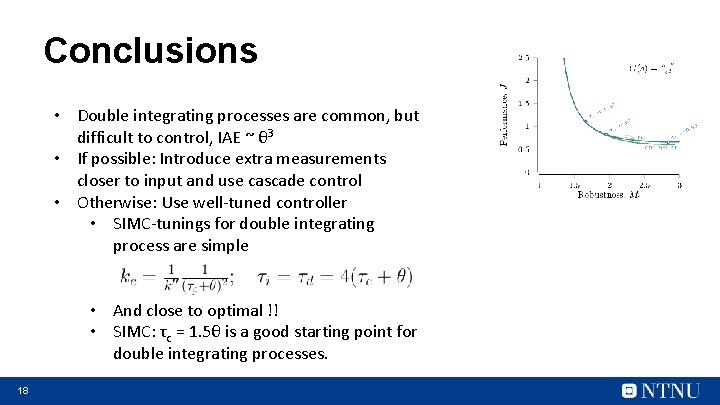
Conclusions • Double integrating processes are common, but difficult to control, IAE ~ θ 3 • If possible: Introduce extra measurements closer to input and use cascade control • Otherwise: Use well-tuned controller • SIMC-tunings for double integrating process are simple • And close to optimal !! • SIMC: τc = 1. 5θ is a good starting point for double integrating processes. 18
- Slides: 18