
Optimal PBD Binding Motif Sp Sp TPX Elia
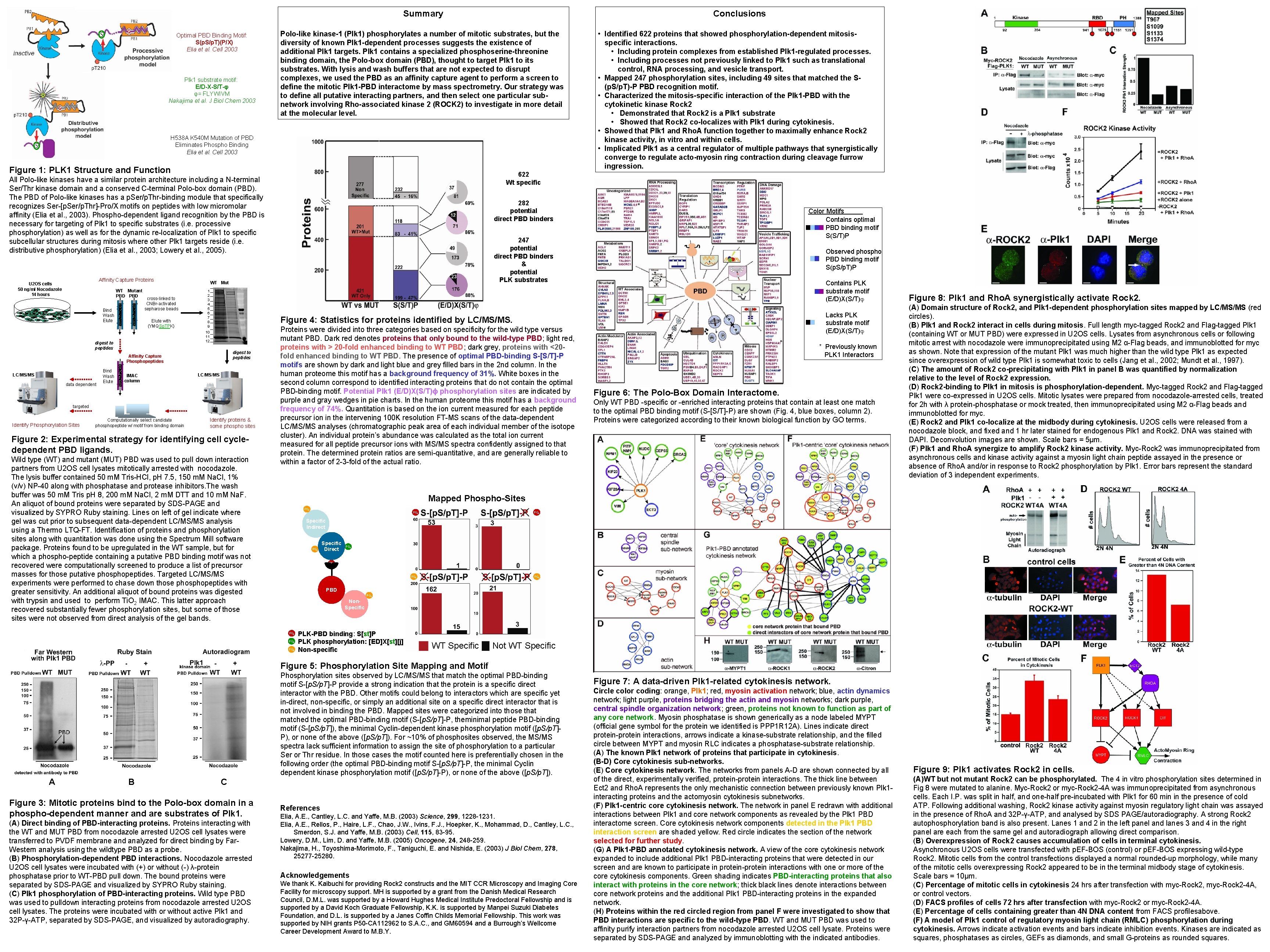
Optimal PBD Binding Motif: S(p. S/p. T)(P/X) Elia et al. Cell 2003 Plk 1 substrate motif: E/D-X-S/T-φ φ= FLYWIVM Nakajima et al. J Biol Chem 2003 Summary Conclusions Polo-like kinase-1 (Plk 1) phosphorylates a number of mitotic substrates, but the diversity of known Plk 1 -dependent processes suggests the existence of additional Plk 1 targets. Plk 1 contains a specialized phoserine-threonine binding domain, the Polo-box domain (PBD), thought to target Plk 1 to its substrates. With lysis and wash buffers that are not expected to disrupt complexes, we used the PBD as an affinity capture agent to perform a screen to define the mitotic Plk 1 -PBD interactome by mass spectrometry. Our strategy was to define all putative interacting partners, and then select one particular subnetwork involving Rho-associated kinase 2 (ROCK 2) to investigate in more detail at the molecular level. • Identified 622 proteins that showed phosphorylation-dependent mitosisspecific interactions. • Including protein complexes from established Plk 1 -regulated processes. • Including processes not previously linked to Plk 1 such as translational control, RNA processing, and vesicle transport. • Mapped 247 phosphorylation sites, including 49 sites that matched the S(p. S/p. T)-P PBD recognition motif. • Characterized the mitosis-specific interaction of the Plk 1 -PBD with the cytokinetic kinase Rock 2 • Demonstrated that Rock 2 is a Plk 1 substrate • Showed that Rock 2 co-localizes with Plk 1 during cytokinesis. • Showed that Plk 1 and Rho. A function together to maximally enhance Rock 2 kinase activity, in vitro and within cells. • Implicated Plk 1 as a central regulator of multiple pathways that synergistically converge to regulate acto-myosin ring contraction during cleavage furrow ingression. H 538 A K 540 M Mutation of PBD Eliminates Phospho Binding Elia et al. Cell 2003 Figure 1: PLK 1 Structure and Function 622 Wt specific All Polo-like kinases have a similar protein architecture including a N-terminal Ser/Thr kinase domain and a conserved C-terminal Polo-box domain (PBD). The PBD of Polo-like kinases has a p. Ser/p. Thr-binding module that specifically recognizes Ser-[p. Ser/p. Thr]-Pro/X motifs on peptides with low micromolar affinity (Elia et al. , 2003). Phospho-dependent ligand recognition by the PBD is necessary for targeting of Plk 1 to specific substrates (i. e. processive phosphorylation) as well as for the dynamic re-localization of Plk 1 to specific subcellular structures during mitosis where other Plk 1 targets reside (i. e. distributive phosphorylation) (Elia et al. , 2003; Lowery et al. , 2005). Affinity Capture Proteins U 2 OS cells 50 ng/ml Nocodazole 14 hours WT Mutant PBD Bind Wash Elute cross-linked to CNBr-activated sepharose beads Elute with (YMQSp. TPK) 1 2 3 4 5 6 7 8 9 data dependent Bind Wash Elute IMAC column digest to peptides LC/MS/MS targeted Identify Phosphorylation Sites Computationally select candidate phosphopeptide w/ motif from binding domain Observed phospho PBD binding motif S(p. S/p. T)P Contains PLK substrate motif (E/D)X(S/T)j Lacks PLK substrate motif (E/D)X(S/T)j Figure 4: Statistics for proteins identified by LC/MS/MS. Affinity Capture Phosphopeptides LC/MS/MS Color Motifs Contains optimal PBD binding motif S(S/T)P 247 potential direct PBD binders & potential PLK substrates WT Mut 10 11 12 digest to peptides 282 potential direct PBD binders Identify proteins & some phospho sites Figure 2: Experimental strategy for identifying cell cycledependent PBD ligands. Wild type (WT) and mutant (MUT) PBD was used to pull down interaction partners from U 2 OS cell lysates mitotically arrested with nocodazole. The lysis buffer contained 50 m. M Tris-HCl, p. H 7. 5, 150 m. M Na. Cl, 1% (v/v) NP-40 along with phosphatase and protease inhibitors. The wash buffer was 50 m. M Tris p. H 8, 200 m. M Na. Cl, 2 m. M DTT and 10 m. M Na. F. An aliquot of bound proteins were separated by SDS-PAGE and visualized by SYPRO Ruby staining. Lines on left of gel indicate where gel was cut prior to subsequent data-dependent LC/MS/MS analysis using a Thermo LTQ-FT. Identification of proteins and phosphorylation sites along with quantitation was done using the Spectrum Mill software package. Proteins found to be upregulated in the WT sample, but for which a phospho-peptide containing a putative PBD binding motif was not recovered were computationally screened to produce a list of precursor masses for those putative phosphopeptides. Targeted LC/MS/MS experiments were performed to chase down those phosphopeptides with greater sensitivity. An additional aliquot of bound proteins was digested with trypsin and used to perform Ti. O 2 IMAC. This latter approach recovered substantially fewer phosphorylation sites, but some of those sites were not observed from direct analysis of the gel bands. Proteins were divided into three categories based on specificity for the wild type versus mutant PBD. Dark red denotes proteins that only bound to the wild-type PBD; light red, proteins with > 20 -fold enhanced binding to WT PBD; dark grey, proteins with <20 fold enhanced binding to WT PBD. The presence of optimal PBD-binding S-[S/T]-P motifs are shown by dark and light blue and grey filled bars in the 2 nd column. In the human proteome this motif has a background frequency of 31%. White boxes in the second column correspond to identified interacting proteins that do not contain the optimal PBD-binding motif. Potential Plk 1 (E/D)X(S/T)ϕ phosphorylation sites are indicated by purple and gray wedges in pie charts. In the human proteome this motif has a background frequency of 74%. Quantitation is based on the ion current measured for each peptide precursor ion in the intervening 100 K resolution FT-MS scans of the data-dependent LC/MS/MS analyses (chromatographic peak area of each individual member of the isotope cluster). An individual protein’s abundance was calculated as the total ion current measured for all peptide precursor ions with MS/MS spectra confidently assigned to that protein. The determined protein ratios are semi-quantitative, and are generally reliable to within a factor of 2 -3 -fold of the actual ratio. * Previously known PLK 1 Interactors Figure 6: The Polo-Box Domain Interactome. Only WT PBD -specific or -enriched interacting proteins that contain at least one match to the optimal PBD binding motif (S-[S/T]-P) are shown (Fig. 4, blue boxes, column 2). Proteins were categorized according to their known biological function by GO terms. Figure 8: Plk 1 and Rho. A synergistically activate Rock 2. (A) Domain structure of Rock 2, and Plk 1 -dependent phosphorylation sites mapped by LC/MS/MS (red circles). (B) Plk 1 and Rock 2 interact in cells during mitosis. Full length myc-tagged Rock 2 and Flag-tagged Plk 1 (containing WT or MUT PBD) were expressed in U 2 OS cells. Lysates from asynchronous cells or following mitotic arrest with nocodazole were immunoprecipitated using M 2 α-Flag beads, and immunoblotted for myc as shown. Note that expression of the mutant Plk 1 was much higher than the wild type Plk 1 as expected since overexpression of wild type Plk 1 is somewhat toxic to cells (Jang et al. , 2002; Mundt et al. , 1997). (C) The amount of Rock 2 co-precipitating with Plk 1 in panel B was quantified by normalization relative to the level of Rock 2 expression. (D) Rock 2 -binding to Plk 1 in mitosis is phosphorylation-dependent. Myc-tagged Rock 2 and Flag-tagged Plk 1 were co-expressed in U 2 OS cells. Mitotic lysates were prepared from nocodazole-arrested cells, treated for 2 h with λ protein-phosphatase or mock treated, then immunoprecipitated using M 2 α-Flag beads and immunoblotted for myc. (E) Rock 2 and Plk 1 co-localize at the midbody during cytokinesis. U 2 OS cells were released from a nocodazole block, and fixed and 1 hr later stained for endogenous Plk 1 and Rock 2. DNA was stained with DAPI. Deconvolution images are shown. Scale bars = 5μm. (F) Plk 1 and Rho. A synergize to amplify Rock 2 kinase activity. Myc-Rock 2 was immunoprecipitated from asynchronous cells and kinase activity against a myosin light chain peptide assayed in the presence or absence of Rho. A and/or in response to Rock 2 phosphorylation by Plk 1. Error bars represent the standard deviation of 3 independent experiments. Mapped Phospho-Sites PO 4 Specific Indirect PO 4 Specific Direct PO 4 PBD PO 4 Non. Specific PO 4 PLK-PBD binding: S[st]P PLK phosphorylation: [ED]X[st][j] Non-specific WT Specific Not WT Specific Figure 5: Phosphorylation Site Mapping and Motif Phosphorylation sites observed by LC/MS/MS that match the optimal PBD-binding motif S-[p. S/p. T]-P provide a strong indication that the protein is a specific direct interactor with the PBD. Other motifs could belong to interactors which are specific yet in-direct, non-specific, or simply an additional site on a specific direct interactor that is not involved in binding the PBD. Mapped sites were categorized into those that matched the optimal PBD-binding motif (S-[p. S/p. T]-P, theminimal peptide PBD-binding motif (S-[p. S/p. T]), the minimal Cyclin-dependent kinase phosphorylation motif ([p. S/p. T]P), or none of the above ([p. S/p. T]). For ~10% of phosites observed, the MS/MS spectra lack sufficient information to assign the site of phosphorylation to a particular Ser or Thr residue. In those cases the motif counted here is preferentially chosen in the following order (the optimal PBD-binding motif S-[p. S/p. T]-P, the minimal Cyclin dependent kinase phosphorylation motif ([p. S/p. T]-P), or none of the above ([p. S/p. T]). A B C Figure 3: Mitotic proteins bind to the Polo-box domain in a phospho-dependent manner and are substrates of Plk 1. (A) Direct binding of PBD-interacting proteins. Proteins interacting with the WT and MUT PBD from nocodazole arrested U 2 OS cell lysates were transferred to PVDF membrane and analyzed for direct binding by Far. Western analysis using the wildtype PBD as a probe. (B) Phosphorylation-dependent PBD interactions. Nocodazole arrested U 2 OS cell lysates were incubated with (+) or without (-) λ-protein phosphatase prior to WT-PBD pull down. The bound proteins were separated by SDS-PAGE and visualized by SYPRO Ruby staining. (C) Plk 1 phosphorylation of PBD-interacting proteins. Wild type PBD was used to pulldown interacting proteins from nocodazole arrested U 2 OS cell lysates. The proteins were incubated with or without active Plk 1 and 32 P-γ-ATP, separated by SDS-PAGE, and visualized by autoradiography. References Elia, A. E. , Cantley, L. C. and Yaffe, M. B. (2003) Science, 299, 1228 -1231. Elia, A. E. , Rellos, P. , Haire, L. F. , Chao, J. W. , Ivins, F. J. , Hoepker, K. , Mohammad, D. , Cantley, L. C. , Smerdon, S. J. and Yaffe, M. B. (2003) Cell, 115, 83 -95. Lowery, D. M. , Lim, D. and Yaffe, M. B. (2005) Oncogene, 248 -259. Nakajima, H. , Toyoshima-Morimoto, F. , Taniguchi, E. and Nishida, E. (2003) J Biol Chem, 278, 25277 -25280. Acknowledgements We thank K. Kaibuchi for providing Rock 2 constructs and the MIT CCR Microscopy and Imaging Core Facility for microscopy support. MH is supported by a grant from the Danish Medical Research Council, D. M. L. was supported by a Howard Hughes Medical Institute Predoctoral Fellowship and is supported by a David Koch Graduate Fellowship, K. K. is supported by Manpei Suzuki Diabetes Foundation, and D. L. is supported by a Janes Coffin Childs Memorial Fellowship. This work was supported by NIH grants P 50 -CA 112962 to S. A. C. , and GM 60594 and a Burrough’s Wellcome Career Development Award to M. B. Y. Figure 7: A data-driven Plk 1 -related cytokinesis network. Circle color coding: orange, Plk 1; red, myosin activation network; blue, actin dynamics network; light purple, proteins bridging the actin and myosin networks; dark purple, central spindle organization network; green, proteins not known to function as part of any core network. Myosin phosphatase is shown generically as a node labeled MYPT (official gene symbol for the protein we identified is PPP 1 R 12 A). Lines indicate direct protein-protein interactions, arrows indicate a kinase-substrate relationship, and the filled circle between MYPT and myosin RLC indicates a phosphatase-substrate relationship. (A) The known Plk 1 network of proteins that participate in cytokinesis. (B-D) Core cytokinesis sub-networks. (E) Core cytokinesis network. The networks from panels A-D are shown connected by all of the direct, experimentally verified, protein-protein interactions. The thick line between Ect 2 and Rho. A represents the only mechanistic connection between previously known Plk 1 interacting proteins and the actomyosin cytokinesis subnetworks. (F) Plk 1 -centric core cytokinesis network. The network in panel E redrawn with additional interactions between Plk 1 and core network components as revealed by the Plk 1 PBD interactome screen. Core cytokinesis network components detected in the Plk 1 PBD interaction screen are shaded yellow. Red circle indicates the section of the network selected for further study. (G) A Plk 1 -PBD annotated cytokinesis network. A view of the core cytokinesis network expanded to include additional Plk 1 PBD-interacting proteins that were detected in our screen and are known to participate in protein-protein interactions with one or more of the core cytokinesis components. Green shading indicates PBD-interacting proteins that also interact with proteins in the core network; thick black lines denote interactions between core network proteins and the additional Plk 1 PBD-interacting proteins in the expanded network. (H) Proteins within the red circled region from panel F were investigated to show that PBD interactions are specific to the wild-type PBD. WT and MUT PBD was used to affinity purify interaction partners from nocodazole arrested U 2 OS cell lysate. Proteins were separated by SDS-PAGE and analyzed by immunoblotting with the indicated antibodies. Figure 9: Plk 1 activates Rock 2 in cells. (A)WT but not mutant Rock 2 can be phosphorylated. The 4 in vitro phosphorylation sites determined in Fig 8 were mutated to alanine. Myc-Rock 2 or myc-Rock 2 -4 A was immunoprecipitated from asynchronous cells. Each I. P. was split in half, and one-half pre-incubated with Plk 1 for 60 min in the presence of cold ATP. Following additional washing, Rock 2 kinase activity against myosin regulatory light chain was assayed in the presence of Rho. A and 32 P-γ-ATP, and analysed by SDS PAGE/autoradiography. A strong Rock 2 autophosphorylation band is also present. Lanes 1 and 2 in the left panel and lanes 3 and 4 in the right panel are each from the same gel and autoradiograph allowing direct comparison. (B) Overexpression of Rock 2 causes accumulation of cells in terminal cytokinesis. Asynchronous U 2 OS cells were transfected with p. EF-BOS (control) or p. EF-BOS expressing wild-type Rock 2. Mitotic cells from the control transfections displayed a normal rounded-up morphology, while many of the mitotic cells overexpressing Rock 2 appeared to be in the terminal midbody stage of cytokinesis. Scale bars = 10μm. (C) Percentage of mitotic cells in cytokinesis 24 hrs after transfection with myc-Rock 2, myc-Rock 2 -4 A, or control vectors. (D) FACS profiles of cells 72 hrs after transfection with myc-Rock 2 or myc-Rock 2 -4 A. (E) Percentage of cells containing greater than 4 N DNA content from FACS profilesabove. (F) A model of Plk 1 control of regulatory myosin light chain (RMLC) phosphorylation during cytokinesis. Arrows indicate activation events and bars indicate inhibition events. Kinases are indicated as squares, phosphatases as circles, GEFs as diamonds, and small G-proteins as rounded squares.
- Slides: 1