
Optimal Operation and Control of Refrigeration Processes including
- Slides: 37
Optimal Operation and Control of Refrigeration Processes (including LNG Plants) September 26, 2003
Outline l l l l The basic refrigeration cycle Other refrigeration processes Where is refrigeration applied? Energy saving by improved operation or control Optimal operation and control LNG plants Summary Acknowledgments References September 26 2003 2
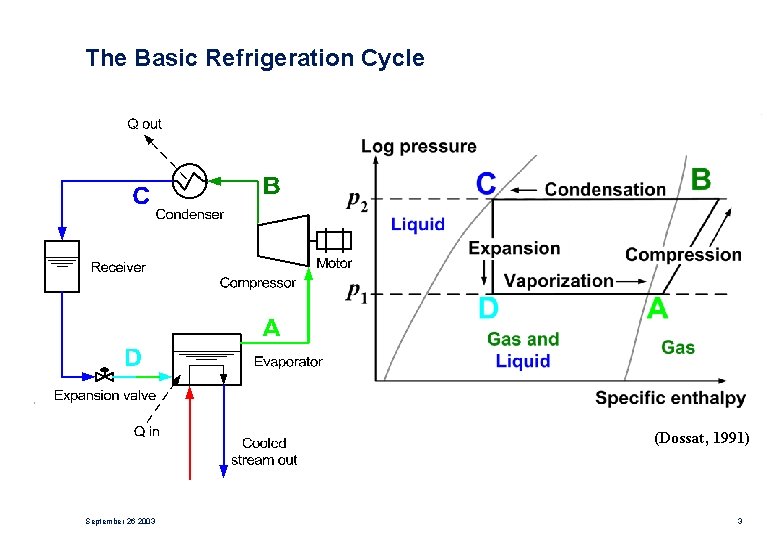
The Basic Refrigeration Cycle (Dossat, 1991) September 26 2003 3
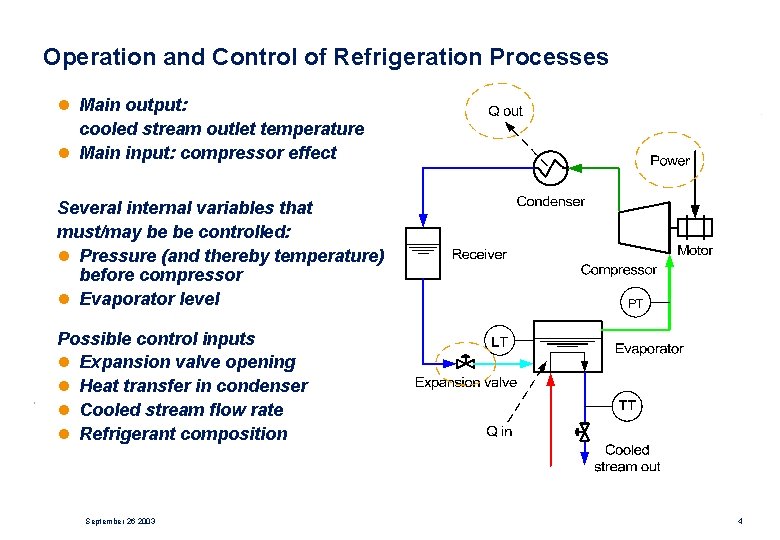
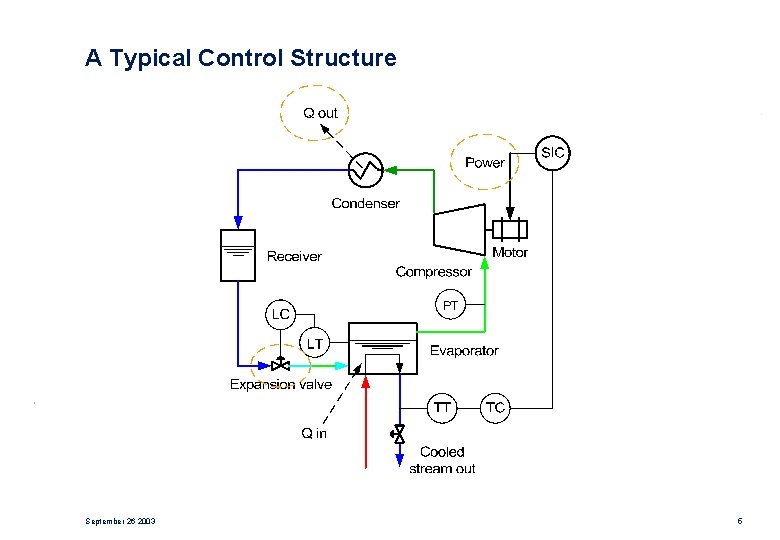
Operation and Control of Refrigeration Processes l Main output: cooled stream outlet temperature l Main input: compressor effect Several internal variables that must/may be be controlled: l Pressure (and thereby temperature) before compressor l Evaporator level Possible control inputs l Expansion valve opening l Heat transfer in condenser l Cooled stream flow rate l Refrigerant composition September 26 2003 4
A Typical Control Structure September 26 2003 5
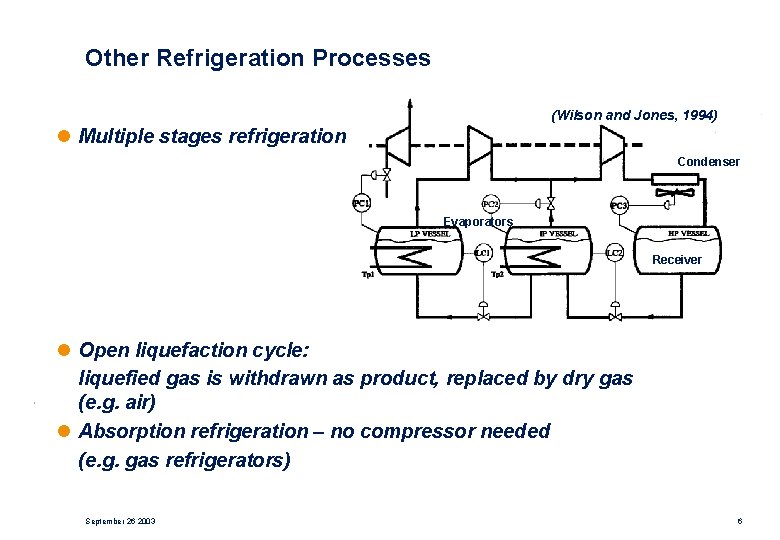
Other Refrigeration Processes (Wilson and Jones, 1994) l Multiple stages refrigeration Condenser Evaporators Receiver l Open liquefaction cycle: liquefied gas is withdrawn as product, replaced by dry gas (e. g. air) l Absorption refrigeration – no compressor needed (e. g. gas refrigerators) September 26 2003 6
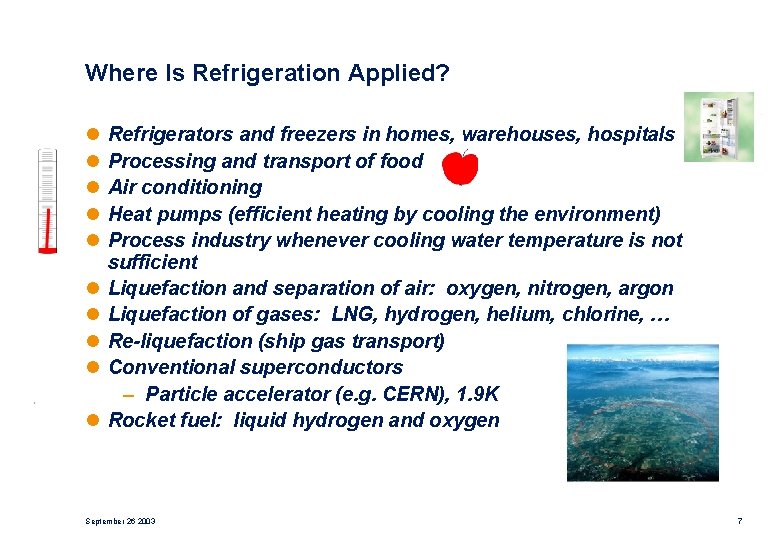
Where Is Refrigeration Applied? l l l l l Refrigerators and freezers in homes, warehouses, hospitals Processing and transport of food Air conditioning Heat pumps (efficient heating by cooling the environment) Process industry whenever cooling water temperature is not sufficient Liquefaction and separation of air: oxygen, nitrogen, argon Liquefaction of gases: LNG, hydrogen, helium, chlorine, … Re-liquefaction (ship gas transport) Conventional superconductors – Particle accelerator (e. g. CERN), 1. 9 K Rocket fuel: liquid hydrogen and oxygen September 26 2003 7
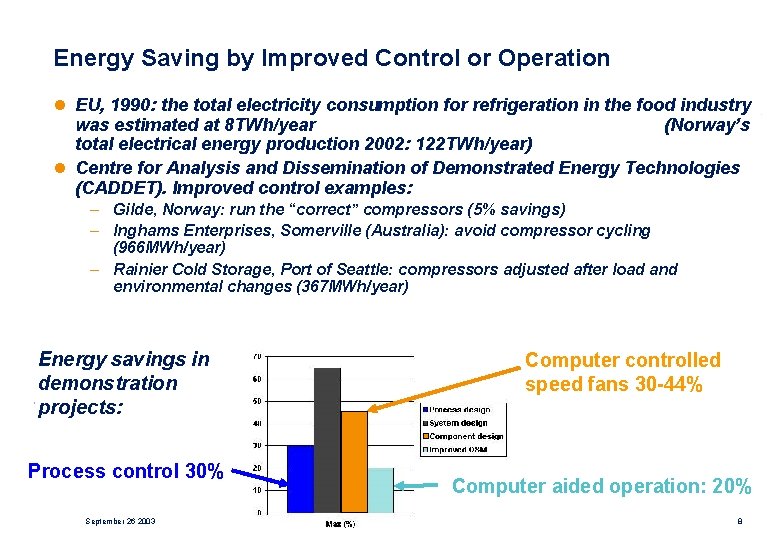
Energy Saving by Improved Control or Operation l EU, 1990: the total electricity consumption for refrigeration in the food industry was estimated at 8 TWh/year (Norway’s total electrical energy production 2002: 122 TWh/year) l Centre for Analysis and Dissemination of Demonstrated Energy Technologies (CADDET). Improved control examples: – Gilde, Norway: run the “correct” compressors (5% savings) – Inghams Enterprises, Somerville (Australia): avoid compressor cycling (966 MWh/year) – Rainier Cold Storage, Port of Seattle: compressors adjusted after load and environmental changes (367 MWh/year) Energy savings in demonstration projects: Process control 30% September 26 2003 Computer controlled speed fans 30 -44% Computer aided operation: 20% 8
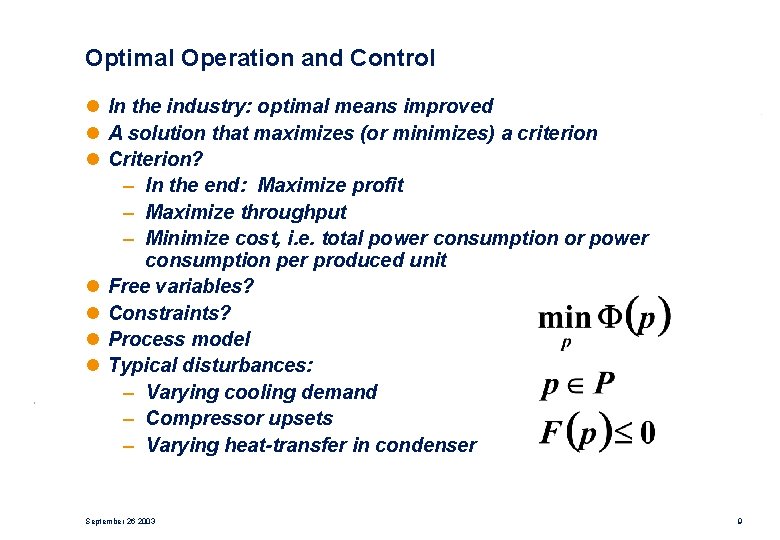
Optimal Operation and Control l In the industry: optimal means improved l A solution that maximizes (or minimizes) a criterion l Criterion? – In the end: Maximize profit – Maximize throughput – Minimize cost, i. e. total power consumption or power consumption per produced unit l Free variables? l Constraints? l Process model l Typical disturbances: – Varying cooling demand – Compressor upsets – Varying heat-transfer in condenser September 26 2003 9
Operation? Control? l Optimal operation = optimal steady state working point Operation may also involve – maintenance of equipment – manual interventions – turnarounds but these are not covered here l Optimal control = optimal way to reach this working point and handle disturbances – Linear Quadratic Gaussian Control (LQG) – Model Predictive Control (MPC) September 26 2003 10
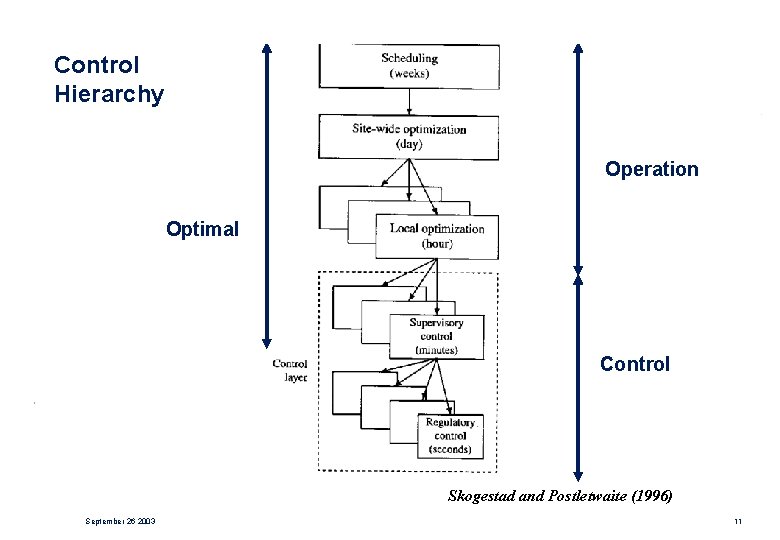
Control Hierarchy Operation Optimal Control Skogestad and Postletwaite (1996) September 26 2003 11
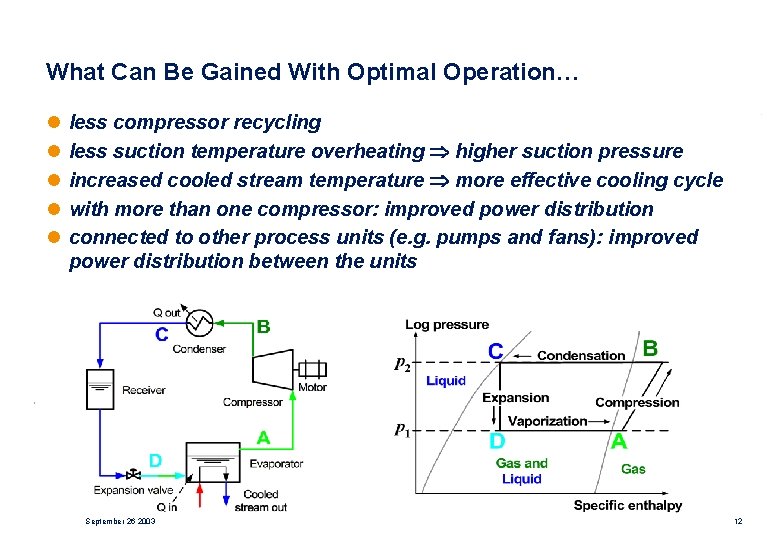
What Can Be Gained With Optimal Operation… l l less compressor recycling less suction temperature overheating higher suction pressure increased cooled stream temperature more effective cooling cycle with more than one compressor: improved power distribution connected to other process units (e. g. pumps and fans): improved power distribution between the units September 26 2003 12
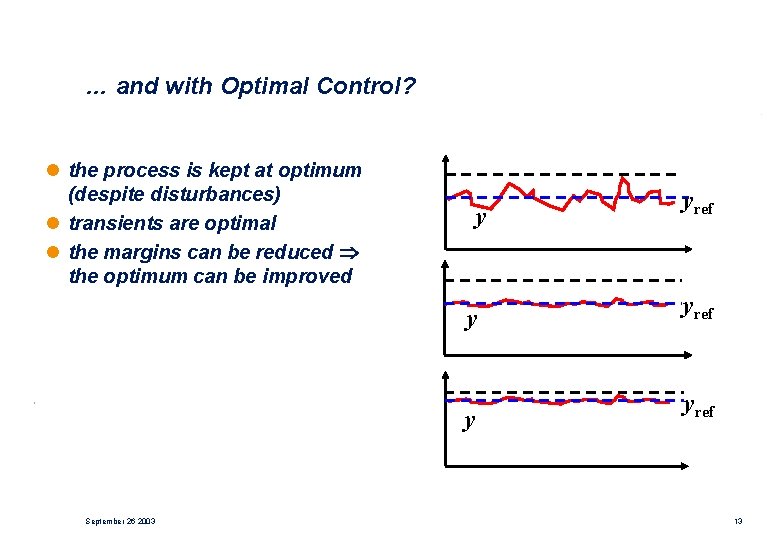
… and with Optimal Control? l the process is kept at optimum (despite disturbances) l transients are optimal l the margins can be reduced the optimum can be improved September 26 2003 y yref 13
Air Separation Units l l Produce oxygen, nitrogen and argon from air Air is liquefied with a nitrogen refrigeration cycle Separation of the components with distillation columns High purity requirements l Main control and operational challenges: the distillation columns l Schenk et al. (2002): Simultaneous optimal design of – process (number of trays and diameter) – control structure (pairing of outputs and inputs) – controller tuning 1. 5 days of CPU time September 26 2003 14
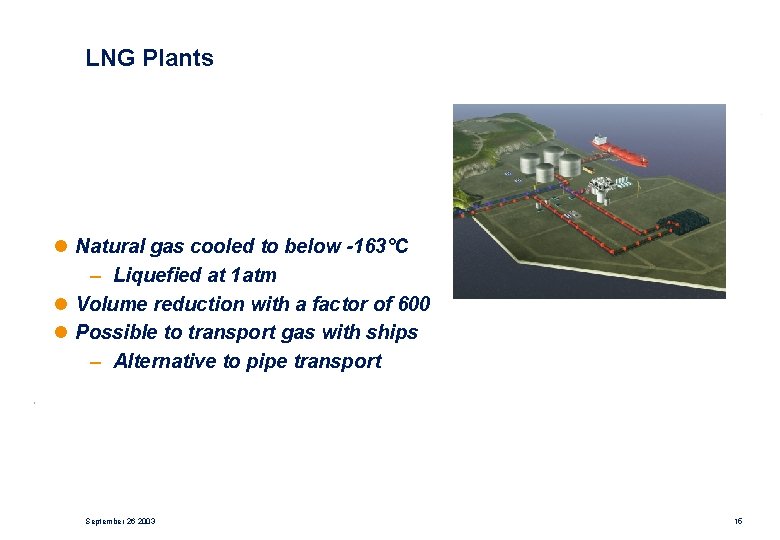
LNG Plants l Natural gas cooled to below -163°C – Liquefied at 1 atm l Volume reduction with a factor of 600 l Possible to transport gas with ships – Alternative to pipe transport September 26 2003 15
Optimal Operation of LNG Plants Main objectives: l Maximize LNG production or l Minimize storage l Minimize energy consumption September 26 2003 16
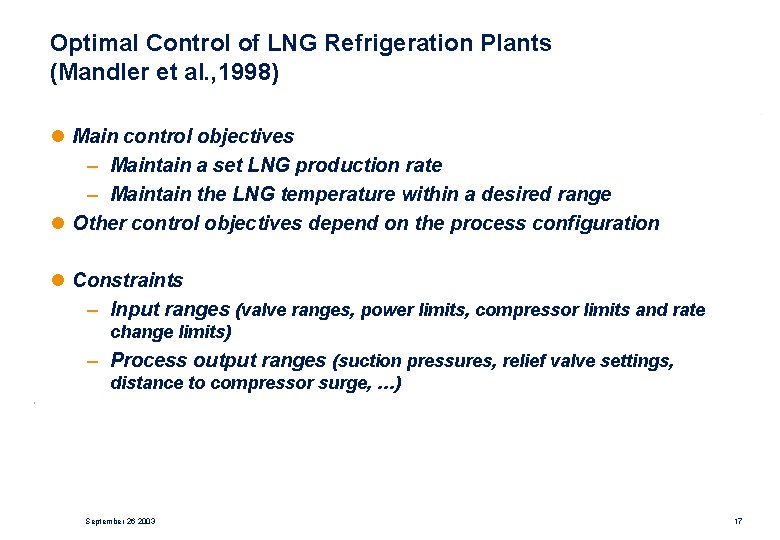
Optimal Control of LNG Refrigeration Plants (Mandler et al. , 1998) l Main control objectives – Maintain a set LNG production rate – Maintain the LNG temperature within a desired range l Other control objectives depend on the process configuration l Constraints – Input ranges (valve ranges, power limits, compressor limits and rate change limits) – Process output ranges (suction pressures, relief valve settings, distance to compressor surge, …) September 26 2003 17
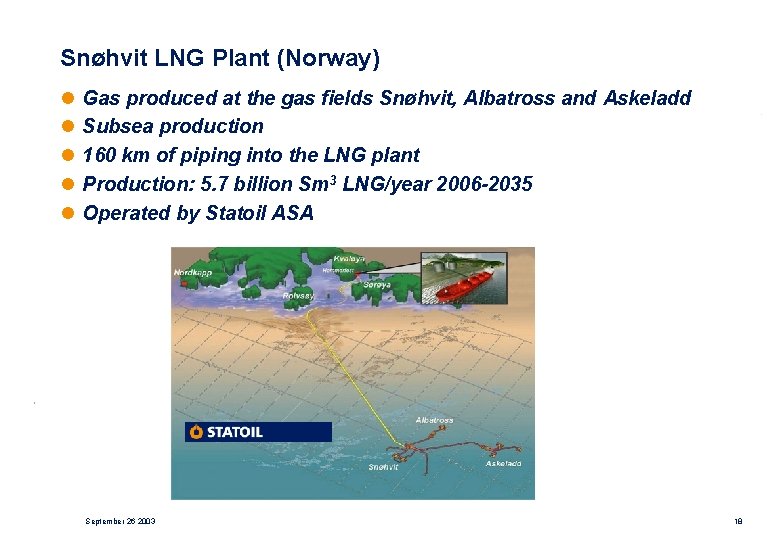
Snøhvit LNG Plant (Norway) l l l Gas produced at the gas fields Snøhvit, Albatross and Askeladd Subsea production 160 km of piping into the LNG plant Production: 5. 7 billion Sm 3 LNG/year 2006 -2035 Operated by Statoil ASA September 26 2003 18
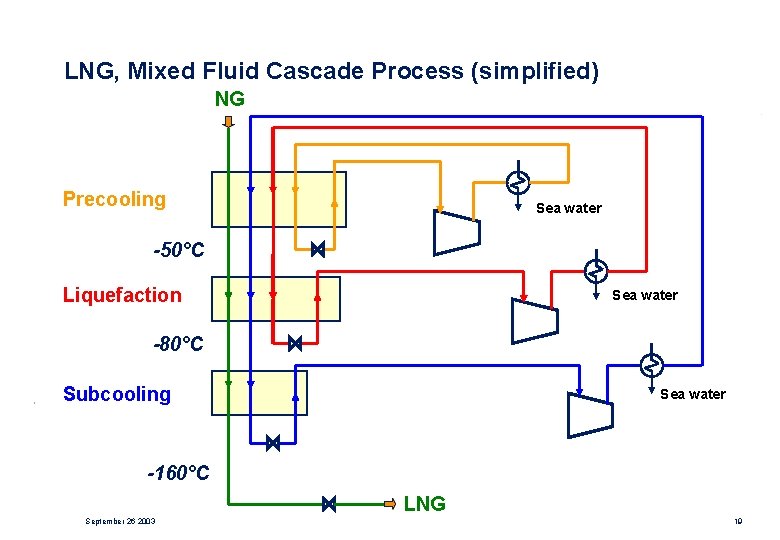
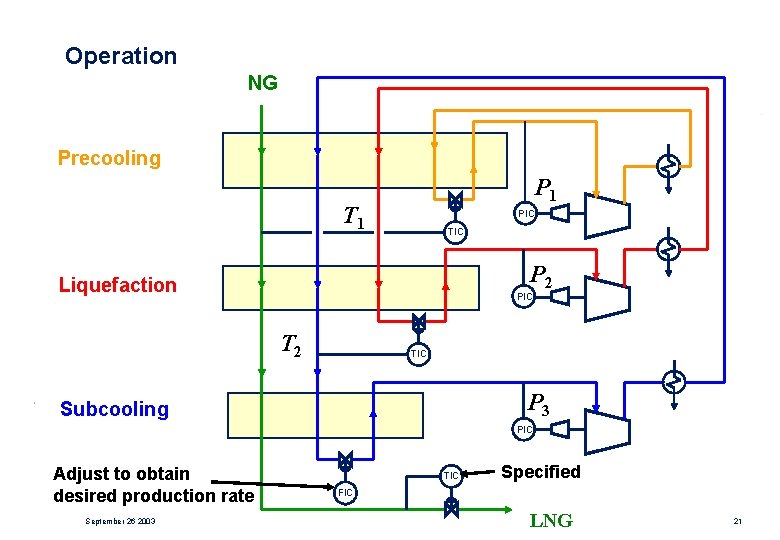
LNG, Mixed Fluid Cascade Process (simplified) NG Precooling Sea water -50°C Liquefaction Sea water -80°C Subcooling Sea water -160°C LNG September 26 2003 19
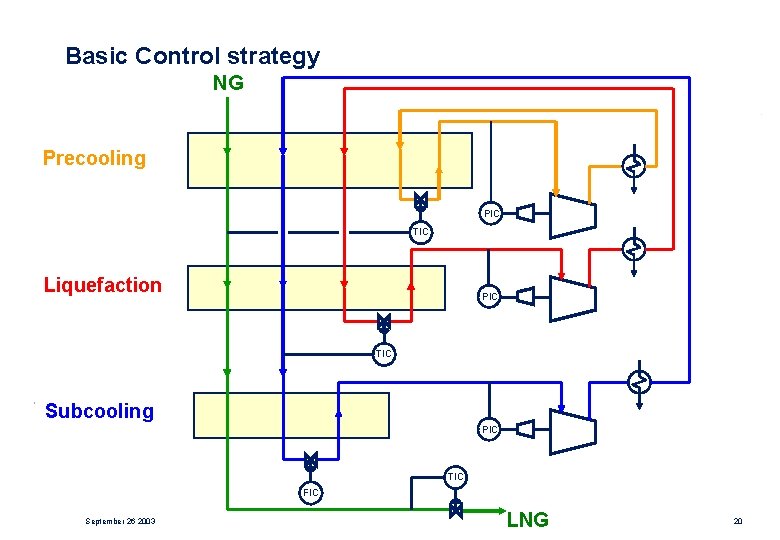
Basic Control strategy NG Precooling PIC TIC Liquefaction PIC TIC Subcooling PIC TIC FIC September 26 2003 LNG 20
Operation NG Precooling P 1 T 1 PIC TIC P 2 Liquefaction PIC T 2 TIC P 3 Subcooling PIC Adjust to obtain desired production rate September 26 2003 TIC Specified FIC LNG 21
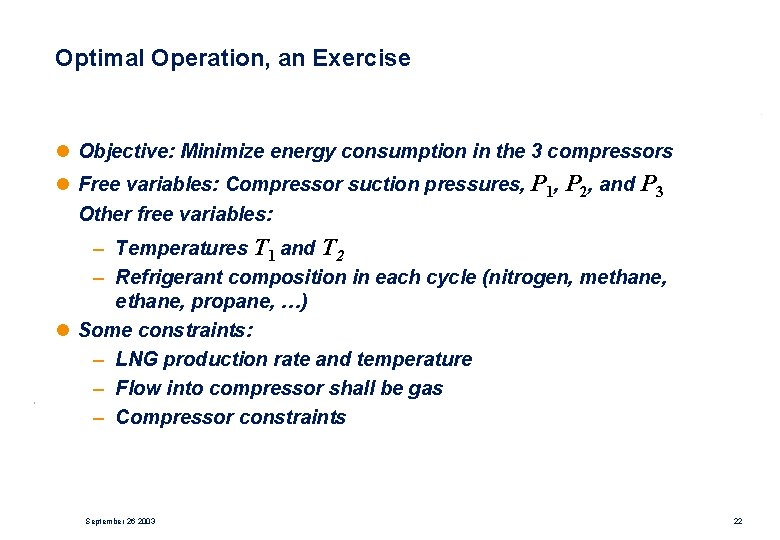
Optimal Operation, an Exercise l Objective: Minimize energy consumption in the 3 compressors l Free variables: Compressor suction pressures, P 1, P 2, and P 3 Other free variables: – Temperatures T 1 and T 2 – Refrigerant composition in each cycle (nitrogen, methane, propane, …) l Some constraints: – LNG production rate and temperature – Flow into compressor shall be gas – Compressor constraints September 26 2003 22
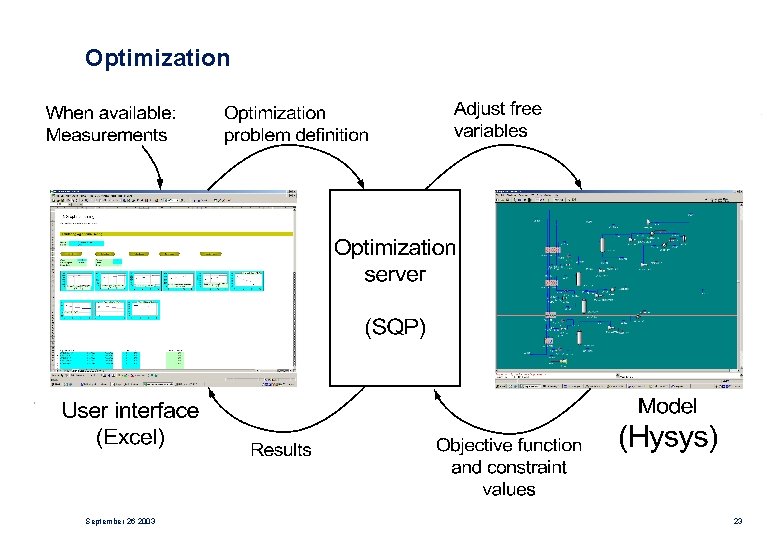
Optimization September 26 2003 23
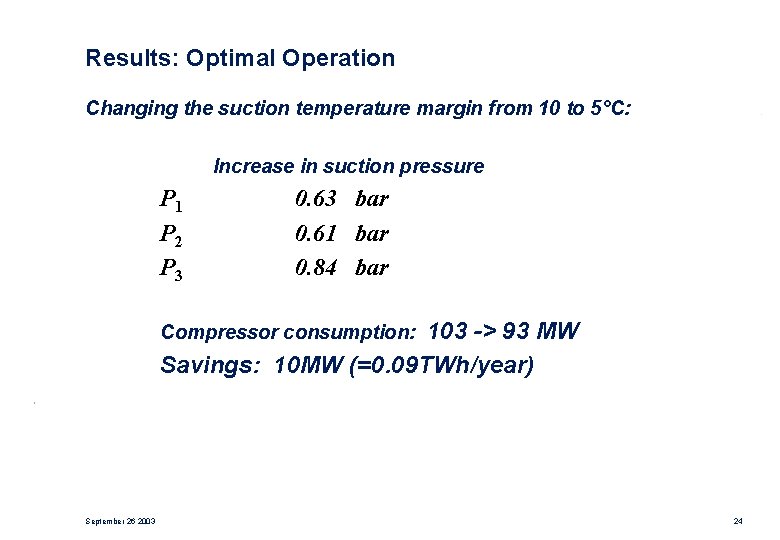
Results: Optimal Operation Changing the suction temperature margin from 10 to 5°C: Increase in suction pressure P 1 P 2 P 3 0. 63 bar 0. 61 bar 0. 84 bar 103 -> 93 MW Savings: 10 MW (=0. 09 TWh/year) Compressor consumption: September 26 2003 24
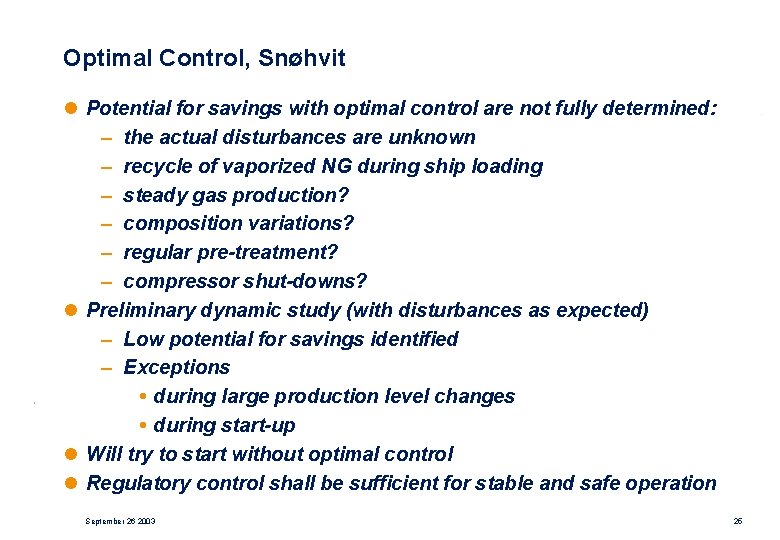
Optimal Control, Snøhvit l Potential for savings with optimal control are not fully determined: – the actual disturbances are unknown – recycle of vaporized NG during ship loading – steady gas production? – composition variations? – regular pre-treatment? – compressor shut-downs? l Preliminary dynamic study (with disturbances as expected) – Low potential for savings identified – Exceptions during large production level changes during start-up l Will try to start without optimal control l Regulatory control shall be sufficient for stable and safe operation September 26 2003 25
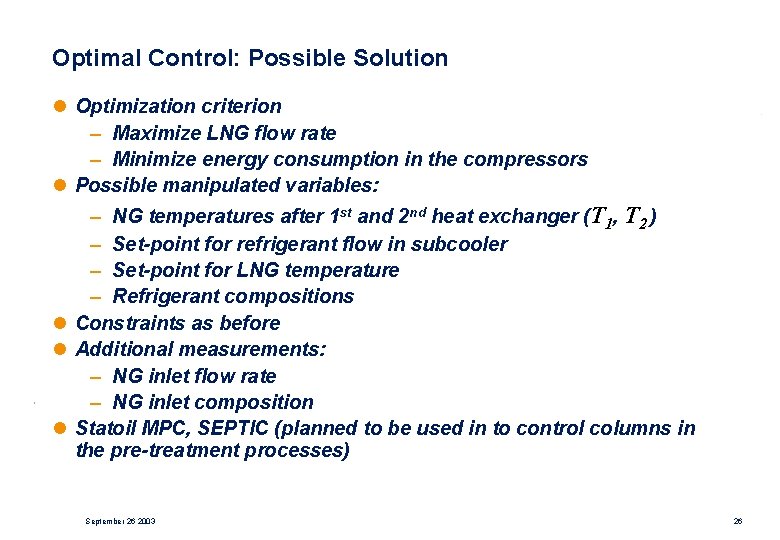
Optimal Control: Possible Solution l Optimization criterion – Maximize LNG flow rate – Minimize energy consumption in the compressors l Possible manipulated variables: – NG temperatures after 1 st and 2 nd heat exchanger (T 1, T 2 ) – Set-point for refrigerant flow in subcooler – Set-point for LNG temperature – Refrigerant compositions l Constraints as before l Additional measurements: – NG inlet flow rate – NG inlet composition l Statoil MPC, SEPTIC (planned to be used in to control columns in the pre-treatment processes) September 26 2003 26
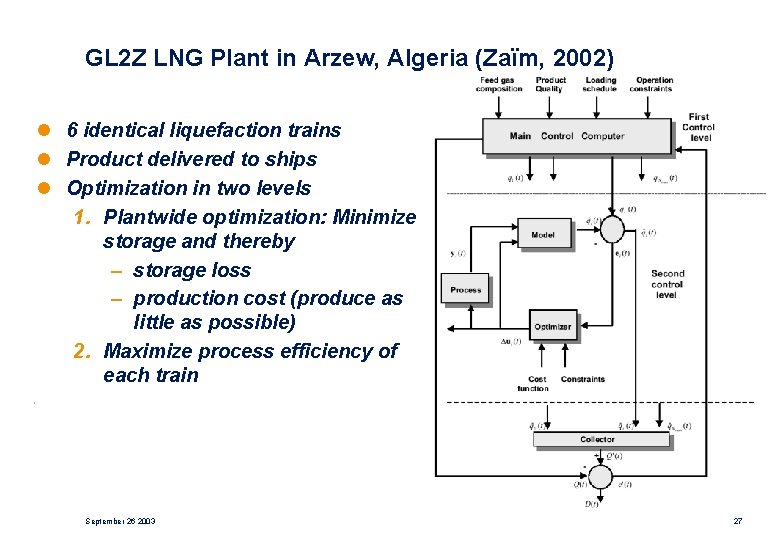
GL 2 Z LNG Plant in Arzew, Algeria (Zaïm, 2002) l 6 identical liquefaction trains l Product delivered to ships l Optimization in two levels 1. Plantwide optimization: Minimize storage and thereby – storage loss – production cost (produce as little as possible) 2. Maximize process efficiency of each train September 26 2003 27
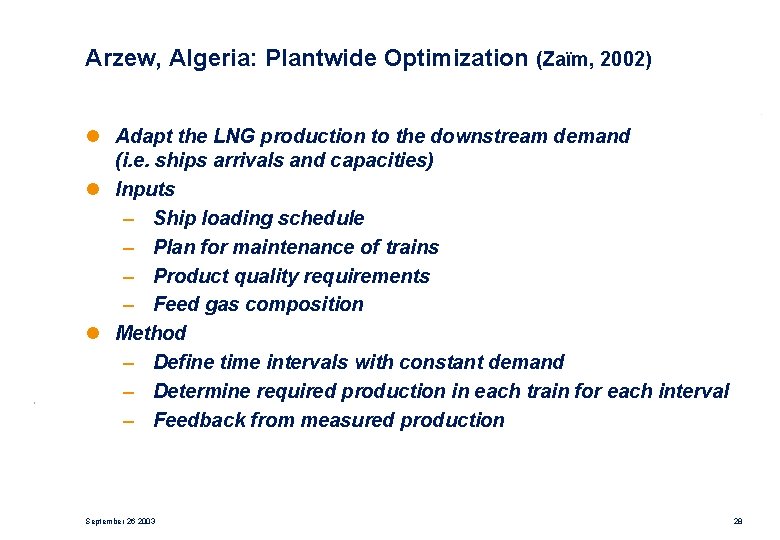
Arzew, Algeria: Plantwide Optimization (Zaïm, 2002) l Adapt the LNG production to the downstream demand (i. e. ships arrivals and capacities) l Inputs – Ship loading schedule – Plan for maintenance of trains – Product quality requirements – Feed gas composition l Method – Define time intervals with constant demand – Determine required production in each train for each interval – Feedback from measured production September 26 2003 28
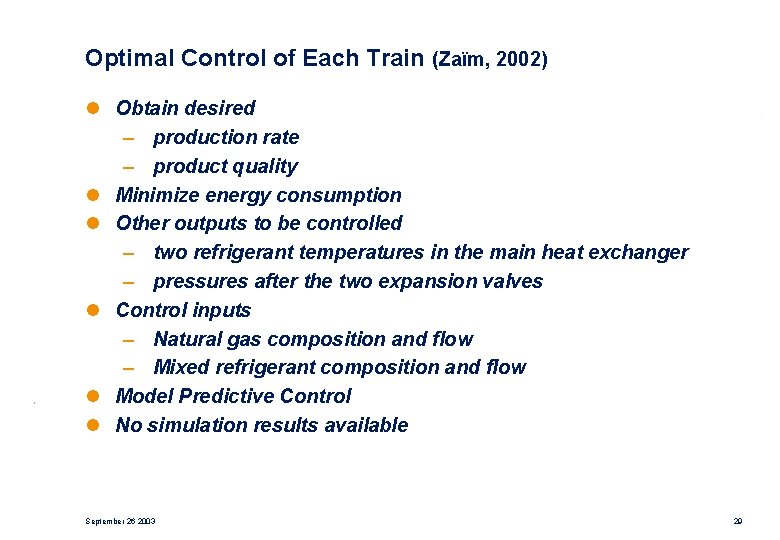
Optimal Control of Each Train (Zaïm, 2002) l Obtain desired – production rate – product quality l Minimize energy consumption l Other outputs to be controlled – two refrigerant temperatures in the main heat exchanger – pressures after the two expansion valves l Control inputs – Natural gas composition and flow – Mixed refrigerant composition and flow l Model Predictive Control l No simulation results available September 26 2003 29
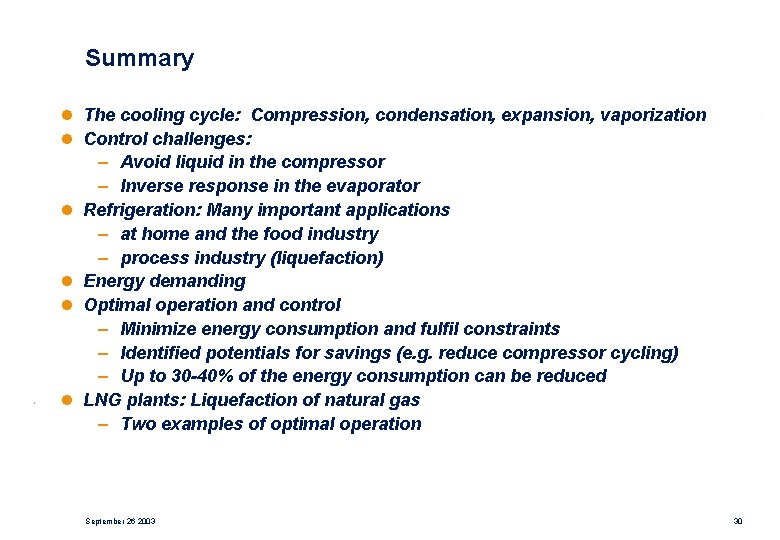
Summary l The cooling cycle: Compression, condensation, expansion, vaporization l Control challenges: – Avoid liquid in the compressor – Inverse response in the evaporator l Refrigeration: Many important applications – at home and the food industry – process industry (liquefaction) l Energy demanding l Optimal operation and control – Minimize energy consumption and fulfil constraints – Identified potentials for savings (e. g. reduce compressor cycling) – Up to 30 -40% of the energy consumption can be reduced l LNG plants: Liquefaction of natural gas – Two examples of optimal operation September 26 2003 30
Acknowledgments l Colleagues at Statoil ASA – Pål Flatby, John-Morten Godhavn, Silja E. Gylseth, Oddvar Jørstad, Håvard Nordhus, Jørgen Opdal, Geir A. Owren, Jan Richard Sagli l Dag Eimer, former colleague at Norsk Hydro ASA l Terje Herzberg, Dept. of Chemical Engineering, NTNU l Morten Hovd, Dept. of Engineering Cybernetics, NTNU l Staff at the NTNU Library September 26 2003 31
References (1) Refrigeration Textbooks Dossat, R. J. (1991), Principles of refrigeration, 3 rd ed. , Prentice-Hall International Editions, London. Flynn, Th. (1997), Cryogenic Engineering, Marcel Dekker, Inc. , New York. Haselden, G. G. (ed. ), Cryogenic fundamentals, Academic Press, London. Energy Consumption and Efficiency EU: http: //europa. eu. int/comm/energy_transport/atlas/htmlu/refrigeration. html Grandum, S. and Eriksen, K. (2000), Control system minimizes energy use in a meat-processing factory, CADDET Energy Efficiency News Bulletin, No. 3, pp. 16 -17 Inghams Enterprises (2002), Advanced Food Refrigeration Control, CADDET web page, http: //www. caddet-ee. org Rainier Cold Storage, Inc. (2000), Improved Refrigeration Control System in A Food Cold Storage Facility, CADDET web page, http: //www. caddet-ee. org The Norwegian Water Resources and Energy Directorate (NVE) The energy folder 2002, http: //www. nve. no/ September 26 2003 32
References (2) Refrigeration Process Control Balchen, J. G. and Mummé, K. I. (1988), Process control. Structures and applications. , Van Nostrand Reinhold, New York. Balchen, J. G. , Telnes, K. and Di Ruscio, D. (1989), Frequency response adaptive control of a refrigeration cycle, Modeling, Identification and Control (MIC), Vol. 10, No. 1, pp. 3 -11. Esnoz, A. and Lopez, A. (2003), Fuzzy logic PI controller with on-line optimum intermediate pressure for double stage refrigeration system, 21 st IIR International Congress of Refrigeration, August 17 -22, 2003, Washington, DC, USA. Goldfarb, S. and Oldham, J. (1996), Refrigeration loop dynamic analysis using PROTISS, ESCAPE-6, 26 -29 May 1996, Rhodes, Greece; Supplement to Computers & Chemical Engineering, Vol. 20, pp. S 811 -S 816 Langley, B. C. (2002), Fine tuning Air Conditioning & Refrigeration Systems, The Fairmont Press Inc. , Lilburn, GA. Lensen, B. A. (1991), Improve control of cryogenic gas plants, Hydrocarbon Processing, May, 1991, pp. 109 -111 Marshall, S. A. and James, R. W. (1975), Dynamic analysis of an industrial refrigeration system to investigate capacity control, Proc. Inst. Mech. Engrs. , Vol. 189, No. 44/75, pp. 437 -444 Wilson, J. A. and Jones, W. E. (1994), The influence of plant design on refrigeration circuit control and operation, ESCAPE-4, Dublin March 28 -30, '94, pp. 215 -221. September 26 2003 33
References (3) Optimal Operation and Control (see also applications and LNG) Chen, J. (1997), Optimal Performance analysis of irreversible cycles used as heat pumps and refrigerators, J. Phys. D: Appl. Phys. , Vol. 30, pp. 582 -587 D’Accadia, M. D. , Sasso, M. and Sibilio, S. (1997), Optimum performance of heat engine-driven heat pumps: A finite-time approach, Energy Convers. Vol. 38, No. 4, pp. 401 -413 Diaz, S. , Tonelli, S. , Bandoni, A. and Biegler, L. T. (2003), Dynamic Optimization for Switching Between Operating Modes in Cryogenic Plants, FOCAPO 2003. 4 th Int. Conf. of Computer-Aided Process Operations, Proceedings of the Conference held at Coral Springs, Florida, January 12 -15, 2003, pp. 601 -604 Leducq, D. , Guilpart, J. and Trystram, G. (2003), Application of a reduced dynamic model to the control of a refrigeration cycle, 21 st IIR International Congress of Refrigeration, August 17 -22, 2003, Washington, DC, USA. Mandler, J. A. (1998), Modeling for Control Analysis and Design in Complex Industrial Separation and Liquefaction Processes, DYCOPS-5, 5 th IFAC Symposium on Dynamics and Control of Process Systems, Corfu, Greece, June 8 -10, 1998, pp. 405 -413. Schenk, M. , Sakizlis, V. , Perkins, J. D. and Pistikopoulos E. N. (2002), Optimization-Based Methodologies for Integrating Design and Control in Cryogenic Plants , European Symposium on Computer Aided Process Engineering - 12, 26 -29 May 2002, The Hague, The Netherlands, pp. 331336. Svensson, Ch. , M. (1994), Studies on on-line optimizing control, with application to a heat pump , Ph. D. thesis, Dept. of Refrigeration and Air Conditioning, Norwegian University of Science and Technology, Trondheim, Norway September 26 2003 34
References (4) Refrigeration Operation and Control Applications Alvarez, G. and Trystram, G. (1995), Design of a new strategy for the control of the refrigeration process: fruit and vegetables conditioned in a pallet, Food Control, Vol. 6, No. 6, pp. 347 -355. Andersen, J. (2002), Temperature control in the large Hadron Collider at CERN, M. Sc. Thesis, Dept. of Engineering Cybernetics, Norwegian University of Science and Technology, Trondheim, Norway Cho, C. H. and Norden, N. (1982), Computer Optimization of Refrigeration Systems in a Textile Plant: A Case History, Automatica, Vol. 18, No. 6, pp. 675 -683. Flemsæter, B. (2000), Investigation, modelling and control of the 1. 9 K cooling loop for superconducting magnets for the large hadron collider, Ph. D. thesis, Dept. of Refrigeration and Air Conditioning, Norwegian University of Science and Technology, Trondheim, Norway Hokanson, D. A. , Houk, B. G. and Johnston, Ch. , R. (1989), DMC Control of a complex refrigerated fractionator, Adv. Instum. Control, pp. 541 -552. Kaya, A. (1991), Improving efficiency in existing chillers with optimization technology, ASHRAE Journal, October 1991, pp. 30 -38 Luong, T. T. H. and Pham, Q. T. (2003), Multi-objective optimization of food refrigeration processes, 21 st IIR International Congress of Refrigeration, August 17 -22, 2003, Washington, DC, USA. Martin, M. , Gannon, J. Rode, C. and Mc. Carthy, J. (1981), Quasi-optimal algorithms for the control loops of the FERMILAB energy saver satellite refrigerator, IEEE Transactions of Nuclear Science, Vol. NS-28, No. 3, June, pp. 3251 -3253 Olson, R. T. and Liebman, J. S. (1990), Optimization of a chilled water plant using sequential quadratic programming, Eng. Opt. , Vol. 15, pp. 171 -191. Skimmeli, T. (1994), Control of Refrigeration Process at Dalgård (Indoor) Ice Rink, Master thesis, Department of Engineering Cybernetics, Norwegian University of Science and Technology Trelea, I. -C. , Alvarez, G. and Trystram, G. (1997), Nonlinear predictive optimal control of a batch refrigeration process, J. Food Process Engn. , Vol. 21, pp. 1 -32. September 26 2003 35
References (5) LNG and Control of LNG plants Mandler, J. A. and Brochu, P. A. (1997), Controllability Analysis of the LNG Process, Presented at 1997 AICh. E Annual Meeting, Los Angeles, CA (Paper 197 a) Mandler, J. A. , Brochu, P. A. , Fotopoulos, J. and Brochu, P. A. (1998), New Control Strategies for the LNG Process, Presented at LNG 12 Conference, Perth, Australia, May 1998 The Snøhvit project: www. statoil. com/snohvit Zaïm, A. (2002), Dynamic optimization of an LNG plant. Case study: GL 2 Z LNG plant in Arzew, Algeria, Ph. D. Thesis, Rheinisch-Westfälishen Technischen Hochschule (RWTH), Aachen, Shaker Verlag, Aachen. Other Sources for the Presentation CERN: http: //public. web. cern. ch/public/ Gram Refrigerators: http: //www. gram. dk/produkter. htm Skogestad, S. and Postletwaite, I. (1996), Multivariable feedback control, John Wiley & Sons, Chichester, UK September 26 2003 36
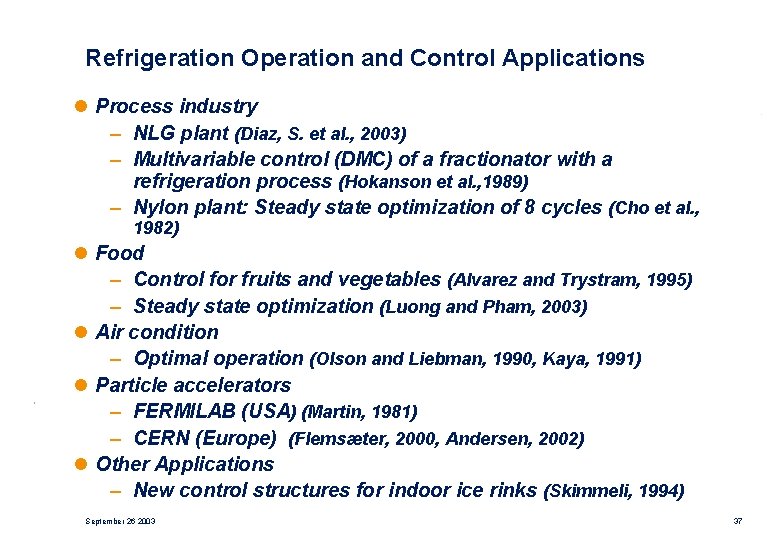
Refrigeration Operation and Control Applications l Process industry – NLG plant (Diaz, S. et al. , 2003) – Multivariable control (DMC) of a fractionator with a refrigeration process (Hokanson et al. , 1989) – Nylon plant: Steady state optimization of 8 cycles (Cho et al. , 1982) l Food – Control for fruits and vegetables (Alvarez and Trystram, 1995) – Steady state optimization (Luong and Pham, 2003) l Air condition – Optimal operation (Olson and Liebman, 1990, Kaya, 1991) l Particle accelerators – FERMILAB (USA) (Martin, 1981) – CERN (Europe) (Flemsæter, 2000, Andersen, 2002) l Other Applications – New control structures for indoor ice rinks (Skimmeli, 1994) September 26 2003 37