
Optimal Management of Aortic Arch Aneurysms Liam Ryan

- Slides: 20
Optimal Management of Aortic Arch Aneurysms Liam Ryan, MD INOVA Heart and Vascular Institute
Liam Ryan, MD Speaker’s Bureau, Research Support and Stockholder: Medtronic
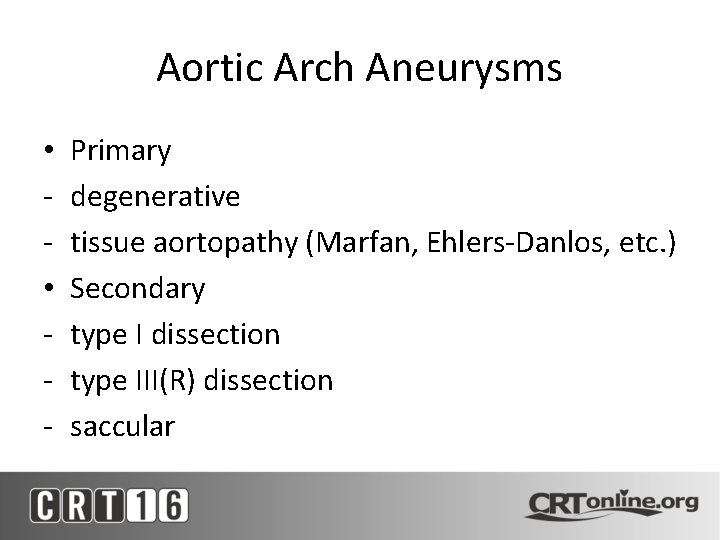
Aortic Arch Aneurysms • • - Primary degenerative tissue aortopathy (Marfan, Ehlers-Danlos, etc. ) Secondary type I dissection type III(R) dissection saccular
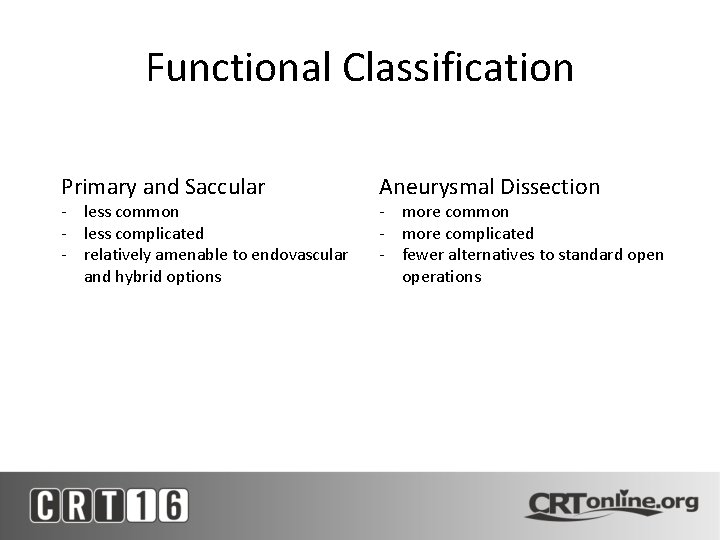
Functional Classification Primary and Saccular - less common - less complicated - relatively amenable to endovascular and hybrid options Aneurysmal Dissection - more common - more complicated - fewer alternatives to standard open operations
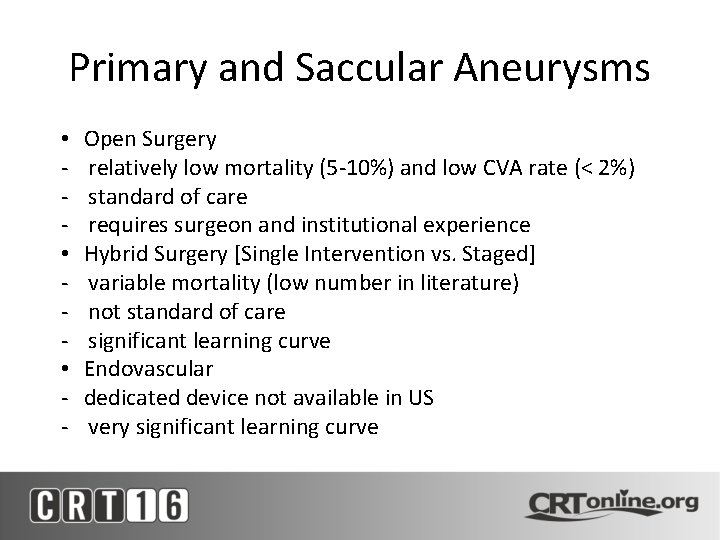
Primary and Saccular Aneurysms • • • - Open Surgery relatively low mortality (5 -10%) and low CVA rate (< 2%) standard of care requires surgeon and institutional experience Hybrid Surgery [Single Intervention vs. Staged] variable mortality (low number in literature) not standard of care significant learning curve Endovascular dedicated device not available in US very significant learning curve
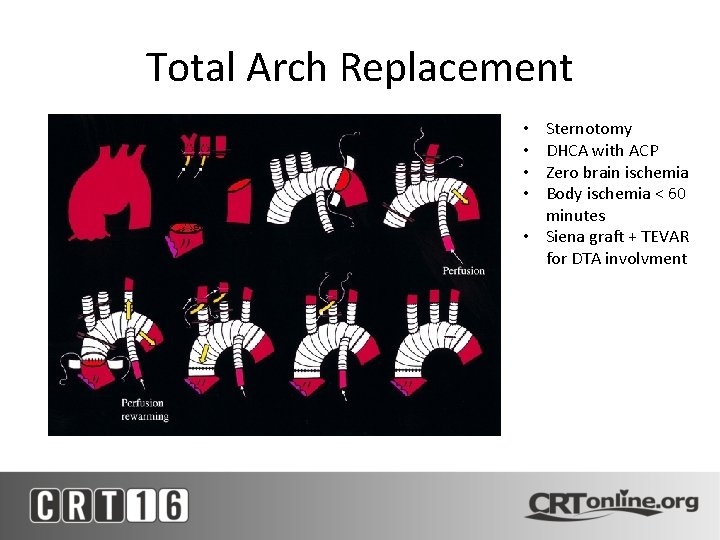
Total Arch Replacement Sternotomy DHCA with ACP Zero brain ischemia Body ischemia < 60 minutes • Siena graft + TEVAR for DTA involvment • •
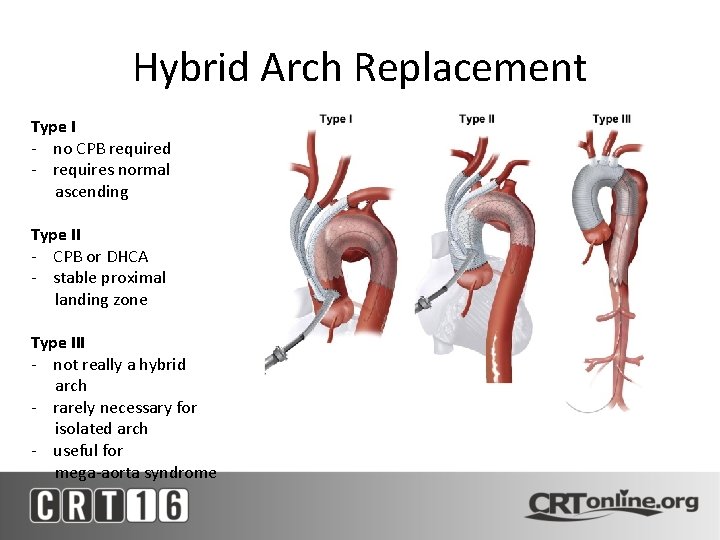
Hybrid Arch Replacement Type I - no CPB required - requires normal ascending Type II - CPB or DHCA - stable proximal landing zone Type III - not really a hybrid arch - rarely necessary for isolated arch - useful for mega-aorta syndrome
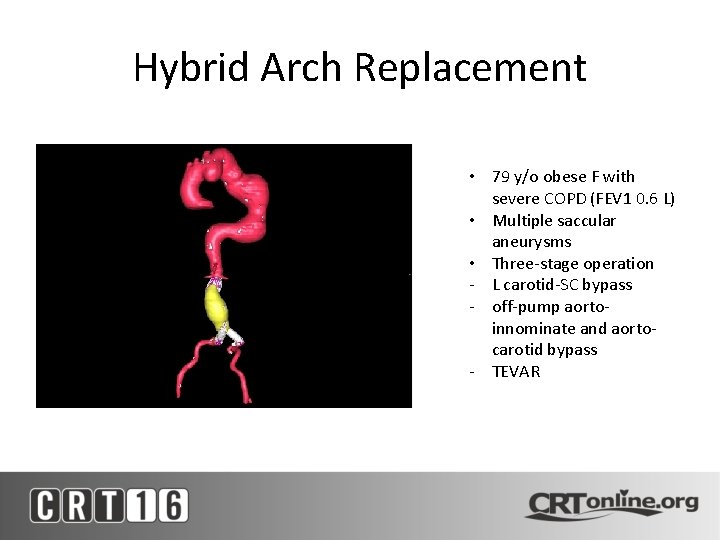
Hybrid Arch Replacement • 79 y/o obese F with severe COPD (FEV 1 0. 6 L) • Multiple saccular aneurysms • Three-stage operation - L carotid-SC bypass - off-pump aortoinnominate and aortocarotid bypass - TEVAR
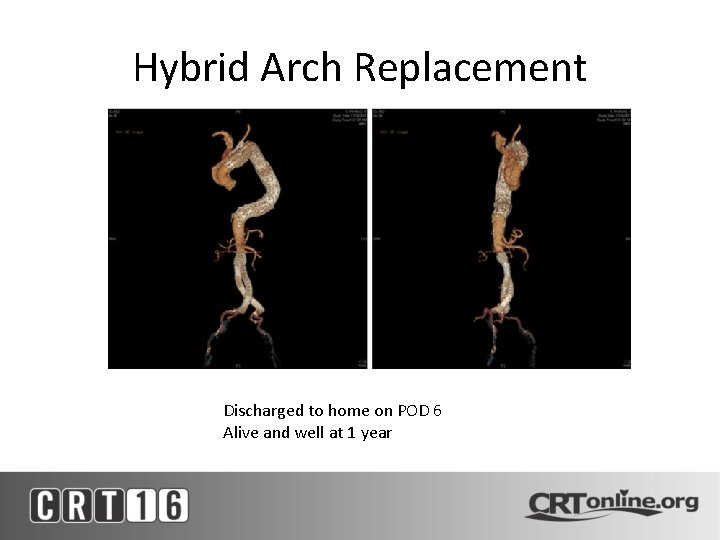
Hybrid Arch Replacement Discharged to home on POD 6 Alive and well at 1 year
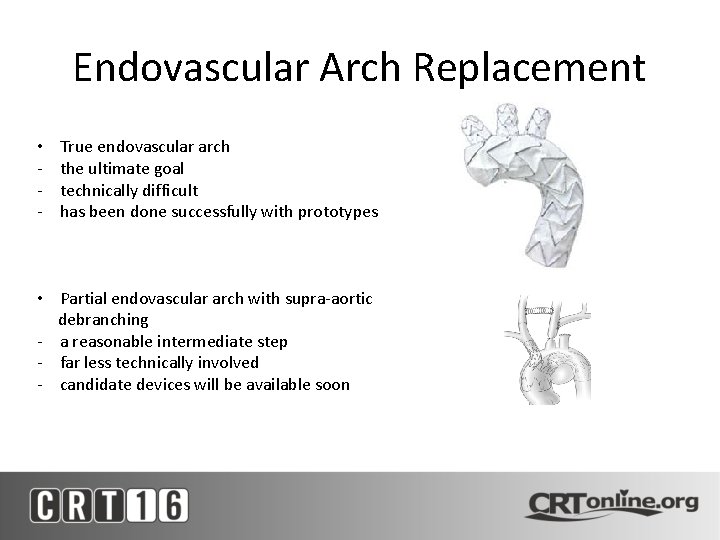
Endovascular Arch Replacement • - True endovascular arch the ultimate goal technically difficult has been done successfully with prototypes • Partial endovascular arch with supra-aortic debranching - a reasonable intermediate step - far less technically involved - candidate devices will be available soon
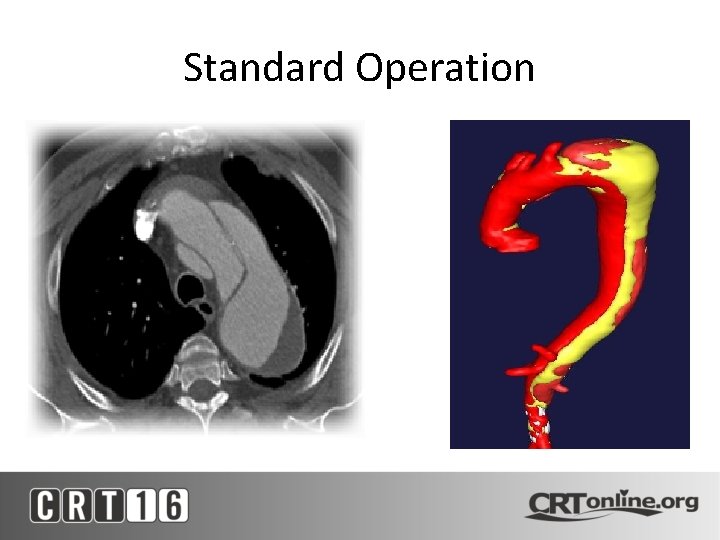
Aneurysmal Dissection • Best approached with open surgery • Presence of immobile septum makes hybrid and endovascular approaches far more difficult • Standard open arch with elephant trunk or frozen elephant trunk is treatment of choice • In most cases, the arch is the first stage of a two or three stage operation - arch + TEVAR (less morbid but not always an option) - arch + TAAA (gold standard) • Room for improvement greatest at index operation
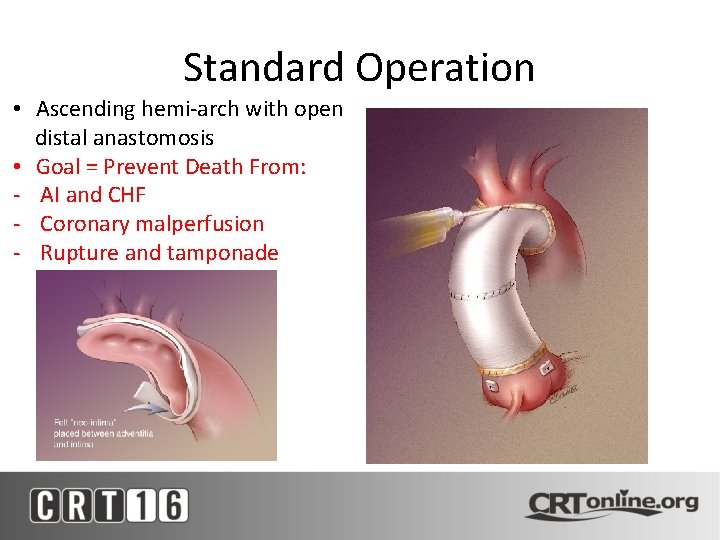
Standard Operation • Ascending hemi-arch with open distal anastomosis • Goal = Prevent Death From: - AI and CHF - Coronary malperfusion - Rupture and tamponade
Standard Operation Admirable short-term results Marginal long-term results Why? 60 -90% of patients have a patent FL at 30 days Likelihood of adverse remodeling substantially higher with patent FL - Highest with partially patent FL (35% require intervention) • Primary modifiable driver of need for delayed intervention • • • -
Standard Operation
Standard Operation • Bavaria et al, 2007 (USA), 26% Reoperation at 12 years *Included Type II • Ishihara et al, 2009 (Japan), 27% Aortic Events at 5 years • De. Bartolomeo et al, 2001 (Italy), 27% Reoperation at 7 years • Griepp et al, (USA), 16% reoperation at 8 years Included Debakey II • Glauber and Murzi, 2010 (UK), 39% reoperation at 10 years
Standard Operation • Approximately 1/3 of secondary operations are primary arch – remaining 2/3 are primary DTA • TEVAR is frequently not an option due to residual dissection in arch (even when arch is not aneurysmal) • Most open operations involve both the arch and the DTA • Combined arch and DTA operations can be done either from the front or through the L chest – dealer’s choice
Potential Solutions • Total Arch Replacement - extensive experience reported in Asian literature - +/- with regard to distal remodeling (imaging quality? ) - does provide reliable proximal LZ for TEVA • Frozen Elephant Trunk (E-Vita or improvised) - improved rates of FL thrombosis - insufficient long-term outcomes data - reports of increased spinal cord ischmia - > 50% are being treated unnecessarily
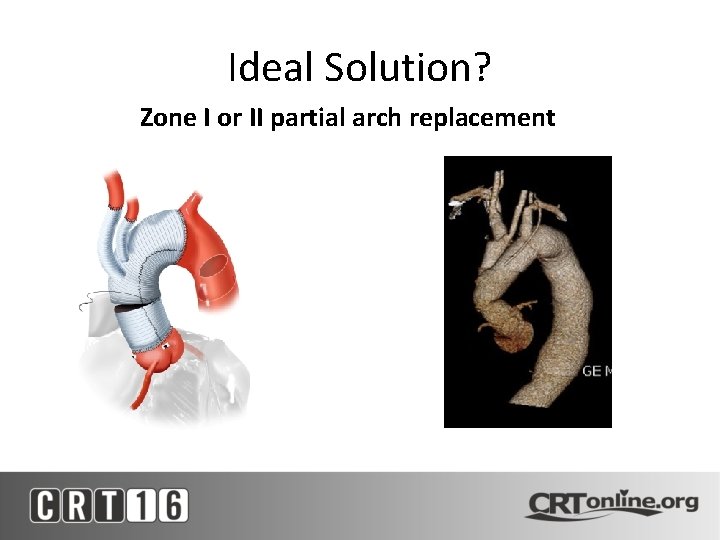
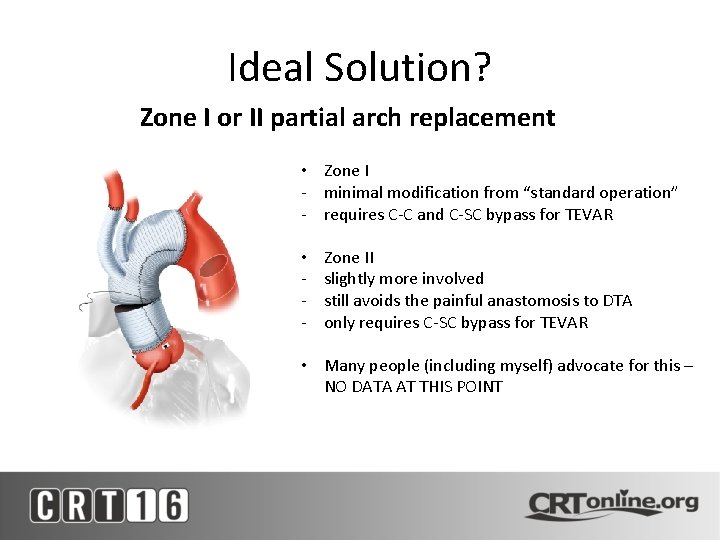
Ideal Solution? Zone I or II partial arch replacement
Ideal Solution? Zone I or II partial arch replacement • Zone I - minimal modification from “standard operation” - requires C-C and C-SC bypass for TEVAR • - Zone II slightly more involved still avoids the painful anastomosis to DTA only requires C-SC bypass for TEVAR • Many people (including myself) advocate for this – NO DATA AT THIS POINT
Conclusion • The arch remains a significant clinical challenge • As a rule open surgery remains the gold standard • For certain patients, hybrid variants are an attractive alternative • There will be an endovascular solution in the future but don’t hold your breath • For aneurysmal dissections, the most promising target for improvement is the index operation