
Optimal foraging theory and risksensitive foraging Matt Begley
Optimal foraging theory and risksensitive foraging Matt Begley
Outline of what will be covered • principle of allocation • trade-offs and foraging behavior • functional response curves
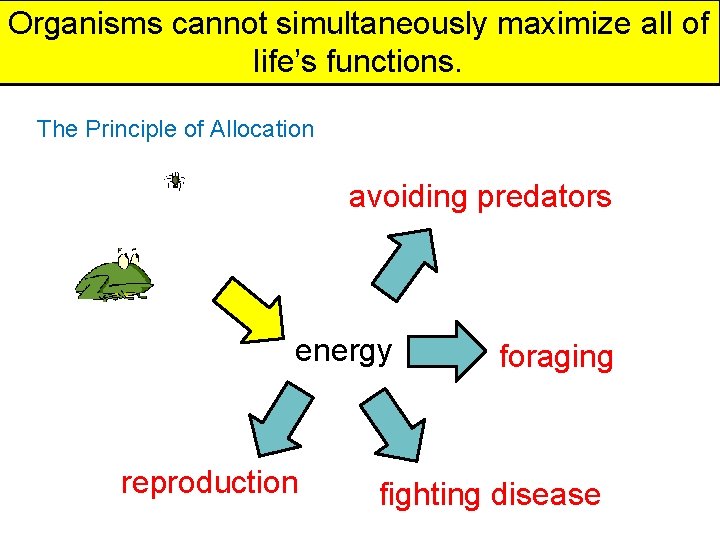
Organisms cannot simultaneously maximize all of life’s functions. The Principle of Allocation avoiding predators energy reproduction foraging fighting disease

High energy demands for carnivores to catch prey The Principle of Allocation avoiding predators vs. energy reproduction foraging fighting disease
Mechanisms to decrease the costs of foraging • Search time: time spent looking for a prey item. • Search image: use of specific attributes in prey to scan their habitat for these prey items • Handling time: once prey have been found Trade-offs and foraging behavior

Are foraging patches with more food more attractive to predators? Trade-offs and foraging behavior

Are foraging patches with more food more attractive to predators? • Functional response: An increase in animal feeding rate, which eventually levels off, that occurs in response to an increase in food availability. Functional response Definition from Molles 2013
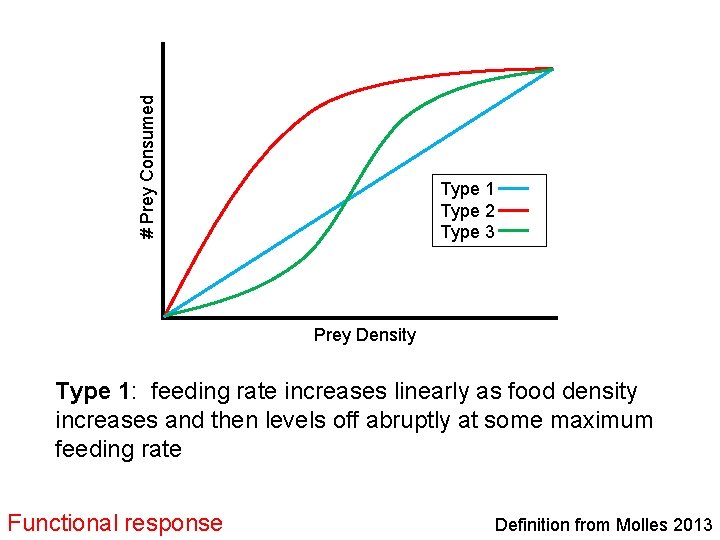
# Prey Consumed Type 1 Type 2 Type 3 Prey Density Type 1: feeding rate increases linearly as food density increases and then levels off abruptly at some maximum feeding rate Functional response Definition from Molles 2013
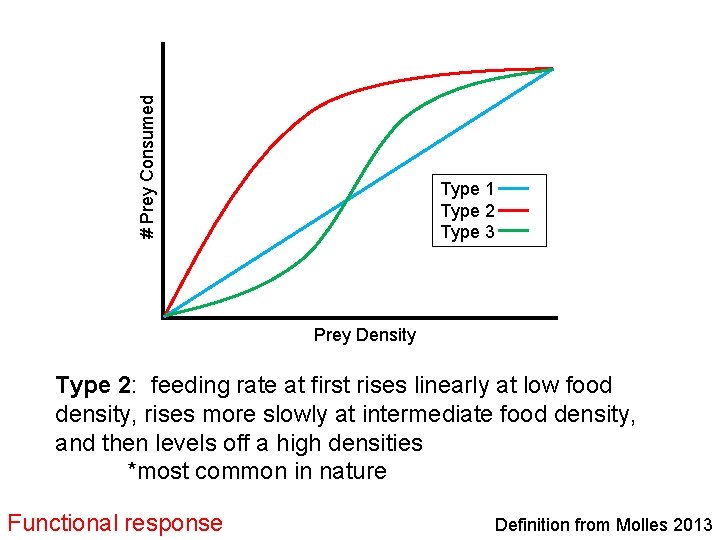
# Prey Consumed Type 1 Type 2 Type 3 Prey Density Type 2: feeding rate at first rises linearly at low food density, rises more slowly at intermediate food density, and then levels off a high densities *most common in nature Functional response Definition from Molles 2013
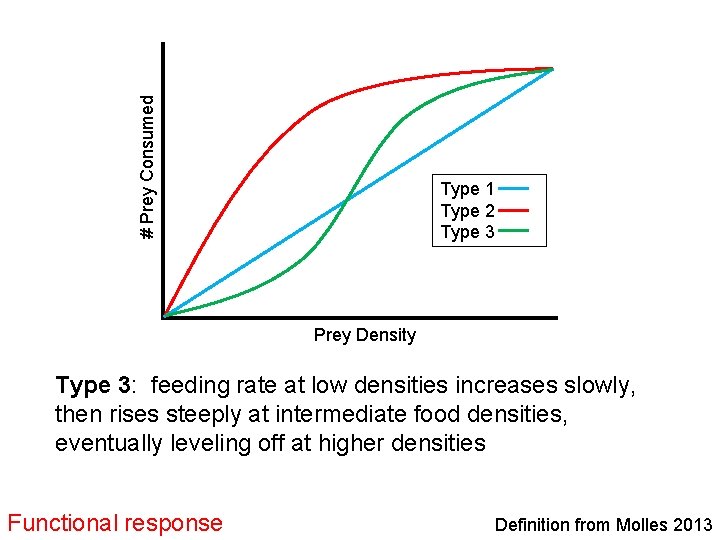
# Prey Consumed Type 1 Type 2 Type 3 Prey Density Type 3: feeding rate at low densities increases slowly, then rises steeply at intermediate food densities, eventually leveling off at higher densities Functional response Definition from Molles 2013
Optimal foraging theory • natural selection should favor individuals that forage as energetically efficient as possible with the assumption that energy supplies are limited Trade-offs and foraging behavior Definition from Molles 2013
Optimal foraging theory • Prey should choose to forage in patches that are the most profitable until the risk of predation becomes too high. • Eventually a threshold is reached where the risk of predation outweighs the benefit of continued feeding and prey must move to another patch. • Similarly, predators that optimize energy intake should aggregate in patches that are most profitable. – When overcrowding of predators occurs, interference competition should cause habitat shifts in which predators switch to a different foraging patch. Trade-offs and foraging behavior
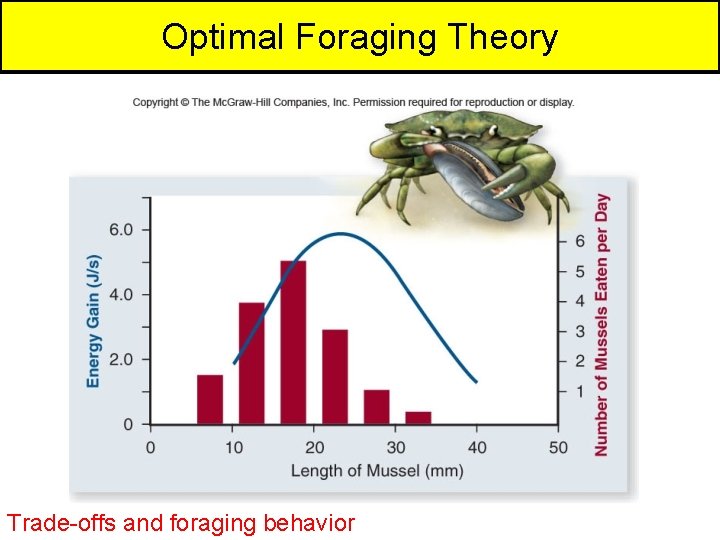
Optimal Foraging Theory Trade-offs and foraging behavior
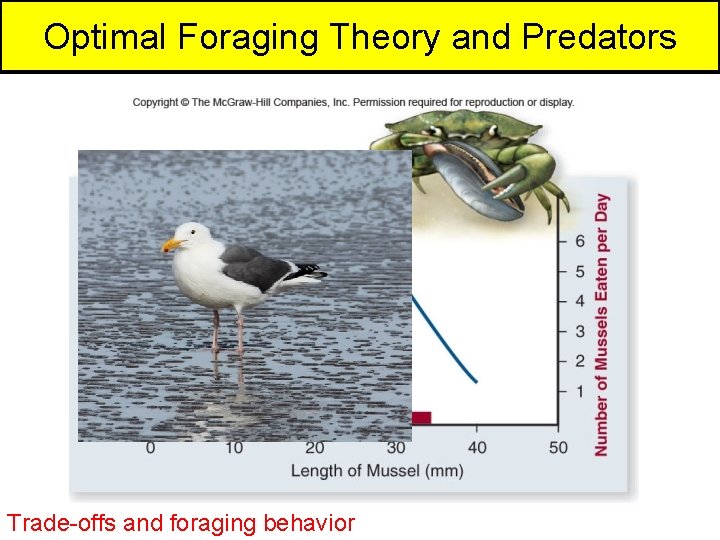
Optimal Foraging Theory and Predators Trade-offs and foraging behavior
Habitat-shifts, foraging, and predation risk Giving-up density • critical point in which the density of food within a given patch is no longer profitable causing the animal to move to other food patches – This is often altered by predation risk. Trade-offs and foraging behavior
References • Molles, M. C. 2013. Ecology: Concepts and Applications. 6 th edition. Mc. Graw Hill, New York, NY. • Raven 8 th edition
- Slides: 16