
Optics for Soft Xray Seeding of LCLSII Grating









- Slides: 52
Optics for Soft X-ray Seeding of LCLS-II - Grating and Mirrors Y. Feng, J. Wu, M. Rowen, P. Heimann, J. Krzywinski, J. Hastings, et. al. Science Research Division X-ray R&D Department 1
Outline Motivations Requirements Input FEL parameters Transform-limited pulses Seeding power X-ray optics Grazing-incidence Grating Monochromator Fixed-focal point operation Resolving power Efficiency Mirrors Pre-mirror Vertically focusing mirror Horizontal focusing mirror Ray-tracing results Summary Science Research Division X-ray R&D Department 2
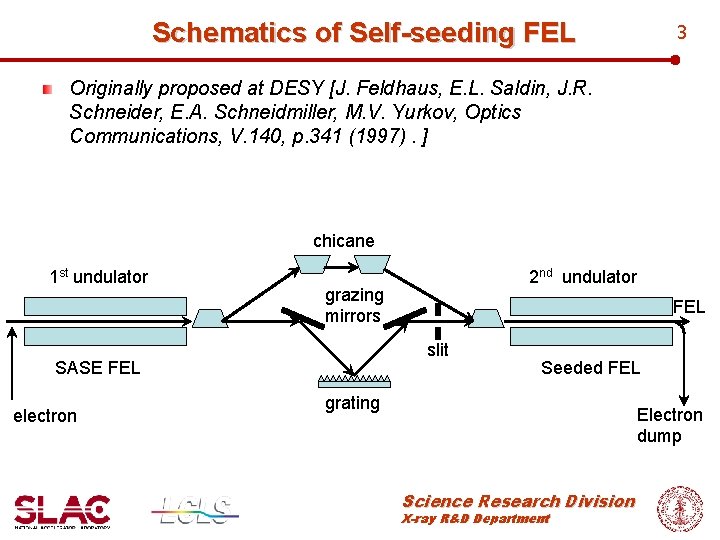
Schematics of Self-seeding FEL 3 Originally proposed at DESY [J. Feldhaus, E. L. Saldin, J. R. Schneider, E. A. Schneidmiller, M. V. Yurkov, Optics Communications, V. 140, p. 341 (1997). ] chicane 1 st undulator grazing mirrors FEL slit SASE FEL electron 2 nd undulator Seeded FEL grating Electron dump Science Research Division X-ray R&D Department
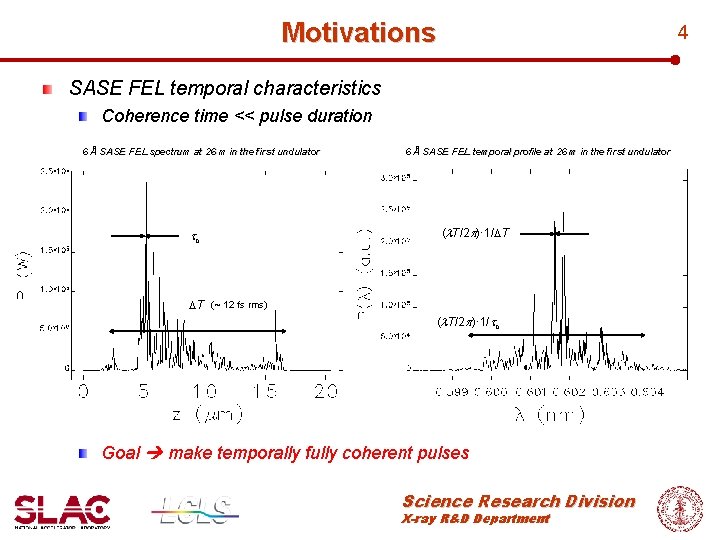
Motivations 4 SASE FEL temporal characteristics Coherence time << pulse duration 6 Å SASE FEL spectrum at 26 m in the first undulator tc 6 Å SASE FEL temporal profile at 26 m in the first undulator (l. T/2 p)· 1/DT DT (~ 12 fs rms) (l. T/2 p)· 1/tc Goal make temporally fully coherent pulses Science Research Division X-ray R&D Department
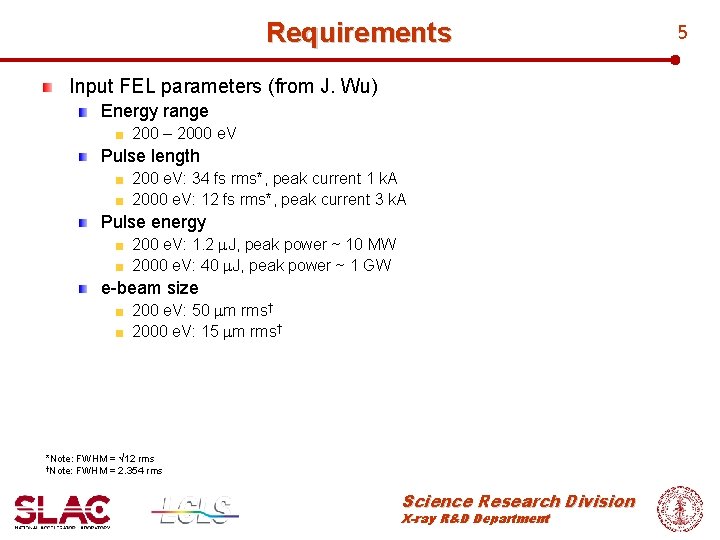
Requirements Input FEL parameters (from J. Wu) Energy range 200 – 2000 e. V Pulse length 200 e. V: 34 fs rms*, peak current 1 k. A 2000 e. V: 12 fs rms*, peak current 3 k. A Pulse energy 200 e. V: 1. 2 m. J, peak power ~ 10 MW 2000 e. V: 40 m. J, peak power ~ 1 GW e-beam size 200 e. V: 50 mm rms† 2000 e. V: 15 mm rms† *Note: FWHM = √ 12 rms †Note: FWHM = 2. 354 rms Science Research Division X-ray R&D Department 5
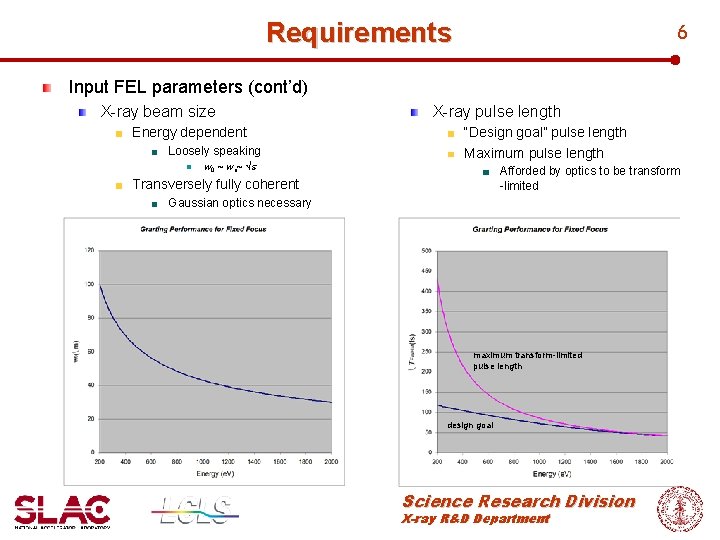
Requirements 6 Input FEL parameters (cont’d) X-ray beam size Energy dependent Loosely speaking w 0 ~ we~ √e X-ray pulse length “Design goal” pulse length Maximum pulse length Afforded by optics to be transform -limited Transversely fully coherent Gaussian optics necessary maximum transform-limited pulse length maximum design goal Science Research Division X-ray R&D Department
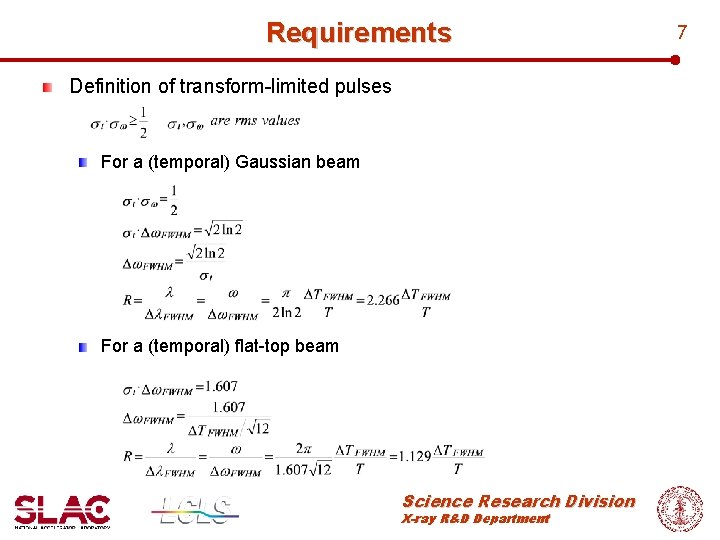
Requirements Definition of transform-limited pulses For a (temporal) Gaussian beam For a (temporal) flat-top beam Science Research Division X-ray R&D Department 7
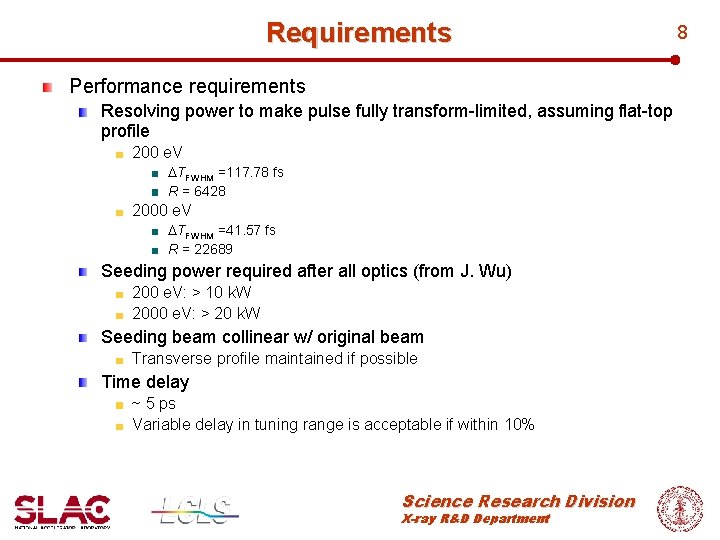
Requirements Performance requirements Resolving power to make pulse fully transform-limited, assuming flat-top profile 200 e. V DTFWHM =117. 78 fs R = 6428 2000 e. V DTFWHM =41. 57 fs R = 22689 Seeding power required after all optics (from J. Wu) 200 e. V: > 10 k. W 2000 e. V: > 20 k. W Seeding beam collinear w/ original beam Transverse profile maintained if possible Time delay ~ 5 ps Variable delay in tuning range is acceptable if within 10% Science Research Division X-ray R&D Department 8
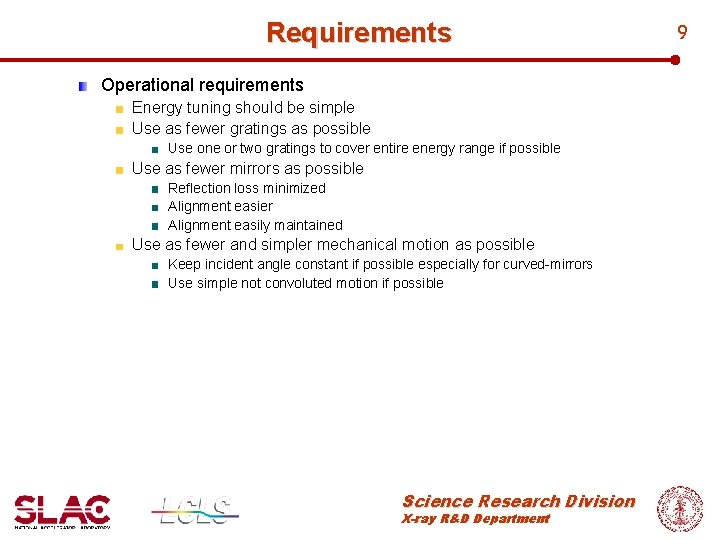
Requirements Operational requirements Energy tuning should be simple Use as fewer gratings as possible Use one or two gratings to cover entire energy range if possible Use as fewer mirrors as possible Reflection loss minimized Alignment easier Alignment easily maintained Use as fewer and simpler mechanical motion as possible Keep incident angle constant if possible especially for curved-mirrors Use simple not convoluted motion if possible Science Research Division X-ray R&D Department 9
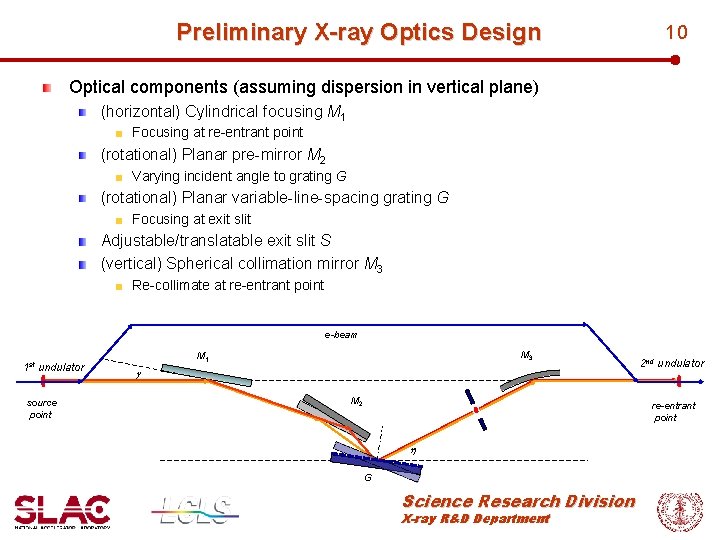
Preliminary X-ray Optics Design 10 Optical components (assuming dispersion in vertical plane) (horizontal) Cylindrical focusing M 1 Focusing at re-entrant point (rotational) Planar pre-mirror M 2 Varying incident angle to grating G (rotational) Planar variable-line-spacing grating G Focusing at exit slit Adjustable/translatable exit slit S (vertical) Spherical collimation mirror M 3 Re-collimate at re-entrant point e-beam 1 st undulator source point M 3 M 1 g M 2 2 nd undulator re-entrant point h G Science Research Division X-ray R&D Department
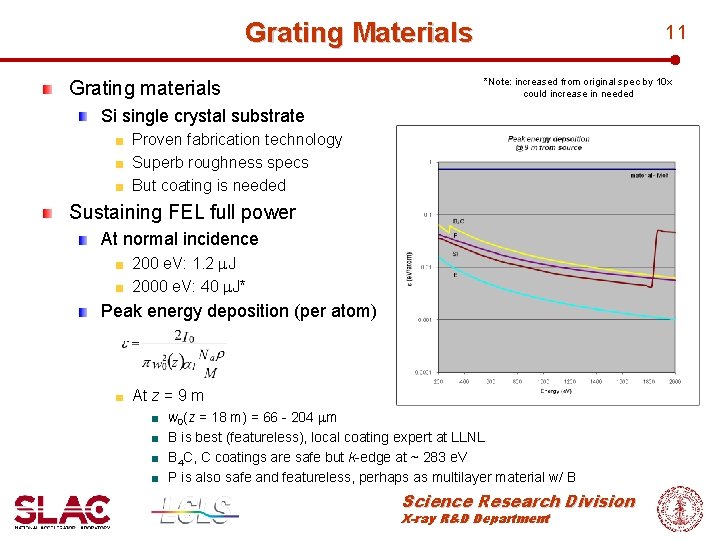
Grating Materials Grating materials 11 *Note: increased from original spec by 10 x could increase in needed Si single crystal substrate Proven fabrication technology Superb roughness specs But coating is needed Sustaining FEL full power At normal incidence 200 e. V: 1. 2 m. J 2000 e. V: 40 m. J* Peak energy deposition (per atom) At z = 9 m w 0(z = 18 m) = 66 - 204 mm B is best (featureless), local coating expert at LLNL B 4 C, C coatings are safe but k-edge at ~ 283 e. V P is also safe and featureless, perhaps as multilayer material w/ B Science Research Division X-ray R&D Department
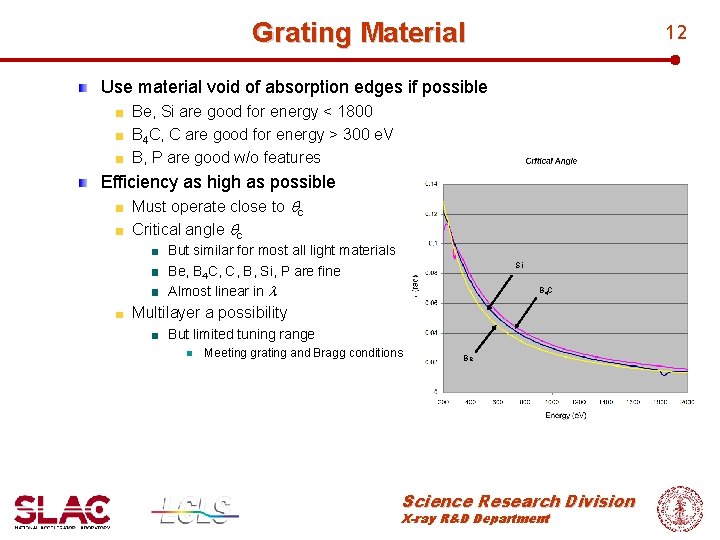
Grating Material 12 Use material void of absorption edges if possible Be, Si are good for energy < 1800 B 4 C, C are good for energy > 300 e. V B, P are good w/o features Efficiency as high as possible Must operate close to qc Critical angle qc But similar for most all light materials Be, B 4 C, C, B, Si, P are fine Almost linear in l Si B 4 C Multilayer a possibility But limited tuning range Meeting grating and Bragg conditions Be Science Research Division X-ray R&D Department
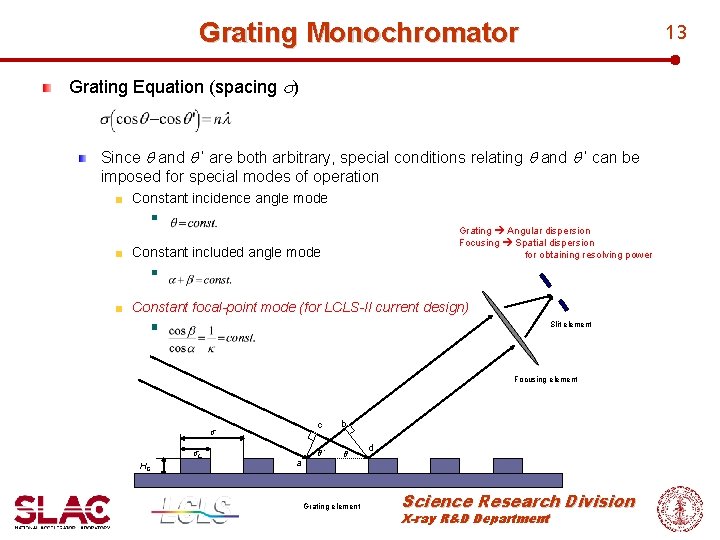
Grating Monochromator 13 Grating Equation (spacing s) Since q and q ’ are both arbitrary, special conditions relating q and q ’ can be imposed for special modes of operation Constant incidence angle mode Grating Angular dispersion Focusing Spatial dispersion for obtaining resolving power Constant included angle mode Constant focal-point mode (for LCLS-II current design) Slit element Focusing element s s. L HG a c b q’ q Grating element d Science Research Division X-ray R&D Department
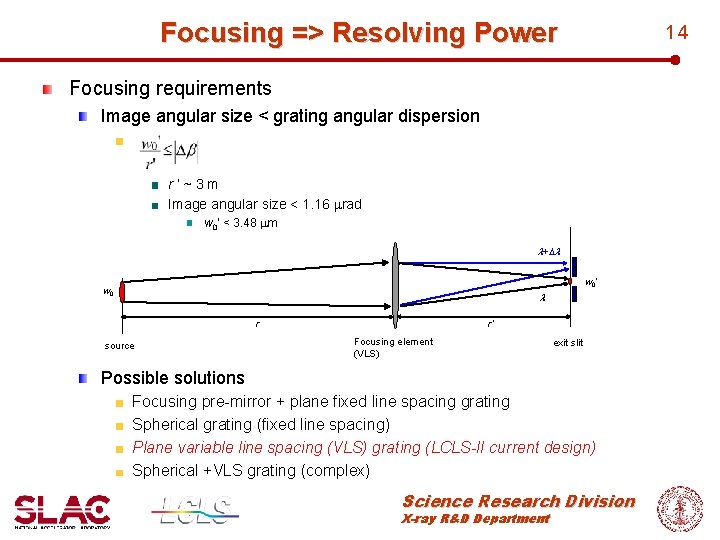
Focusing => Resolving Power 14 Focusing requirements Image angular size < grating angular dispersion r’~3 m Image angular size < 1. 16 mrad w 0’ < 3. 48 mm l+Dl w 0’ w 0 l r source r’ Focusing element (VLS) exit slit Possible solutions Focusing pre-mirror + plane fixed line spacing grating Spherical grating (fixed line spacing) Plane variable line spacing (VLS) grating (LCLS-II current design) Spherical +VLS grating (complex) Science Research Division X-ray R&D Department
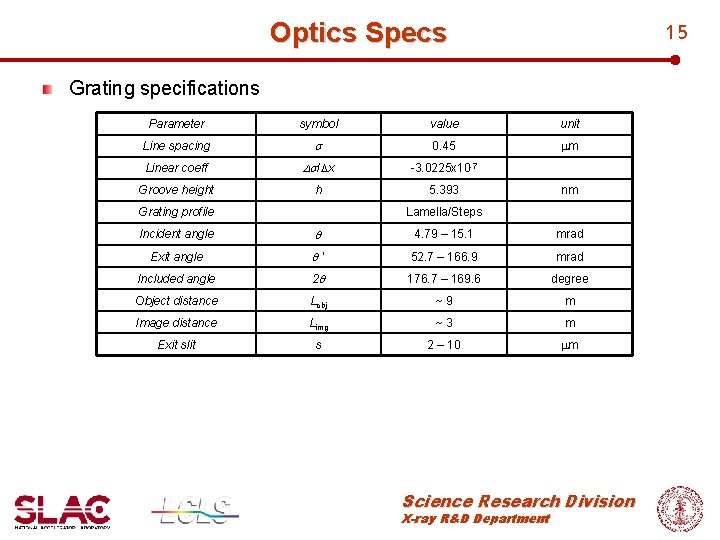
Optics Specs 15 Grating specifications Parameter symbol value unit Line spacing s 0. 45 mm Linear coeff Ds/Dx -3. 0225 x 10 -7 Groove height h 5. 393 Grating profile nm Lamella/Steps Incident angle q 4. 79 – 15. 1 mrad Exit angle q’ 52. 7 – 166. 9 mrad Included angle 2 q 176. 7 – 169. 6 degree Object distance Lobj ~9 m Image distance Limg ~3 m Exit slit s 2 – 10 mm Science Research Division X-ray R&D Department
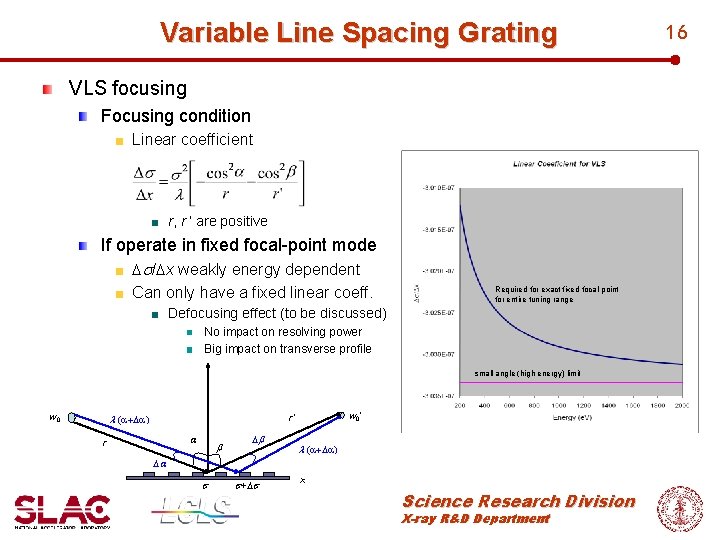
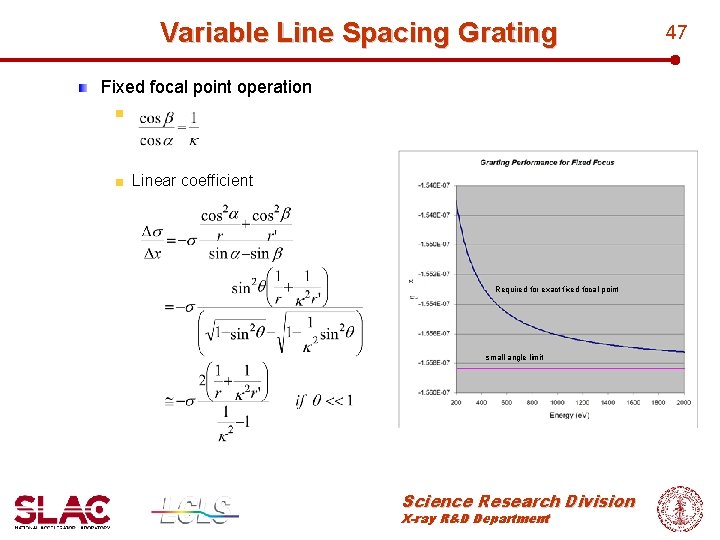
Variable Line Spacing Grating VLS focusing Focusing condition Linear coefficient r, r ’ are positive If operate in fixed focal-point mode Ds/Dx weakly energy dependent Can only have a fixed linear coeff. Required for exact fixed focal-point for entire tuning range Defocusing effect (to be discussed) No impact on resolving power Big impact on transverse profile small angle (high energy) limit w 0 l (a+Da) w 0’ r’ a r b Db l (a+Da) Da s s+Ds x Science Research Division X-ray R&D Department 16
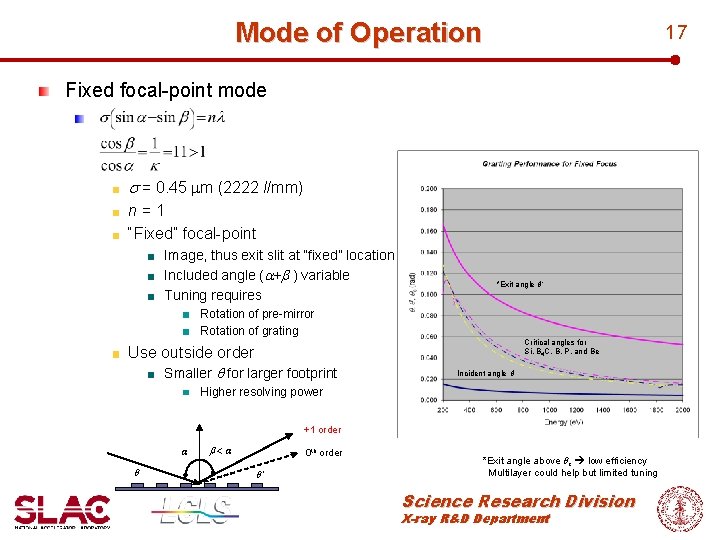
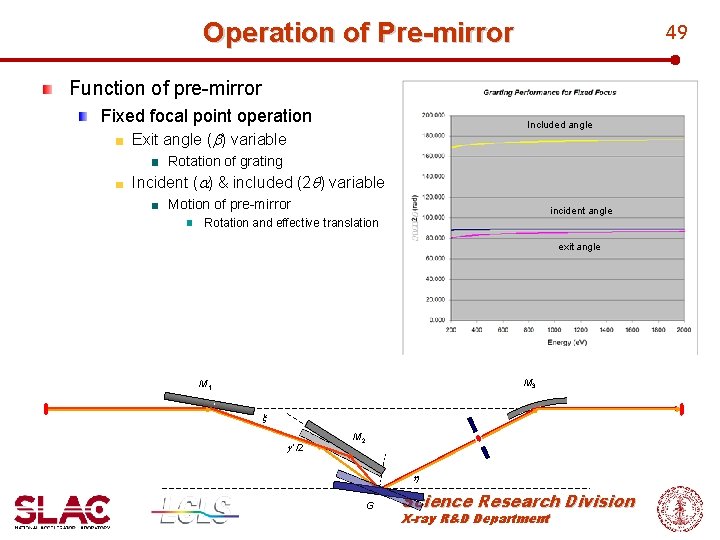
Mode of Operation 17 Fixed focal-point mode s = 0. 45 mm (2222 l/mm) n=1 “Fixed” focal-point Image, thus exit slit at “fixed” location Included angle (a+b ) variable Tuning requires *Exit angle q’ Rotation of pre-mirror Rotation of grating Critical angles for Si, B 4 C, B, P, and Be Use outside order Smaller q for larger footprint Incident angle q Higher resolving power +1 order a q b<a 0 th order q’ *Exit angle above qc low efficiency Multilayer could help but limited tuning Science Research Division X-ray R&D Department
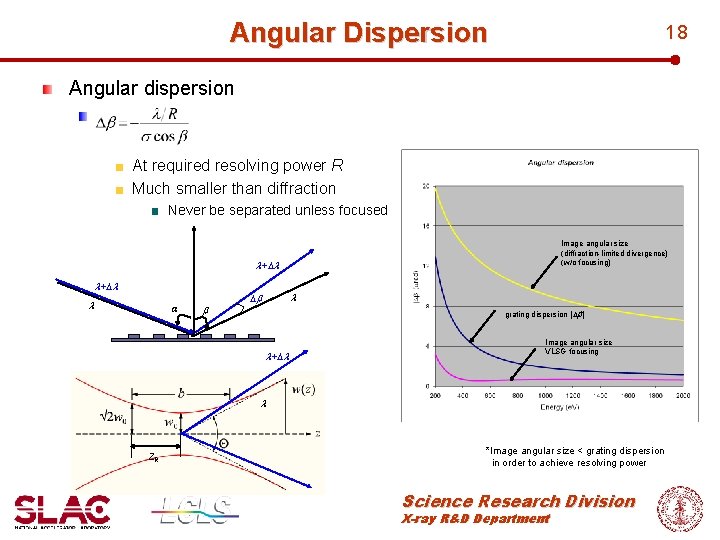
Angular Dispersion 18 Angular dispersion At required resolving power R Much smaller than diffraction Never be separated unless focused Image angular size (diffraction-limited divergence) (w/o focusing) l+Dl l a b l Db grating dispersion |Db| l+Dl Image angular size VLSG focusing l ZR *Image angular size < grating dispersion in order to achieve resolving power Science Research Division X-ray R&D Department
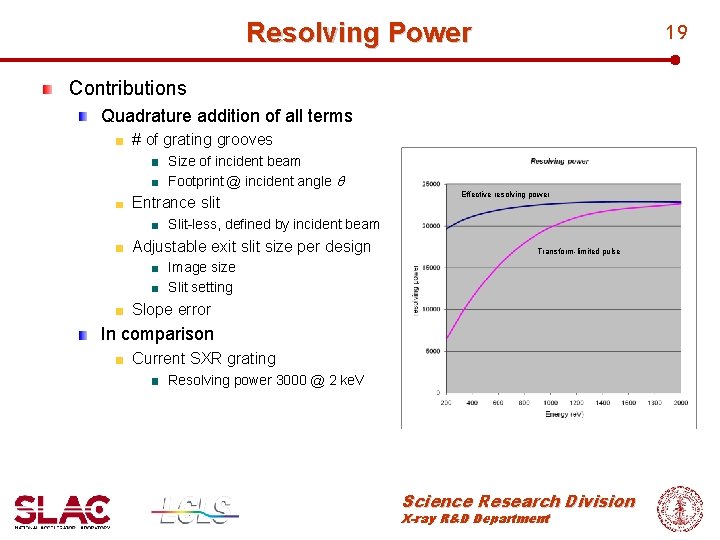
Resolving Power 19 Contributions Quadrature addition of all terms # of grating grooves Size of incident beam Footprint @ incident angle q Entrance slit Effective resolving power Slit-less, defined by incident beam Adjustable exit slit size per design Transform-limited pulse Image size Slit setting Slope error In comparison Current SXR grating Resolving power 3000 @ 2 ke. V Science Research Division X-ray R&D Department
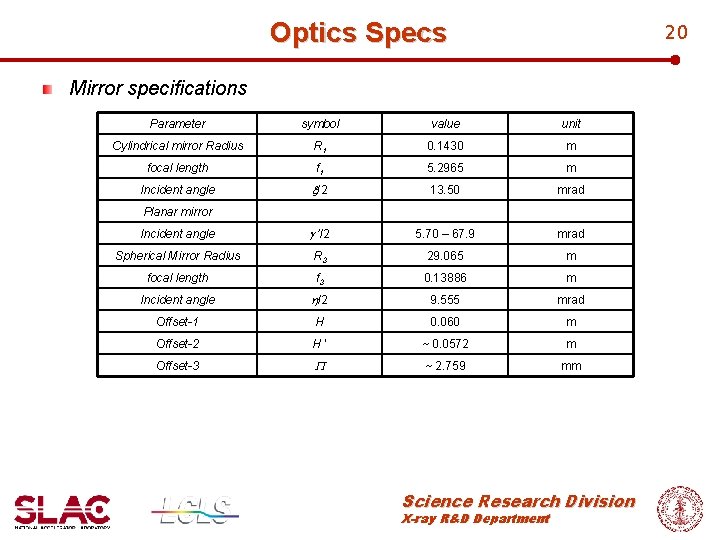
Optics Specs 20 Mirror specifications Parameter symbol value unit Cylindrical mirror Radius R 1 0. 1430 m focal length f 1 5. 2965 m Incident angle x/2 13. 50 mrad Incident angle g ’/2 5. 70 – 67. 9 mrad Spherical Mirror Radius R 3 29. 065 m focal length f 3 0. 13886 m Incident angle h/2 9. 555 mrad Offset-1 H 0. 060 m Offset-2 H’ ~ 0. 0572 m Offset-3 P ~ 2. 759 mm Planar mirror Science Research Division X-ray R&D Department
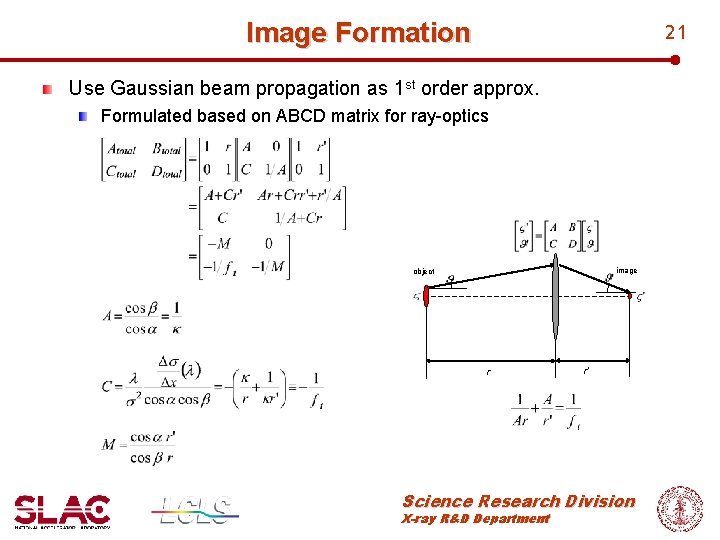
Image Formation 21 Use Gaussian beam propagation as 1 st order approx. Formulated based on ABCD matrix for ray-optics image object r r’ Science Research Division X-ray R&D Department
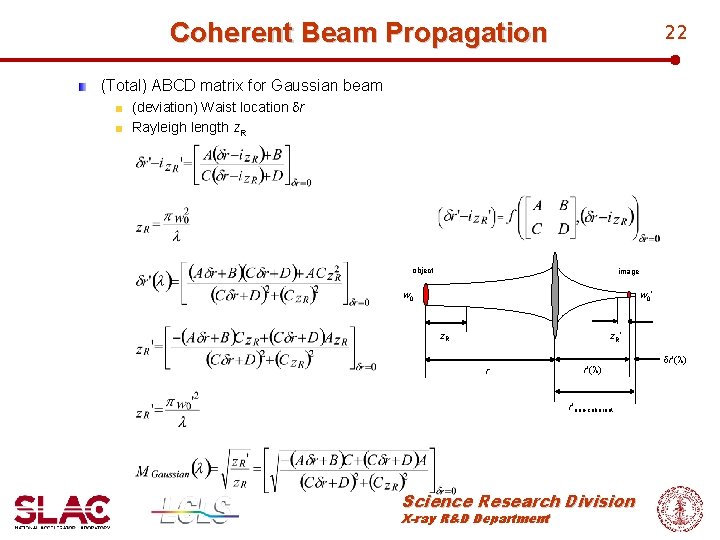
Coherent Beam Propagation 22 (Total) ABCD matrix for Gaussian beam (deviation) Waist location dr Rayleigh length z. R object image w 0’ w 0 z. R’ r r’(l) r’non-coherent Science Research Division X-ray R&D Department dr’(l)
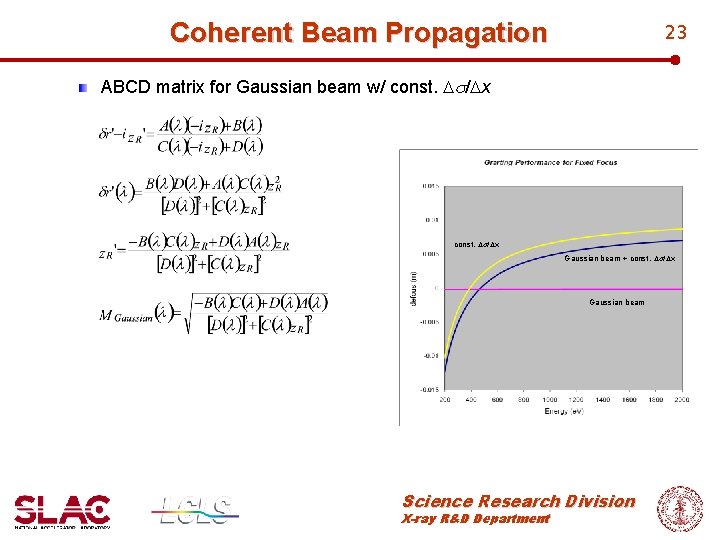
Coherent Beam Propagation 23 ABCD matrix for Gaussian beam w/ const. Ds/Dx Gaussian beam + const. Ds/Dx Gaussian beam Science Research Division X-ray R&D Department
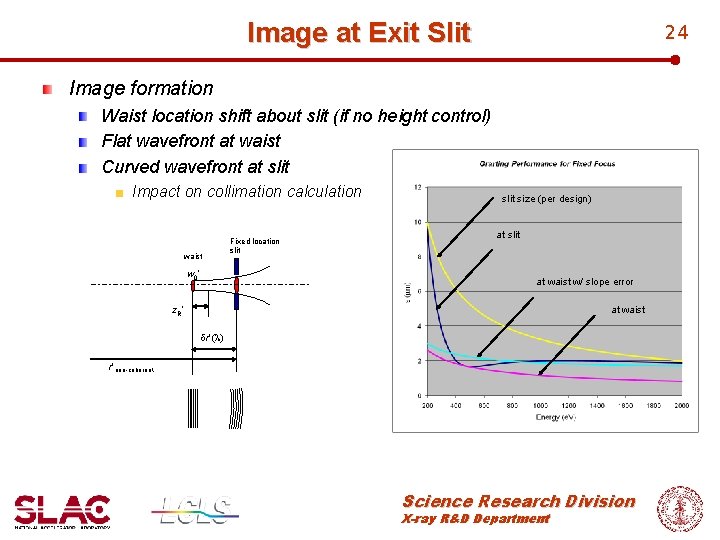
Image at Exit Slit 24 Image formation Waist location shift about slit (if no height control) Flat wavefront at waist Curved wavefront at slit Impact on collimation calculation waist w 0’ Fixed location slit size (per design) at slit at waist w/ slope error at waist z. R’ dr’(l) r’non-coherent Science Research Division X-ray R&D Department
Re-Collimation 25 Re-Collimation after exit slit ABCD matrix image object ft r r’ f Science Research Division X-ray R&D Department
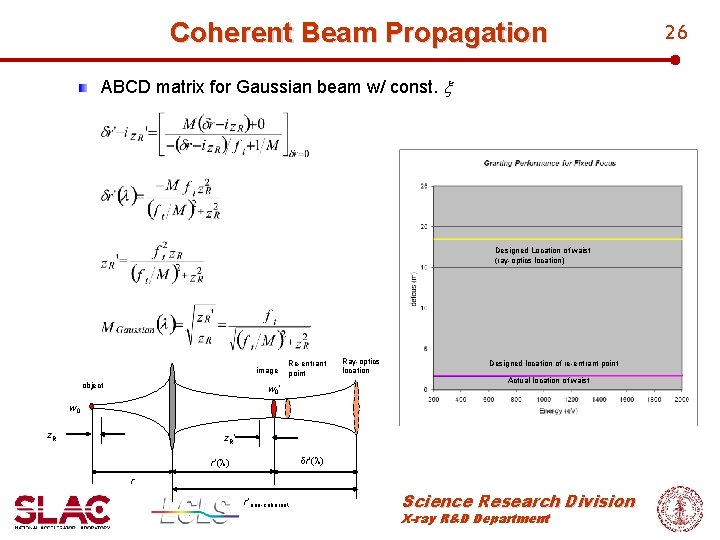
Coherent Beam Propagation ABCD matrix for Gaussian beam w/ const. x Designed Location of waist (ray-optics location) image object Re-entrant point w 0’ Ray-optics location Designed location of re-entrant point Actual location of waist w 0 z. R’ dr’(l) r r’non-coherent Science Research Division X-ray R&D Department 26
Beam Size in Dispersion Plane 27 Beam size evolution Grating w 0’ object image z. R Ray-optics z. R’ dr’(l) r r’non-coherent source Collimation mirror Ray-optics location Re-entrant image point w 0’ object Re-entrant point z. R’ z. R r’(l) dr’(l) r r’non-coherent Science Research Division X-ray R&D Department
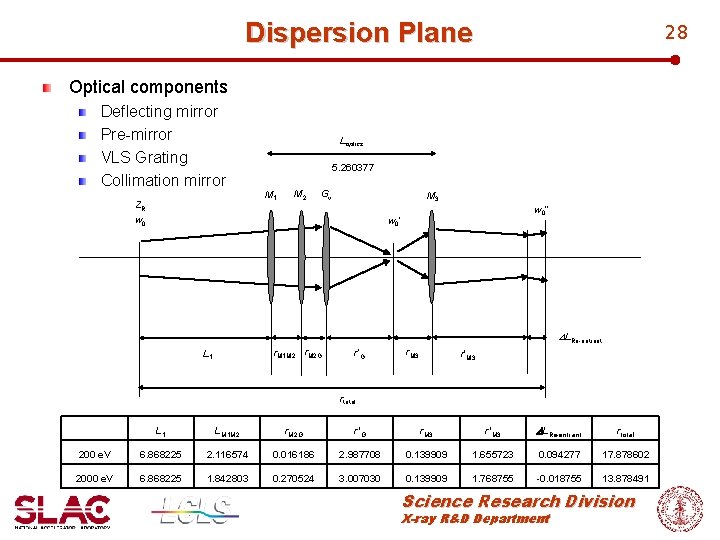
Dispersion Plane 28 Optical components Deflecting mirror Pre-mirror VLS Grating Collimation mirror ZR w 0 Loptics 5. 260377 M 1 M 2 Gv M 3 w 0’’ w 0’ DLRe-entrant r. M 1 M 2 r. M 2 G L 1 r’G r. M 3 r’M 3 rtotal L 1 LM 1 M 2 r. M 2 G r’G r. M 3 r’M 3 DLRe-entrant rtotal 200 e. V 6. 868225 2. 116574 0. 016186 2. 987708 0. 139909 1. 655723 0. 094277 17. 878602 2000 e. V 6. 868225 1. 842803 0. 270524 3. 007030 0. 139909 1. 768755 -0. 018755 13. 878491 Science Research Division X-ray R&D Department
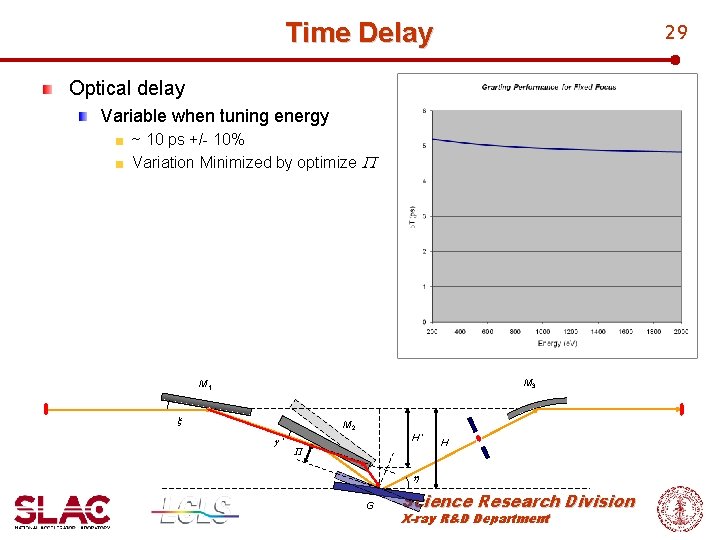
Time Delay 29 Optical delay Variable when tuning energy ~ 10 ps +/- 10% Variation Minimized by optimize P M 3 M 1 x M 2 g’ H’ P H h G Science Research Division X-ray R&D Department
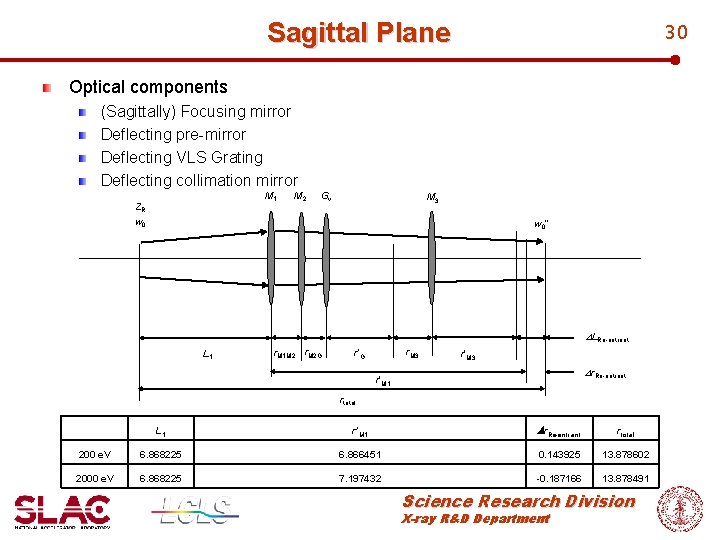
Sagittal Plane 30 Optical components (Sagittally) Focusing mirror Deflecting pre-mirror Deflecting VLS Grating Deflecting collimation mirror M 1 ZR w 0 M 2 Gv M 3 w 0’’ DLRe-entrant L 1 r. M 1 M 2 r. M 2 G r. M 3 r’G r’M 3 Dr. Re-entrant r’M 1 rtotal L 1 r’M 1 Dr. Re-entrant rtotal 200 e. V 6. 868225 6. 866451 0. 143925 13. 878602 2000 e. V 6. 868225 7. 197432 -0. 187166 13. 878491 Science Research Division X-ray R&D Department
Coherent Beam Propagation ABCD matrix for Gaussian beam w/ const. x Designed Location of waist (ray-optics) Designed location of reentrant point Actual location of waist object image w 0 z. R’ Re-entrant point Ray-optics location w 0’ z. R dr’(l) r r’non-coherent Science Research Division X-ray R&D Department 31
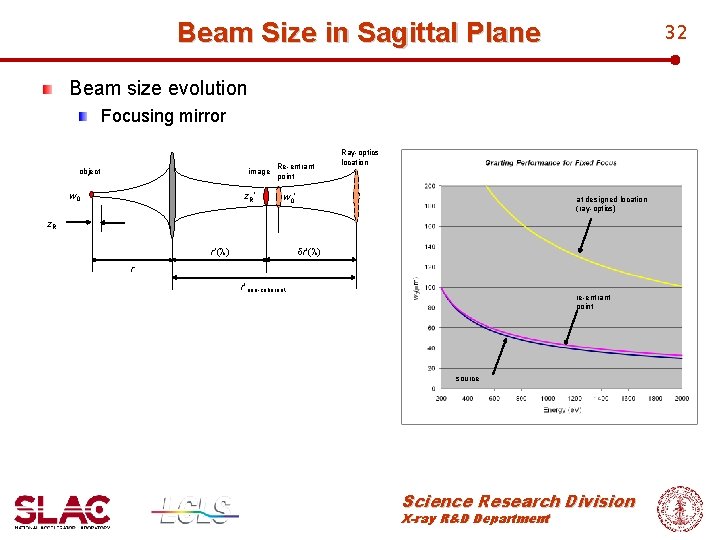
Beam Size in Sagittal Plane 32 Beam size evolution Focusing mirror object image w 0 z. R’ Re-entrant point Ray-optics location w 0’ at designed location (ray-optics) z. R dr’(l) r r’non-coherent re-entrant point source Science Research Division X-ray R&D Department
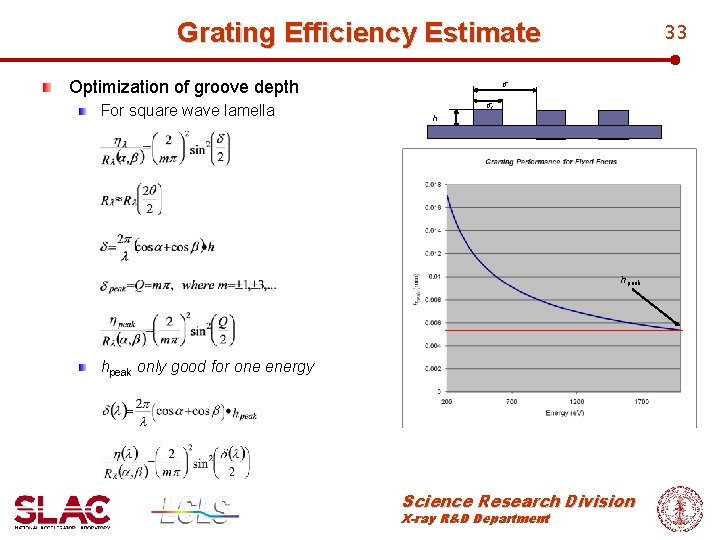
Grating Efficiency Estimate Optimization of groove depth For square wave lamella 33 s s. L h hpeak only good for one energy Science Research Division X-ray R&D Department
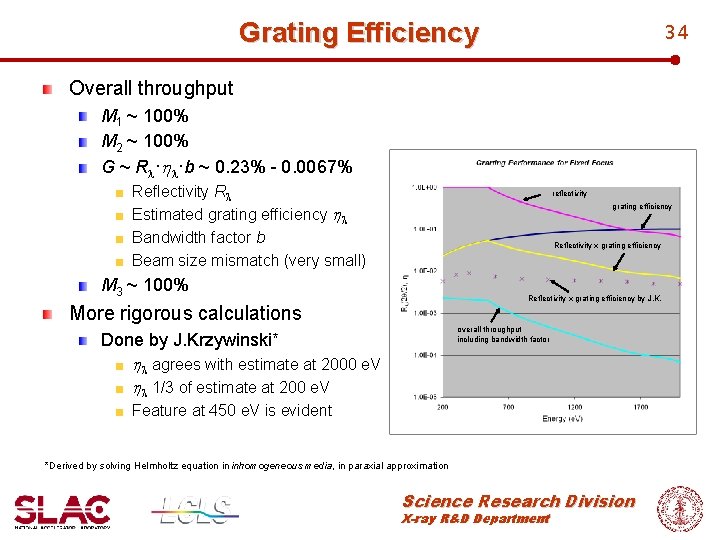
Grating Efficiency 34 Overall throughput M 1 ~ 100% M 2 ~ 100% G ~ Rl·hl·b ~ 0. 23% - 0. 0067% Reflectivity Rl Estimated grating efficiency hl Bandwidth factor b Beam size mismatch (very small) reflectivity grating efficiency Reflectivity x grating efficiency M 3 ~ 100% Reflectivity x grating efficiency by J. K. More rigorous calculations overall throughput including bandwidth factor Done by J. Krzywinski* hl agrees with estimate at 2000 e. V hl 1/3 of estimate at 200 e. V Feature at 450 e. V is evident *Derived by solving Helmholtz equation in inhomogeneous media, in paraxial approximation Science Research Division X-ray R&D Department
Seeding Power 35 Output power poutput ~ pinput·Rl·hl·b Estimates indicate goal is met Simple amplitude grating estimate J. K. rigorous calculation input power output power by K. J. design goal Science Research Division X-ray R&D Department
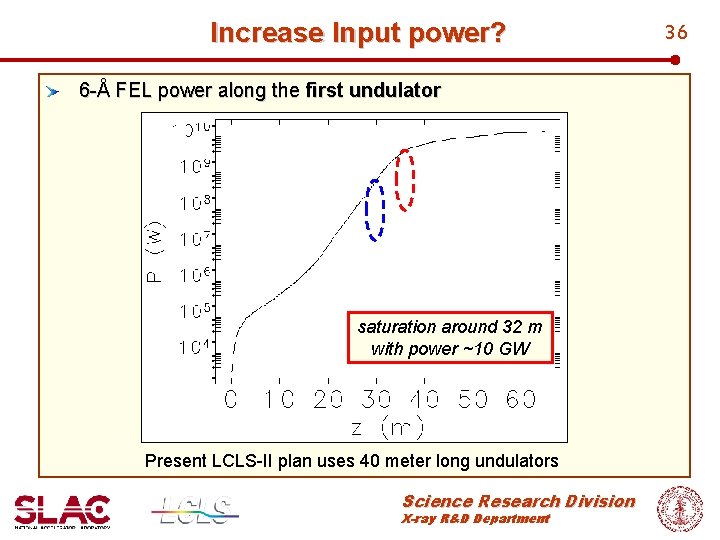
Increase Input power? 6 -Å FEL power along the first undulator saturation around 32 m with power ~10 GW Present LCLS-II plan uses 40 meter long undulators Science Research Division X-ray R&D Department 36
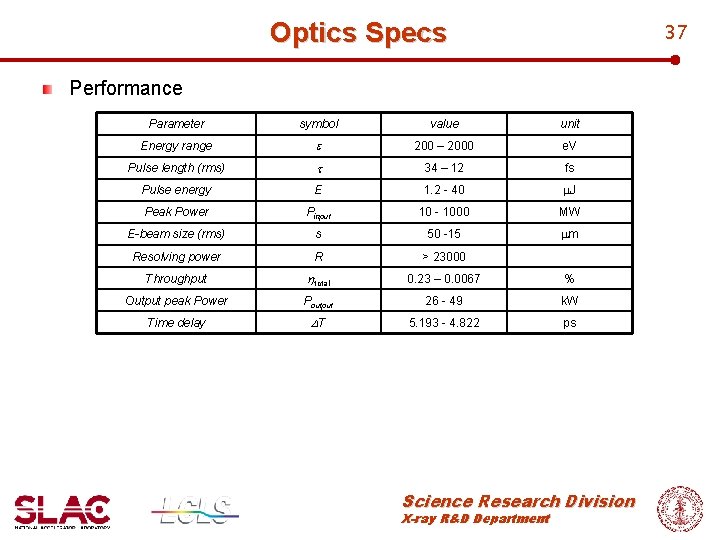
Optics Specs 37 Performance Parameter symbol value unit Energy range e 200 – 2000 e. V Pulse length (rms) t 34 – 12 fs Pulse energy E 1. 2 - 40 m. J Peak Power Pinput 10 - 1000 MW E-beam size (rms) s 50 -15 mm Resolving power R > 23000 Throughput htotal 0. 23 – 0. 0067 % Output peak Power Poutput 26 - 49 k. W Time delay DT 5. 193 - 4. 822 ps Science Research Division X-ray R&D Department
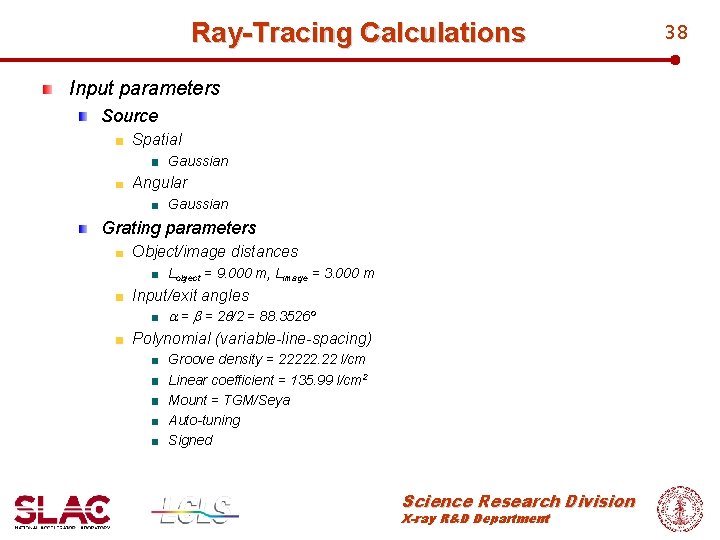
Ray-Tracing Calculations Input parameters Source Spatial Gaussian Angular Gaussian Grating parameters Object/image distances Lobject = 9. 000 m, Limage = 3. 000 m Input/exit angles a = b = 2 q/2 = 88. 3526º Polynomial (variable-line-spacing) Groove density = 22222. 22 l/cm Linear coefficient = 135. 99 l/cm 2 Mount = TGM/Seya Auto-tuning Signed Science Research Division X-ray R&D Department 38
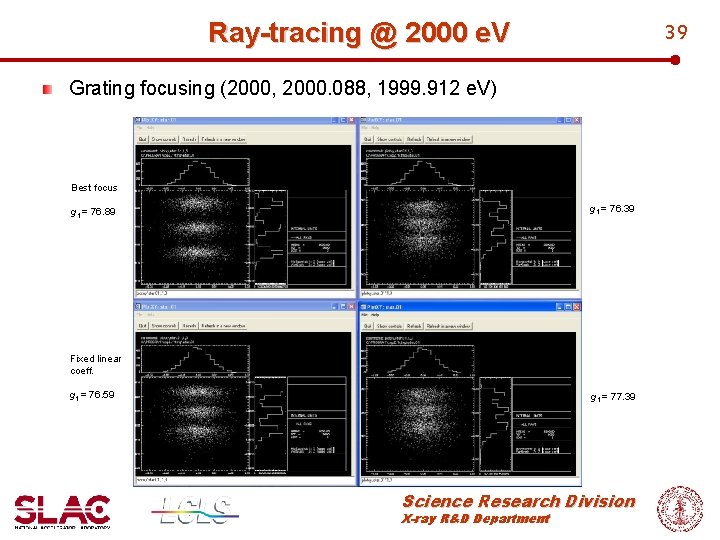
Ray-tracing @ 2000 e. V 39 Grating focusing (2000, 2000. 088, 1999. 912 e. V) Best focus g 1 = 76. 39 g 1 = 76. 89 Fixed linear coeff. g 1 = 76. 59 g 1 = 77. 39 Science Research Division X-ray R&D Department
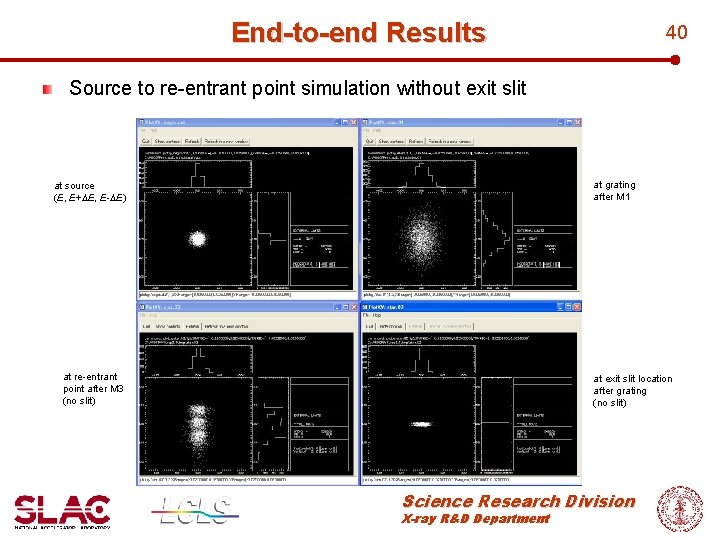
End-to-end Results 40 Source to re-entrant point simulation without exit slit at grating after M 1 at source (E, E+DE, E-DE) at re-entrant point after M 3 (no slit) at exit slit location after grating (no slit) Science Research Division X-ray R&D Department
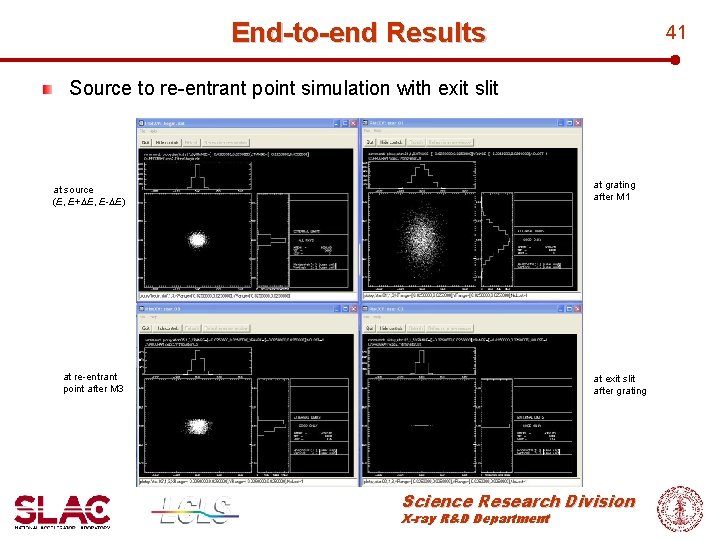
End-to-end Results 41 Source to re-entrant point simulation with exit slit at grating after M 1 at source (E, E+DE, E-DE) at re-entrant point after M 3 at exit slit after grating Science Research Division X-ray R&D Department
Summary Design meets all requirements High-resolution Grating Monochromator Fixed-focus operation excellent choice Only single grating needed Capable of tuning entire energy range Defocusing effects understood Few moving parts Efficiency sufficient for seeding Estimate and rigorous calculation indicate enough output power after mono Delay is variable but only weakly energy dependent Mirrors Pre-mirror Enables fixed-focus operation Vertical collimation mirror Re-collimates mono beam at entrance point Has a short focal length, defocus effect is evident, but could be compensated Horizontal focusing mirror Focuses input beam at entrance point Science Research Division X-ray R&D Department 42
43 Science Research Division X-ray R&D Department
Supporting Slides Alternative configurations ABCD formulations Ray-optics Gaussian beams Arbitrary coherent beams Science Research Division X-ray R&D Department 44
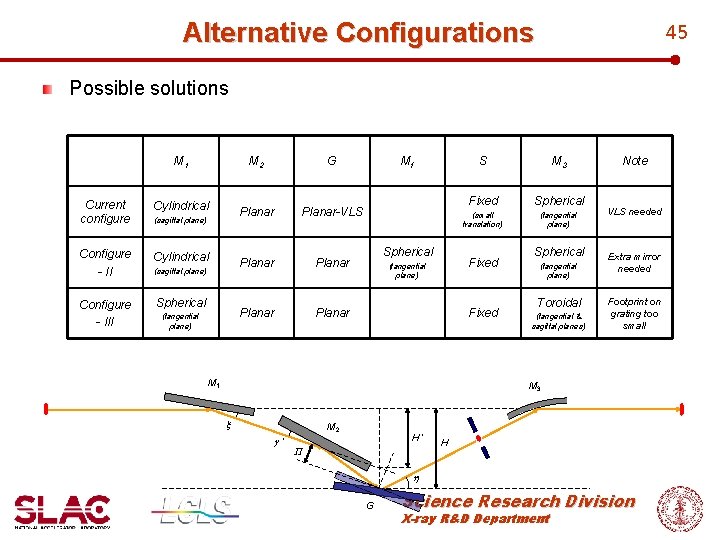
Alternative Configurations 45 Possible solutions M 1 M 2 G Current configure Cylindrical Planar-VLS Configure - II Cylindrical Planar Configure - III Spherical Planar (sagittal plane) (tangential plane) Mf Spherical S M 3 Fixed Spherical (small translation) (tangential plane) Fixed M 1 Spherical (tangential plane) Toroidal (tangential & sagittal planes) Note VLS needed Extra mirror needed Footprint on grating too small M 3 x M 2 g’ H’ P H h G Science Research Division X-ray R&D Department
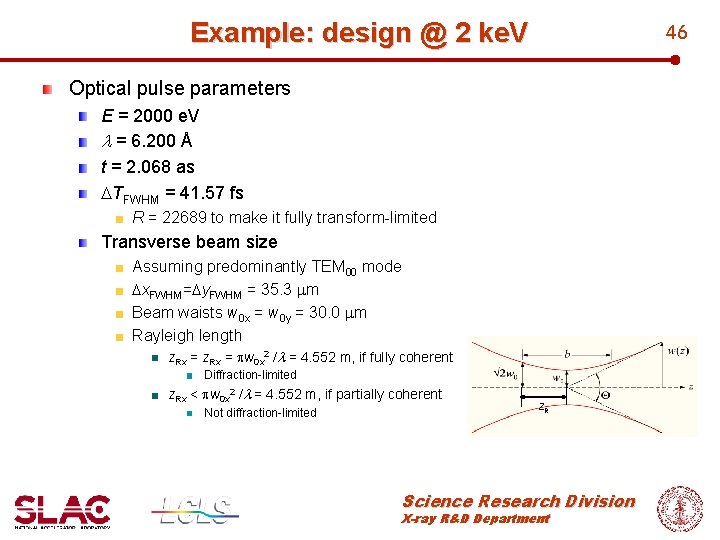
Example: design @ 2 ke. V 46 Optical pulse parameters E = 2000 e. V l = 6. 200 Å t = 2. 068 as DTFWHM = 41. 57 fs R = 22689 to make it fully transform-limited Transverse beam size Assuming predominantly TEM 00 mode Dx. FWHM=Dy. FWHM = 35. 3 mm Beam waists w 0 x = w 0 y = 30. 0 mm Rayleigh length z. Rx = pw 0 x 2 /l = 4. 552 m, if fully coherent Diffraction-limited z. Rx < pw 0 x 2 /l = 4. 552 m, if partially coherent Not diffraction-limited ZR Science Research Division X-ray R&D Department
Variable Line Spacing Grating Fixed focal point operation Linear coefficient Required for exact fixed focal-point small angle limit Science Research Division X-ray R&D Department 47
Variable Line Spacing Grating If Ds/Dx = constant at lopt Effective focus location lopt Effects of defocus Larger image size at exit slit Curved wavefront at exit slit l object image w 0’ l’ w 0 r’(l’) r r’(l) Science Research Division X-ray R&D Department 48
Operation of Pre-mirror 49 Function of pre-mirror Fixed focal point operation Included angle Exit angle (b) variable Rotation of grating Incident (a) & included (2 q) variable Motion of pre-mirror incident angle Rotation and effective translation exit angle M 3 M 1 x g ’/2 M 2 h G Science Research Division X-ray R&D Department
Operation of Pre-mirror 50 Motion of pre-mirror Rotation Translation Variable Single rotation about a pivot point M 3 M 1 x g ’/2 M 2 h G Science Research Division X-ray R&D Department
Rotation of Pre-mirror Rotation of pre-mirror Center of rotation ½ distance P above grating Paraxial approximation g’ G’ C P/2 P Pivot point C P/2 P Science Research Division X-ray R&D Department 51
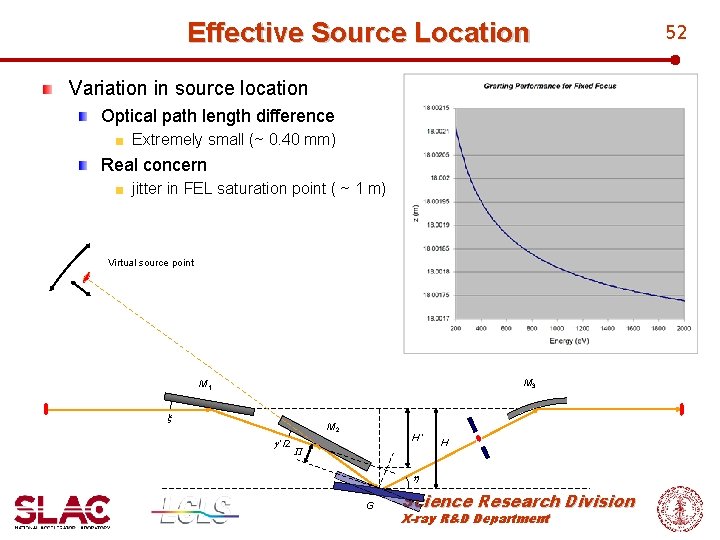
Effective Source Location Variation in source location Optical path length difference Extremely small (~ 0. 40 mm) Real concern jitter in FEL saturation point ( ~ 1 m) Virtual source point M 3 M 1 x M 2 g ’/2 H’ P H h G Science Research Division X-ray R&D Department 52