
OpticalOptical Double Resonance Spectroscopy of CH 2 Zhong
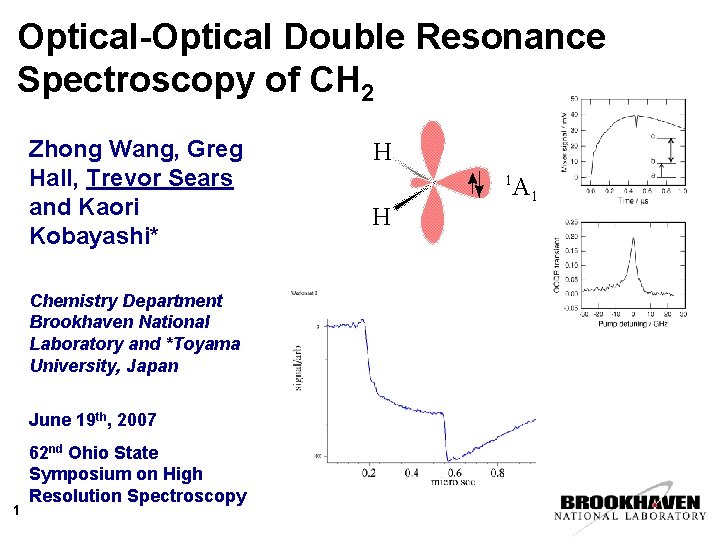
Optical-Optical Double Resonance Spectroscopy of CH 2 Zhong Wang, Greg Hall, Trevor Sears and Kaori Kobayashi* Chemistry Department Brookhaven National Laboratory and *Toyama University, Japan June 19 th, 2007 1 62 nd Ohio State Symposium on High Resolution Spectroscopy H 1 H A 1
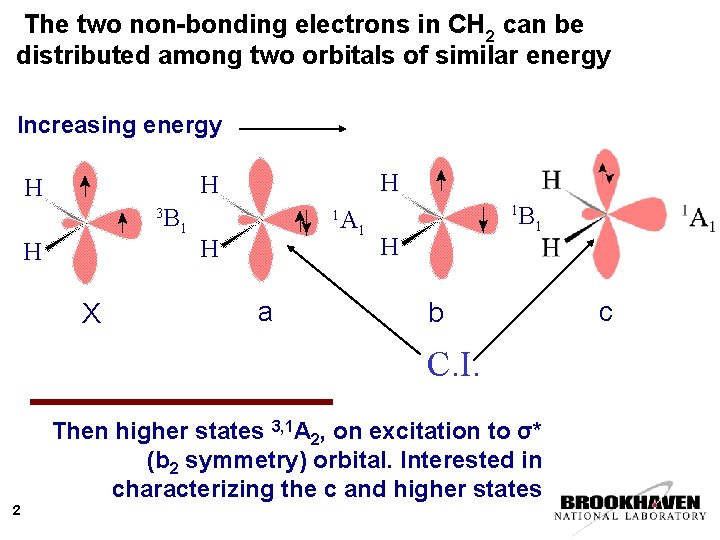
The two non-bonding electrons in CH 2 can be distributed among two orbitals of similar energy Increasing energy H H H 3 H X B 1 1 H a A 1 1 H B 1 b c C. I. Then higher states 3, 1 A 2, on excitation to σ* (b 2 symmetry) orbital. Interested in characterizing the c and higher states 2 Logo
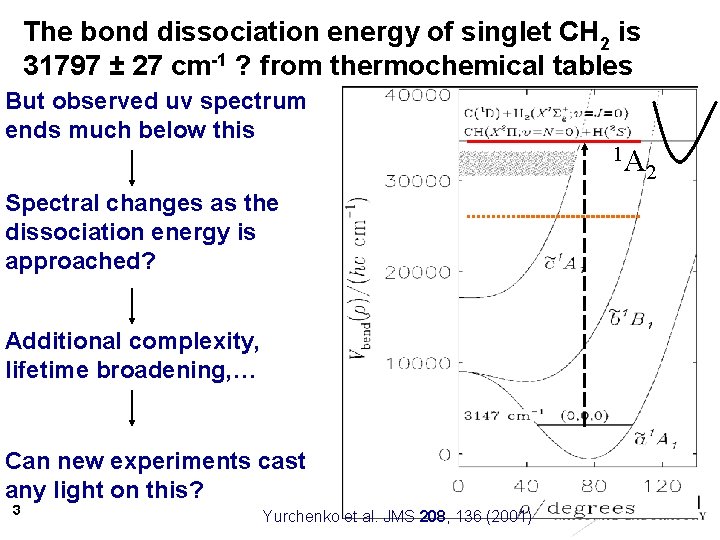
The bond dissociation energy of singlet CH 2 is 31797 ± 27 cm-1 ? from thermochemical tables But observed uv spectrum ends much below this 1 A 2 Spectral changes as the dissociation energy is approached? Additional complexity, lifetime broadening, … Can new experiments cast any light on this? 3 Yurchenko et al. JMS 208, 136 (2001) Logo
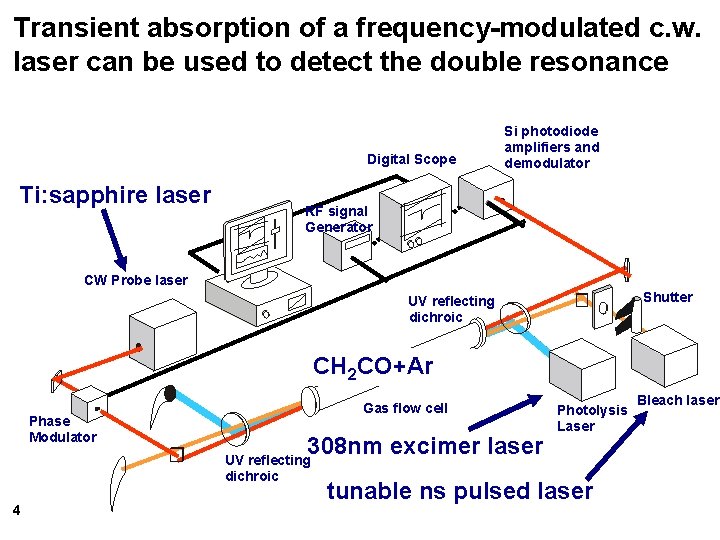
Transient absorption of a frequency-modulated c. w. laser can be used to detect the double resonance Digital Scope Ti: sapphire laser Si photodiode amplifiers and demodulator RF signal Generator CW Probe laser Shutter UV reflecting dichroic CH 2 CO+Ar Phase Modulator Gas flow cell 308 nm excimer laser UV reflecting dichroic 4 Photolysis Laser tunable ns pulsed laser Bleach laser
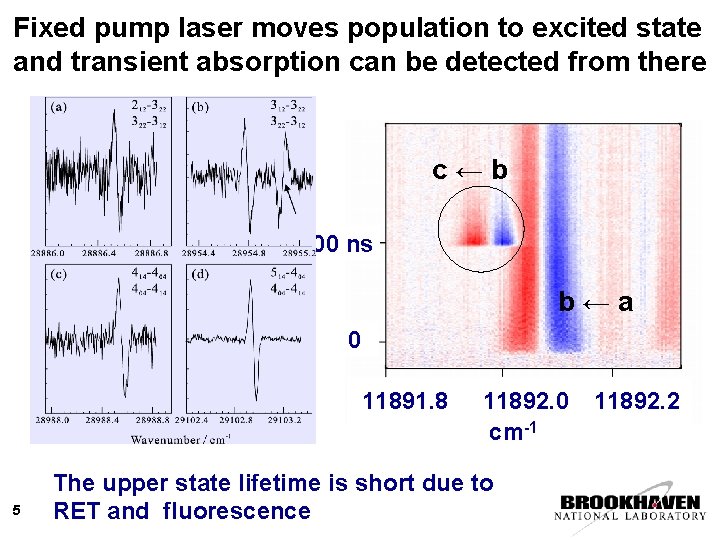
Fixed pump laser moves population to excited state and transient absorption can be detected from there c c←b b 400 ns b←a a Ladder scheme Pump-Probe 5 0 11891. 8 11892. 0 cm-1 The upper state lifetime is short due to RET and fluorescence 11892. 2
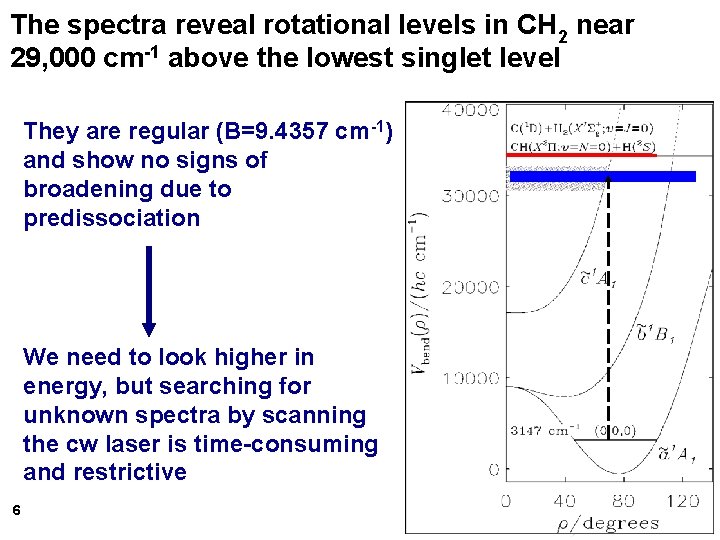
The spectra reveal rotational levels in CH 2 near 29, 000 cm-1 above the lowest singlet level They are regular (B=9. 4357 cm-1) and show no signs of broadening due to predissociation We need to look higher in energy, but searching for unknown spectra by scanning the cw laser is time-consuming and restrictive 6
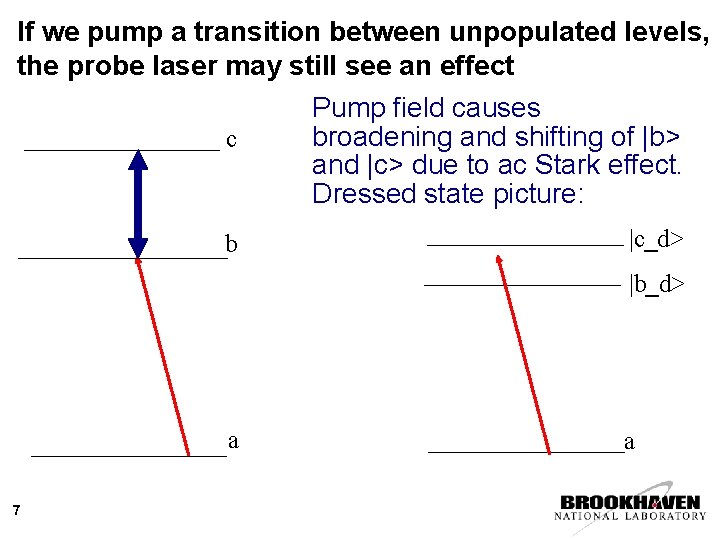
If we pump a transition between unpopulated levels, the probe laser may still see an effect Pump field causes broadening and shifting of |b> c and |c> due to ac Stark effect. Dressed state picture: b |c_d> |b_d> a 7 a
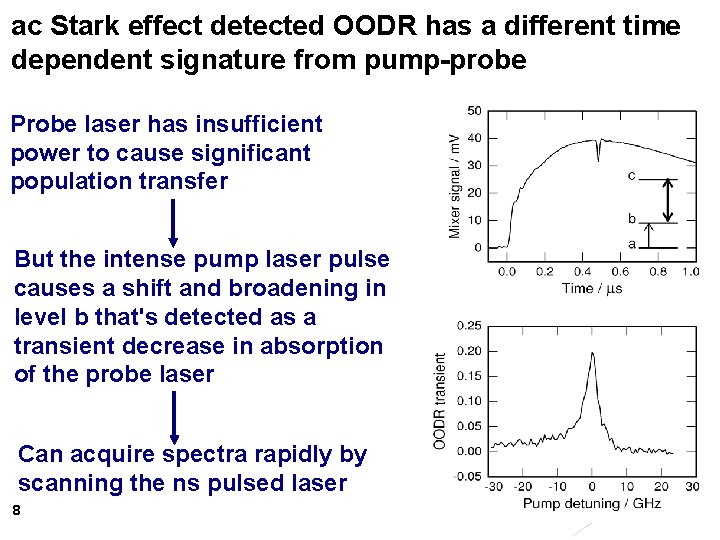
ac Stark effect detected OODR has a different time dependent signature from pump-probe Probe laser has insufficient power to cause significant population transfer But the intense pump laser pulse causes a shift and broadening in level b that's detected as a transient decrease in absorption of the probe laser Can acquire spectra rapidly by scanning the ns pulsed laser 8
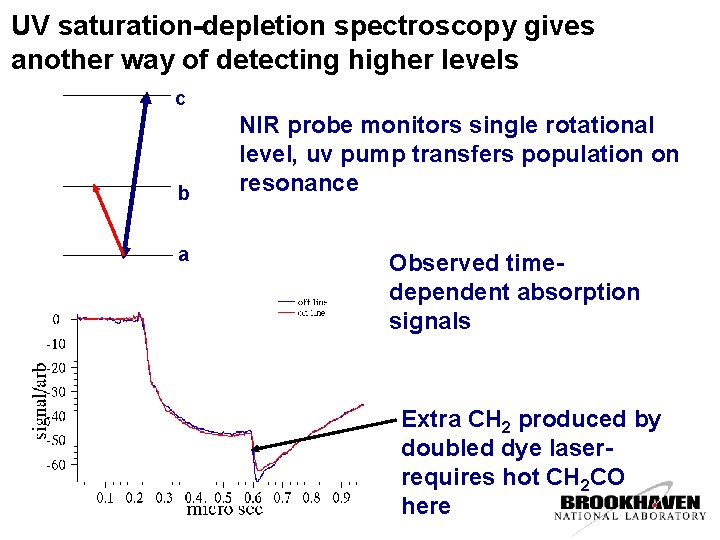
UV saturation-depletion spectroscopy gives another way of detecting higher levels c b a NIR probe monitors single rotational level, uv pump transfers population on resonance Observed timedependent absorption signals Extra CH 2 produced by doubled dye laserrequires hot CH 2 CO here
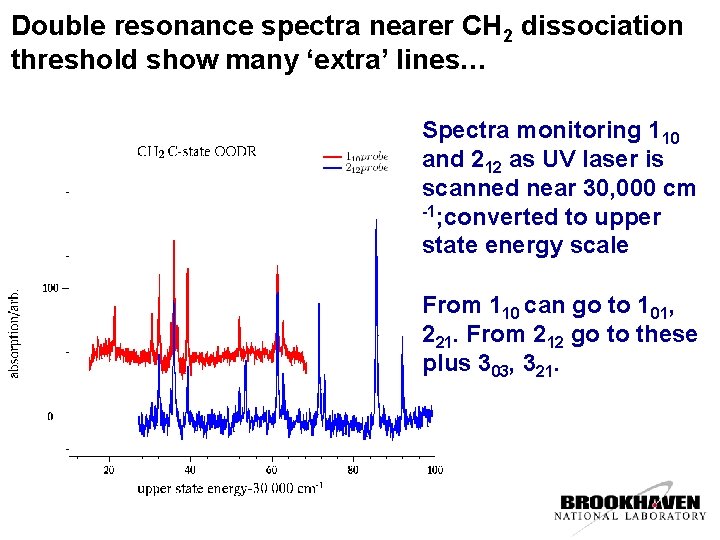
Double resonance spectra nearer CH 2 dissociation threshold show many ‘extra’ lines… Spectra monitoring 110 and 212 as UV laser is scanned near 30, 000 cm -1; converted to upper state energy scale From 110 can go to 101, 221. From 212 go to these plus 303, 321.
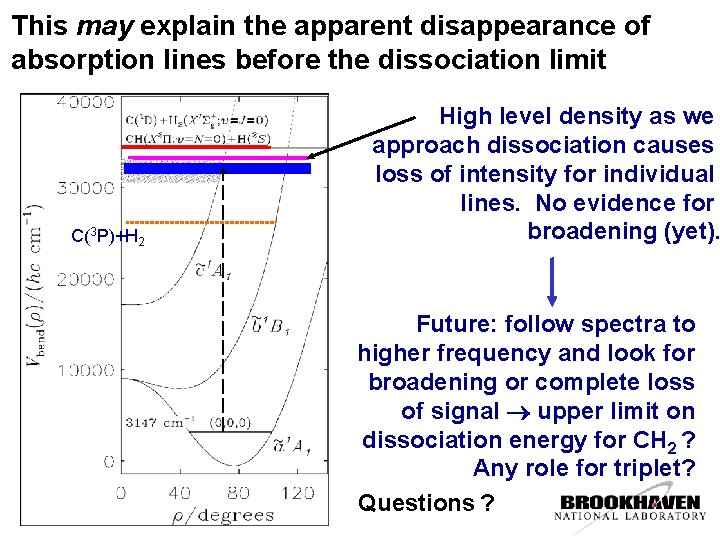
This may explain the apparent disappearance of absorption lines before the dissociation limit C(3 P)+H 2 High level density as we approach dissociation causes loss of intensity for individual lines. No evidence for broadening (yet). Future: follow spectra to higher frequency and look for broadening or complete loss of signal upper limit on dissociation energy for CH 2 ? Any role for triplet? Questions ?
- Slides: 11