
Optical Zeeman Spectroscopy of the 0 0 bands
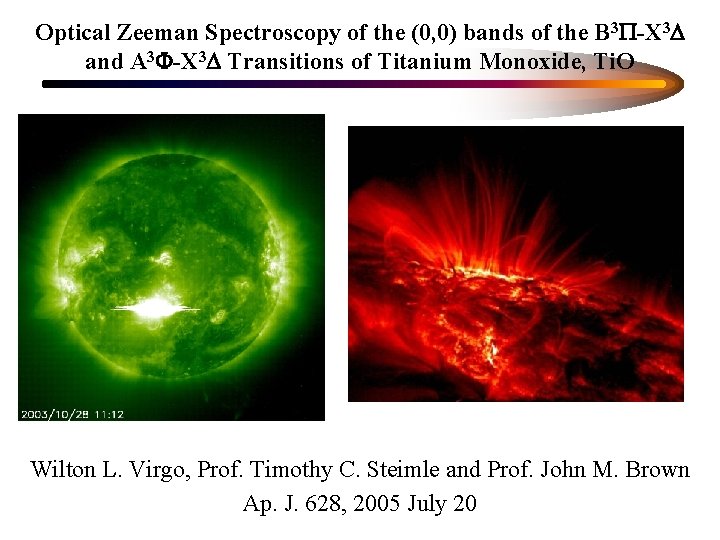
Optical Zeeman Spectroscopy of the (0, 0) bands of the B 3 P-X 3 D and A 3 F-X 3 D Transitions of Titanium Monoxide, Ti. O Wilton L. Virgo, Prof. Timothy C. Steimle and Prof. John M. Brown Ap. J. 628, 2005 July 20

Zeeman Spectroscopy of Ti. O: Dual Purpose • Magnetic “g” factors are useful in unraveling the nature of electronic states of metal containing molecules. – Analyze electronic state composition and provide evidence for mixing between states. • Optical Zeeman effect of Ti. O is used to probe ambient stellar magnetic fields. – Experimentally determine magnetic tuning rates of molecular energy levels.
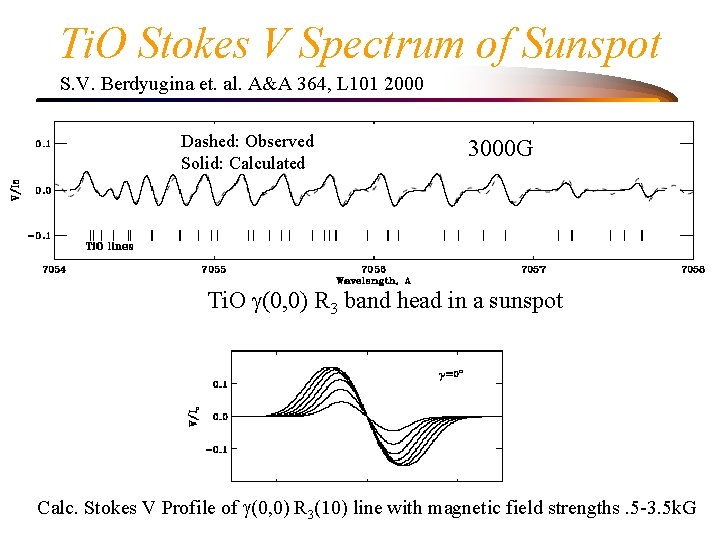
Ti. O Stokes V Spectrum of Sunspot S. V. Berdyugina et. al. A&A 364, L 101 2000 Dashed: Observed Solid: Calculated 3000 G Ti. O g(0, 0) R 3 band head in a sunspot Calc. Stokes V Profile of g(0, 0) R 3(10) line with magnetic field strengths. 5 -3. 5 k. G
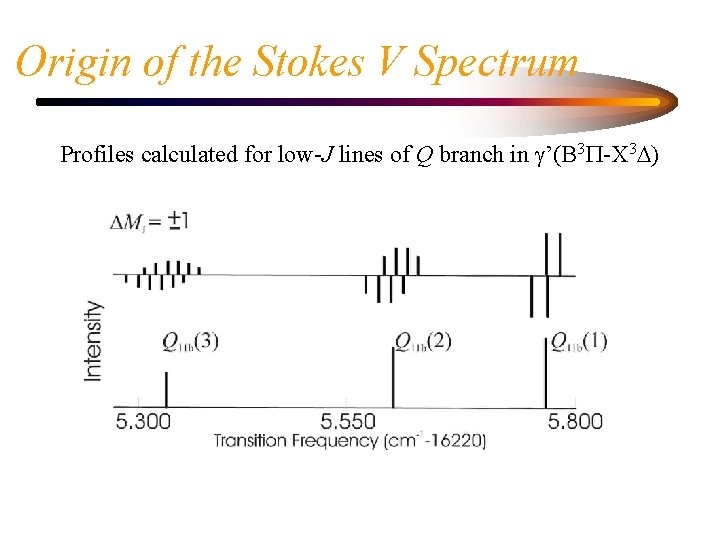
Origin of the Stokes V Spectrum Profiles calculated for low-J lines of Q branch in g’(B 3 P-X 3 D)

Zeeman Effect in Diatomic Molecules: Berdyugina’s Astrophysical Model Berdyugina et. al. A&A 412, 513 (2003), A&A 385, 701 (2002). Magnetic dipole moment operator is a sum of terms directly proportional to angular momentum operators: m. L = -m. Bg. LL, m. S = -m. Bg. SS In principle, Zeeman effect can be predicted a priori from field free eigenvalues and eigenvectors given the g-values: 1. Only diagonal terms in J included 2. Predicts linear field dependence 3. g. S, g. L fixed to 2. 002 and 1. 0 4. L and S are rigorously good

Modeling the Zeeman Effect in Ti. O: Sophisticated Effective Hamiltonian Approach 1. Spin-orbit and rotational mixing significant in metal species 2. Evident in large L-doubling in B 3 P state of Ti. O Eff. Hamiltonian absorbs effects of other states into the g parameters Makes allowance for all possible admixtures of electronic states Adjustable g parameter values glean insight into the perturbations Key difference from astrophysical model: Accounts for both linear and non-linear field dependence by including off diagonal in J matrix elements
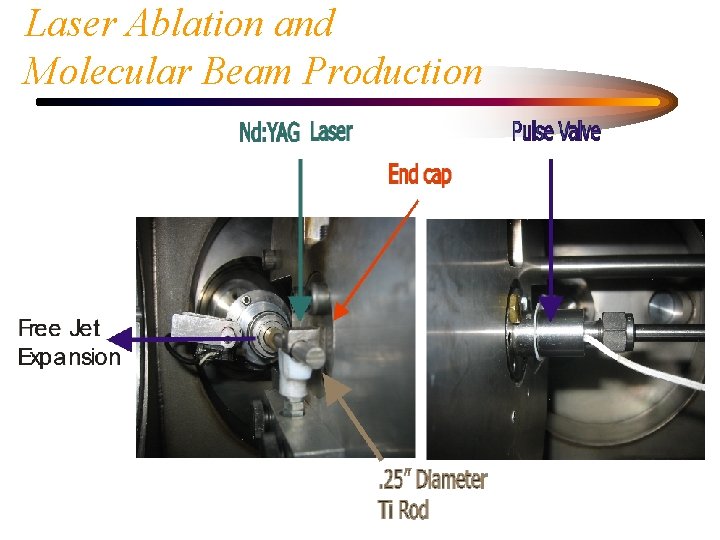
Laser Ablation and Molecular Beam Production

High-Resolution Spectrometer Optical Zeeman Spectroscopy Electromagnet

Electromagnet for Zeeman Spectroscopy (56 G-1. 2 k. G)
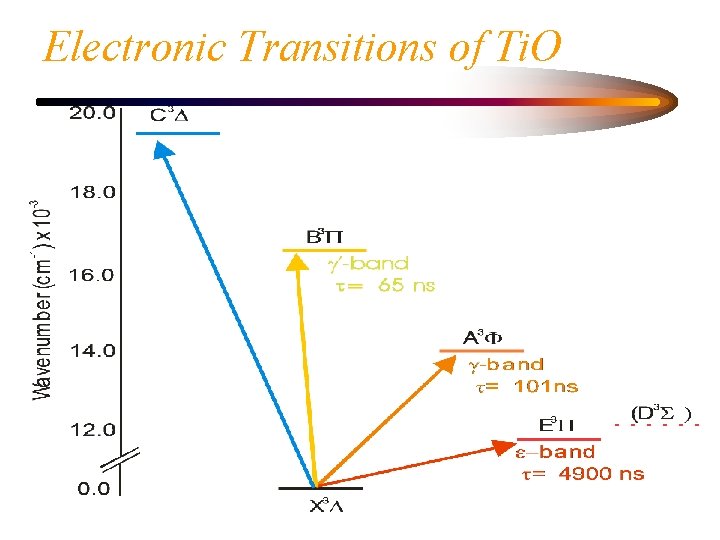
Electronic Transitions of Ti. O

Zeeman Spectra: R 11(1) g F 2 3 (A 3 -X D 1)

Zeeman Spectra: Q 11 b(1) (0, 0) g’(B 3 P 0 - X 3 D 1) Feature
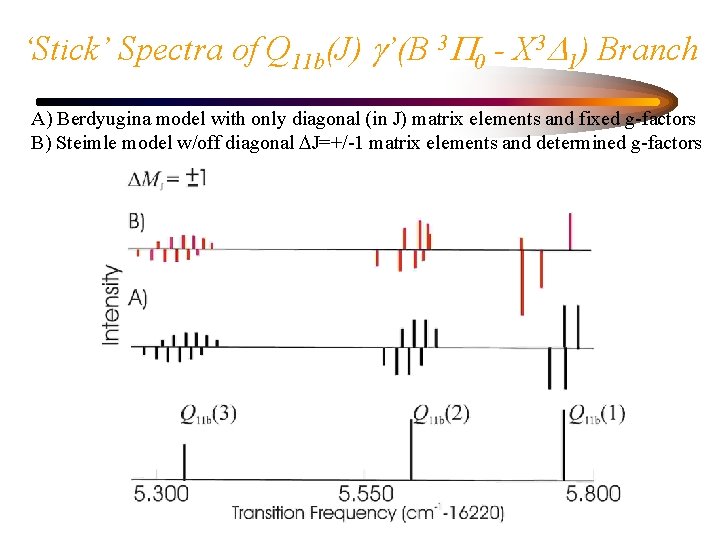
‘Stick’ Spectra of Q 11 b(J) g’(B 3 P 0 - X 3 D 1) Branch A) Berdyugina model with only diagonal (in J) matrix elements and fixed g-factors B) Steimle model w/off diagonal DJ=+/-1 matrix elements and determined g-factors
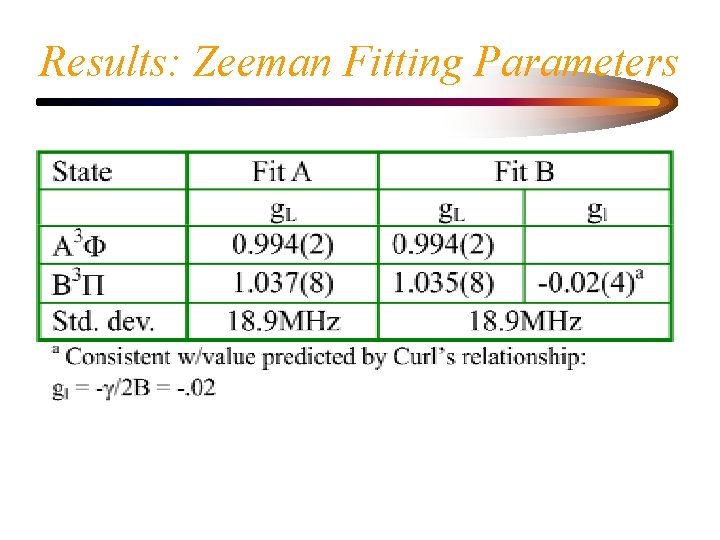
Results: Zeeman Fitting Parameters
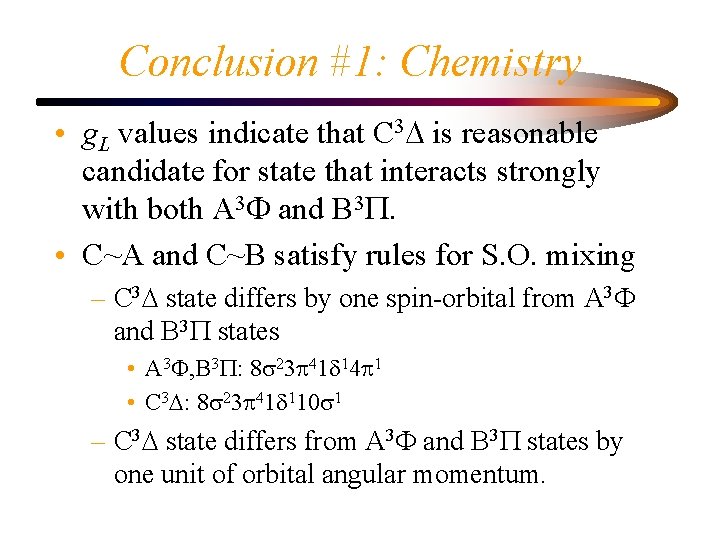
Conclusion #1: Chemistry • g. L values indicate that C 3 D is reasonable candidate for state that interacts strongly with both A 3 F and B 3 P. • C~A and C~B satisfy rules for S. O. mixing – C 3 D state differs by one spin-orbital from A 3 F and B 3 P states • A 3 F, B 3 P: 8 s 23 p 41 d 14 p 1 • C 3 D: 8 s 23 p 41 d 110 s 1 – C 3 D state differs from A 3 F and B 3 P states by one unit of orbital angular momentum.
Conclusion #2: Astrophysics • Significant L-doubling in B 3 P 0 state requires inclusion of DJ=+/-1 matrix elements. • Strong off-diagonal J interaction will impose a non-linear response to magnetic field in the low-J lines. Fitted g-factors necessary to reproduce experimental observations. Unexpected by current astrophysical model.
Thank You Funding provided by NSF Experimental Physical Chemistry
- Slides: 17