
Optical System Design for Cube Sats Joseph M
Optical System Design for Cube. Sats Joseph M. Howard, Garrett J. West Optics Branch, Code 551, GSFC NASA
Agenda 1. 2. 3. 4. 5. Optical Design Lab (ODL) Optical Specifications Refractive vs. Reflective Freeform Optics Examples 2
Welcome to the ODL!! • Optical Design Lab (ODL): – Goddard Optics Branch, Bldg 5, Room W 054 – We provide optical design services, and a gateway to the Engineering Technology Directorate (ETD) • Contact: Joe. Howard@nasa. gov • The conversation starts with specifications… 3
Optical Design Specification 1. What is the NAME of your mission, the basic concept (one or two sentences), and the top level science requirements ? Are there "competition sensitive" aspects of this study that you need us to be aware? 2. Are there schedule constraints ? (e. g. Instrument Design Lab, IDL, or Mission Planning Lab, MPL, run in a few weeks, etc. ) 3. Number of instruments ? (typically this is just one) 4
Optical Design Specification 4. Conjugates ? Is your object of interest at infinity, which is to be imaged onto a detector? (This case is the most common. ) 5. Aperture ? Is this defined as an Entrance pupil diameter (EPD) ? Or a working F/# ? Is this requirement driven by radiometry (i. e. sensitivity), or resolution (i. e. diffraction limited) ? 6. Field of view (FOV) ? Do you have a detector concept in mind? If so, tell us the pixel size and array size. 5
Optical Design Specification 7. Focal Length or Magnification ? What is your desired Pixel sampling on the object of interest (e. g. sky or ground) ? Optical performance figure of merit ? 8. Wavelength range ? (i. e. optical bandpass) If the instrument is a spectrometer, please include desired spectral resolution. 9. Systems requirements ? Strongest engineering driver: cost, volume, mass, or performance? Any optically important mechanisms (e. g. scan or steering mirrors)? Any significant packaging or mass constraints for this instrument? 6

Design Solutions: Refractive • Plot Aperture (F/#) vs FOV • Refractive can be more compact • Large bandpass may require many lenses for chromatic correction • Mass adds up for complex systems • Glass may be sensitive to radiation environment • Larger field of view capability • Throughput may be impacted depending on glass transmittance and number of surfaces LENSES 7
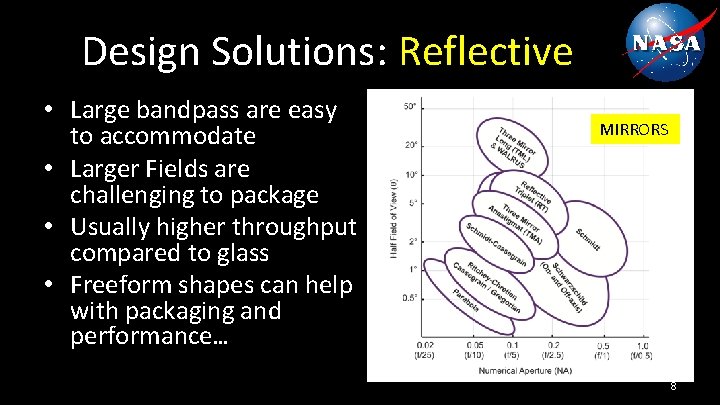
Design Solutions: Reflective • Large bandpass are easy to accommodate • Larger Fields are challenging to package • Usually higher throughput compared to glass • Freeform shapes can help with packaging and performance… MIRRORS 8
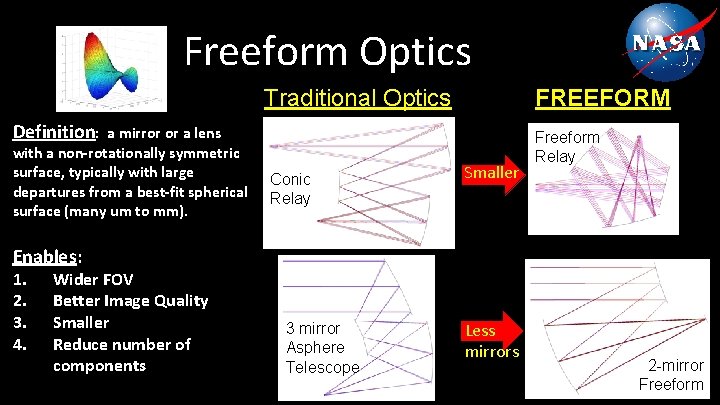
Freeform Optics Traditional Optics FREEFORM Definition: a mirror or a lens with a non-rotationally symmetric surface, typically with large departures from a best-fit spherical surface (many um to mm). Conic Relay Smaller Freeform Relay Enables: 1. 2. 3. 4. Wider FOV Better Image Quality Smaller Reduce number of components 3 mirror Asphere Telescope Less mirrors 2 -mirror Freeform 9
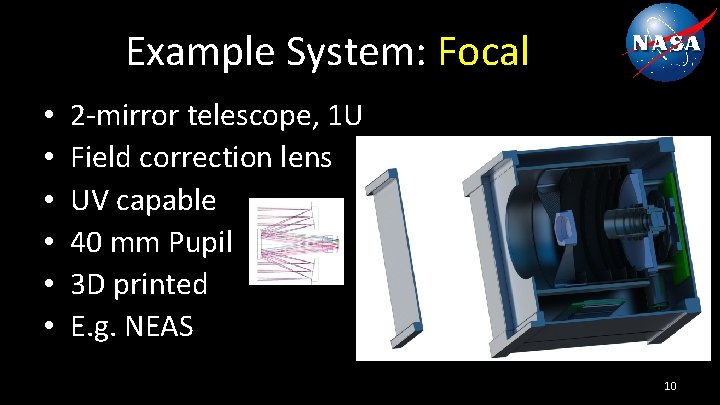
Example System: Focal • • • 2 -mirror telescope, 1 U Field correction lens UV capable 40 mm Pupil 3 D printed E. g. NEAS 10
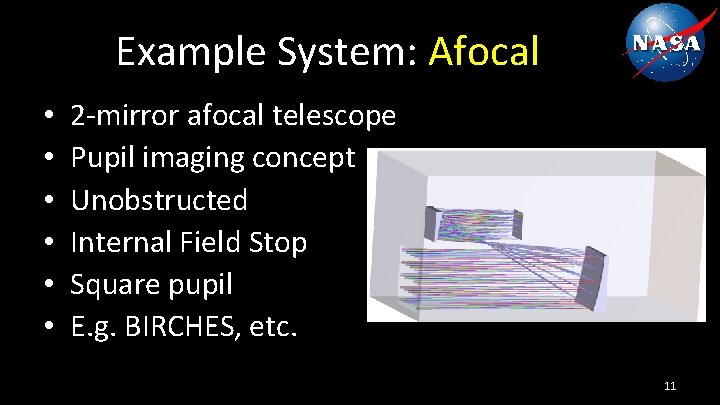
Example System: Afocal • • • 2 -mirror afocal telescope Pupil imaging concept Unobstructed Internal Field Stop Square pupil E. g. BIRCHES, etc. 11
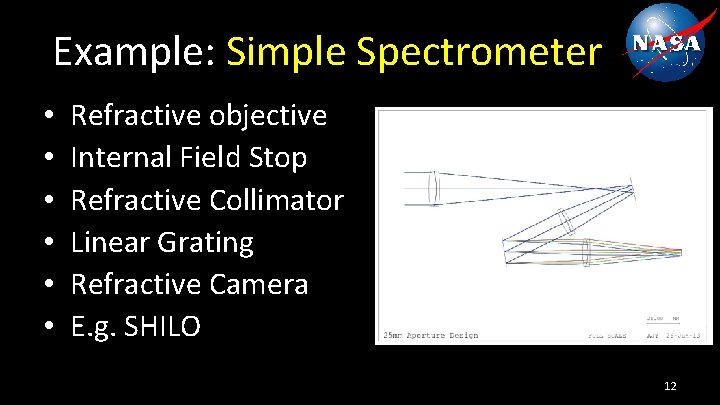
Example: Simple Spectrometer • • • Refractive objective Internal Field Stop Refractive Collimator Linear Grating Refractive Camera E. g. SHILO 12
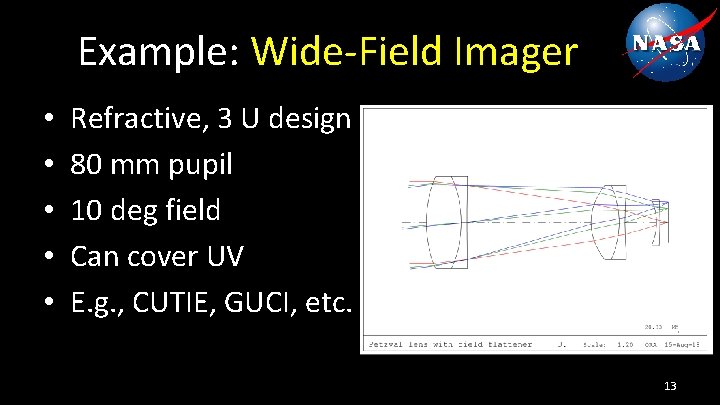
Example: Wide-Field Imager • • • Refractive, 3 U design 80 mm pupil 10 deg field Can cover UV E. g. , CUTIE, GUCI, etc. 13
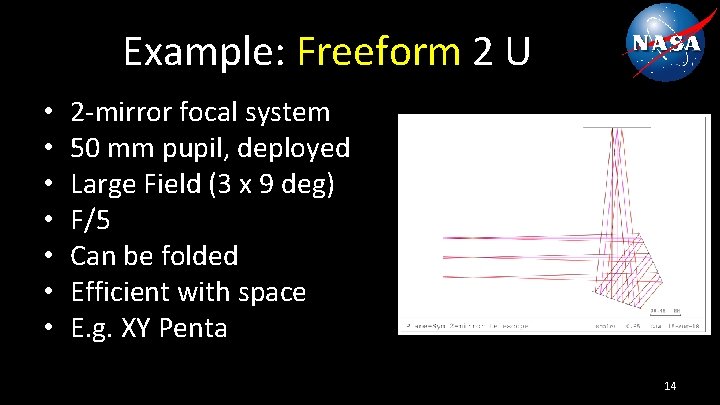
Example: Freeform 2 U • • 2 -mirror focal system 50 mm pupil, deployed Large Field (3 x 9 deg) F/5 Can be folded Efficient with space E. g. XY Penta 14
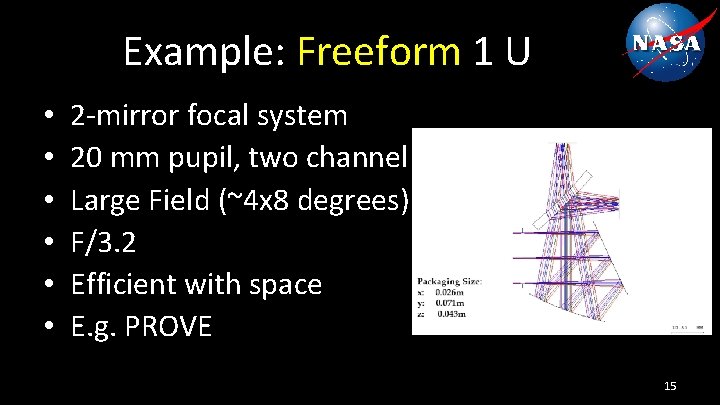
Example: Freeform 1 U • • • 2 -mirror focal system 20 mm pupil, two channel Large Field (~4 x 8 degrees) F/3. 2 Efficient with space E. g. PROVE 15
Concluding Remarks • The minimum aperture size of optical instrumentation is often driven by the laws of physics, so miniaturization of optics is often not an option for science applications. • Freeform optics are enabling smaller optical systems of a given aperture with large fields of view. • If you need help with your optical design, contact the Optical Design Lab (ODL): Joe. Howard@nasa. gov 16
- Slides: 16