
Optical Resolution For a circular opening of diameter

- Slides: 12
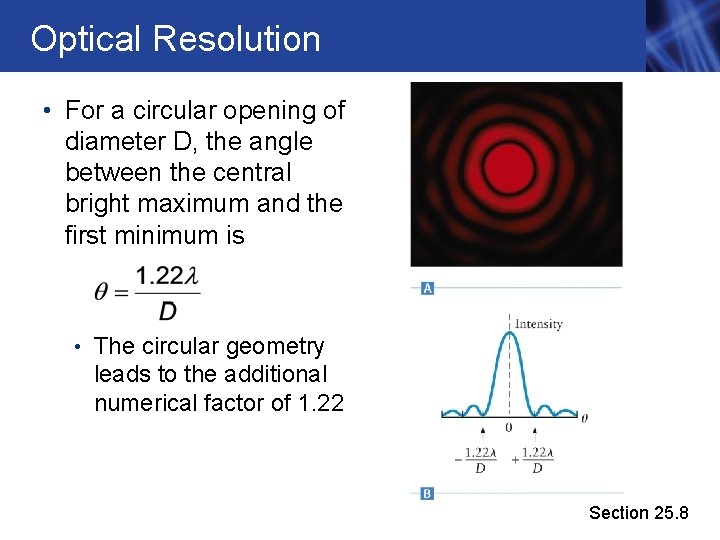
Optical Resolution • For a circular opening of diameter D, the angle between the central bright maximum and the first minimum is • The circular geometry leads to the additional numerical factor of 1. 22 Section 25. 8
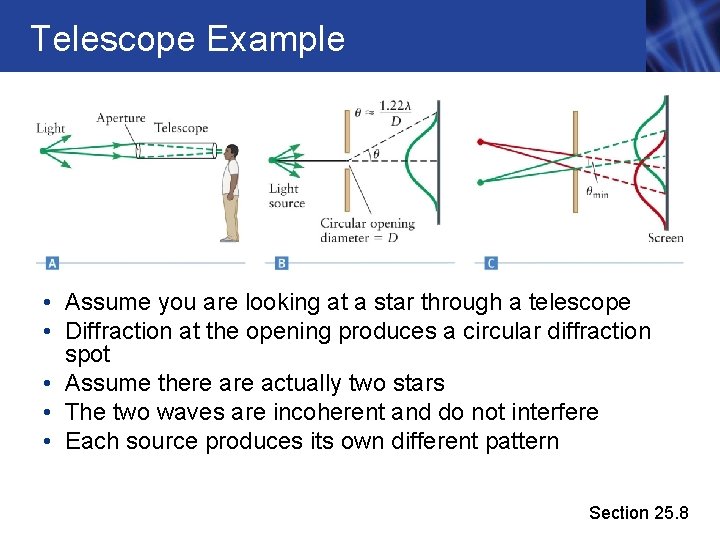
Telescope Example • Assume you are looking at a star through a telescope • Diffraction at the opening produces a circular diffraction spot • Assume there actually two stars • The two waves are incoherent and do not interfere • Each source produces its own different pattern Section 25. 8
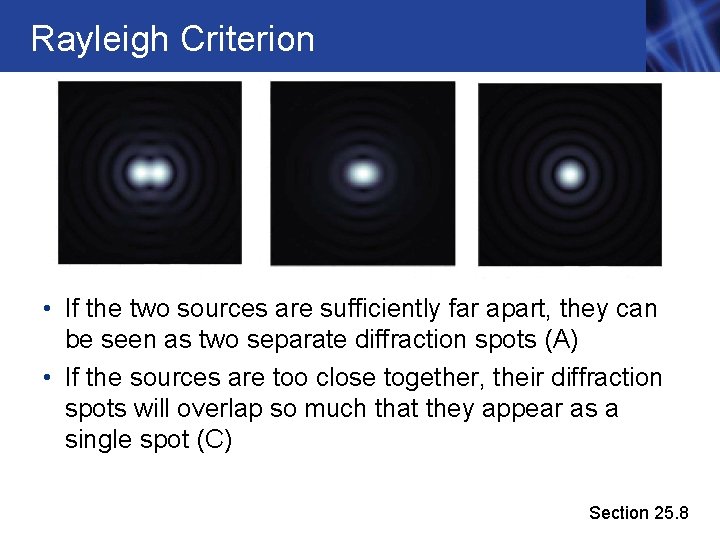
Rayleigh Criterion • If the two sources are sufficiently far apart, they can be seen as two separate diffraction spots (A) • If the sources are too close together, their diffraction spots will overlap so much that they appear as a single spot (C) Section 25. 8
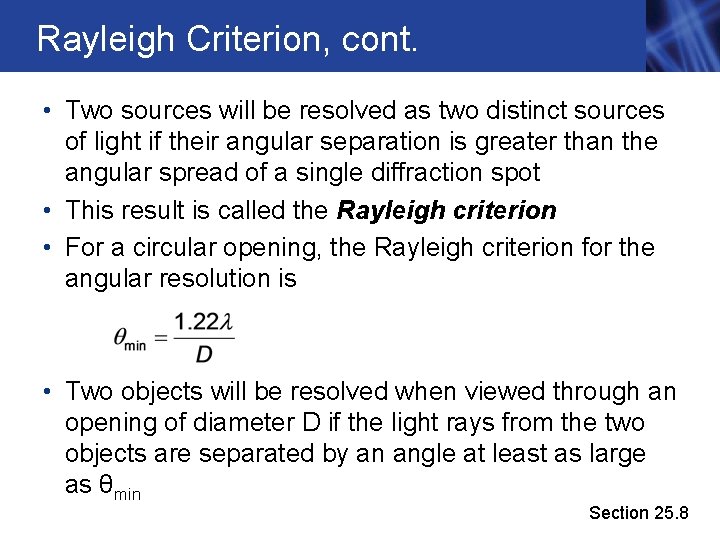
Rayleigh Criterion, cont. • Two sources will be resolved as two distinct sources of light if their angular separation is greater than the angular spread of a single diffraction spot • This result is called the Rayleigh criterion • For a circular opening, the Rayleigh criterion for the angular resolution is • Two objects will be resolved when viewed through an opening of diameter D if the light rays from the two objects are separated by an angle at least as large as θmin Section 25. 8
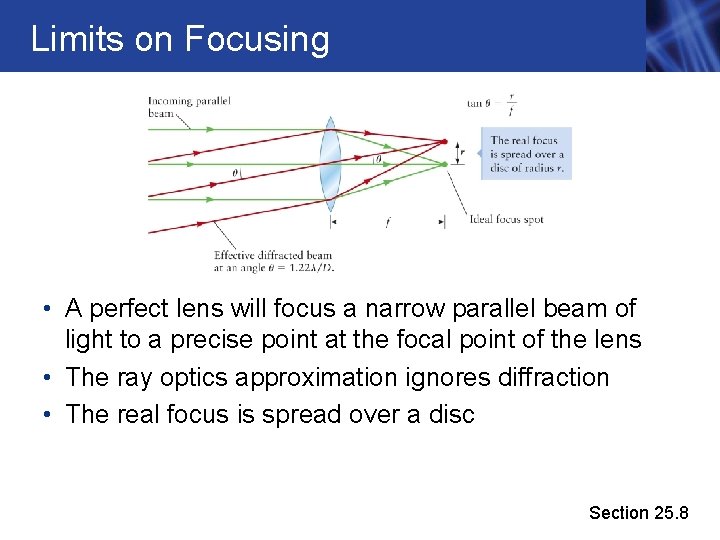
Limits on Focusing • A perfect lens will focus a narrow parallel beam of light to a precise point at the focal point of the lens • The ray optics approximation ignores diffraction • The real focus is spread over a disc Section 25. 8
Limits on Focusing, cont. • If the lens has a diameter D, it acts like an opening and according to the Rayleigh criterion produces a diffracted beam spread over a range of angles • Diffraction spreads the focal point over a disk of radius r • • The focal length is limited to Section 25. 8
Limits on Focusing, final • The wave nature of light limits the focusing qualities of even a perfect lens • It is not possible to focus a beam of light to a spot smaller than approximately the wavelength • The ray approximation of geometrical optics can be applied at size scale much greater than the wavelength • When a slit or a focused beam of light is made so small that its dimensions are comparable to the wavelength, diffraction effects become important Section 25. 8
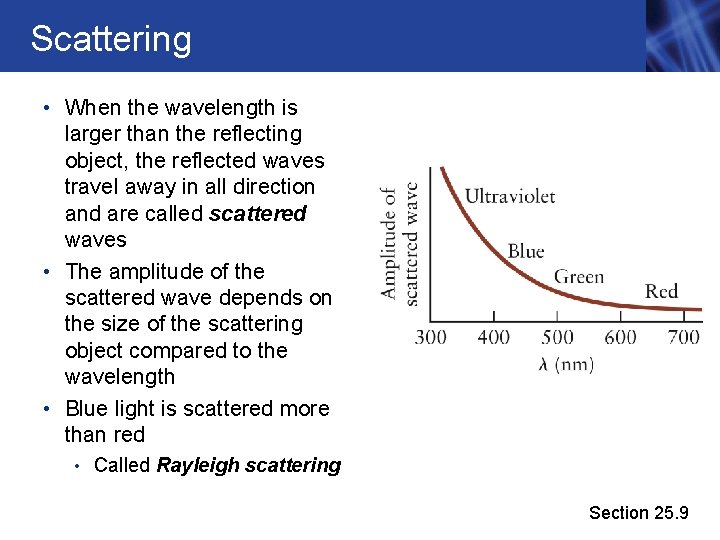
Scattering • When the wavelength is larger than the reflecting object, the reflected waves travel away in all direction and are called scattered waves • The amplitude of the scattered wave depends on the size of the scattering object compared to the wavelength • Blue light is scattered more than red • Called Rayleigh scattering Section 25. 9
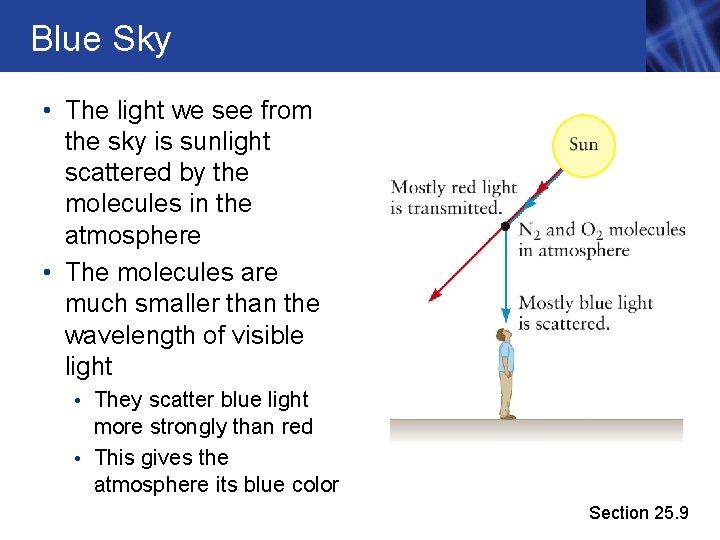
Blue Sky • The light we see from the sky is sunlight scattered by the molecules in the atmosphere • The molecules are much smaller than the wavelength of visible light • They scatter blue light more strongly than red • This gives the atmosphere its blue color Section 25. 9
Scattering, Sky, and Sun • Blue sky • Although violet scatters more than blue, the sky appears blue • The Sun emits more strongly in blue than violet • Our eyes are more sensitive to blue • The sky appears blue even though the violet light is scattered more • Sun near horizon • There are molecules to scatter the light • Most of the blue is scattered away, leaving the red Section 25. 9
Nature of Light • Interference and diffraction show convincingly that light has wave properties • Certain properties of light can only be explained with a particle theory of light • Color vision is one effect that can be correctly explained by the particle theory • Have strong evidence that light is both a particle and a wave • Called wave-particle duality • Quantum theory tries to reconcile these ideas Section 25. 10
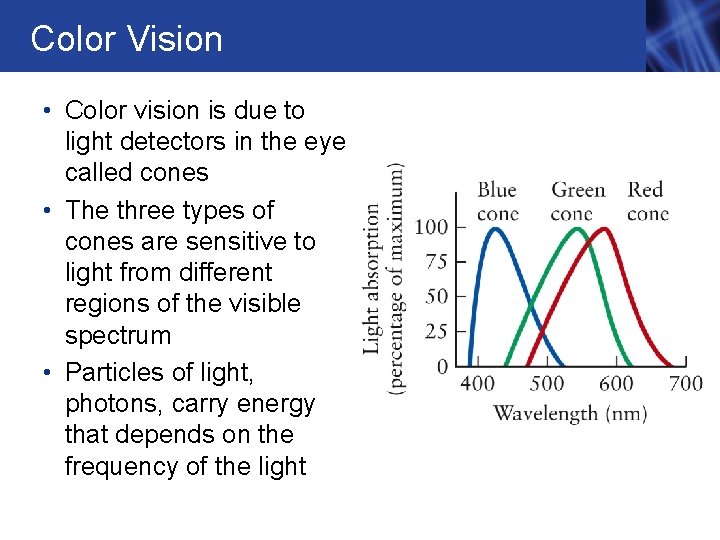
Color Vision • Color vision is due to light detectors in the eye called cones • The three types of cones are sensitive to light from different regions of the visible spectrum • Particles of light, photons, carry energy that depends on the frequency of the light