
Optical Properties Introduction By optical property is meant

Optical Properties
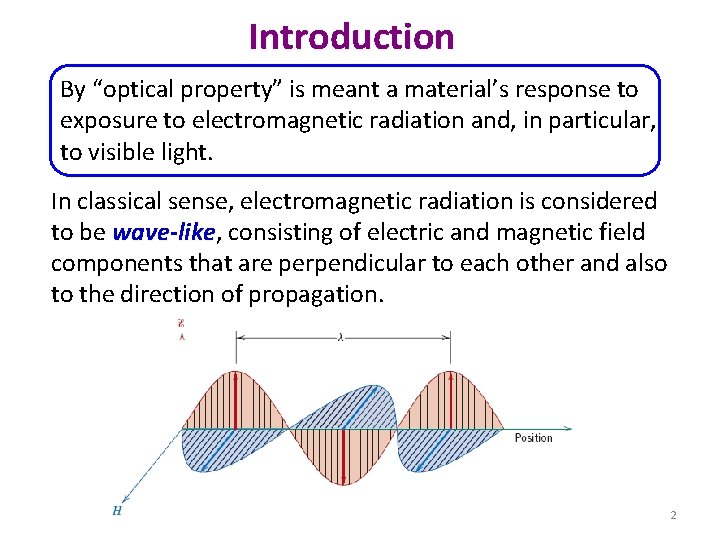
Introduction By “optical property” is meant a material’s response to exposure to electromagnetic radiation and, in particular, to visible light. In classical sense, electromagnetic radiation is considered to be wave-like, wave-like consisting of electric and magnetic field components that are perpendicular to each other and also to the direction of propagation. 2
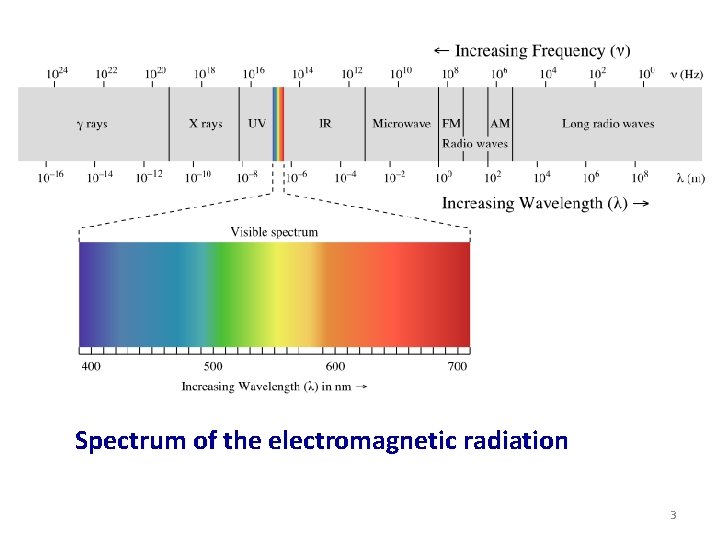
Spectrum of the electromagnetic radiation 3
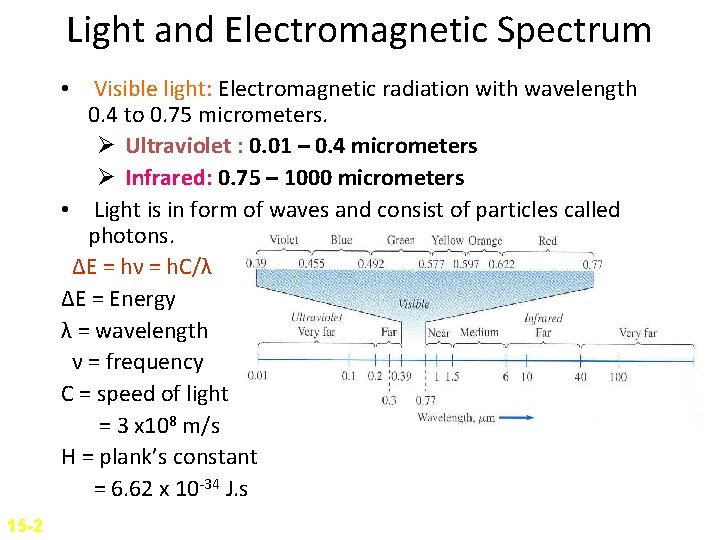
Light and Electromagnetic Spectrum • Visible light: Electromagnetic radiation with wavelength 0. 4 to 0. 75 micrometers. Ø Ultraviolet : 0. 01 – 0. 4 micrometers Ø Infrared: 0. 75 – 1000 micrometers • Light is in form of waves and consist of particles called photons. ΔE = hν = h. C/λ ΔE = Energy λ = wavelength ν = frequency C = speed of light = 3 x 10⁸ m/s H = plank’s constant = 6. 62 x 10 -34 J. s 15 -2
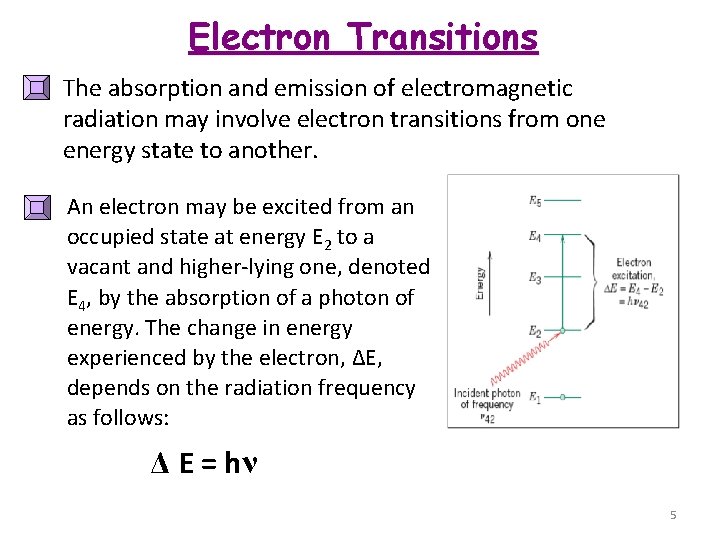
Electron Transitions The absorption and emission of electromagnetic radiation may involve electron transitions from one energy state to another. An electron may be excited from an occupied state at energy E 2 to a vacant and higher-lying one, denoted E 4, by the absorption of a photon of energy. The change in energy experienced by the electron, ΔE, depends on the radiation frequency as follows: Δ E = hν 5
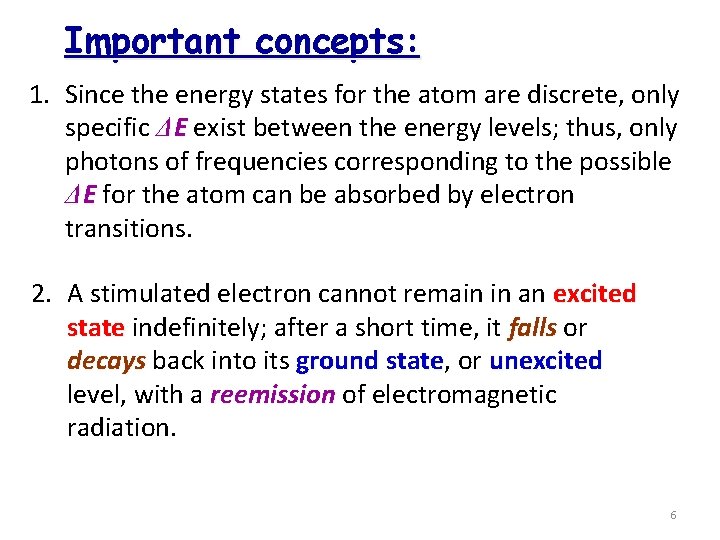
Important concepts: 1. Since the energy states for the atom are discrete, only specific ΔE exist between the energy levels; thus, only photons of frequencies corresponding to the possible ΔE for the atom can be absorbed by electron transitions. 2. A stimulated electron cannot remain in an excited state indefinitely; after a short time, it falls or decays back into its ground state, state or unexcited level, with a reemission of electromagnetic radiation. 6
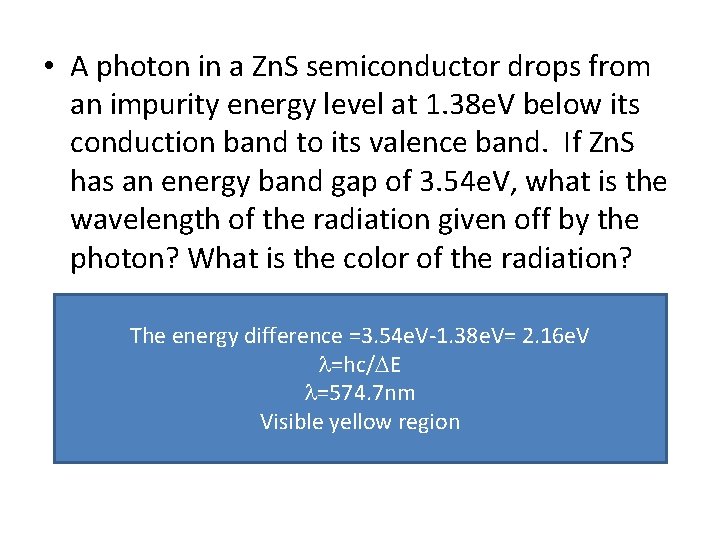
• A photon in a Zn. S semiconductor drops from an impurity energy level at 1. 38 e. V below its conduction band to its valence band. If Zn. S has an energy band gap of 3. 54 e. V, what is the wavelength of the radiation given off by the photon? What is the color of the radiation? The energy difference =3. 54 e. V-1. 38 e. V= 2. 16 e. V =hc/ E =574. 7 nm Visible yellow region
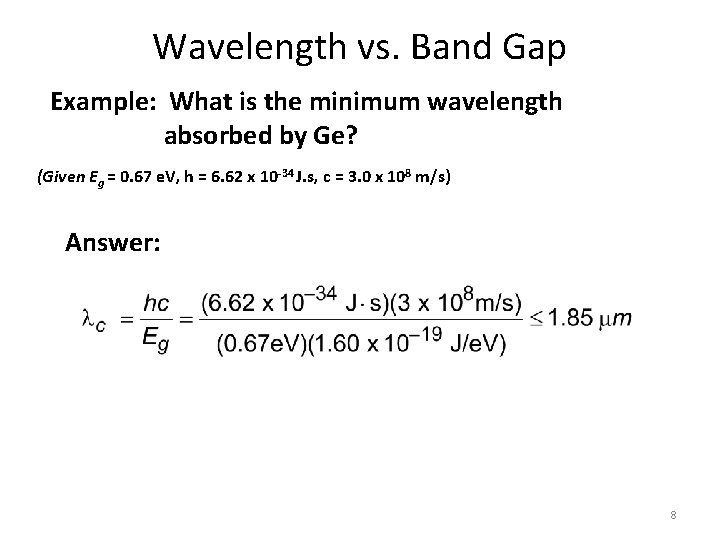
Wavelength vs. Band Gap Example: What is the minimum wavelength absorbed by Ge? (Given Eg = 0. 67 e. V, h = 6. 62 x 10 -34 J. s, c = 3. 0 x 108 m/s) Answer: 8
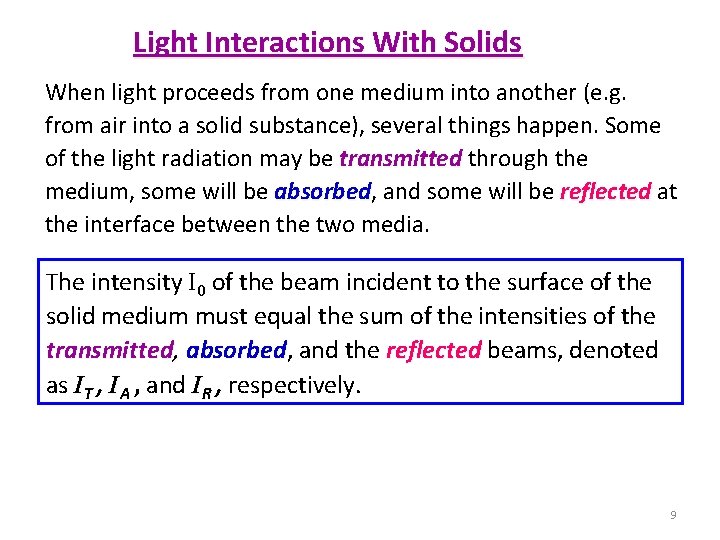
Light Interactions With Solids When light proceeds from one medium into another (e. g. from air into a solid substance), several things happen. Some of the light radiation may be transmitted through the medium, some will be absorbed, absorbed and some will be reflected at the interface between the two media. The intensity I 0 of the beam incident to the surface of the solid medium must equal the sum of the intensities of the transmitted, absorbed and the reflected beams, denoted as IT , IA , and IR , respectively. 9
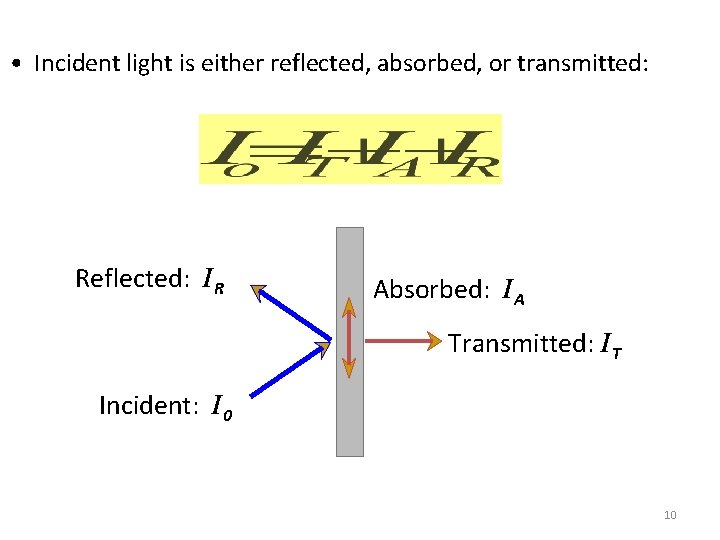
• Incident light is either reflected, absorbed, or transmitted: Reflected: IR Absorbed: IA Transmitted: IT Incident: I 0 10
• Optical Classification of Materials: 1. Materials that are capable of transmitting light with relatively little absorption and reflection are transparent. 2. Translucent materials are those through which light is transmitted diffusely; that is, light is scattered within the interior, to the degree that objects are not clearly distinguishable when viewed through a specimen of the material. 3. Materials that are impervious / impenetrable to the transmission of visible light are termed opaque 11
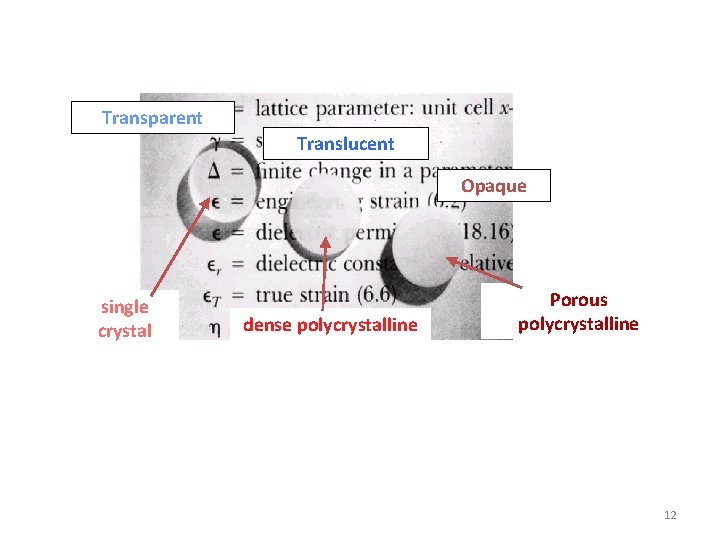
Transparent Translucent Opaque single crystal dense polycrystalline Porous polycrystalline 12
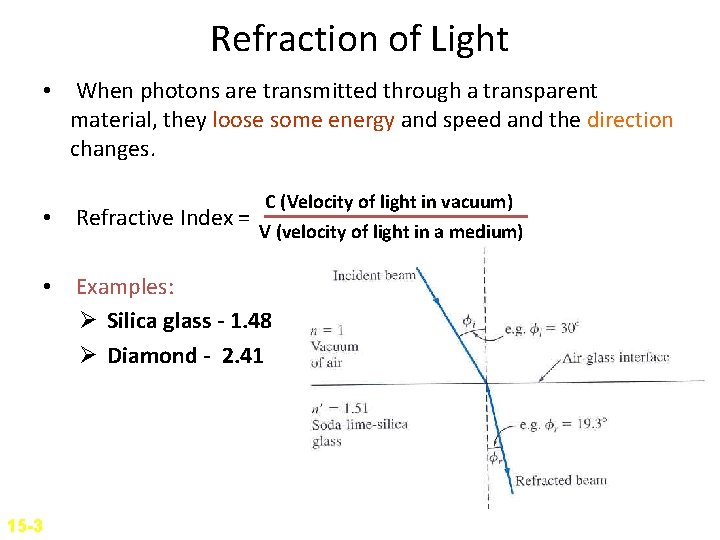
Refraction of Light • When photons are transmitted through a transparent material, they loose some energy and speed and the direction changes. • Refractive Index = C (Velocity of light in vacuum) V (velocity of light in a medium) • Examples: Ø Silica glass - 1. 48 Ø Diamond - 2. 41 15 -3
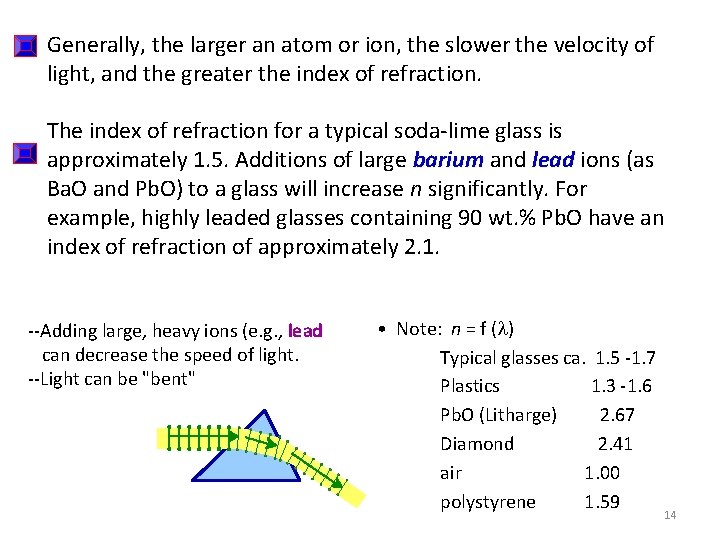
Generally, the larger an atom or ion, the slower the velocity of light, and the greater the index of refraction. The index of refraction for a typical soda-lime glass is approximately 1. 5. Additions of large barium and lead ions (as Ba. O and Pb. O) to a glass will increase n significantly. For example, highly leaded glasses containing 90 wt. % Pb. O have an index of refraction of approximately 2. 1. --Adding large, heavy ions (e. g. , lead can decrease the speed of light. --Light can be "bent" • Note: n = f ( ) Typical glasses ca. 1. 5 -1. 7 Plastics 1. 3 -1. 6 Pb. O (Litharge) 2. 67 Diamond 2. 41 air 1. 00 polystyrene 1. 59 14
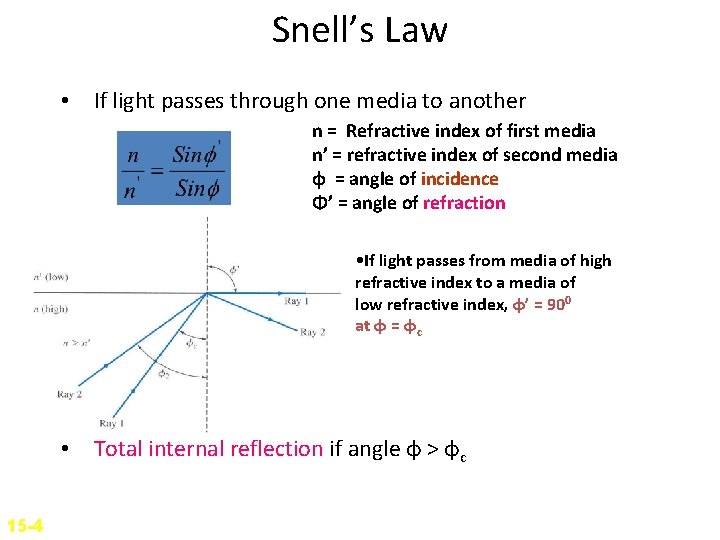
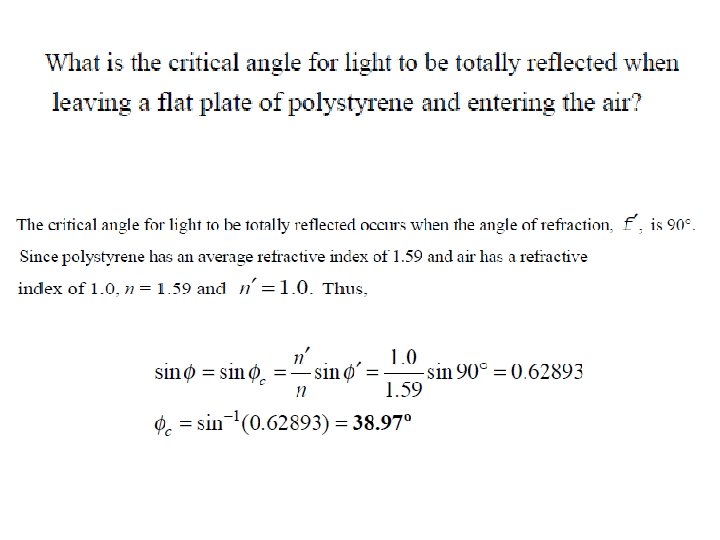
Snell’s Law • If light passes through one media to another n = Refractive index of first media n’ = refractive index of second media φ = angle of incidence Φ’ = angle of refraction • If light passes from media of high refractive index to a media of low refractive index, φ’ = 900 at φ = φc • Total internal reflection if angle φ > φc 15 -4
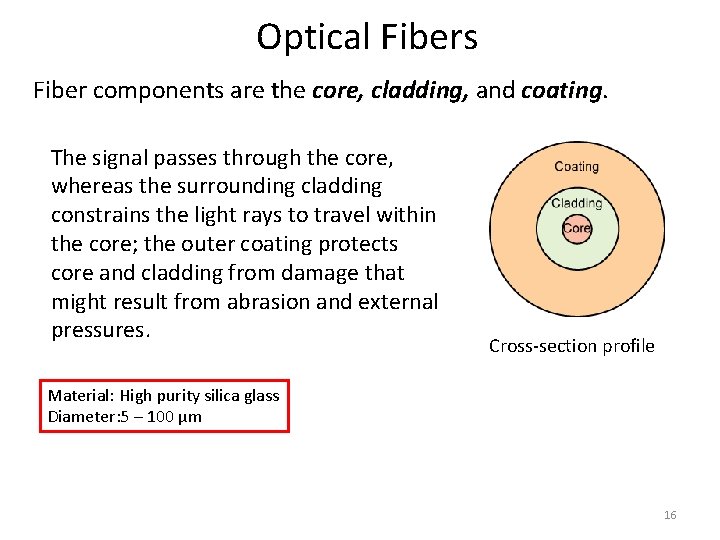
Optical Fibers Fiber components are the core, cladding, and coating The signal passes through the core, whereas the surrounding cladding constrains the light rays to travel within the core; the outer coating protects core and cladding from damage that might result from abrasion and external pressures. Cross-section profile Material: High purity silica glass Diameter: 5 – 100 μm 16
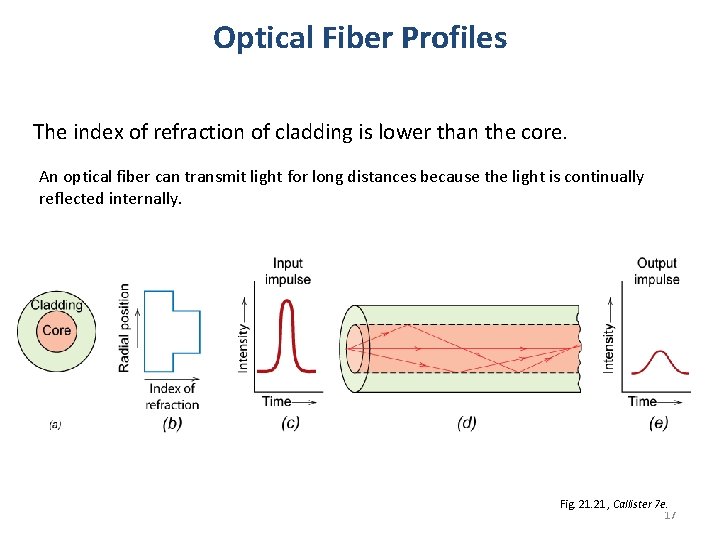
Optical Fiber Profiles The index of refraction of cladding is lower than the core. An optical fiber can transmit light for long distances because the light is continually reflected internally. Fig. 21, Callister 7 e. 17
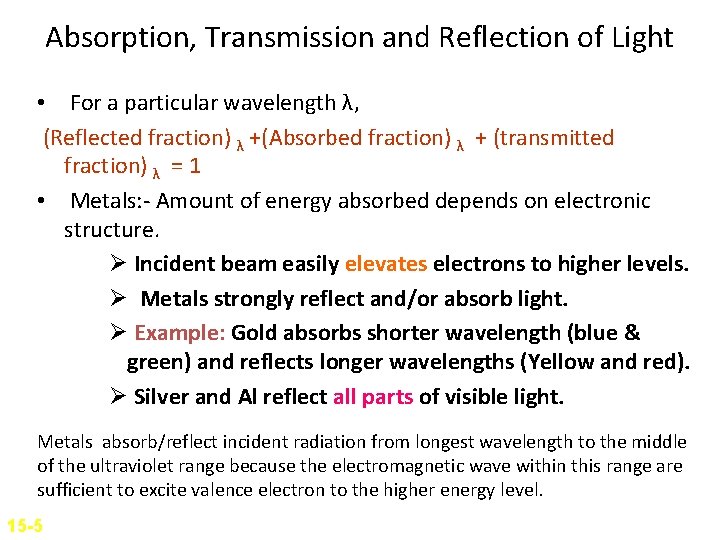
Absorption, Transmission and Reflection of Light • For a particular wavelength λ, (Reflected fraction) λ +(Absorbed fraction) λ + (transmitted fraction) λ = 1 • Metals: - Amount of energy absorbed depends on electronic structure. Ø Incident beam easily elevates electrons to higher levels. Ø Metals strongly reflect and/or absorb light. Ø Example: Gold absorbs shorter wavelength (blue & green) and reflects longer wavelengths (Yellow and red). Ø Silver and Al reflect all parts of visible light. Metals absorb/reflect incident radiation from longest wavelength to the middle of the ultraviolet range because the electromagnetic wave within this range are sufficient to excite valence electron to the higher energy level. 15 -5
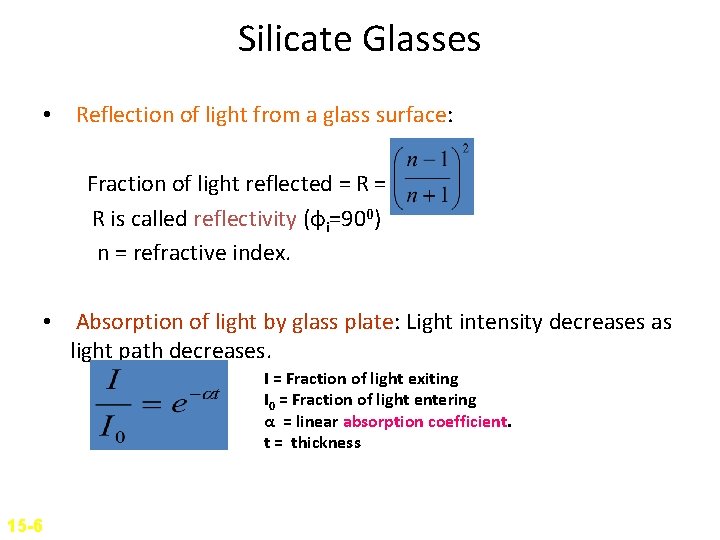
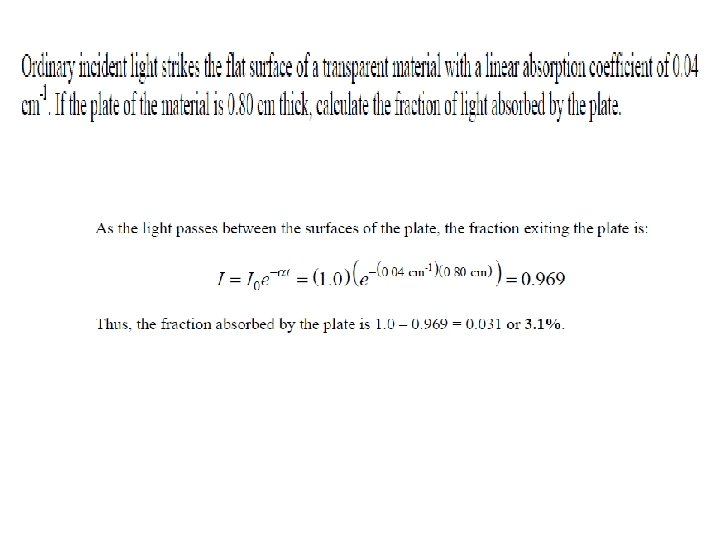
Silicate Glasses • Reflection of light from a glass surface: Fraction of light reflected = R is called reflectivity (φi=900) n = refractive index. • Absorption of light by glass plate: Light intensity decreases as light path decreases. I = Fraction of light exiting I 0 = Fraction of light entering α = linear absorption coefficient. t = thickness 15 -6
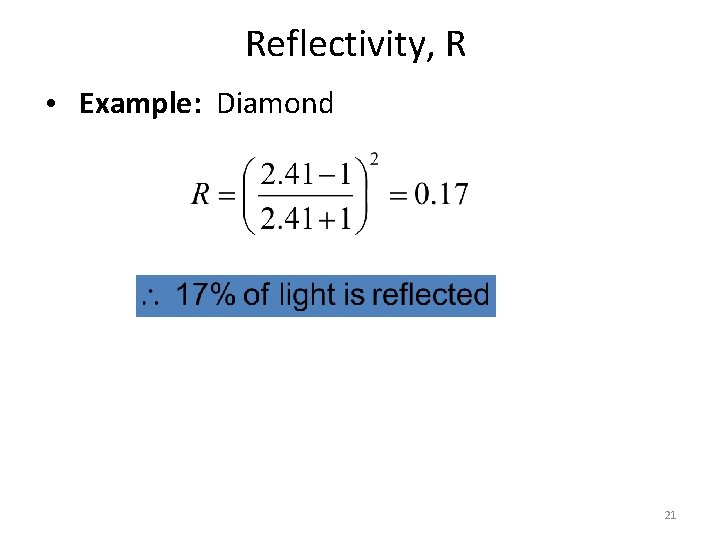
Reflectivity, R • Example: Diamond 21
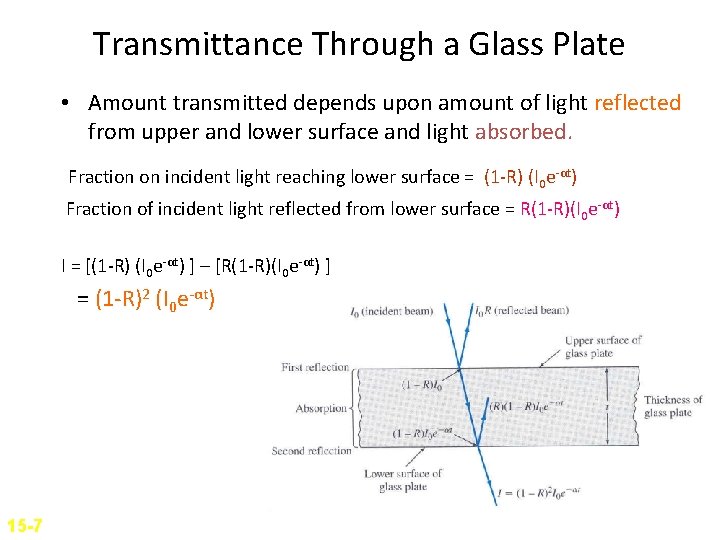
Transmittance Through a Glass Plate • Amount transmitted depends upon amount of light reflected from upper and lower surface and light absorbed. Fraction on incident light reaching lower surface = (1 -R) (I 0 e-αt) Fraction of incident light reflected from lower surface = R(1 -R)(I 0 e-αt) I = [(1 -R) (I 0 e-αt) ] – [R(1 -R)(I 0 e-αt) ] = (1 -R)2 (I 0 e-αt) 15 -7
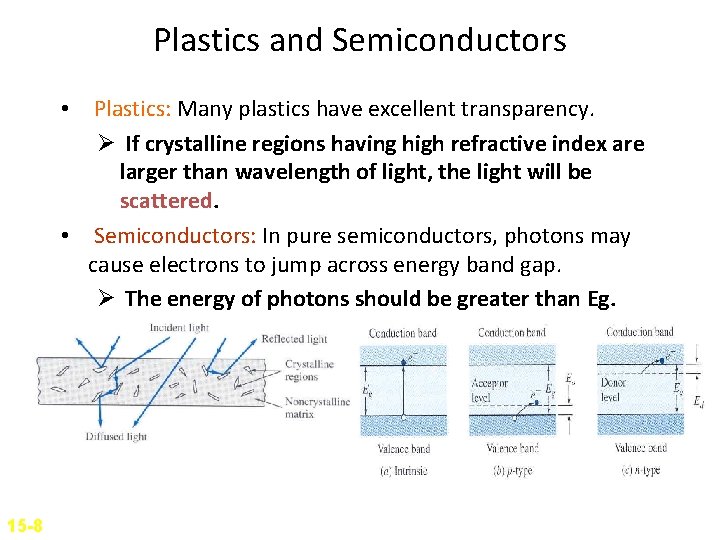
Plastics and Semiconductors • Plastics: Many plastics have excellent transparency. Ø If crystalline regions having high refractive index are larger than wavelength of light, the light will be scattered. • Semiconductors: In pure semiconductors, photons may cause electrons to jump across energy band gap. Ø The energy of photons should be greater than Eg. Ø Impure semiconductors absorb photons of lower energy. 15 -8
Luminescence • Luminescence is the process by which substance absorbs energy and spontaneously emits visible or near visible radiation. • Electrons are excited by input energy and drop to lower energy level. • Fluorescence: Emissions occur within 10 -8 seconds after excitation. • Phosphorescence: Emissions occur 10 -8 seconds after excitation. Ø Produced by material called phosphors. • Emission spectra can be controlled by adding activators. 15 -9
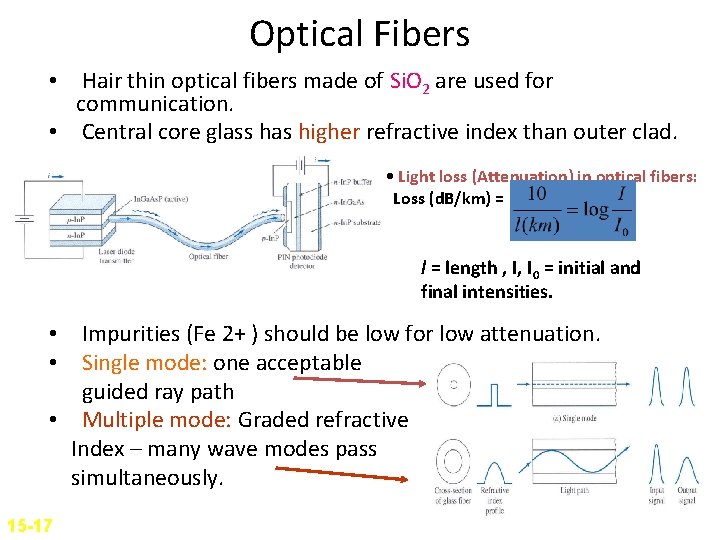
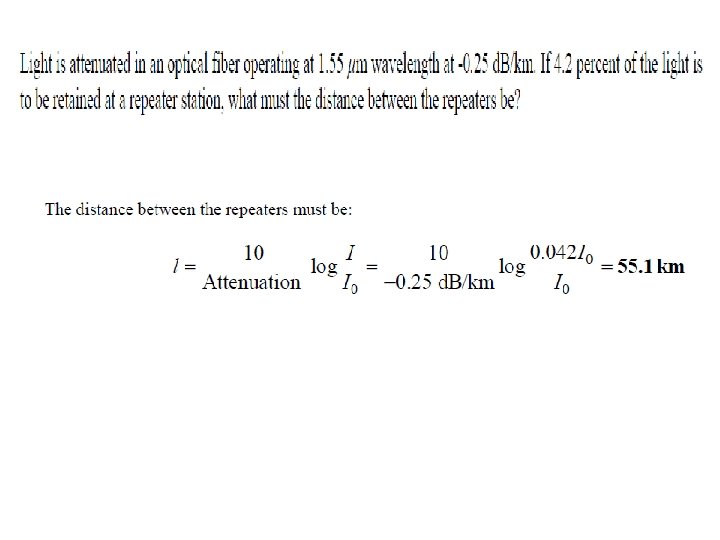
Optical Fibers • Hair thin optical fibers made of Si. O 2 are used for communication. • Central core glass has higher refractive index than outer clad. • Light loss (Attenuation) in optical fibers: Loss (d. B/km) = length , I, I 0 = initial and final intensities. • Impurities (Fe 2+ ) should be low for low attenuation. • Single mode: one acceptable guided ray path • Multiple mode: Graded refractive Index – many wave modes pass simultaneously. 15 -17
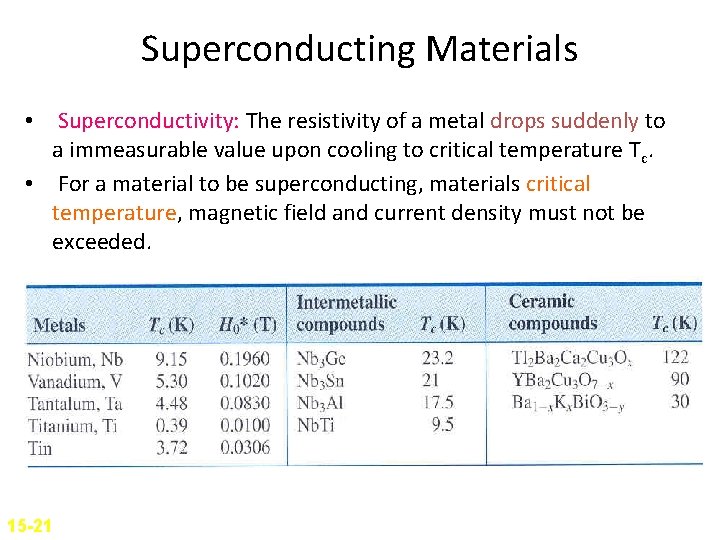
Superconducting Materials • Superconductivity: The resistivity of a metal drops suddenly to a immeasurable value upon cooling to critical temperature Tc. • For a material to be superconducting, materials critical temperature, magnetic field and current density must not be exceeded. 15 -21

Superconducting Materials
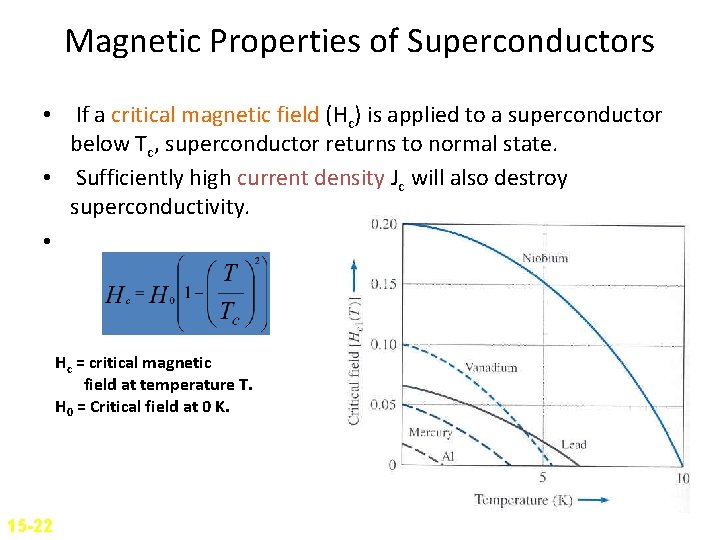
Magnetic Properties of Superconductors • If a critical magnetic field (Hc) is applied to a superconductor below Tc, superconductor returns to normal state. • Sufficiently high current density Jc will also destroy superconductivity. • Hc = critical magnetic field at temperature T. H 0 = Critical field at 0 K. 15 -22
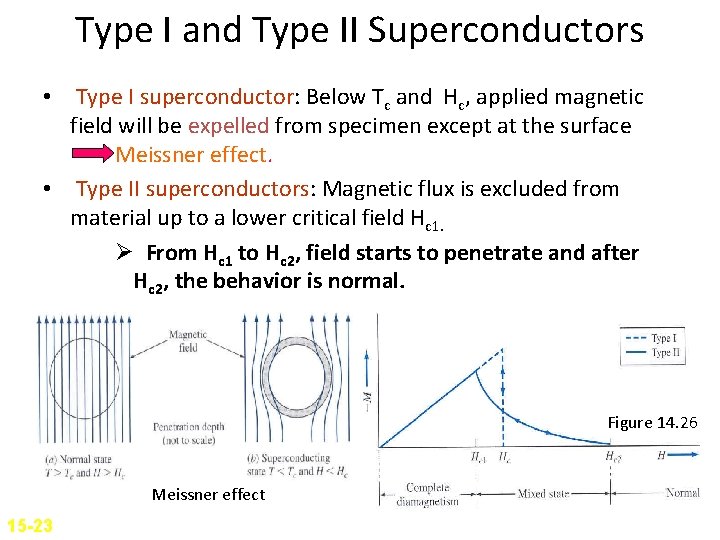
Type I and Type II Superconductors • Type I superconductor: Below Tc and Hc, applied magnetic field will be expelled from specimen except at the surface Meissner effect. • Type II superconductors: Magnetic flux is excluded from material up to a lower critical field Hc 1. Ø From Hc 1 to Hc 2, field starts to penetrate and after Hc 2, the behavior is normal. Figure 14. 26 Meissner effect 15 -23
- Slides: 31