
Optical Particle Counter Measurements for Comparison with Satellite

- Slides: 24
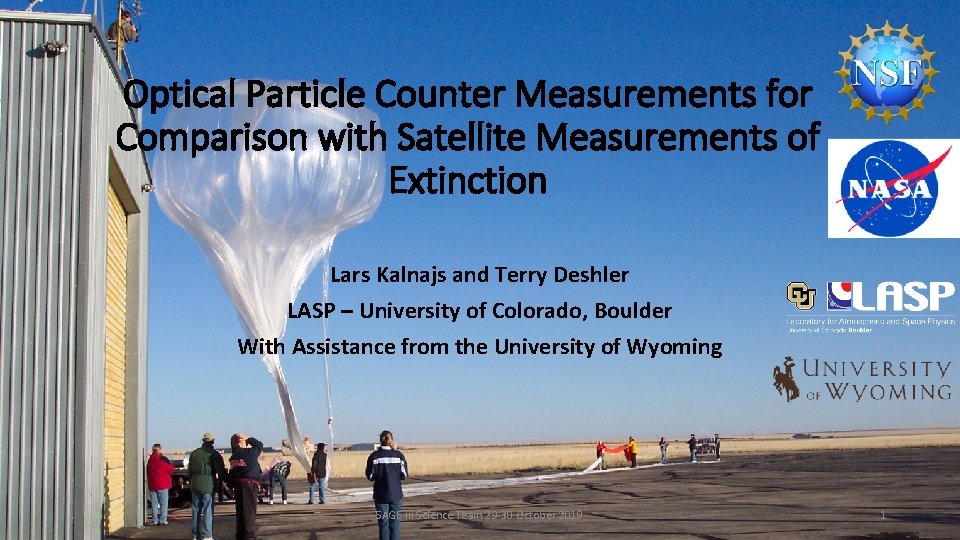
Optical Particle Counter Measurements for Comparison with Satellite Measurements of Extinction Lars Kalnajs and Terry Deshler LASP – University of Colorado, Boulder With Assistance from the University of Wyoming SAGE III Science Team 29 -30 October 2019 1
Objectives 1. Provide aerosol size distribution parameters for use by remote aerosol instruments, enhancing their ability to provide a broader range of aerosol properties a) Retrieve Aerosol Extinction and Surface Area Densities from In situ Size Distribution Measurements for comparison with, and use by, satellite instruments 2. Continue in situ balloon borne measurements of stratospheric aerosol size distributions to compare with SAGE III-ISS and other satellites 3. Augment an existing tropical balloon sounding site with aerosol instruments and performing regular tropical soundings 4. Maintain and enhance an in situ measurement capability to provide measurement data from regions with high aerosol loadings that may be opaque to limb sounding measurements during future volcanic eruptions SAGE III Science Team 29 -30 October 2019 2
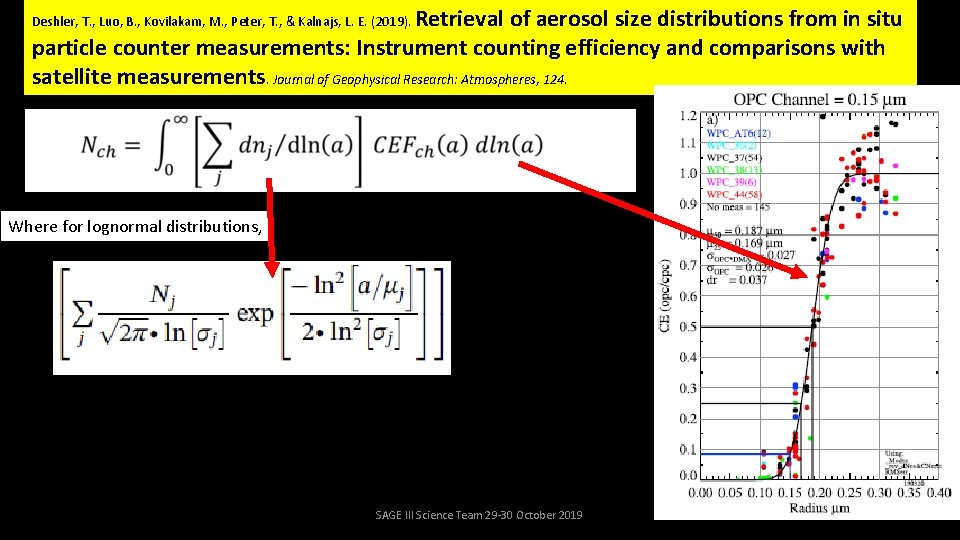
Retrieval of aerosol size distributions from in situ particle counter measurements: Instrument counting efficiency and comparisons with satellite measurements. Journal of Geophysical Research: Atmospheres, 124. Deshler, T. , Luo, B. , Kovilakam, M. , Peter, T. , & Kalnajs, L. E. (2019). Where for lognormal distributions, SAGE III Science Team 29 -30 October 2019 3
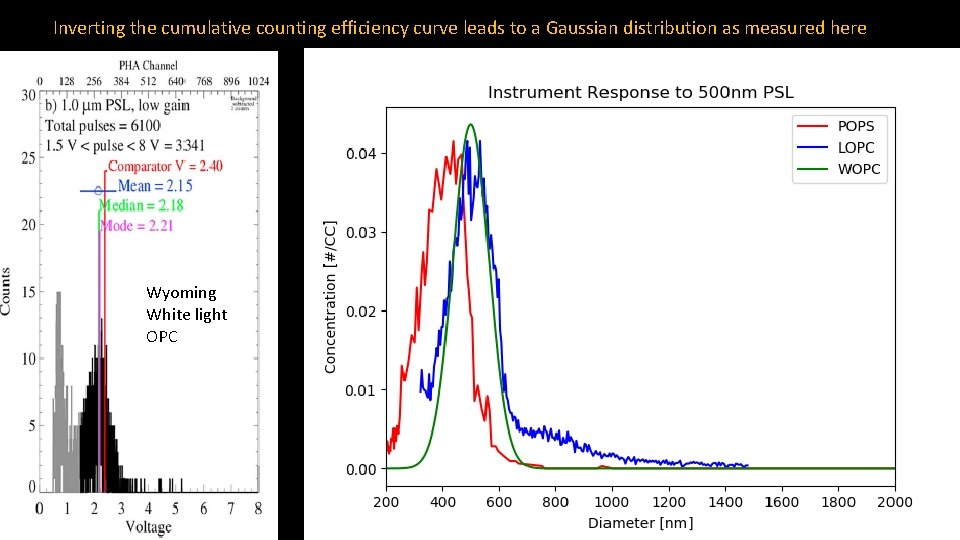
Inverting the cumulative counting efficiency curve leads to a Gaussian distribution as measured here Wyoming White light OPC SAGE III Science Team 29 -30 October 2019 4
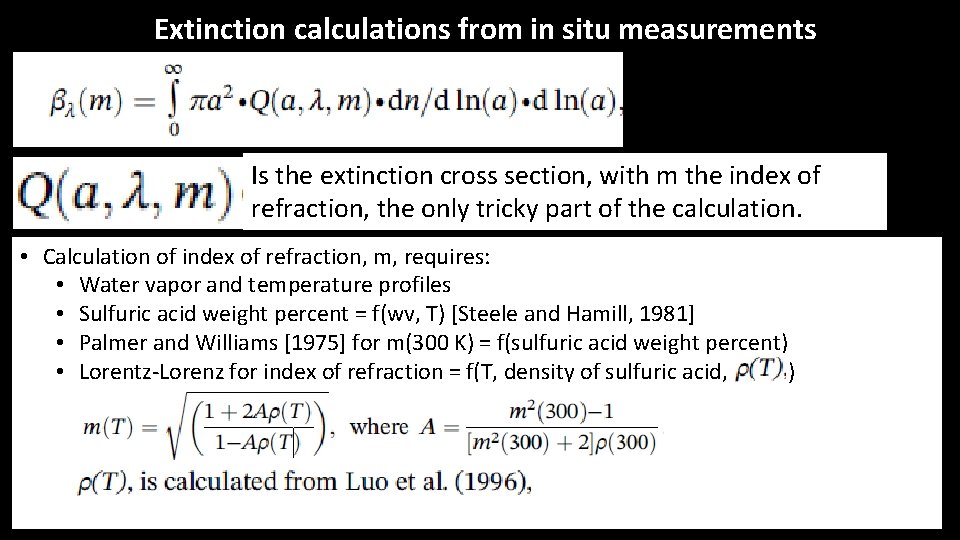
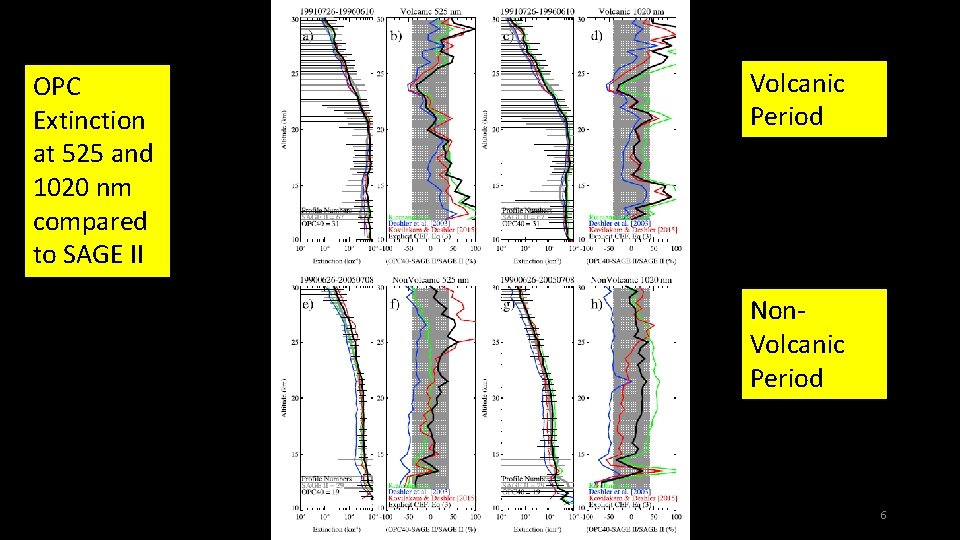
Extinction calculations from in situ measurements Is the extinction cross section, with m the index of refraction, the only tricky part of the calculation. • Calculation of index of refraction, m, requires: • Water vapor and temperature profiles • Sulfuric acid weight percent = f(wv, T) [Steele and Hamill, 1981] • Palmer and Williams [1975] for m(300 K) = f(sulfuric acid weight percent) • Lorentz-Lorenz for index of refraction = f(T, density of sulfuric acid, ) SAGE III Science Team 29 -30 October 2019 5
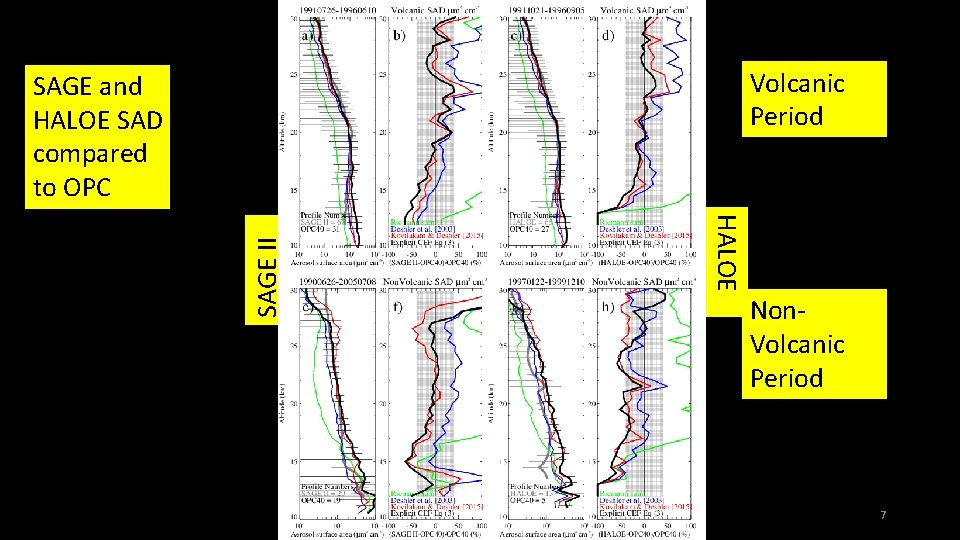
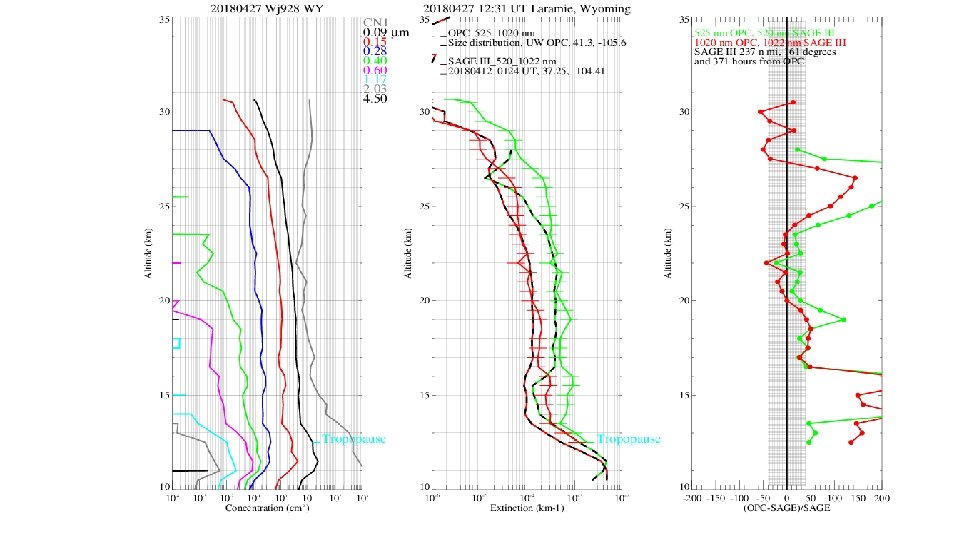
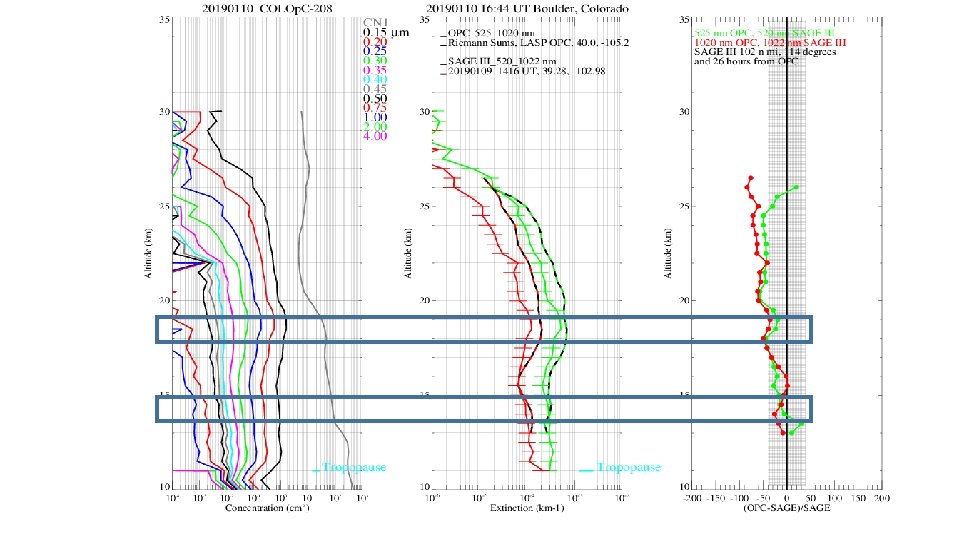
Volcanic Period OPC Extinction at 525 and 1020 nm compared to SAGE II Non. Volcanic Period SAGE III Science Team 30 -31 October 2018 6
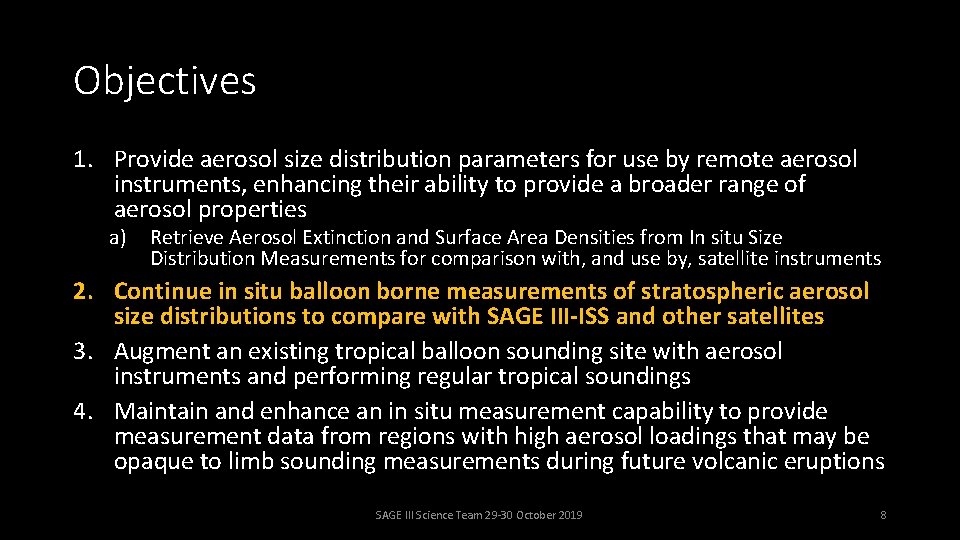
Volcanic Period SAGE and HALOE SAD compared to OPC SAGE II HALOE Non. Volcanic Period SAGE III Science Team 30 -31 October 2018 7
Objectives 1. Provide aerosol size distribution parameters for use by remote aerosol instruments, enhancing their ability to provide a broader range of aerosol properties a) Retrieve Aerosol Extinction and Surface Area Densities from In situ Size Distribution Measurements for comparison with, and use by, satellite instruments 2. Continue in situ balloon borne measurements of stratospheric aerosol size distributions to compare with SAGE III-ISS and other satellites 3. Augment an existing tropical balloon sounding site with aerosol instruments and performing regular tropical soundings 4. Maintain and enhance an in situ measurement capability to provide measurement data from regions with high aerosol loadings that may be opaque to limb sounding measurements during future volcanic eruptions SAGE III Science Team 29 -30 October 2019 8
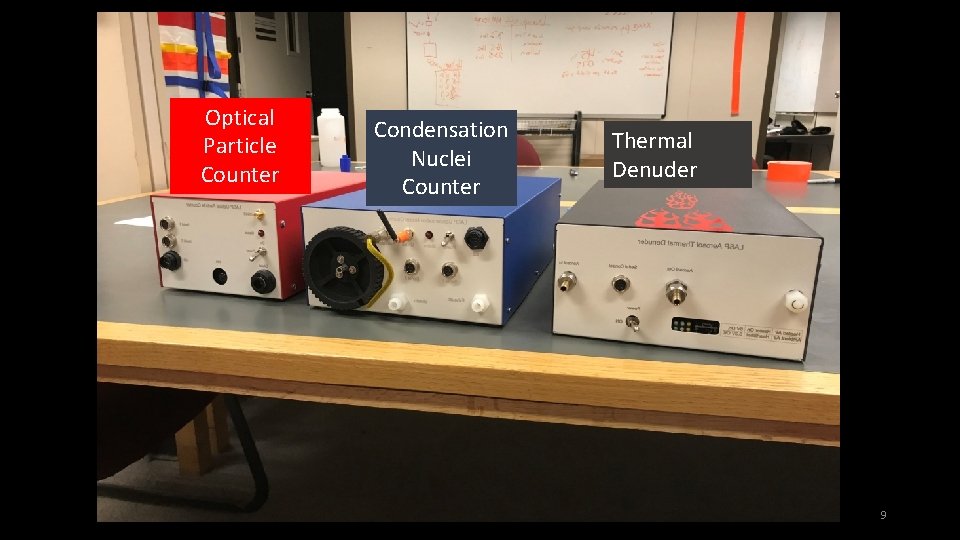
Optical Particle Counter Condensation Nuclei Counter SAGE III Science Team 29 -30 October 2019 Thermal Denuder 9
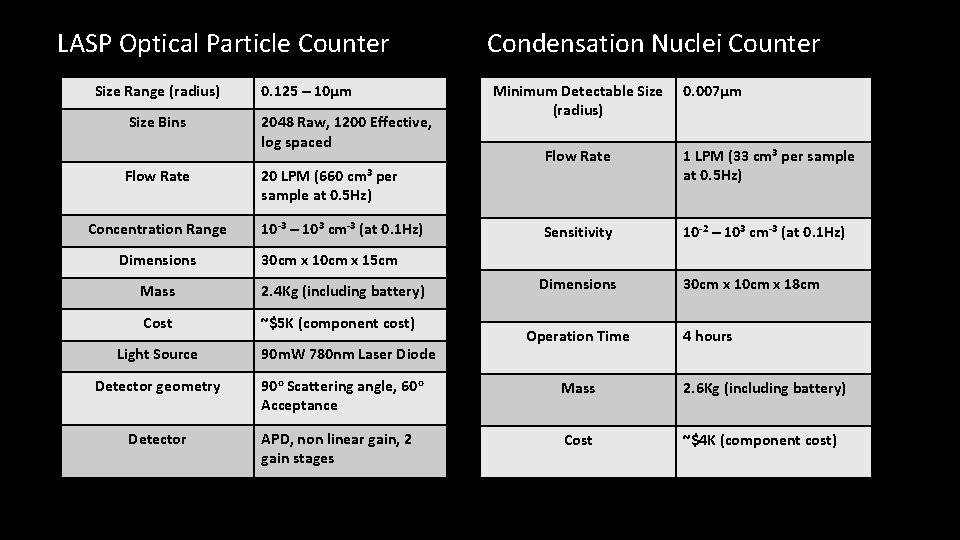
LASP Optical Particle Counter Size Range (radius) Size Bins Flow Rate Concentration Range Dimensions 0. 125 – 10μm 2048 Raw, 1200 Effective, log spaced 10 -3 – 103 cm-3 (at 0. 1 Hz) Cost ~$5 K (component cost) Detector 0. 007μm Flow Rate 1 LPM (33 cm 3 per sample at 0. 5 Hz) Sensitivity 10 -2 – 103 cm-3 (at 0. 1 Hz) Dimensions 30 cm x 18 cm 30 cm x 15 cm 2. 4 Kg (including battery) Detector geometry Minimum Detectable Size (radius) 20 LPM (660 cm 3 per sample at 0. 5 Hz) Mass Light Source Condensation Nuclei Counter 90 m. W 780 nm Laser Diode Operation Time 4 hours 90 o Scattering angle, 60 o Acceptance Mass 2. 6 Kg (including battery) APD, non linear gain, 2 gain stages Cost ~$4 K (component cost)
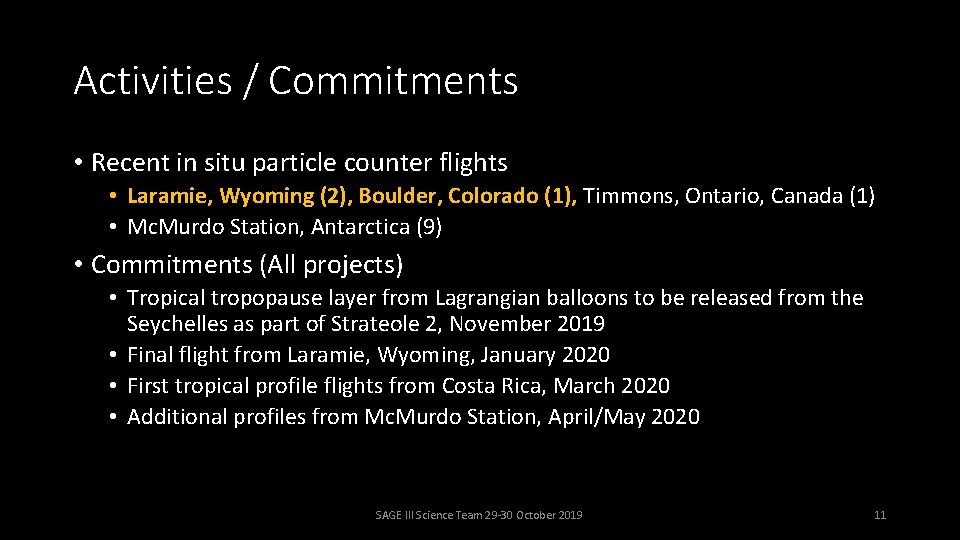
Activities / Commitments • Recent in situ particle counter flights • Laramie, Wyoming (2), Boulder, Colorado (1), Timmons, Ontario, Canada (1) • Mc. Murdo Station, Antarctica (9) • Commitments (All projects) • Tropical tropopause layer from Lagrangian balloons to be released from the Seychelles as part of Strateole 2, November 2019 • Final flight from Laramie, Wyoming, January 2020 • First tropical profile flights from Costa Rica, March 2020 • Additional profiles from Mc. Murdo Station, April/May 2020 SAGE III Science Team 29 -30 October 2019 11
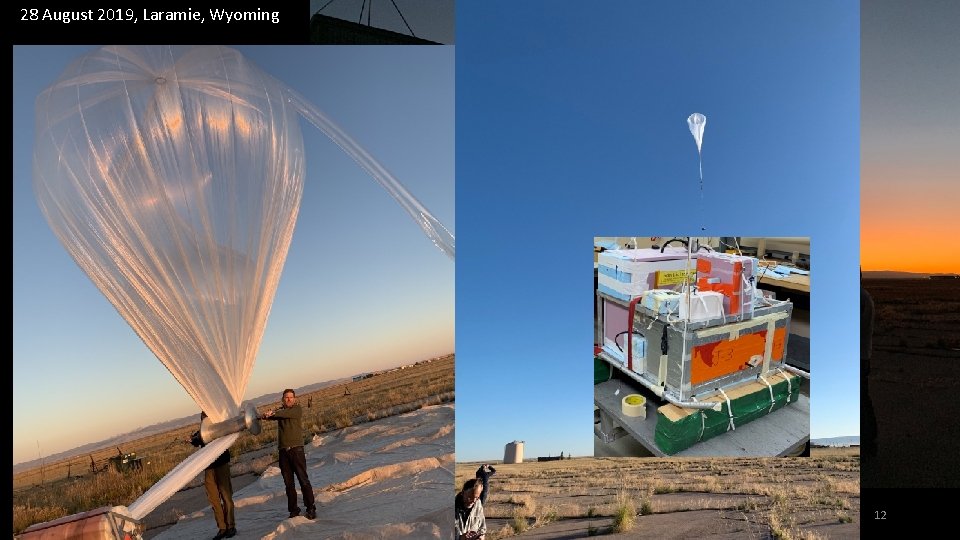
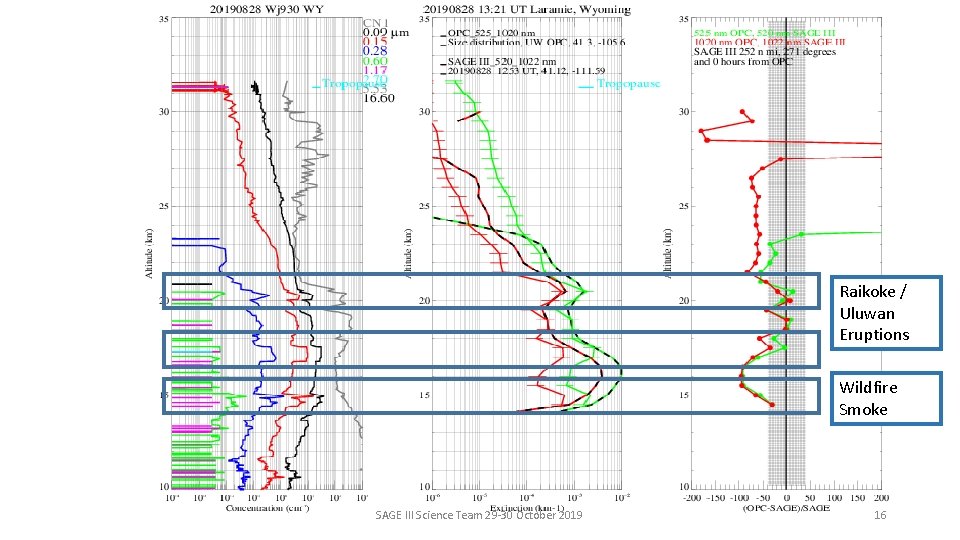
28 August 2019, Laramie, Wyoming SAGE III Science Team 29 -30 October 2019 12
SAGE III Science Team 29 -30 October 2019 13
SAGE III Science Team 29 -30 October 2019 14
Raikoke / Uluwan Eruptions Wildfire Smoke SAGE III Science Team 29 -30 October 2019 15
Raikoke / Uluwan Eruptions Wildfire Smoke SAGE III Science Team 29 -30 October 2019 16
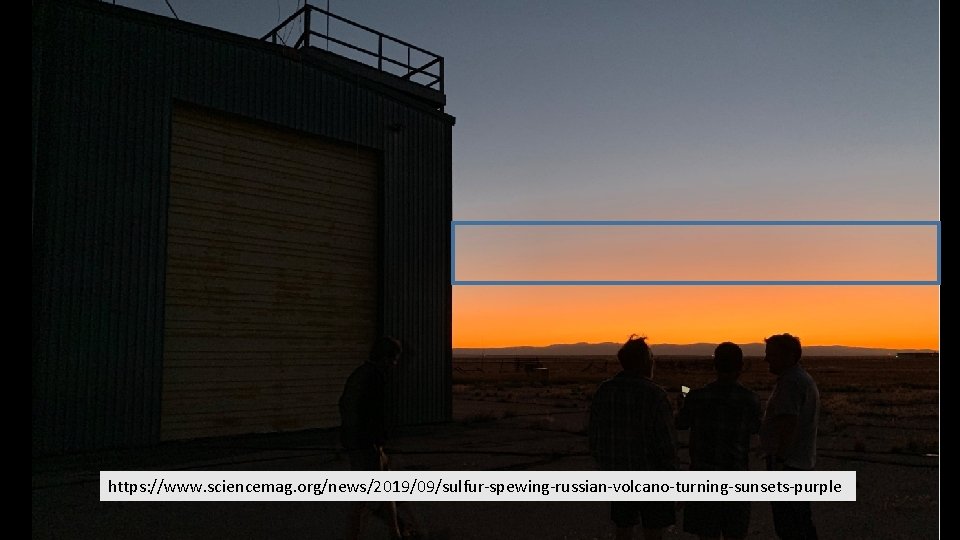
https: //www. sciencemag. org/news/2019/09/sulfur-spewing-russian-volcano-turning-sunsets-purple
SAGE III Science Team 29 -30 October 2019 18
SAGE III Science Team 29 -30 October 2019 19
SAGE III Science Team 29 -30 October 2019 20
SAGE III Science Team 29 -30 October 2019 21
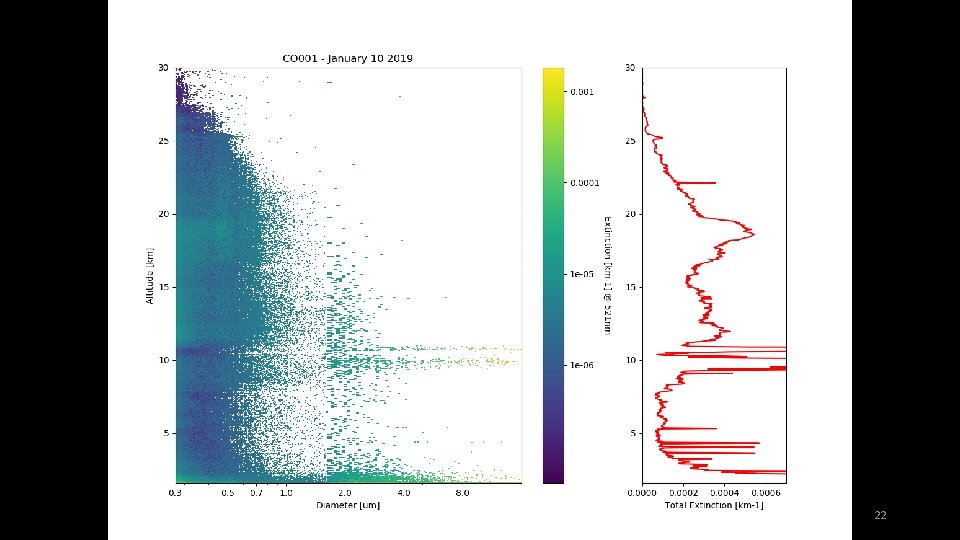
SAGE III Science Team 29 -30 October 2019 22
Objectives 1. Provide aerosol size distribution parameters for use by remote aerosol instruments, enhancing their ability to provide a broader range of aerosol properties a) Retrieve Aerosol Extinction and Surface Area Densities from In situ Size Distribution Measurements for comparison with, and use by, satellite instruments 2. Continue in situ balloon borne measurements of stratospheric aerosol size distributions to compare with SAGE III-ISS and other satellites 3. Augment an existing tropical balloon sounding site with aerosol instruments and performing regular tropical soundings 4. Maintain and enhance an in situ measurement capability to provide measurement data from regions with high aerosol loadings that may be opaque to limb sounding measurements during future volcanic eruptions SAGE III Science Team 29 -30 October 2019 23
In situ LOPC and CNC measurements planned for comparison with SAGE III overpasses Mid Latitudes Tropics • One final aerosol comparison gondola to be flown from Laramie • Launch every 2 -4 months from Colorado on small rubber balloons • Payload will consist of 2 packages, LOPC and CNC, and meet FAA/ICAO definition of light balloon • Payloads recovered and re-flown • Launch 3 -4 payloads from a tropical location (nominally Costa Rica) • Coordinate with Ticosonde launches • LOPC/CNC combined payloads • Recoveries are less likely • Exploring smaller disposable OPC for some of these launches SAGE III Science Team 29 -30 October 2019 24