
Optical Mineralogy Lab 14 Fall 2012 Biaxial Interference
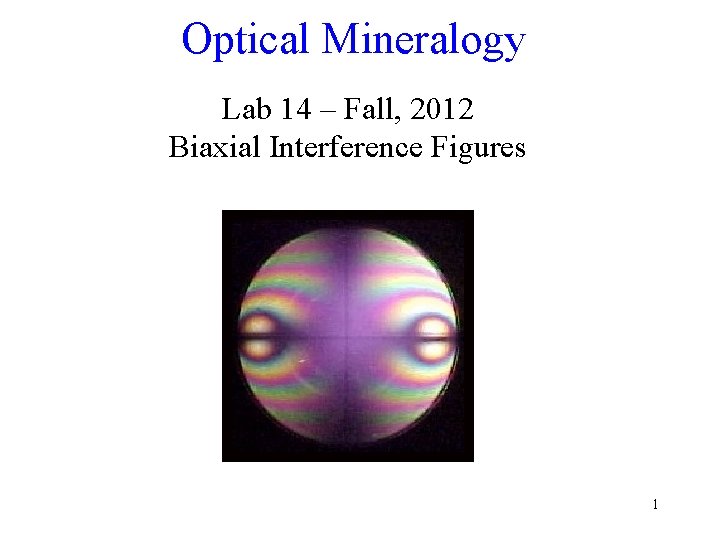
Optical Mineralogy Lab 14 – Fall, 2012 Biaxial Interference Figures 1
Biaxial Sign: Bxa Figures • To determine the optic sign of a biaxial mineral from a BXA figure, position the isogyres so that the melatopes are in the NE and SW quadrants • There should be an area near the melatopes that shows a 1 o gray interference color • Observe this area as you insert the 550 nm or 1 o red compensator 2
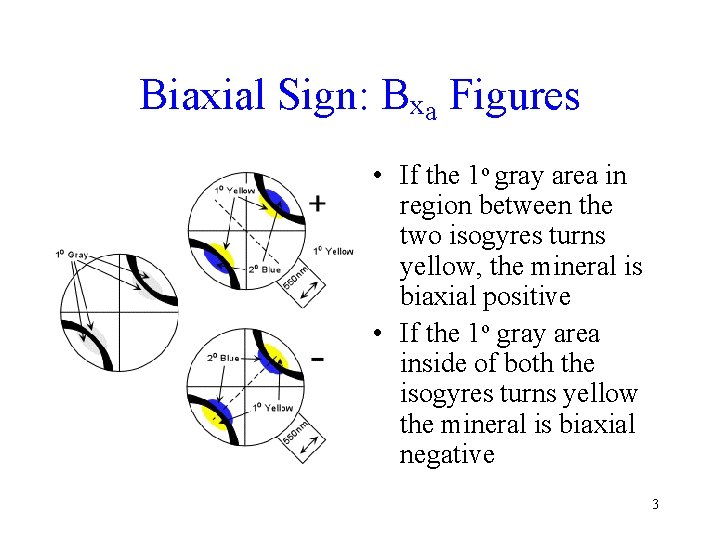
Biaxial Sign: Bxa Figures • If the 1 o gray area in region between the two isogyres turns yellow, the mineral is biaxial positive • If the 1 o gray area inside of both the isogyres turns yellow the mineral is biaxial negative 3
Biaxial Sign: Centered OA Figures • Optic axis figures probably provide the easiest method for determination of optic sign because grains with an orientation that would produce an OA figure are perhaps the easiest to find • Place the isogyre so that the inside of the isogyre is in the NE quadrant • Find the area that shows 1 o gray close to the melatope • Observe this area as the 550 nm compensator plate is inserted 4
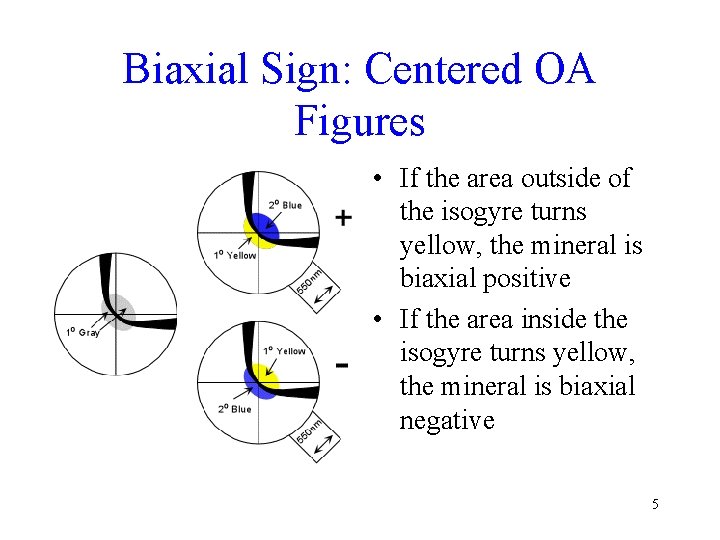
Biaxial Sign: Centered OA Figures • If the area outside of the isogyre turns yellow, the mineral is biaxial positive • If the area inside the isogyre turns yellow, the mineral is biaxial negative 5
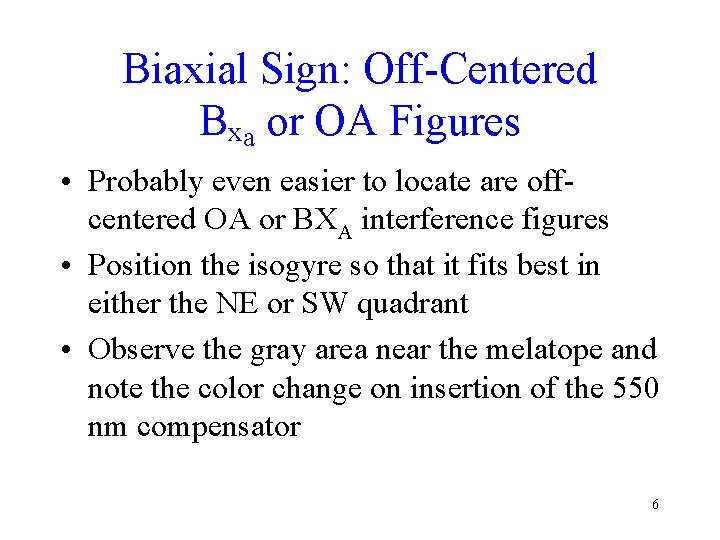
Biaxial Sign: Off-Centered Bxa or OA Figures • Probably even easier to locate are offcentered OA or BXA interference figures • Position the isogyre so that it fits best in either the NE or SW quadrant • Observe the gray area near the melatope and note the color change on insertion of the 550 nm compensator 6
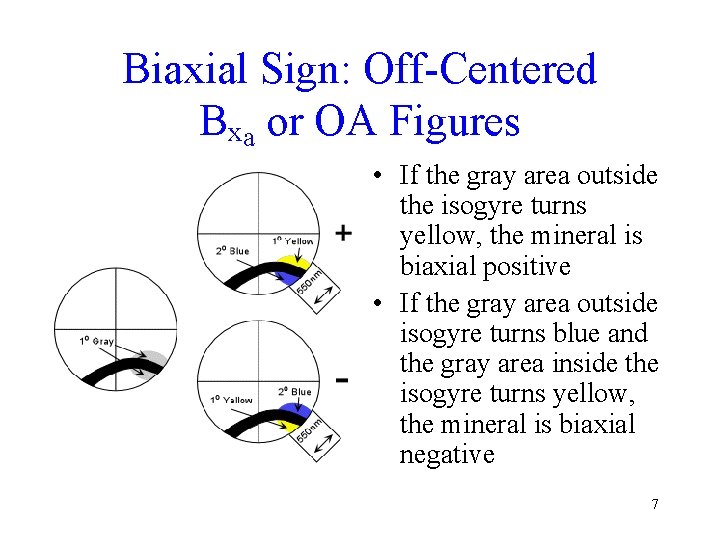
Biaxial Sign: Off-Centered Bxa or OA Figures • If the gray area outside the isogyre turns yellow, the mineral is biaxial positive • If the gray area outside isogyre turns blue and the gray area inside the isogyre turns yellow, the mineral is biaxial negative 7
Estimation of 2 V • Precise determination of 2 V can only be made by determining the 3 principal refractive indices of the mineral • 2 V can be estimated from Bxa and OA figures using the diagrams shown here 8
2 V Estimation: Bxa Figure • For a BXA figure the distance between the melatopes is proportional to the 2 V angle • To estimate the 2 V from a BXA figure, it is necessary to know the numerical aperture (N. A. ) of the objective lens used to observe the interference figure • The microscopes in our labs have an N. A. of between 0. 65 and 0. 85 9
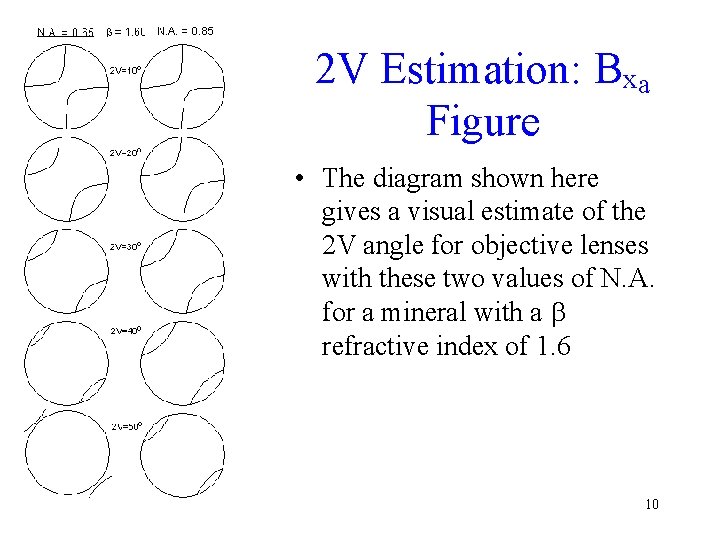
2 V Estimation: Bxa Figure • The diagram shown here gives a visual estimate of the 2 V angle for objective lenses with these two values of N. A. for a mineral with a b refractive index of 1. 6 10
2 V Estimation: Bxa Figure • Remember that if the 2 V is 0 o the mineral is uniaxial, and would thus show the uniaxial interference figure • The separation of the isogyres or melatopes increases with 2 V and the isogyres eventually go outside of the field of view for a 2 V of 50 o with the smaller N. A. , and about 60 o for the larger N. A 11
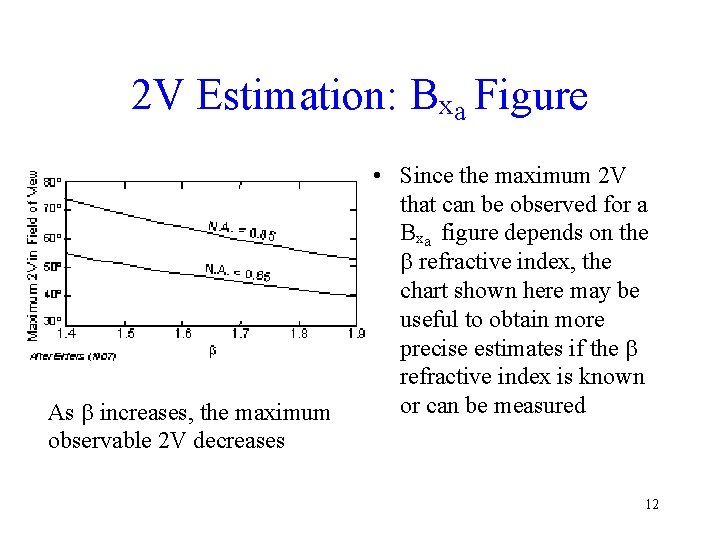
2 V Estimation: Bxa Figure As b increases, the maximum observable 2 V decreases • Since the maximum 2 V that can be observed for a Bxa figure depends on the b refractive index, the chart shown here may be useful to obtain more precise estimates if the b refractive index is known or can be measured 12
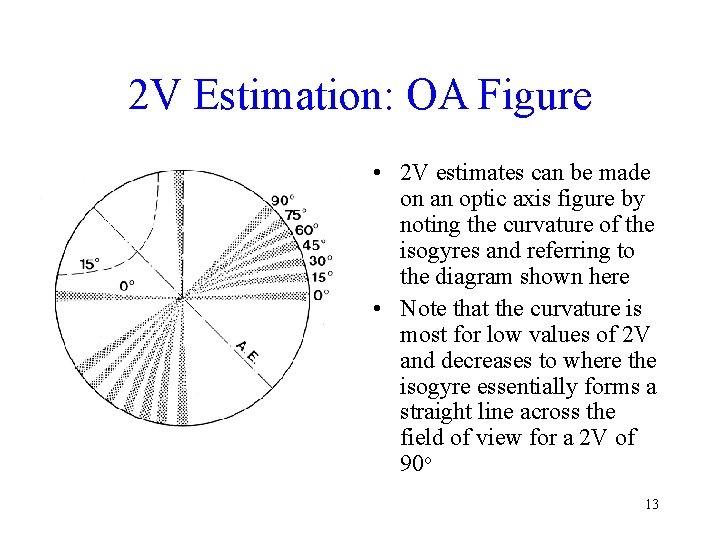
2 V Estimation: OA Figure • 2 V estimates can be made on an optic axis figure by noting the curvature of the isogyres and referring to the diagram shown here • Note that the curvature is most for low values of 2 V and decreases to where the isogyre essentially forms a straight line across the field of view for a 2 V of 90 o 13
- Slides: 13