
Optical lattices for ultracold atomic gases Andrea Trombettoni
Optical lattices for ultracold atomic gases Andrea Trombettoni (SISSA, Trieste) Sestri Levante, 9 June 2009
Outlook A brief introduction on ultracold atoms Why using optical lattices? ü Effective tuning of the interactions ü Experimental realization of interacting lattice Hamiltonians Ultracold bosons on a disordered lattice: the shift of the critical temperature
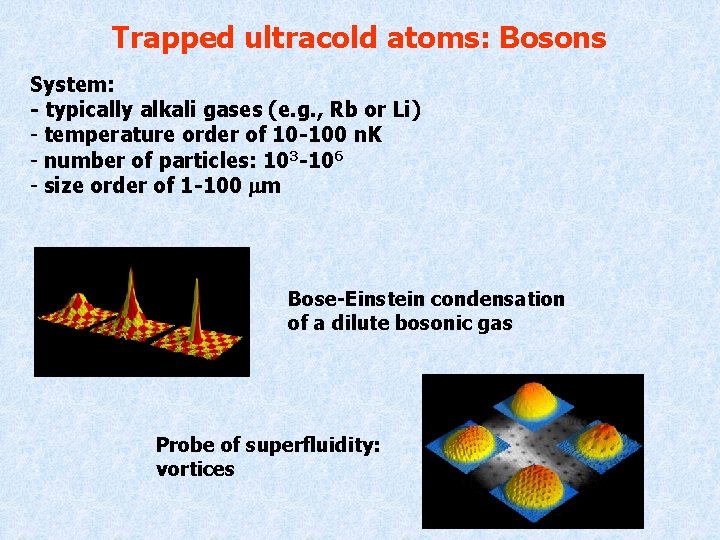
Trapped ultracold atoms: Bosons System: - typically alkali gases (e. g. , Rb or Li) - temperature order of 10 -100 n. K - number of particles: 103 -106 - size order of 1 -100 mm Bose-Einstein condensation of a dilute bosonic gas Probe of superfluidity: vortices

Trapped ultracold atoms: Fermions A non-interacting Fermi gas Tuning the interactions… … and inducing a fermionic “condensate”
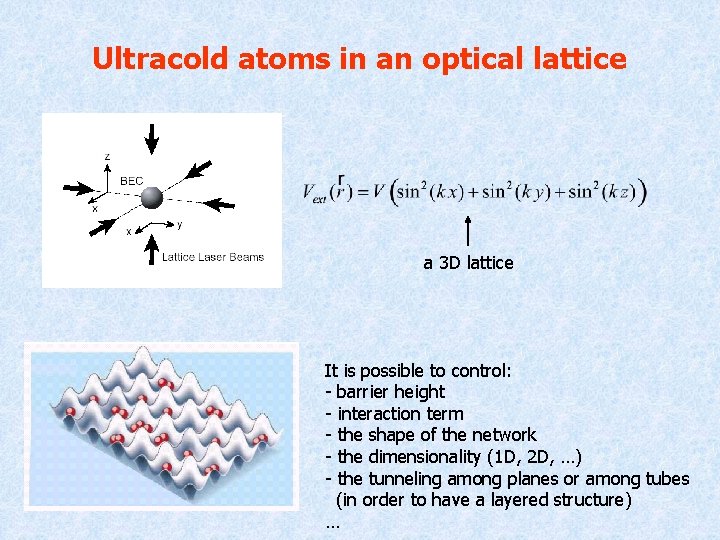
Ultracold atoms in an optical lattice a 3 D lattice It is possible to control: - barrier height - interaction term - the shape of the network - the dimensionality (1 D, 2 D, …) - the tunneling among planes or among tubes (in order to have a layered structure) …
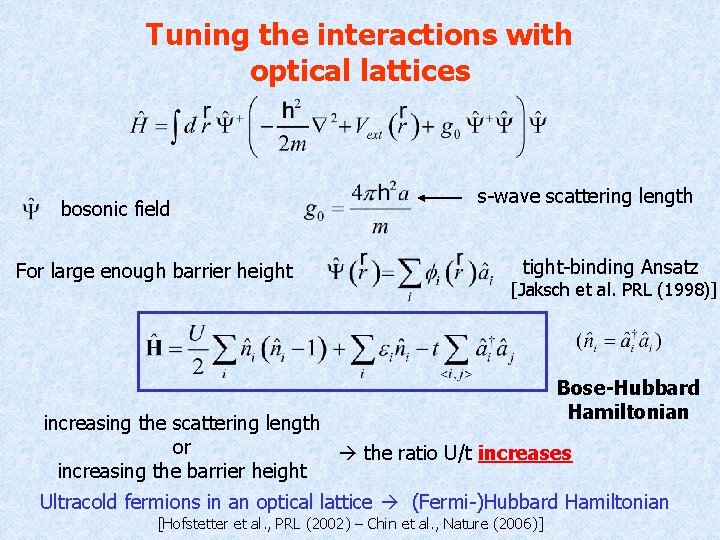
Tuning the interactions with optical lattices bosonic field For large enough barrier height s-wave scattering length tight-binding Ansatz [Jaksch et al. PRL (1998)] Bose-Hubbard Hamiltonian increasing the scattering length or the ratio U/t increases increasing the barrier height Ultracold fermions in an optical lattice (Fermi-)Hubbard Hamiltonian [Hofstetter et al. , PRL (2002) – Chin et al. , Nature (2006)]
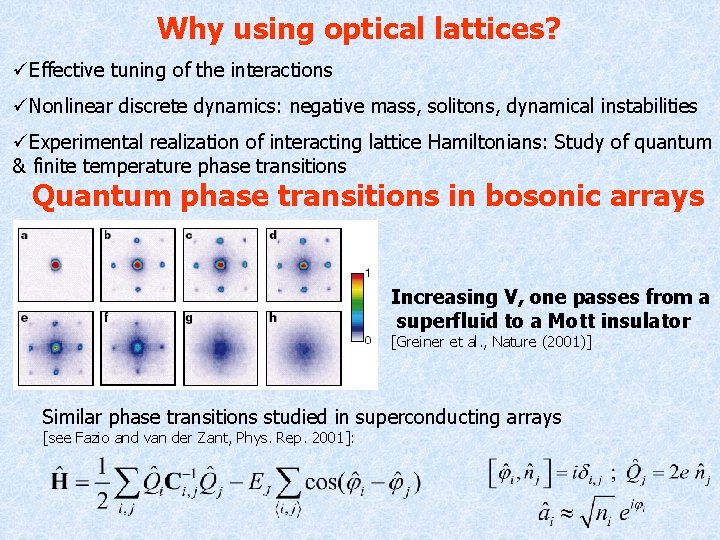
Why using optical lattices? üEffective tuning of the interactions üNonlinear discrete dynamics: negative mass, solitons, dynamical instabilities üExperimental realization of interacting lattice Hamiltonians: Study of quantum & finite temperature phase transitions Quantum phase transitions in bosonic arrays Increasing V, one passes from a superfluid to a Mott insulator [Greiner et al. , Nature (2001)] Similar phase transitions studied in superconducting arrays [see Fazio and van der Zant, Phys. Rep. 2001]:
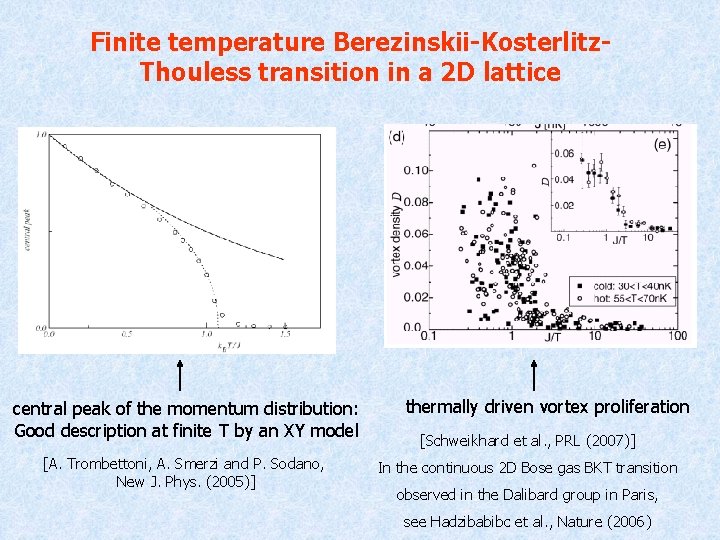
Finite temperature Berezinskii-Kosterlitz. Thouless transition in a 2 D lattice central peak of the momentum distribution: Good description at finite T by an XY model [A. Trombettoni, A. Smerzi and P. Sodano, New J. Phys. (2005)] thermally driven vortex proliferation [Schweikhard et al. , PRL (2007)] In the continuous 2 D Bose gas BKT transition observed in the Dalibard group in Paris, see Hadzibabibc et al. , Nature (2006)
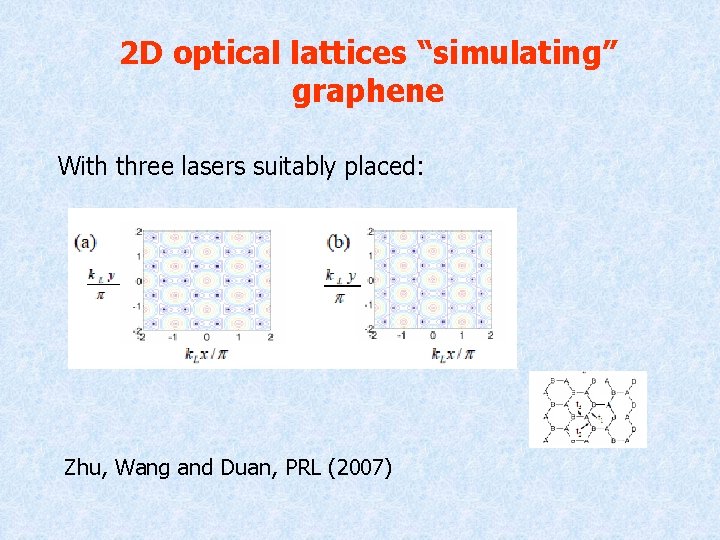
2 D optical lattices “simulating” graphene With three lasers suitably placed: Zhu, Wang and Duan, PRL (2007)

Trapped ultracold atoms Ultracold bosons and/or fermions in trapping potentials provide new experimentally realizable interacting systems on which to test well-known paradigms of the statistical mechanics: -) in a periodic potential -> strongly interacting lattice systems -) interaction can be enhanced/tuned through Feshbach resonances (BEC-BCS crossover – unitary limit) -) inhomogeneity can be tailored – defects/impurities can be added -) effects of the nonlinear interactions on the dynamics -) strong analogies with superconducting and superfluid systems -) used to study 2 D physics -) predicted a Laughlin ground-state for 2 D bosons in rotation: anyionic excitations …
Outlook A brief introduction on ultracold atoms Why using optical lattices? ü Effective tuning of the interactions ü Experimental realization of interacting lattice Hamiltonians Ultracold bosons on a disordered lattice: the shift of the critical temperature ü Infinite-range model: d. Tc<0, and vanishing d. Tc for large filling f ü 3 D lattice: ordered limit & connection with the spherical model ü 3 D lattice with disorder: d. Tc>0 for large f - d. Tc<0 for small f with: L. Dell’Anna, S. Fantoni (SISSA), P. Sodano (Perugia) [J. Stat. Mech. P 11012 (2008)]
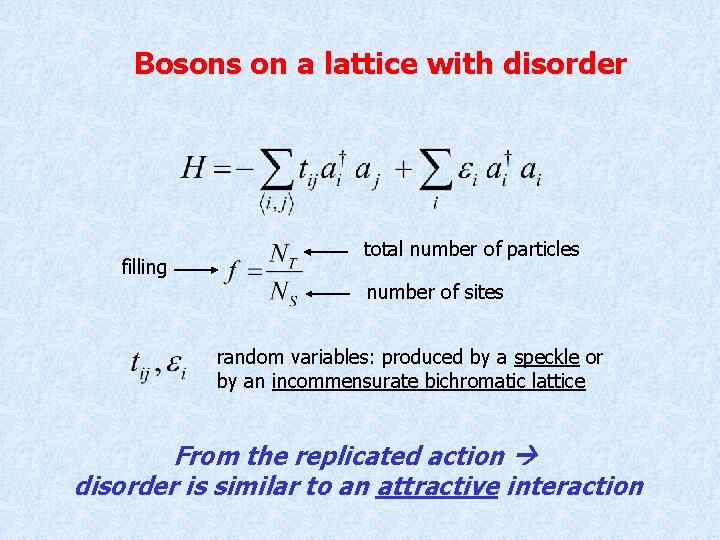
Bosons on a lattice with disorder filling total number of particles number of sites random variables: produced by a speckle or by an incommensurate bichromatic lattice From the replicated action disorder is similar to an attractive interaction
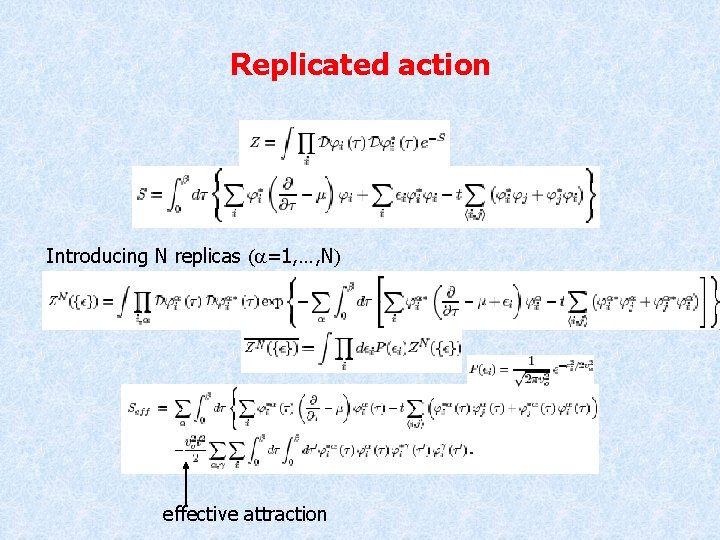
Replicated action Introducing N replicas (a=1, …, N) effective attraction
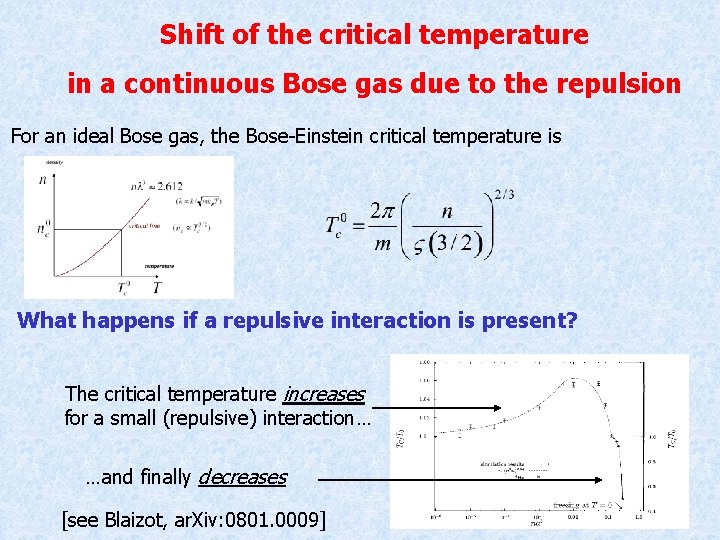
Shift of the critical temperature in a continuous Bose gas due to the repulsion For an ideal Bose gas, the Bose-Einstein critical temperature is What happens if a repulsive interaction is present? The critical temperature increases for a small (repulsive) interaction… …and finally decreases [see Blaizot, ar. Xiv: 0801. 0009]
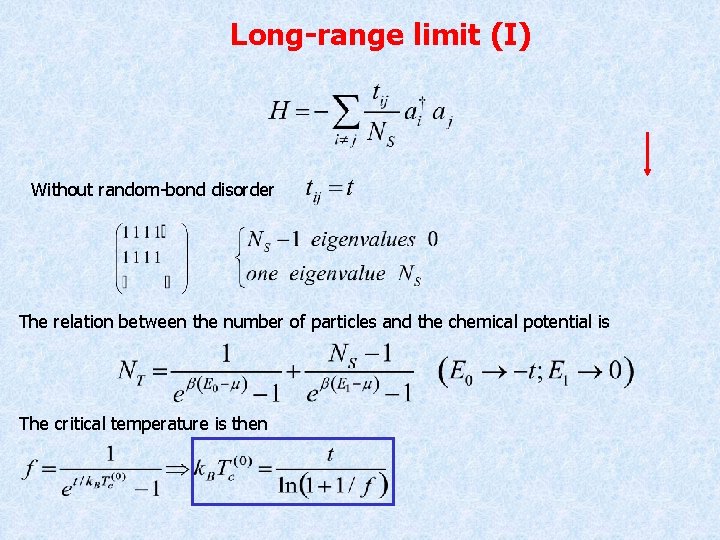
Long-range limit (I) Without random-bond disorder The relation between the number of particles and the chemical potential is The critical temperature is then
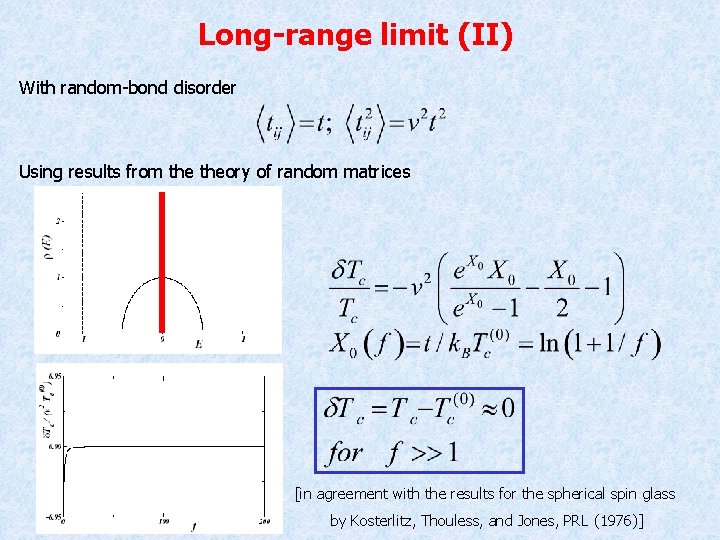
Long-range limit (II) With random-bond disorder Using results from theory of random matrices [in agreement with the results for the spherical spin glass by Kosterlitz, Thouless, and Jones, PRL (1976)]
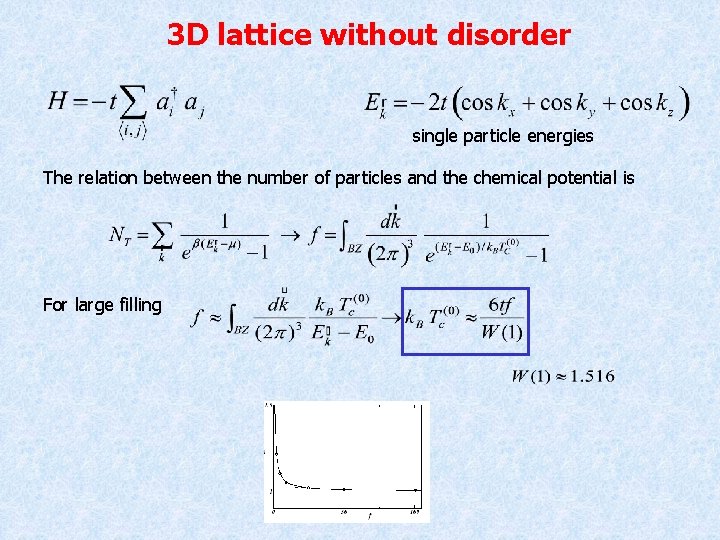
3 D lattice without disorder single particle energies The relation between the number of particles and the chemical potential is For large filling
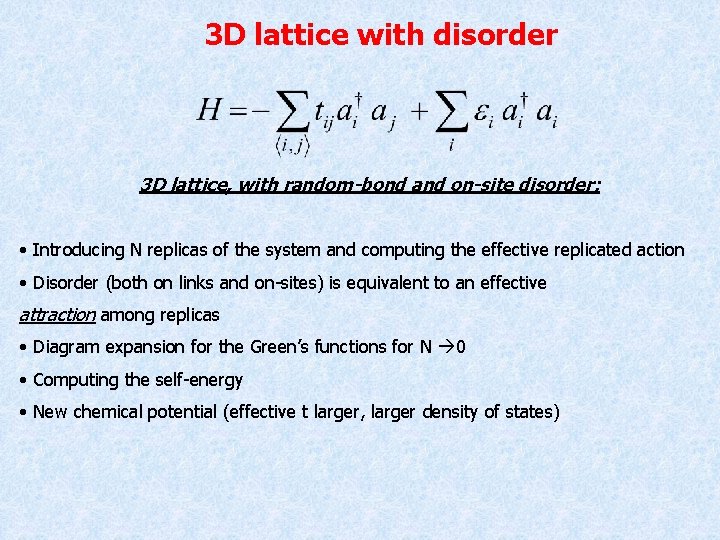
3 D lattice with disorder 3 D lattice, with random-bond and on-site disorder: • Introducing N replicas of the system and computing the effective replicated action • Disorder (both on links and on-sites) is equivalent to an effective attraction among replicas • Diagram expansion for the Green’s functions for N 0 • Computing the self-energy • New chemical potential (effective t larger, larger density of states)
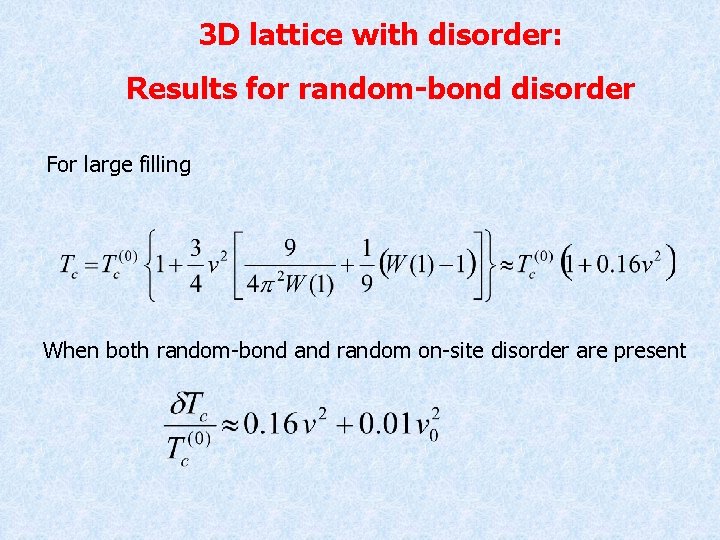
3 D lattice with disorder: Results for random-bond disorder For large filling When both random-bond and random on-site disorder are present
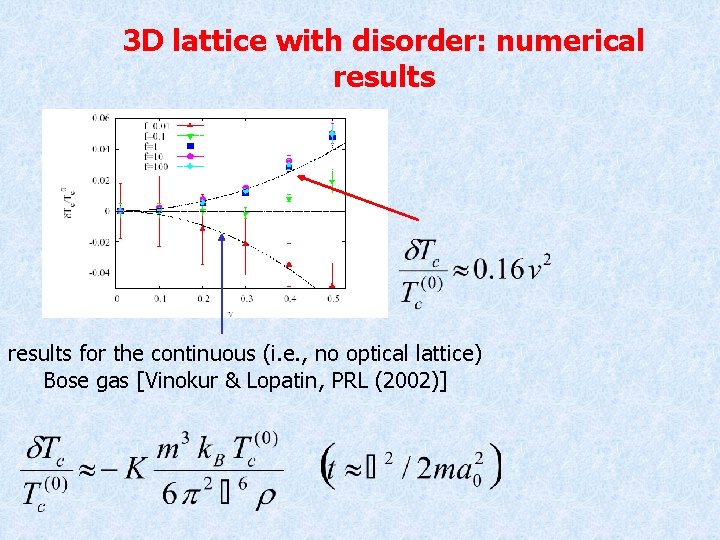
3 D lattice with disorder: numerical results for the continuous (i. e. , no optical lattice) Bose gas [Vinokur & Lopatin, PRL (2002)]
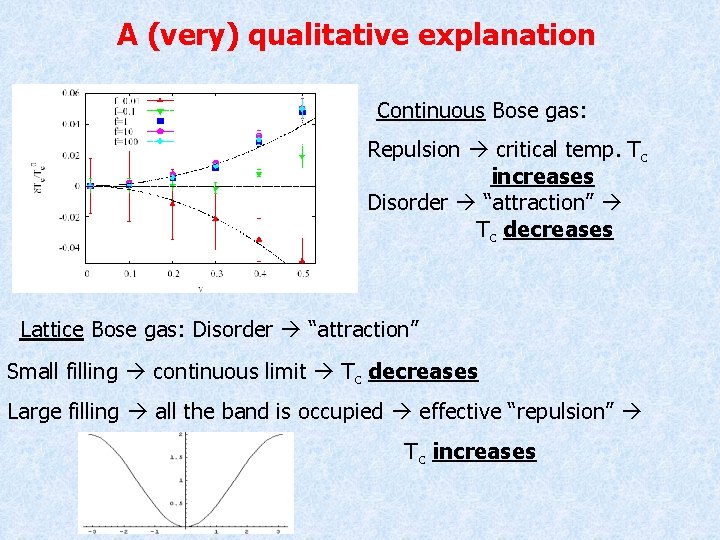
A (very) qualitative explanation Continuous Bose gas: Repulsion critical temp. Tc increases Disorder “attraction” Tc decreases Lattice Bose gas: Disorder “attraction” Small filling continuous limit Tc decreases Large filling all the band is occupied effective “repulsion” Tc increases

Thank you!
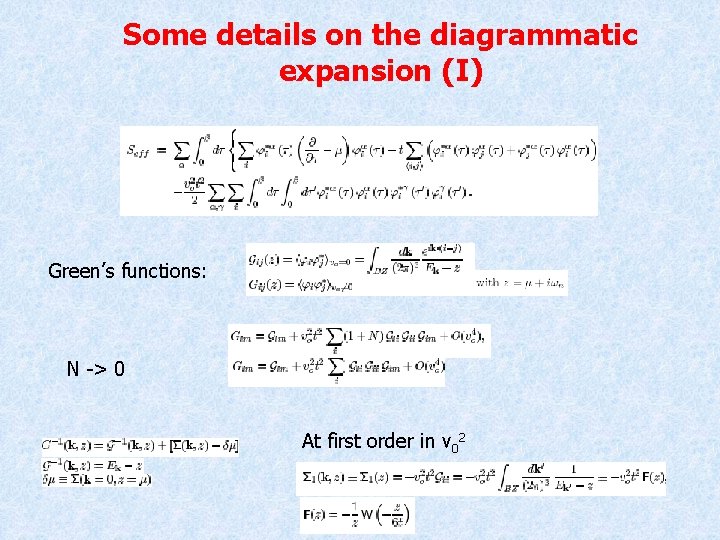
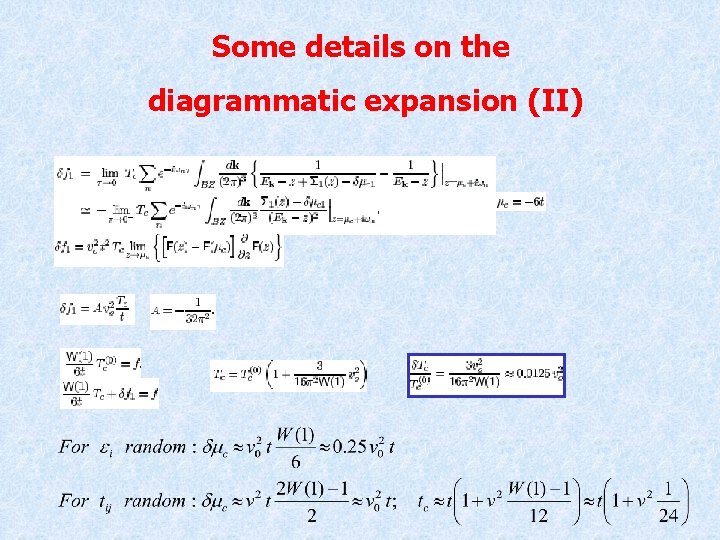
Some details on the diagrammatic expansion (I) Green’s functions: N -> 0 At first order in v 02
Some details on the diagrammatic expansion (II)
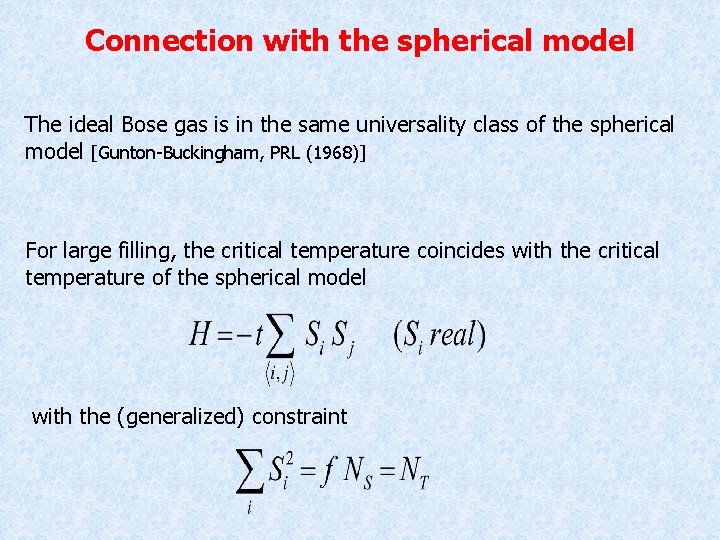
Connection with the spherical model The ideal Bose gas is in the same universality class of the spherical model [Gunton-Buckingham, PRL (1968)] For large filling, the critical temperature coincides with the critical temperature of the spherical model with the (generalized) constraint
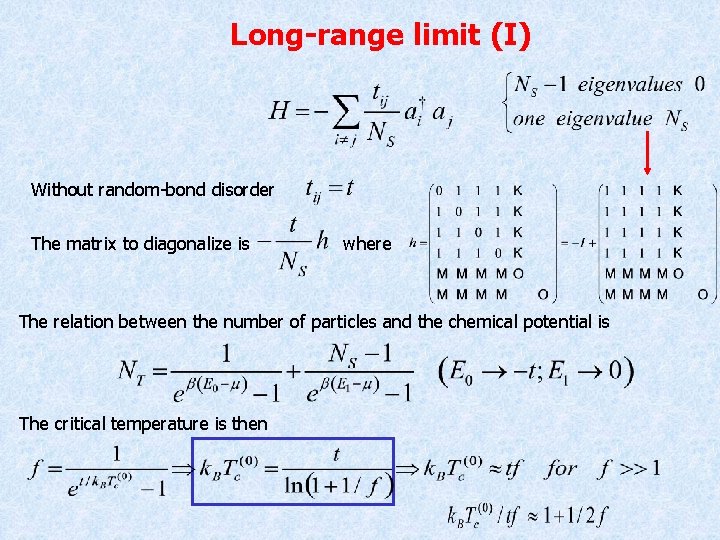
Long-range limit (I) Without random-bond disorder The matrix to diagonalize is where The relation between the number of particles and the chemical potential is The critical temperature is then
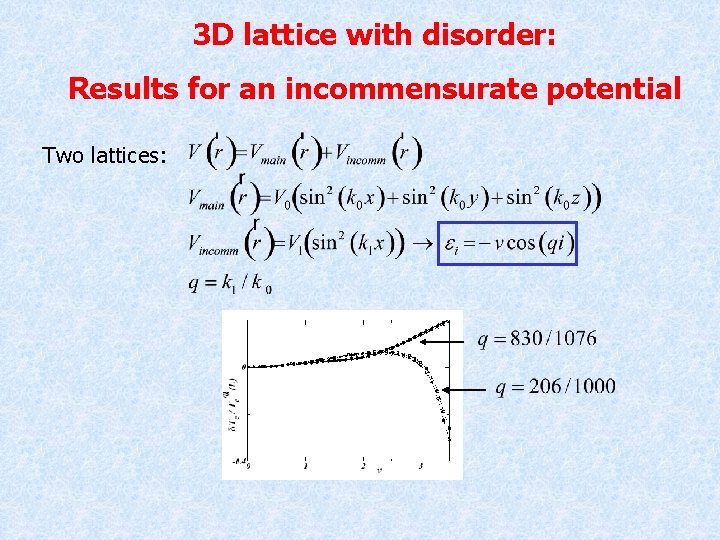
3 D lattice with disorder: Results for an incommensurate potential Two lattices:
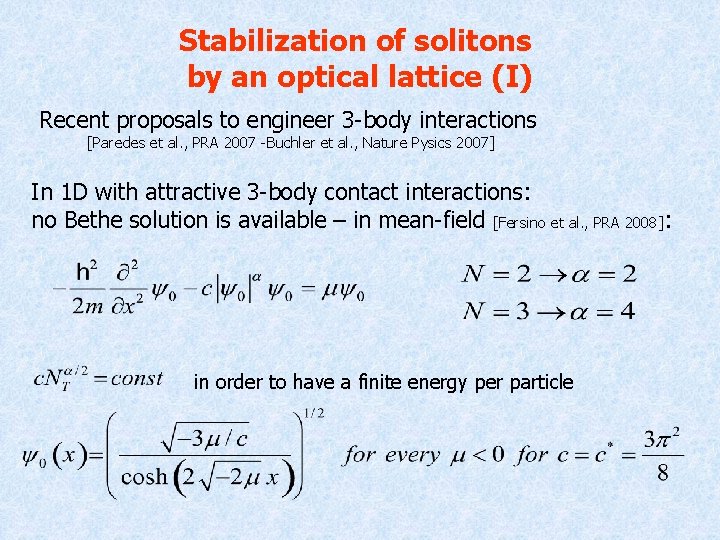
Stabilization of solitons by an optical lattice (I) Recent proposals to engineer 3 -body interactions [Paredes et al. , PRA 2007 -Buchler et al. , Nature Pysics 2007] In 1 D with attractive 3 -body contact interactions: no Bethe solution is available – in mean-field [Fersino et al. , PRA 2008]: in order to have a finite energy per particle
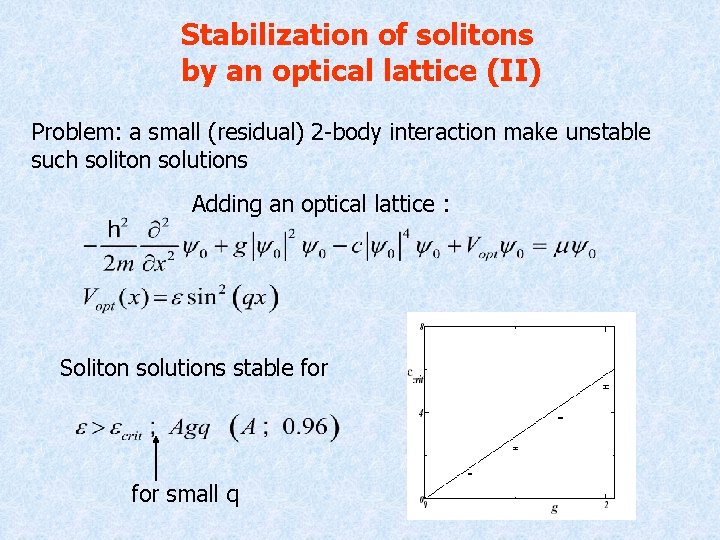
Stabilization of solitons by an optical lattice (II) Problem: a small (residual) 2 -body interaction make unstable such soliton solutions Adding an optical lattice : Soliton solutions stable for small q
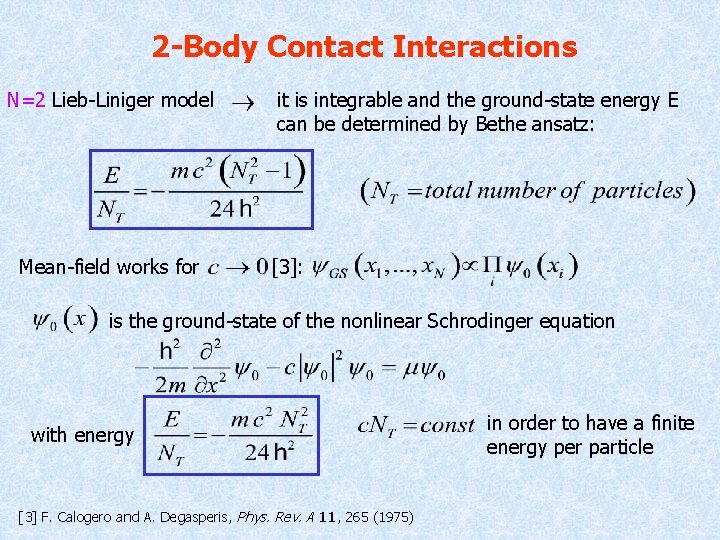
2 -Body Contact Interactions N=2 Lieb-Liniger model Mean-field works for it is integrable and the ground-state energy E can be determined by Bethe ansatz: [3]: is the ground-state of the nonlinear Schrodinger equation with energy [3] F. Calogero and A. Degasperis, Phys. Rev. A 11, 265 (1975) in order to have a finite energy per particle
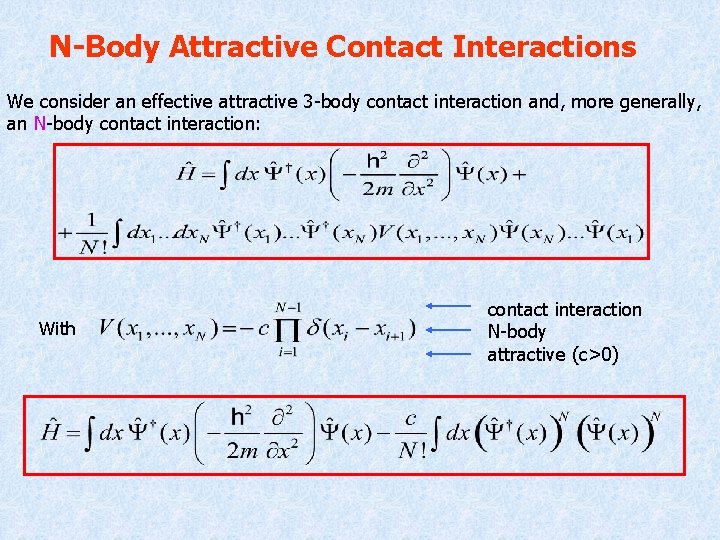
N-Body Attractive Contact Interactions We consider an effective attractive 3 -body contact interaction and, more generally, an N-body contact interaction: With contact interaction N-body attractive (c>0)
- Slides: 31