
Optical flow motion vector computation Course Computer Graphics

- Slides: 18
Optical flow (motion vector) computation Course: Computer Graphics and Image Processing Semester: Fall 2002 Presenter: Nilesh Ghubade (nileshg@temple. edu) Advisor: Dr Longin Jan Latecki Dept: Computer and Information Science, Temple University, Philadelphia, PA-19122
Motion Analysis 1. Three groups of motion-related problems: Motion detection n 2. Moving object detection and location n n 3. Registers any detected motion. Single static camera. Used for security purposes. Determination of object trajectory. Static camera, moving objects OR Moving camera, static objects OR Both camera and objects moving. Deriving 3 D properties n Use of set of 2 D projections acquired at different time instants of object motion.
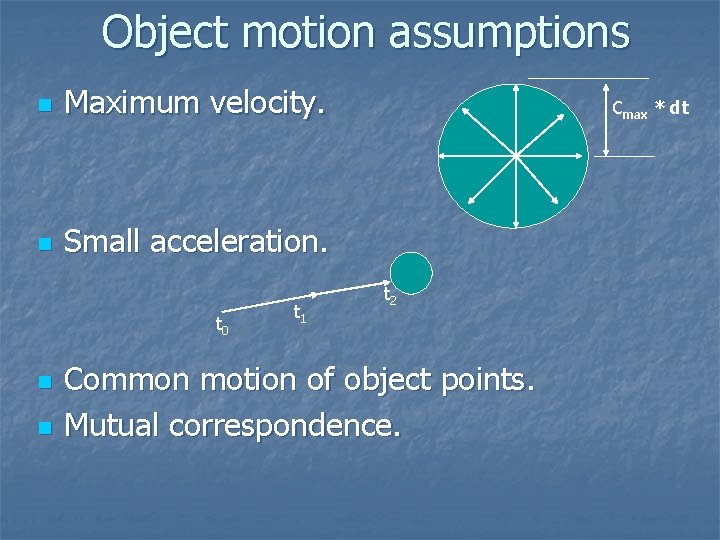
Object motion assumptions n Maximum velocity. n Small acceleration. t 0 n n t 1 Cmax * dt t 2 Common motion of object points. Mutual correspondence.
Differential motion analysis n n n Simple subtraction of images acquired at different instants in time makes motion detection possible, assuming stationary camera position and constant illumination. Difference image is a binary image subtract two consecutive images. Cumulative difference image: Reveals motion direction. n Time related motion properties. n Slow motion and small object motion. Constructed from sequence of ‘n’ images taking first image as the reference image. n
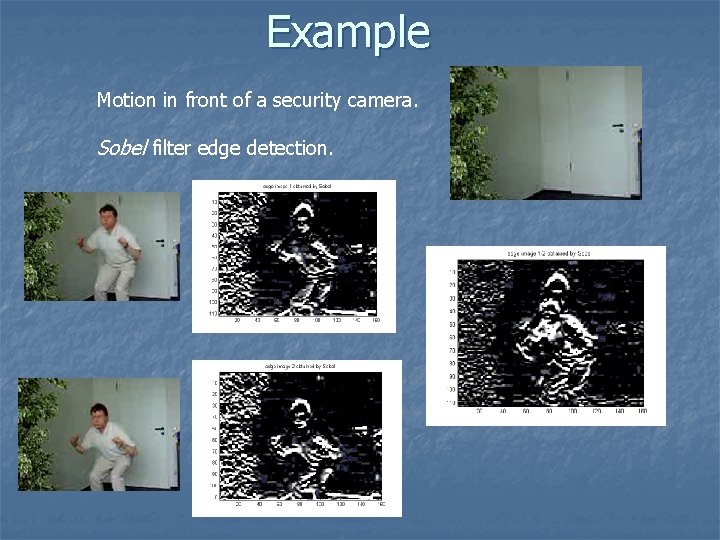
Example Motion in front of a security camera. Sobel filter edge detection.
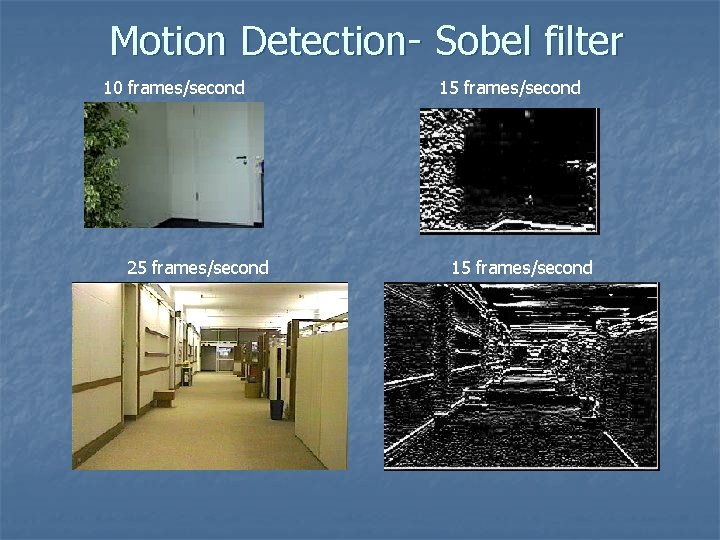
Motion Detection- Sobel filter 10 frames/second 25 frames/second 15 frames/second
Optical Flow n n Optical Flow reflects the image changes due to motion during a time interval dt. Optical flow field is the velocity field that represents the 3 D motion of object points across a 2 D image. It should not be sensitive to illumination changes and motion of unimportant objects (e. g. shadows) Exceptions: 1. 2. Non-zero optical flow fixed sphere illuminated by a moving source. Zero optical flow smooth sphere under constant illumination, although there is rotational motion and true nonzero motion field.
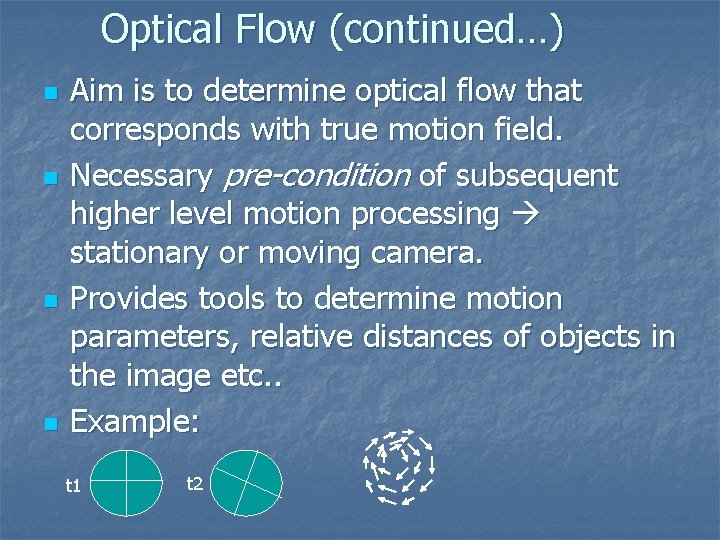
Optical Flow (continued…) n n Aim is to determine optical flow that corresponds with true motion field. Necessary pre-condition of subsequent higher level motion processing stationary or moving camera. Provides tools to determine motion parameters, relative distances of objects in the image etc. . Example: t 1 t 2
Assumptions Optical flow computation is based on two assumptions: 1. 2. The observed brightness of any object point is constant over time. Nearby points in the image plane move in a similar manner (the velocity smoothness constraint).
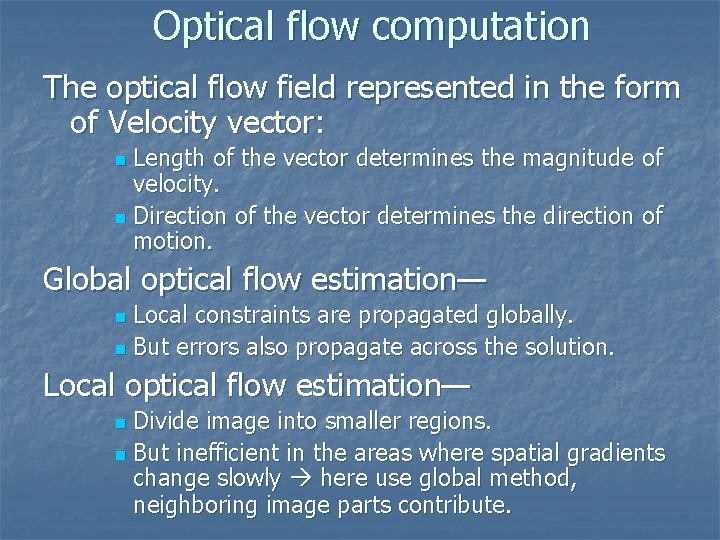
Optical flow computation The optical flow field represented in the form of Velocity vector: Length of the vector determines the magnitude of velocity. n Direction of the vector determines the direction of motion. n Global optical flow estimation— Local constraints are propagated globally. n But errors also propagate across the solution. n Local optical flow estimation— Divide image into smaller regions. n But inefficient in the areas where spatial gradients change slowly here use global method, neighboring image parts contribute. n
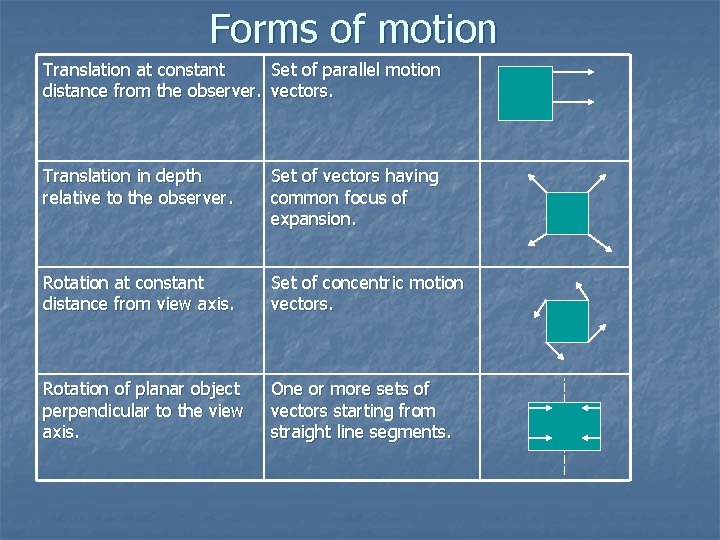
Forms of motion Translation at constant Set of parallel motion distance from the observer. vectors. Translation in depth relative to the observer. Set of vectors having common focus of expansion. Rotation at constant distance from view axis. Set of concentric motion vectors. Rotation of planar object perpendicular to the view axis. One or more sets of vectors starting from straight line segments.
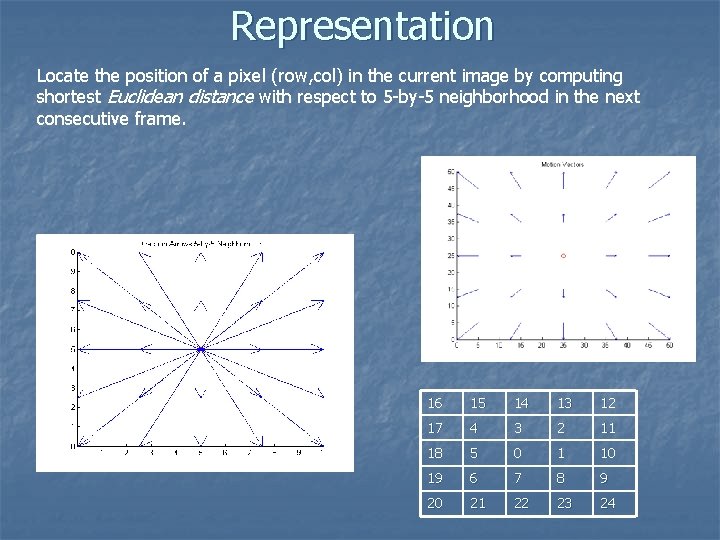
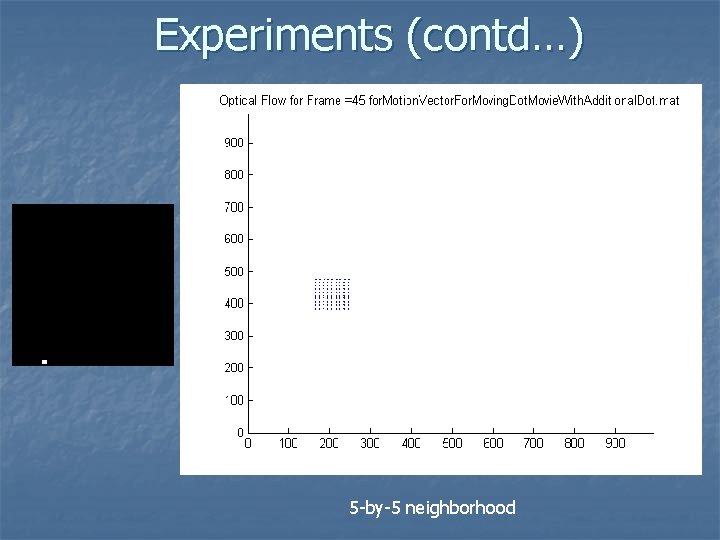
Representation Locate the position of a pixel (row, col) in the current image by computing shortest Euclidean distance with respect to 5 -by-5 neighborhood in the next consecutive frame. 16 15 14 13 12 17 4 3 2 11 18 5 0 1 10 19 6 7 8 9 20 21 22 23 24
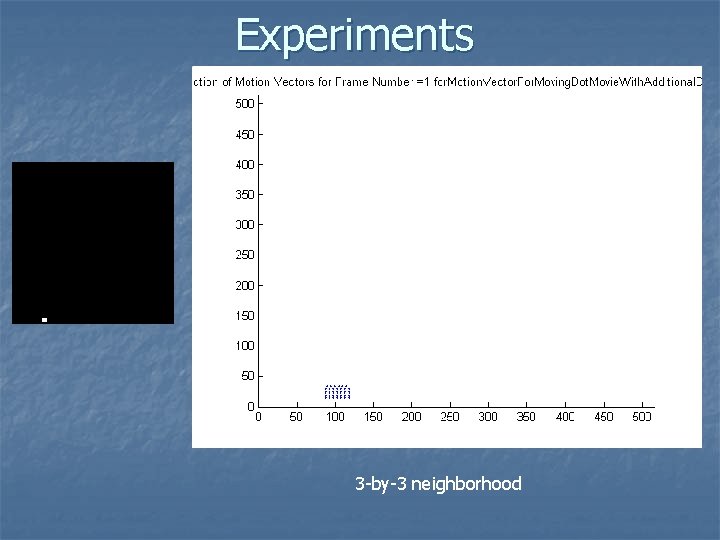
Experiments 3 -by-3 neighborhood
Experiments (contd…) 5 -by-5 neighborhood
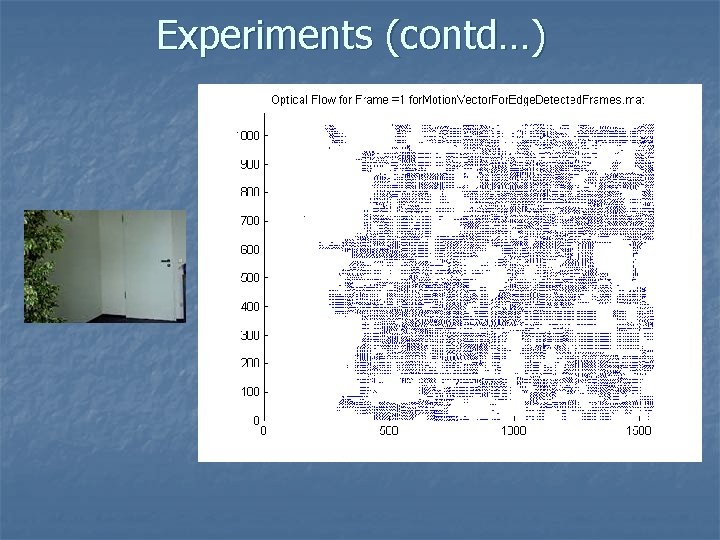
Experiments (contd…)
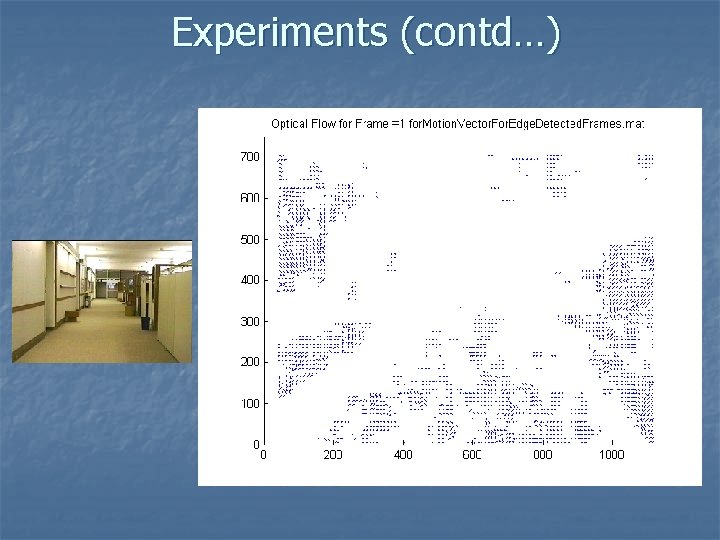
Experiments (contd…)
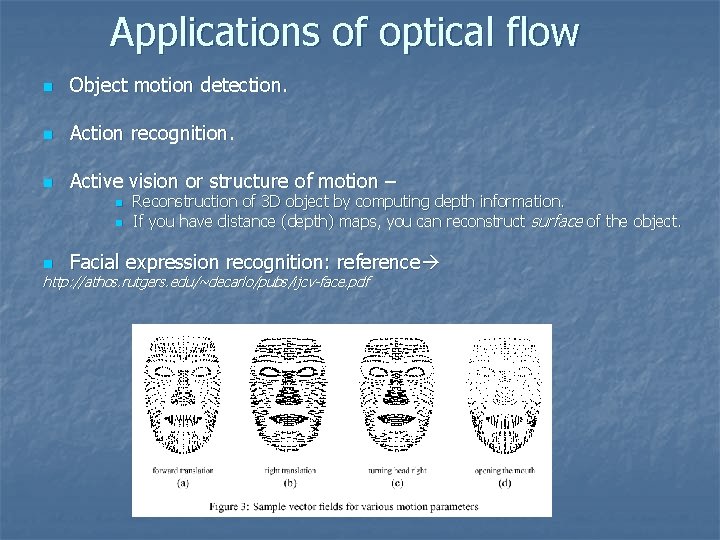
Applications of optical flow n Object motion detection. n Action recognition. n Active vision or structure of motion – n n n Reconstruction of 3 D object by computing depth information. If you have distance (depth) maps, you can reconstruct surface of the object. Facial expression recognition: reference http: //athos. rutgers. edu/~decarlo/pubs/ijcv-face. pdf
Thank you