
Optical Fiber Communications Chapter 1 Overview Overview Chapter
Optical Fiber Communications Chapter 1 Overview
Overview – Chapter 1 1. 1 Motivations for Lightwave Communications 1. 2 Optical Spectral Bands 1. 3 Decibel Units 1. 4 Network Information Rates 1. 5 WDM Concepts 1. 6 Key Elements of Optical Fiber Systems 1. 7 Standards for Optical Fiber Communications 2
1. 1 Motivations (1) • Lifestyle changes from Internet growth and use – Average phone call lasts 3 minutes – Average Internet session is 20 minutes • More and more bandwidth-hungry services are appearing – Web searching, home shopping, high-definition interactive video, remote education, telemedicine and e-health, high-resolution editing of home videos, blogging, and large-scale high-capacity e-science and Grid computing • Increase in PC storage capacity and processing power – 20 G hard drives were fine around 2000; now standard is 160 G – Laptops ran at 300 MHz; now the speed is over 3 GHz • There is an extremely large choice of remotely accessible programs and information databases 3
1. 1 Motivations (2) Advantages of optical fibers • Long Distance Transmission: The lower transmission losses in fibers compared to copper wires allow data to be sent over longer distances. • Large Information Capacity: Fibers have wider bandwidths than copper wires, so that more information can be sent over a single physical line. • Small Size and Low Weight: The low weight and the small dimensions of fibers offer a distinct advantage over heavy, bulky wire cables in crowded underground city ducts or in ceiling-mounted cable trays. • Immunity to Electrical Interference: The dielectric nature of optical fibers makes them immune to the electromagnetic interference effects. • Enhanced Safety: Optical fibers do not have the problems of ground loops, sparks, and potentially high voltages inherent in copper lines. • Increased Signal Security: An signal is well-confined within the fiber and an opaque coating around the fiber absorbs any signal emissions. 4
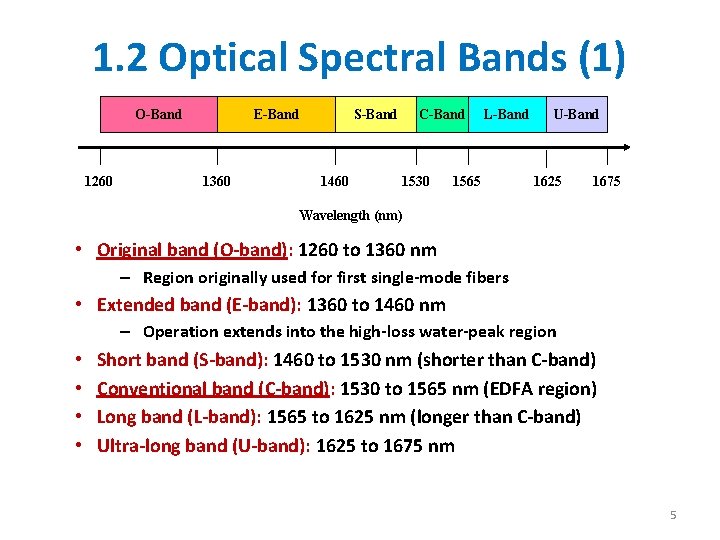
1. 2 Optical Spectral Bands (1) O-Band 1260 E-Band 1360 S-Band 1460 C-Band 1530 L-Band 1565 U-Band 1625 1675 Wavelength (nm) • Original band (O-band): 1260 to 1360 nm – Region originally used for first single-mode fibers • Extended band (E-band): 1360 to 1460 nm – Operation extends into the high-loss water-peak region • • Short band (S-band): 1460 to 1530 nm (shorter than C-band) Conventional band (C-band): 1530 to 1565 nm (EDFA region) Long band (L-band): 1565 to 1625 nm (longer than C-band) Ultra-long band (U-band): 1625 to 1675 nm 5

1. 2 Optical Spectral Bands (2) Optical communication uses wavelength to designate the spectral operating region and photon energy or optical power when discussing topics such as signal strength or electro-optical component performance. 1. In a vacuum the speed of light c is equal to the wavelength λ times the frequency ν, so that c=λν 2. The relationship between the energy of a photon and its frequency (or wavelength) is determined by Planck’s Law E=hν where h = 6. 63 × 10– 34 J-s = 4. 14 × 10– 15 e. V-s is Planck’s constant. 3. In terms of wavelength (measured in units of μm), the energy in electron volts is given by E(e. V) = 1. 2406/λ(μm) 6
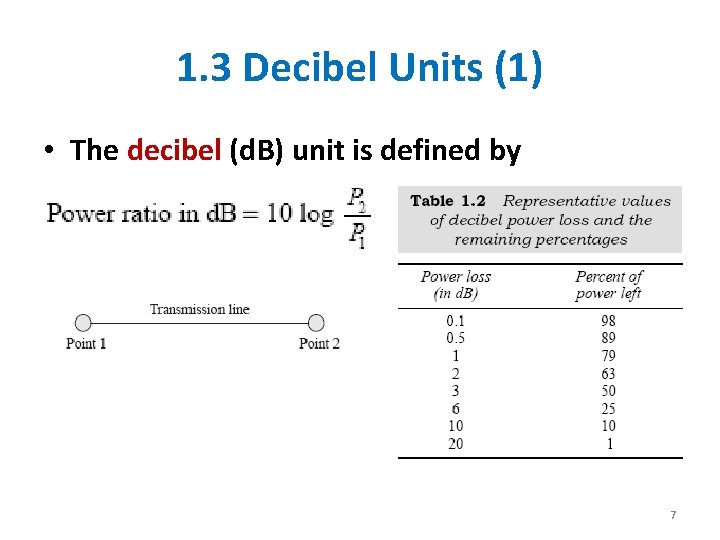
1. 3 Decibel Units (1) • The decibel (d. B) unit is defined by 7
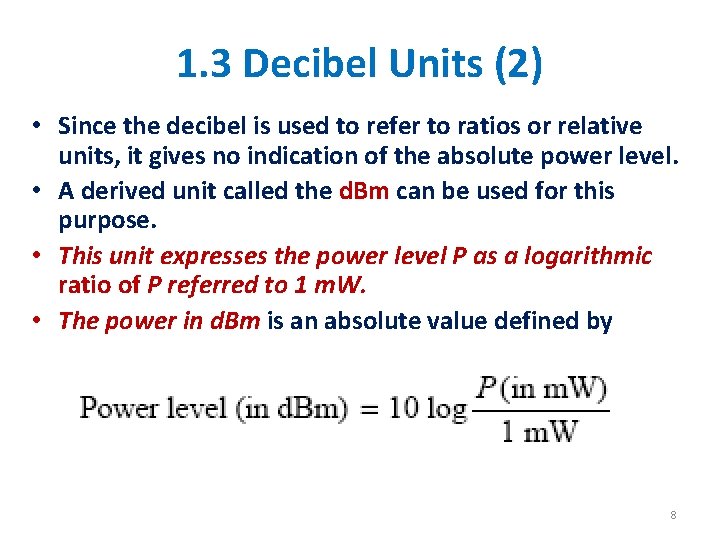
1. 3 Decibel Units (2) • Since the decibel is used to refer to ratios or relative units, it gives no indication of the absolute power level. • A derived unit called the d. Bm can be used for this purpose. • This unit expresses the power level P as a logarithmic ratio of P referred to 1 m. W. • The power in d. Bm is an absolute value defined by 8
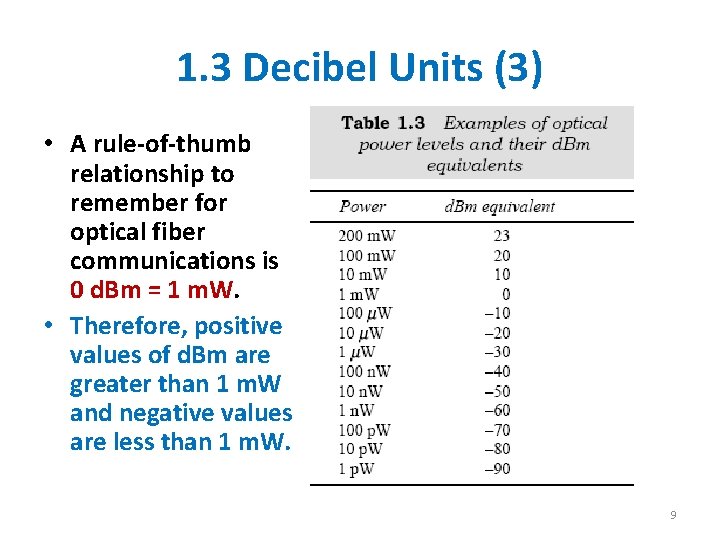
1. 3 Decibel Units (3) • A rule-of-thumb relationship to remember for optical fiber communications is 0 d. Bm = 1 m. W. • Therefore, positive values of d. Bm are greater than 1 m. W and negative values are less than 1 m. W. 9
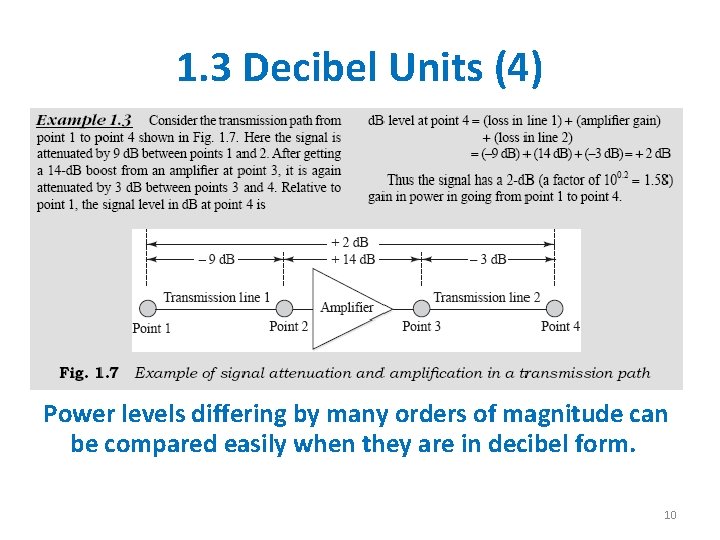
1. 3 Decibel Units (4) Power levels differing by many orders of magnitude can be compared easily when they are in decibel form. 10
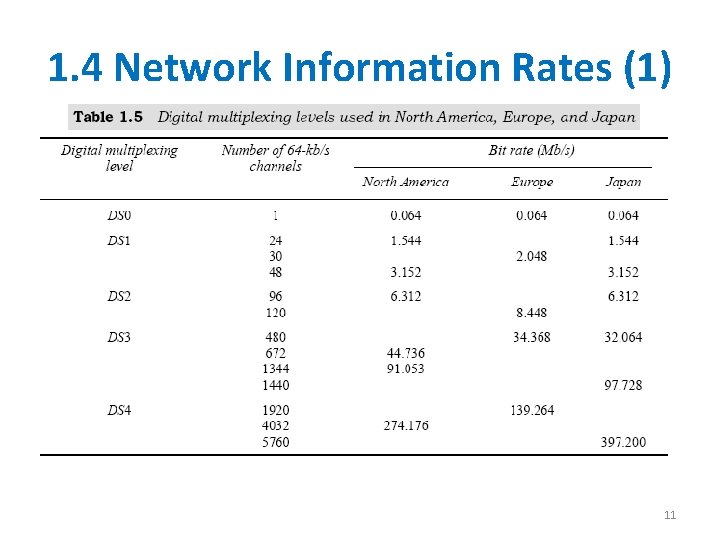
1. 4 Network Information Rates (1) 11
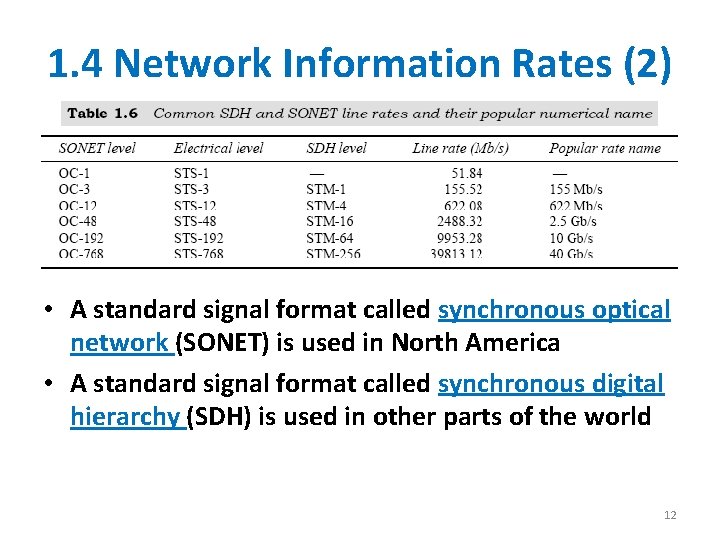
1. 4 Network Information Rates (2) • A standard signal format called synchronous optical network (SONET) is used in North America • A standard signal format called synchronous digital hierarchy (SDH) is used in other parts of the world 12
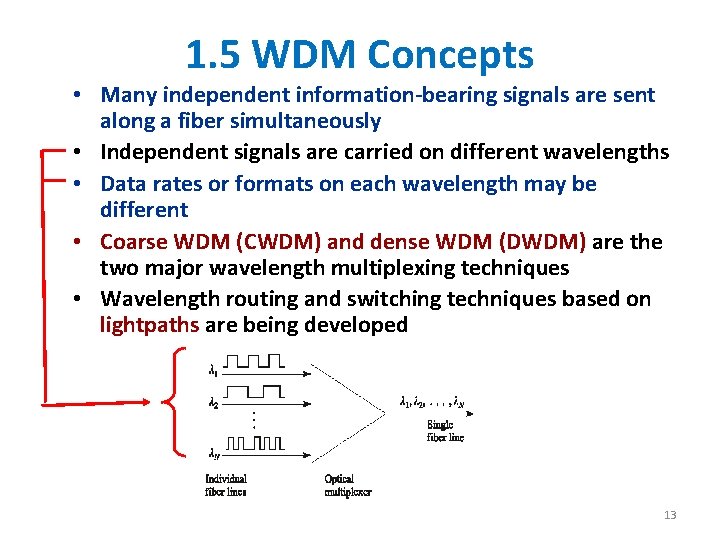
1. 5 WDM Concepts • Many independent information-bearing signals are sent along a fiber simultaneously • Independent signals are carried on different wavelengths • Data rates or formats on each wavelength may be different • Coarse WDM (CWDM) and dense WDM (DWDM) are the two major wavelength multiplexing techniques • Wavelength routing and switching techniques based on lightpaths are being developed 13
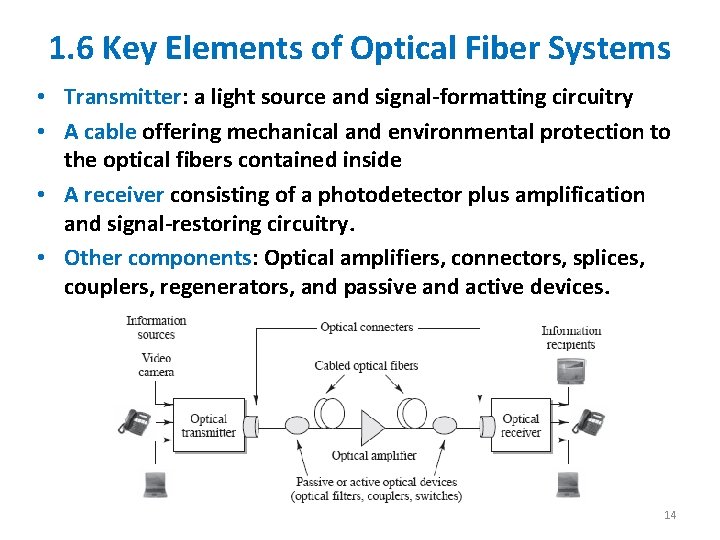
1. 6 Key Elements of Optical Fiber Systems • Transmitter: a light source and signal-formatting circuitry • A cable offering mechanical and environmental protection to the optical fibers contained inside • A receiver consisting of a photodetector plus amplification and signal-restoring circuitry. • Other components: Optical amplifiers, connectors, splices, couplers, regenerators, and passive and active devices. 14
1. 7 Standards The three basic classes for fiber optics are primary standards, component testing standards, and system standards. • Primary standards deal with physical parameters: attenuation, bandwidth, operational characteristics of fibers, and optical power levels and spectral widths. • Component testing standards define tests for fiber-optic component performance and establish equipment-calibration procedures. – The main ones are Fiber Optic Test Procedures (FOTP) • System standards refer to measurement methods for optical links and networks. 15
- Slides: 15