
Optical Emission Spectroscopic Analysis of Silicon Carbide plasma
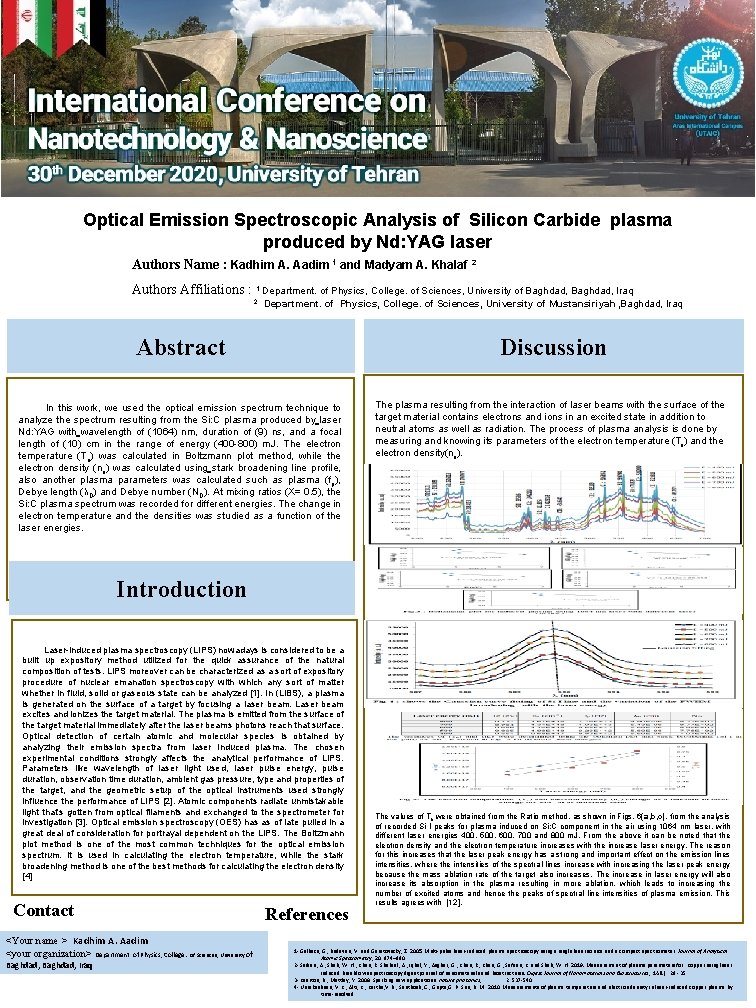
Optical Emission Spectroscopic Analysis of Silicon Carbide plasma produced by Nd: YAG laser Authors Name : Kadhim A. Aadim 1 and Madyam A. Khalaf 2 Authors Affiliations : 1 Department. of Physics, College. of Sciences, University of Baghdad, Iraq 2 Department. of Physics, College. of Sciences, University of Mustansiriyah , Baghdad, Iraq Abstract Discussion In this work, we used the optical emission spectrum technique to analyze the spectrum resulting from the Si: C plasma produced by laser Nd: YAG with wavelength of (1064) nm, duration of (9) ns, and a focal length of (10) cm in the range of energy (400 -800) m. J. The electron temperature (Te) was calculated in Boltzmann plot method, while the electron density (ne) was calculated using stark broadening line profile, also another plasma parameters was calculated such as plasma (fp), Debye length (λD) and Debye number (ND). At mixing ratios (X= 0. 5), the Si: C plasma spectrum was recorded for different energies. The change in electron temperature and the densities was studied as a function of the laser energies. The plasma resulting from the interaction of laser beams with the surface of the target material contains electrons and ions in an excited state in addition to neutral atoms as well as radiation. The process of plasma analysis is done by measuring and knowing its parameters of the electron temperature (Te) and the electron density(ne). … Introduction Laser-induced plasma spectroscopy (LIPS) nowadays is considered to be a built up expository method utilized for the quick assurance of the natural composition of tests. LIPS moreover can be characterized as a sort of expository procedure of nuclear emanation spectroscopy with which any sort of matter whether in fluid, solid or gaseous state can be analyzed [1]. In (LIBS), a plasma is generated on the surface of a target by focusing a laser beam. Laser beam excites and ionizes the target material. The plasma is emitted from the surface of the target material immediately after the laser beams photons reach that surface. Optical detection of certain atomic and molecular species is obtained by analyzing their emission spectra from laser Induced plasma. The chosen experimental conditions strongly affects the analytical performance of LIPS. Parameters like wavelength of laser light used, laser pulse energy, pulse duration, observation time duration, ambient gas pressure, type and properties of the target, and the geometric setup of the optical instruments used strongly influence the performance of LIPS [2]. Atomic components radiate unmistakable light that's gotten from optical filaments and exchanged to the spectrometer for investigation [3]. Optical emission spectroscopy (OES) has as of late pulled in a great deal of consideration for portrayal dependent on the LIPS. The Boltzmann plot method is one of the most common techniques for the optical emission spectrum. It is used in calculating the electron temperature, while the stark broadening method is one of the best methods for calculating the electron density [4] Contact <Your name > Kadhim A. Aadim <your organization> Department. of Physics, College. of Sciences, University of Baghdad, Iraq References The values of Te were obtained from the Ratio method, as shown in Figs. 6(a, b, c), from the analysis of recorded Si I peaks for plasma induced on Si: C component in the air using 1064 nm laser, with different laser energies 400, 500, 600, 700 and 800 m. J. From the above it can be noted that the electron density and the electron temperature increases with the increase laser energy. The reason for this increases that the laser peak energy has a strong and important effect on the emission lines intensities, where the intensities of the spectral lines increase with increasing the laser peak energy because the mass ablation rate of the target also increases. The increase in laser energy will also increase its absorption in the plasma resulting in more ablation, which leads to increasing the number of excited atoms and hence the peaks of spectral line intensities of plasma emission. This results agrees with [12]. 1 - Galbacs, G. , Budavari, V. and Geretovszky, Z. 2005. Multi-pulse laser-induced plasma spectroscopy using a single laser source and a compact spectrometer. Journal of Analytical Atomic Spectrometry, 20: 974– 980. 2 - Safeen, A. , Shah, W. H. , Khan, R. Shakeel, A. , Iqbal, Y. , Asghar, G. , Khan, R. , Khan, G. , Safeen, K. and Shah, W. H. 2019. Measurement of plasma parameters for copper using laser induced breakdown spectroscopy digest journal of nanomaterials and biostructures. Digest Journal of Nanomaterials and Biostructures, 14(1) : 29 - 35. 3 - Kearton, B. , Mattley, Y. 2008. Sparking new applications. nature photonics, 2: 537 -540. 4 - Unnikrishnan, V. K. , Alti, K. , Kartha, V. B. , Santhosh, C. , Gupta, G. P. Suri, B. M. 2010. Measurements of plasma temperature and electron density in laser-induced copper plasma by time-resolved
- Slides: 1