
Optical Diffraction Tomography A J Devaney Department of
- Slides: 12
Optical Diffraction Tomography A. J. Devaney Department of Electrical Engineering Northeastern University Boston, MA 02115 USA E-mail: tonydev 2@aol. com • Review problems with classical optical microscopy • Review experimental setup and goal of optical diffraction tomography (ODT) • Describe two approaches to ODT • Phase retrieval • Holographic • Review results to date • Outline future goals Holography, Acoustical, Encyclopedia of Applied Physics, Vol. 7 , 511 -530, 1992 10/17/97 Optical Diffraction Tomography 1
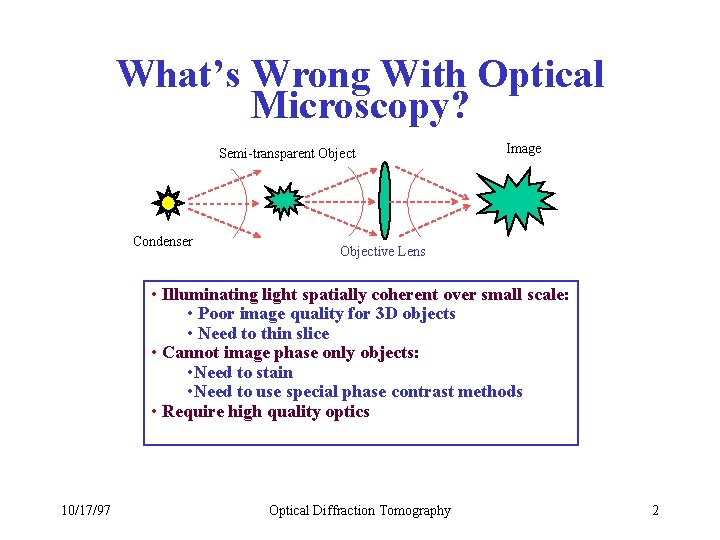
What’s Wrong With Optical Microscopy? Semi-transparent Object Condenser Image Objective Lens • Illuminating light spatially coherent over small scale: • Poor image quality for 3 D objects • Need to thin slice • Cannot image phase only objects: • Need to stain • Need to use special phase contrast methods • Require high quality optics 10/17/97 Optical Diffraction Tomography 2
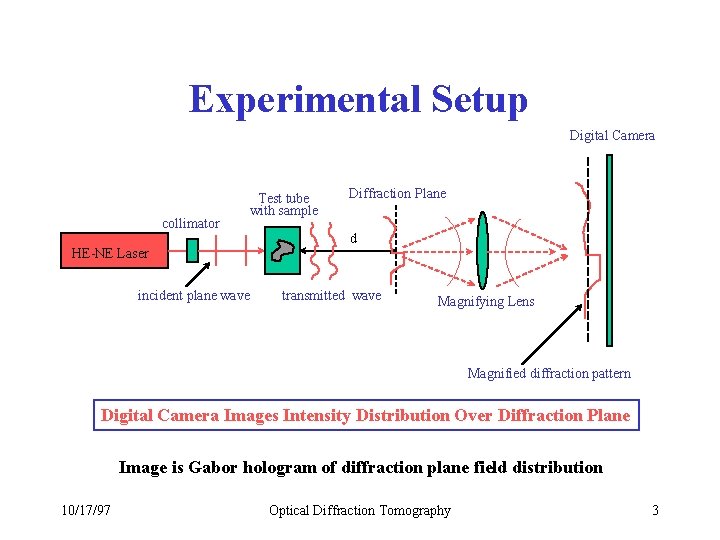
Experimental Setup Digital Camera collimator Test tube with sample HE-NE Laser incident plane wave Diffraction Plane d transmitted wave Magnifying Lens Magnified diffraction pattern Digital Camera Images Intensity Distribution Over Diffraction Plane Image is Gabor hologram of diffraction plane field distribution 10/17/97 Optical Diffraction Tomography 3
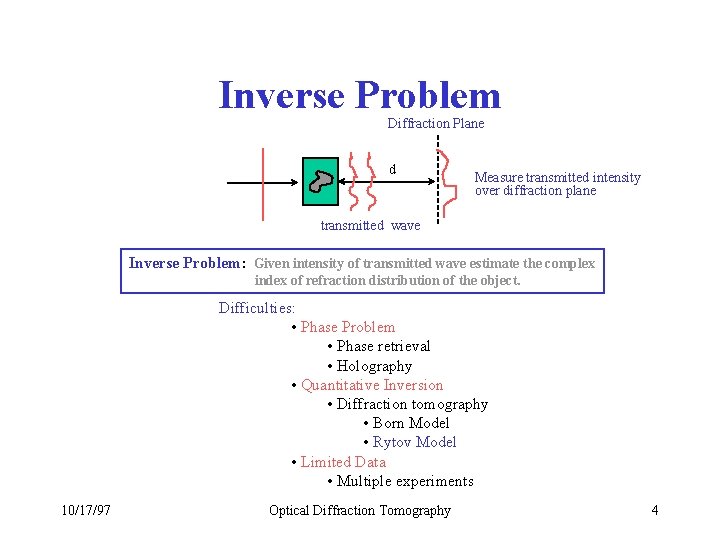
Inverse Problem Diffraction Plane d Measure transmitted intensity over diffraction plane transmitted wave Inverse Problem: Given intensity of transmitted wave estimate the complex index of refraction distribution of the object. Difficulties: • Phase Problem • Phase retrieval • Holography • Quantitative Inversion • Diffraction tomography • Born Model • Rytov Model • Limited Data • Multiple experiments 10/17/97 Optical Diffraction Tomography 4
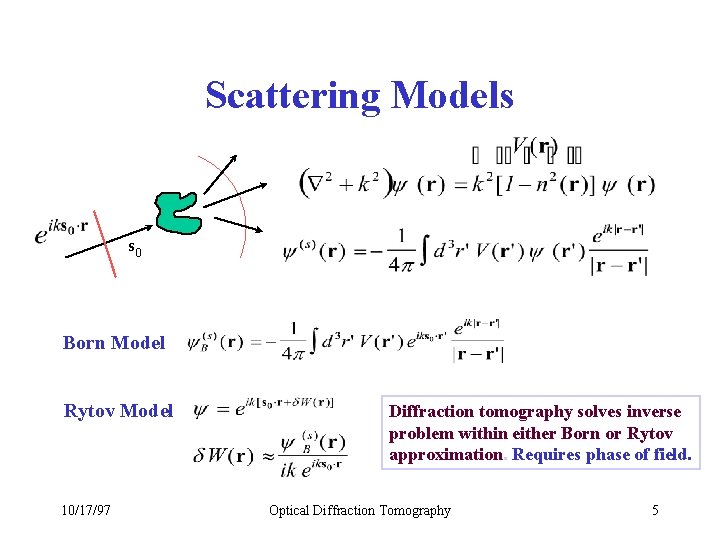
Scattering Models s 0 Born Model Rytov Model 10/17/97 Diffraction tomography solves inverse problem within either Born or Rytov approximation. Requires phase of field. Optical Diffraction Tomography 5
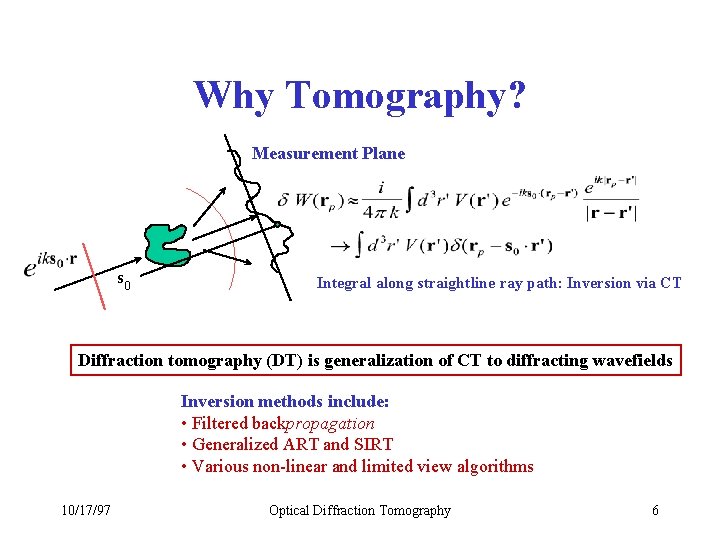
Why Tomography? Measurement Plane s 0 Integral along straightline ray path: Inversion via CT Diffraction tomography (DT) is generalization of CT to diffracting wavefields Inversion methods include: • Filtered backpropagation • Generalized ART and SIRT • Various non-linear and limited view algorithms 10/17/97 Optical Diffraction Tomography 6
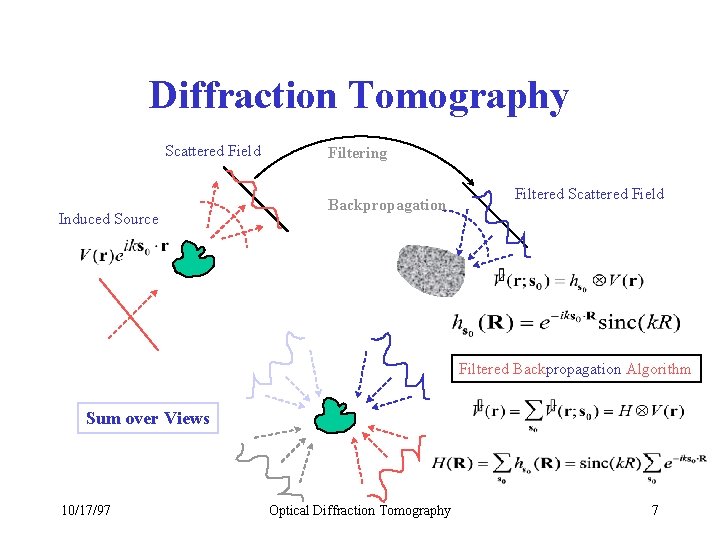
Diffraction Tomography Scattered Field Induced Source Filtering Backpropagation Filtered Scattered Field Filtered Backpropagation Algorithm Sum over Views 10/17/97 Optical Diffraction Tomography 7
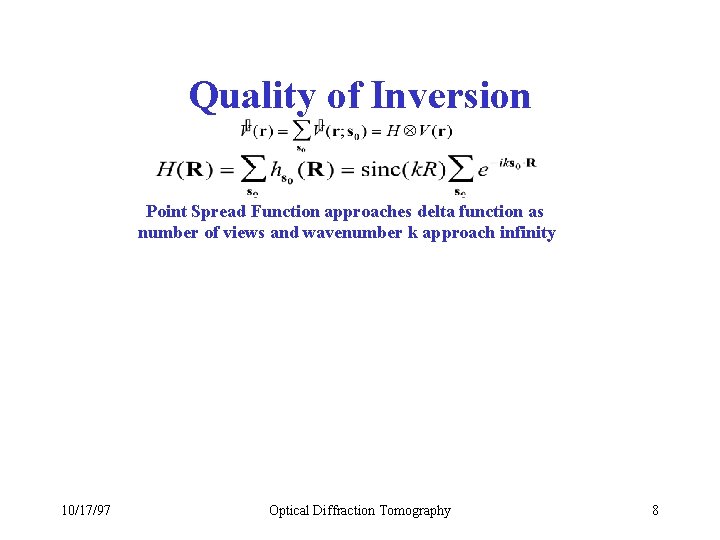
Quality of Inversion Point Spread Function approaches delta function as number of views and wavenumber k approach infinity 10/17/97 Optical Diffraction Tomography 8
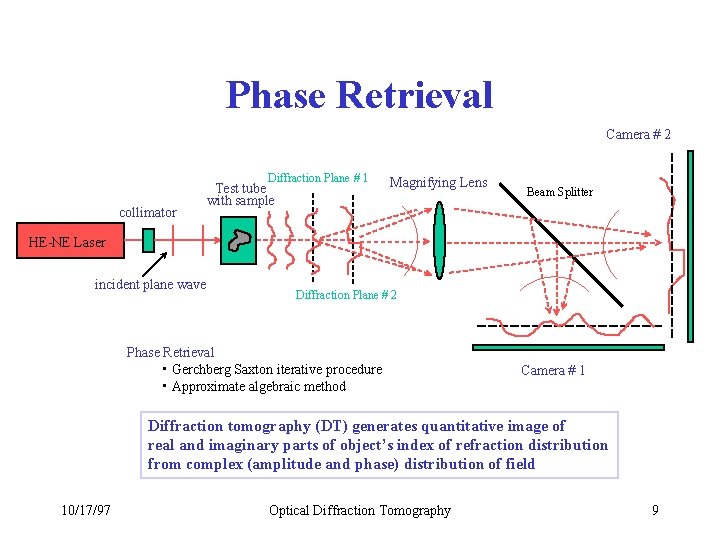
Phase Retrieval Camera # 2 Diffraction Plane # 1 collimator Test tube with sample Magnifying Lens Beam Splitter HE-NE Laser incident plane wave Diffraction Plane # 2 Phase Retrieval • Gerchberg Saxton iterative procedure • Approximate algebraic method Camera # 1 Diffraction tomography (DT) generates quantitative image of real and imaginary parts of object’s index of refraction distribution from complex (amplitude and phase) distribution of field 10/17/97 Optical Diffraction Tomography 9
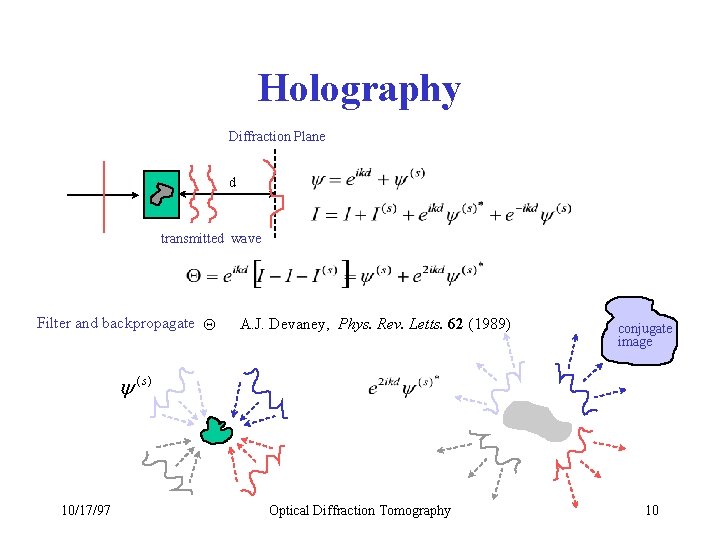
Holography Diffraction Plane d transmitted wave Filter and backpropagate Q A. J. Devaney, Phys. Rev. Letts. 62 (1989) conjugate image y ( s) 10/17/97 Optical Diffraction Tomography 10
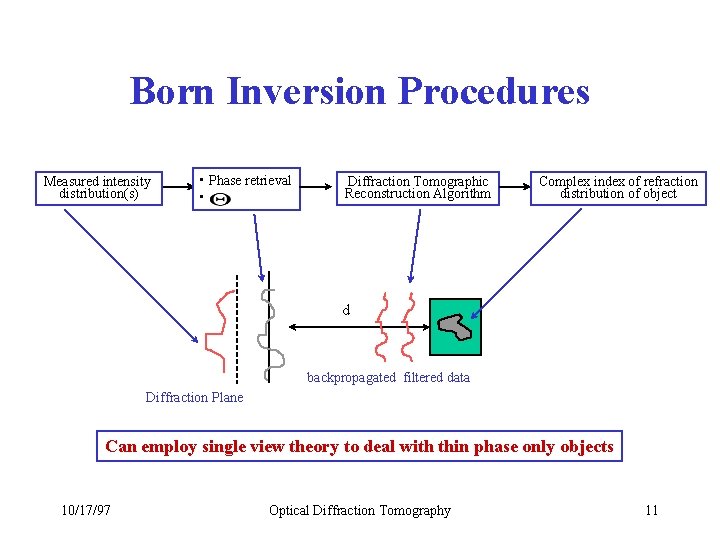
Born Inversion Procedures Measured intensity distribution(s) • Phase retrieval • Diffraction Tomographic Reconstruction Algorithm Complex index of refraction distribution of object d backpropagated filtered data Diffraction Plane Can employ single view theory to deal with thin phase only objects 10/17/97 Optical Diffraction Tomography 11
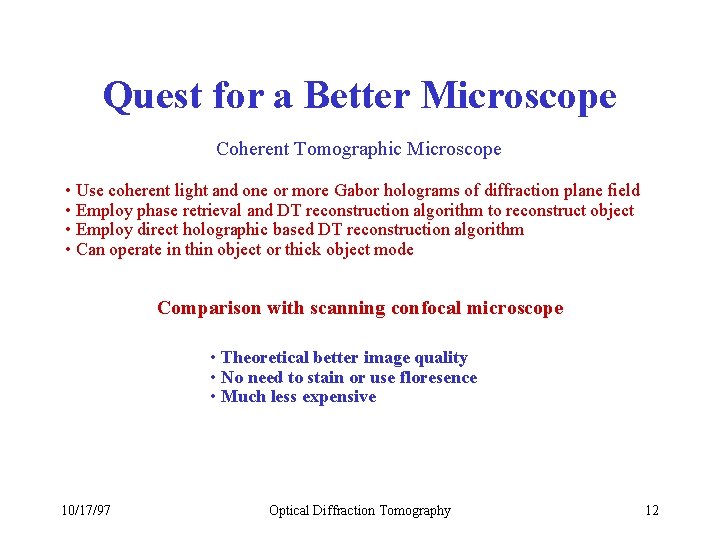
Quest for a Better Microscope Coherent Tomographic Microscope • Use coherent light and one or more Gabor holograms of diffraction plane field • Employ phase retrieval and DT reconstruction algorithm to reconstruct object • Employ direct holographic based DT reconstruction algorithm • Can operate in thin object or thick object mode Comparison with scanning confocal microscope • Theoretical better image quality • No need to stain or use floresence • Much less expensive 10/17/97 Optical Diffraction Tomography 12