
Optical Detector Systems at ESO Projects completed or
- Slides: 18
Optical Detector Systems at ESO (Projects completed or started since Df. A 2005) Dietrich Baade & Andrea Balestra, Claudio Cumani, Sebastian Deiries, Mark Downing, Christoph Geimer, Olaf Iwert, Roland Reiss, Javier Reyes, and Mirko Todorovic For more details see also www. eso. org/sci Df. A 2009 Dietrich Baade: Optical Detector Systems at ESO 1 / 18
Controller Scientific Detector Systems R&D Projects Signal (Wavefront) Sensing Df. A 2009 Dietrich Baade: Optical Detector Systems at ESO 2 / 18
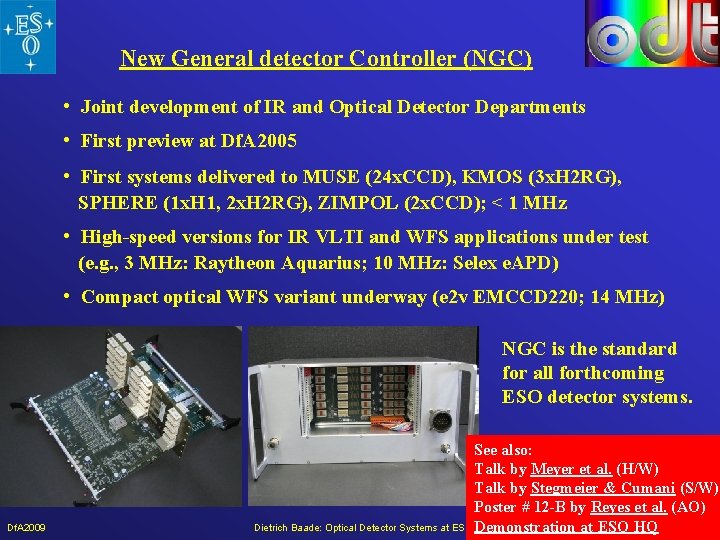
New General detector Controller (NGC) • Joint development of IR and Optical Detector Departments • First preview at Df. A 2005 • First systems delivered to MUSE (24 x. CCD), KMOS (3 x. H 2 RG), SPHERE (1 x. H 1, 2 x. H 2 RG), ZIMPOL (2 x. CCD); < 1 MHz • High-speed versions for IR VLTI and WFS applications under test (e. g. , 3 MHz: Raytheon Aquarius; 10 MHz: Selex e. APD) • Compact optical WFS variant underway (e 2 v EMCCD 220; 14 MHz) NGC is the standard for all forthcoming ESO detector systems. Df. A 2009 See also: Talk by Meyer et al. (H/W) Talk by Stegmeier & Cumani (S/W) Poster # 12 -B by Reyes et al. (AO) Dietrich Baade: Optical Detector Systems at ESO Demonstration at ESO HQ 3 / 18
Controller Scientific Detector Systems R&D Projects Signal (Wavefront) Sensing Df. A 2009 Dietrich Baade: Optical Detector Systems at ESO 4 / 18
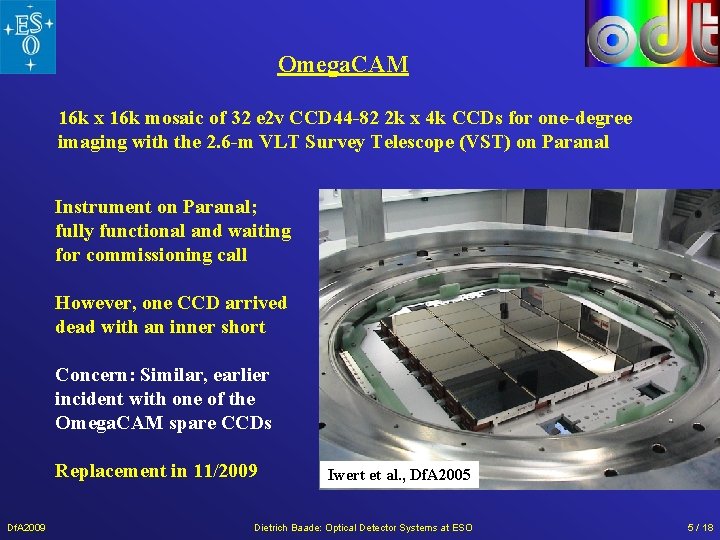
Omega. CAM 16 k x 16 k mosaic of 32 e 2 v CCD 44 -82 2 k x 4 k CCDs for one-degree imaging with the 2. 6 -m VLT Survey Telescope (VST) on Paranal Instrument on Paranal; fully functional and waiting for commissioning call However, one CCD arrived dead with an inner short Concern: Similar, earlier incident with one of the Omega. CAM spare CCDs Replacement in 11/2009 Df. A 2009 Iwert et al. , Df. A 2005 Dietrich Baade: Optical Detector Systems at ESO 5 / 18
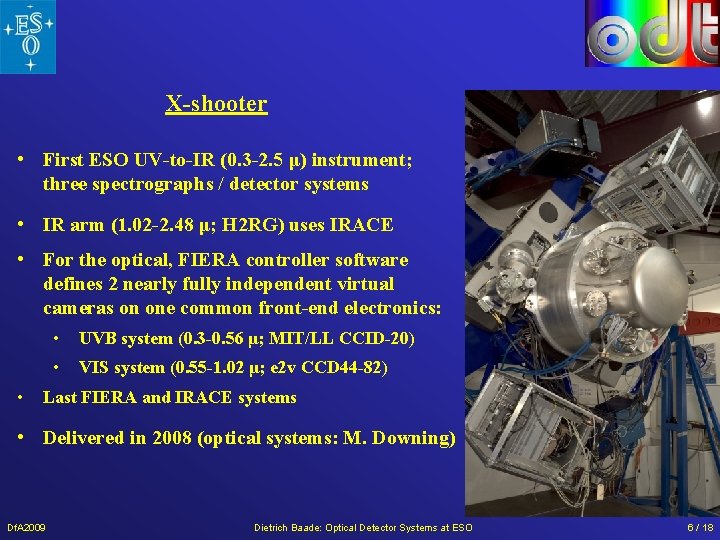
X-shooter • First ESO UV-to-IR (0. 3 -2. 5 μ) instrument; three spectrographs / detector systems • IR arm (1. 02 -2. 48 μ; H 2 RG) uses IRACE • For the optical, FIERA controller software defines 2 nearly fully independent virtual cameras on one common front-end electronics: • • UVB system (0. 3 -0. 56 μ; MIT/LL CCID-20) • VIS system (0. 55 -1. 02 μ; e 2 v CCD 44 -82) Last FIERA and IRACE systems • Delivered in 2008 (optical systems: M. Downing) Df. A 2009 Dietrich Baade: Optical Detector Systems at ESO 6 / 18
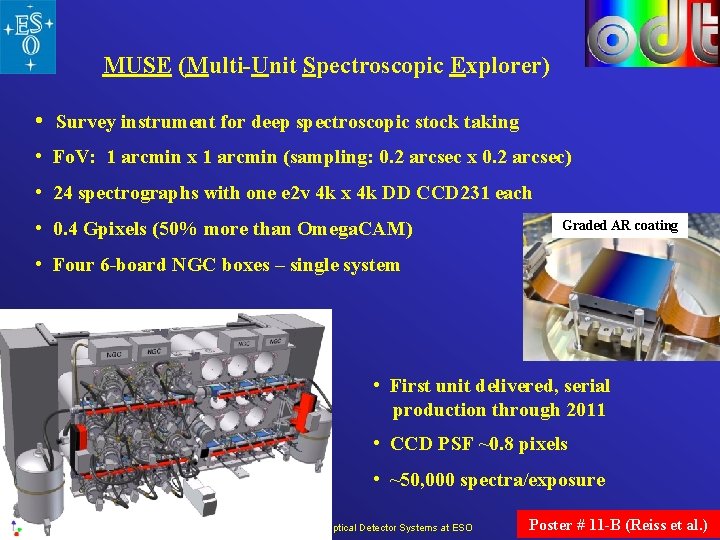
MUSE (Multi-Unit Spectroscopic Explorer) • Survey instrument for deep spectroscopic stock taking • Fo. V: 1 arcmin x 1 arcmin (sampling: 0. 2 arcsec x 0. 2 arcsec) • 24 spectrographs with one e 2 v 4 k x 4 k DD CCD 231 each • 0. 4 Gpixels (50% more than Omega. CAM) Graded AR coating • Four 6 -board NGC boxes – single system • First unit delivered, serial production through 2011 • CCD PSF ~0. 8 pixels • ~50, 000 spectra/exposure Df. A 2009 Dietrich Baade: Optical Detector Systems at ESO Poster # 11 -B (Reiss et al. ) 7 / 18
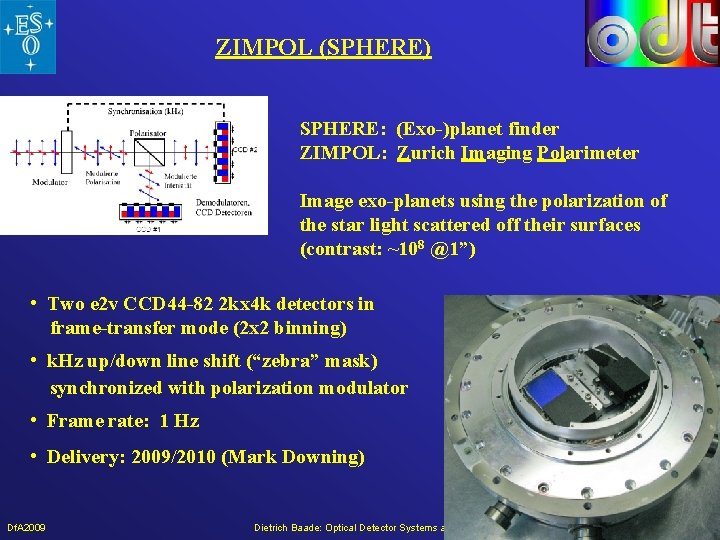
ZIMPOL (SPHERE) SPHERE: (Exo-)planet finder ZIMPOL: Zurich Imaging Polarimeter Image exo-planets using the polarization of the star light scattered off their surfaces (contrast: ~108 @1”) • Two e 2 v CCD 44 -82 2 kx 4 k detectors in frame-transfer mode (2 x 2 binning) • k. Hz up/down line shift (“zebra” mask) synchronized with polarization modulator • Frame rate: 1 Hz • Delivery: 2009/2010 (Mark Downing) Df. A 2009 Dietrich Baade: Optical Detector Systems at ESO 8 / 18
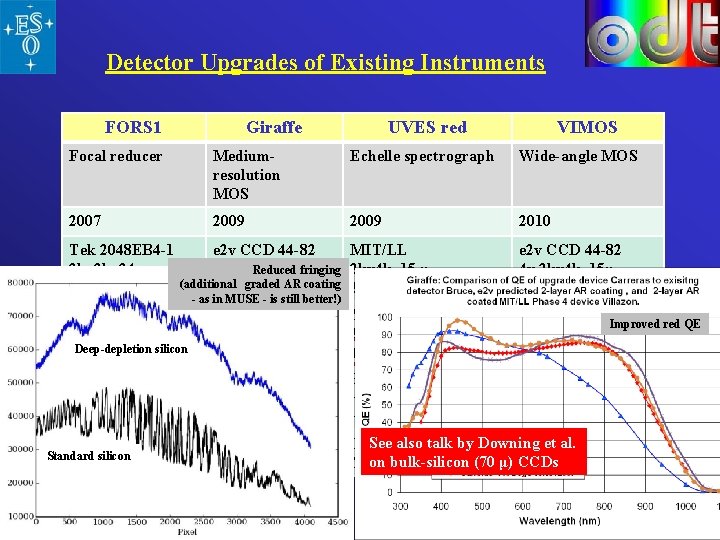
Detector Upgrades of Existing Instruments FORS 1 Giraffe UVES red Focal reducer Mediumresolution MOS Echelle spectrograph Wide-angle MOS 2007 2009 2010 Tek 2048 EB 4 -1 2 kx 2 k, 24 μ e 2 v CCD 44 -82 MIT/LL 2 kx 4 k, Reduced 15 μ fringing 2 kx 4 k, 15 μ (additional AR coating 20 μ thick 20 μ graded std silicon - as in MUSE - is still better!) e 2 v CCD 44 -82 4 x 2 kx 4 k, 15μ 20 μ std silicon e 2 v CCD 44 -82 2 x 2 kx 4 k, 15 μ e 2 v CCD 44 -82 2 kx 4 k, 15 μ 40 μ DD silicon MIT/LL 2 kx 4 k, 15 μ 40 μ high-res. silicon e 2 v CCD 44 -82 Improved red QE 4 x 2 kx 4 k, 15μ 40 μ DD silicon 1. 3 x increase in UVB response Red response doubled; much reduced fringing R/NIR response nearly doubled; much reduced fringing Doubled R/NIR response & reduced fringing (TBC) Roland Reiss Mark Downing See. Iwert also /talk by Downing et al. Haddad / Olaf Nicolas on bulk-silicon Nicolas Haddad (70 μ) CCDs Mark Downing Deep-depletion silicon Standard silicon Df. A 2009 VIMOS Dietrich Baade: Optical Detector Systems at ESO 9 / 18
Controller Scientific Detector Systems R&D Projects Signal (Wavefront) Sensing Df. A 2009 Dietrich Baade: Optical Detector Systems at ESO 10 / 18
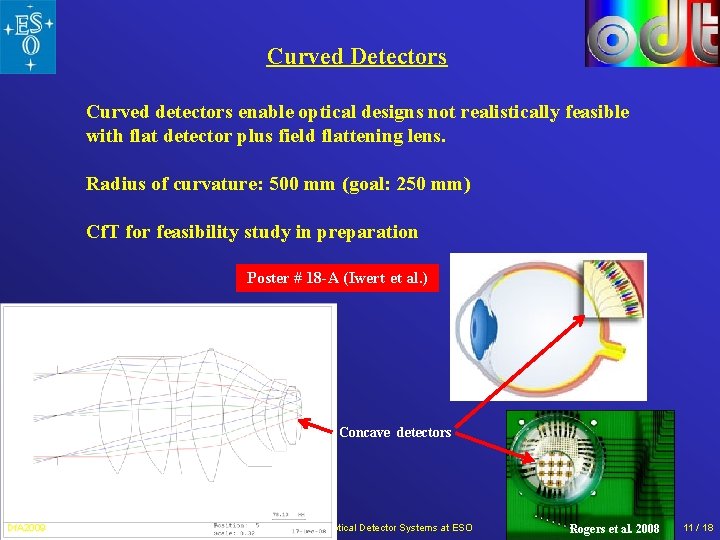
Curved Detectors Curved detectors enable optical designs not realistically feasible with flat detector plus field flattening lens. Radius of curvature: 500 mm (goal: 250 mm) Cf. T for feasibility study in preparation Poster # 18 -A (Iwert et al. ) Concave detectors Df. A 2009 Dietrich Baade: Optical Detector Systems at ESO Rogers et al. 2008 11 / 18
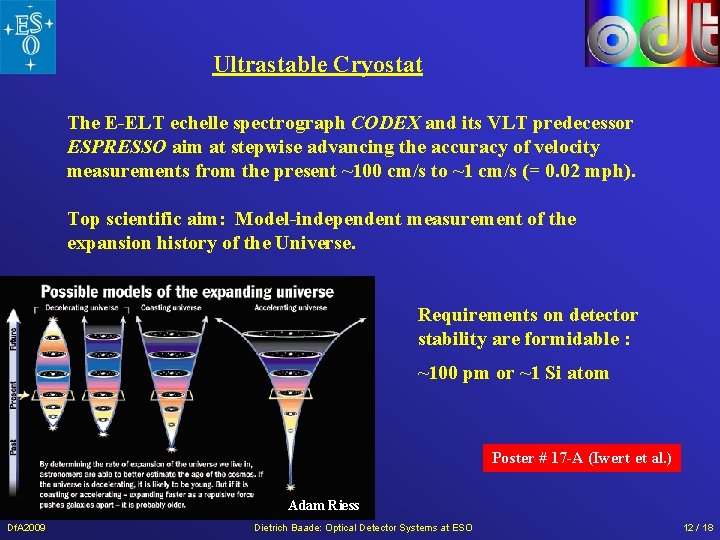
Ultrastable Cryostat The E-ELT echelle spectrograph CODEX and its VLT predecessor ESPRESSO aim at stepwise advancing the accuracy of velocity measurements from the present ~100 cm/s to ~1 cm/s (= 0. 02 mph). Top scientific aim: Model-independent measurement of the expansion history of the Universe. Requirements on detector stability are formidable : ~100 pm or ~1 Si atom Poster # 17 -A (Iwert et al. ) Adam Riess Df. A 2009 Dietrich Baade: Optical Detector Systems at ESO 12 / 18
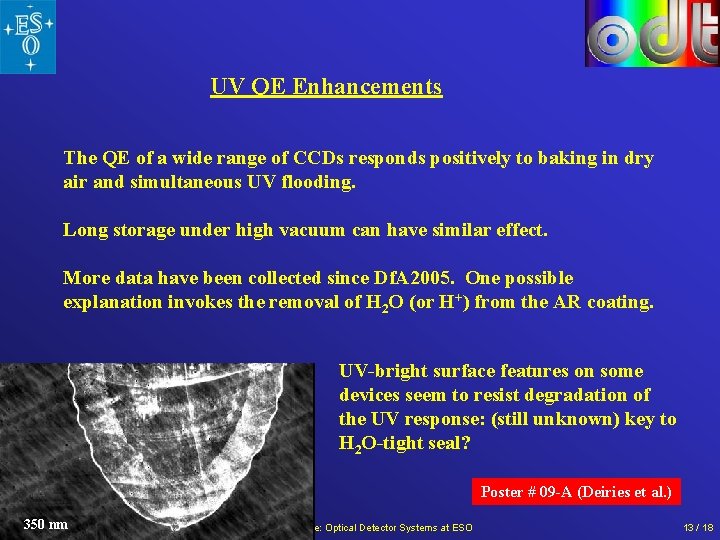
UV QE Enhancements The QE of a wide range of CCDs responds positively to baking in dry air and simultaneous UV flooding. Long storage under high vacuum can have similar effect. More data have been collected since Df. A 2005. One possible explanation invokes the removal of H 2 O (or H+) from the AR coating. UV-bright surface features on some devices seem to resist degradation of the UV response: (still unknown) key to H 2 O-tight seal? Poster # 09 -A (Deiries et al. ) 350 nm Df. A 2009 Dietrich Baade: Optical Detector Systems at ESO 13 / 18
Controller Scientific Detector Systems R&D Projects Signal (Wavefront) Sensing Df. A 2009 Dietrich Baade: Optical Detector Systems at ESO 14 / 18
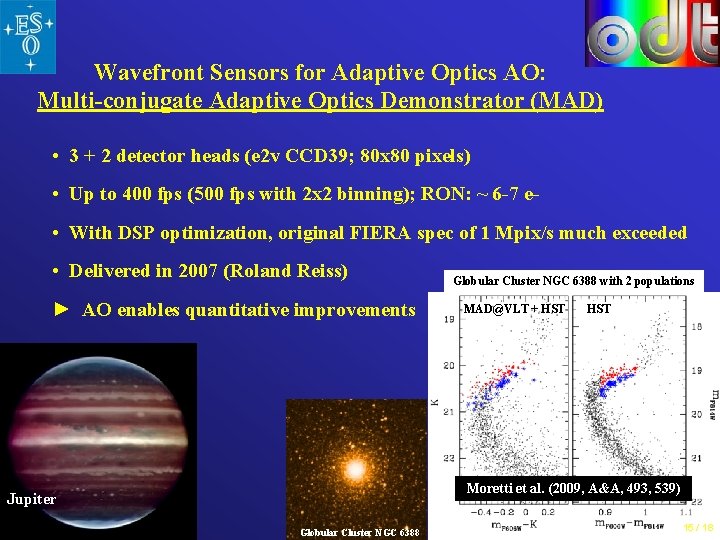
Wavefront Sensors for Adaptive Optics AO: Multi-conjugate Adaptive Optics Demonstrator (MAD) • 3 + 2 detector heads (e 2 v CCD 39; 80 x 80 pixels) • Up to 400 fps (500 fps with 2 x 2 binning); RON: ~ 6 -7 e • With DSP optimization, original FIERA spec of 1 Mpix/s much exceeded • Delivered in 2007 (Roland Reiss) ► AO enables quantitative improvements MAD@VLT + HST Moretti et al. (2009, A&A, 493, 539) Jupiter Df. A 2009 Globular Cluster NGC 6388 with 2 populations Globular Cluster NGC 6388 15 / 18
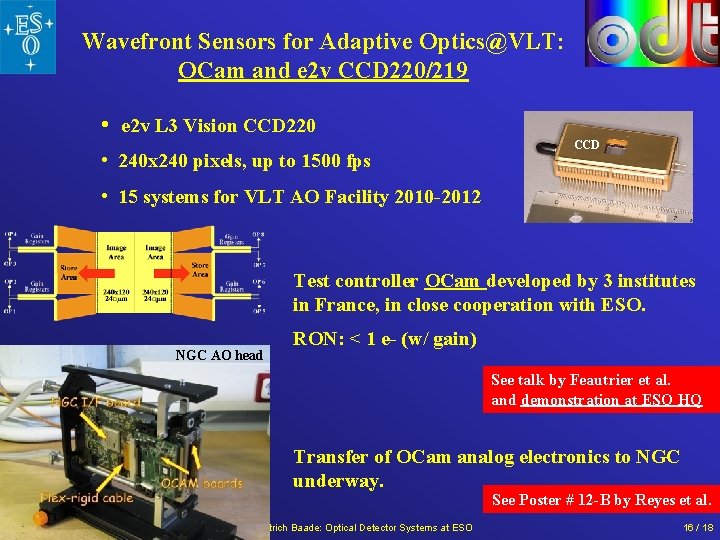
Wavefront Sensors for Adaptive Optics@VLT: OCam and e 2 v CCD 220/219 • e 2 v L 3 Vision CCD 220 • 240 x 240 pixels, up to 1500 fps CCD • 15 systems for VLT AO Facility 2010 -2012 Test controller OCam developed by 3 institutes in France, in close cooperation with ESO. NGC AO head RON: < 1 e- (w/ gain) See talk by Feautrier et al. and demonstration at ESO HQ CCD Transfer of OCam analog electronics to NGC underway. See Poster # 12 -B by Reyes et al. Df. A 2009 Dietrich Baade: Optical Detector Systems at ESO 16 / 18
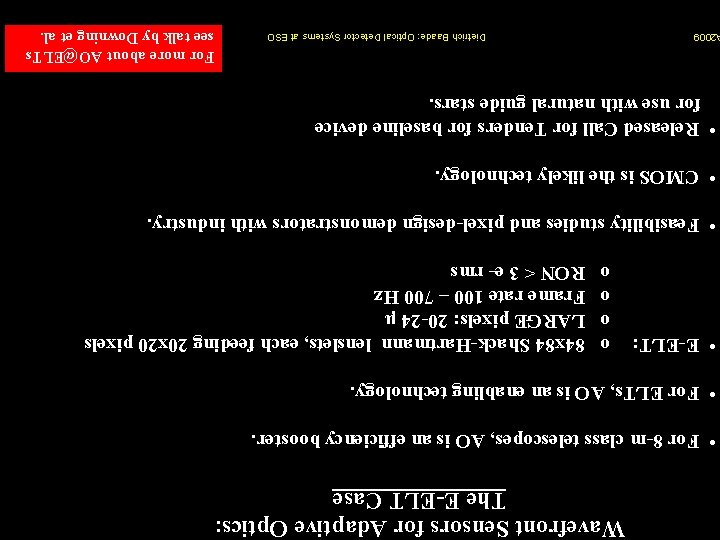
17 / 18 Wavefront Sensors for Adaptive Optics: The E-ELT Case • For 8 -m class telescopes, AO is an efficiency booster. • For ELTs, AO is an enabling technology. • E-ELT: o o 84 x 84 Shack-Hartmann lenslets, each feeding 20 x 20 pixels LARGE pixels: 20 -24 μ Frame rate 100 – 700 Hz RON < 3 e- rms • Feasibility studies and pixel-design demonstrators with industry. • CMOS is the likely technology. • Released Call for Tenders for baseline device for use with natural guide stars. 2009 Dietrich Baade: Optical Detector Systems at ESO For more about AO@ELTs see talk by Downing et al.
Summary of (Optical) Detector Trends @ ESO • Complexity of design and operation increasing • Growing volume of parameter space (speed, noise, stability, etc. ) • Multiple units – serial production • Much improved red QE with thicker devices • Future ESO detector systems based on NGC • Growing importance of signal sensing • CMOS technology making its way into optical astronomy • Df. A 2009 Dietrich Baade: Optical Detector Systems Photo: Stéphane Guisard (ESO)at ESO 18 / 18