
Optical Design of a Broadband IR Spectrometer Kiel

Optical Design of a Broadband IR Spectrometer Kiel Williams, With Julie Cass & Gilles Dongmo-Momo Mentor Josef Frisch 8/11/2011 Courtesy lightsources. org
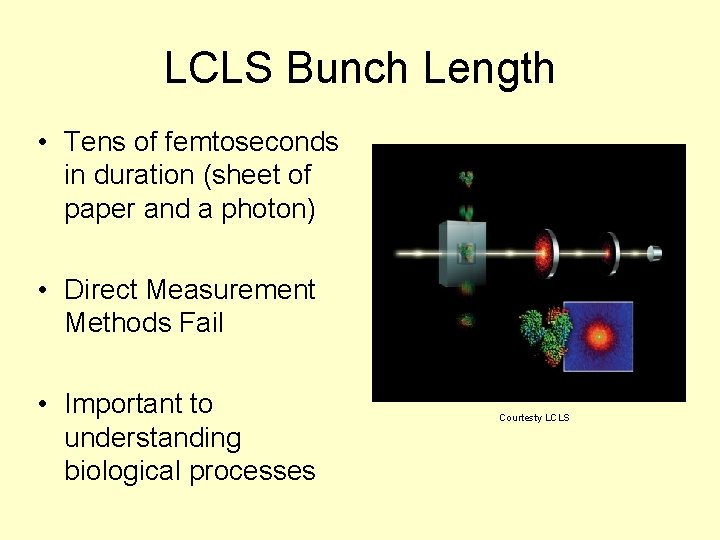
LCLS Bunch Length • Tens of femtoseconds in duration (sheet of paper and a photon) • Direct Measurement Methods Fail • Important to understanding biological processes Courtesty LCLS

Spectral Measurements • Optical Transition Radiation (OTR) produced by by bunches • Spectrum of OTR contains bunch length information • Primarily within IR spectrum Courtesy H. Loos
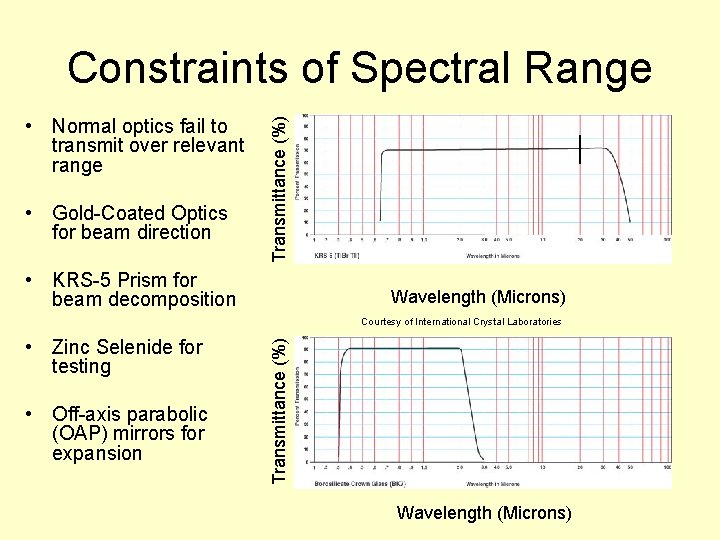
• Normal optics fail to transmit over relevant range • Gold-Coated Optics for beam direction Transmittance (%) Constraints of Spectral Range • KRS-5 Prism for beam decomposition Wavelength (Microns) • Zinc Selenide for testing • Off-axis parabolic (OAP) mirrors for expansion Transmittance (%) Courtesy of International Crystal Laboratories Wavelength (Microns)
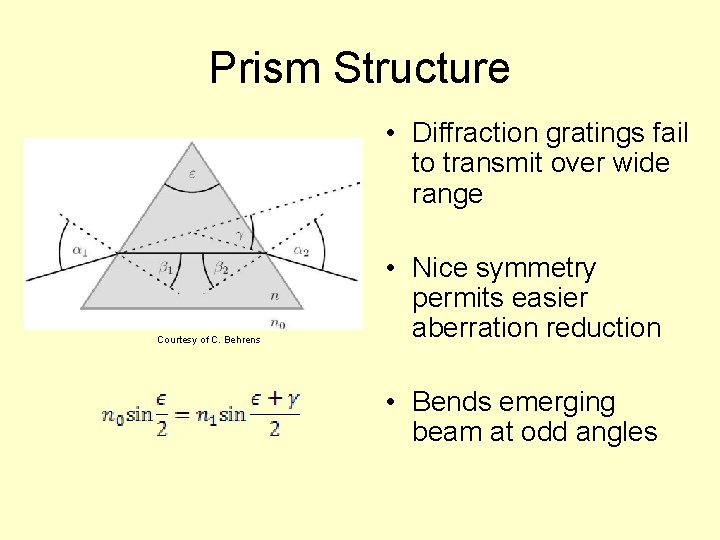
Prism Structure • Diffraction gratings fail to transmit over wide range Courtesy of C. Behrens • Nice symmetry permits easier aberration reduction • Bends emerging beam at odd angles
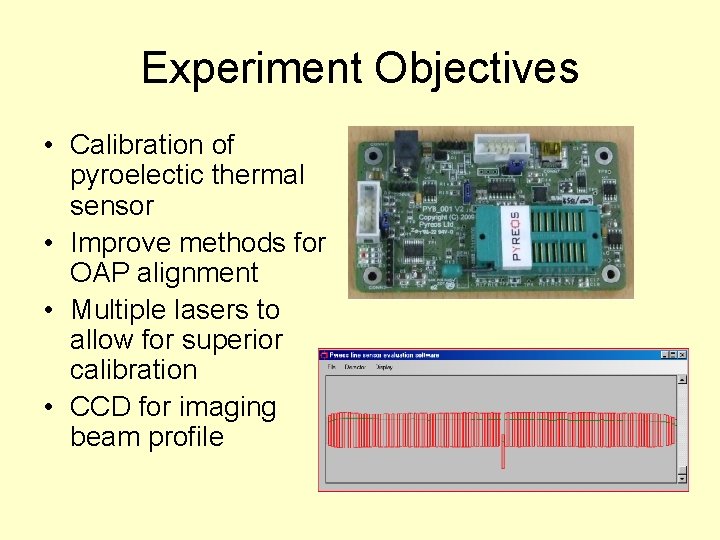
Experiment Objectives • Calibration of pyroelectic thermal sensor • Improve methods for OAP alignment • Multiple lasers to allow for superior calibration • CCD for imaging beam profile
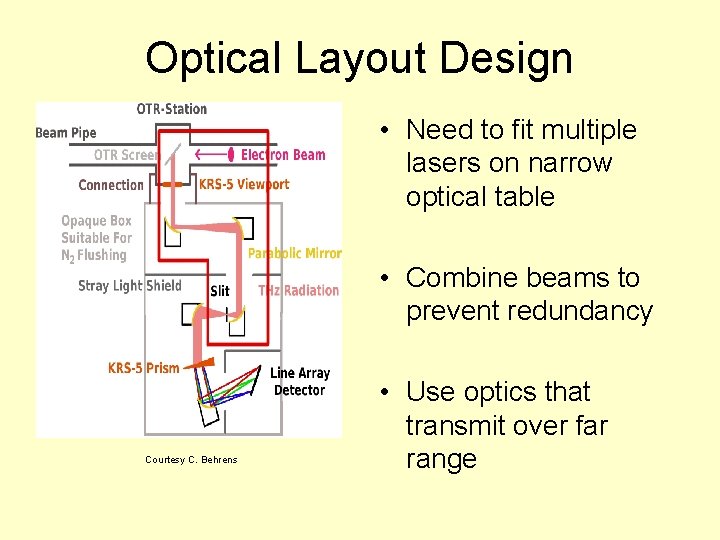
Optical Layout Design • Need to fit multiple lasers on narrow optical table • Combine beams to prevent redundancy Courtesy C. Behrens • Use optics that transmit over far range
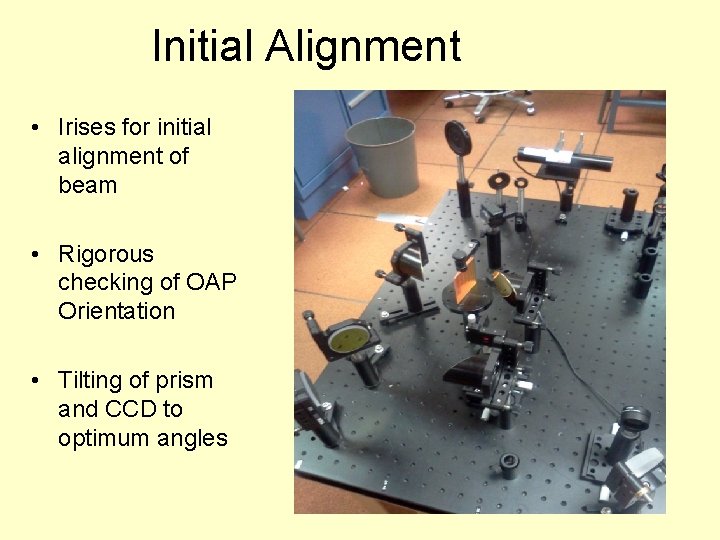
Initial Alignment • Irises for initial alignment of beam • Rigorous checking of OAP Orientation • Tilting of prism and CCD to optimum angles
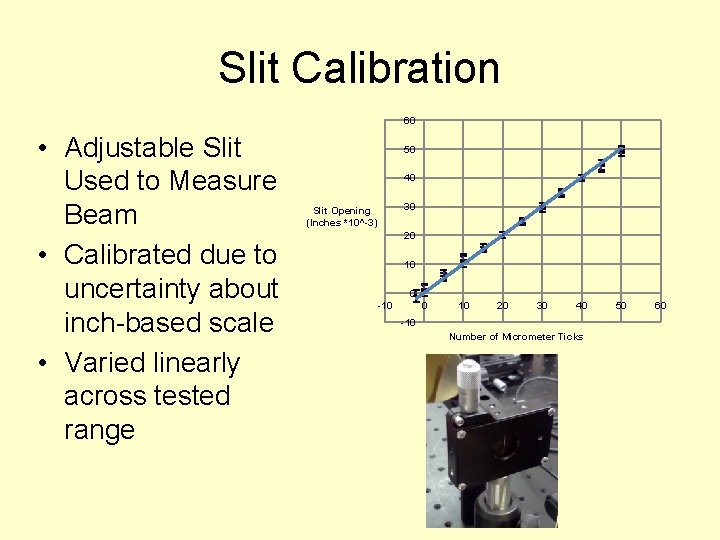
Slit Calibration 60 • Adjustable Slit Used to Measure Beam • Calibrated due to uncertainty about inch-based scale • Varied linearly across tested range 50 40 30 Slit Opening (Inches *10^-3) 20 10 0 -10 0 10 20 30 40 -10 Number of Micrometer Ticks 50 60
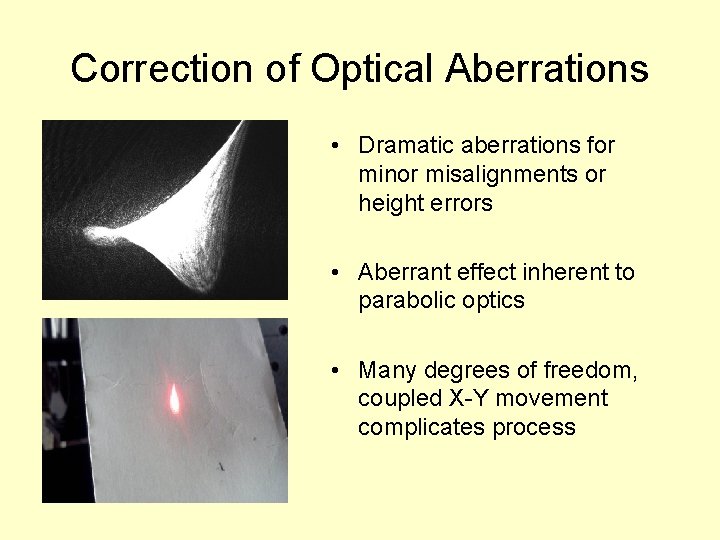
Correction of Optical Aberrations • Dramatic aberrations for minor misalignments or height errors • Aberrant effect inherent to parabolic optics • Many degrees of freedom, coupled X-Y movement complicates process
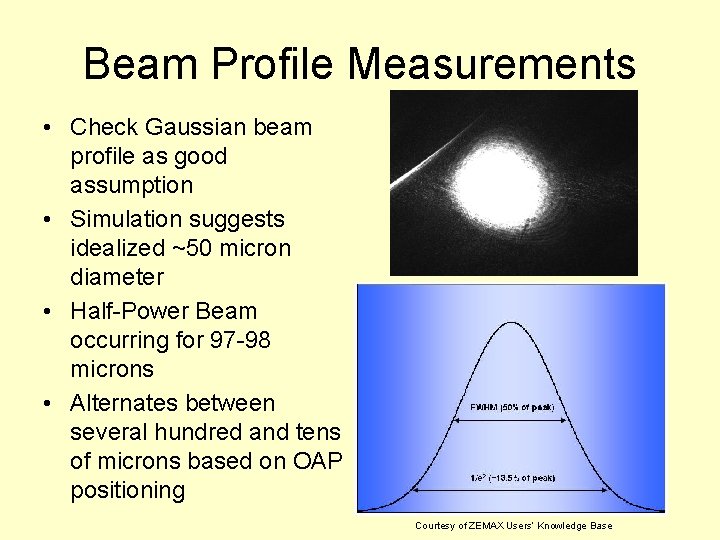
Beam Profile Measurements • Check Gaussian beam profile as good assumption • Simulation suggests idealized ~50 micron diameter • Half-Power Beam occurring for 97 -98 microns • Alternates between several hundred and tens of microns based on OAP positioning Courtesy of ZEMAX Users’ Knowledge Base
Results and Future Goals • Obtainment of thermal imaging for IR lasers • Integration of thermal sensor into system • More rigorous comparison to simulation

Acknowledgements • • • Many thanks to Mentor Josef Frisch Alan Fisher Mark Petree George Burgueno US Department of Energy

Questions?
- Slides: 14