
OPTICAL COMPONENTS 92011 Applications See notes Optical Devices

- Slides: 34
OPTICAL COMPONENTS 9/20/11
Applications • See notes
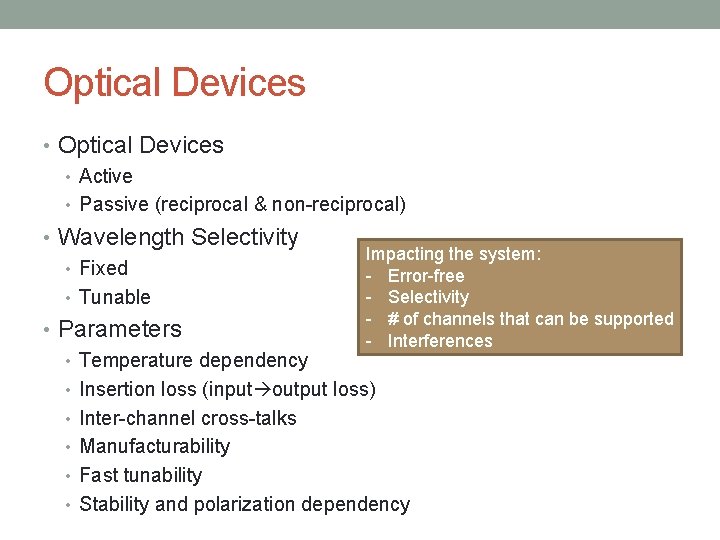
Optical Devices • Active • Passive (reciprocal & non-reciprocal) • Wavelength Selectivity • Fixed • Tunable Impacting the system: - Error-free - Selectivity - # of channels that can be supported - Interferences • Parameters • Temperature dependency • Insertion loss (input output loss) • Inter-channel cross-talks • Manufacturability • Fast tunability • Stability and polarization dependency
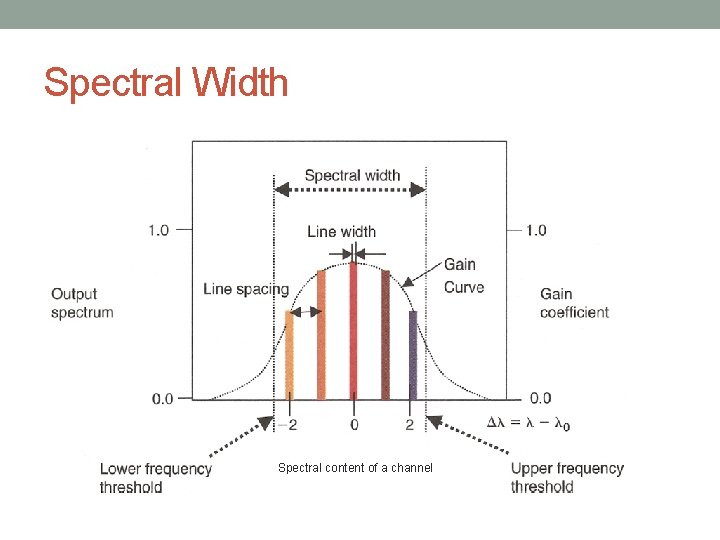
Spectral Width Spectral content of a channel
Passive Devices • Reciprocal (input/outputs act the same way) • Couplers • Half-wavelength plates • Non-reciprocal • Circulators • Rotators • Insulators
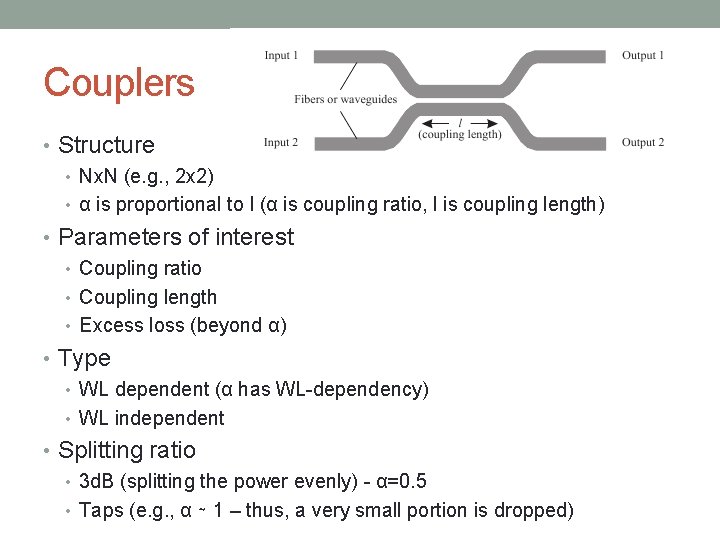
Couplers • Structure • Nx. N (e. g. , 2 x 2) • α is proportional to l (α is coupling ratio, l is coupling length) • Parameters of interest • Coupling ratio • Coupling length • Excess loss (beyond α) • Type • WL dependent (α has WL-dependency) • WL independent • Splitting ratio • 3 d. B (splitting the power evenly) - α=0. 5 • Taps (e. g. , α ∼ 1 – thus, a very small portion is dropped)
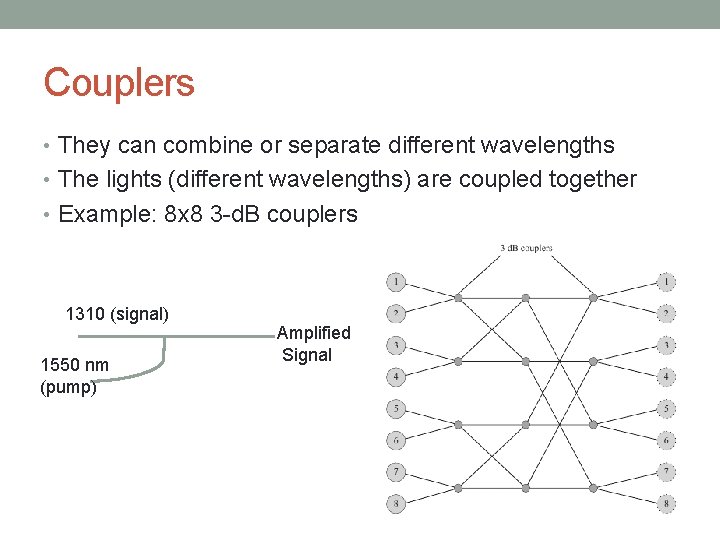
Couplers • They can combine or separate different wavelengths • The lights (different wavelengths) are coupled together • Example: 8 x 8 3 -d. B couplers 1310 (signal) 1550 nm (pump) Amplified Signal
Half-Wavelength Plates • Passive reciprocal devices • They maintain the polarization but rotate the orientation of polarization is rotated by by ΔΦ=2πR; (R=+/-0. 25 for λ/4) • Note d= Rλ/Δn; d is the thickness of the birefringent plate – assuming mica or quartz plate
Passive Non-Reciprocal Devices • Types • Isolators • Faraday Rotators • Circulators
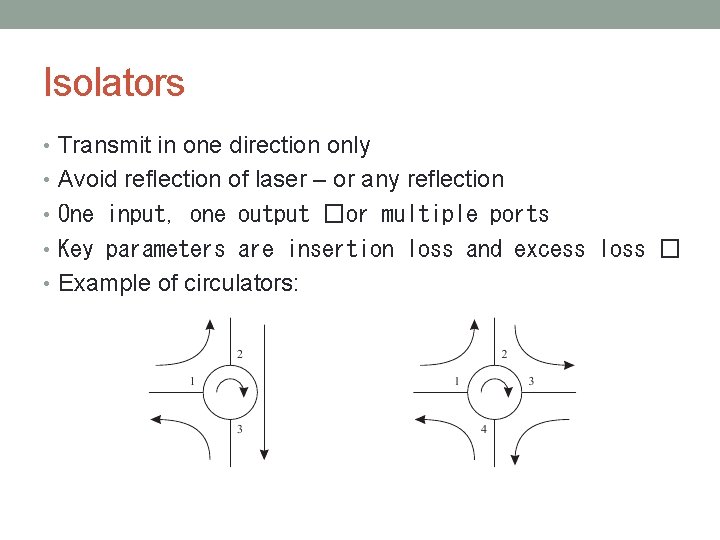
Isolators • Transmit in one direction only • Avoid reflection of laser – or any reflection • One input, one output �or multiple ports • Key parameters are insertion loss and excess loss � • Example of circulators:
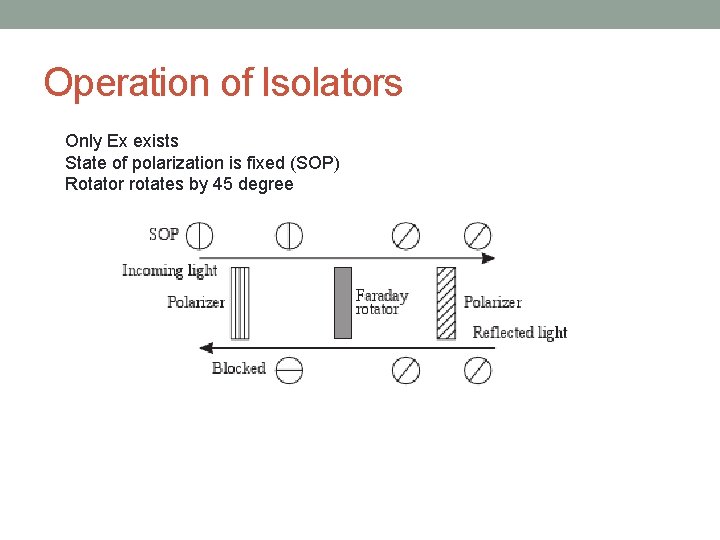
Operation of Isolators Only Ex exists State of polarization is fixed (SOP) Rotator rotates by 45 degree
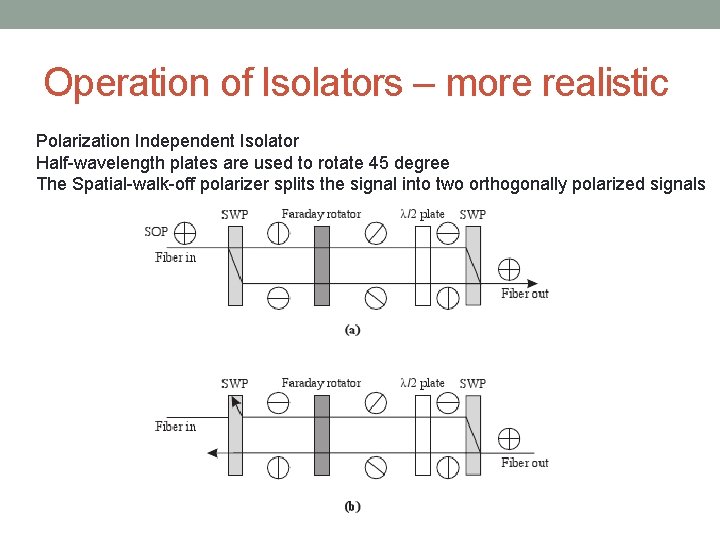
Operation of Isolators – more realistic Polarization Independent Isolator Half-wavelength plates are used to rotate 45 degree The Spatial-walk-off polarizer splits the signal into two orthogonally polarized signals
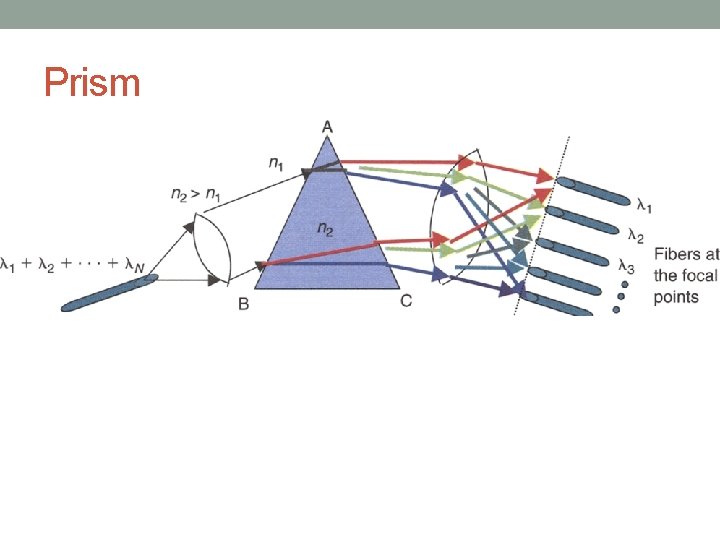
Prism
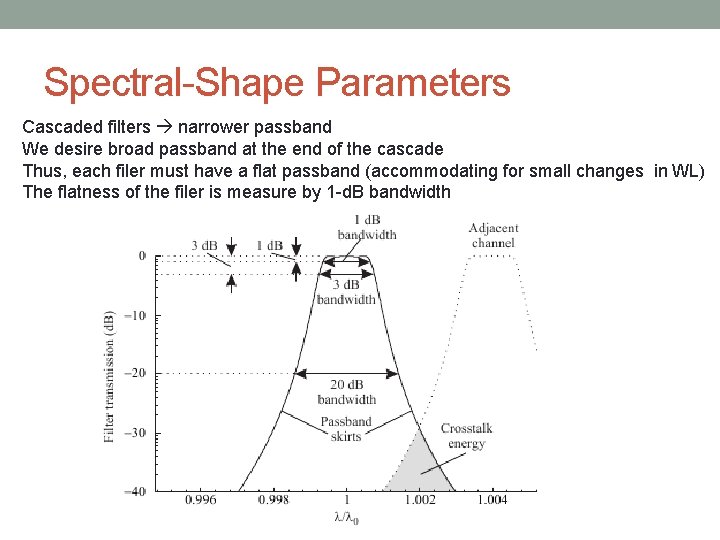
Spectral-Shape Parameters Cascaded filters narrower passband We desire broad passband at the end of the cascade Thus, each filer must have a flat passband (accommodating for small changes in WL) The flatness of the filer is measure by 1 -d. B bandwidth
Components
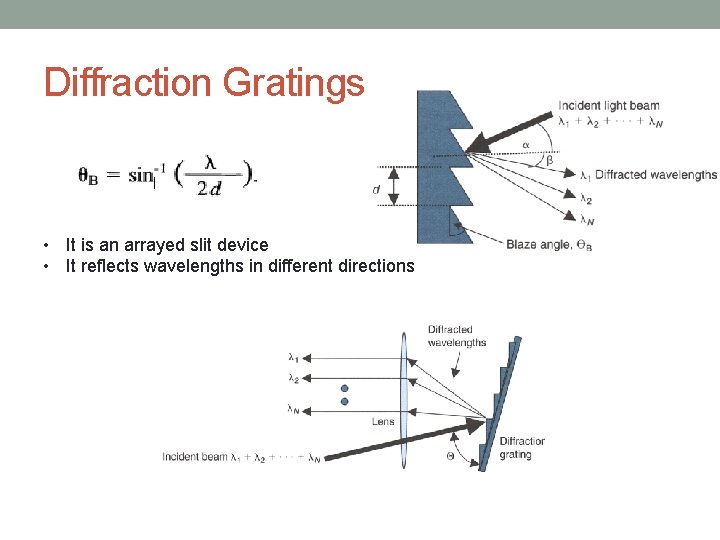
Gratings • Describe a device involving interference among multiple optical signals coming from the same source but having difference phase shift • There a number of gratings • Reflective • Transmission • Diffraction • Stimax (same as reflection but integrate with concave mirrors
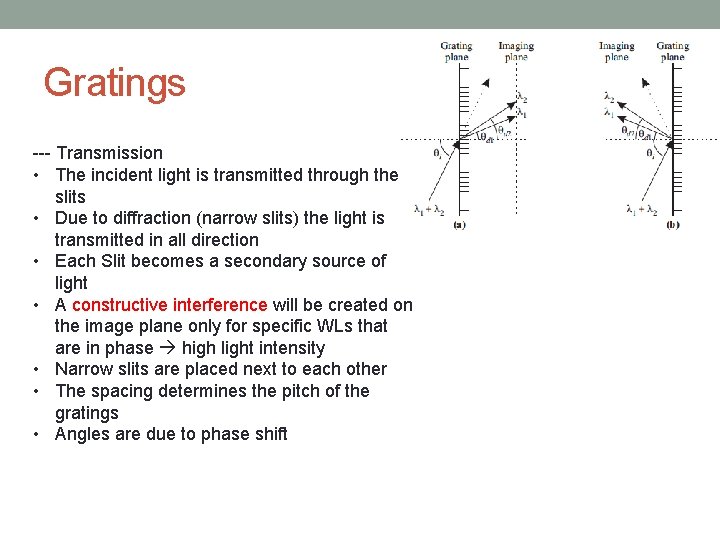
Gratings --- Transmission • The incident light is transmitted through the slits • Due to diffraction (narrow slits) the light is transmitted in all direction • Each Slit becomes a secondary source of light • A constructive interference will be created on the image plane only for specific WLs that are in phase high light intensity • Narrow slits are placed next to each other • The spacing determines the pitch of the gratings • Angles are due to phase shift
Diffraction Gratings • It is an arrayed slit device • It reflects wavelengths in different directions
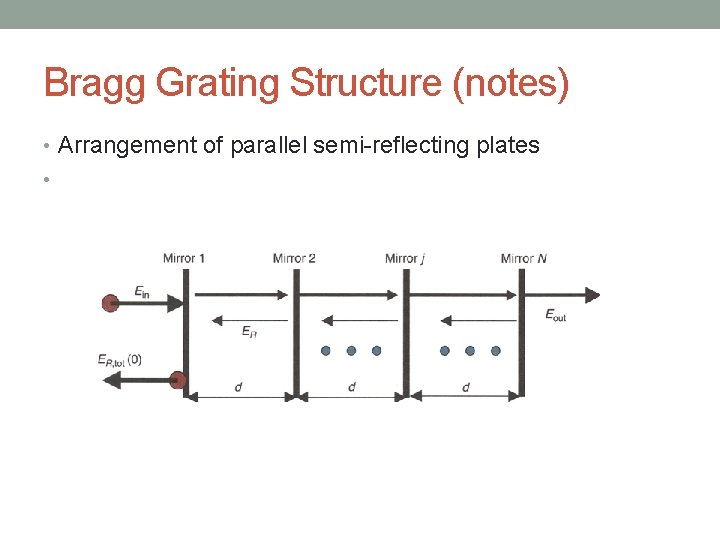
Bragg Grating Structure (notes) • Arrangement of parallel semi-reflecting plates •
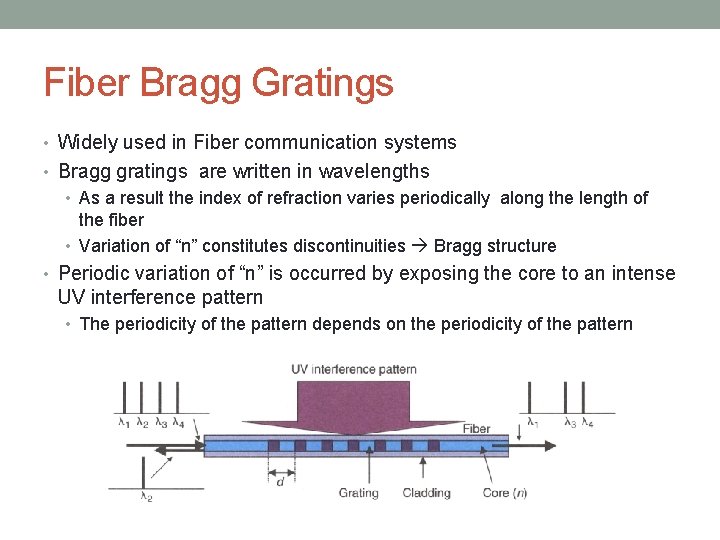
Fiber Bragg Gratings • Widely used in Fiber communication systems • Bragg gratings are written in wavelengths • As a result the index of refraction varies periodically along the length of the fiber • Variation of “n” constitutes discontinuities Bragg structure • Periodic variation of “n” is occurred by exposing the core to an intense UV interference pattern • The periodicity of the pattern depends on the periodicity of the pattern
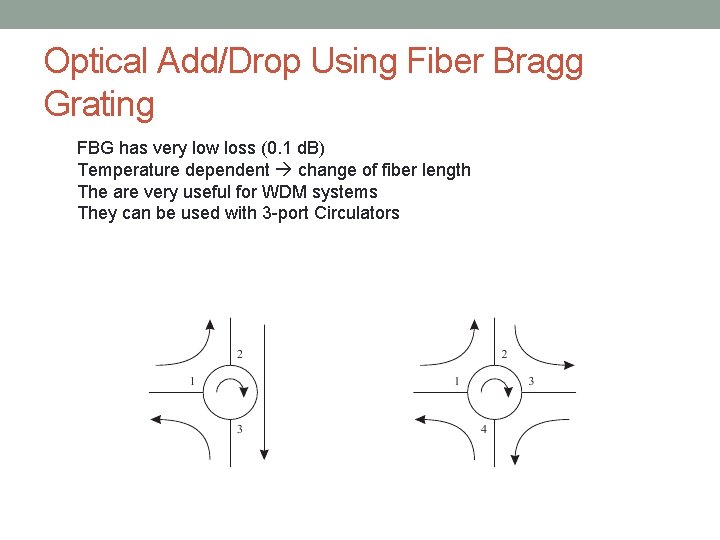
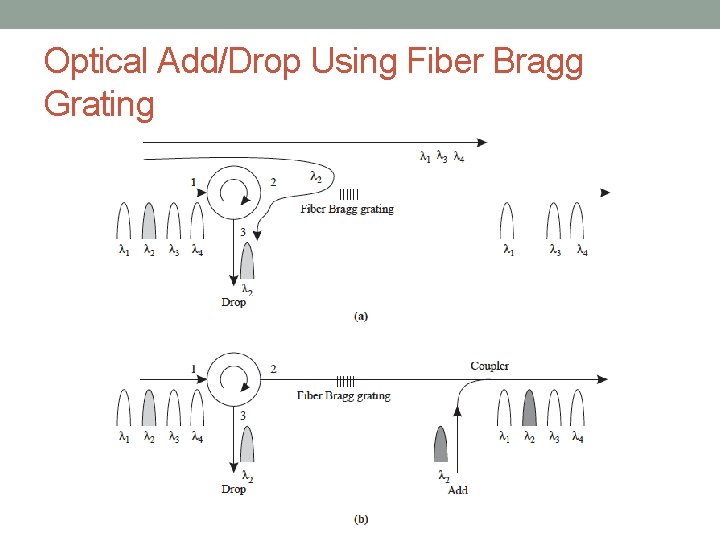
Optical Add/Drop Using Fiber Bragg Grating FBG has very low loss (0. 1 d. B) Temperature dependent change of fiber length The are very useful for WDM systems They can be used with 3 -port Circulators
Optical Add/Drop Using Fiber Bragg Grating
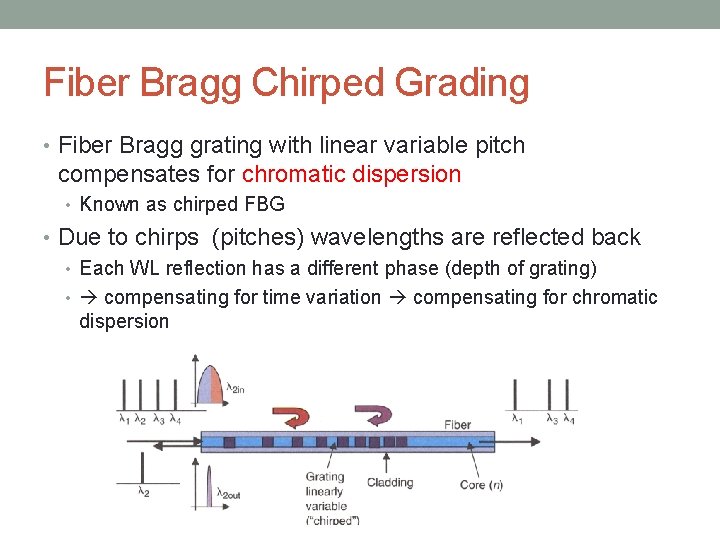
Fiber Bragg Chirped Grading • Fiber Bragg grating with linear variable pitch compensates for chromatic dispersion • Known as chirped FBG • Due to chirps (pitches) wavelengths are reflected back • Each WL reflection has a different phase (depth of grating) • compensating for time variation compensating for chromatic dispersion
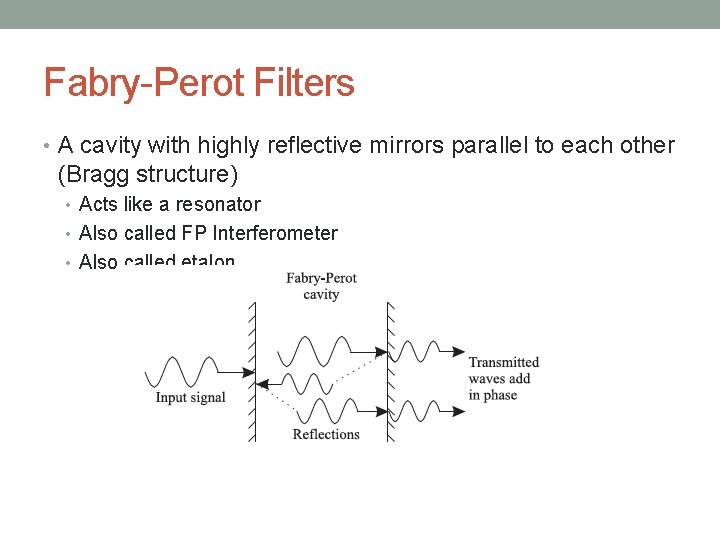
Fabry-Perot Filters • A cavity with highly reflective mirrors parallel to each other (Bragg structure) • Acts like a resonator • Also called FP Interferometer • Also called etalon
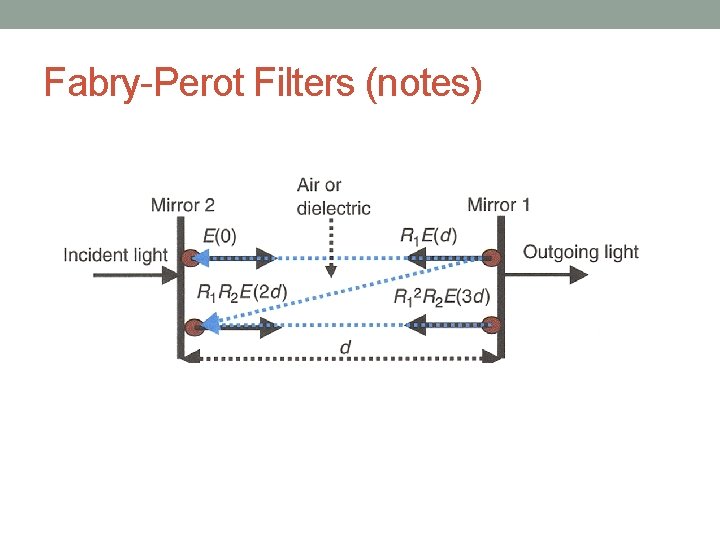
Fabry-Perot Filters (notes)
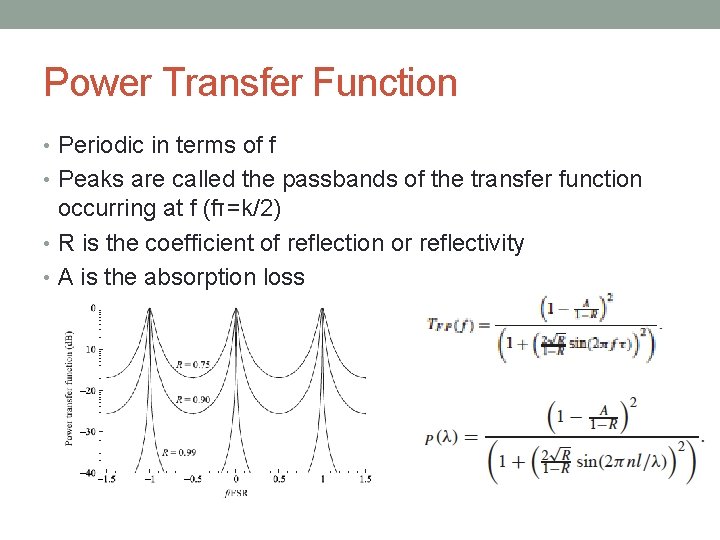
Power Transfer Function • Periodic in terms of f • Peaks are called the passbands of the transfer function occurring at f (fτ=k/2) • R is the coefficient of reflection or reflectivity • A is the absorption loss
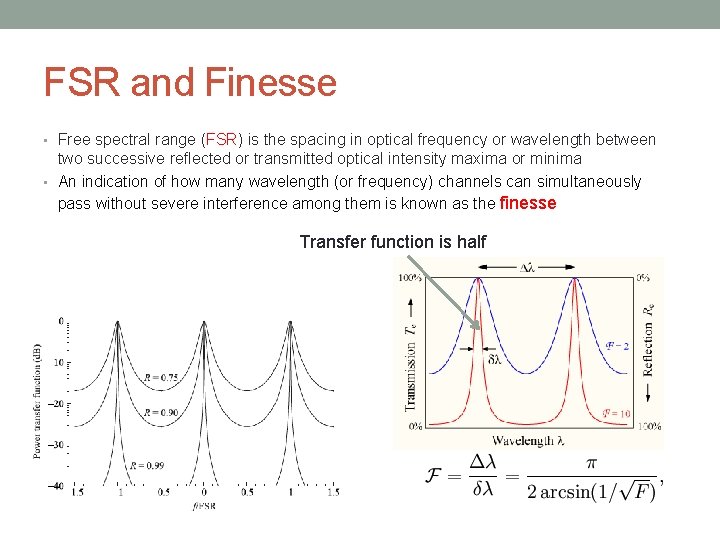
FSR and Finesse • Free spectral range (FSR) is the spacing in optical frequency or wavelength between two successive reflected or transmitted optical intensity maxima or minima • An indication of how many wavelength (or frequency) channels can simultaneously pass without severe interference among them is known as the finesse Transfer function is half
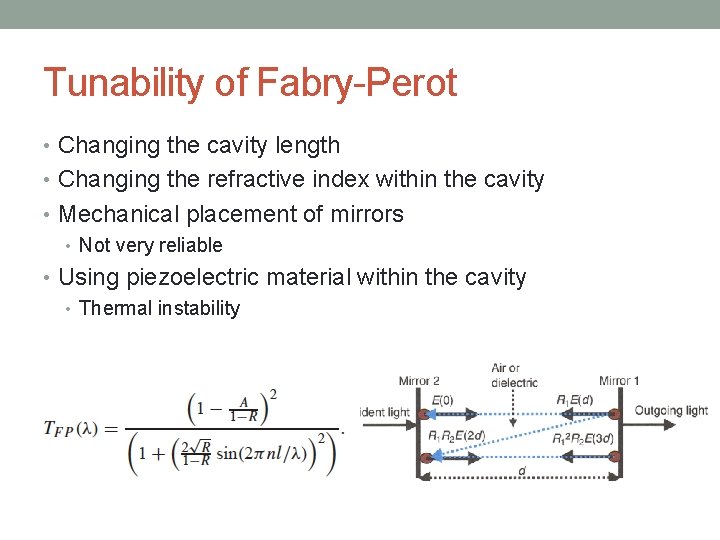
Tunability of Fabry-Perot • Changing the cavity length • Changing the refractive index within the cavity • Mechanical placement of mirrors • Not very reliable • Using piezoelectric material within the cavity • Thermal instability
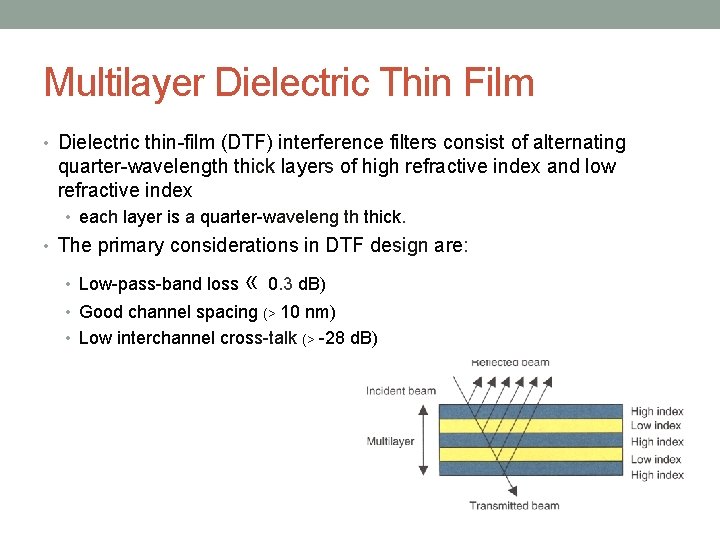
Multilayer Dielectric Thin Film • Dielectric thin-film (DTF) interference filters consist of alternating quarter-wavelength thick layers of high refractive index and low refractive index • each layer is a quarter-waveleng th thick. • The primary considerations in DTF design are: • Low-pass-band loss « 0. 3 d. B) • Good channel spacing (> 10 nm) • Low interchannel cross-talk (> -28 d. B)
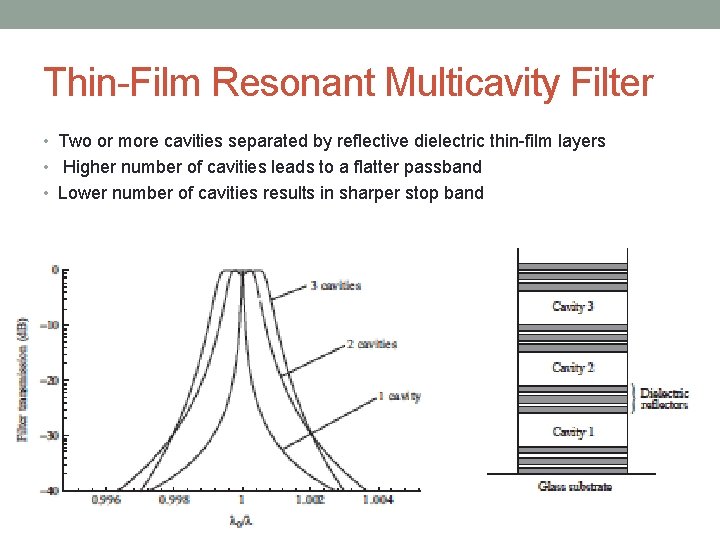
Thin-Film Resonant Multicavity Filter • Two or more cavities separated by reflective dielectric thin-film layers • Higher number of cavities leads to a flatter passband • Lower number of cavities results in sharper stop band
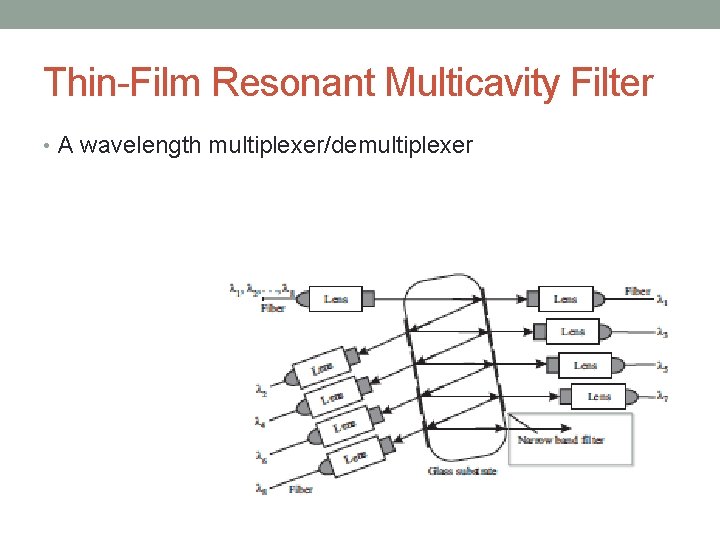
Thin-Film Resonant Multicavity Filter • A wavelength multiplexer/demultiplexer
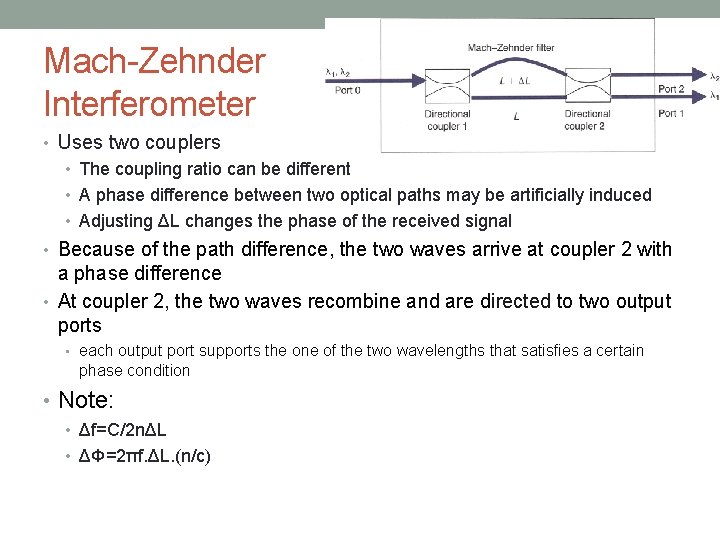
Mach-Zehnder Interferometer • Uses two couplers • The coupling ratio can be different • A phase difference between two optical paths may be artificially induced • Adjusting ΔL changes the phase of the received signal • Because of the path difference, the two waves arrive at coupler 2 with a phase difference • At coupler 2, the two waves recombine and are directed to two output ports • each output port supports the one of the two wavelengths that satisfies a certain phase condition • Note: • Δf=C/2 nΔL • ΔΦ=2πf. ΔL. (n/c)
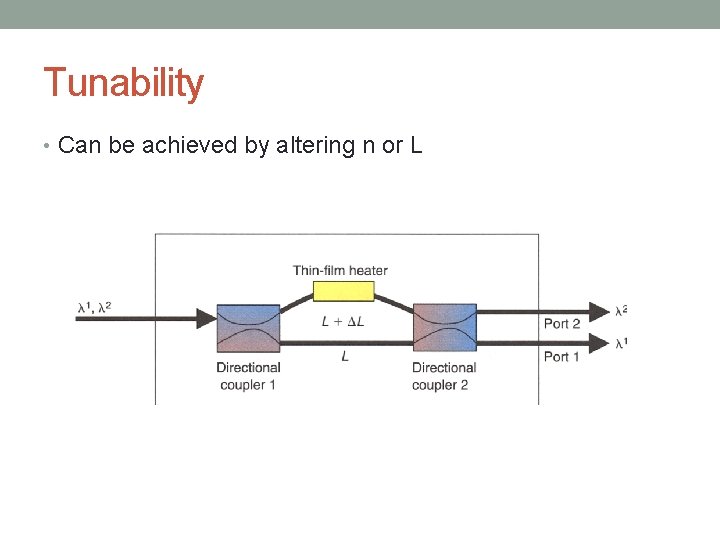
Tunability • Can be achieved by altering n or L
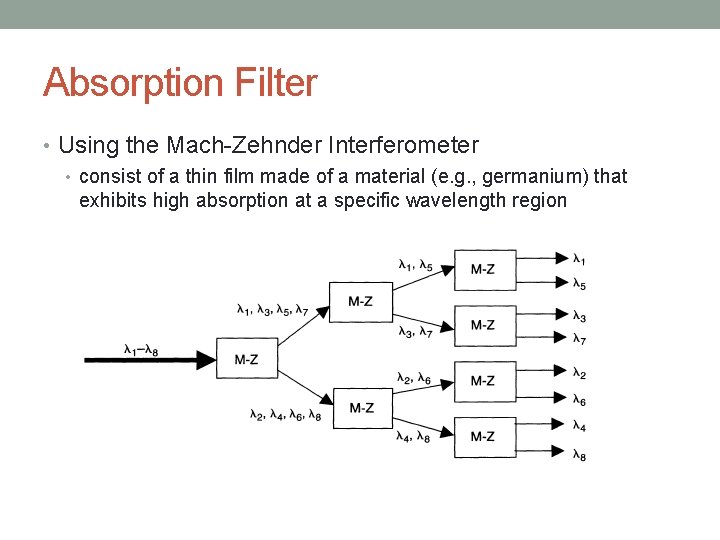
Absorption Filter • Using the Mach-Zehnder Interferometer • consist of a thin film made of a material (e. g. , germanium) that exhibits high absorption at a specific wavelength region