
Optical Coating Development for the Advanced LIGO Gravitational
- Slides: 30
Optical Coating Development for the Advanced LIGO Gravitational Wave Antennas Gregory Harry LIGO/MIT - On Behalf of the Coating Working Group University of Sannio at Benevento October 9, 2006 Benevento, Italy LIGO-G 060506 -00 -R
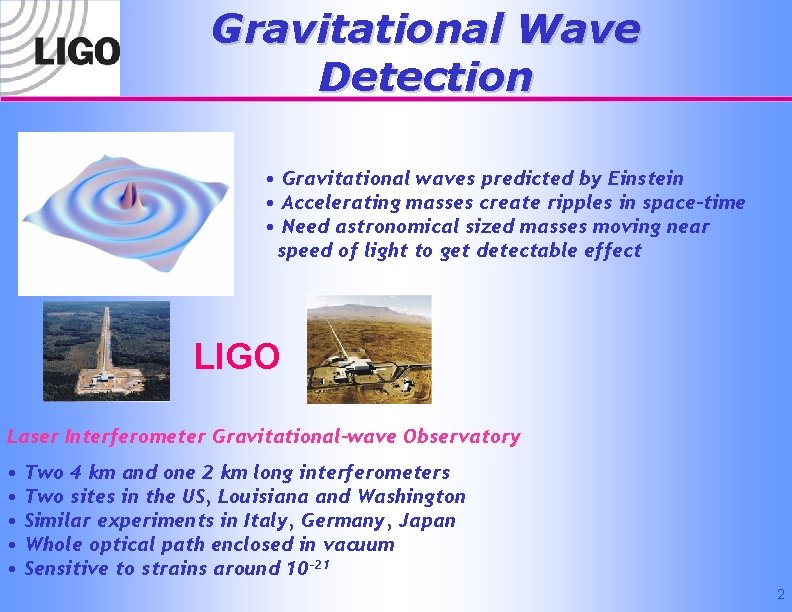
Gravitational Wave Detection • Gravitational waves predicted by Einstein • Accelerating masses create ripples in space-time • Need astronomical sized masses moving near speed of light to get detectable effect LIGO Laser Interferometer Gravitational-wave Observatory • Two 4 km and one 2 km long interferometers • Two sites in the US, Louisiana and Washington • Similar experiments in Italy, Germany, Japan • Whole optical path enclosed in vacuum • Sensitive to strains around 10 -21 2
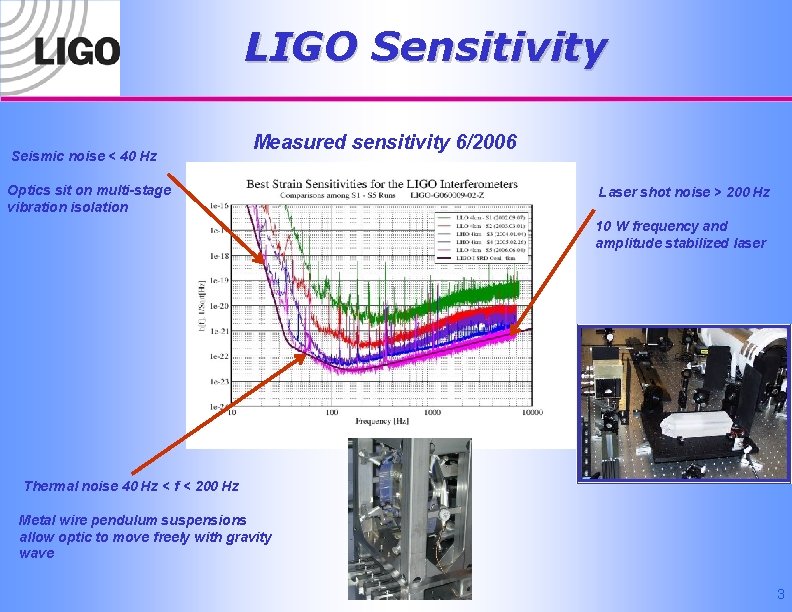
LIGO Sensitivity Seismic noise < 40 Hz Measured sensitivity 6/2006 Optics sit on multi-stage vibration isolation Laser shot noise > 200 Hz 10 W frequency and amplitude stabilized laser Thermal noise 40 Hz < f < 200 Hz Metal wire pendulum suspensions allow optic to move freely with gravity wave 3
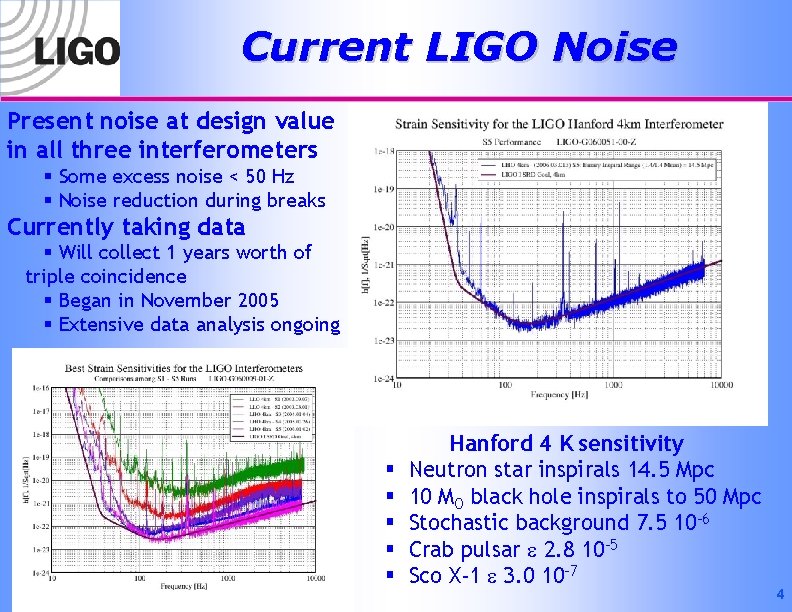
Current LIGO Noise Present noise at design value in all three interferometers § Some excess noise < 50 Hz § Noise reduction during breaks Currently taking data § Will collect 1 years worth of triple coincidence § Began in November 2005 § Extensive data analysis ongoing § § § Hanford 4 K sensitivity Neutron star inspirals 14. 5 Mpc 10 MO black hole inspirals to 50 Mpc Stochastic background 7. 5 10 -6 Crab pulsar e 2. 8 10 -5 Sco X-1 e 3. 0 10 -7 4
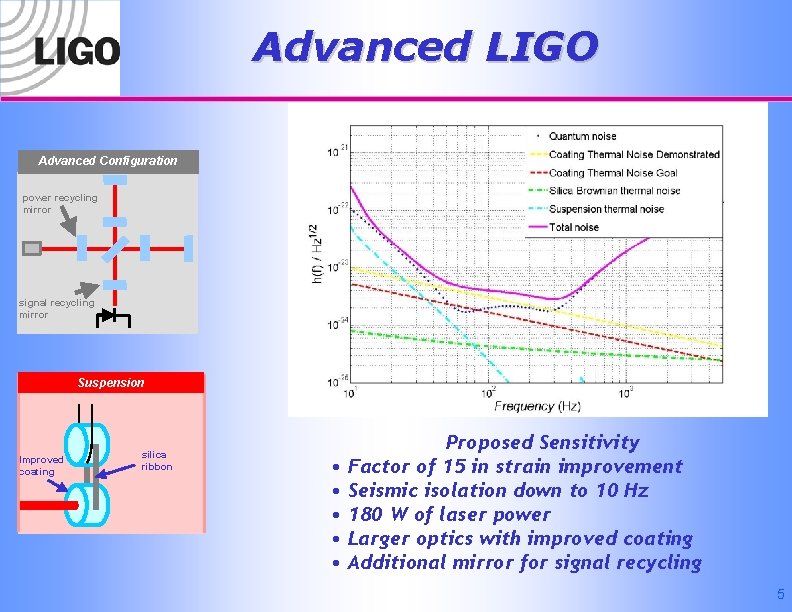
Advanced LIGO Advanced Configuration power recycling mirror signal recycling mirror Suspension Improved coating silica ribbon • • • Proposed Sensitivity Factor of 15 in strain improvement Seismic isolation down to 10 Hz 180 W of laser power Larger optics with improved coating Additional mirror for signal recycling 5
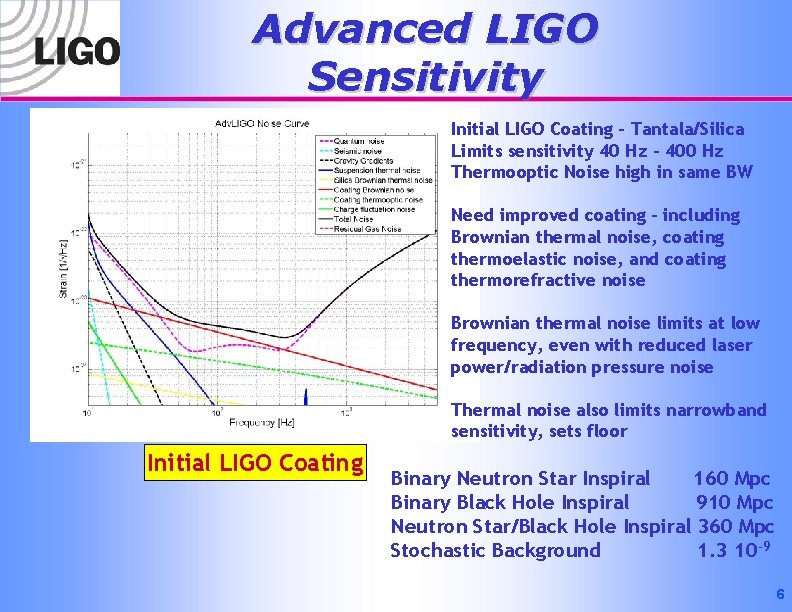
Advanced LIGO Sensitivity Initial LIGO Coating – Tantala/Silica Limits sensitivity 40 Hz – 400 Hz Thermooptic Noise high in same BW Need improved coating – including Brownian thermal noise, coating thermoelastic noise, and coating thermorefractive noise Brownian thermal noise limits at low frequency, even with reduced laser power/radiation pressure noise Thermal noise also limits narrowband sensitivity, sets floor Initial LIGO Coating Binary Neutron Star Inspiral 160 Mpc Binary Black Hole Inspiral 910 Mpc Neutron Star/Black Hole Inspiral 360 Mpc Stochastic Background 1. 3 10 -9 6
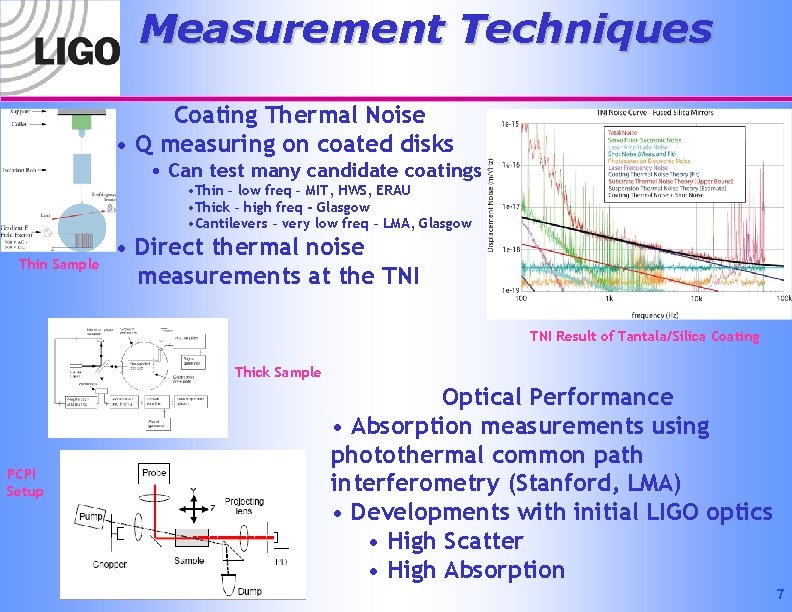
Measurement Techniques Coating Thermal Noise • Q measuring on coated disks • Can test many candidate coatings • Thin – low freq – MIT, HWS, ERAU • Thick – high freq - Glasgow • Cantilevers – very low freq – LMA, Glasgow Thin Sample • Direct thermal noise measurements at the TNI Result of Tantala/Silica Coating Thick Sample PCPI Setup Optical Performance • Absorption measurements using photothermal common path interferometry (Stanford, LMA) • Developments with initial LIGO optics • High Scatter • High Absorption 7
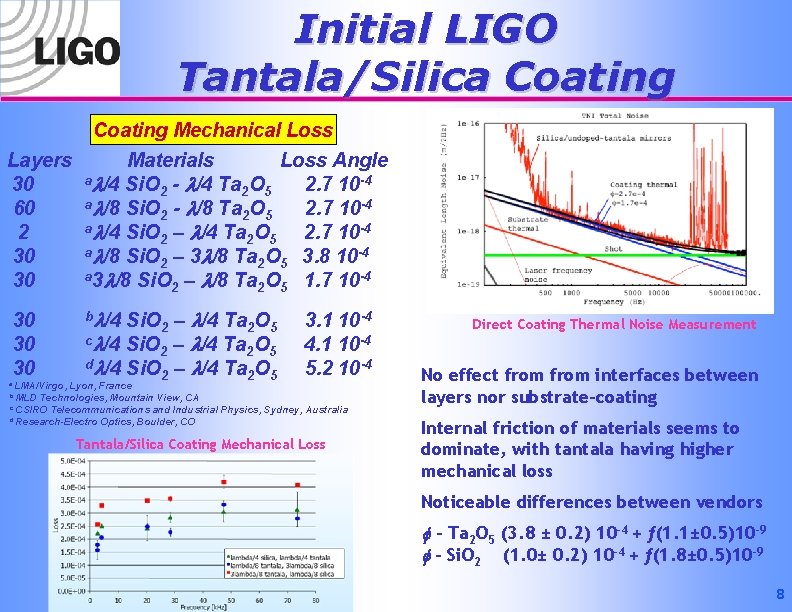
Initial LIGO Tantala/Silica Coating Mechanical Loss Layers Materials Loss Angle al/4 Si. O - l/4 Ta O 30 2. 7 10 -4 2 2 5 al/8 Si. O - l/8 Ta O 60 2. 7 10 -4 2 2 5 al/4 Si. O – l/4 Ta O 2 2. 7 10 -4 2 2 5 al/8 Si. O – 3 l/8 Ta O -4 30 2 2 5 3. 8 10 a 3 l/8 Si. O – l/8 Ta O -4 30 2 2 5 1. 7 10 30 30 30 a LMA/Virgo, l/4 Si. O 2 – l/4 Ta 2 O 5 cl/4 Si. O – l/4 Ta O 2 2 5 dl/4 Si. O – l/4 Ta O 2 2 5 b 3. 1 10 -4 4. 1 10 -4 5. 2 10 -4 Lyon, France b MLD Technologies, Mountain View, CA c CSIRO Telecommunications and Industrial Physics, Sydney, Australia d Research-Electro Optics, Boulder, CO Tantala/Silica Coating Mechanical Loss Direct Coating Thermal Noise Measurement No effect from interfaces between layers nor substrate-coating Internal friction of materials seems to dominate, with tantala having higher mechanical loss Noticeable differences between vendors f – Ta 2 O 5 (3. 8 ± 0. 2) 10 -4 + f(1. 1± 0. 5)10 -9 f – Si. O 2 (1. 0± 0. 2) 10 -4 + f(1. 8± 0. 5)10 -9 8
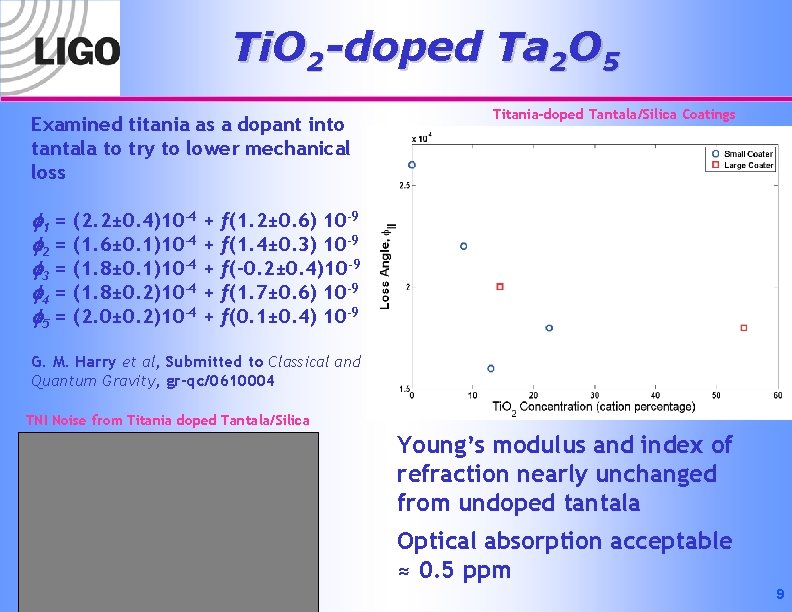
Ti. O 2 -doped Ta 2 O 5 Examined titania as a dopant into tantala to try to lower mechanical loss Titania-doped Tantala/Silica Coatings f 1 = (2. 2± 0. 4)10 -4 + f(1. 2± 0. 6) 10 -9 f 2 = (1. 6± 0. 1)10 -4 + f(1. 4± 0. 3) 10 -9 f 3 = (1. 8± 0. 1)10 -4 + f(-0. 2± 0. 4)10 -9 f 4 = (1. 8± 0. 2)10 -4 + f(1. 7± 0. 6) 10 -9 f 5 = (2. 0± 0. 2)10 -4 + f(0. 1± 0. 4) 10 -9 G. M. Harry et al, Submitted to Classical and Quantum Gravity, gr-qc/0610004 TNI Noise from Titania doped Tantala/Silica Young’s modulus and index of refraction nearly unchanged from undoped tantala Optical absorption acceptable ≈ 0. 5 ppm 9
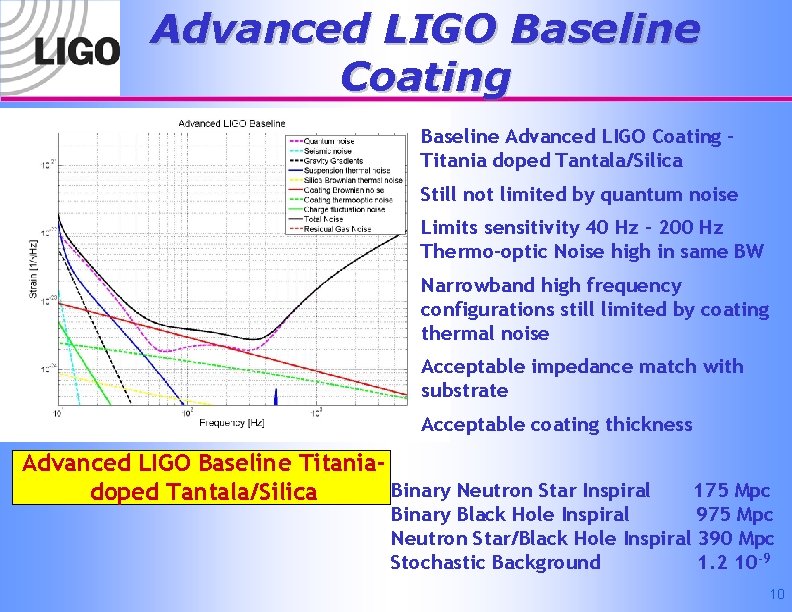
Advanced LIGO Baseline Coating Baseline Advanced LIGO Coating – Titania doped Tantala/Silica Still not limited by quantum noise Limits sensitivity 40 Hz – 200 Hz Thermo-optic Noise high in same BW Narrowband high frequency configurations still limited by coating thermal noise Acceptable impedance match with substrate Acceptable coating thickness Advanced LIGO Baseline Titania. Binary Neutron Star Inspiral doped Tantala/Silica 175 Mpc Binary Black Hole Inspiral 975 Mpc Neutron Star/Black Hole Inspiral 390 Mpc Stochastic Background 1. 2 10 -9 10
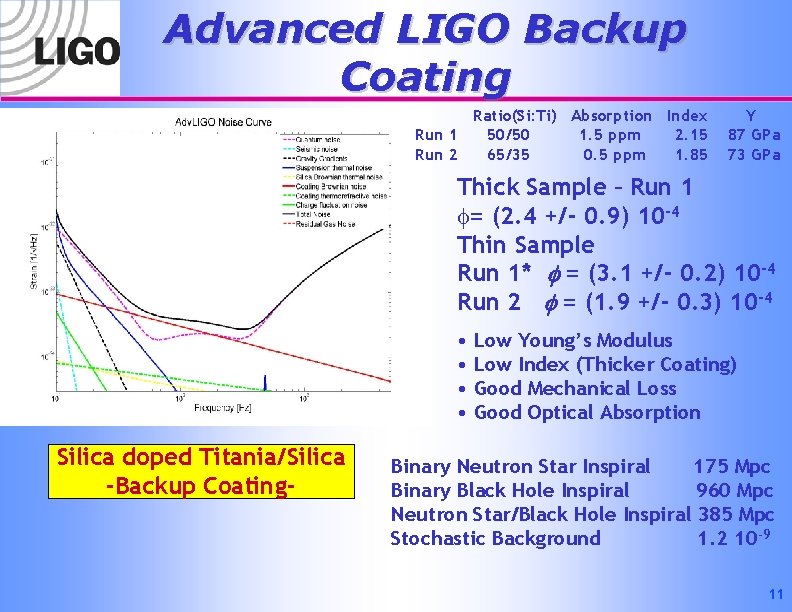
Advanced LIGO Backup Coating Ratio(Si: Ti) Absorption Index Run 1 50/50 1. 5 ppm 2. 15 Run 2 65/35 0. 5 ppm 1. 85 Y 87 GPa 73 GPa Thick Sample – Run 1 f= (2. 4 +/- 0. 9) 10 -4 Thin Sample Run 1* f = (3. 1 +/- 0. 2) 10 -4 Run 2 f = (1. 9 +/- 0. 3) 10 -4 • Low Young’s Modulus • Low Index (Thicker Coating) • Good Mechanical Loss • Good Optical Absorption Silica doped Titania/Silica -Backup Coating- Binary Neutron Star Inspiral 175 Mpc Binary Black Hole Inspiral 960 Mpc Neutron Star/Black Hole Inspiral 385 Mpc Stochastic Background 1. 2 10 -9 11
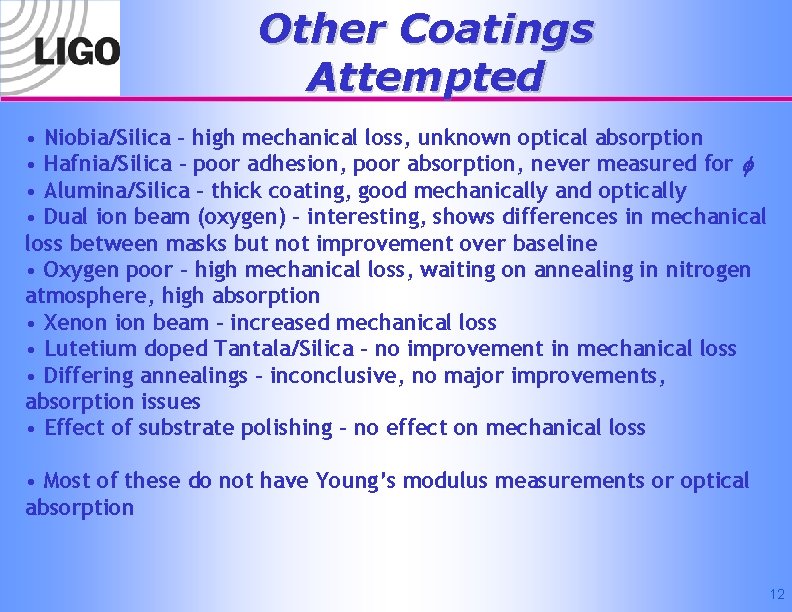
Other Coatings Attempted • Niobia/Silica – high mechanical loss, unknown optical absorption • Hafnia/Silica – poor adhesion, poor absorption, never measured for f • Alumina/Silica – thick coating, good mechanically and optically • Dual ion beam (oxygen) – interesting, shows differences in mechanical loss between masks but not improvement over baseline • Oxygen poor – high mechanical loss, waiting on annealing in nitrogen atmosphere, high absorption • Xenon ion beam – increased mechanical loss • Lutetium doped Tantala/Silica – no improvement in mechanical loss • Differing annealings – inconclusive, no major improvements, absorption issues • Effect of substrate polishing – no effect on mechanical loss • Most of these do not have Young’s modulus measurements or optical absorption 12
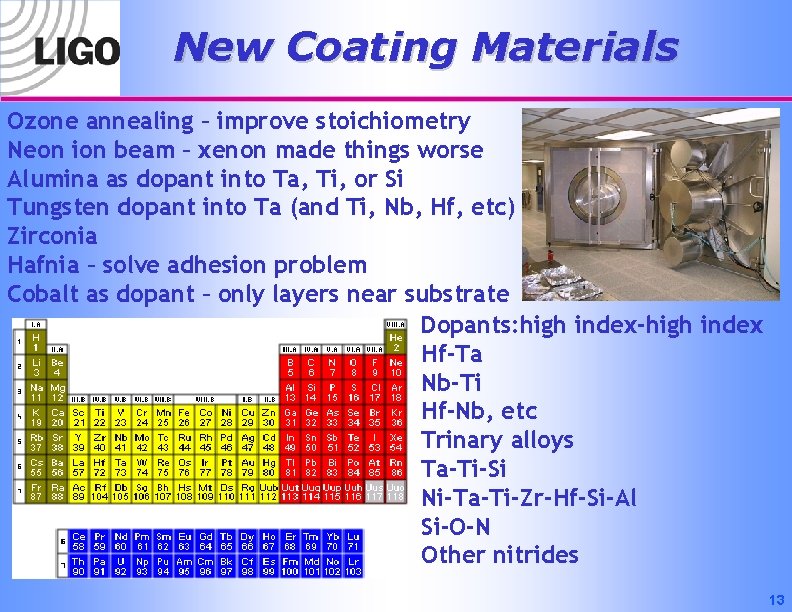
New Coating Materials Ozone annealing – improve stoichiometry Neon ion beam – xenon made things worse Alumina as dopant into Ta, Ti, or Si Tungsten dopant into Ta (and Ti, Nb, Hf, etc) Zirconia Hafnia – solve adhesion problem Cobalt as dopant – only layers near substrate Dopants: high index-high index Hf-Ta Nb-Ti Hf-Nb, etc Trinary alloys Ta-Ti-Si Ni-Ta-Ti-Zr-Hf-Si-Al Si-O-N Other nitrides 13
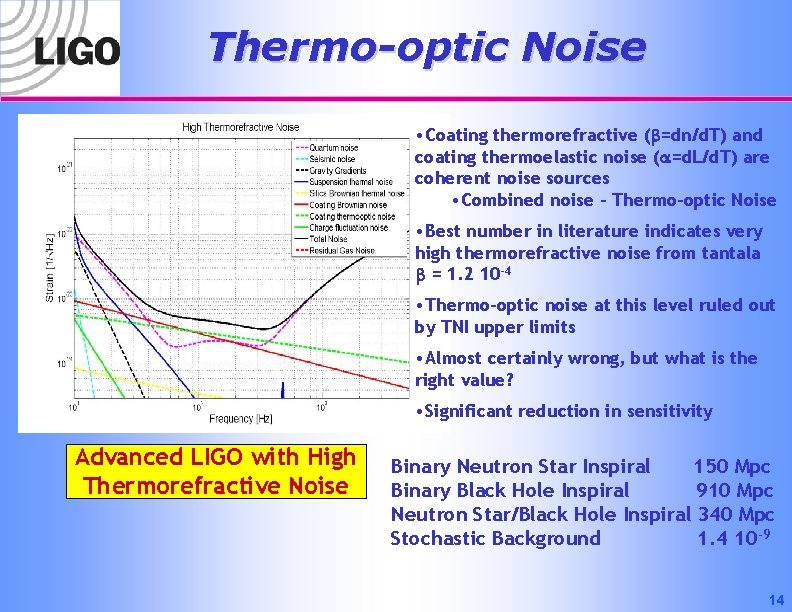
Thermo-optic Noise • Coating thermorefractive (b=dn/d. T) and coating thermoelastic noise (a=d. L/d. T) are coherent noise sources • Combined noise – Thermo-optic Noise • Best number in literature indicates very high thermorefractive noise from tantala b = 1. 2 10 -4 • Thermo-optic noise at this level ruled out by TNI upper limits • Almost certainly wrong, but what is the right value? • Significant reduction in sensitivity Advanced LIGO with High Thermorefractive Noise Binary Neutron Star Inspiral 150 Mpc Binary Black Hole Inspiral 910 Mpc Neutron Star/Black Hole Inspiral 340 Mpc Stochastic Background 1. 4 10 -9 14
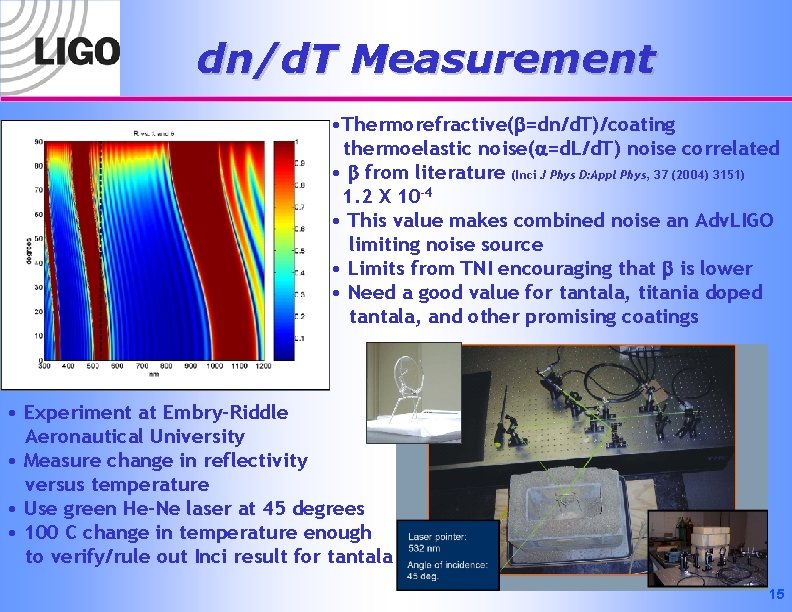
dn/d. T Measurement • Thermorefractive(b=dn/d. T)/coating thermoelastic noise(a=d. L/d. T) noise correlated • b from literature (Inci J Phys D: Appl Phys, 37 (2004) 3151) 1. 2 X 10 -4 • This value makes combined noise an Adv. LIGO limiting noise source • Limits from TNI encouraging that b is lower • Need a good value for tantala, titania doped tantala, and other promising coatings • Experiment at Embry-Riddle Aeronautical University • Measure change in reflectivity versus temperature • Use green He-Ne laser at 45 degrees • 100 C change in temperature enough to verify/rule out Inci result for tantala 15
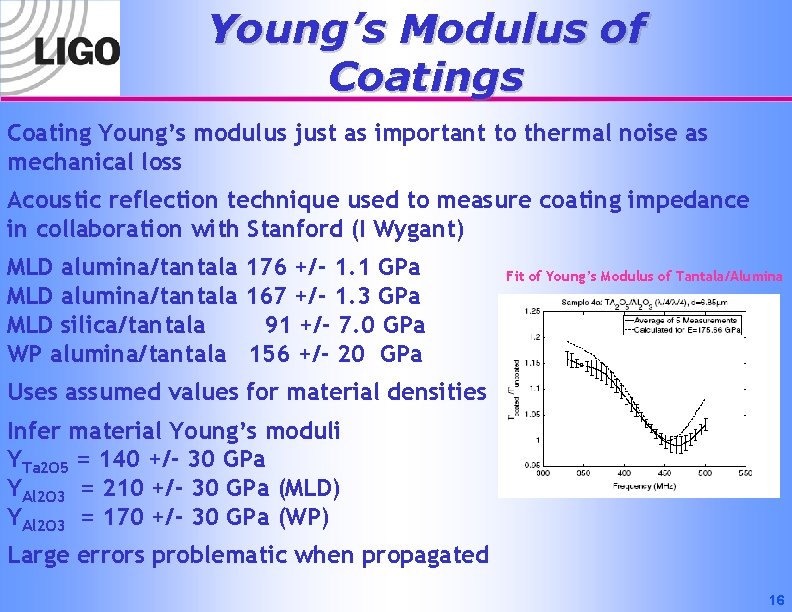
Young’s Modulus of Coatings Coating Young’s modulus just as important to thermal noise as mechanical loss Acoustic reflection technique used to measure coating impedance in collaboration with Stanford (I Wygant) MLD alumina/tantala 176 +/- 1. 1 GPa MLD alumina/tantala 167 +/- 1. 3 GPa MLD silica/tantala 91 +/- 7. 0 GPa WP alumina/tantala 156 +/- 20 GPa Fit of Young’s Modulus of Tantala/Alumina Uses assumed values for material densities Infer material Young’s moduli YTa 2 O 5 = 140 +/- 30 GPa YAl 2 O 3 = 210 +/- 30 GPa (MLD) YAl 2 O 3 = 170 +/- 30 GPa (WP) Large errors problematic when propagated 16
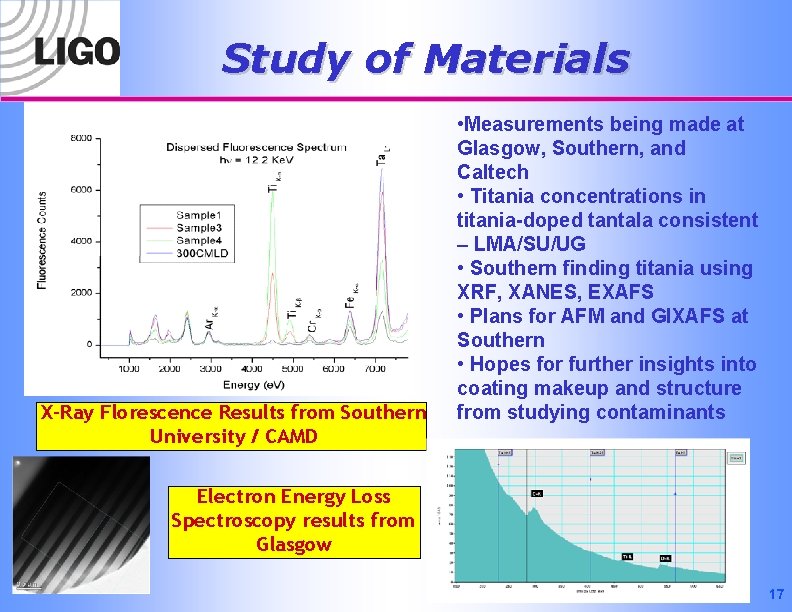
Study of Materials X-Ray Florescence Results from Southern University / CAMD • Measurements being made at Glasgow, Southern, and Caltech • Titania concentrations in titania-doped tantala consistent – LMA/SU/UG • Southern finding titania using XRF, XANES, EXAFS • Plans for AFM and GIXAFS at Southern • Hopes for further insights into coating makeup and structure from studying contaminants Electron Energy Loss Spectroscopy results from Glasgow 17
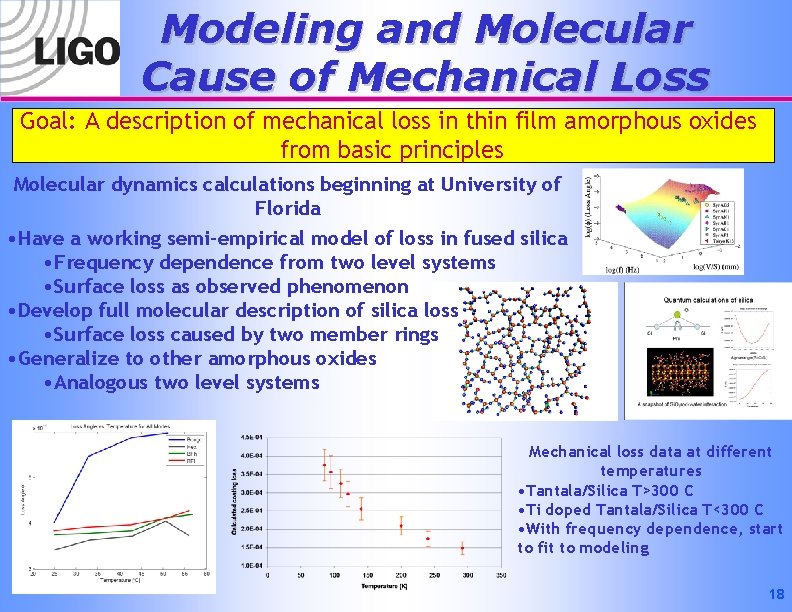
Modeling and Molecular Cause of Mechanical Loss Goal: A description of mechanical loss in thin film amorphous oxides from basic principles Molecular dynamics calculations beginning at University of Florida • Have a working semi-empirical model of loss in fused silica • Frequency dependence from two level systems • Surface loss as observed phenomenon • Develop full molecular description of silica loss • Surface loss caused by two member rings • Generalize to other amorphous oxides • Analogous two level systems Mechanical loss data at different temperatures • Tantala/Silica T>300 C • Ti doped Tantala/Silica T<300 C • With frequency dependence, start to fit to modeling 18
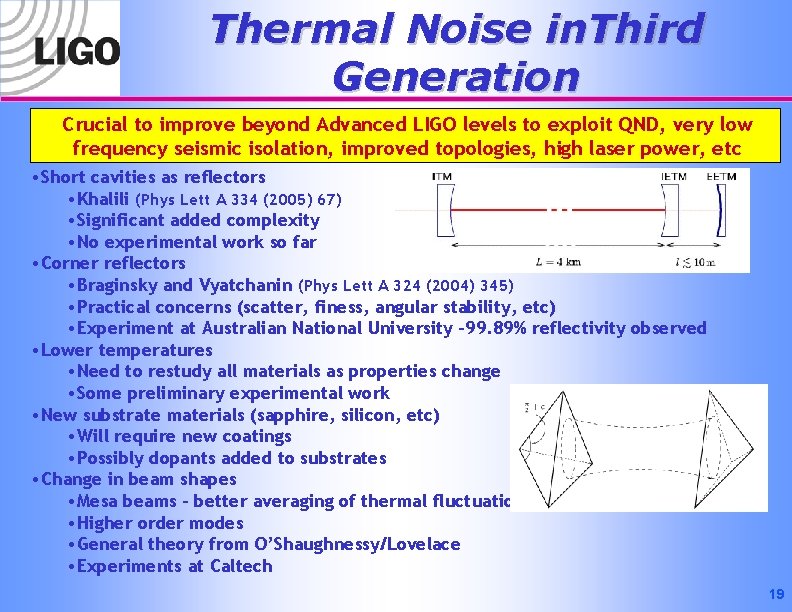
Thermal Noise in. Third Generation Crucial to improve beyond Advanced LIGO levels to exploit QND, very low frequency seismic isolation, improved topologies, high laser power, etc • Short cavities as reflectors • Khalili (Phys Lett A 334 (2005) 67) • Significant added complexity • No experimental work so far • Corner reflectors • Braginsky and Vyatchanin (Phys Lett A 324 (2004) 345) • Practical concerns (scatter, finess, angular stability, etc) • Experiment at Australian National University -99. 89% reflectivity observed • Lower temperatures • Need to restudy all materials as properties change • Some preliminary experimental work • New substrate materials (sapphire, silicon, etc) • Will require new coatings • Possibly dopants added to substrates • Change in beam shapes • Mesa beams – better averaging of thermal fluctuations • Higher order modes • General theory from O’Shaughnessy/Lovelace • Experiments at Caltech 19
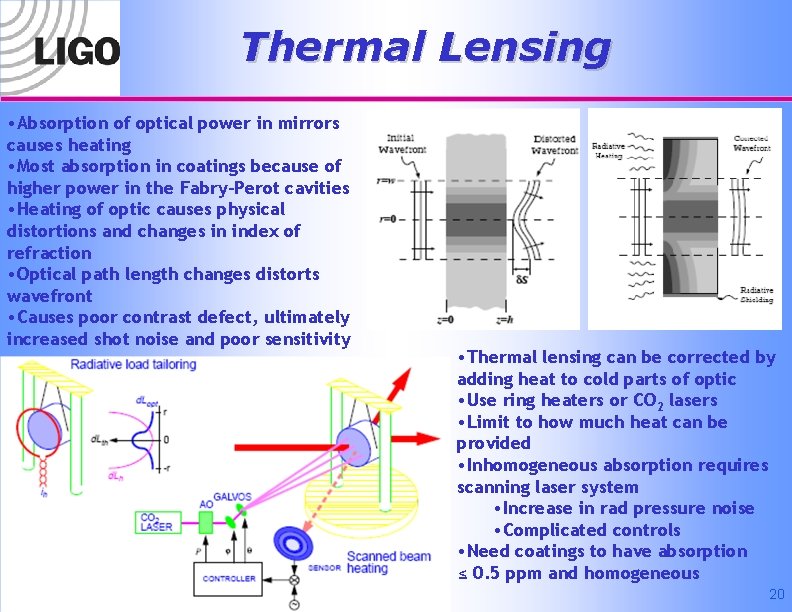
Thermal Lensing • Absorption of optical power in mirrors causes heating • Most absorption in coatings because of higher power in the Fabry-Perot cavities • Heating of optic causes physical distortions and changes in index of refraction • Optical path length changes distorts wavefront • Causes poor contrast defect, ultimately increased shot noise and poor sensitivity • Thermal lensing can be corrected by adding heat to cold parts of optic • Use ring heaters or CO 2 lasers • Limit to how much heat can be provided • Inhomogeneous absorption requires scanning laser system • Increase in rad pressure noise • Complicated controls • Need coatings to have absorption ≤ 0. 5 ppm and homogeneous 20
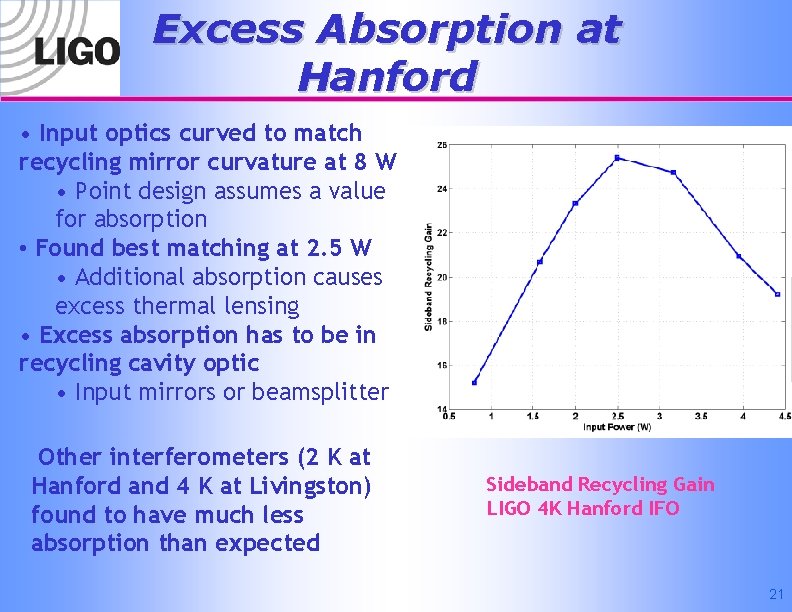
Excess Absorption at Hanford • Input optics curved to match recycling mirror curvature at 8 W • Point design assumes a value for absorption • Found best matching at 2. 5 W • Additional absorption causes excess thermal lensing • Excess absorption has to be in recycling cavity optic • Input mirrors or beamsplitter Other interferometers (2 K at Hanford and 4 K at Livingston) found to have much less absorption than expected Sideband Recycling Gain LIGO 4 K Hanford IFO 21
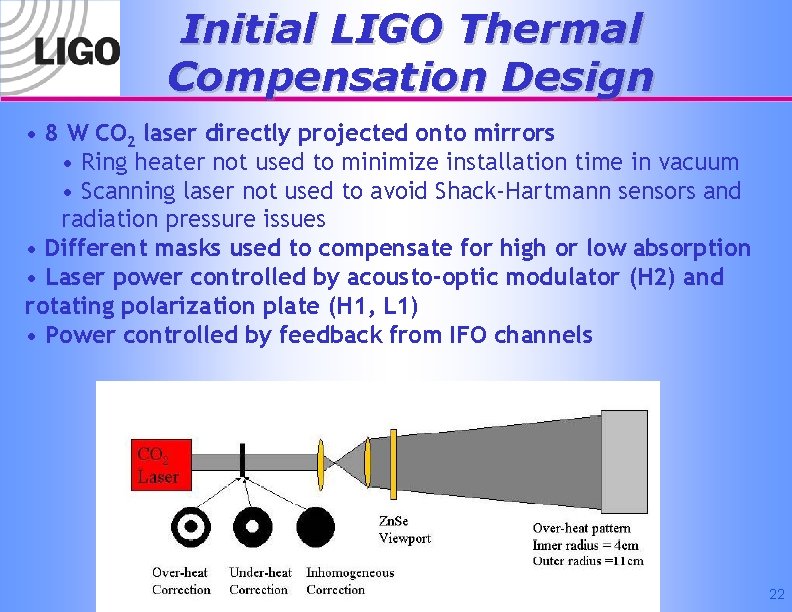
Initial LIGO Thermal Compensation Design • 8 W CO 2 laser directly projected onto mirrors • Ring heater not used to minimize installation time in vacuum • Scanning laser not used to avoid Shack-Hartmann sensors and radiation pressure issues • Different masks used to compensate for high or low absorption • Laser power controlled by acousto-optic modulator (H 2) and rotating polarization plate (H 1, L 1) • Power controlled by feedback from IFO channels 22
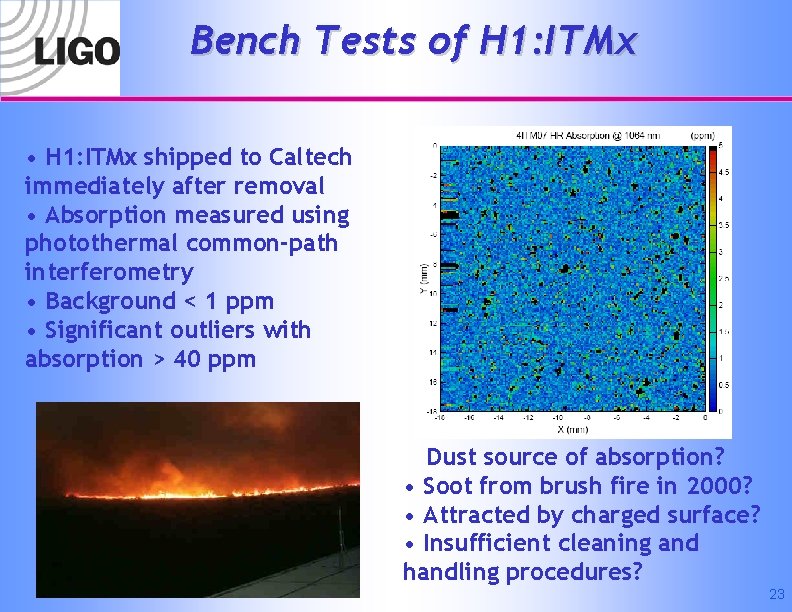
Bench Tests of H 1: ITMx • H 1: ITMx shipped to Caltech immediately after removal • Absorption measured using photothermal common-path interferometry • Background < 1 ppm • Significant outliers with absorption > 40 ppm Dust source of absorption? • Soot from brush fire in 2000? • Attracted by charged surface? • Insufficient cleaning and handling procedures? 23
Conclusions • Coating thermal noise limiting noise source in Advance LIGO’s most sensitive frequency band • Determined source of coating mechanical loss is internal friction in constituent materials • High index, typically tantala, is the biggest source of thermal noise • Doping a means of reducing mechanical loss • Titania doped into tantala • Silica doped in titania • Many other techniques tried to improve thermal noise, many still to be pursued • Thermo-optic noise a potential problem that is understudied • Need more information on coating Young’s moduli • Much work to be done with characterizing coating materials and developing thermal noise theory • New ideas for third generation only beginning to get attention • Absorption and scatter high in Initial LIGO • Both at levels that would not be acceptable in Advanced LIGO 24
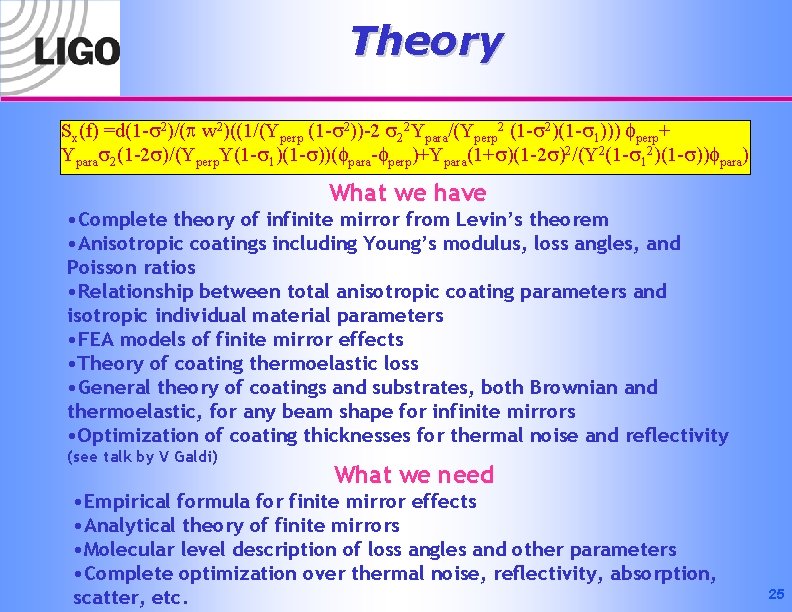
Theory Sx(f) =d(1 -s 2)/(p w 2)((1/(Yperp (1 -s 2))-2 s 22 Ypara/(Yperp 2 (1 -s 2)(1 -s 1))) fperp+ Yparas 2(1 -2 s)/(Yperp. Y(1 -s 1)(1 -s))(fpara-fperp)+Ypara(1+s)(1 -2 s)2/(Y 2(1 -s 12)(1 -s))fpara) What we have • Complete theory of infinite mirror from Levin’s theorem • Anisotropic coatings including Young’s modulus, loss angles, and Poisson ratios • Relationship between total anisotropic coating parameters and isotropic individual material parameters • FEA models of finite mirror effects • Theory of coating thermoelastic loss • General theory of coatings and substrates, both Brownian and thermoelastic, for any beam shape for infinite mirrors • Optimization of coating thicknesses for thermal noise and reflectivity (see talk by V Galdi) What we need • Empirical formula for finite mirror effects • Analytical theory of finite mirrors • Molecular level description of loss angles and other parameters • Complete optimization over thermal noise, reflectivity, absorption, scatter, etc. 25
Scatter in Initial LIGO 26
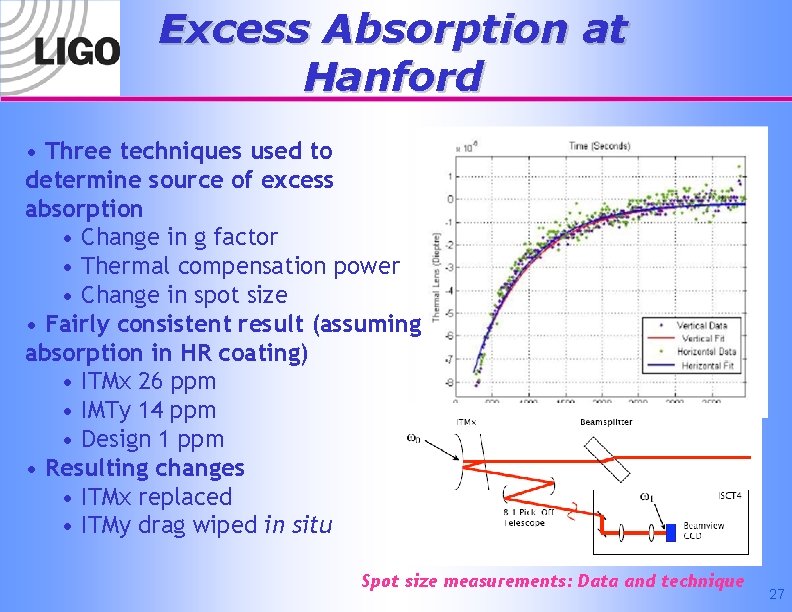
Excess Absorption at Hanford • Three techniques used to determine source of excess absorption • Change in g factor • Thermal compensation power • Change in spot size • Fairly consistent result (assuming absorption in HR coating) • ITMx 26 ppm • IMTy 14 ppm • Design 1 ppm • Resulting changes • ITMx replaced • ITMy drag wiped in situ Spot size measurements: Data and technique 27
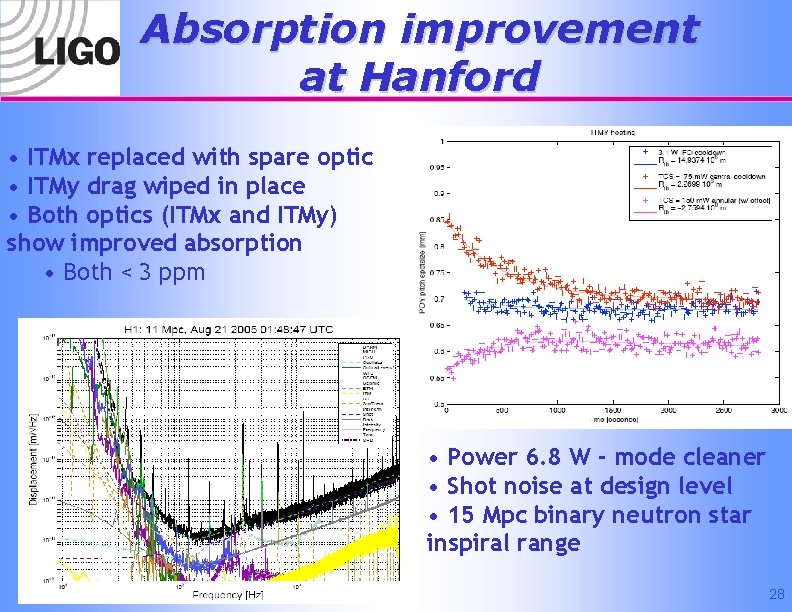
Absorption improvement at Hanford • ITMx replaced with spare optic • ITMy drag wiped in place • Both optics (ITMx and ITMy) show improved absorption • Both < 3 ppm • Power 6. 8 W - mode cleaner • Shot noise at design level • 15 Mpc binary neutron star inspiral range 28
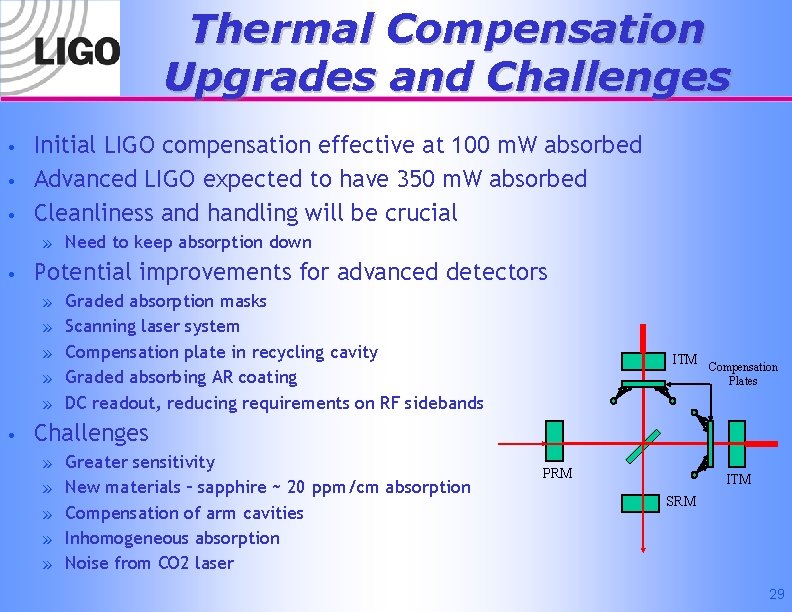
Thermal Compensation Upgrades and Challenges • • • Initial LIGO compensation effective at 100 m. W absorbed Advanced LIGO expected to have 350 m. W absorbed Cleanliness and handling will be crucial » Need to keep absorption down • Potential improvements for advanced detectors » » » • Graded absorption masks Scanning laser system Compensation plate in recycling cavity Graded absorbing AR coating DC readout, reducing requirements on RF sidebands ITM Compensation Plates Challenges » » » Greater sensitivity New materials – sapphire ~ 20 ppm/cm absorption Compensation of arm cavities Inhomogeneous absorption Noise from CO 2 laser PRM ITM SRM 29
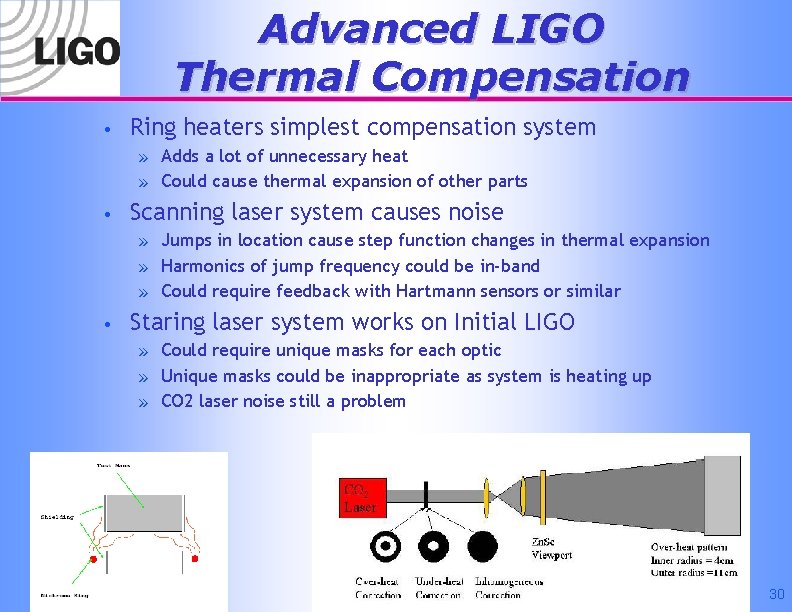
Advanced LIGO Thermal Compensation • Ring heaters simplest compensation system » Adds a lot of unnecessary heat » Could cause thermal expansion of other parts • Scanning laser system causes noise » Jumps in location cause step function changes in thermal expansion » Harmonics of jump frequency could be in-band » Could require feedback with Hartmann sensors or similar • Staring laser system works on Initial LIGO » Could require unique masks for each optic » Unique masks could be inappropriate as system is heating up » CO 2 laser noise still a problem 30