
Optical Assemblies for Space Environments Characterization of W
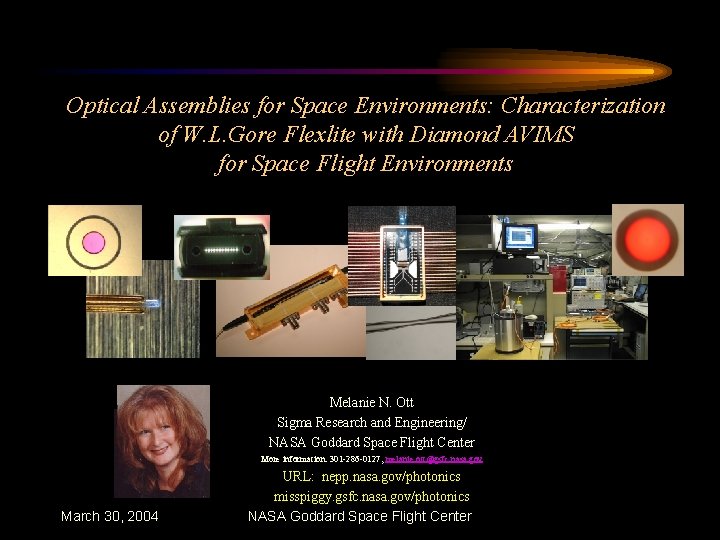
Optical Assemblies for Space Environments: Characterization of W. L. Gore Flexlite with Diamond AVIMS for Space Flight Environments Melanie N. Ott Sigma Research and Engineering/ NASA Goddard Space Flight Center More information: 301 -286 -0127, melanie. ott@gsfc. nasa. gov March 30, 2004 URL: nepp. nasa. gov/photonics misspiggy. gsfc. nasa. gov/photonics NASA Goddard Space Flight Center
Optical Assemblies for Space Environments: Characterization of W. L. Gore Flexlite with Diamond AVIMS for Space Flight Environments Melanie N. Ott Sigma Research and Engineering/ NASA Goddard Space Flight Center More information: 301 -286 -0127, melanie. ott@gsfc. nasa. gov URL: nepp. nasa. gov/photonics Technical Team: Shawn Macmurphy, Marcellus Proctor, Patricia Friedberg March 30, 2004 NASA Goddard Space Flight Center
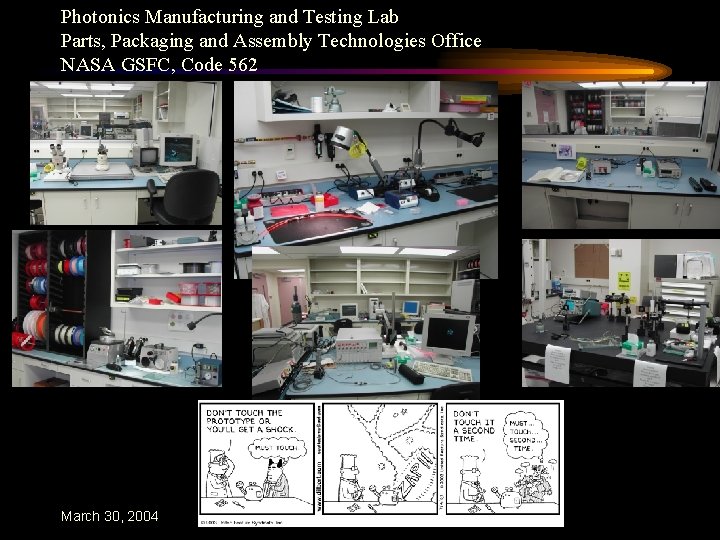
Photonics Manufacturing and Testing Lab Parts, Packaging and Assembly Technologies Office NASA GSFC, Code 562 March 30, 2004 NASA Goddard Space Flight Center
Outline • • March 30, 2004 MLA Requirements & Components Characterization plan Materials Study Results Vibration Testing & Results Thermal Testing & Results Radiation Parameters Radiation Testing Results Conclusions NASA Goddard Space Flight Center
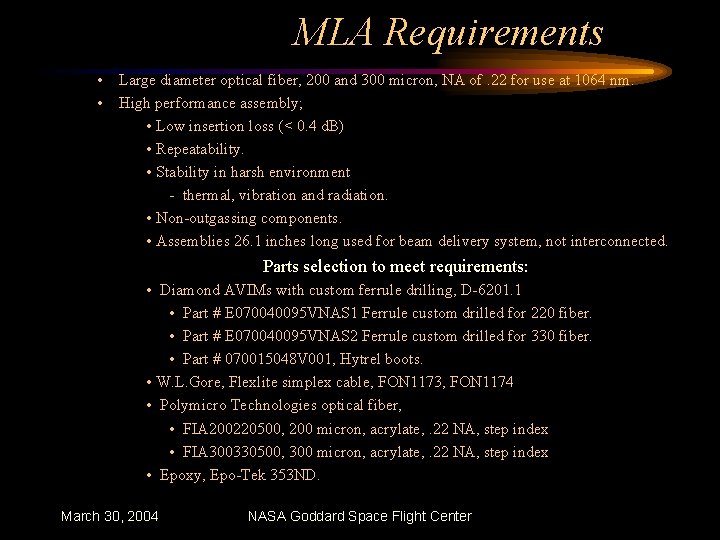
MLA Requirements • Large diameter optical fiber, 200 and 300 micron, NA of. 22 for use at 1064 nm. • High performance assembly; • Low insertion loss (< 0. 4 d. B) • Repeatability. • Stability in harsh environment - thermal, vibration and radiation. • Non-outgassing components. • Assemblies 26. 1 inches long used for beam delivery system, not interconnected. Parts selection to meet requirements: • Diamond AVIMs with custom ferrule drilling, D-6201. 1 • Part # E 070040095 VNAS 1 Ferrule custom drilled for 220 fiber. • Part # E 070040095 VNAS 2 Ferrule custom drilled for 330 fiber. • Part # 070015048 V 001, Hytrel boots. • W. L. Gore, Flexlite simplex cable, FON 1173, FON 1174 • Polymicro Technologies optical fiber, • FIA 200220500, 200 micron, acrylate, . 22 NA, step index • FIA 300330500, 300 micron, acrylate, . 22 NA, step index • Epoxy, Epo-Tek 353 ND. March 30, 2004 NASA Goddard Space Flight Center
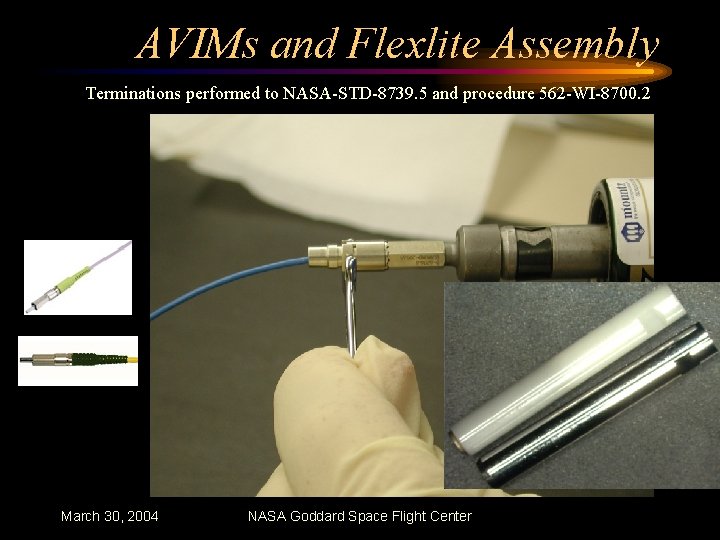
AVIMs and Flexlite Assembly Terminations performed to NASA-STD-8739. 5 and procedure 562 -WI-8700. 2 March 30, 2004 NASA Goddard Space Flight Center
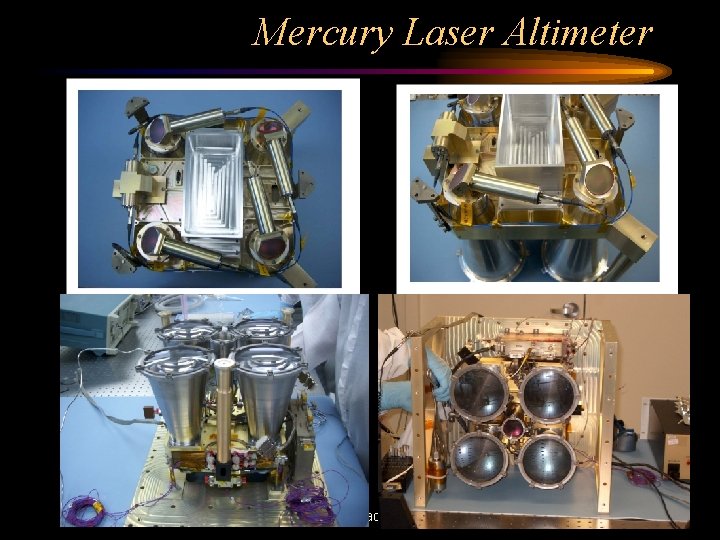
Mercury Laser Altimeter March 30, 2004 NASA Goddard Space Flight Center
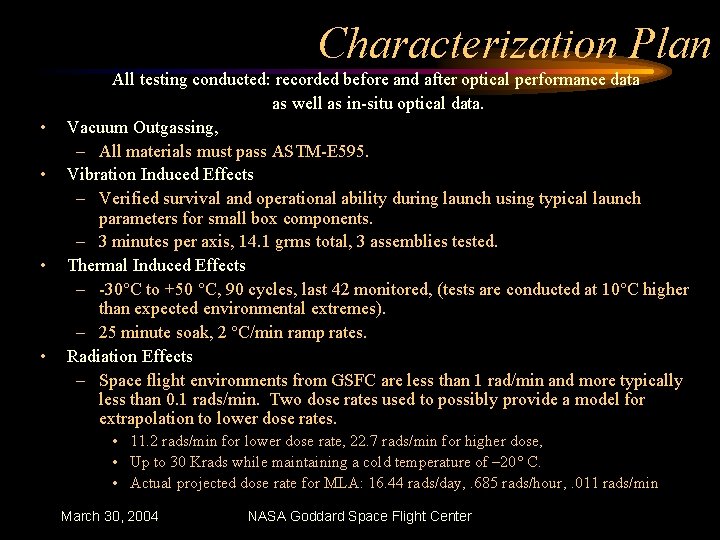
Characterization Plan • • All testing conducted: recorded before and after optical performance data as well as in-situ optical data. Vacuum Outgassing, – All materials must pass ASTM-E 595. Vibration Induced Effects – Verified survival and operational ability during launch using typical launch parameters for small box components. – 3 minutes per axis, 14. 1 grms total, 3 assemblies tested. Thermal Induced Effects – -30°C to +50 °C, 90 cycles, last 42 monitored, (tests are conducted at 10°C higher than expected environmental extremes). – 25 minute soak, 2 °C/min ramp rates. Radiation Effects – Space flight environments from GSFC are less than 1 rad/min and more typically less than 0. 1 rads/min. Two dose rates used to possibly provide a model for extrapolation to lower dose rates. • 11. 2 rads/min for lower dose rate, 22. 7 rads/min for higher dose, • Up to 30 Krads while maintaining a cold temperature of – 20° C. • Actual projected dose rate for MLA: 16. 44 rads/day, . 685 rads/hour, . 011 rads/min March 30, 2004 NASA Goddard Space Flight Center
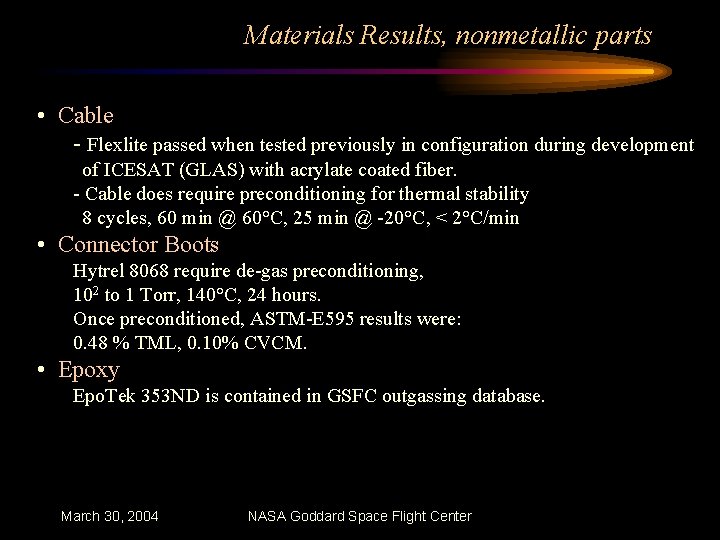
Materials Results, nonmetallic parts • Cable - Flexlite passed when tested previously in configuration during development of ICESAT (GLAS) with acrylate coated fiber. - Cable does require preconditioning for thermal stability 8 cycles, 60 min @ 60°C, 25 min @ -20°C, < 2°C/min • Connector Boots Hytrel 8068 require de-gas preconditioning, 102 to 1 Torr, 140°C, 24 hours. Once preconditioned, ASTM-E 595 results were: 0. 48 % TML, 0. 10% CVCM. • Epoxy Epo. Tek 353 ND is contained in GSFC outgassing database. March 30, 2004 NASA Goddard Space Flight Center
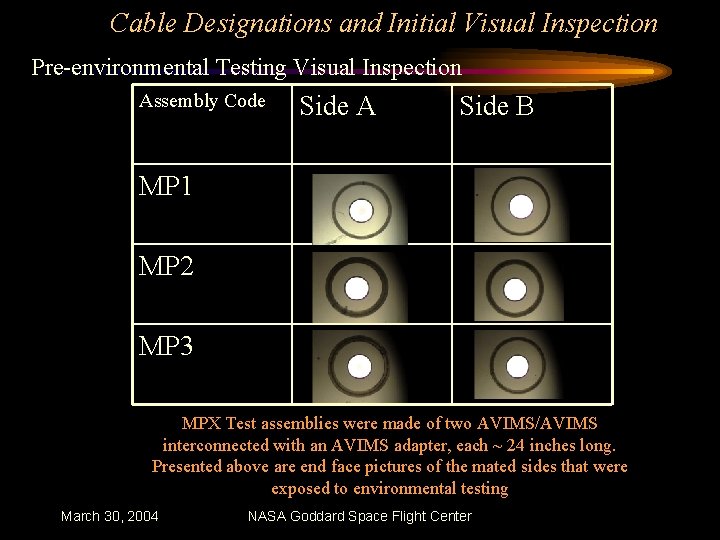
Cable Designations and Initial Visual Inspection Pre-environmental Testing Visual Inspection Assembly Code Side A Side B MP 1 MP 2 MP 3 MPX Test assemblies were made of two AVIMS/AVIMS interconnected with an AVIMS adapter, each ~ 24 inches long. Presented above are end face pictures of the mated sides that were exposed to environmental testing March 30, 2004 NASA Goddard Space Flight Center
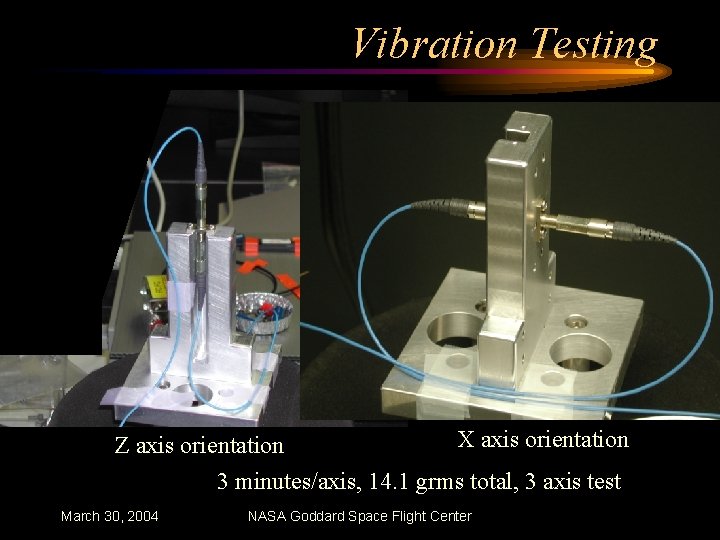
Vibration Testing X X axis orientation Z axis orientation Y Z 3 minutes/axis, 14. 1 grms total, 3 axis test March 30, 2004 NASA Goddard Space Flight Center
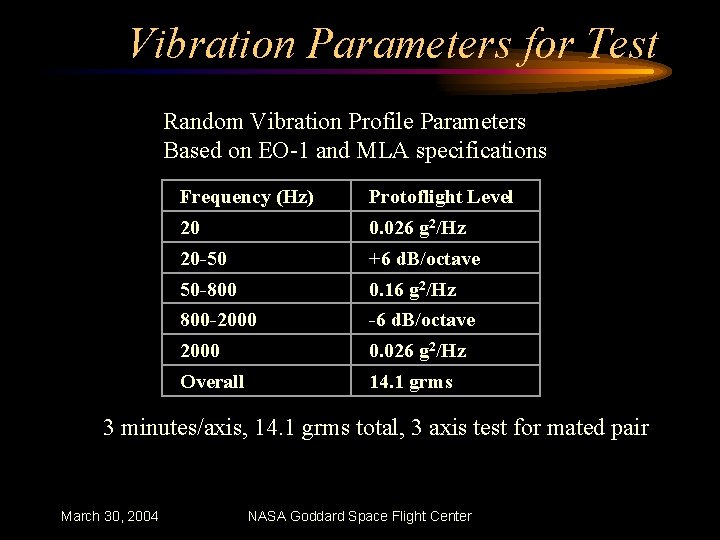
Vibration Parameters for Test Random Vibration Profile Parameters Based on EO-1 and MLA specifications Frequency (Hz) Protoflight Level 20 0. 026 g 2/Hz 20 -50 +6 d. B/octave 50 -800 0. 16 g 2/Hz 800 -2000 -6 d. B/octave 2000 0. 026 g 2/Hz Overall 14. 1 grms 3 minutes/axis, 14. 1 grms total, 3 axis test for mated pair March 30, 2004 NASA Goddard Space Flight Center
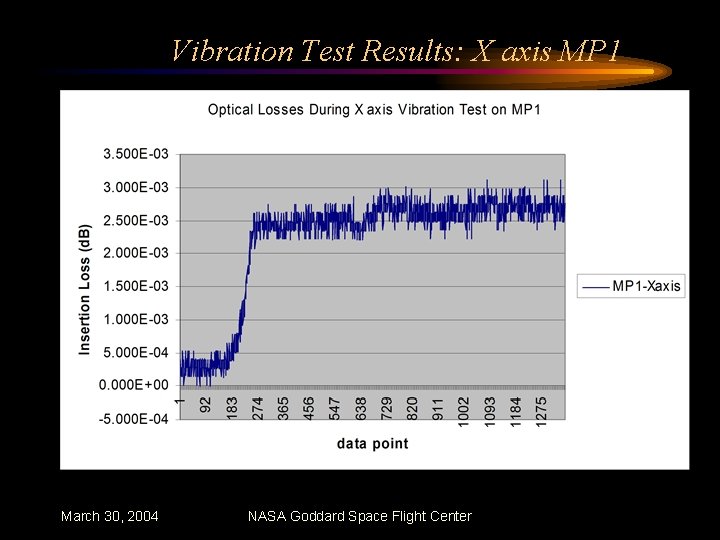
Vibration Test Results: X axis MP 1 March 30, 2004 NASA Goddard Space Flight Center
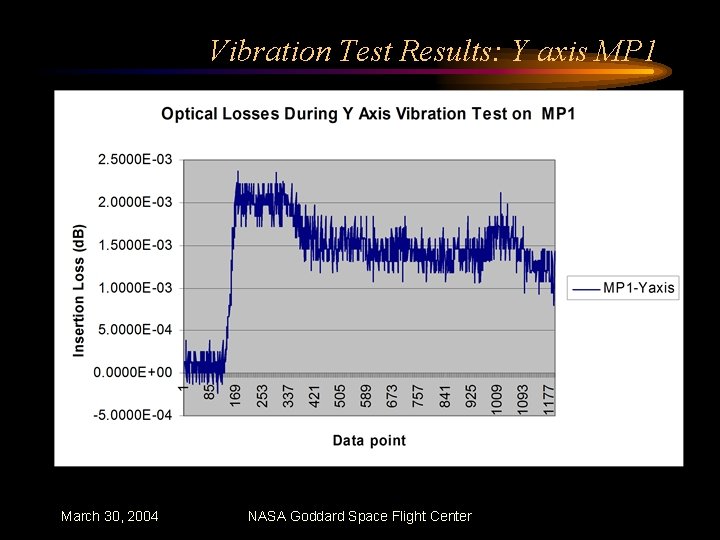
Vibration Test Results: Y axis MP 1 March 30, 2004 NASA Goddard Space Flight Center
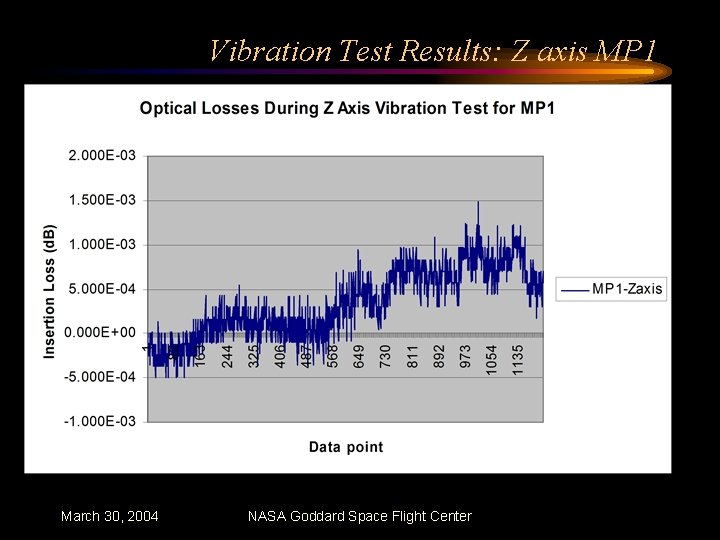
Vibration Test Results: Z axis MP 1 March 30, 2004 NASA Goddard Space Flight Center
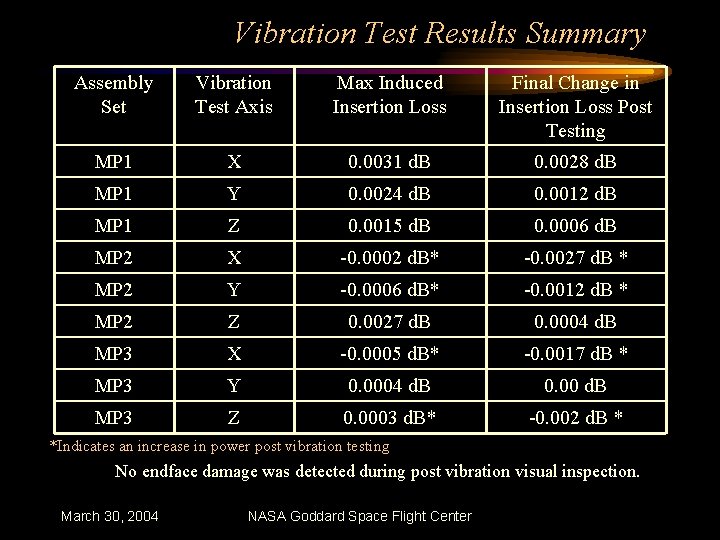
Vibration Test Results Summary Assembly Set Vibration Test Axis Max Induced Insertion Loss Final Change in Insertion Loss Post Testing MP 1 X 0. 0031 d. B 0. 0028 d. B MP 1 Y 0. 0024 d. B 0. 0012 d. B MP 1 Z 0. 0015 d. B 0. 0006 d. B MP 2 X -0. 0002 d. B* -0. 0027 d. B * MP 2 Y -0. 0006 d. B* -0. 0012 d. B * MP 2 Z 0. 0027 d. B 0. 0004 d. B MP 3 X -0. 0005 d. B* -0. 0017 d. B * MP 3 Y 0. 0004 d. B 0. 00 d. B MP 3 Z 0. 0003 d. B* -0. 002 d. B * *Indicates an increase in power post vibration testing No endface damage was detected during post vibration visual inspection. March 30, 2004 NASA Goddard Space Flight Center
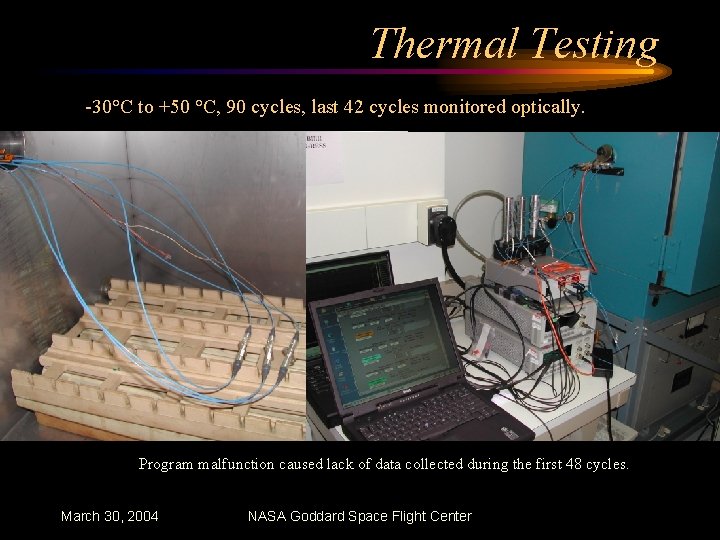
Thermal Testing -30°C to +50 °C, 90 cycles, last 42 cycles monitored optically. Program malfunction caused lack of data collected during the first 48 cycles. March 30, 2004 NASA Goddard Space Flight Center
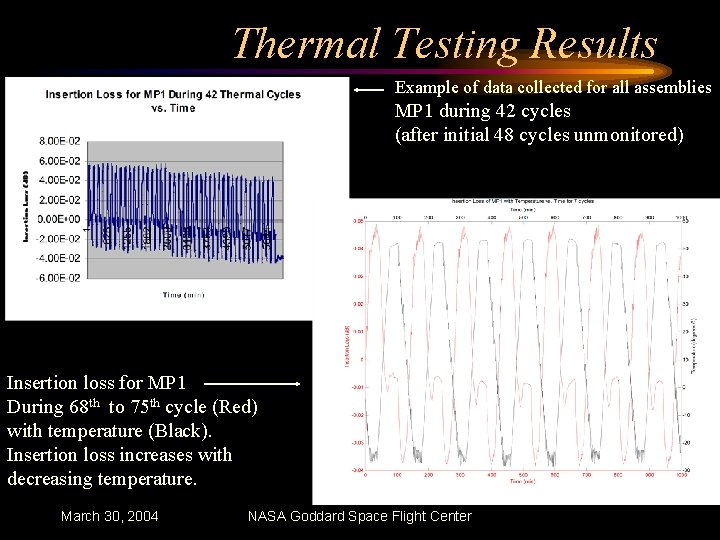
Thermal Testing Results Example of data collected for all assemblies MP 1 during 42 cycles (after initial 48 cycles unmonitored) Insertion loss for MP 1 During 68 th to 75 th cycle (Red) with temperature (Black). Insertion loss increases with decreasing temperature. March 30, 2004 NASA Goddard Space Flight Center
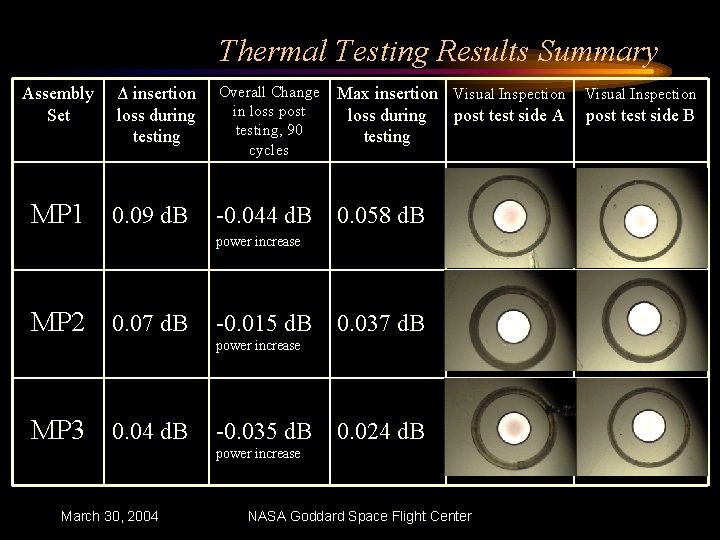
Thermal Testing Results Summary Assembly Set Δ insertion loss during testing MP 1 0. 09 d. B Overall Change in loss post testing, 90 cycles Max insertion Visual Inspection loss during post test side A testing -0. 044 d. B 0. 058 d. B power increase MP 2 0. 07 d. B -0. 015 d. B 0. 037 d. B power increase MP 3 0. 04 d. B -0. 035 d. B 0. 024 d. B power increase March 30, 2004 NASA Goddard Space Flight Center Visual Inspection post test side B
Radiation Test Parameters Tested up to 30 krads in Cobalt 60 chamber: • 10 m of FON 1173 (200 micron core fiber) • 10 m of FON 1174 (300 micron core fiber) • High dose rate 22. 7 rads/min • Low dose rate 11. 2 rads/min • While maintaining at temperature of -20°C. • Monitored optical power at 850 nm @ < 1 micro watt of power. March 30, 2004 NASA Goddard Space Flight Center
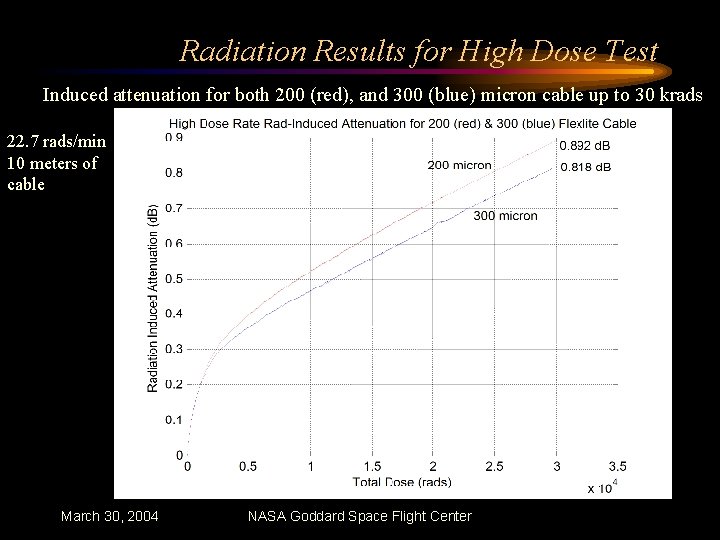
Radiation Results for High Dose Test Induced attenuation for both 200 (red), and 300 (blue) micron cable up to 30 krads 22. 7 rads/min 10 meters of cable March 30, 2004 NASA Goddard Space Flight Center
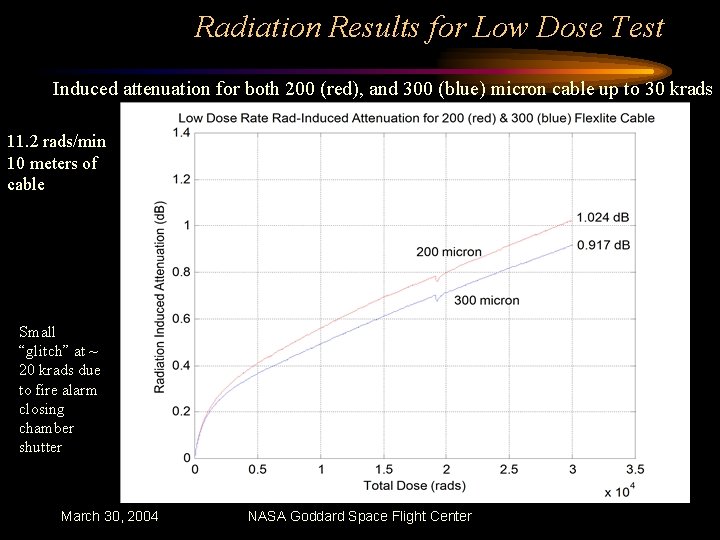
Radiation Results for Low Dose Test Induced attenuation for both 200 (red), and 300 (blue) micron cable up to 30 krads 11. 2 rads/min 10 meters of cable Small “glitch” at ~ 20 krads due to fire alarm closing chamber shutter March 30, 2004 NASA Goddard Space Flight Center
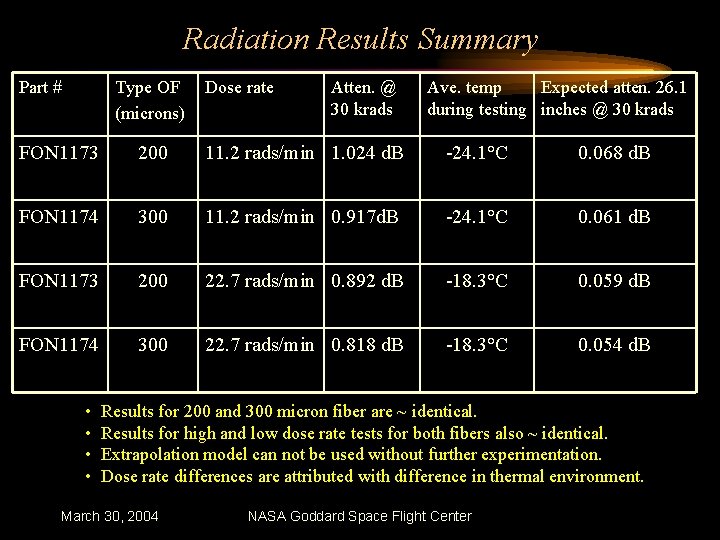
Radiation Results Summary Part # Type OF (microns) Dose rate Atten. @ 30 krads Ave. temp Expected atten. 26. 1 during testing inches @ 30 krads FON 1173 200 11. 2 rads/min 1. 024 d. B -24. 1°C 0. 068 d. B FON 1174 300 11. 2 rads/min 0. 917 d. B -24. 1°C 0. 061 d. B FON 1173 200 22. 7 rads/min 0. 892 d. B -18. 3°C 0. 059 d. B FON 1174 300 22. 7 rads/min 0. 818 d. B -18. 3°C 0. 054 d. B • • Results for 200 and 300 micron fiber are ~ identical. Results for high and low dose rate tests for both fibers also ~ identical. Extrapolation model can not be used without further experimentation. Dose rate differences are attributed with difference in thermal environment. March 30, 2004 NASA Goddard Space Flight Center
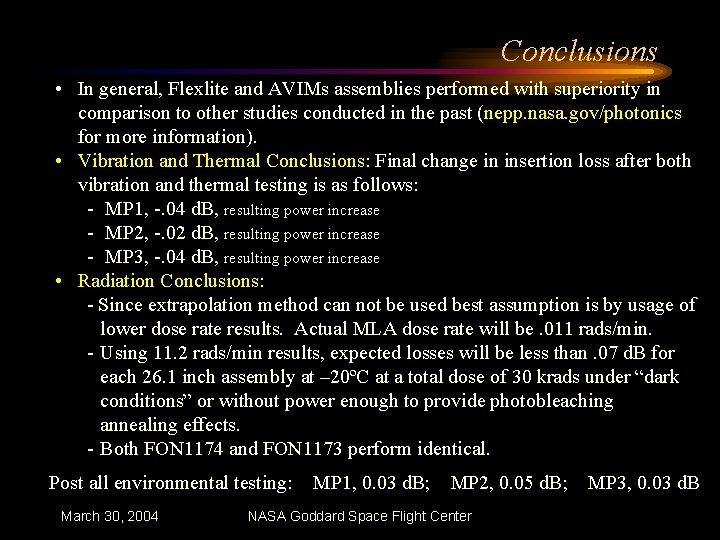
Conclusions • In general, Flexlite and AVIMs assemblies performed with superiority in comparison to other studies conducted in the past (nepp. nasa. gov/photonics for more information). • Vibration and Thermal Conclusions: Final change in insertion loss after both vibration and thermal testing is as follows: - MP 1, -. 04 d. B, resulting power increase - MP 2, -. 02 d. B, resulting power increase - MP 3, -. 04 d. B, resulting power increase • Radiation Conclusions: - Since extrapolation method can not be used best assumption is by usage of lower dose rate results. Actual MLA dose rate will be. 011 rads/min. - Using 11. 2 rads/min results, expected losses will be less than. 07 d. B for each 26. 1 inch assembly at – 20ºC at a total dose of 30 krads under “dark conditions” or without power enough to provide photobleaching annealing effects. - Both FON 1174 and FON 1173 perform identical. Post all environmental testing: March 30, 2004 MP 1, 0. 03 d. B; MP 2, 0. 05 d. B; NASA Goddard Space Flight Center MP 3, 0. 03 d. B
Acknowledgements Special thanks to NASA Electronic Parts and Packaging Program & MESSENGER, Mercury Laser Altimeter Program for funding of this work. Additional thanks to Dr. Henning Leidecker (always!) Darryl Lakins Dr. Charles Barnes Phillip Zulueta Luis A Ramos-Izquierdo Arlin Bartels For resources and program management support Special thanks to the Web. Ex team for making this possible Jeannette Plante & Carl Szabo For more information see the websites: http: //nepp. nasa. gov/photonics http: //misspiggy. gsfc. nasa. gov/photonics March 30, 2004 NASA Goddard Space Flight Center
- Slides: 25