
Optical Activity of Chiral Epoxides Influence of Structure
- Slides: 7
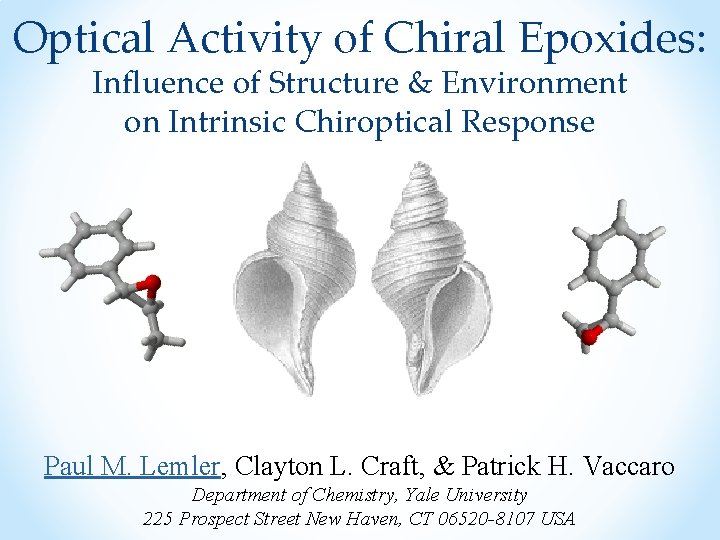
Optical Activity of Chiral Epoxides: Influence of Structure & Environment on Intrinsic Chiroptical Response Paul M. Lemler, Clayton L. Craft, & Patrick H. Vaccaro Department of Chemistry, Yale University 225 Prospect Street New Haven, CT 06520 -8107 USA
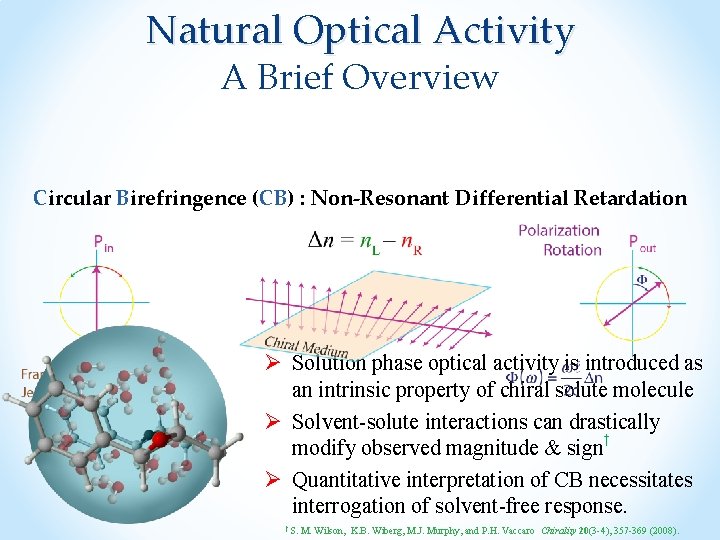
Natural Optical Activity A Brief Overview Circular Birefringence (CB) : Non-Resonant Differential Retardation Ø Solution phase optical activity is introduced as an intrinsic property of chiral solute molecule Ø Solvent-solute interactions can drastically † modify observed magnitude & sign Ø Quantitative interpretation of CB necessitates interrogation of solvent-free response. † S. M. Wilson, K. B. Wiberg, M. J. Murphy, and P. H. Vaccaro Chirality 20(3 -4), 357 -369 (2008).
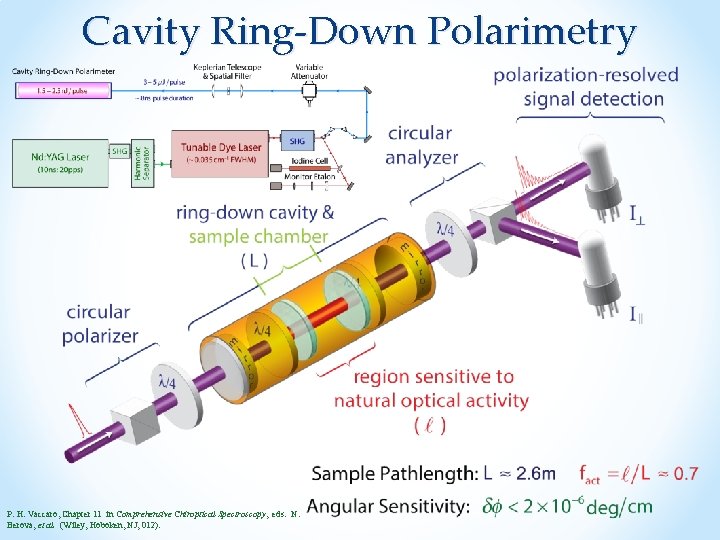
Cavity Ring-Down Polarimetry P. H. Vaccaro, Chapter 11 in Comprehensive Chiroptical Spectroscopy, eds. N. Berova, et al. (Wiley, Hoboken, NJ, 012).
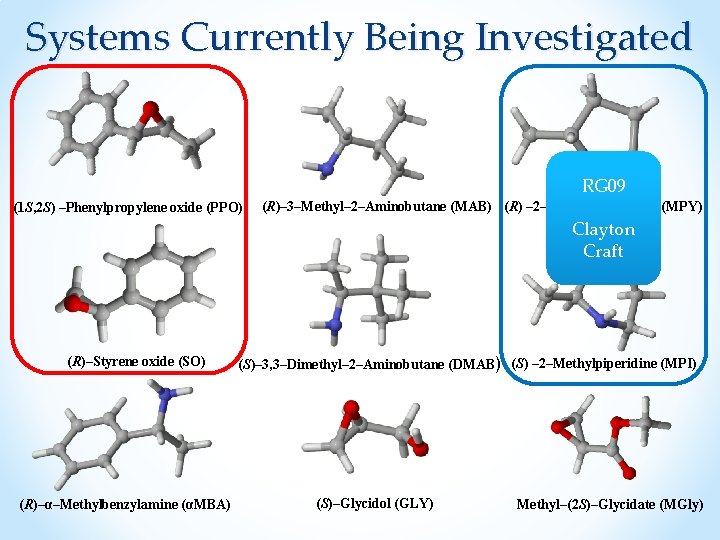
Systems Currently Being Investigated RG 09 (1 S, 2 S) –Phenylpropylene oxide (PPO) (R)– 3–Methyl– 2–Aminobutane (MAB) (R) – 2–Methylpyrrolidine (MPY) Clayton Craft (R)–Styrene oxide (SO) (R)–α–Methylbenzylamine (αMBA) (S)– 3, 3–Dimethyl– 2–Aminobutane (DMAB) (S) – 2–Methylpiperidine (MPI) (S)–Glycidol (GLY) Methyl–(2 S)–Glycidate (MGly)
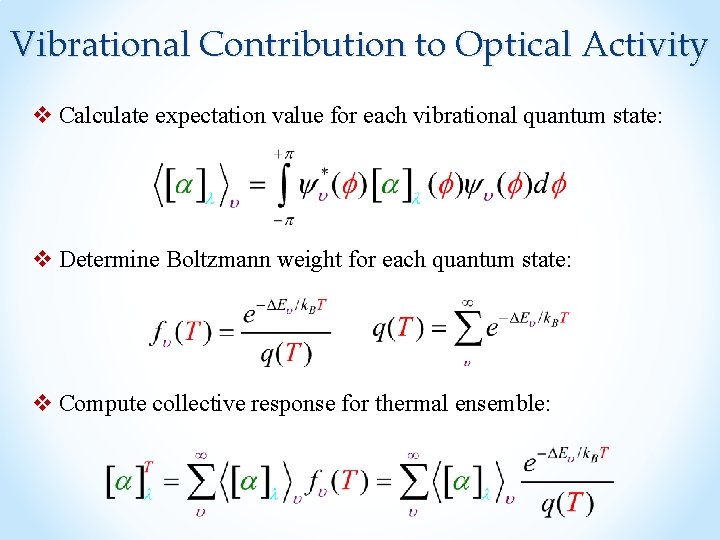
Vibrational Contribution to Optical Activity v Calculate expectation value for each vibrational quantum state: v Determine Boltzmann weight for each quantum state: v Compute collective response for thermal ensemble:
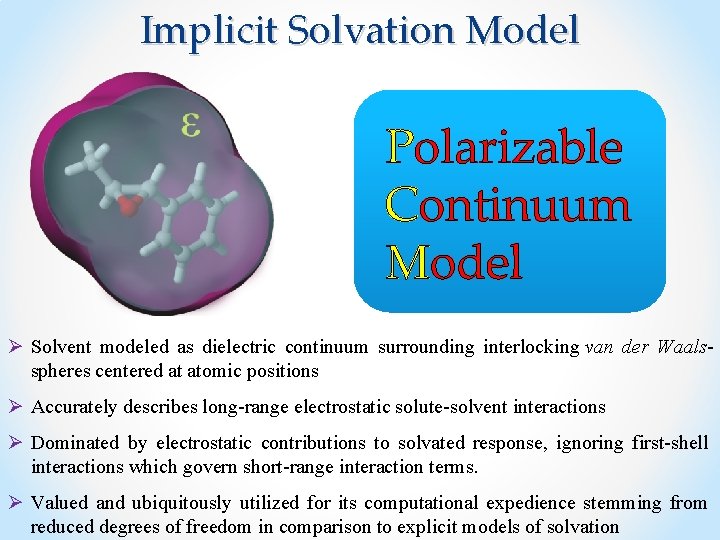
Implicit Solvation Model Polarizable Continuum Model Ø Solvent modeled as dielectric continuum surrounding interlocking van der Waalsspheres centered at atomic positions Ø Accurately describes long-range electrostatic solute-solvent interactions Ø Dominated by electrostatic contributions to solvated response, ignoring first-shell interactions which govern short-range interaction terms. Ø Valued and ubiquitously utilized for its computational expedience stemming from reduced degrees of freedom in comparison to explicit models of solvation
Summary and Conclusions Ø Cavity Ring-Down Polarimetry (CRDP) affords a sensitive probe for elucidating dispersive optical activity (CB) under rarefied gas-phase conditions. Ø Solvation can influence optical activity in pronounced and counterintuitive ways, modifying both the magnitude and the sign of response evoked from rigid molecules. Ø Small electronic response of styrene oxide (SO) is perturbed significantly by vibrational contributions and highlights inadequacies of DFT predictions for optical activity. Ø Implicit solvation models are in good accord with PPO behavior, but show less satisfactory agreement with SO response possibly due to vibrational contributions. Ø Future efforts will include molecular dynamics simulations to search for solute-solvent complexes combined with more extensive vibrational-averaging analyses. Supported by U. S. National Science Foundation