
Opportunities on buildings Opportunities on buildings Seal exterior
Opportunities on buildings
Opportunities on buildings • Seal exterior cracks/ openings/ gaps with caulk, gasketing, whether stripping, etc. • Consider new thermal doors, thermal windows, roofing insulations, etc. • Install windbreaks near exterior doors • Replace single pane glass with insulating glass • Consider covering some window and skylight areas with insulated wall panels inside the building. • If visibility is not required but lights is required, consider replacing exterior windows with insulated glass block.
Opportunities on buildings • Consider tinted glass, reflective glass, coatings, awnings, overhangs, draperies, blinds and shades for sunlight exterior windows. • Use landscaping to advantage • Add vestibules or revolving doors to primary exterior personnel doors. • Consider automatic doors, air curtains, strip doors, etch, at high traffic passages between conditioned and non conditioned spaces, use self closing doors if possible. • Use intermediate doors in stairways and vertical passages to minimize buildings stack effect.
Energy conscious design • Design provides the organization with an opportunity to create a positive step change in energy performance. • During the review of this opportunity the following may be considered: • Why use the energy source? • What is the right energy source? • Who are the technological options? • Who will maintain this design later? • How will the existing processes be modified? • How will the baseline be affected? • Will this lead to sustainable or renewable opportunities? • When will these changes affect the En. MS?
Procurement strategy Procurement of energy services, products and equipment • When procuring energy services etc. the suppliers should be informed that procurement is partly evaluated on the basis of energy performance. • The organization shall define the criteria for assessing energy use over the expected operating lifeline of energy using products. • The organization should include contingency and emergency situations and potential disasters relating to equipment with significant energy use and determine how the organization will react to these situations, .
Procurement strategy Procurement of energy supply The organization shall define energy purchasing specifications as applicable for effective energy performance. Energy supply purchasing In developing the purchasing specifications for energy supply the following items may be considered: a. Energy equality b. Availability c. Capacity d. Variation over specified time e. Billing parameter and cost;
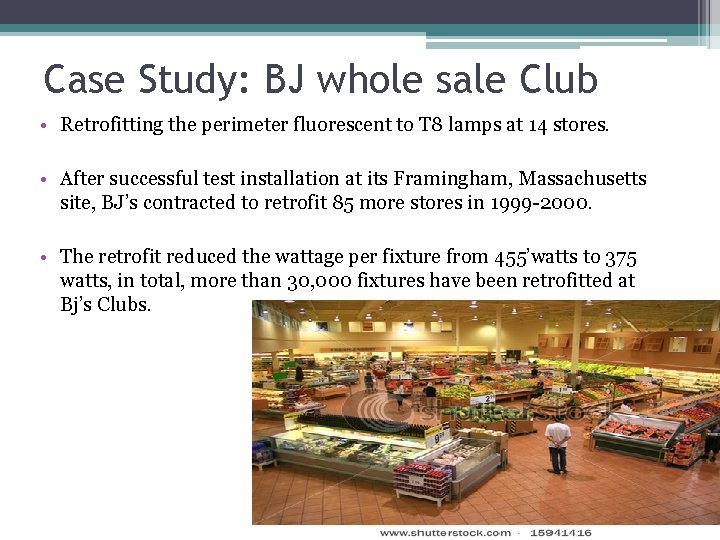
Case Study: BJ whole sale Club • Retrofitting the perimeter fluorescent to T 8 lamps at 14 stores. • After successful test installation at its Framingham, Massachusetts site, BJ’s contracted to retrofit 85 more stores in 1999 -2000. • The retrofit reduced the wattage per fixture from 455’watts to 375 watts, in total, more than 30, 000 fixtures have been retrofitted at Bj’s Clubs.
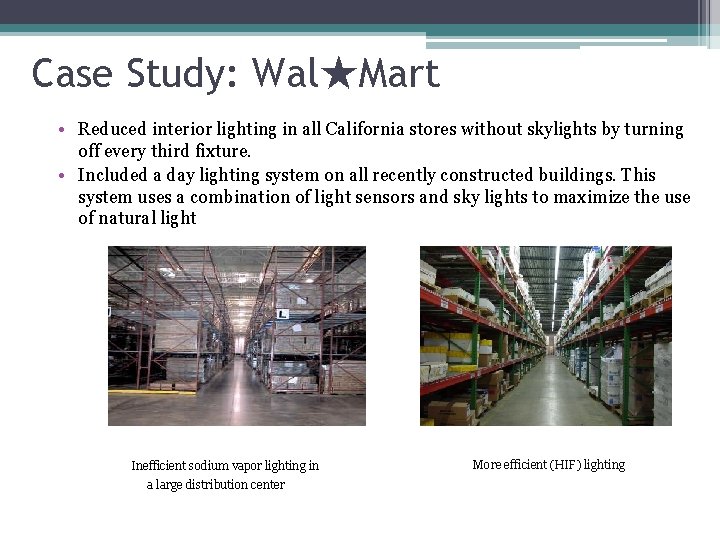
Case Study: Wal★Mart • Reduced interior lighting in all California stores without skylights by turning off every third fixture. • Included a day lighting system on all recently constructed buildings. This system uses a combination of light sensors and sky lights to maximize the use of natural light Inefficient sodium vapor lighting in a large distribution center More efficient (HIF) lighting
Case Study: Wal★Mart • Installed T 8 low mercury florescent lamps and electronic ballast ( the most efficient lighting system on the market) at new stores. These lighting systems are 30 % more efficient that required by California code. • Since the mid 1990’s all Wal★Mart’s built in California have white membrane roofs. The high solar reflectivity of this membrane result in lowering the cooling load by about 8% • This results in an annual savings of about 250 million KWH per year enough power to supply than 20, 000 homes
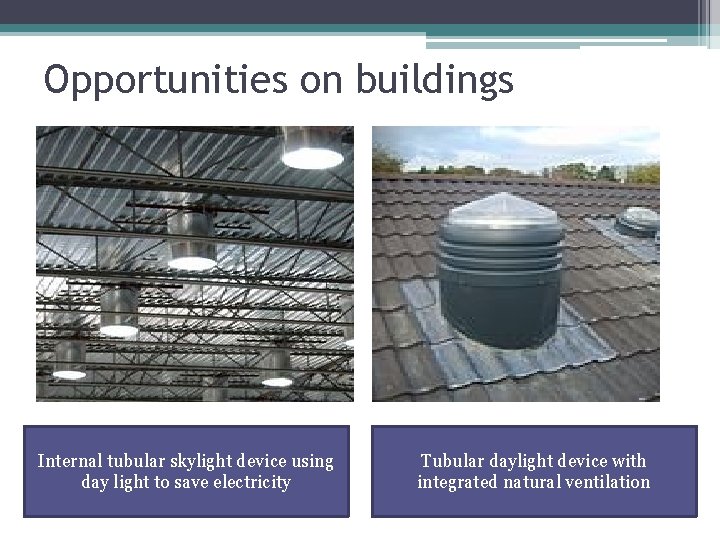
Opportunities on buildings Internal tubular skylight device using day light to save electricity Tubular daylight device with integrated natural ventilation
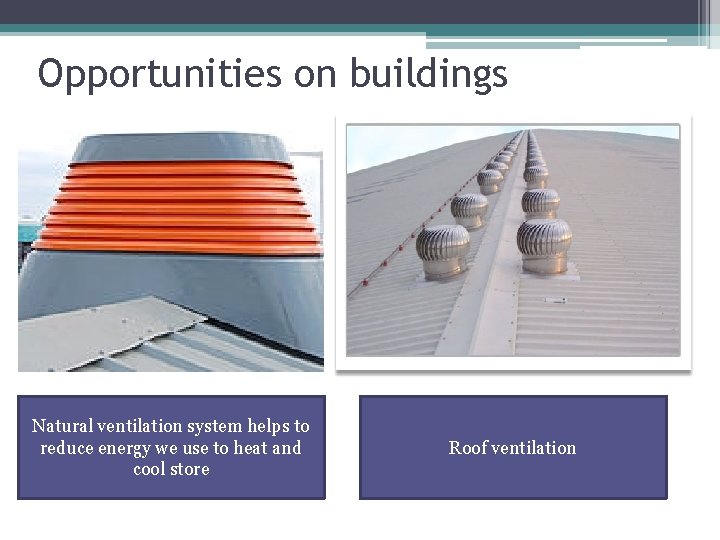
Opportunities on buildings Natural ventilation system helps to reduce energy we use to heat and cool store Roof ventilation
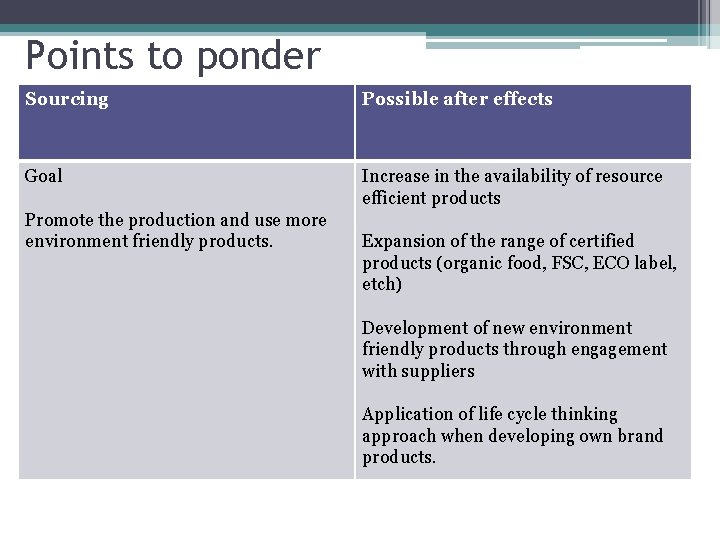
Points to ponder Sourcing Possible after effects Goal Increase in the availability of resource efficient products Promote the production and use more environment friendly products. Expansion of the range of certified products (organic food, FSC, ECO label, etch) Development of new environment friendly products through engagement with suppliers Application of life cycle thinking approach when developing own brand products.
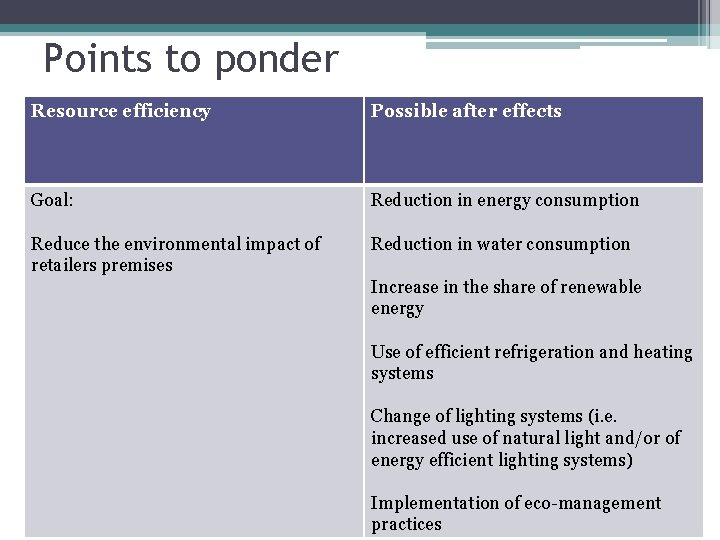
Points to ponder Resource efficiency Possible after effects Goal: Reduction in energy consumption Reduce the environmental impact of retailers premises Reduction in water consumption Increase in the share of renewable energy Use of efficient refrigeration and heating systems Change of lighting systems (i. e. increased use of natural light and/or of energy efficient lighting systems) Implementation of eco-management practices
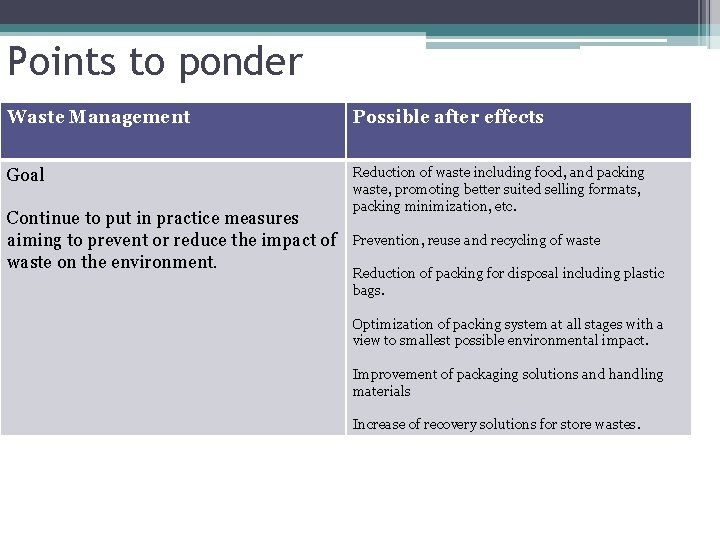
Points to ponder Waste Management Possible after effects Goal Reduction of waste including food, and packing waste, promoting better suited selling formats, packing minimization, etc. Continue to put in practice measures aiming to prevent or reduce the impact of waste on the environment. Prevention, reuse and recycling of waste Reduction of packing for disposal including plastic bags. Optimization of packing system at all stages with a view to smallest possible environmental impact. Improvement of packaging solutions and handling materials Increase of recovery solutions for store wastes.
Energy Efficiency Audits
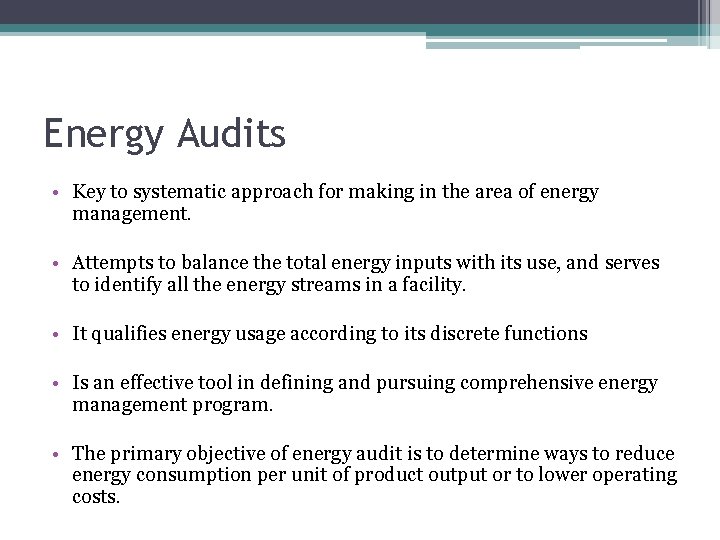
Energy Audits • Key to systematic approach for making in the area of energy management. • Attempts to balance the total energy inputs with its use, and serves to identify all the energy streams in a facility. • It qualifies energy usage according to its discrete functions • Is an effective tool in defining and pursuing comprehensive energy management program. • The primary objective of energy audit is to determine ways to reduce energy consumption per unit of product output or to lower operating costs.
Type of Energy Audit The type of Energy Audit to be performed depends on: • Functions and type of industry • Dept to which final audit is needed, and • Potential and magnitude of cost reduction desired Thus Energy Audit can be classified into the following two types: • Preliminary Audit • Detailed Audit
Preliminary Audit Methodology Preliminary energy audit is a relatively quick exercise to: • • Establish energy consumption in the organization Estimate the scope for saving Identify the most likely (and the easiest areas for attention) Identify immediate(especially no-/low cost) improvements / savings • Set a reference point • Preliminary energy audit uses existing or easily obtained data.
Energy Audit Methodology Detailed Energy Auditing is carried out in three phases: • Phase 1 – pre audit Phase • Phase II – Audit Phase • Phase III – Post Audit Phase • This type of audit offers the most accurate estimate energy savings and cost • It considers the interactive effect of all project, accounts for the energy use of all major equipments, and includes detailed energy cost saving calculations and project cost. • In as comprehensive audit, one ot the key elements is the energy balance
Monitoring Instruments • • Anemometer Ultrasonic flow meter Lux Meter Tachometers – Stroboscopic Tachometer Power analyzer. Contact thermometers Infrared Non-contact temperature sensors Miscellaneous instruments – leak detectors
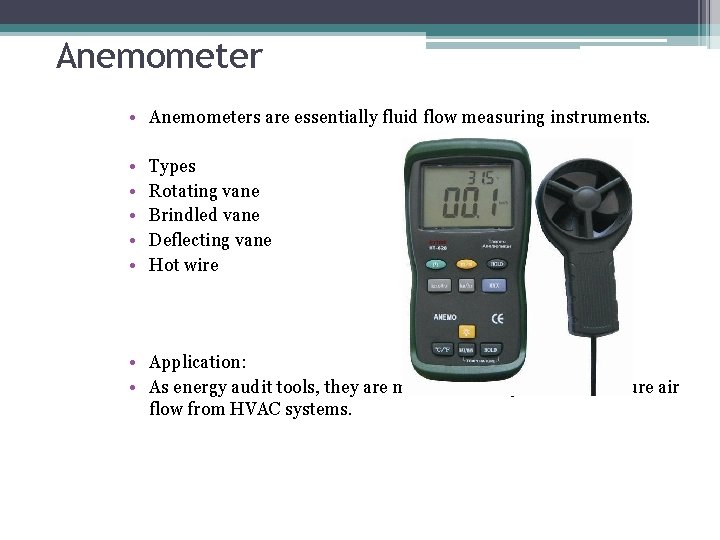
Anemometer • Anemometers are essentially fluid flow measuring instruments. • • • Types Rotating vane Brindled vane Deflecting vane Hot wire • Application: • As energy audit tools, they are most commonly used to measure air flow from HVAC systems.
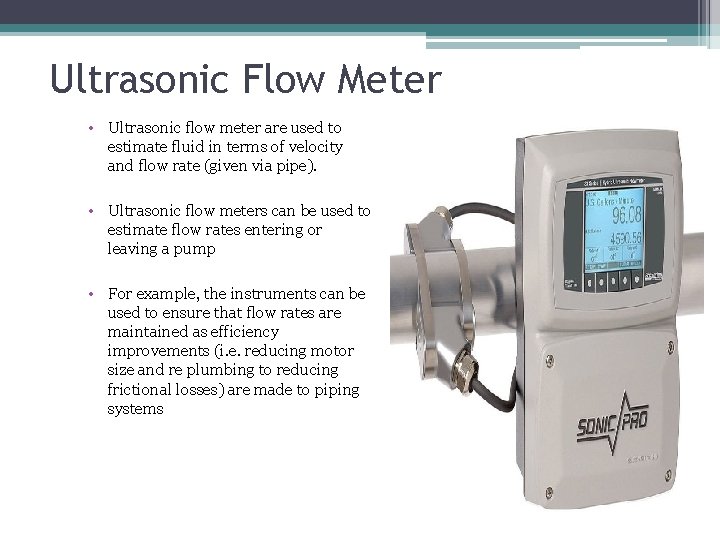
Ultrasonic Flow Meter • Ultrasonic flow meter are used to estimate fluid in terms of velocity and flow rate (given via pipe). • Ultrasonic flow meters can be used to estimate flow rates entering or leaving a pump • For example, the instruments can be used to ensure that flow rates are maintained as efficiency improvements (i. e. reducing motor size and re plumbing to reducing frictional losses) are made to piping systems
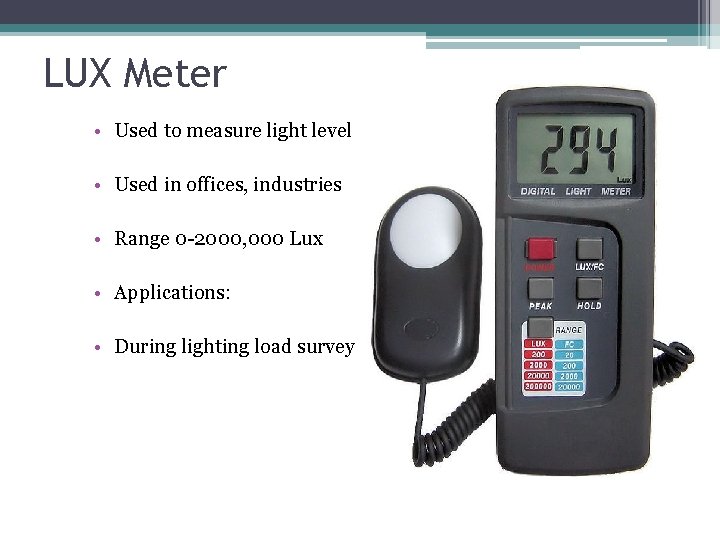
LUX Meter • Used to measure light level • Used in offices, industries • Range 0 -2000, 000 Lux • Applications: • During lighting load survey
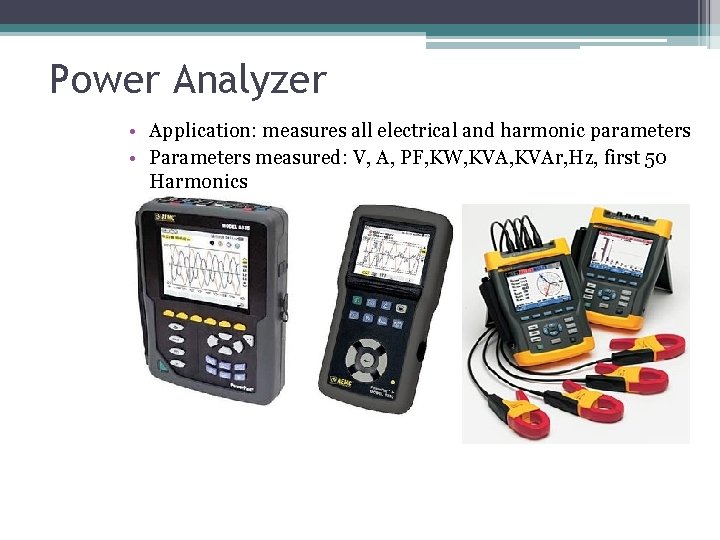
Power Analyzer • Application: measures all electrical and harmonic parameters • Parameters measured: V, A, PF, KW, KVAr, Hz, first 50 Harmonics
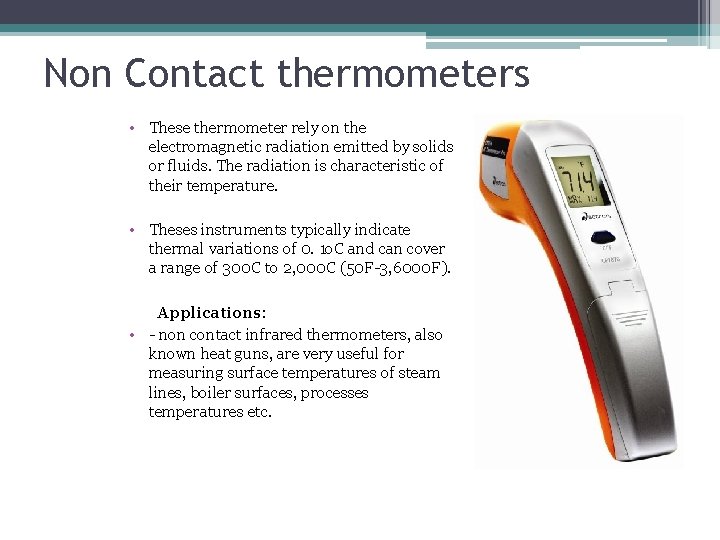
Non Contact thermometers • These thermometer rely on the electromagnetic radiation emitted by solids or fluids. The radiation is characteristic of their temperature. • Theses instruments typically indicate thermal variations of 0. 1 o. C and can cover a range of 300 C to 2, 000 C (50 F-3, 6000 F). Applications: • - non contact infrared thermometers, also known heat guns, are very useful for measuring surface temperatures of steam lines, boiler surfaces, processes temperatures etc.
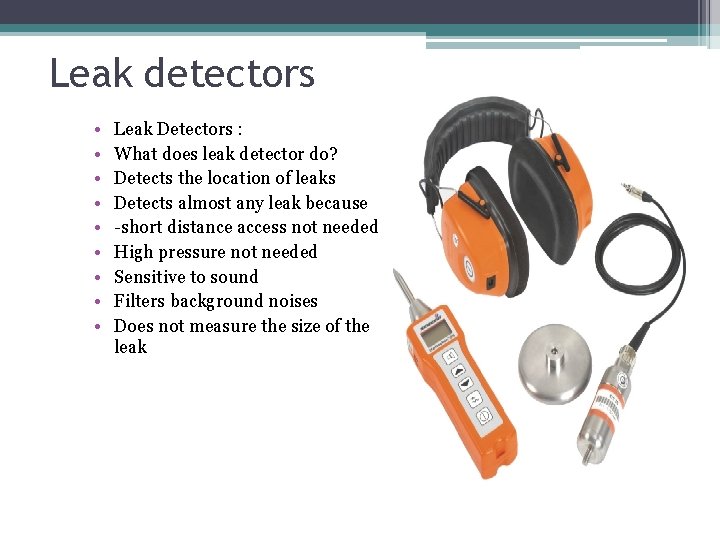
Leak detectors • • • Leak Detectors : What does leak detector do? Detects the location of leaks Detects almost any leak because -short distance access not needed High pressure not needed Sensitive to sound Filters background noises Does not measure the size of the leak
Energy audit report: sample Report on DETAILED ENERGY BUILDING AUDIT Table of Contents Acknowledgement Executive summary -Energy Audit options at a glance & recommendations Introduction about the plant - General Building & process Description Energy audit team Major energy use and areas Component of production cost (raw materials, energy, man power, others)
Energy audit report: sample • - Process description General building information Building systems information and major unit operations Major raw materials inputs, quantity and cost Repair and renovation projects if any Energy and Utility system description - List of utilities - Brief description of each utility Detailed Flow diagram of energy and material balance( of each department) - Flowchart showing flow rate, temperatures, pressures, of all systems - Water balance for entire industry
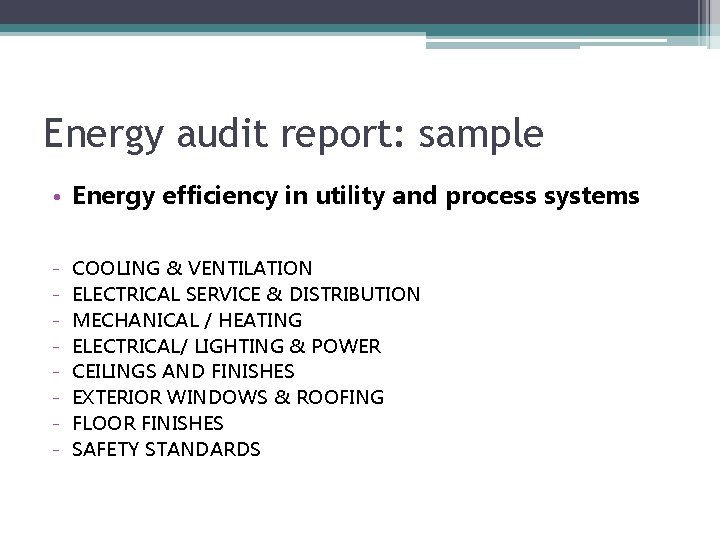
Energy audit report: sample • Energy efficiency in utility and process systems - COOLING & VENTILATION ELECTRICAL SERVICE & DISTRIBUTION MECHANICAL / HEATING ELECTRICAL/ LIGHTING & POWER CEILINGS AND FINISHES EXTERIOR WINDOWS & ROOFING FLOOR FINISHES SAFETY STANDARDS
Energy audit report: sample • Energy Conservation options and recommendations - List of options in terms of No Cost. Medium and high cost, annual energy and cost savings and payback - Implementation plan for energy savings projects
Energy audit report: sample • Annexes: • List of energy audit • List of instruments used • List of vendors and others details
ADDIE & Training Cycle
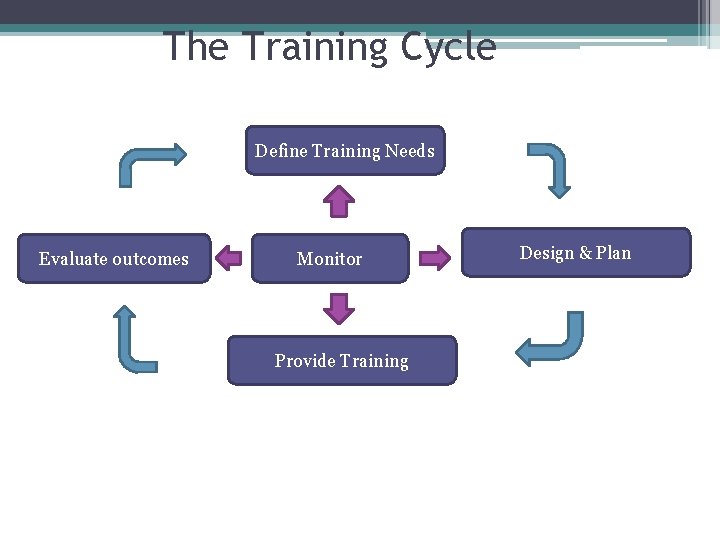
The Training Cycle Define Training Needs Evaluate outcomes Monitor Provide Training Design & Plan
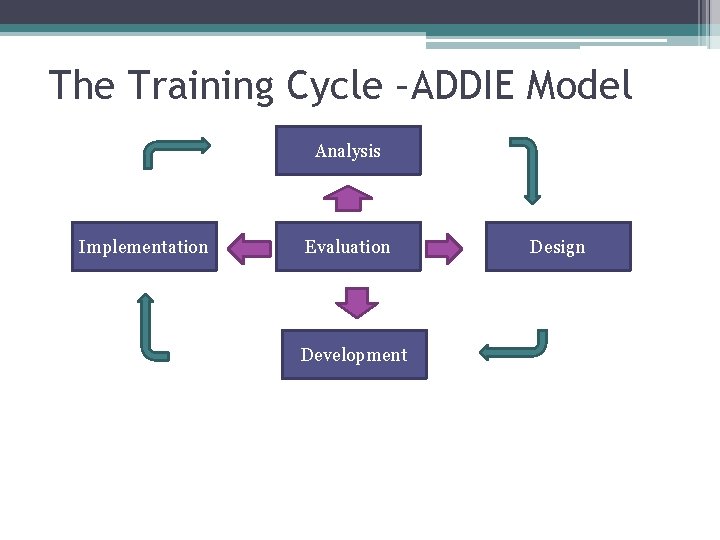
The Training Cycle –ADDIE Model Analysis Implementation Evaluation Development Design
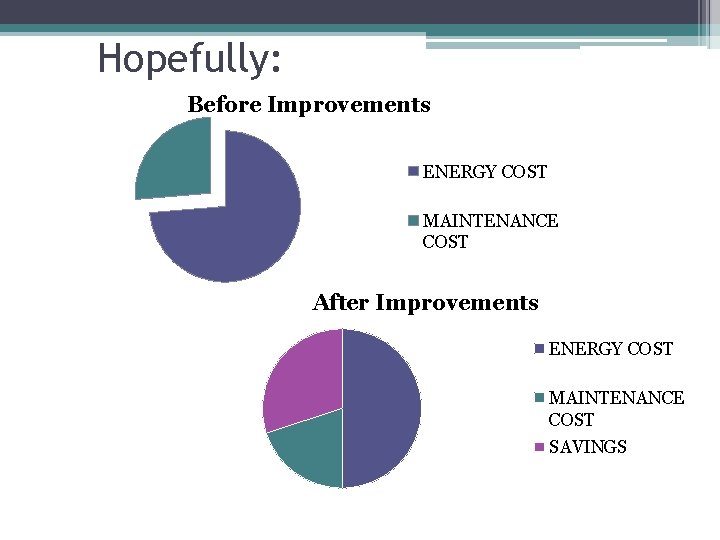
Hopefully: Before Improvements ENERGY COST MAINTENANCE COST After Improvements ENERGY COST MAINTENANCE COST SAVINGS

Thank you!
- Slides: 36