
Opportunities for Growth Building a Business with LongTerm
Opportunities for Growth: Building a Business with Long-Term Care William Popomaronis P. D. Vice-President, Professional Affairs
The strength of our numbers NCPA represents the interests of America's community pharmacists, including the owners of more than 22, 000 independent community pharmacies. Together they represent an $81. 5 billion health care marketplace and employ more than 250, 000 people. Forty percent (40%) of members provide LTC services.
What differentiates our members As community-based healthcare professionals and entrepreneurs, independent pharmacists are uniquely positioned to customize solutions to healthcare challenges affecting local communities and employers.

Our mission We deliver advocacy, connections and solutions that enable independent pharmacists to thrive.
Advancing LTC Services in Your Community Asking the Right Questions Let’s Get Started
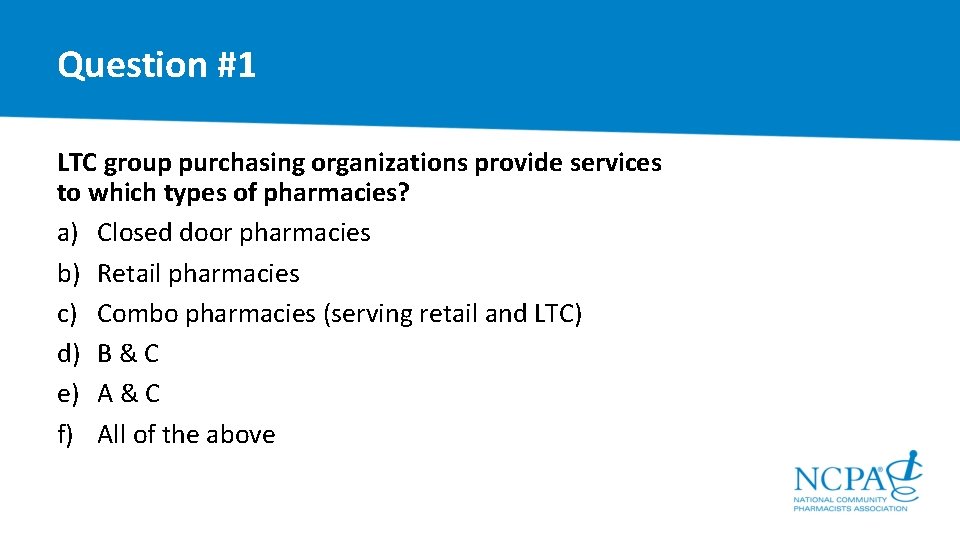
Question #1 LTC group purchasing organizations provide services to which types of pharmacies? a) Closed door pharmacies b) Retail pharmacies c) Combo pharmacies (serving retail and LTC) d) B & C e) A & C f) All of the above
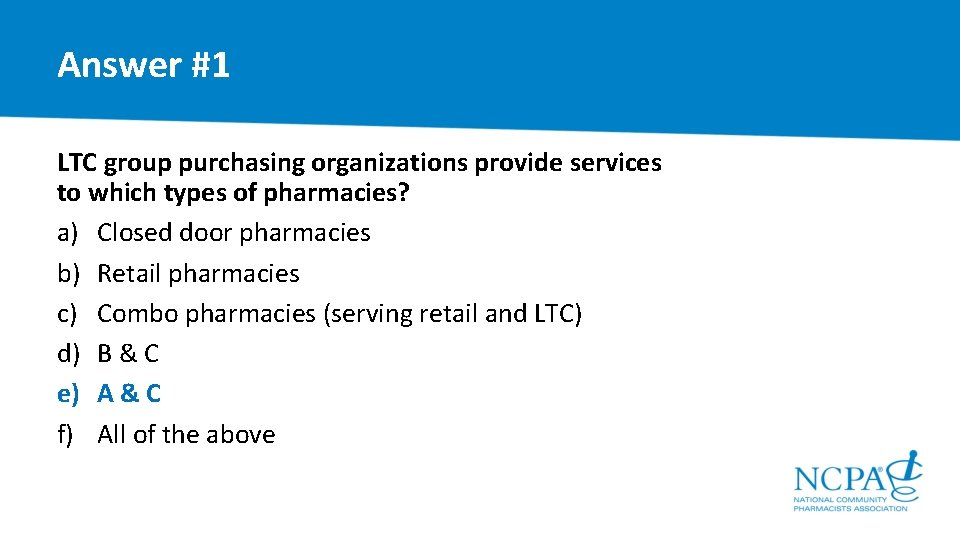
Answer #1 LTC group purchasing organizations provide services to which types of pharmacies? a) Closed door pharmacies b) Retail pharmacies c) Combo pharmacies (serving retail and LTC) d) B & C e) A & C f) All of the above
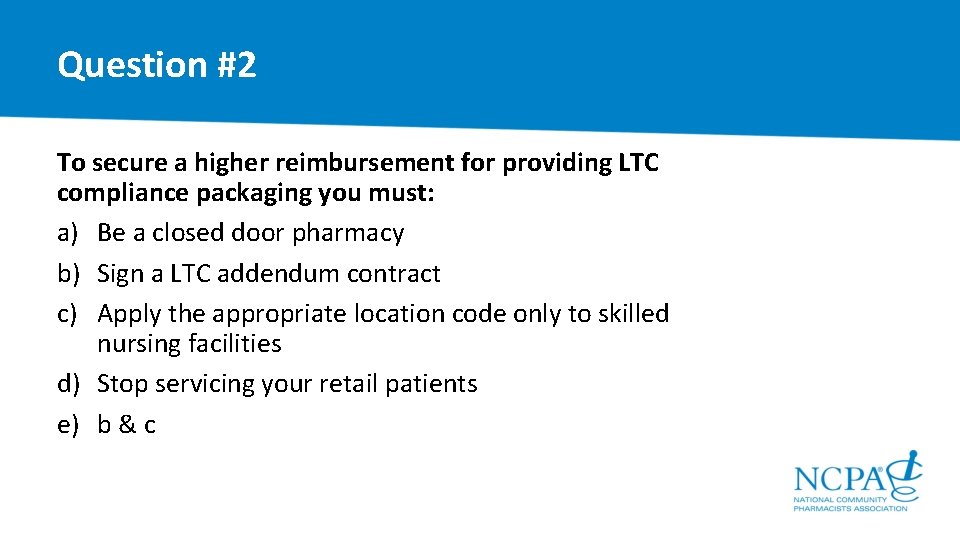
Question #2 To secure a higher reimbursement for providing LTC compliance packaging you must: a) Be a closed door pharmacy b) Sign a LTC addendum contract c) Apply the appropriate location code only to skilled nursing facilities d) Stop servicing your retail patients e) b & c
Answer #2 To secure a higher reimbursement for providing LTC compliance packaging you must: a) Can only be a closed door pharmacy b) Sign a LTC addendum contract c) Apply the appropriate location code only to skilled nursing facilities d) Stop servicing your retail patients e) b & c
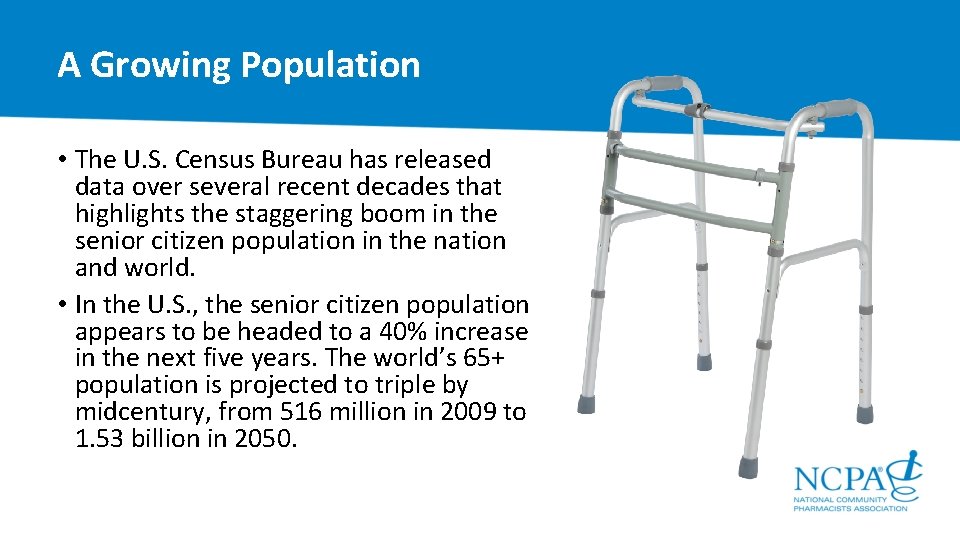
A Growing Population • The U. S. Census Bureau has released data over several recent decades that highlights the staggering boom in the senior citizen population in the nation and world. • In the U. S. , the senior citizen population appears to be headed to a 40% increase in the next five years. The world’s 65+ population is projected to triple by midcentury, from 516 million in 2009 to 1. 53 billion in 2050.
A Changing Population • With an expanding senior population, the ways we define health care for this population continue to expand as well. • The PPACA (Patient Protection and Affordable Care Act) has expanded the definition to better meet the financial and medical needs of seniors.
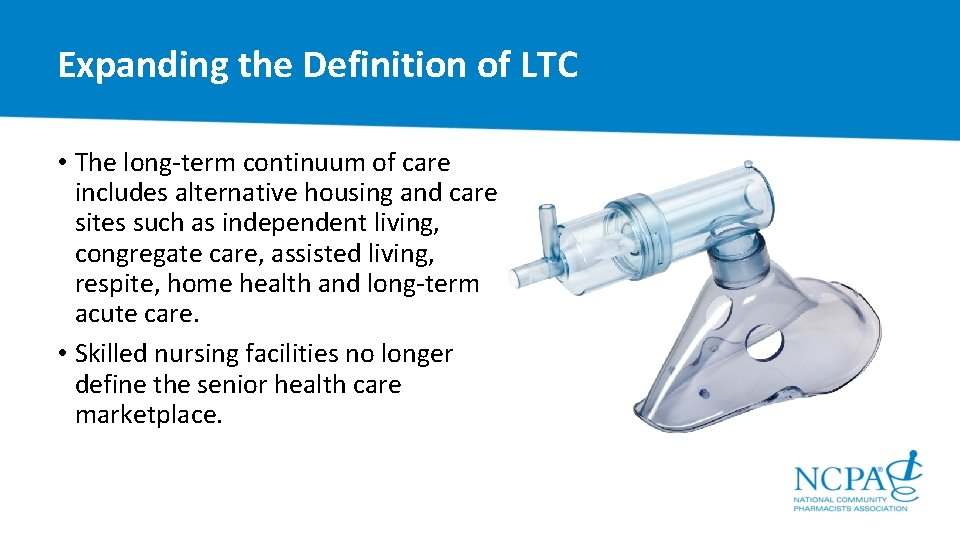
Expanding the Definition of LTC • The long-term continuum of care includes alternative housing and care sites such as independent living, congregate care, assisted living, respite, home health and long-term acute care. • Skilled nursing facilities no longer define the senior health care marketplace. 13
Expanding the Definition of LTC (Cont’d) • Fortunately, the range of senior care options continues to expand to better meet the financial needs of individuals and they are making decisions based on their desires rather than need. • The customer is the senior, and the market will follow that customer through the myriad of care settings. • Long-term care has fewer “long-term” patients.
Expanding the Definition of LTC (Cont’d) • 70% of the individuals entering a skilled nursing facility are discharged within 45 days. • Home health and home companion care have become the standard care for the aged both at home and in assisted living.
Demographic Profile: Consumers of Aging Services • Adult day centers provide care for more 900, 000 older Americans each day. • There are 2. 6 million beneficiaries using home health agencies. • By the year 2040, 88 million older Americans will need some form of assistive care. • People age 65 face at least a 70% lifetime risk of entering a nursing home. Source: Leading Age 16
LTC: The Pharmacist’s Role • The senior care pharmacy practice is both clinical and business in nature. • Should be a staple offering in your community pharmacy. • It starts with keeping seniors well and in their communities. • Caregiver stress is real! • The senior care pharmacist should always be looking for opportunities to perform MTM, provide packaging that drives adherence, and provide CMR. • Let’s take a look at care settings.
Skilled Nursing Facilities (SNF) • Acute and sub acute care levels— however only 30% remain long-term, the rest are discharged • Highly regulated • Medication ordering, delivery, and storage have to be clearly defined (CMS LTC Performance Standards 2005) • https: //www. cms. gov/Medicare/Prescription-Drug. Coverage/Prescription. Drug. Cov. Contra/downloads/LTC Guidance. pdf • Most receive their medications in unit dose blister cards or boxes 18
Skilled Nursing Facility (SNF) (Cont’d) • Short-cycle dispense is mandated • There is an expectation of daily or greater deliveries • Medicare Part A and Part D reimbursement 19
Skilled Nursing Facility (SNF) (Cont’d) • Medicare Part A covers: • Skilled nursing provided by participating long-term care facilities only for 100 days, unless the resident has had a re-qualifying hospital stay • The facility is paid for all services with one per diem payment. This is called the prospective payment system (PPS). • Then Medicare Part B 20
Intermediate Care Facilities (aka Nursing Facilities) • Nursing home care for residents needing assistance with activities of daily living (ADL), but without significant nursing requirements. • ADL may be defined as activities we perform for self-care on a daily basis such as bathing, toileting, dressing, or grooming. • Many of these facilities are being reclassified as states start allowing Assisted Living facilities to increase patient acuity in their settings. • Medicare Part A and Part D reimbursement 21
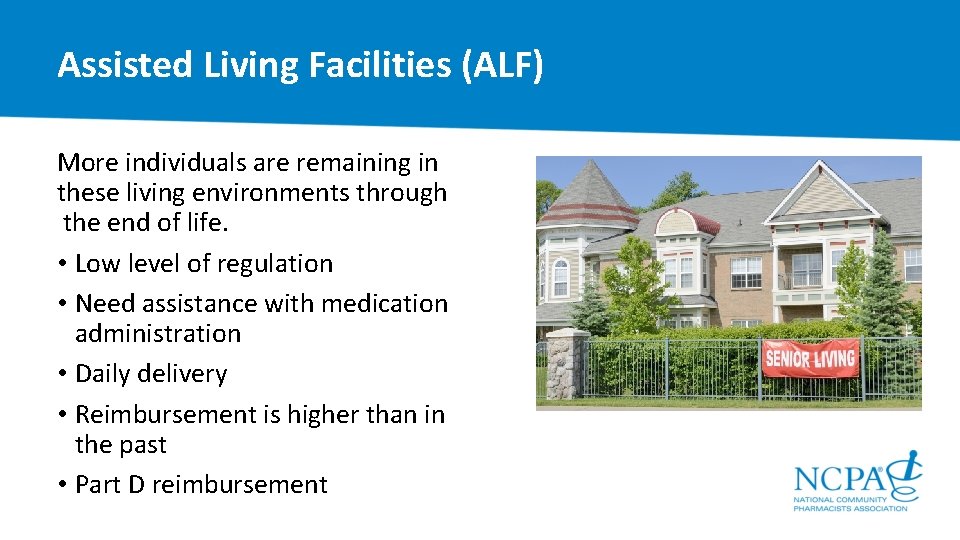
Assisted Living Facilities (ALF) More individuals are remaining in these living environments through the end of life. • Low level of regulation • Need assistance with medication administration • Daily delivery • Reimbursement is higher than in the past • Part D reimbursement 22
Continuing Care Retirement Communities (CCRC) • Part independent living, part assisted living and part skilled nursing home, CCRCs offer a tiered approach to the aging process, accommodating residents’ changing needs. • Upon entering, healthy adults can reside independently in single-family homes, apartments or condominiums. When assistance with everyday activities becomes necessary, they can move into assisted living or nursing care facilities • Also known as Life Cycle Communities • Part A or Part D depending on care level 23 23
Congregate Care/Independent Living • Features a community environment with one or more meals per day prepared and served in a community dining room. • Many other services and amenities may be provided such as transportation, pools, convenience store, bank, barber/beauty shop, resident laundry, housekeeping, and security. • Part D reimbursement 24 24
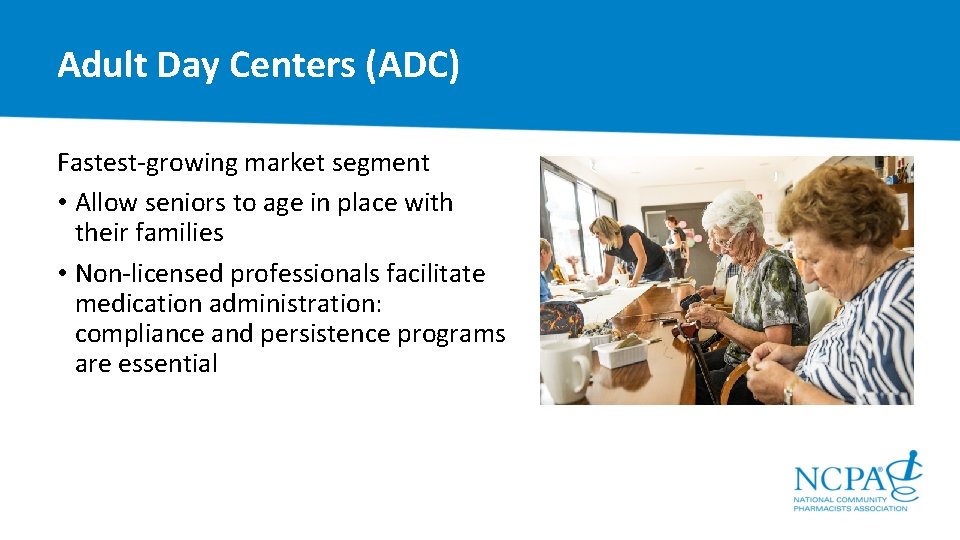
Adult Day Centers (ADC) Fastest-growing market segment • Allow seniors to age in place with their families • Non-licensed professionals facilitate medication administration: compliance and persistence programs are essential 25
Adult Day Centers (ADC) (Cont’d) • Medication monitoring is helpful to allow residents to remain healthy and help the care givers better understand the needs of the patient • Hiring nurses now and are accepting a more medically complex patient • Private Insurance, Part D, Medicaid, Cash 26
New Options • New senior care options are hitting the market place each day. • Transitional Care • Home Community Based services • Medical Home Model • Fastest-growing model in health care reform. • Patient Centered Customized Adherence programs. • Numerous models popping up with skilled nursing as well as hospital. No need to have a contract with facility.
Pay-for-Performance Is Here Medicare has various initiatives to encourage improved quality of care in all health care settings where Medicare beneficiaries receive their health care services, including: • Physician offices • Hospitals • Home health care agencies • Ambulatory care facilities • Nursing homes • Dialysis facilities
Pay-for-Performance Is Here (Cont’d) • Pharmacy reimbursement likely to be effected by star ratings in the near future. Opportunity: what are some key measures pharmacists can influence in the LTC space? Adherence, reduction of poly pharmacy and medication related events • Value based reimbursements in LTC?
Group Purchasing Organizations (GPO) • GPO is in reality a group services organization • Primary value is to closed-door pharmacies. However, many of the GPOs are providing valuable combo shop contracts. • Value proposition includes: • Purchasing – market share incentives • LTC provider networks – Part D (PSAO) • Clinical and business consultant pharmacist tools (formulary management support) • Consistent with most retail buying groups
LTC Addendum Contracts—Location Codes • Must be executed to receive a higher reimbursement for providing LTC compliance packaging • Each payer's definition of LTC pharmacy services vary, however, generally speaking if the medication delivered to a central location and the medication is passed by the appropriate health care professional then
LTC Addendum Contracts—Location Codes (Cont’d) • LTC GPO’s can assist • Patient residence type and pharmacy service type Example: Nursing facility (residence type) Retail (pharmacy type) • Some plans are requiring packaging type • Submission clarification codes are accepted by some plans for short fills for vacation supply, lost meds, therapy change
LTC Addendum Contracts—Location Codes (Cont’d) • Must be executed to receive a higher reimbursement for providing LTC compliance packaging • Each payer's definition of LTC pharmacy services vary, however, generally speaking if the medication delivered to a central location AND the medication is passed by the appropriate health care professional then • LTC GPO’s can assist 33
LTC Addendum Contracts—Location Codes (Cont’d) • Patient residence type and pharmacy service type Example: Nursing facility (residence type) Retail (pharmacy type) • Some plans are requiring packaging type • Submission clarification codes are accepted by some plans for short fills for vacation supply, lost meds, therapy change, etc. 34
Does It LTC Make Business Sense For Me? • Start with ALF on down • 100 residents served equals approximately $750, 000 in gross sales • Mostly Part D billing • Better margins for providing compliance packaging • Some medication review required (State dependent) • Can “close door” the pharmacy – LTC GPOs can assist
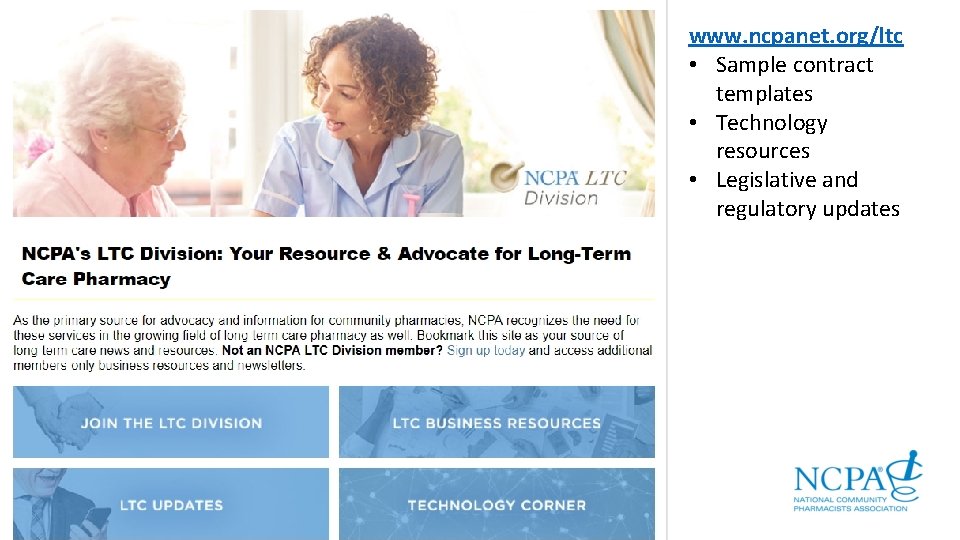
www. ncpanet. org/ltc • Sample contract templates • Technology resources • Legislative and regulatory updates
Questions? William Popomaronis P. D. Vice-President, Professional Affairs william. Popomaronis@ncpanet. org (703) 838 -2644
- Slides: 39