
Opportunities and Blue Ocean Strategy Why Existing Business
Opportunities and Blue Ocean Strategy

Why Existing Business Leave Gaps in the Market?
Reasons… (1) • Established Businesses Fail to See New Opportunities – They resistance to change in response to changing circumstances • New Opportunities are thought to be too small – Small opportunities may be ignored • Fail to advance existing or adopt new technology – Established organisations may regard its business as based on a particular technology rather than the serving of customer needs • Fail to change the way of doing things – The best way to deliver value to customers will change as the competitive climate evolves
Reasons… (2) • Internal Politics – This occurs when individuals and groups do not feel their interests and goals are aligned with those each other or with those of the organisation as a whole • Anti-trust actions by government – Governments are concerned to ensure that monopolies do not distort the workings of an economy • Government intervention to support the new entrant – Governments are tempted to provide support for both the smaller business and the new entrant
Types of Opportunity (1) • New Product – The new product offers the customer a physical device which provides a new means to satisfy a need to solve a problem • New service – The new service offers the customer an act, or a series of acts, which satisfy a particular need or solve a particular problem • New means of production – The product must be produced at lower cost or in a way which allows greater flexibility in the way it is delivered to the customer
Types of Opportunity (2) • New Distribution Route – A new way of getting the product to the customer means that the customer finds it easier, more convenient, or less time consuming to obtain the product or service • Improved service – Enhance the value of a product to the customer by offering an additional service element with it • Relationship building – Relationships are built on trust, and trust adds value by reducing the cost needed to monitor contracts
How many of today’s industries were then unknown, if we look back one hundred years?
Creating Blue Ocean • Finding new opportunities enter the blue ocean • New venture (relatively fewer resources) is hard to compete with the existing business (relatively more resources) in the same market • To win in the future, companies must stop competing with each other • The only way to beat the competition is to stop trying to beat the competition
Blue Ocean vs. Red Ocean • All the industries in existence today • Industry boundaries are defined and accepted, and the competitive rules of the game are known • Complete in the same market space • Beat the competition • Explore existing demand Blue Ocean • All the industries not in existence today • Untapped market space, demand creation, and the opportunity for highly profitable growth • Create uncontested space • Make the competition irrelevant • Create and capture new demand
New Market • The industries never stand still, they continuously evolve • Operations improve, markets expand players come and go • Due to the change of the business environment, the red ocean becomes increasingly bloody, management will need to shift concern to blue oceans
What does the New Business Environment Look Like?
Level Playing Field • Commerce – All competitors have an equal opportunity • Competition – Historical and geographical divisions are becoming increasingly irrelevant • That no matter what your profession-doctor, lawyer, architect, accountant- you had better be good at the touch-feely service stuff – because anything that can be digitised can be outsourced to either the smartest or the cheapest producer, or both.
Flattener 1 • The fall of the Berlin Wall and the proliferation of MS Windows as an Operating System – This fall represented a blow to communism as a form of government – It caused solidarity of the democratic nation against communisms • The Windows OS – Windows became the dominant OS of the era – Communication increased “the age of me and my machine…”
Flattener 2 • Netscape went public – This was the first of many internet booms, a web browser that challenged Microsoft – The digitisation that took place meant that everyday occurrences such as words, files, films, music and pictures could be accessed and manipulated on a computer screen by all people across the world – The silicon bubble – Although the bubble went… has the proliferation of technology slowed?
Flattener 3 • Work flow software – The ability of machines to talk to other machines with no humans involved – Office and work suites that fostered collaboration within and without a company – Commonality of standards (Xtml, TCP/IP) – MS Word became the industry standard
Flattener 4 • Open Source – Communities uploading and collaborating on online projects – Self-organising collaborative communities; peerreviewed software shared and improved through an online community – Apache web server – Linux – Open Office – Star Office – Java – Blogs
Flattener 5 • Outsourcing – Outsourcing has allowed companies to split service and manufacturing activities into components – All the components can be sub-contracted and performed in the most efficient, cost-effective way – This led to the outsourcing phenomenon we see today – Greed led to more greed – Is there anyone to blame?
Flattener 6 • Off shoring – The internal relocation of a company's manufacturing or other processes to a foreign land in order to take advantage of less costly operations there. – Contract manufacturing elevated China to economic prominence – Now countries such as Malaysia, Mexico, Brazil must compete against China and each other to have businesses offshore to them
Flattener 7 • Supply-Chaining – A method of collaborating horizontally—among suppliers, retailer, and customers to create value – Value Chain: activities, functions, and business process that support a product or service – Robust networks of suppliers, retailers, and customers increased business efficiency. – Wal-Mart as the best example of a company using technology to streamline item sales, distribution, and shipping
Flattener 8 • Insourcing – Logistics giants took control of customer supply chains, helping shops go global – UPS as a prime example for insourcing, in which the company's employees perform services-beyond shipping--for another company. – For example, UPS repairs Toshiba computers on behalf of Toshiba. The work is done at the UPS hub, by UPS employees.
Flattener 9 • In-Forming – Power searching allowed everyone to use the internet as a “personal supply chain of knowledge” – Google and other search engines are the prime example – Never before in the history of the planet have so many people-on their own-had the ability to find so much information about so many things and about so many other people
Flattener 10 • “The Steroids” – Light “digital” technology – Digital, Mobile, Personal, and Virtual – Personal digital devices like mobile phones, i. Pods, personal digital assistants, instant messaging, and voice over Internet Protocol
New Business Environment Enhances Red Ocean Competition • You are completing with everyone in this world • As trade barriers between nations and regions are dismantled and as information on products and prices becomes instantly and globally available • Niche markets and havens for monopoly continue to disappear • While supply is on the raise as global competition intensifies, there is no clear evidence of an increase in demand worldwide statistics even point to declining populations in many developed markets
How Can a Company Break Out of the Red Ocean of Bloody Competition?
Value Innovation • Value without innovation tends to focus on value creation through an incremental scale something that improves value but is not sufficient to make you stand out in the marketplace • Innovation without value tends to be technology-driven, market pioneering, or futuristic, often shooting beyond what buyers are ready to accept and pay for • Value innovation occurs only when companies align innovation with utility, price and cost position.
Value Cost – Trade Off • It is conventionally believed that companies can either create greater value at a higher cost or create reasonable value at a lower cost • In blue ocean strategy, you pursue differentiation and low cost simultaneously – Cost savings are made by eliminating and reducing the factors an industry competes on – Buyer value is lifted by rising and creating elements the industry has never offered
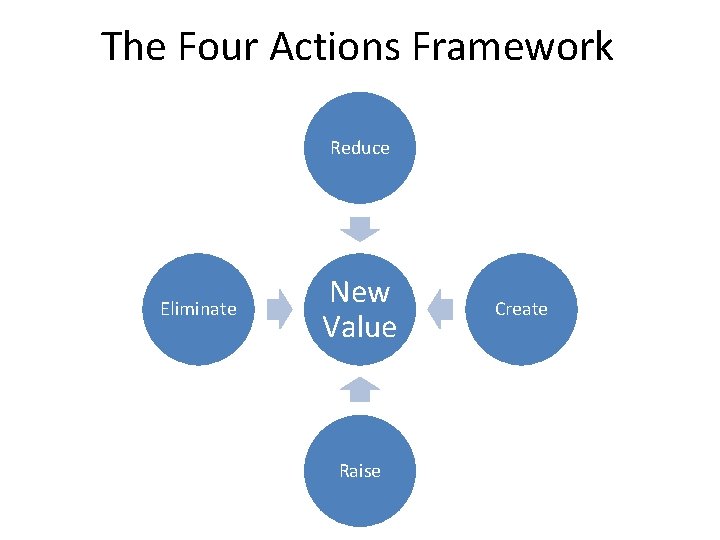
The Four Actions Framework Reduce Eliminate New Value Raise Create
• Eliminate Actions (1) – Which of the factors that the industry takes for granted should be eliminated? – Sometimes there is a fundamental change in what buyers value, but companies that are focused on benchmarking once another do not act on, or even perceive, the change • Reduce – Which factors should be reduced well below the industry’s standard? – The product/service may be over-designed in the race to match and beat the competition • These two actions help the company drop the cost structure
Actions (2) • Raise – Which factors should be raised well above the industry’s standard? – Push you to uncover the compromises your industry force customers to make • Create – Which factors should be created that the industry has never offered? – Discover entirely new sources of value for buyers and to create new demand shift the strategic pricing of the industry • These two actions help the company to lift buyers’ value
Three Characteristics of a Good Strategy • Focus – Reduce cost – Other competitors are hard to match the cost • Divergence – When a company’s strategy is formed reactively as it tries to keep up with the competition, it loses its uniqueness • Compelling tagline – A good tagline must not only deliver a clear message but also advertise and offering trustfully, or else customers will lose trust and interest
A Company Caught in the Red Ocean • Over-delivery without payback – To value-innovate, the company must decide which factors to eliminate and reduce, and not only those to raise and create • An incoherent strategy – They do little to distinguish the company from the best competitor or to provide a clear strategic vision • Strategic contradictions – There areas where a company is offering a high level on one competing factor while ignoring others that support that factor
How do We Formulate Blue Ocean Strategy?
Reconstruct Market Boundaries (1) • Look across alternative industries – A company competes not only with the other firms in its own industry but also with companies in those other industries that produce alternative products or services – Find out why do customers trade across them? • Look across strategic groups within industries – Look at a group of companies within an industry that pursue a similar strategy – Find out where customers trade up, for the higher group, and why do they trade down for the lower one?
Reconstruct Market Boundaries (2) • Look across the chain of buyers – Target customer? , in reality, though, there is a chain of “buyers” who are directly or indirectly involved in the buying decision – The purchasers who pay for the product or service may differ from the actual users, and in some case there are important influencers as well – Find out how to redesign the product/service to focus on a previously overlooked set of buyers • Look across complementary product and service offerings – Few products and services are used in a vacuum. – In most cases, other products and services affect their value – Untapped value is often hidden in complementary products and services – Find out what happens before, during and after the product is used
Reconstruct Market Boundaries (3) • Look across functional or emotional appeal to buyers – Company compete on price and function largely on calculations of utility functional appeal – Company compete on feelings emotional appeal – If company compete on emotional appeal, what elements can you strip out to make it functional? – If company complete on functionality what elements can be added to make it emotional? • Look across time – Looking at external trends with the right perspective can show you how to create blue ocean opportunities – Look for what trends have a high probability of impacting your industry and how can you open up unprecedented customer utility
Focus on the Big Picture • A company and its managers focus their main attention on the big picture rather than becoming immersed in numbers and jargon and getting caught up in operational detail • This approach consistently produces strategies that unlock the creativity of a wide range of people within an organisation, open company eyes to blue oceans, and are easy to understand communicate for effective execution
Visualising Strategy – Visual Awakening • Compare your business with your competitors by drawing your “as is” strategy canvas – Looking for the similarities and differences between your and your competitors • See where your strategy need to change
Visualising Strategy – Visual Exploration • Go into the field to explore the market boundaries – A company should never outsource its eye • Observe the distinctive advantage of alternative products and service • See which factors your should eliminate, create or change
Visualising Strategy – Visual Strategy Fair • Draw your “to be” strategy canvas based on insights from field observations • Get feedback on alternative strategy canvases from customers, competitors’ customer and noncustomers • Use feedback to build the best “to be” future strategy
Visualising Strategy – Visual Communication • Distribute your before and after strategic profiles on one page for easy comparison • Support only those projects and operational moves that allow your company to close the gaps to actualise the new strategy • Employees were motivated by the clear game plan that many pinned up a version of the picture in their mind
Reach Beyond Existing Demand (1) • Conventional strategy practice – Focus on existing customers – The drive for finer segmentation to accommodate buyer differences • Challenges – To grow their share of a market, companies strive to retain and expand existing customers – The more intense the competition is, the greater, on average, is the resulting customisation of offering – It will end up risk creating too-small target markets
Reach Beyond Existing Demand (2) • Blue ocean approach – Instead of concentrating on customers, a company needs to look to non-customers – Instead of focusing on customer differences, company need to build on powerful commonalities in what buyers value – Find out what are these noncustomers have in common and try to meet those needs
Tiers of Non-customer (1) • First tier of noncustomer Soon-to-be – The non-customers who are on the edge of your market – They are buyers who minimally purchase an industry’s offering out of necessity but are mentally non-customers of industry – Upon finding any better alternative, they will eagerly jump ship – If offered a leap in value, not only would they stay, but also their frequency of purchases would multiply, unlocking enormous latent demand
Tiers of Non-customer (2) • Second tier of non-customer – refusing – The people who refuse to use your industry’s offerings – People who either do not use or cannot afford to use the current market offerings because they find the offerings unacceptable or beyond their means – These are buyers who have seen your industry’s offerings as an option to fulfil their needs but have voted against them
Tiers of Non-customer (3) • Third tier of non-customer unexplored – They are farthest from your market – They are non-customers who have never thought of your market’s offerings as an option – These non-customers have not been targeted or thought of as potential customers by any player in the industry – That is because their needs and the business opportunities associated with them have somehow always been assumed to belong to other markets
What are the Hurdles That the Enterprise Needs to Overcome?
Cognitive Hurdle • Cognitive Hurdle – An organisation wedded to the status quo – In many turnarounds and corporate transformations, the hardest battle is simply to make people aware of the need for a strategic shift and to agree on causes • Break through cognitive hurdle – Showing the worst reality to the staff can shift their mind-set – Ask them to listen to their most disgruntled customers first-hand – Don’t rely on market surveys
Resource Hurdle • Resource Hurdle – Limited resources – Does organisation has enough resources to afford these changes? • Break through resource hurdle – Redistribute resources to your hot spot • Hot spot low resource and high performance – Redistribute resources from your cold spot • Cold spot high resource and low performance – Engage in horse trading • Trading your unit’s excess resources in one area for another unit’s excess resources to fill remaining resources gap
Motivational Hurdle • Motivational hurdle – Unmotivated staff • Break through motivational hurdle – Concentrate your efforts on the key influencers in the organisation – Fishbowl management • All the actions and inactions are made as transparent to others as are fish in a bowl of water • It also need to conduct in the fairness manner – Unless people believe that the strategic challenge is attainable, the change is not likely to successes. Therefore, we need to broke the strategic movement into bite-size atoms
Political Hurdle • Political hurdle – Opposition from powerful vested interests • Break through political hurdle – Secure a highly respected influencer on the top management team – Leverage your angles and silence your devils • Angles those who have the most to gain from the strategic shift • Devils those who have the most to lose from it • Building a broader coalition with your angles before a battle begins
We are in the Blue Ocean, Then What?
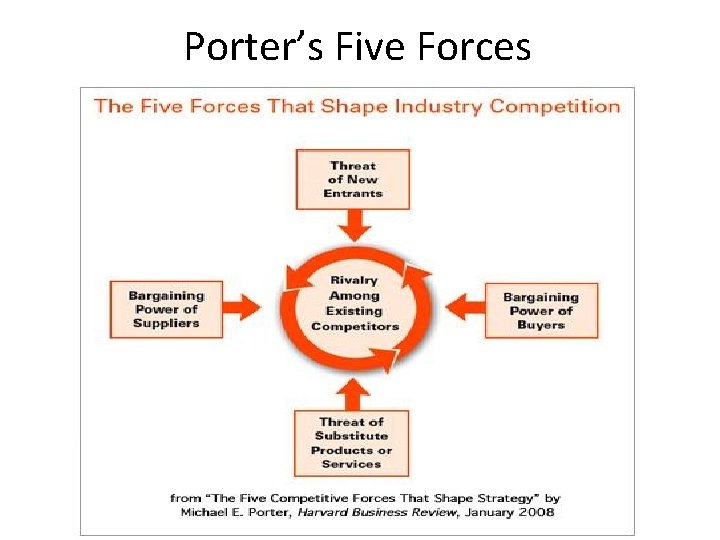
Porter’s Five Forces
New Paradigm… • In Porter’s argument, all five forces are equally weighted • The new paradigm suggests that all five forces are not equally weighted • Among these five forces, the most important force is the “threat of new entrant”. • As a result, once your enterprise enters the blue ocean, the most important task is to create the barrier to entry
Create Barriers to Entry…Some Suggestions…… • Economy of scales – Focuses on creating effective and efficiency cost structure before others’ enter • Continuing innovation – Improve the value of product – Intellectual property protection • Strategic alliance – Ally with the key strategic partner to secure the position in the blue ocean
References • Friedman, T. (2005), The World is Flat: A Brief History of the Twenty-First Century, New York: Farrar, Straus and Giroux • Greenwald, B. and Kahn, J. (2007), Competition Demystified: A Radically Simplified Approach to Business Strategy, Thames, Ditton: Commonwealth Publishing Ltd. • Kim, C. and Mauborgne, R. (2005), Blue Ocean Strategy: How to Create Uncontested Market Space and Make the Competition Irrelevant, Boston: Harvard Business Press • Rae, D. (2007), Entrepreneurship: From Opportunity to Action, Basingstoke, Hampshire: Palgrave Macmillan • Wickham, P. A. (2006), Strategic Entrepreneurship 4 th Ed. , Harlow, Essex: Pearson Education
- Slides: 55