
Opponents of the New Deal Critics of the
- Slides: 16
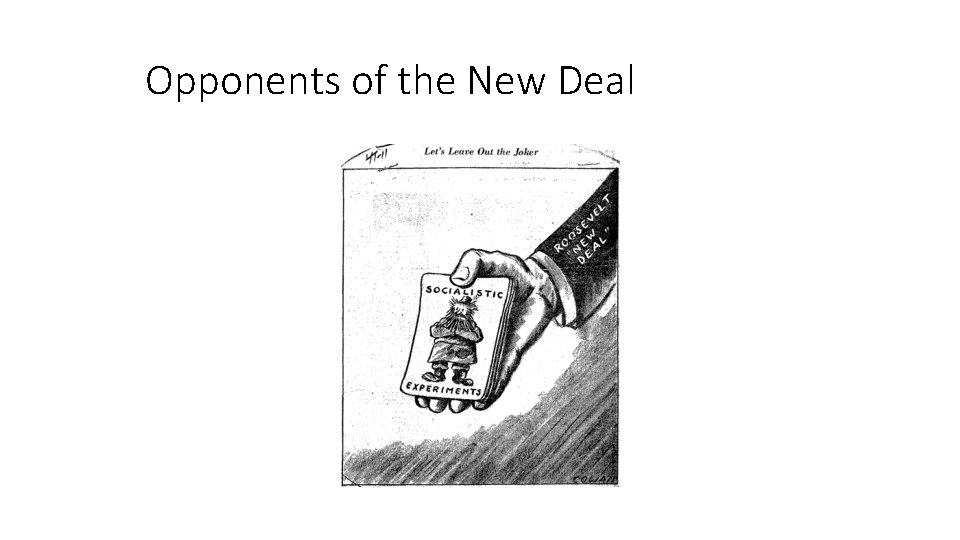
Opponents of the New Deal
Critics of the New Deal • Criticism of the Roosevelt administration ranged from arguments that its policies would harm business and economic recovery to charges that it was subverting democracy. • Some critics labeled the New Deal as fascism, although at that time fascism did not connote the racism of the Nazis but rather an ideology of authoritarian nationalism and planned economy, associated with Benito Mussolini's Italy. • Conservative critics saw the New Deal as a manifestation of socialism or communism. • The left accused Roosevelt of empowering big business while the right opposed the policies that regulated business and expanded workers' rights.
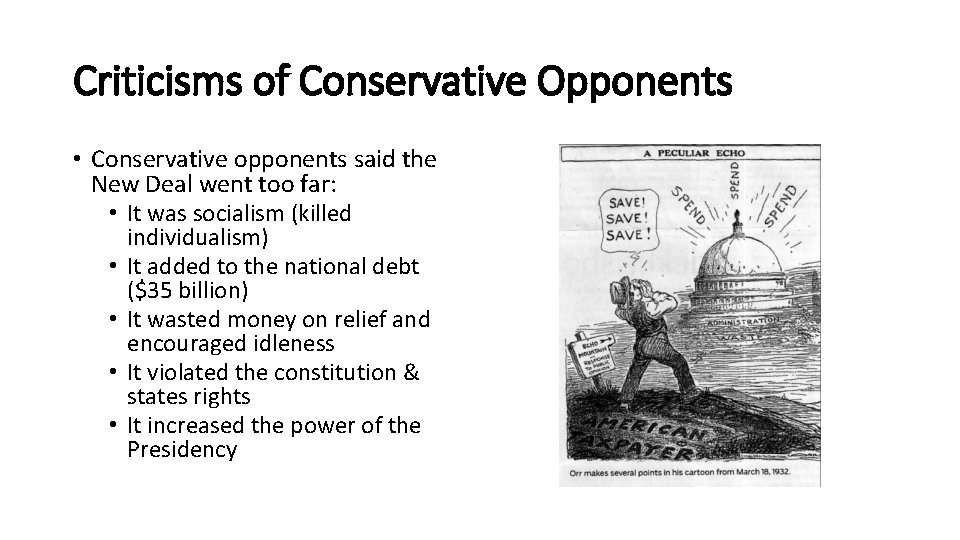
Criticisms of Conservative Opponents • Conservative opponents said the New Deal went too far: • It was socialism (killed • • individualism) It added to the national debt ($35 billion) It wasted money on relief and encouraged idleness It violated the constitution & states rights It increased the power of the Presidency
The American Liberty League • Formed in 1934 by conservative Democrats such as Al Smith with the support of many industrialists • Its stated goal to "defend and uphold the Constitution" and "foster the right to work, earn, save and acquire property. " • The League spent between $500, 000 and $1. 5 million in promotional campaigns; much of their funding came from leaders of Dupont, U. S. Steel, General Motors, Standard Oil, and Goodyear Tire and Rubber Company. • It reached over 125, 000 members. • The League used print media and radio to distribute information • Its political goal was defeating FDR in 1936, backing the presidential candidacy of Republican Governor Alf Landon. • FDR’s strategy: Make the Liberty League synonymous with social and economic privilege, associate it closely with the Republican Party, then attack the Republicans by attacking the League.
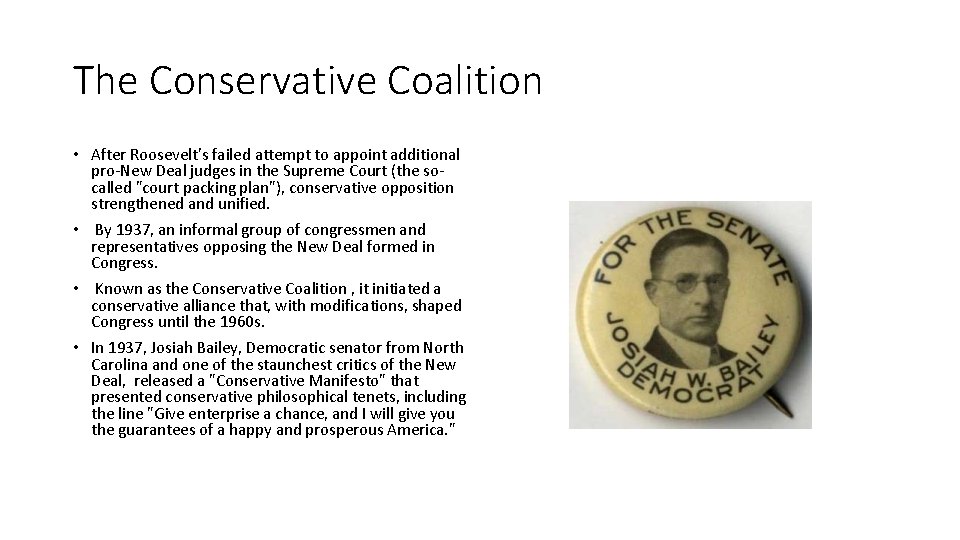
The Conservative Coalition • After Roosevelt's failed attempt to appoint additional pro-New Deal judges in the Supreme Court (the socalled "court packing plan"), conservative opposition strengthened and unified. • By 1937, an informal group of congressmen and representatives opposing the New Deal formed in Congress. • Known as the Conservative Coalition , it initiated a conservative alliance that, with modifications, shaped Congress until the 1960 s. • In 1937, Josiah Bailey, Democratic senator from North Carolina and one of the staunchest critics of the New Deal, released a "Conservative Manifesto" that presented conservative philosophical tenets, including the line "Give enterprise a chance, and I will give you the guarantees of a happy and prosperous America. "
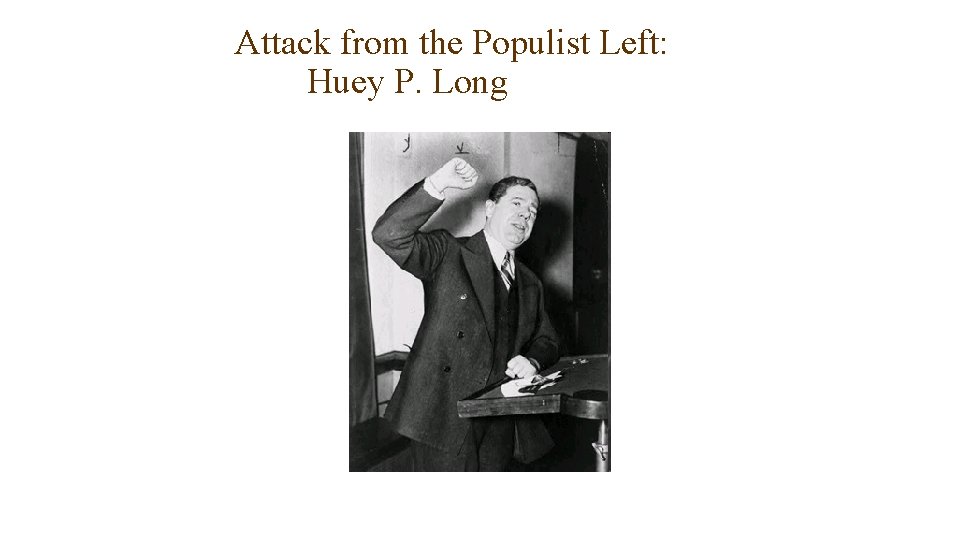
Attack from the Populist Left: Huey P. Long
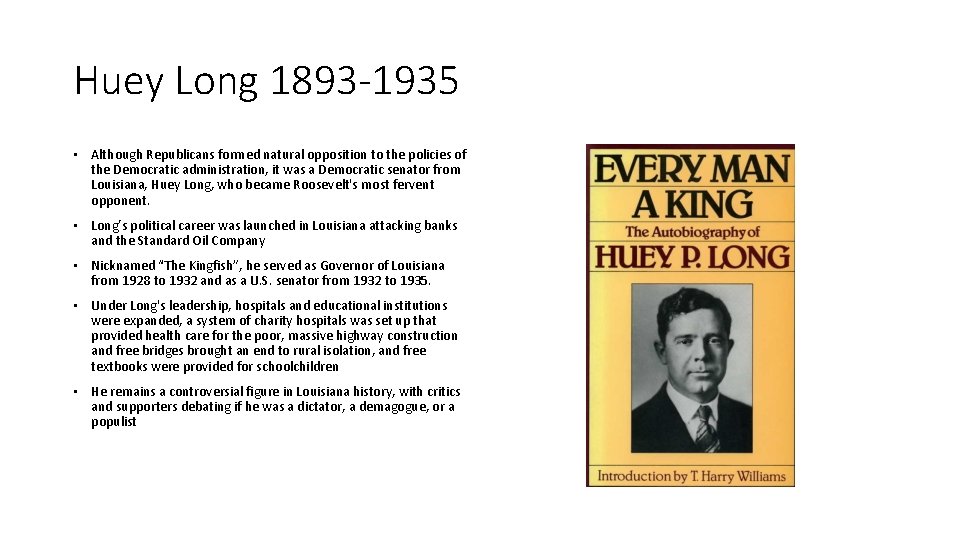
Huey Long 1893 -1935 • Although Republicans formed natural opposition to the policies of the Democratic administration, it was a Democratic senator from Louisiana, Huey Long, who became Roosevelt's most fervent opponent. • Long’s political career was launched in Louisiana attacking banks and the Standard Oil Company • Nicknamed “The Kingfish”, he served as Governor of Louisiana from 1928 to 1932 and as a U. S. senator from 1932 to 1935. • Under Long's leadership, hospitals and educational institutions were expanded, a system of charity hospitals was set up that provided health care for the poor, massive highway construction and free bridges brought an end to rural isolation, and free textbooks were provided for schoolchildren • He remains a controversial figure in Louisiana history, with critics and supporters debating if he was a dictator, a demagogue, or a populist
Share-Our-Wealth • In 1934, Long proposed a radical wealth redistribution plan which called for heavy taxes on accumulated wealth over one million dollars. • The tax revenue would support the following: 1) A family allowance of $5, 000 a year. 2) An annual guaranteed income of $2, 500. 3) Old age pensions at 60 4) Immediate payment of veteran’s benefits 5) Free college and vocational school tuition 6) Govt. purchase and storage of agricultural surplus • He popularized his ideas through radio and Share Our Wealth clubs began to mushroom across the country. • There were seven million members in Share-Our-Wealth Societies across the nation • While some labeled Long a socialist, Roosevelt called him "one of the two most dangerous men in America" and accused him of spreading fascism. • Historians believe that pressure from Long and his organization contributed to Roosevelt's "turn to the left" in 1935. He enacted the Second New Deal, including the Social Security Act, the Works Progress Administration, the National Labor Relations Board, Aid to Dependent Children, the National Youth Administration, and the Wealth Tax Act of 1935. • In private, Roosevelt candidly admitted to trying to "steal Long's thunder”. • A secret Democratic National Committee poll showed yjat Long would get 10% of the vote as a third party candidate in 1936. • Long followed up his earlier autobiography, Every Man a King, with a second book titled My First Days in the White House, laying out his plans for the presidency after the election. • He was assassinated in 1935, shortly after he announced that he would run for president.
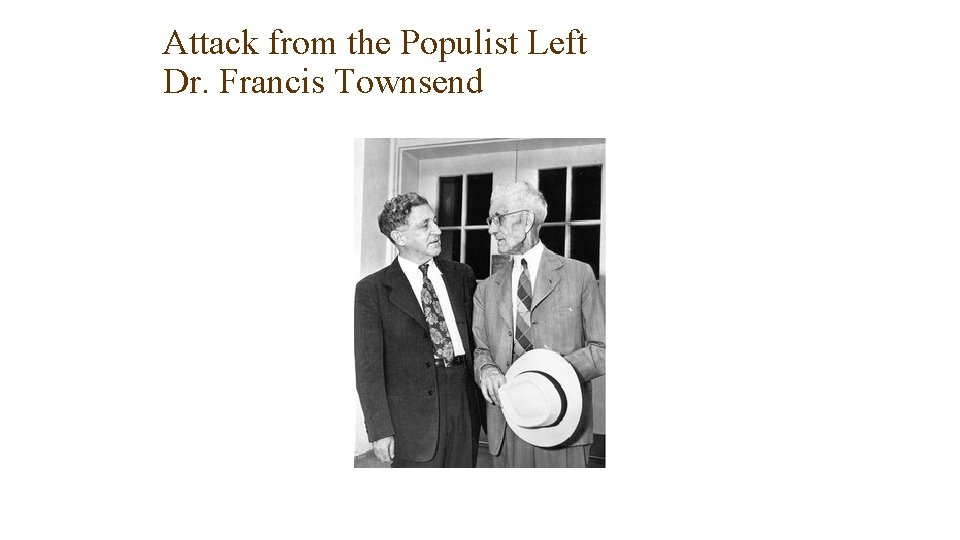
Attack from the Populist Left Dr. Francis Townsend
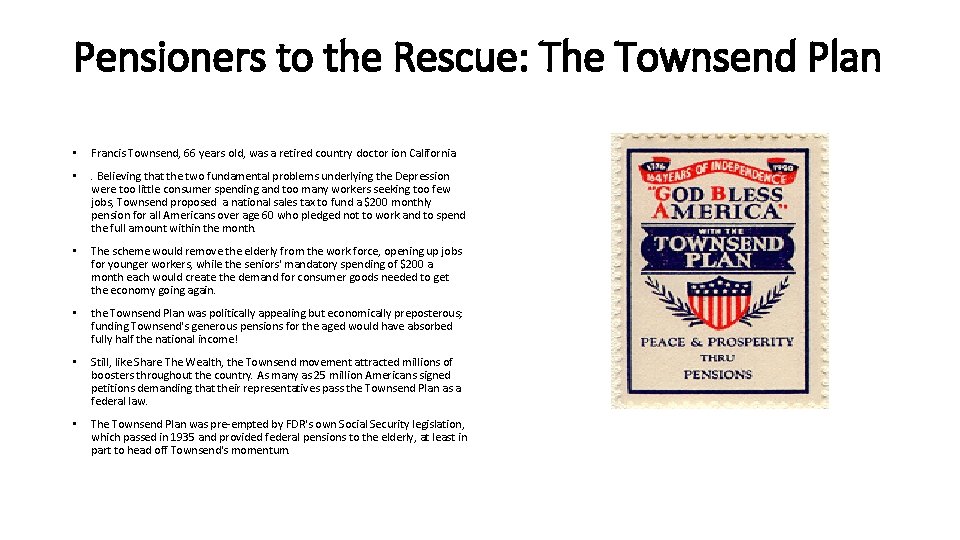
Pensioners to the Rescue: The Townsend Plan • Francis Townsend, 66 years old, was a retired country doctor ion California • . Believing that the two fundamental problems underlying the Depression were too little consumer spending and too many workers seeking too few jobs, Townsend proposed a national sales tax to fund a $200 monthly pension for all Americans over age 60 who pledged not to work and to spend the full amount within the month. • The scheme would remove the elderly from the work force, opening up jobs for younger workers, while the seniors' mandatory spending of $200 a month each would create the demand for consumer goods needed to get the economy going again. • the Townsend Plan was politically appealing but economically preposterous; funding Townsend's generous pensions for the aged would have absorbed fully half the national income! • Still, like Share The Wealth, the Townsend movement attracted millions of boosters throughout the country. As many as 25 million Americans signed petitions demanding that their representatives pass the Townsend Plan as a federal law. • The Townsend Plan was pre-empted by FDR's own Social Security legislation, which passed in 1935 and provided federal pensions to the elderly, at least in part to head off Townsend's momentum.
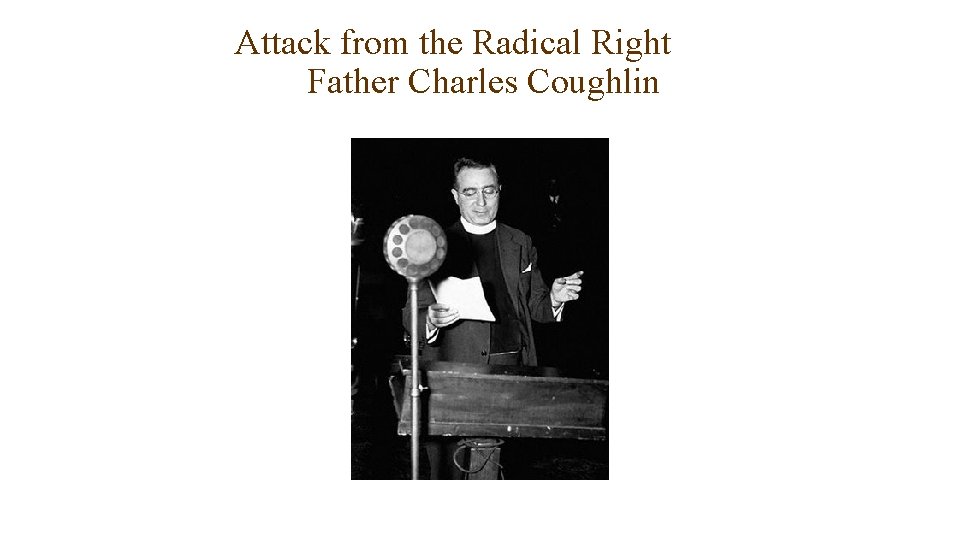
Attack from the Radical Right Father Charles Coughlin
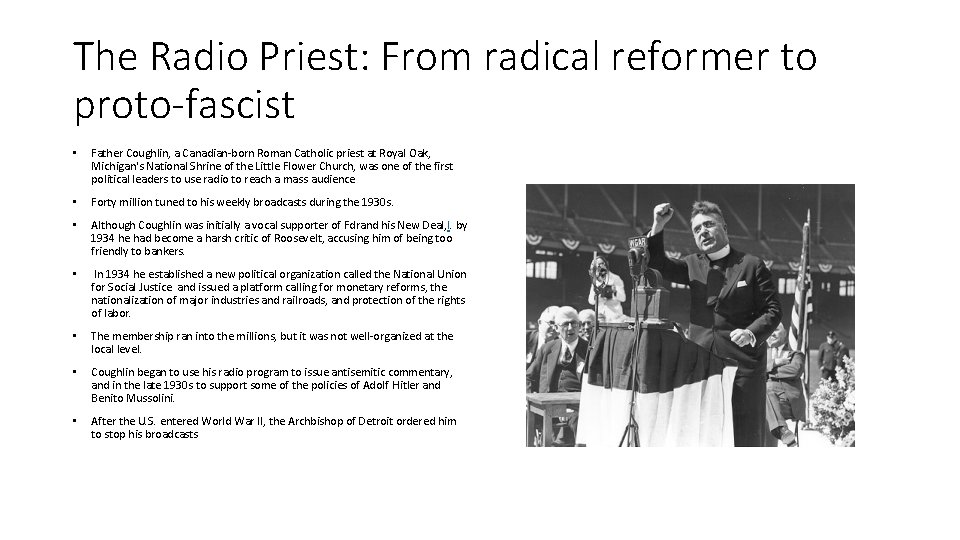
The Radio Priest: From radical reformer to proto-fascist • Father Coughlin, a Canadian-born Roman Catholic priest at Royal Oak, Michigan's National Shrine of the Little Flower Church, was one of the first political leaders to use radio to reach a mass audience • Forty million tuned to his weekly broadcasts during the 1930 s. • Although Coughlin was initially a vocal supporter of Fdrand his New Deal, l. by 1934 he had become a harsh critic of Roosevelt, accusing him of being too friendly to bankers. • In 1934 he established a new political organization called the National Union for Social Justice and issued a platform calling for monetary reforms, the nationalization of major industries and railroads, and protection of the rights of labor. • The membership ran into the millions, but it was not well-organized at the local level. • Coughlin began to use his radio program to issue antisemitic commentary, and in the late 1930 s to support some of the policies of Adolf Hitler and Benito Mussolini. • After the U. S. entered World War II, the Archbishop of Detroit ordered him to stop his broadcasts
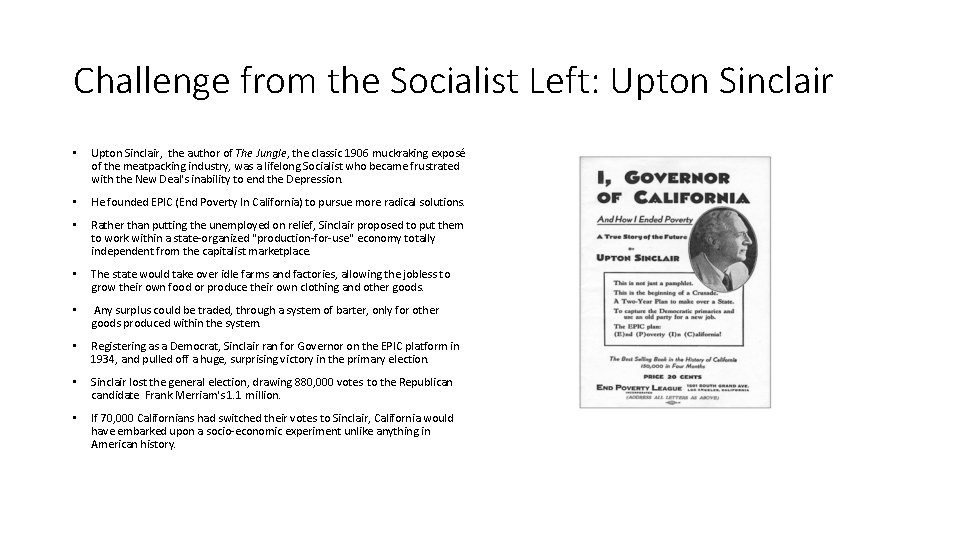
Challenge from the Socialist Left: Upton Sinclair • Upton Sinclair, the author of The Jungle, the classic 1906 muckraking exposé of the meatpacking industry, was a lifelong Socialist who became frustrated with the New Deal's inability to end the Depression. • He founded EPIC (End Poverty In California) to pursue more radical solutions. • Rather than putting the unemployed on relief, Sinclair proposed to put them to work within a state-organized "production-for-use" economy totally independent from the capitalist marketplace. • The state would take over idle farms and factories, allowing the jobless to grow their own food or produce their own clothing and other goods. • Any surplus could be traded, through a system of barter, only for other goods produced within the system. • Registering as a Democrat, Sinclair ran for Governor on the EPIC platform in 1934, and pulled off a huge, surprising victory in the primary election. • Sinclair lost the general election, drawing 880, 000 votes to the Republican candidate Frank Merriam's 1. 1 million. • If 70, 000 Californians had switched their votes to Sinclair, California would have embarked upon a socio-economic experiment unlike anything in American history.
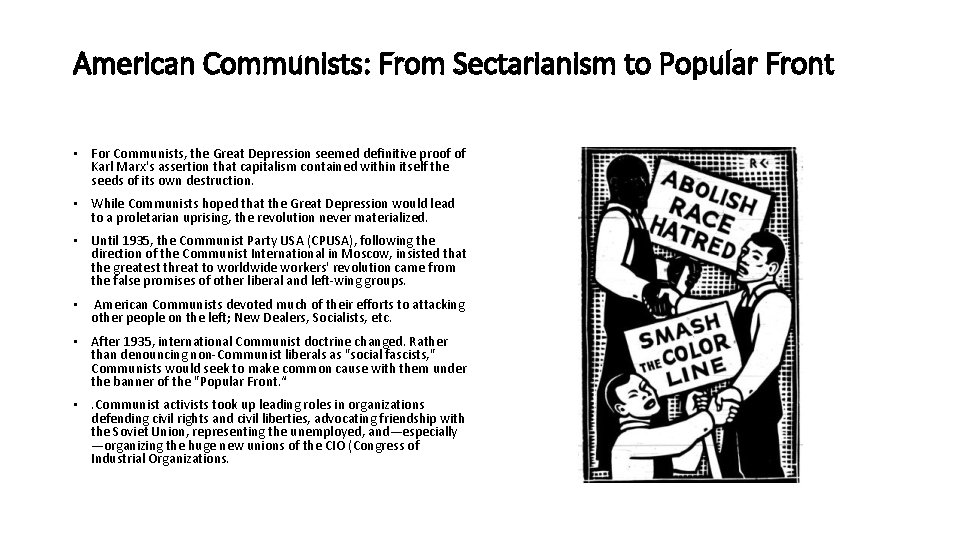
American Communists: From Sectarianism to Popular Front • For Communists, the Great Depression seemed definitive proof of Karl Marx's assertion that capitalism contained within itself the seeds of its own destruction. • While Communists hoped that the Great Depression would lead to a proletarian uprising, the revolution never materialized. • Until 1935, the Communist Party USA (CPUSA), following the direction of the Communist International in Moscow, insisted that the greatest threat to worldwide workers' revolution came from the false promises of other liberal and left-wing groups. • American Communists devoted much of their efforts to attacking other people on the left; New Dealers, Socialists, etc. • After 1935, international Communist doctrine changed. Rather than denouncing non-Communist liberals as "social fascists, " Communists would seek to make common cause with them under the banner of the "Popular Front. “ • . Communist activists took up leading roles in organizations defending civil rights and civil liberties, advocating friendship with the Soviet Union, representing the unemployed, and—especially —organizing the huge new unions of the CIO (Congress of Industrial Organizations.
Did FDR Save Capitalism? • The Great Depression produced a sharp increase in protest and anticapitalist sentiment that threatened to undermine the existing political system and create new political parties. • Roosevelt shifted to the left in rhetoric and policy, consciously seeking to steal the thunder of populist and socialist critics like Huey Long, Father Coughlin and Upton Sinclair. • The Second New Deal produced programs that won the support of working class Americans • The genius of The New Deal is that it was designed with the understanding that in order for capitalism to survive it needs rules harnessing its benefits for the public interest, otherwise it destroys itself either through economic collapse or political revolution.
LASTING IMPACT OF THE NEW DEAL: Political and Economic Results • Political: • increased power of the president • Increased role of Federal government in society • Party Realignment; the Democratic coalition of big city residents, southern whites and northern blacks. • Economic: • created the basics of the American welfare state • aided the stabilization of the stock market and banking system • established a power base for various disadvantaged groups to challenge the dominance of corporations