
OPM 2103 Operations Management Class 9 Strategic Capacity

- Slides: 20
OPM 2103 Operations Management Class 9 – Strategic Capacity Planning Copyright © 2018 Mc. Graw-Hill Higher Education. 1
Class 9 Course Learning Outcomes 3. Apply appropriate qualitative and quantitative methods in various areas of operations management that will facilitate managerial decisions aligned to the strategic priorities of an organization. Session Learning Outcomes 9. 1 9. 2 9. 3 9. 4 9. 5 Name three key questions in capacity planning. Explain the importance of capacity planning Describe ways of defining and measuring capacity. Name several determinants of effective capacity. Briefly describe approaches that are useful for evaluating capacity alternatives Copyright © 2018 Mc. Graw-Hill Higher Education. 2
Introduction to Capacity Planning Capacity refers to an upper limit or ceiling on the load that an operating unit can handle The load might be in terms of the number of physical units produced (e. g. , bicycles assembled per hour) or the number of services performed (e. g. , computers upgraded per hour). The operating unit might be a plant, department, machine, store, or worker. Capacity needs include equipment, space, and employee skills. The goal of strategic capacity planning is to achieve a match between the long-term supply capabilities of an organization and the predicted level of long-term demand Overcapacity causes operating costs that are too high, while undercapacity causes strained resources and possible loss of customers. 3
9. 1 Name three key questions in capacity planning The key questions in capacity planning are the following: 1. 2. 3. What kind of capacity is needed? How much is needed to match demand? When is it needed? Forecasts are key inputs used to answer the questions of how much capacity is needed and when is it needed. Related questions include: 1. 2. 3. 4. 5. How much will it cost, how will it be funded, and what is the expected return? What are the potential benefits and risks? Are there sustainability issues that need to be addressed? Should capacity be changed all at once, or through several (or more) small changes? Can the supply chain handle the necessary changes? 4
9. 2 Explain the importance of capacity planning For a number of reasons, capacity decisions are among the most fundamental of all the design decisions that managers must make. In fact, capacity decisions can be critical for an organization. 1. Capacity decisions have a real impact on the ability of the organization to meet future demands for products and services; capacity essentially limits the rate of output possible. 2. Capacity decisions affect operating costs. 3. Capacity is usually a major determinant of initial cost. 4. Capacity decisions often involve long-term commitment of resources. 5. Capacity decisions can affect competitiveness. 6. Capacity affects the ease of management. 7. Globalization has increased the importance and the complexity of capacity decisions. 8. Because capacity decisions often involve substantial financial and other resources, it is necessary to plan for them far in advance. 5
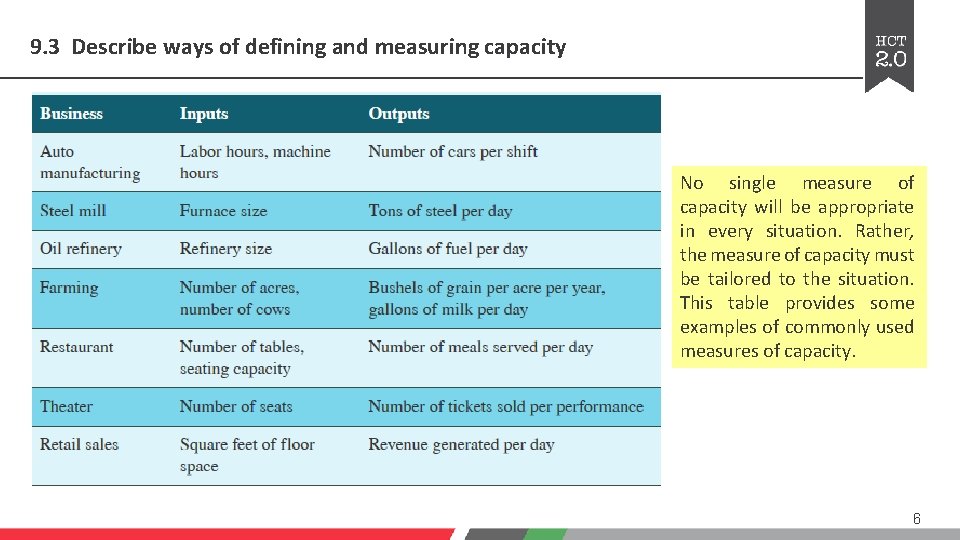
9. 3 Describe ways of defining and measuring capacity No single measure of capacity will be appropriate in every situation. Rather, the measure of capacity must be tailored to the situation. This table provides some examples of commonly used measures of capacity. 6
9. 3 Describe ways of defining and measuring capacity Up to this point, we have been using a general definition of capacity. Although it is functional, it can be refined into two useful definitions of capacity: 1. Design capacity: The maximum output rate or service capacity an operation, process, or facility is designed for. 2. Effective capacity: Design capacity minus allowances such as personal time, and maintenance. 7
9. 3 Describe ways of defining and measuring capacity Design capacity is the maximum rate of output achieved under ideal conditions. Effective capacity is always less than design capacity due to realities of changing product mix, the need for periodic maintenance of equipment, lunch breaks, coffee breaks, problems in scheduling and balancing operations, and similar circumstances. Actual output cannot exceed effective capacity and is often less because of machine breakdowns, absenteeism, shortages of materials, and quality problems, as well as factors that are outside the control of the operations managers. 8
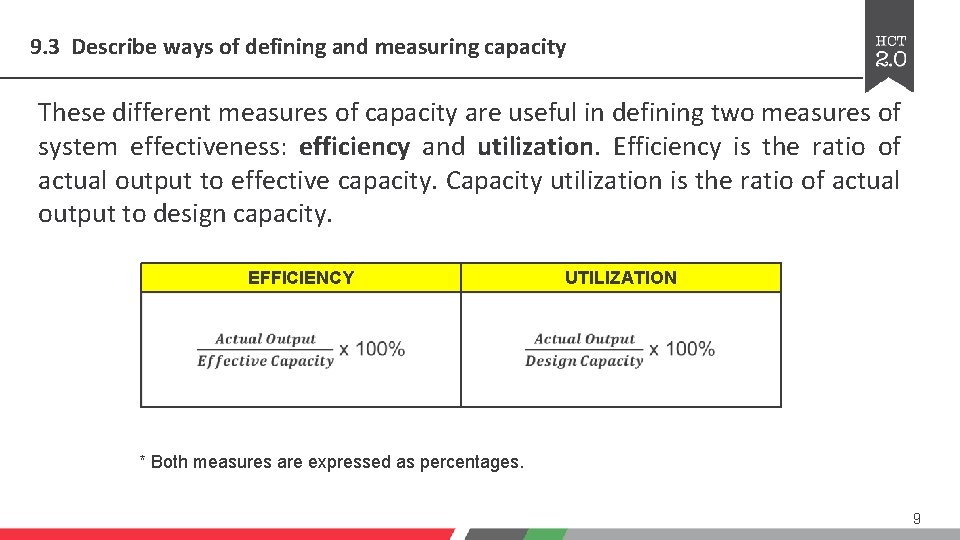
9. 3 Describe ways of defining and measuring capacity These different measures of capacity are useful in defining two measures of system effectiveness: efficiency and utilization. Efficiency is the ratio of actual output to effective capacity. Capacity utilization is the ratio of actual output to design capacity. EFFICIENCY UTILIZATION * Both measures are expressed as percentages. 9
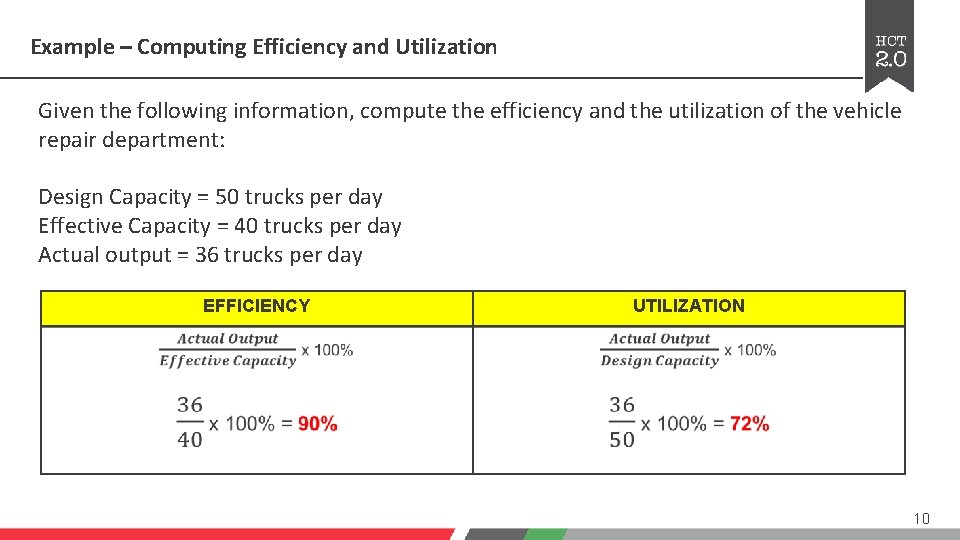
Example – Computing Efficiency and Utilization Given the following information, compute the efficiency and the utilization of the vehicle repair department: Design Capacity = 50 trucks per day Effective Capacity = 40 trucks per day Actual output = 36 trucks per day EFFICIENCY UTILIZATION 10
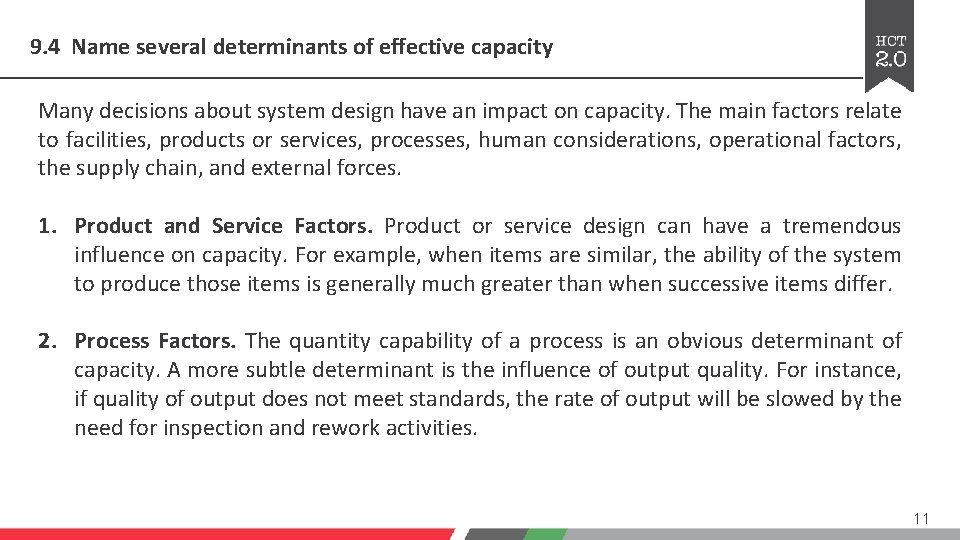
9. 4 Name several determinants of effective capacity Many decisions about system design have an impact on capacity. The main factors relate to facilities, products or services, processes, human considerations, operational factors, the supply chain, and external forces. 1. Product and Service Factors. Product or service design can have a tremendous influence on capacity. For example, when items are similar, the ability of the system to produce those items is generally much greater than when successive items differ. 2. Process Factors. The quantity capability of a process is an obvious determinant of capacity. A more subtle determinant is the influence of output quality. For instance, if quality of output does not meet standards, the rate of output will be slowed by the need for inspection and rework activities. 11
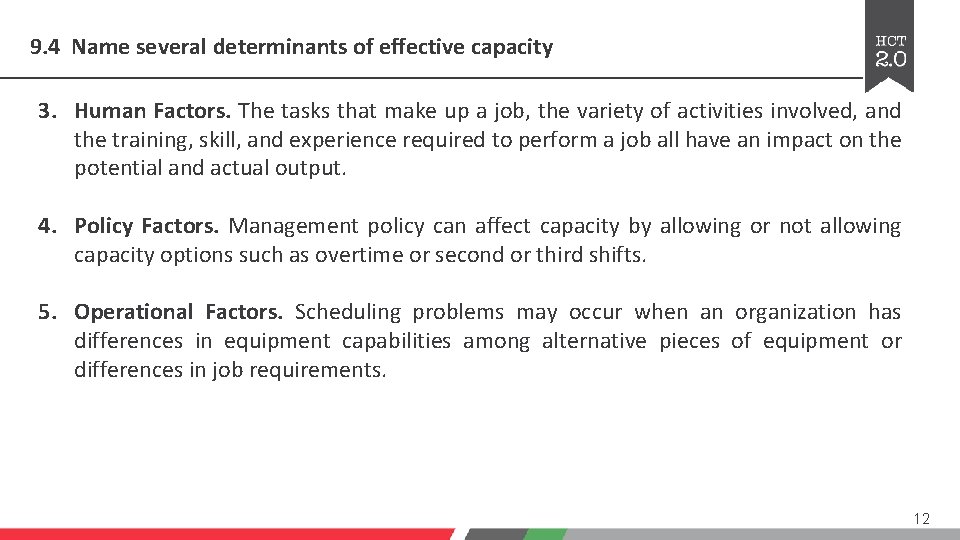
9. 4 Name several determinants of effective capacity 3. Human Factors. The tasks that make up a job, the variety of activities involved, and the training, skill, and experience required to perform a job all have an impact on the potential and actual output. 4. Policy Factors. Management policy can affect capacity by allowing or not allowing capacity options such as overtime or second or third shifts. 5. Operational Factors. Scheduling problems may occur when an organization has differences in equipment capabilities among alternative pieces of equipment or differences in job requirements. 12
9. 4 Name several determinants of effective capacity 6. Supply Chain Factors. Supply chain factors must be taken into account in capacity planning if substantial capacity changes are involved. 7. External Factors. Product standards, especially minimum quality and performance standards, can restrict management’s options for increasing and using capacity. Thus, pollution standards on products and equipment often reduce effective capacity, as does paperwork required by government regulatory agencies by engaging employees in nonproductive activities. A similar effect occurs when a union contract limits the number of hours and type of work an employee may do. 13
9. 5 Briefly describe approaches that are useful for evaluating capacity alternatives An organization needs to examine alternatives for future capacity from a number of different perspectives. A number of techniques are useful for evaluating capacity alternatives from an economic standpoint. Some of the more common are cost–volume analysis, financial analysis, decision theory, and waiting-line analysis. Cost–volume analysis will be covered in our course. Cost–volume analysis focuses on relationships between cost, revenue, and volume of output. The purpose of cost–volume analysis is to estimate the income of an organization under different operating conditions. It is particularly useful as a tool for comparing capacity alternatives. 14
Cost-volume analysis Use of the technique requires identification of all costs related to the production of a given product. These costs are then designated as fixed costs or variable costs. Fixed costs tend to remain constant regardless of volume of output. Examples include rental costs, property taxes, equipment costs, heating and cooling expenses, and certain administrative costs. Variable costs vary directly with volume of output. The major components of variable costs are generally materials and labor costs. We will assume that variable cost per unit remains the same regardless of volume of output, and that all output can be sold. 15
Cost-volume symbols and formula SYMBOL Description To Find Formula FC Fixed Cost TC FC + VC VC Variable Cost VC Qx. V V Variable Cost Per Unit TR Rx. Q TC Total Cost TR Total Revenue P TR – TC R Revenue Per Unit P (alternative formula) Q (R-V) - FC Q Quantity or Volume of Output QBEP Break-even Quantity P Profit QBEP Q to generate specific profit 16
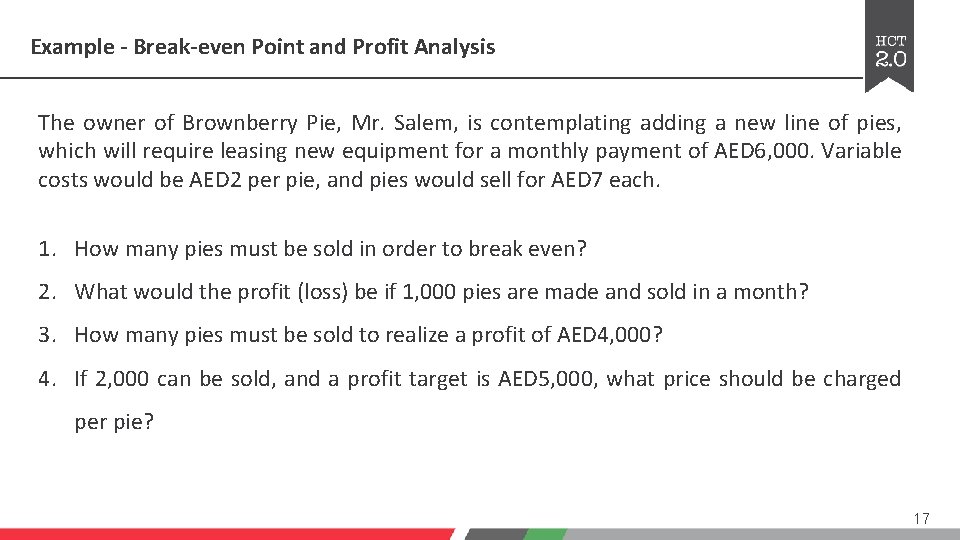
Example - Break-even Point and Profit Analysis The owner of Brownberry Pie, Mr. Salem, is contemplating adding a new line of pies, which will require leasing new equipment for a monthly payment of AED 6, 000. Variable costs would be AED 2 per pie, and pies would sell for AED 7 each. 1. How many pies must be sold in order to break even? 2. What would the profit (loss) be if 1, 000 pies are made and sold in a month? 3. How many pies must be sold to realize a profit of AED 4, 000? 4. If 2, 000 can be sold, and a profit target is AED 5, 000, what price should be charged per pie? 17
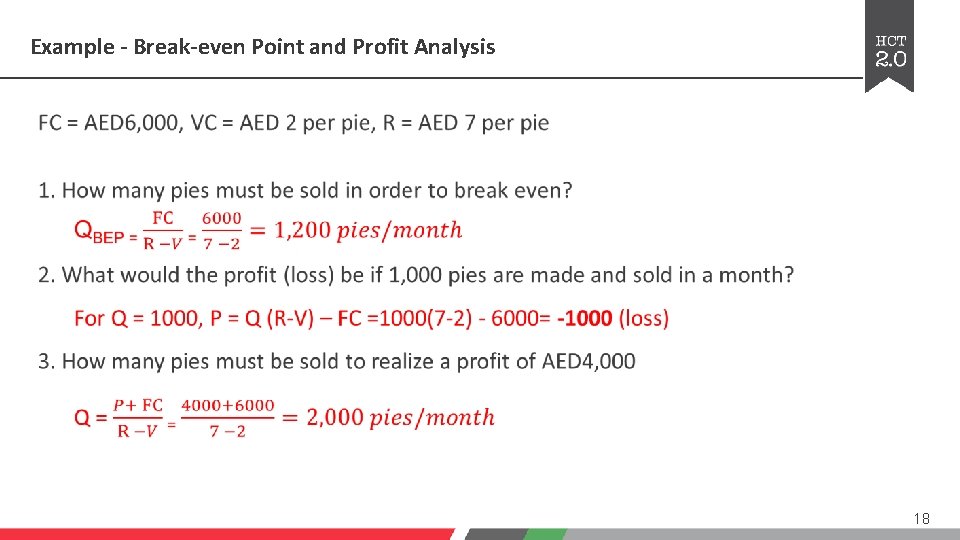
Example - Break-even Point and Profit Analysis 18
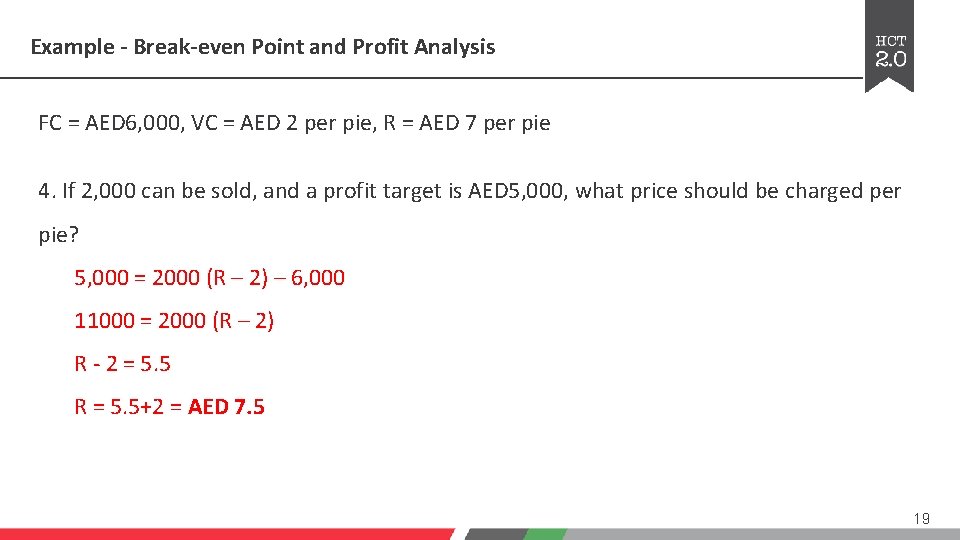
Example - Break-even Point and Profit Analysis FC = AED 6, 000, VC = AED 2 per pie, R = AED 7 per pie 4. If 2, 000 can be sold, and a profit target is AED 5, 000, what price should be charged per pie? 5, 000 = 2000 (R – 2) – 6, 000 11000 = 2000 (R – 2) R - 2 = 5. 5 R = 5. 5+2 = AED 7. 5 19
Questions? 20