
Opioids and the gut Job bag number NPEUNAL0059

Opioids and the gut Job bag number: NP-EU-NAL-0059 Date of preparation: September 2017 1 05/09/2017 © Shionogi Limited. 33 Kingsway. London WC 2 B 6 UF, UK Registered in England Wales No. 07945432.
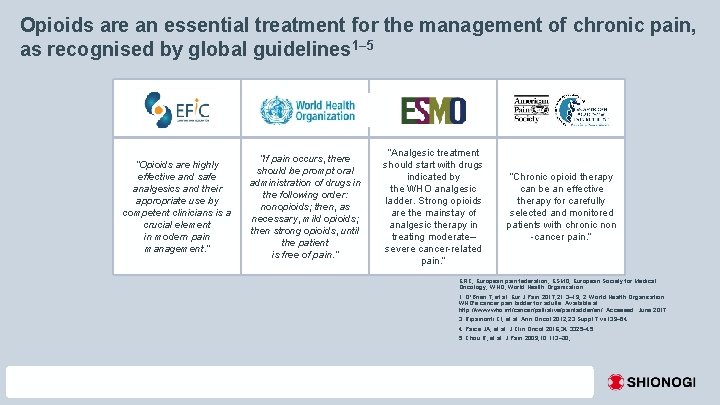
Opioids are an essential treatment for the management of chronic pain, as recognised by global guidelines 1– 5 “Opioids are highly effective and safe analgesics and their appropriate use by competent clinicians is a crucial element in modern pain management. ” “If pain occurs, there should be prompt oral administration of drugs in the following order: nonopioids; then, as necessary, mild opioids; then strong opioids, until the patient is free of pain. ” “Analgesic treatment should start with drugs indicated by the WHO analgesic ladder. Strong opioids are the mainstay of analgesic therapy in treating moderate– severe cancer-related pain. ” “Chronic opioid therapy can be an effective therapy for carefully selected and monitored patients with chronic non -cancer pain. ” EFIC, European pain federation; ESMO, European Society for Medical Oncology; WHO, World Health Organization. 1. O'Brien T, et al. Eur J Pain 2017; 21: 3– 19; 2. World Health Organization. WHO's cancer pain ladder for adults. Available at: http: //www. who. int/cancer/palliative/painladder/en/. Accessed: June 2017 3. Ripamonti CI, et al. Ann Oncol 2012; 23 Suppl 7: vii 139– 54 4. Paice JA, et al. J Clin Oncol 2016; 34: 3325– 45 5. Chou R, et al. J Pain 2009; 10: 113– 30; 2 05/09/2017 © Shionogi Limited. 33 Kingsway. London WC 2 B 6 UF, UK Registered in England Wales No. 07945432.
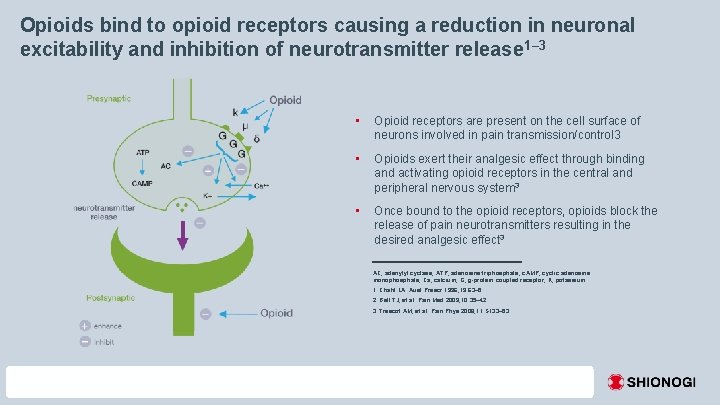
Opioids bind to opioid receptors causing a reduction in neuronal excitability and inhibition of neurotransmitter release 1– 3 • Opioid receptors are present on the cell surface of neurons involved in pain transmission/control 3 • Opioids exert their analgesic effect through binding and activating opioid receptors in the central and peripheral nervous system 3 • Once bound to the opioid receptors, opioids block the release of pain neurotransmitters resulting in the desired analgesic effect 3 AC, adenylyl cyclase; ATP, adenosine triphosphate; c. AMP, cyclic adenosine monophosphate; Ca, calcium; G, g-protein coupled receptor; K, potassium. 1. Chahl LA. Aust Prescr 1996; 19: 63– 5 2. Bell TJ, et al. Pain Med 2009; 10: 35– 42 3. Trescot AM, et al. Pain Phys 2008; 11: S 133– 53 3 05/09/2017 © Shionogi Limited. 33 Kingsway. London WC 2 B 6 UF, UK Registered in England Wales No. 07945432.
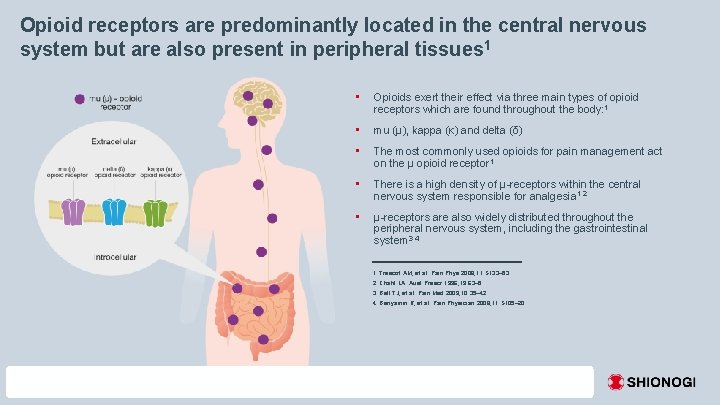
Opioid receptors are predominantly located in the central nervous system but are also present in peripheral tissues 1 • Opioids exert their effect via three main types of opioid receptors which are found throughout the body: 1 • mu (µ), kappa (κ) and delta (δ) • The most commonly used opioids for pain management act on the μ opioid receptor 1 • There is a high density of µ-receptors within the central nervous system responsible for analgesia 1, 2 • µ-receptors are also widely distributed throughout the peripheral nervous system, including the gastrointestinal system 3, 4 1. Trescot AM, et al. Pain Phys 2008; 11: S 133– 53 2. Chahl LA. Aust Prescr 1996; 19: 63– 5 3. Bell TJ, et al. Pain Med 2009; 10: 35– 42 4. Benyamin R, et al. Pain Physician 2008; 11: S 105– 20. 4 05/09/2017 © Shionogi Limited. 33 Kingsway. London WC 2 B 6 UF, UK Registered in England Wales No. 07945432.
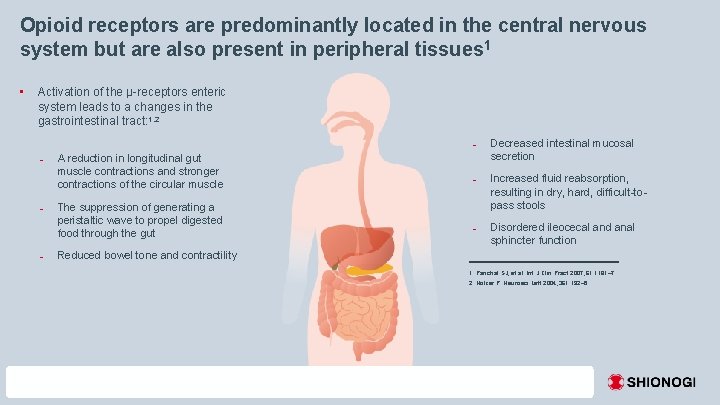
Opioid receptors are predominantly located in the central nervous system but are also present in peripheral tissues 1 • Activation of the µ-receptors enteric system leads to a changes in the gastrointestinal tract: 1, 2 - - - A reduction in longitudinal gut muscle contractions and stronger contractions of the circular muscle The suppression of generating a peristaltic wave to propel digested food through the gut - Decreased intestinal mucosal secretion - Increased fluid reabsorption, resulting in dry, hard, difficult-topass stools - Disordered ileocecal and anal sphincter function Reduced bowel tone and contractility 1. Panchal SJ, et al. Int J Clin Pract 2007; 61: 1181– 7 2. Holzer P. Neurosci Lett 2004; 361: 192– 5. 5 05/09/2017 © Shionogi Limited. 33 Kingsway. London WC 2 B 6 UF, UK Registered in England Wales No. 07945432.
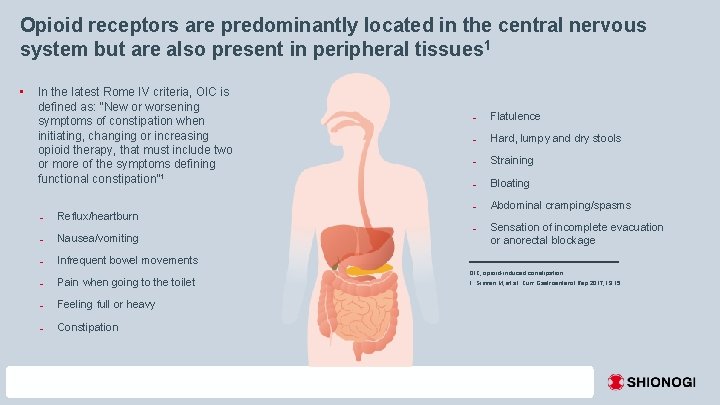
Opioid receptors are predominantly located in the central nervous system but are also present in peripheral tissues 1 • In the latest Rome IV criteria, OIC is defined as: “New or worsening symptoms of constipation when initiating, changing or increasing opioid therapy, that must include two or more of the symptoms defining functional constipation” 1 - Reflux/heartburn - Nausea/vomiting - Infrequent bowel movements - Pain when going to the toilet - Feeling full or heavy - Constipation - Flatulence - Hard, lumpy and dry stools - Straining - Bloating - Abdominal cramping/spasms - Sensation of incomplete evacuation or anorectal blockage OIC, opioid-induced constipation. 6 05/09/2017 1. Simren M, et al. Curr Gastroenterol Rep 2017; 19: 15 © Shionogi Limited. 33 Kingsway. London WC 2 B 6 UF, UK Registered in England Wales No. 07945432.
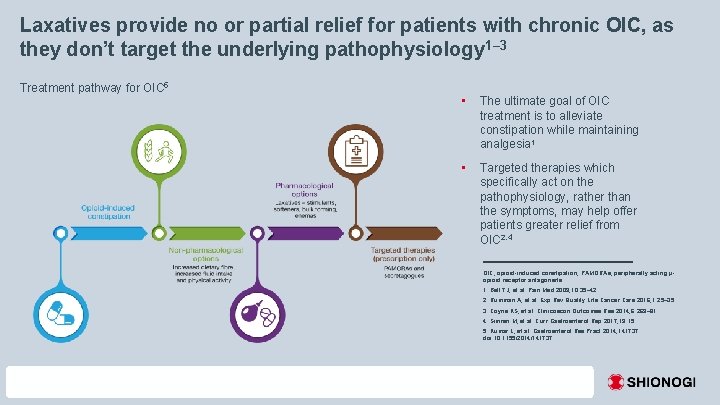
Laxatives provide no or partial relief for patients with chronic OIC, as they don’t target the underlying pathophysiology 1– 3 Treatment pathway for OIC 5 • The ultimate goal of OIC treatment is to alleviate constipation while maintaining analgesia 1 • Targeted therapies which specifically act on the pathophysiology, rather than the symptoms, may help offer patients greater relief from OIC 2, 4 OIC, opioid-induced constipation; PAMORAs, peripherally acting μopioid receptor antagonists. 1. Bell TJ, et al. Pain Med 2009; 10: 35– 42 2. Rumman A, et al. Exp Rev Quality Life Cancer Care 2016; 1: 25– 35 3. Coyne KS, et al. Clinicoecon Outcomes Res 2014; 6: 269– 81 4. Simren M, et al. Curr Gastroenterol Rep 2017; 19: 15 5. Kumar L, et al. Gastroenterol Res Pract 2014; 141737. doi: 10. 1155/2014/141737. 7 05/09/2017 © Shionogi Limited. 33 Kingsway. London WC 2 B 6 UF, UK Registered in England Wales No. 07945432.
- Slides: 7