
Opioid Use Disorder Basics John Mahan MD Melissa
Opioid Use Disorder Basics John Mahan, MD Melissa Weimer, DO, MCR
Disclosures �Dr. Mahan has no disclosures. �Dr. Weimer was a consultant to Indivior, for which she received honorarium. This was a one-time consultation to discuss how to stop taking medication they manufacture.
Objectives �Identify risk factors, signs and symptoms, and co-occurring disorders with opioid use disorders. �Understand how to screen and diagnose opioid use disorders in primary care. �Describe the components of an opioid risk assessment for patients with chronic pain �Describe medication treatment options for opioid use disorder.
Does this person have opioid use disorder? � 45 yo female with chronic low back pain who has been prescribed opioids for the last 5 years. She takes her medication as prescribed, has never had an early refill or lost Rx, all of her urine drug tests are as expected and she sees one provider. She reports being scared about needing to taper her opioids and would like you to stop her opioid taper.
Does this person have an opioid use disorder? � 45 yo female with chronic low back pain who has been prescribed opioids for the last 5 years. She takes her medication as prescribed, has never had an early refill or lost Rx, all of her urine drug tests are as expected and she sees one provider. She started having severe, dental pain after a dental procedure and has been in the ED 3 times in the last month for pain.
Does this person have an opioid use disorder? � 45 yo female with chronic low back pain who has been prescribed opioids for the last 5 years. She takes her medication every 2 hours and sometimes sooner for severe pain. When she was first prescribed opioids, she was working. Now, she is unemployed and has marital discord. She was recently found to have HCV on routine screening.
Addiction is a chronic relapsing disease of brain reward, motivation, memory and related circuitry. It is characterized by compulsive drug seeking and use, accompanied by functional and molecular changes in the brain. It is not a character flaw or lack of willpower.
Brief Neurobiology of Addiction �Addiction is a pathological hijacking of brain mechanisms of reward-related learning and memory �There at least two ways that drugs cause this disruption: ◦ (1) by imitating the brain’s natural chemical messengers and ◦ (2) by over-stimulating the “reward circuit” of the brain.

Pathological Hijacking �The brain starts to ◦ produce less dopamine OR ◦ reduce the number of dopamine receptors in the reward circuit. �The result is a lessening of dopamine’s impact �This reduces the abuser’s ability to enjoy the drug, as well as the events in life that previously brought pleasure.
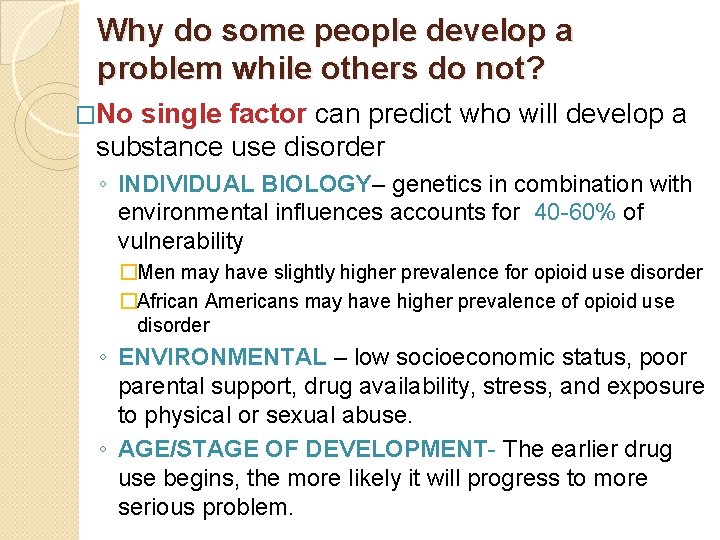
Why do some people develop a problem while others do not? �No single factor can predict who will develop a substance use disorder ◦ INDIVIDUAL BIOLOGY– genetics in combination with environmental influences accounts for 40 -60% of vulnerability �Men may have slightly higher prevalence for opioid use disorder �African Americans may have higher prevalence of opioid use disorder ◦ ENVIRONMENTAL – low socioeconomic status, poor parental support, drug availability, stress, and exposure to physical or sexual abuse. ◦ AGE/STAGE OF DEVELOPMENT- The earlier drug use begins, the more likely it will progress to more serious problem.
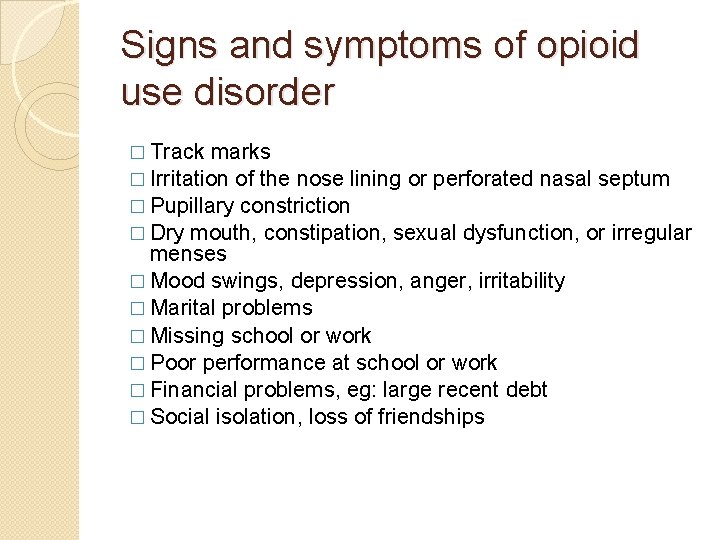
Signs and symptoms of opioid use disorder � Track marks � Irritation of the nose lining or perforated nasal septum � Pupillary constriction � Dry mouth, constipation, sexual dysfunction, or irregular menses � Mood swings, depression, anger, irritability � Marital problems � Missing school or work � Poor performance at school or work � Financial problems, eg: large recent debt � Social isolation, loss of friendships

Opioid Withdrawal Assessment Grade 0 1 2 3 4 Symptoms / Signs Anxiety, Drug Craving Yawning, Sweating, Runny nose, Tearing eyes, Restlessness Insomnia Dilated pupils, Gooseflesh, Muscle twitching & shaking, Muscle & Joint aches, Loss of appetite Nausea, extreme restlessness, elevated blood pressure, Heart rate > 100, Fever Vomiting / dehydration, Diarrhea, Abdominal cramps, Curled-up body position Clinical Opiate Withdrawal Scale (COWS): pulse, sweating, restlessness & anxiety, pupil size, aches, runny nose & tearing, GI sx, tremor, yawning, gooseflesh (score 5 -12 mild, 13 -24 mod, 25 -36 mod sev, 36 -48 severe)
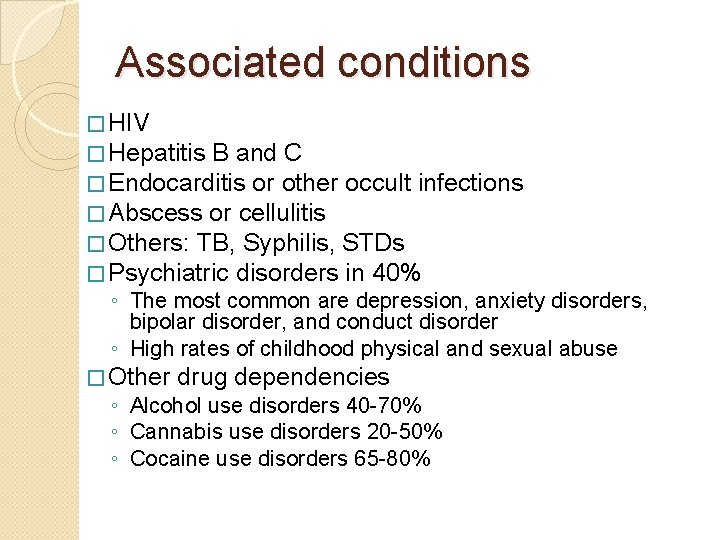
Associated conditions � HIV � Hepatitis B and C � Endocarditis or other occult infections � Abscess or cellulitis � Others: TB, Syphilis, STDs � Psychiatric disorders in 40% ◦ The most common are depression, anxiety disorders, bipolar disorder, and conduct disorder ◦ High rates of childhood physical and sexual abuse � Other drug dependencies ◦ Alcohol use disorders 40 -70% ◦ Cannabis use disorders 20 -50% ◦ Cocaine use disorders 65 -80%
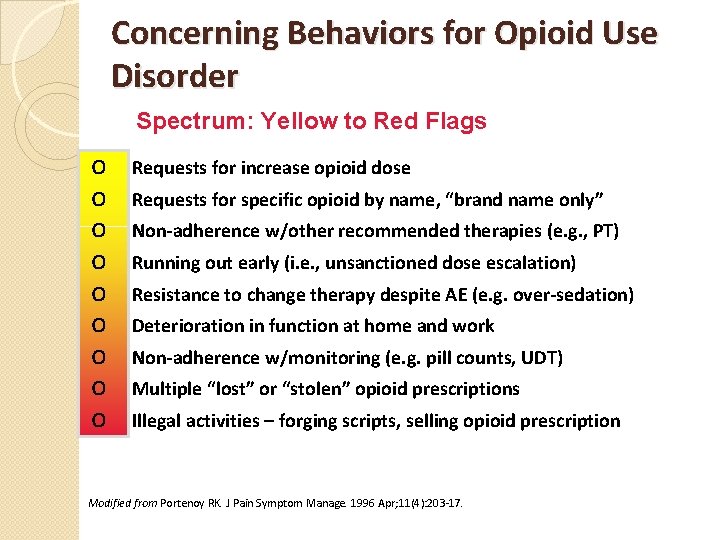
Concerning Behaviors for Opioid Use Disorder Spectrum: Yellow to Red Flags o o o o o Requests for increase opioid dose Requests for specific opioid by name, “brand name only” Non-adherence w/other recommended therapies (e. g. , PT) Running out early (i. e. , unsanctioned dose escalation) Resistance to change therapy despite AE (e. g. over-sedation) Deterioration in function at home and work Non-adherence w/monitoring (e. g. pill counts, UDT) Multiple “lost” or “stolen” opioid prescriptions Illegal activities – forging scripts, selling opioid prescription Modified from Portenoy RK. J Pain Symptom Manage. 1996 Apr; 11(4): 203 -17.
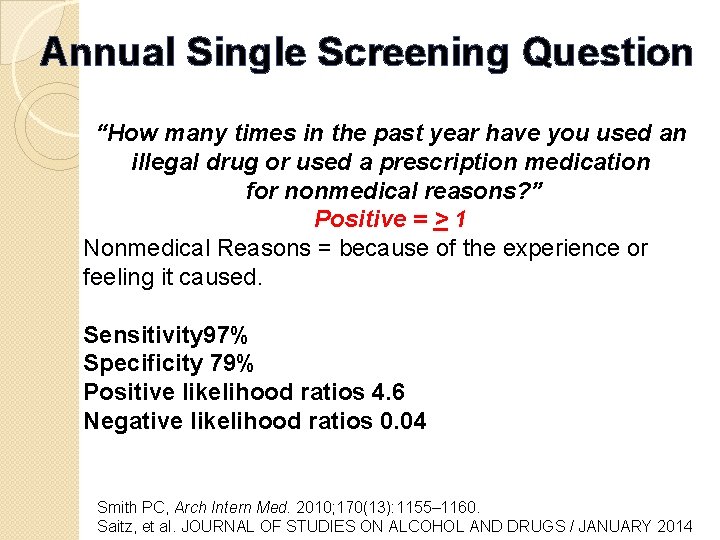
Annual Single Screening Question “How many times in the past year have you used an illegal drug or used a prescription medication for nonmedical reasons? ” Positive = > 1 Nonmedical Reasons = because of the experience or feeling it caused. Sensitivity 97% Specificity 79% Positive likelihood ratios 4. 6 Negative likelihood ratios 0. 04 Smith PC, Arch Intern Med. 2010; 170(13): 1155– 1160. Saitz, et al. JOURNAL OF STUDIES ON ALCOHOL AND DRUGS / JANUARY 2014
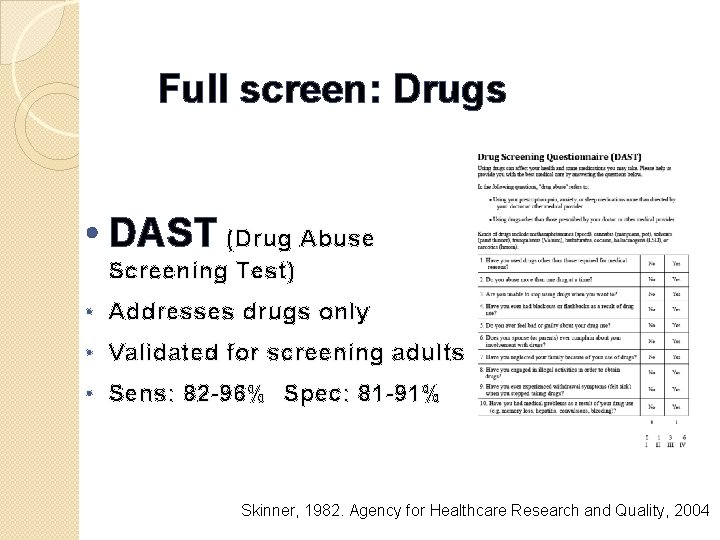
Full screen: Drugs • DAST (Drug Abuse Screening Test) • Addresses drugs only • Validated for screening adults • Sens: 82 -96% Spec: 81 -91% Skinner, 1982. Agency for Healthcare Research and Quality, 2004
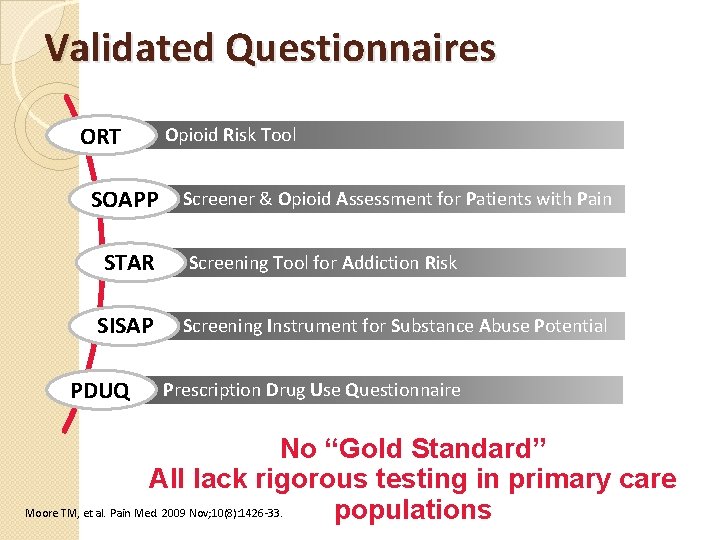
Validated Questionnaires ORT SOAPP STAR SISAP PDUQ Opioid Risk Tool Screener & Opioid Assessment for Patients with Pain Screening Tool for Addiction Risk Screening Instrument for Substance Abuse Potential Prescription Drug Use Questionnaire No “Gold Standard” All lack rigorous testing in primary care Moore TM, et al. Pain Med. 2009 Nov; 10(8): 1426 -33. populations
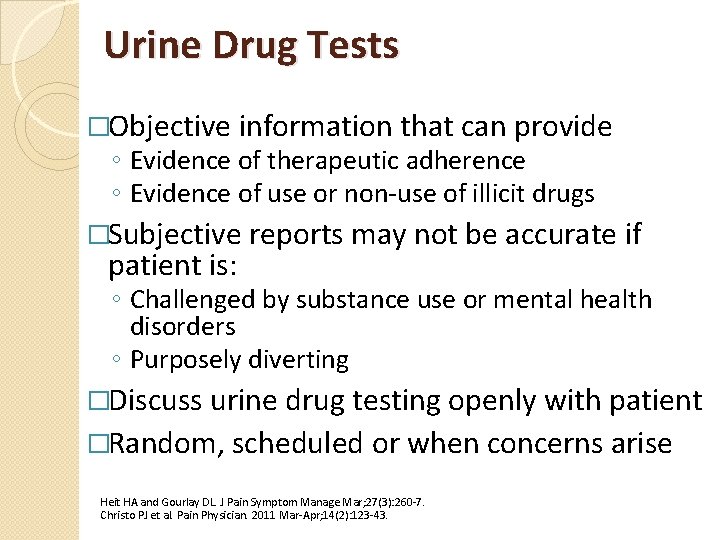
Urine Drug Tests �Objective information that can provide ◦ Evidence of therapeutic adherence ◦ Evidence of use or non-use of illicit drugs �Subjective reports may not be accurate if patient is: ◦ Challenged by substance use or mental health disorders ◦ Purposely diverting �Discuss urine drug testing openly with patient �Random, scheduled or when concerns arise Heit HA and Gourlay DL. J Pain Symptom Manage Mar; 27(3): 260 -7. Christo PJ et al. Pain Physician. 2011 Mar-Apr; 14(2): 123 -43.
Monitoring for Opioid Misuse �Other strategies ◦ Pill counts (scheduled vs random) ◦ Prescription drug monitoring program data �History from “reliable” family members ◦ Beware of family members with secondary gain for giving inaccurate information
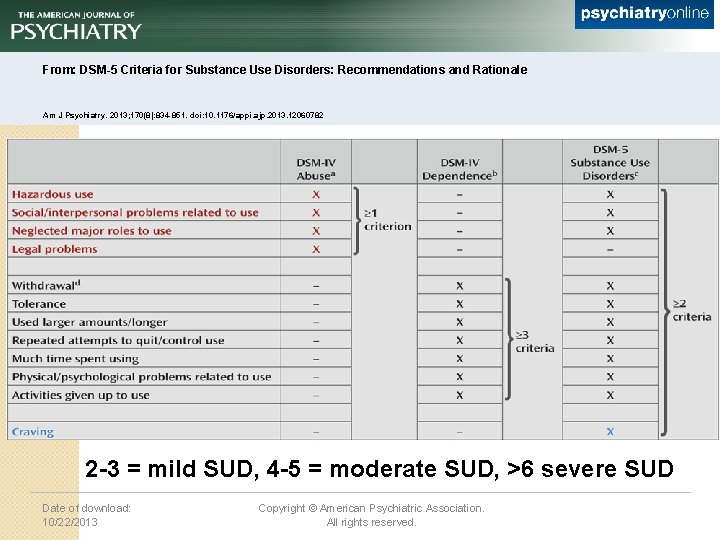
From: DSM-5 Criteria for Substance Use Disorders: Recommendations and Rationale Am J Psychiatry. 2013; 170(8): 834 -851. doi: 10. 1176/appi. ajp. 2013. 12060782 2 -3 = mild SUD, 4 -5 = moderate SUD, >6 severe SUD Date of download: 10/22/2013 Copyright © American Psychiatric Association. All rights reserved.
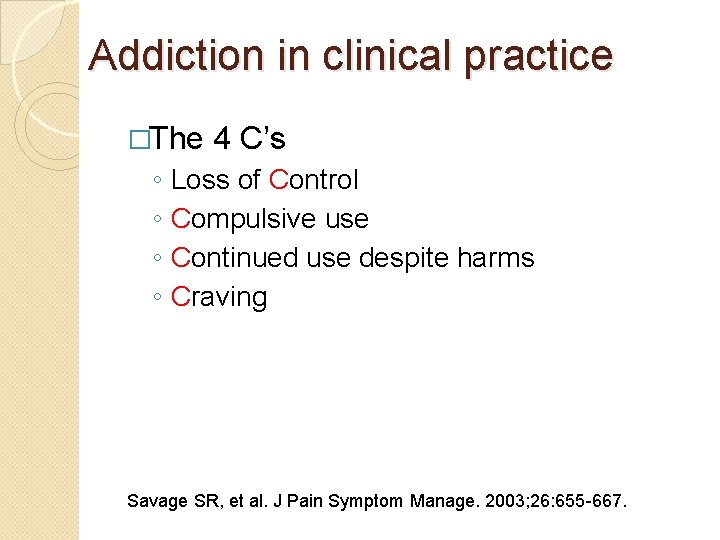
Addiction in clinical practice �The 4 C’s ◦ ◦ Loss of Control Compulsive use Continued use despite harms Craving Savage SR, et al. J Pain Symptom Manage. 2003; 26: 655 -667.
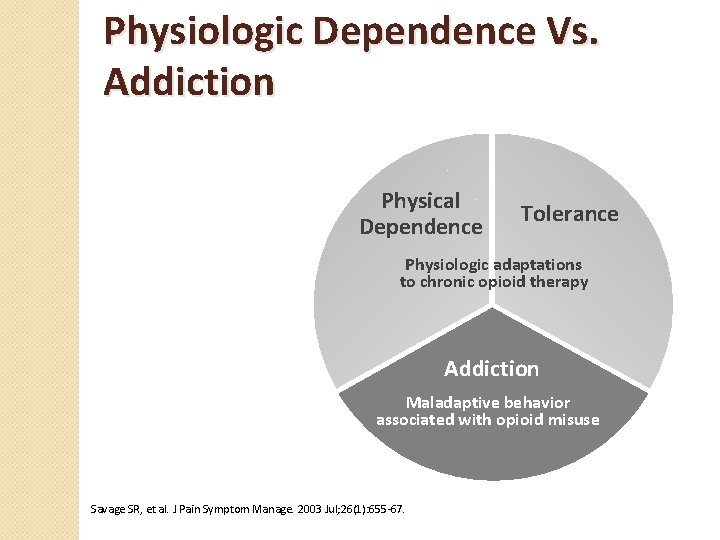
Physiologic Dependence Vs. Addiction Physical Dependence Tolerance Physiologic adaptations to chronic opioid therapy Addiction Maladaptive behavior associated with opioid misuse Savage SR, et al. J Pain Symptom Manage. 2003 Jul; 26(1): 655 -67.
Treatment of Opioid Disorders �Detoxification (not treatment) �Medication Assisted Treatment �Outpatient treatment �Residential treatment
Methadone Maintenance Therapy �Full agonist with long elimination half-life �Reduces euphoria of subsequent opioid abuse �Only licensed methadone clinics are permitted to dispense methadone �Typical effective dose range 60 -90 mg/day �SE: QTc prolongation, sedation �Effective to ◦ Increase retention in treatment ◦ Reduce use of opioids ◦ Reduce human immunodeficiency virus (HIV) Mattick RP, Breen C, Kimber J, Davoli M. Methadone maintenance therapy versus no opioid replacement therapy for opioid dependence. Cochrane Database of Systematic Reviews 2009, I
Buprenorphine (subutex™) /naloxone (Suboxone™) � Partial opioid agonist (plateau effect) � Less euphoric effect than other opioids � Paired with antagonist to prevent abuse through injection � Office based prescribing (DEA waiver, training) � Less optimal candidate for buprenorphine treatment: ◦ ◦ ◦ significant psychiatric comorbidity polysubstance use, frequent relapses in prior treatment attempts discharges from more structured treatment settings pregnancy
Methadone Vs. Buprenorphine �Low dose Buprenorphine (2 -6 mg) was less effective than methadone in retaining people in treatment. �Buprenorphine (>7 mg/day) was not different from methadone (>40 mg/day) in retaining people in treatment or in suppression of illicit opioid use. Mattick RP, Breen C, Kimber J, Davoli M. Buprenorphine maintenance versus placebo or methadone maintenance for opioid dependence. Cochrane Database of Systematic Reviews 2014, Issue 2.
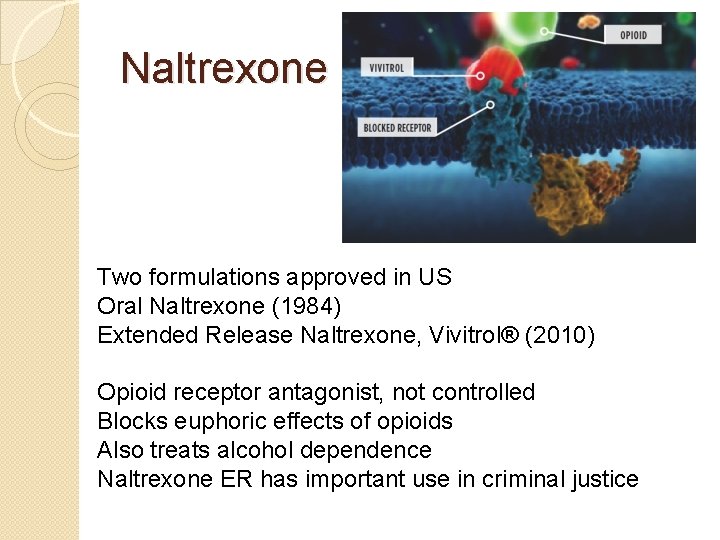
Naltrexone Two formulations approved in US Oral Naltrexone (1984) Extended Release Naltrexone, Vivitrol® (2010) Opioid receptor antagonist, not controlled Blocks euphoric effects of opioids Also treats alcohol dependence Naltrexone ER has important use in criminal justice
Does this person have opioid use disorder? � 45 yo female with chronic low back pain who has been prescribed opioids for the last 5 years. She takes her medication as prescribed, has never had an early refill or lost Rx, all of her urine drug tests are as expected and she sees one provider. She reports being scared about needing to taper her opioids and would like you to stop her opioid taper.
Does this person have an opioid use disorder? � 45 yo female with chronic low back pain who has been prescribed opioids for the last 5 years. She takes her medication as prescribed, has never had an early refill or lost Rx, all of her urine drug tests are as expected and she sees one provider. She started having severe, dental pain after a dental procedure and has been in the ED 3 times in the last month for pain.
Does this person have an opioid use disorder? � 45 yo female with chronic low back pain who has been prescribed opioids for the last 5 years. She takes her medication every 2 hours and sometimes sooner for severe pain. When she was first prescribed opioids, she was working. Now, she is unemployed and has marital discord. She was recently found to have HCV on routine screening.

Questions? Melissa. Weimer@sphp. com Mahan. JM@jacksoncounty. org
- Slides: 31