
Opinion spam and Analysis G 201592009 1 35
- Slides: 35
Opinion spam and Analysis 소프트웨어공학 연구실 G 201592009 최효린 1 / 35
Contents • • ABSTRACT 1. INTRODUCTION 2. RELATED WORK 3. OPINION DATA AND ANALYSIS • Review Data from Amazon. com • Reviews, Reviewers and Products • Review Ratings and Feedbacks • 4. SPAM DETECTION • Detection of Duplicate Reviews • Detecting Type 2 & Type 3 Spam Reviews • 5. ANALYSIS OF TYPE 1 SPAM REVIEWS • 6. CONCLUSIONS 2 / 35
ABSTRACT • 웹 상의 “Evaluative text” • It is now very common for people to read opinions on the Web. • Opinion spam, trustworthiness 등의 문제가 있다. • For examples, if one sees that the reviews of the product are mostly positive, one is very likely to buy it. • 이 논문은 아마존(amazon. com)의 제품 리뷰를 분석하여 “Opinion spam”을 식별하는 주요 기법을 제시함. 3 / 35
1. INTRODUCTION • Reviews contain rich user opinions on products and services. • They are used by potential customers to find opinions of existing users before deciding to purchase a product. • They are also used by product manufacturers to identify product problems and/or to find marketing intelligence information about their competitors. • Positive opinions can result in significant financial gains. 4 / 35
1. INTRODUCTION • This gives good incentives for opinion spam. • There are generally three types of spam reviews: • Type 1 (untruthful opinions) : positive reviews to some target objects in order to promote the objects, or by giving negative reviews to damage their reputations. • Type 2 (reviews on brands only) : specifically for the brands, the manufacturers or the sellers of the products. • Type 3 (non-reviews) : (1) advertisements, (2) containing no opinions 5 / 35
2. RELATED WORK • Current studies are mainly focused on mining opinions in reviews and/or classify reviews as positive or negative based on the sentiments of the reviewers. • Since our objective is to detect spam activities in reviews, we discuss some existing work on spam research. • Web spam • Email spam • recommender systems, etc. 6 / 35
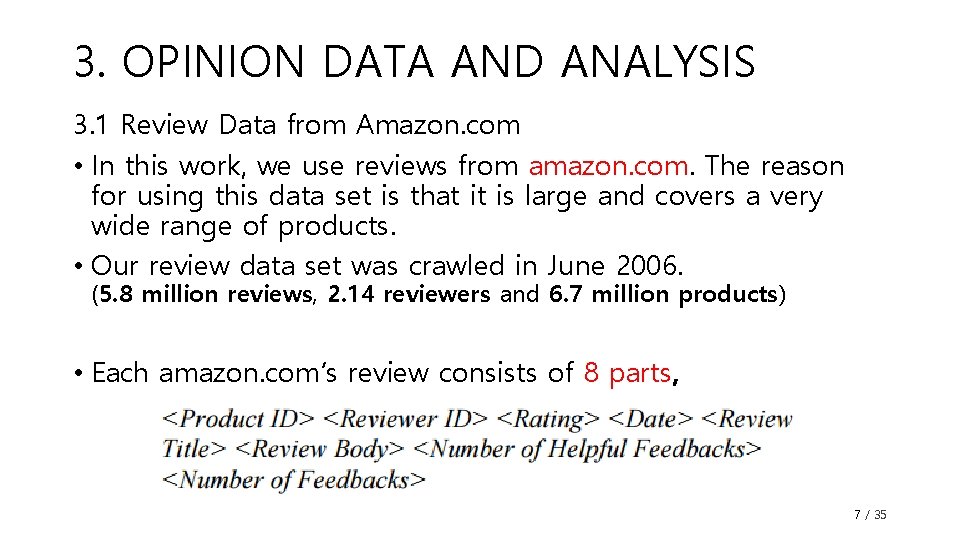
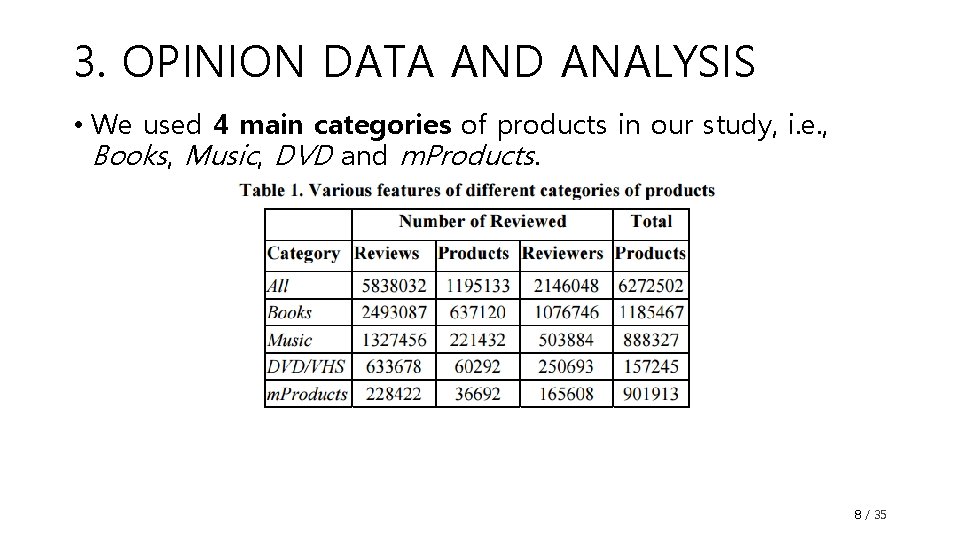
3. OPINION DATA AND ANALYSIS 3. 1 Review Data from Amazon. com • In this work, we use reviews from amazon. com. The reason for using this data set is that it is large and covers a very wide range of products. • Our review data set was crawled in June 2006. (5. 8 million reviews, 2. 14 reviewers and 6. 7 million products) • Each amazon. com’s review consists of 8 parts, 7 / 35
3. OPINION DATA AND ANALYSIS • We used 4 main categories of products in our study, i. e. , Books, Music, DVD and m. Products. 8 / 35
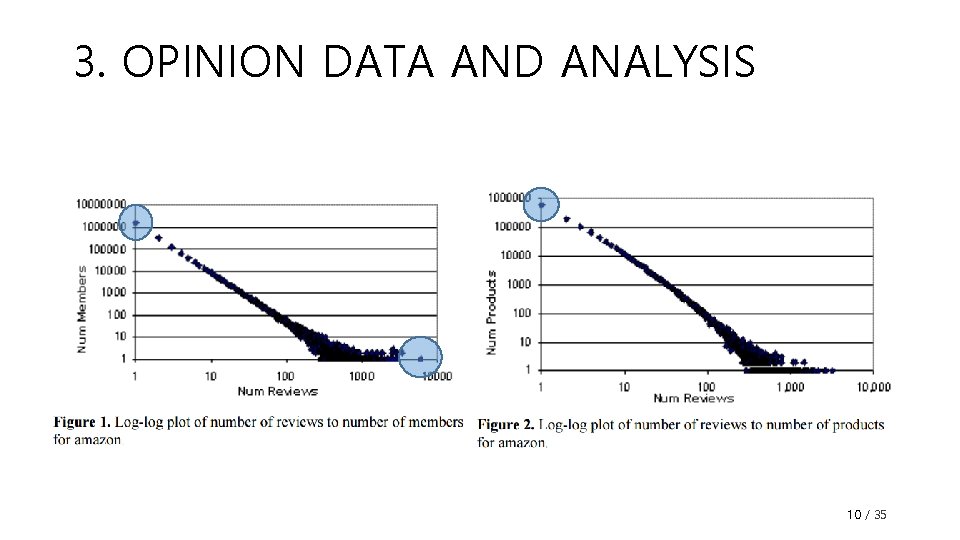
3. OPINION DATA AND ANALYSIS 3. 2 Reviews, Reviewers and Products • Before studying the review spam, let us first have some basic information about reviews, reviewers, products, ratings and feedback on reviews. • Specifically, we show the following plots: 1. Number of reviews vs. number of reviewers 2. Number of reviews vs. number of products 9 / 35
3. OPINION DATA AND ANALYSIS 10 / 35
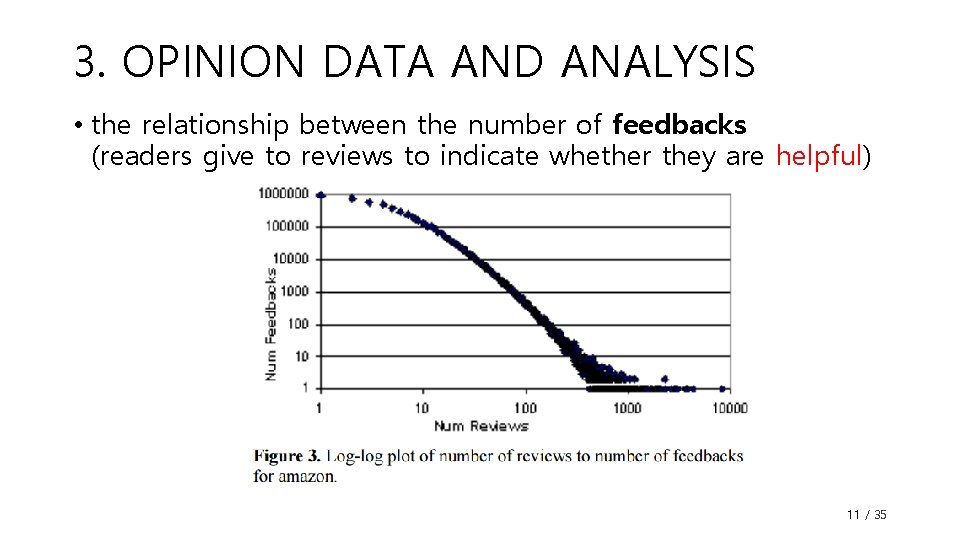
3. OPINION DATA AND ANALYSIS • the relationship between the number of feedbacks (readers give to reviews to indicate whether they are helpful) 11 / 35
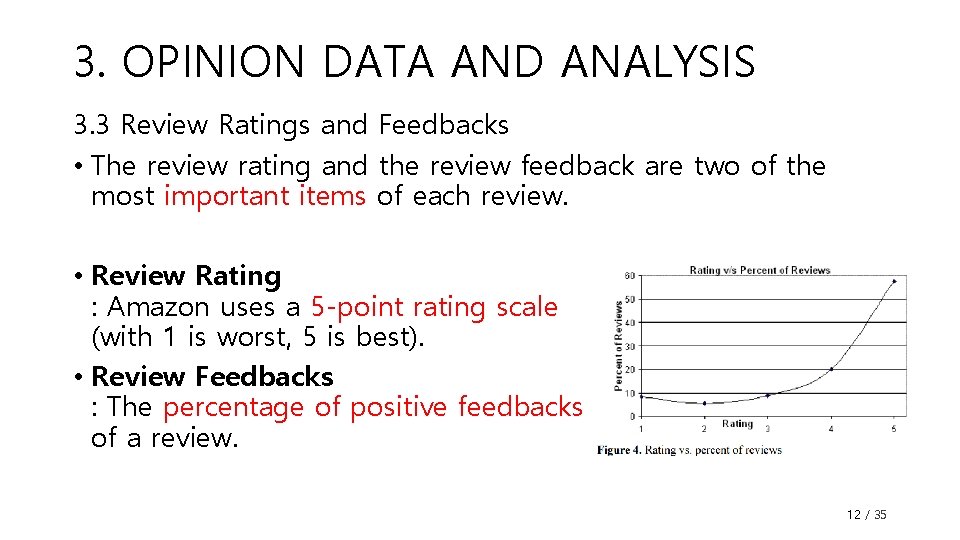
3. OPINION DATA AND ANALYSIS 3. 3 Review Ratings and Feedbacks • The review rating and the review feedback are two of the most important items of each review. • Review Rating : Amazon uses a 5 -point rating scale (with 1 is worst, 5 is best). • Review Feedbacks : The percentage of positive feedbacks of a review. 12 / 35
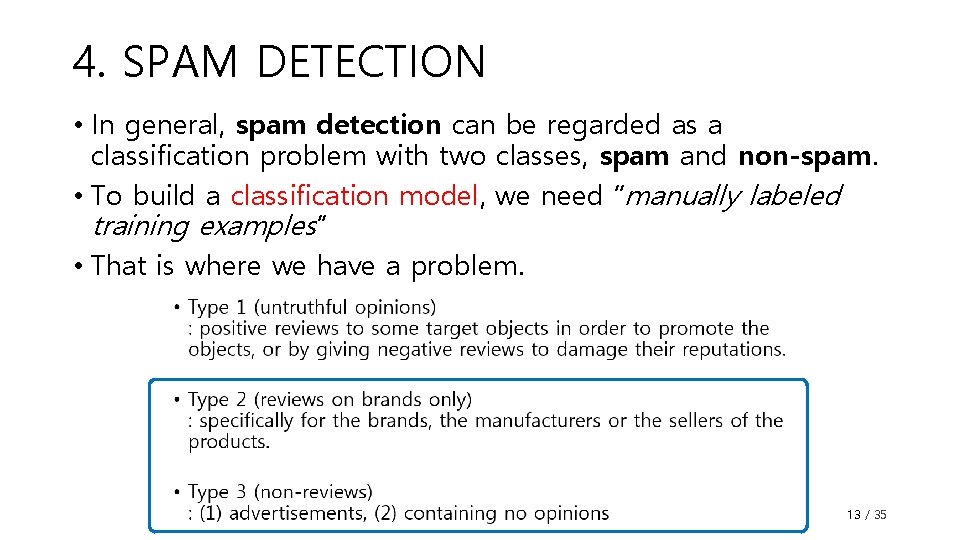
4. SPAM DETECTION • In general, spam detection can be regarded as a classification problem with two classes, spam and non-spam. • To build a classification model, we need “manually labeled training examples” • That is where we have a problem. 13 / 35
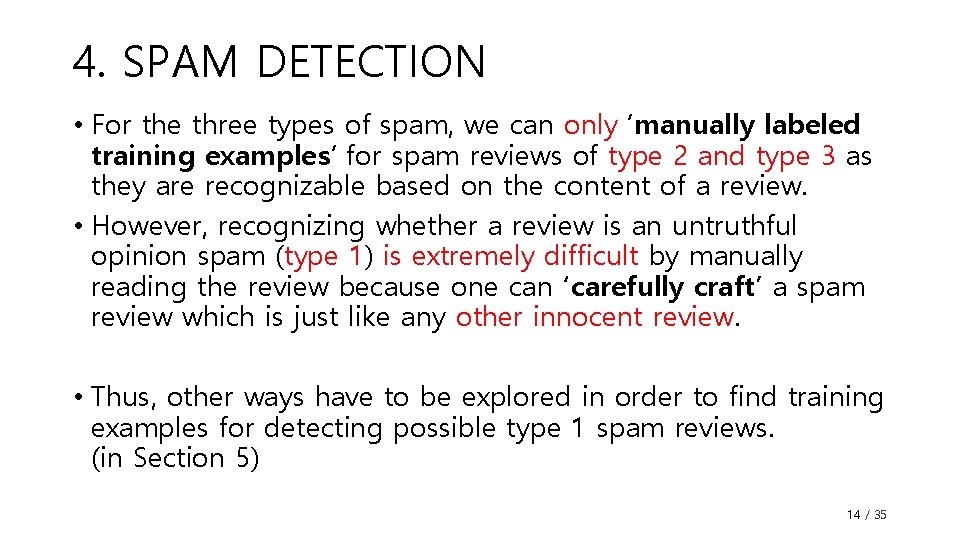
4. SPAM DETECTION • For the three types of spam, we can only ‘manually labeled training examples’ for spam reviews of type 2 and type 3 as they are recognizable based on the content of a review. • However, recognizing whether a review is an untruthful opinion spam (type 1) is extremely difficult by manually reading the review because one can ‘carefully craft’ a spam review which is just like any other innocent review. • Thus, other ways have to be explored in order to find training examples for detecting possible type 1 spam reviews. (in Section 5) 14 / 35
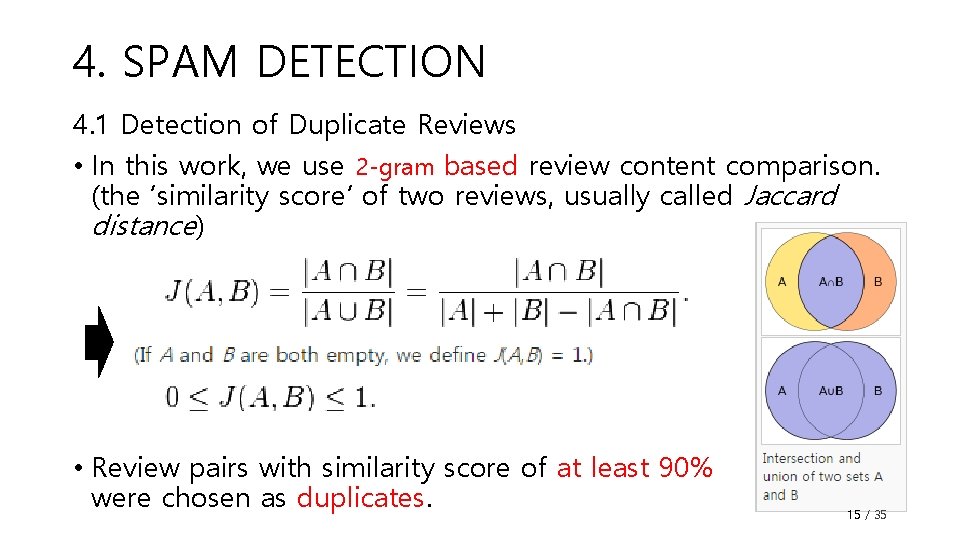
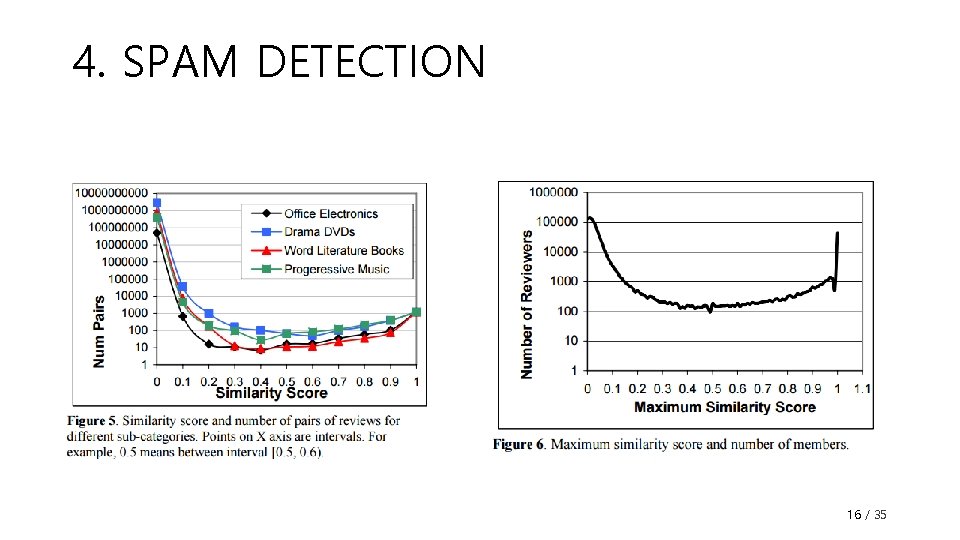
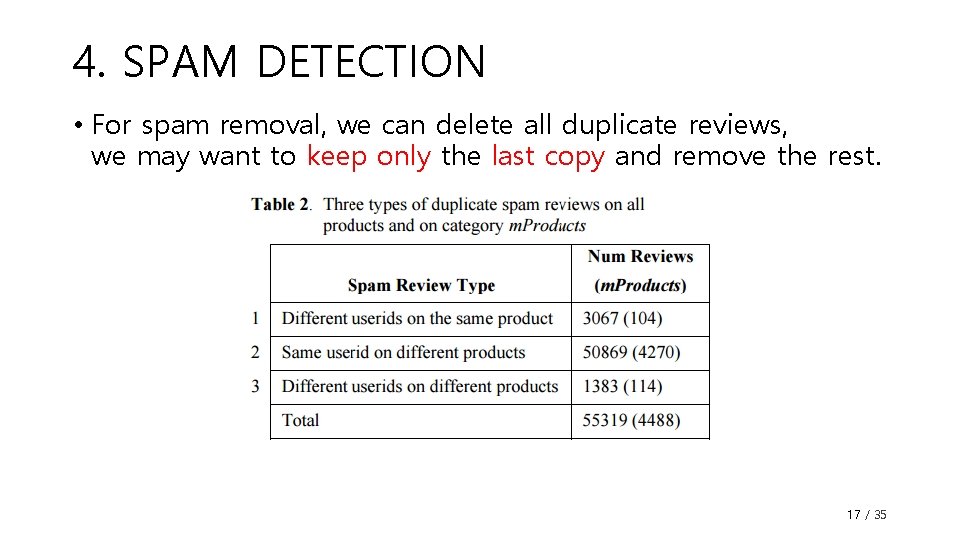
4. SPAM DETECTION 4. 1 Detection of Duplicate Reviews • In this work, we use 2 -gram based review content comparison. (the ‘similarity score’ of two reviews, usually called Jaccard distance) • Review pairs with similarity score of at least 90% were chosen as duplicates. 15 / 35
4. SPAM DETECTION 16 / 35
4. SPAM DETECTION • For spam removal, we can delete all duplicate reviews, we may want to keep only the last copy and remove the rest. 17 / 35
4. SPAM DETECTION 4. 2 Detecting Type 2 & Type 3 Spam Reviews • As we mentioned earlier, these two types of reviews are recognizable manually. Thus, we employ the classification learning approach based on manually labeled examples. • Manually labeling them is extremely time-consuming. However, we are already able to achieve very good classification results (see Section 4. 2. 3). 18 / 35
4. SPAM DETECTION 4. 2. 1 Model Building Using Logistic Regression • The reason for using logistic regression is that it produces a probability estimate of each review being a spam, which is desirable. • To build a model, we need to create the training data. • We have defined features to characterize reviews. 19 / 35
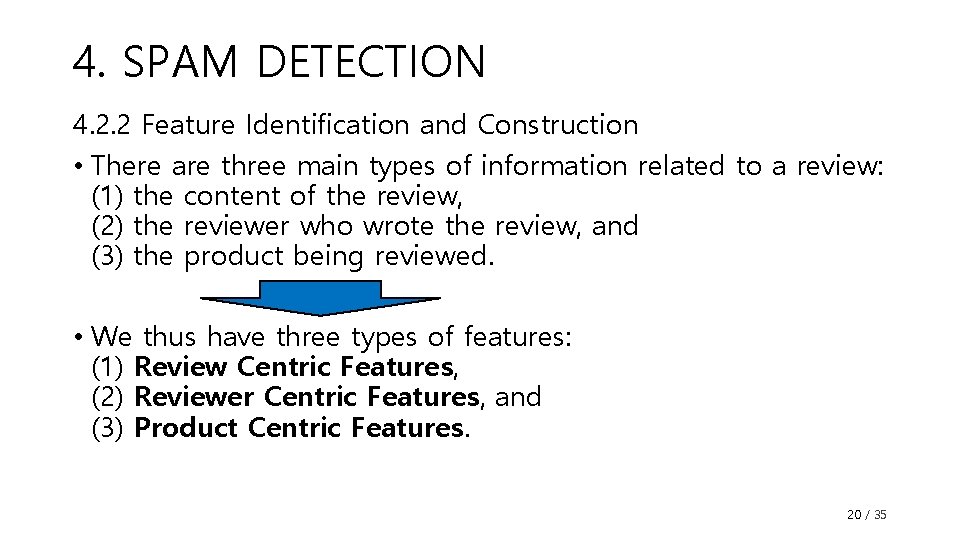
4. SPAM DETECTION 4. 2. 2 Feature Identification and Construction • There are three main types of information related to a review: (1) the content of the review, (2) the reviewer who wrote the review, and (3) the product being reviewed. • We thus have three types of features: (1) Review Centric Features, (2) Reviewer Centric Features, and (3) Product Centric Features. 20 / 35
4. SPAM DETECTION 4. 2. 2. 1 Review Centric Features • Number of feedbacks (F 1), Length of the review title (F 4), a review is the first review (F 8), etc. • Textual features: • Percent of positive (F 10), and negative (F 11), Percent of times brand name (F 13), etc. • Rating related features: • Binary features indicating whether a bad review was written just after the first good review of the product and vice versa (F 20, F 21), etc. 21 / 35
4. SPAM DETECTION 4. 2. 2. 2 Reviewer Centric Features • Ratio of the number of reviews that the reviewer wrote which were the first reviews (F 22), • Percent of times that a reviewer wrote a review with binary features F 20 (F 31) and F 21 (F 32), etc. 4. 2. 2. 3 Product Centric Features • Price (F 33), and Sales rank (F 34), etc. 22 / 35
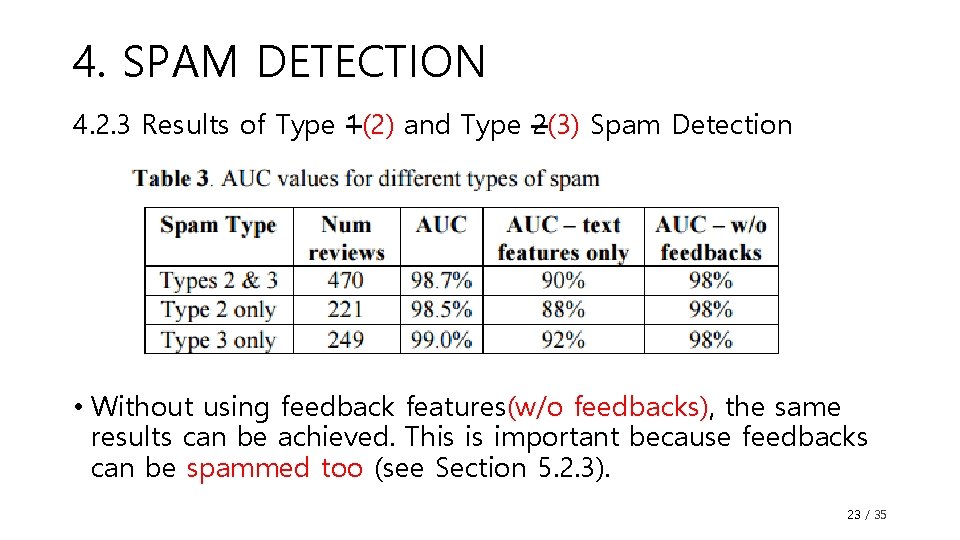
4. SPAM DETECTION 4. 2. 3 Results of Type 1(2) and Type 2(3) Spam Detection • Without using feedback features(w/o feedbacks), the same results can be achieved. This is important because feedbacks can be spammed too (see Section 5. 2. 3). 23 / 35
5. ANALYSIS OF TYPE 1 SPAM REVIEWS • From the presentation of Section 4, we can conclude that type 2 and types 3 spam reviews are fairly easy to detect. • Detecting type 1 spam reviews is, however, very difficult as they are not easily recognizable manually. • Let us recall what type 1 spam reviews aim to achieve: 1. To promote some target objects, e. g. , one’s own products (hype spam). 2. To damage the reputation of some other target objects, e. g. , products of one’s competitors (defaming spam). 24 / 35
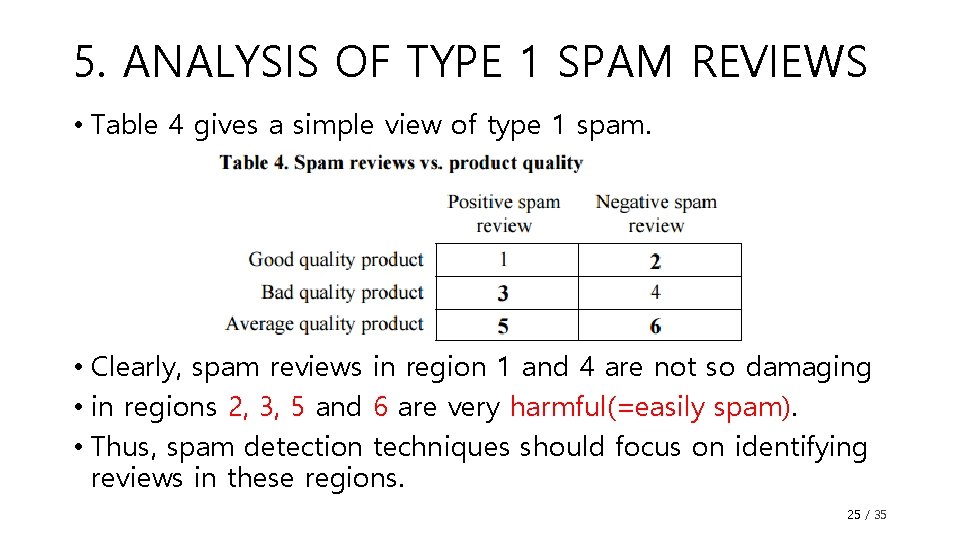
5. ANALYSIS OF TYPE 1 SPAM REVIEWS • Table 4 gives a simple view of type 1 spam. • Clearly, spam reviews in region 1 and 4 are not so damaging • in regions 2, 3, 5 and 6 are very harmful(=easily spam). • Thus, spam detection techniques should focus on identifying reviews in these regions. 25 / 35
5. ANALYSIS OF TYPE 1 SPAM REVIEWS 5. 1 Making Use of Duplicates • We would like to build a classification model. • But, we have no manually labeled training data, we have to look from other sources. • A natural choice is the three types of duplicates discussed in Section 4, which are almost certainly spam reviews. • it is reasonable to assume that they are a fairly good and random sample of many kinds of spam. 26 / 35
5. ANALYSIS OF TYPE 1 SPAM REVIEWS 5. 1. 1 Model Building Using Duplicates • To further confirm its predictability, we want to show that it is also predictive of reviews that are more likely to be spam and are not duplicated, i. e. , Outlier reviews. • We use the logistic regression model to predict outlier reviews. • Is it harmful spam review? or truly have different views from others? 27 / 35
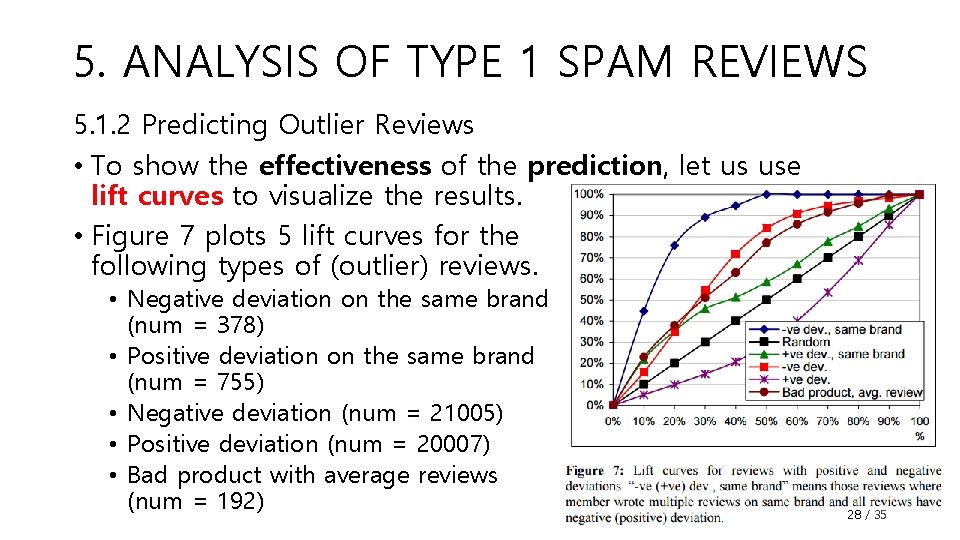
5. ANALYSIS OF TYPE 1 SPAM REVIEWS 5. 1. 2 Predicting Outlier Reviews • To show the effectiveness of the prediction, let us use lift curves to visualize the results. • Figure 7 plots 5 lift curves for the following types of (outlier) reviews. • Negative deviation on the same brand (num = 378) • Positive deviation on the same brand (num = 755) • Negative deviation (num = 21005) • Positive deviation (num = 20007) • Bad product with average reviews (num = 192) 28 / 35
5. ANALYSIS OF TYPE 1 SPAM REVIEWS 5. 1. 2 Predicting Outlier Reviews • Let us make several important observations: • reviewers who are biased towards a brand give reviews with negative deviations on products of that brand are very likely to be spammers. It should be removed as spam reviews. • The other sides, much less likely to be spammed. 29 / 35
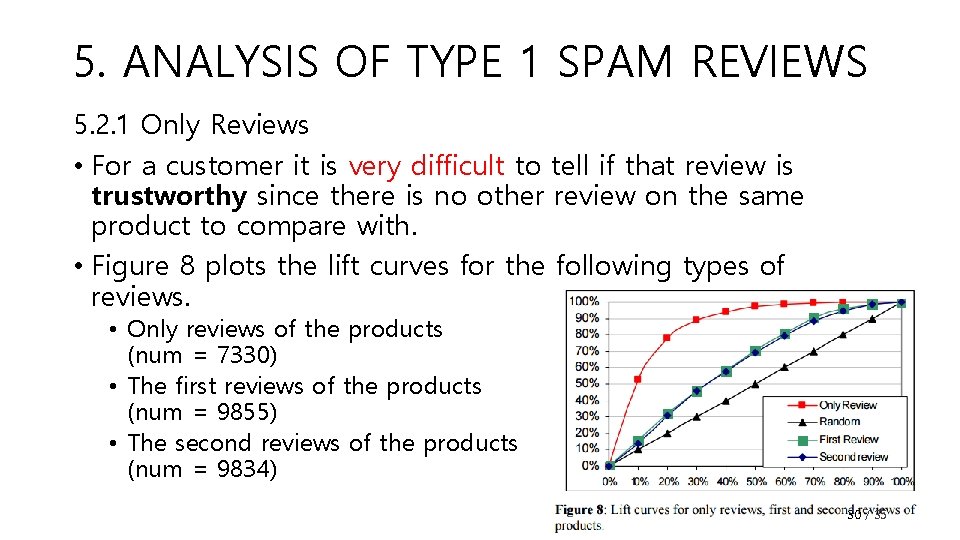
5. ANALYSIS OF TYPE 1 SPAM REVIEWS 5. 2. 1 Only Reviews • For a customer it is very difficult to tell if that review is trustworthy since there is no other review on the same product to compare with. • Figure 8 plots the lift curves for the following types of reviews. • Only reviews of the products (num = 7330) • The first reviews of the products (num = 9855) • The second reviews of the products (num = 9834) 30 / 35
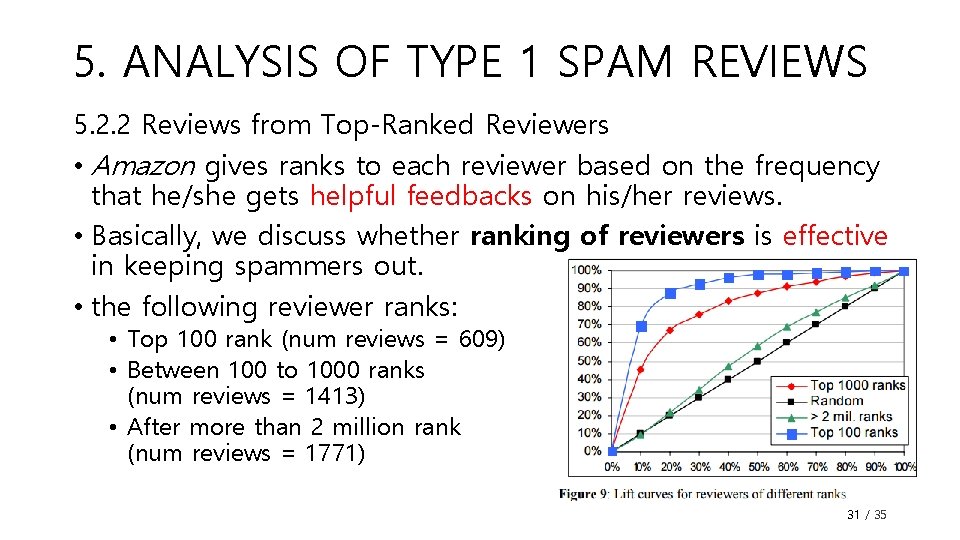
5. ANALYSIS OF TYPE 1 SPAM REVIEWS 5. 2. 2 Reviews from Top-Ranked Reviewers • Amazon gives ranks to each reviewer based on the frequency that he/she gets helpful feedbacks on his/her reviews. • Basically, we discuss whether ranking of reviewers is effective in keeping spammers out. • the following reviewer ranks: • Top 100 rank (num reviews = 609) • Between 100 to 1000 ranks (num reviews = 1413) • After more than 2 million rank (num reviews = 1771) 31 / 35
5. ANALYSIS OF TYPE 1 SPAM REVIEWS 5. 2. 2 Reviews from Top-Ranked Reviewers • “Feedbacks can be spammed too” • This is a very surprising result because it shows that top ranked reviewers are less trustworthy as compared to bottom ranked reviewers. 32 / 35
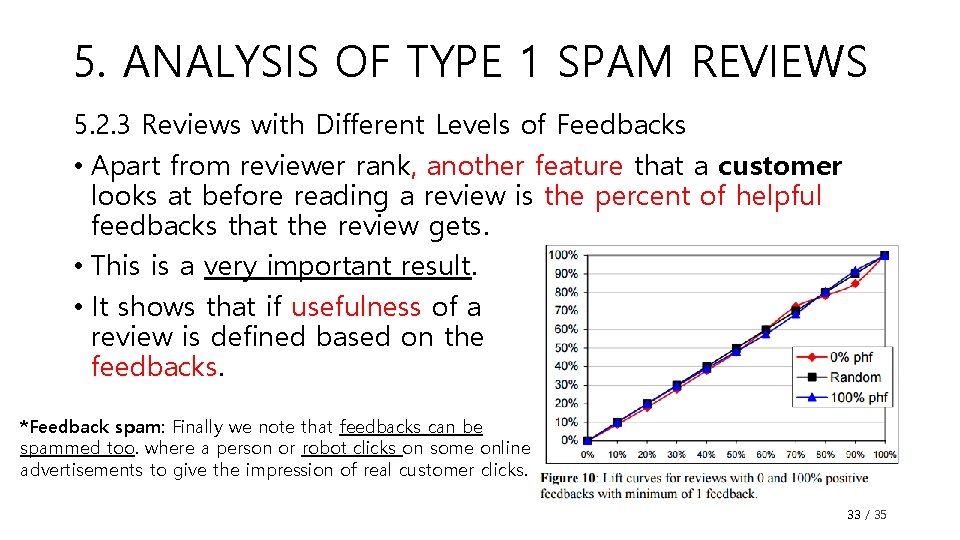
5. ANALYSIS OF TYPE 1 SPAM REVIEWS 5. 2. 3 Reviews with Different Levels of Feedbacks • Apart from reviewer rank, another feature that a customer looks at before reading a review is the percent of helpful feedbacks that the review gets. • This is a very important result. • It shows that if usefulness of a review is defined based on the feedbacks. *Feedback spam: Finally we note that feedbacks can be spammed too. where a person or robot clicks on some online advertisements to give the impression of real customer clicks. 33 / 35
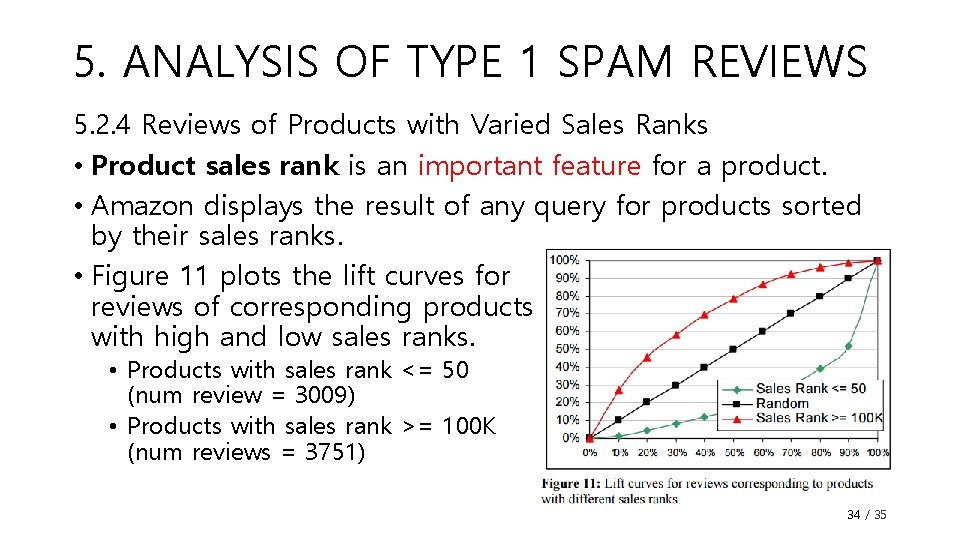
5. ANALYSIS OF TYPE 1 SPAM REVIEWS 5. 2. 4 Reviews of Products with Varied Sales Ranks • Product sales rank is an important feature for a product. • Amazon displays the result of any query for products sorted by their sales ranks. • Figure 11 plots the lift curves for reviews of corresponding products with high and low sales ranks. • Products with sales rank <= 50 (num review = 3009) • Products with sales rank >= 100 K (num reviews = 3751) 34 / 35
6. CONCLUSIONS • 이 논문에서는 다음과 같은 내용을 연구했다. • Opinion spam in reviews as initial investigation. • Identified three types of spam • Detection techniques of spam • 현재까지의 연구는 Opinion spam에 대한 기본적인 분석이다. • 향후에는 더 발전된 Spam detection 방법과, Review 이외에 다 른 분야(forums, blogs)에서도 살펴볼 것이다. 35 / 35