
Operator Precedence and Associativity Lets build a CFG
Operator Precedence and Associativity • Let’s build a CFG for expressions consisting of: • elementary identifier i. • + and - (binary ops) have lowest precedence, and are left associative. • * and / (binary ops) have middle precedence, and are right associative. • + and - (unary ops) have highest precedence, and are right associative.
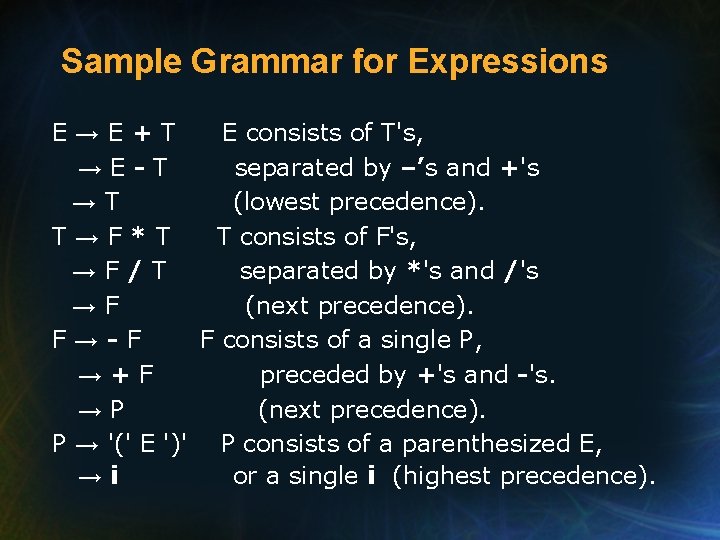
Sample Grammar for Expressions E→E+T E consists of T's, →E-T separated by –’s and +'s →T (lowest precedence). T→F*T T consists of F's, →F/T separated by *'s and /'s →F (next precedence). F→-F F consists of a single P, →+F preceded by +'s and -'s. →P (next precedence). P → '(' E ')' P consists of a parenthesized E, →i or a single i (highest precedence).

Operator Precedence and Associativity (cont’d) • Operator precedence: – The lower in the grammar, the higher the precedence. • Operator Associativity: – left recursion in the grammar means left associativity of the operator, and causes left branching in the tree. – right recursion in the grammar means right associativity of the operator, and causes right branching in the tree.
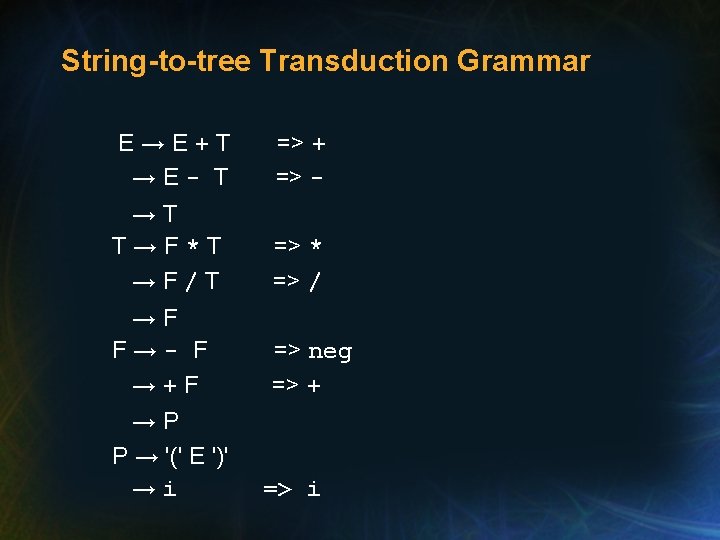
String-to-tree Transduction Grammar E→E+T →E- T => + => - →T T→F*T →F/T => * => / →F F→- F →+F => neg => + →P P → '(' E ')' →i => i
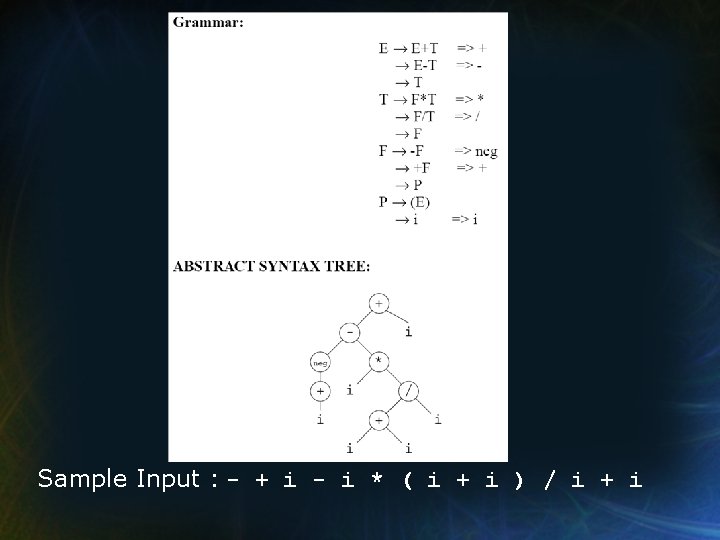
Sample Input : - + i - i * ( i + i ) / i + i
- Slides: 5