
Operations Support Department EMERGENCY RESPONSE UNITS ERU CONCEPT
- Slides: 18
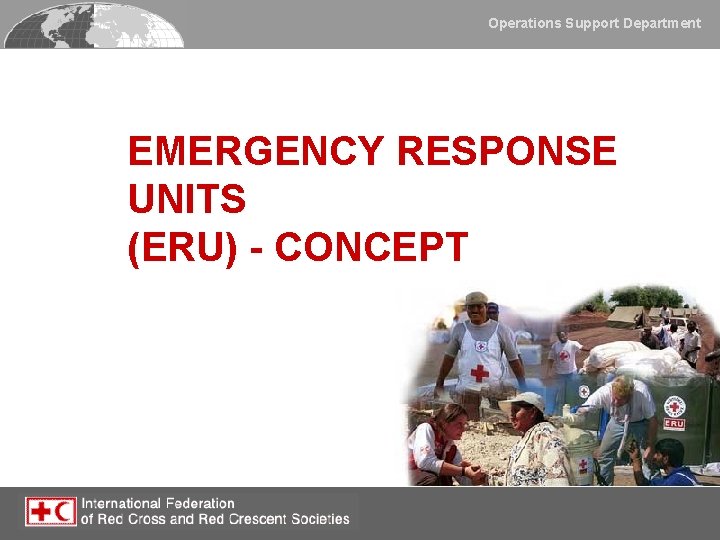
Operations Support Department EMERGENCY RESPONSE UNITS (ERU) - CONCEPT
Operations Support Department What are ERUs? • • Rapid response tool for disaster response Standardised modules of equipment Pre-trained teams of personnel Ready to be deployed at short notice Self-sufficient for 1 month Deployed for up to 4 months Sponsored by National Societies
Operations Support Department Why ERUs? • Provides support function / direct services to beneficiaries • Bridges a gap in services when local facilities have been overwhelmed by needs, or destroyed – natural disasters • Rapid set-up where services are not available – refugee camps
Operations Support Department ERU Overview • 12 ERU National Societies – Austrian RC, British RC, Belgian/Fl RC, Danish RC, French RC, Finnish RC, German RC, Japan RC, Norwegian RC, Spanish RC, Swedish RC, American. RC • 45 deployments since 1996 • Contexts – Natural disasters – floods, earthquakes – Population movements – refugee camps (non-conflict) • ICRC – Watsan (Sudan), logistics (Afghanistan)
Operations Support Department Types of ERU: Support / Service Function • Logistics • Telecommunications & Information. Technology • Water – sanitation modules: – – Treatment & Supply Line Distribution & Trucking Mass Sanitation Specialised Water • Basic Health Care • Referral Hospital • Relief (distribution support)
Operations Support Department Logistics ERU • Reception, storage & on-forwarding of relief goods • Preparation for other incoming ERUs – customs clearance, transport to site • Logistics analysis in field – local capacity, liaison with local authorities • Implementation of Federation standards • Integrate logistics functions with Federation and host National Society
Operations Support Department Relief ERU • Support to host National Society • Identification of relief needs • Rapid relief distribution training for RC volunteers • Targeted beneficiary selection & registration • Distribution of goods to Federation standards • Tracking of distributions / reporting • Monitoring & Evaluation • Works closely with logistics who mobilise required relief items
Operations Support Department Telecommunications & IT • Establishes communications set-up in field • Establishes communications link from field to GVA • Support to other ERUs and field: – – – Needs assessment Telecom coordination with local authorities Set-up satellite link and email connection Set-up radio network – HF/VHF – ERU frequencies Support & troubleshooting for communication & computer systems • Variety of technology ** may be subject to local legal restrictions (Tampere Declaration)
Operations Support Department Treatment & Supply Line Module • Treatment & storage of raw water to Sphere / WHO standards • Can supply up to 600, 000 litres / day for 40, 000 beneficiaries • 1 or 2 supply lines • Depends on local availability of water • Does not provide desalination • Weight: 13 MT • Volume: 50 Cb. M
Operations Support Department Distribution & Trucking Module • Transport, storage & distribution system of treated water • Can provide up to 75, 000 litres/day • 3 Identical storage & distribution systems at 3 different locations using bladder tanks + tapstands at distribution points • Note – does not treat raw water • Weight: 5 MT • Volume: 12 Cb. M
Operations Support Department Mass Sanitation Module • Basic sanitation & environmental health interventions for up to 40, 000 beneficiaries • Latrine construction • Solid waste disposal • Burial of corpses • Vector control – spraying in malarial areas • Weight: 4. 7 MT • Volume: 23 Cb. M
Operations Support Department Specialised Water Module • Provides treated water and basic sanitation for health facilities and up to 15, 000 beneficiaries • Treatment and distribution of 120, 000 litres /day to Sphere / WHO standards • Storage capacity of maximum 200, 000 litres / day • May be deployed to support basic health care and referral hospital ERUs • Weight: 15 MT • Volume: 70 Cb. M
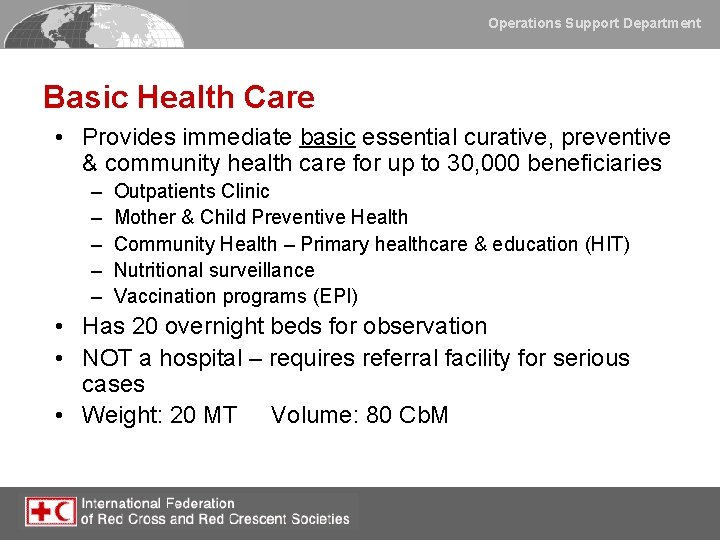
Operations Support Department Basic Health Care • Provides immediate basic essential curative, preventive & community health care for up to 30, 000 beneficiaries – – – Outpatients Clinic Mother & Child Preventive Health Community Health – Primary healthcare & education (HIT) Nutritional surveillance Vaccination programs (EPI) • Has 20 overnight beds for observation • NOT a hospital – requires referral facility for serious cases • Weight: 20 MT Volume: 80 Cb. M
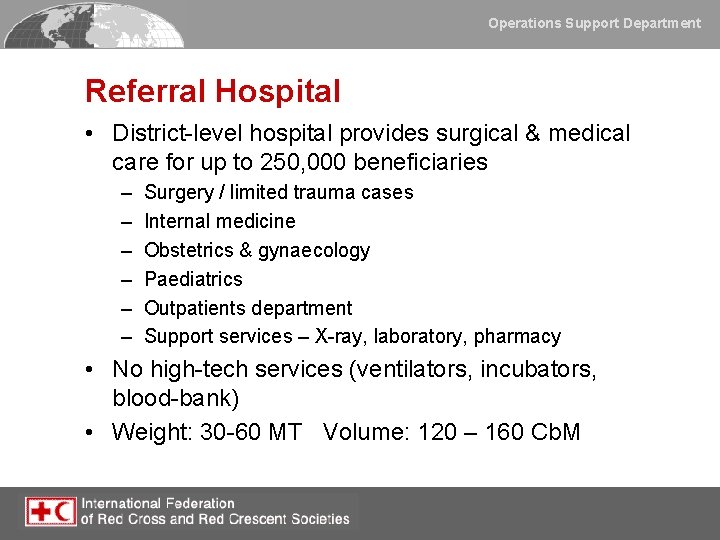
Operations Support Department Referral Hospital • District-level hospital provides surgical & medical care for up to 250, 000 beneficiaries – – – Surgery / limited trauma cases Internal medicine Obstetrics & gynaecology Paediatrics Outpatients department Support services – X-ray, laboratory, pharmacy • No high-tech services (ventilators, incubators, blood-bank) • Weight: 30 -60 MT Volume: 120 – 160 Cb. M
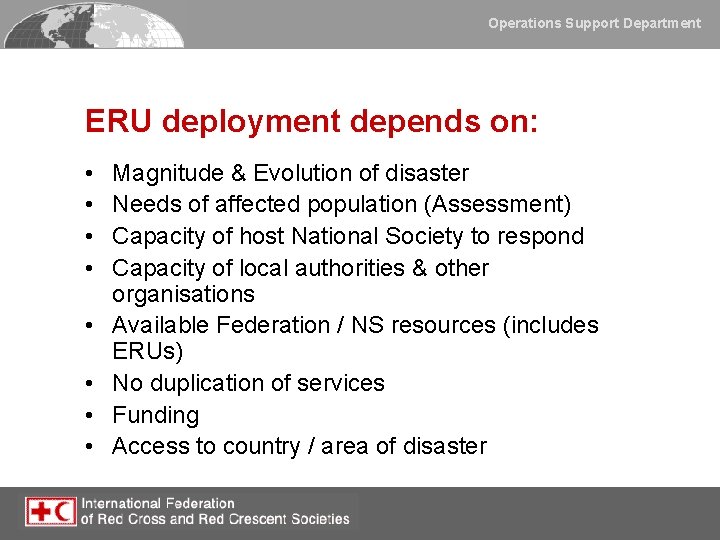
Operations Support Department ERU deployment depends on: • • Magnitude & Evolution of disaster Needs of affected population (Assessment) Capacity of host National Society to respond Capacity of local authorities & other organisations Available Federation / NS resources (includes ERUs) No duplication of services Funding Access to country / area of disaster
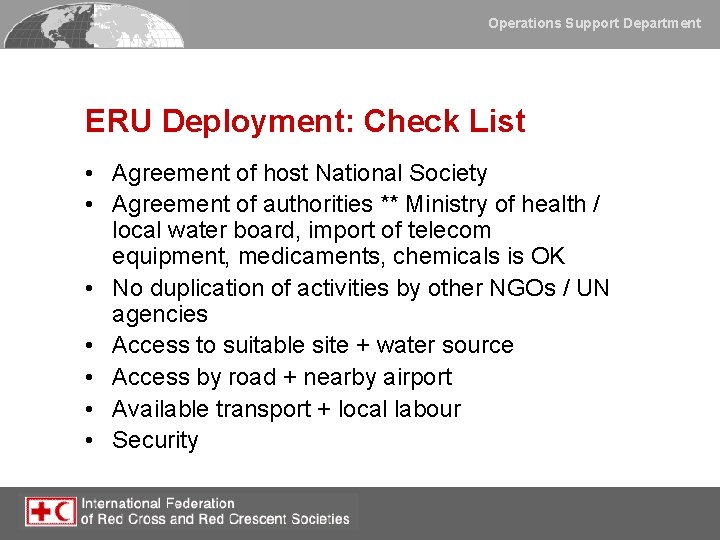
Operations Support Department ERU Deployment: Check List • Agreement of host National Society • Agreement of authorities ** Ministry of health / local water board, import of telecom equipment, medicaments, chemicals is OK • No duplication of activities by other NGOs / UN agencies • Access to suitable site + water source • Access by road + nearby airport • Available transport + local labour • Security
Operations Support Department ERU Responsibilities • Deploying National Society: – – – Overall development of the ERU Recruitment & staffing Training to specific technical ERU standard Funding Procurement of equipment to ERU standards Mobilisation + deployment (staff, packing, cargo flights, running costs) – Refurbishment
Operations Support Department ERU Responsibilities • Federation – Coordination by ERU Officer located in Geneva – Support to ERU NS training – ERU technical working groups – technical development & standardisation across NS – Field Team Leader Training – Standard Operating Procedures – Coordinates mobilisation & deployment – Information dissemination – donors, DMIS