
Operations Risk Management Planning Template for Underway Replenishment





- Slides: 26
Operations Risk Management Planning Template for Underway Replenishment LCDR Jeffrey P. Cole, USN Dr Frank Noonan, WPI 1
Underway Replenishment (UNREP) • At sea, re-supply of critical items is necessary for operational readiness. • Dangerous activity. • Multiplicity of factors influence feasibility. • Go-No Go decision. 2
US NAVY Mishap Data • Two collisions this FY • Mishap rate this FY > twice the Mishap rate from 1996 - 2000 • DOD property damages $101 million for FY 00; FY 96 -FY 99 $72 million • Fatalities 4; Major injuries 169 (FY 00) • Fatalities 15; Major injuries 897 (FY 96 -00) 3
Operational Risk Management Process • • • Risk Identification Risk Assessment Risk Evaluation Implementation Monitor 4
Levels for ORM • On the Run • Deliberate • In-Depth 5
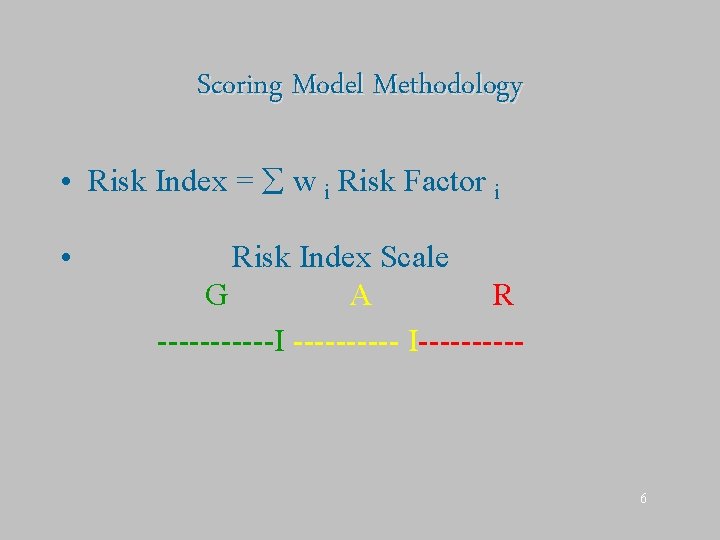
Scoring Model Methodology • Risk Index = w i Risk Factor i • Risk Index Scale G A R ------I ----- I----- 6
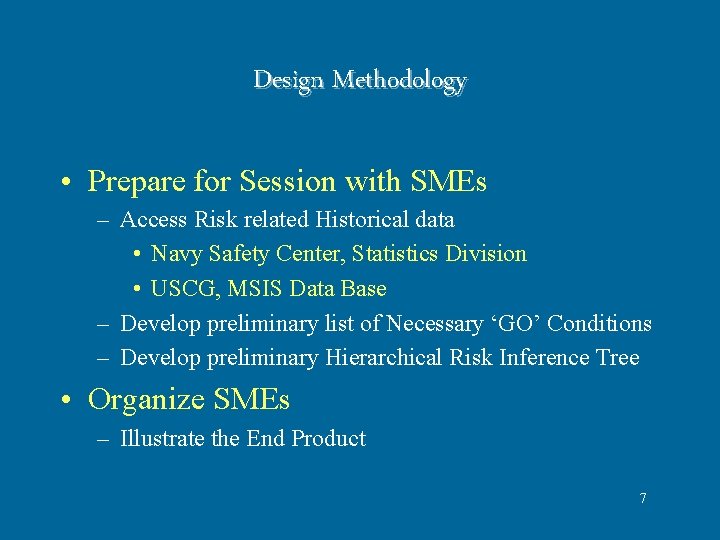
Design Methodology • Prepare for Session with SMEs – Access Risk related Historical data • Navy Safety Center, Statistics Division • USCG, MSIS Data Base – Develop preliminary list of Necessary ‘GO’ Conditions – Develop preliminary Hierarchical Risk Inference Tree • Organize SMEs – Illustrate the End Product 7
Illustrative ORM End Product MEASURING RISK WITH THE GREEN AMBER RED (GAR) SURF OPERATIONS RISK ASSESSMENT -"CROSSING THE BAR" • The parameters listed below must be met before the 36' AMBAR may be operated in surf conditions for the purpose of executing a SAR case (or performing training). These parameters are identified in ALCOGARDONE 002/99 and include: • • 1. A qualified RHI Surf Coxswain is operating the boat, and; • 2. The 36'AMBARistheonlycapableresourceavailable, and; • 3. A backup Helo or MLB is en route (must actually be on scene during training), and; • 4. The mission is to save life exclusively (unless training), and, • 5. The surf is on average four feet but does not exceed 6 feet. 8
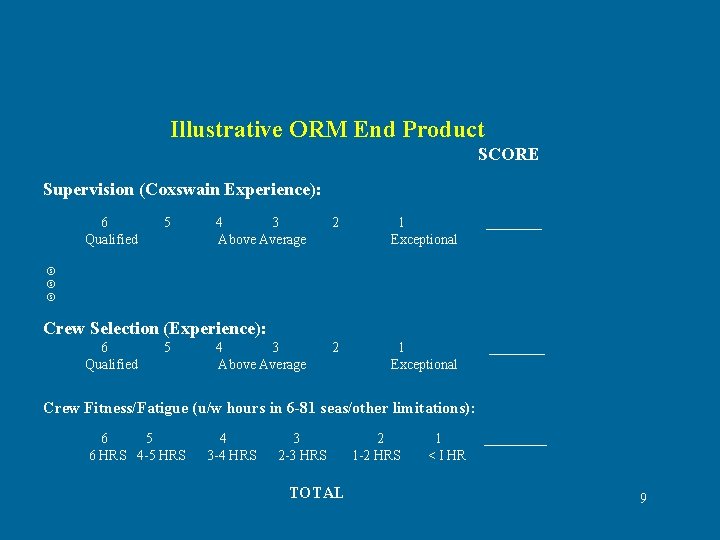
Illustrative ORM End Product SCORE Supervision (Coxswain Experience): 6 5 4 3 2 Qualified Above Average 1 ____ Exceptional Crew Selection (Experience): 6 5 4 3 2 Qualified Above Average 1 ____ Exceptional Crew Fitness/Fatigue (u/w hours in 6 -81 seas/other limitations): 6 5 4 3 2 1 _____ 6 HRS 4 -5 HRS 3 -4 HRS 2 -3 HRS 1 -2 HRS < I HR TOTAL 9
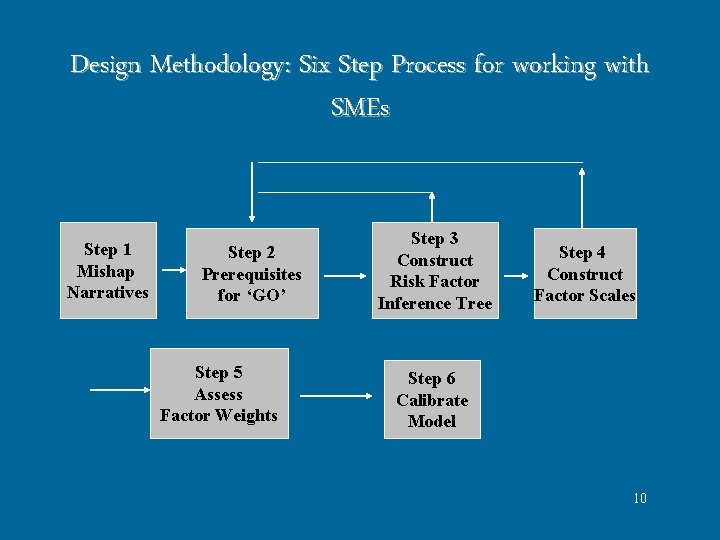
Design Methodology: Six Step Process for working with SMEs Step 1 Mishap Narratives Step 2 Prerequisites for ‘GO’ Step 5 Assess Factor Weights Step 3 Construct Risk Factor Inference Tree Step 4 Construct Factor Scales Step 6 Calibrate Model 10
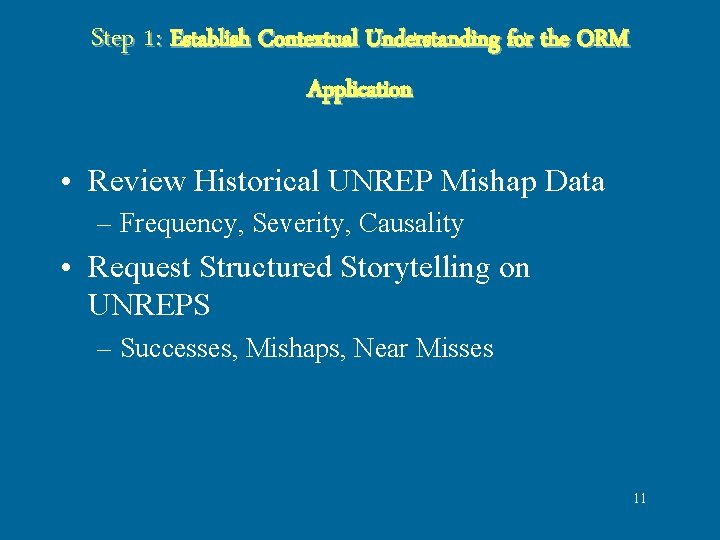
Step 1: Establish Contextual Understanding for the ORM Application • Review Historical UNREP Mishap Data – Frequency, Severity, Causality • Request Structured Storytelling on UNREPS – Successes, Mishaps, Near Misses 11
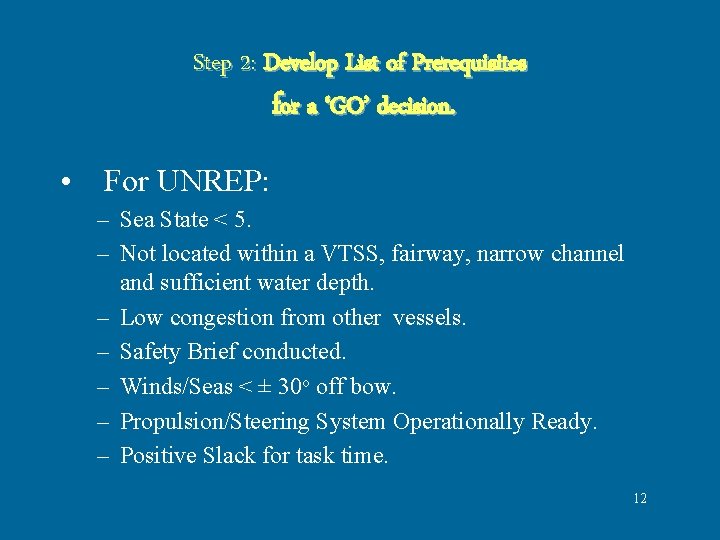
Step 2: Develop List of Prerequisites for a ‘GO’ decision. • For UNREP: – Sea State < 5. – Not located within a VTSS, fairway, narrow channel and sufficient water depth. – Low congestion from other vessels. – Safety Brief conducted. – Winds/Seas < ± 30 o off bow. – Propulsion/Steering System Operationally Ready. – Positive Slack for task time. 12
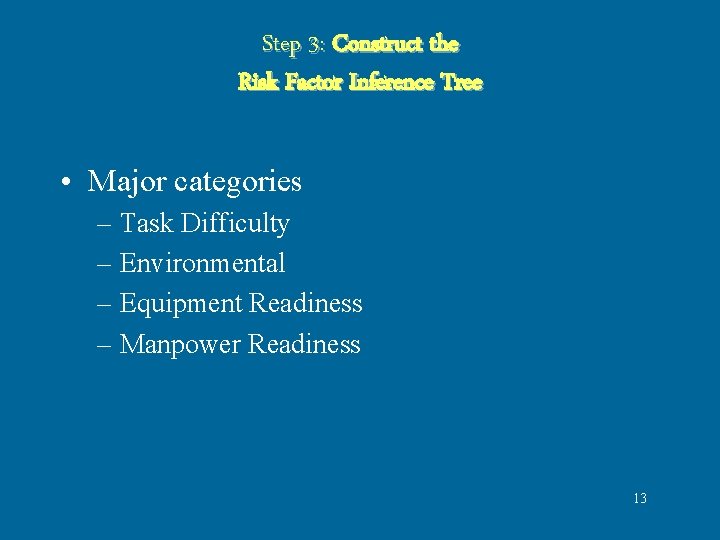
Step 3: Construct the Risk Factor Inference Tree • Major categories – Task Difficulty – Environmental – Equipment Readiness – Manpower Readiness 13
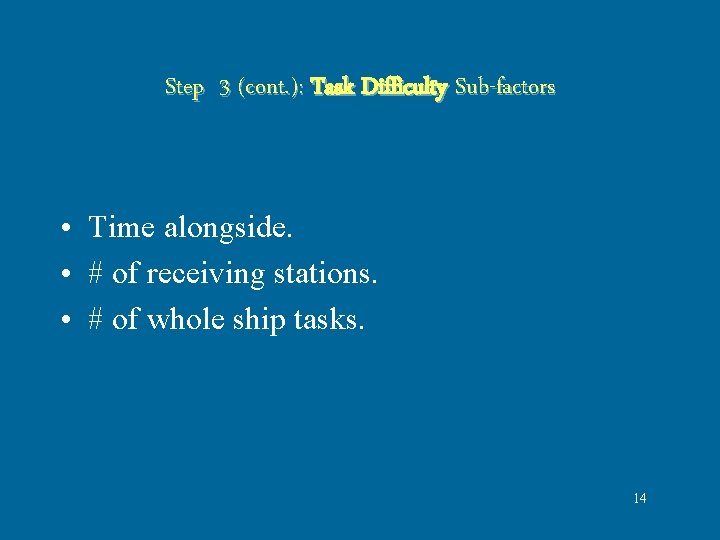
Step 3 (cont. ): Task Difficulty Sub-factors • Time alongside. • # of receiving stations. • # of whole ship tasks. 14
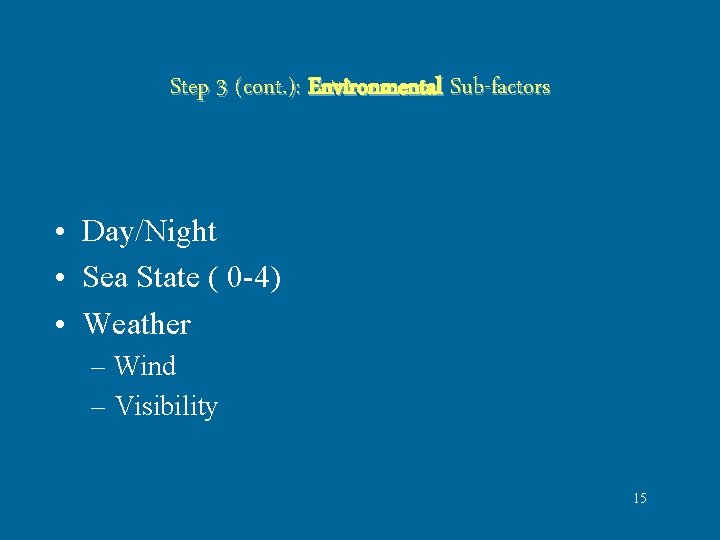
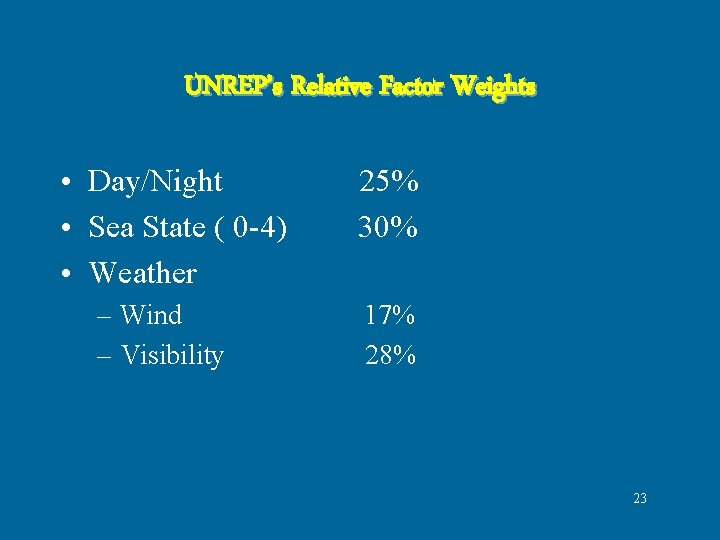
Step 3 (cont. ): Environmental Sub-factors • Day/Night • Sea State ( 0 -4) • Weather – Wind – Visibility 15
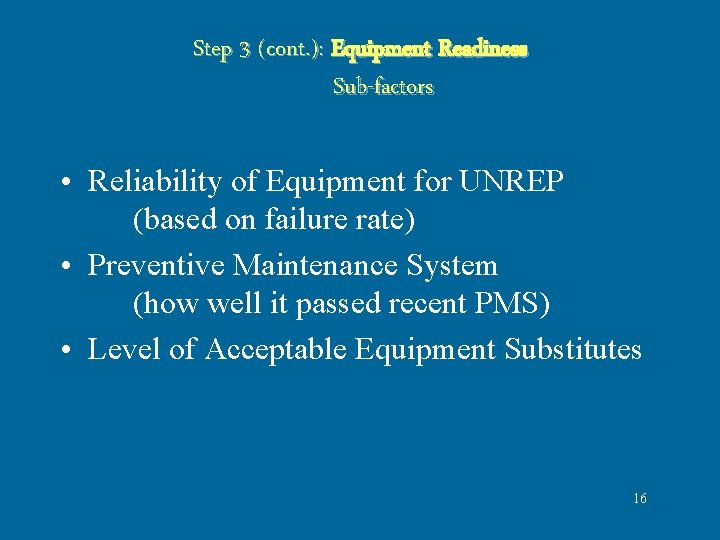
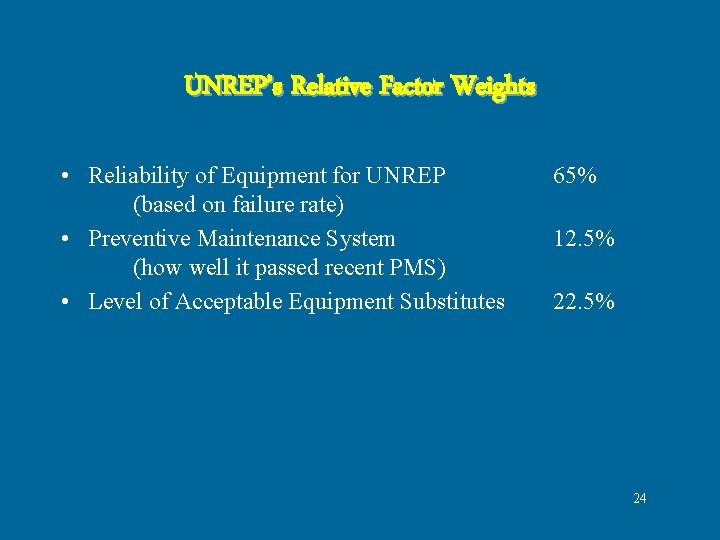
Step 3 (cont. ): Equipment Readiness Sub-factors • Reliability of Equipment for UNREP (based on failure rate) • Preventive Maintenance System (how well it passed recent PMS) • Level of Acceptable Equipment Substitutes 16
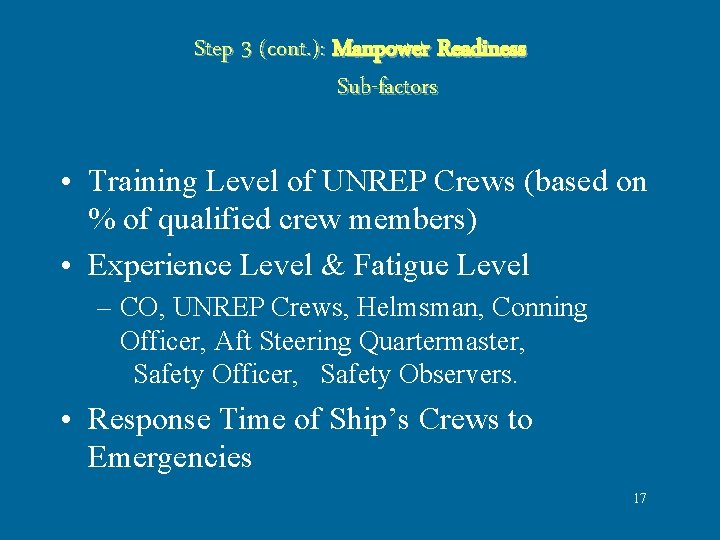
Step 3 (cont. ): Manpower Readiness Sub-factors • Training Level of UNREP Crews (based on % of qualified crew members) • Experience Level & Fatigue Level – CO, UNREP Crews, Helmsman, Conning Officer, Aft Steering Quartermaster, Safety Officer, Safety Observers. • Response Time of Ship’s Crews to Emergencies 17
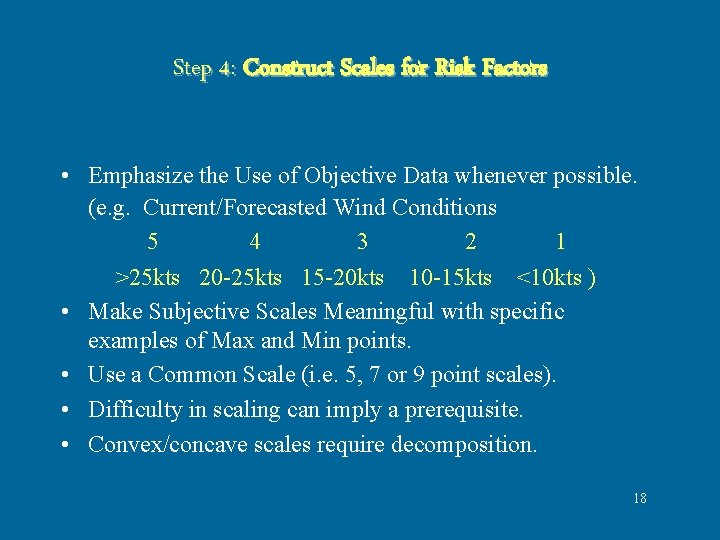
Step 4: Construct Scales for Risk Factors • Emphasize the Use of Objective Data whenever possible. (e. g. Current/Forecasted Wind Conditions 5 4 3 2 1 >25 kts 20 -25 kts 15 -20 kts 10 -15 kts <10 kts ) • Make Subjective Scales Meaningful with specific examples of Max and Min points. • Use a Common Scale (i. e. 5, 7 or 9 point scales). • Difficulty in scaling can imply a prerequisite. • Convex/concave scales require decomposition. 18
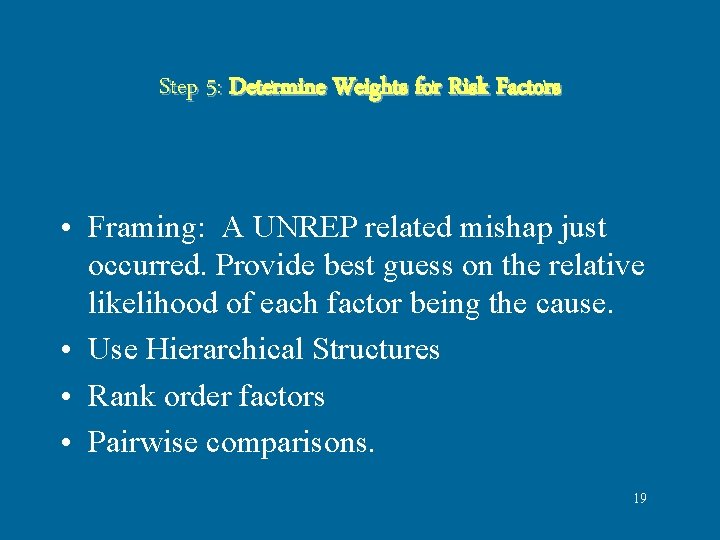
Step 5: Determine Weights for Risk Factors • Framing: A UNREP related mishap just occurred. Provide best guess on the relative likelihood of each factor being the cause. • Use Hierarchical Structures • Rank order factors • Pairwise comparisons. 19
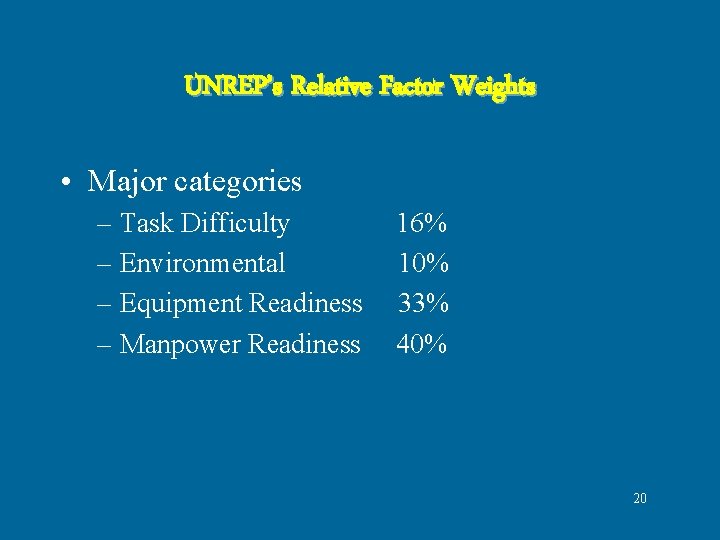
UNREP’s Relative Factor Weights • Major categories – Task Difficulty 16% – Environmental 10% – Equipment Readiness 33% – Manpower Readiness 40% 20
UNREP’s Relative Factor Weights • Training Level of UNREP Crews 55% • Experience Level – CO 17% – UNREP Crews, Helmsman, Conning Officer, 18% Aft Steering Quartermaster, Safety Officer, Safety Observers. • Response Time of Ship’s Crews to Emergencies 10% 21
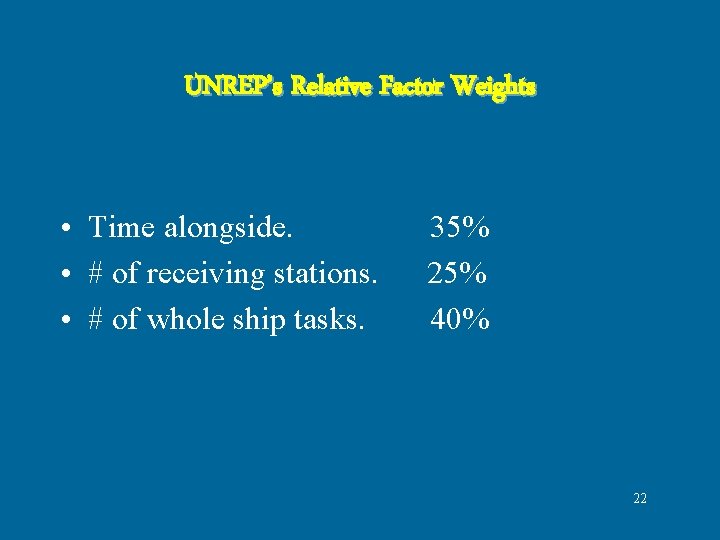
UNREP’s Relative Factor Weights • Time alongside. 35% • # of receiving stations. 25% • # of whole ship tasks. 40% 22
UNREP’s Relative Factor Weights • Day/Night 25% • Sea State ( 0 -4) 30% • Weather – Wind 17% – Visibility 28% 23
UNREP’s Relative Factor Weights • Reliability of Equipment for UNREP 65% (based on failure rate) • Preventive Maintenance System 12. 5% (how well it passed recent PMS) • Level of Acceptable Equipment Substitutes 22. 5% 24
Scoring Model Methodology • Risk Index = w i Risk Factor i • Risk Index Scale G A R ------I ----- I----- 25
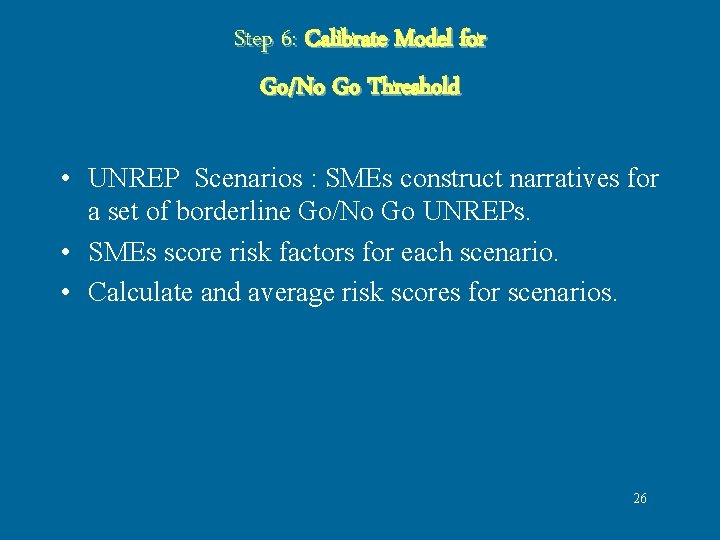
Step 6: Calibrate Model for Go/No Go Threshold • UNREP Scenarios : SMEs construct narratives for a set of borderline Go/No Go UNREPs. • SMEs score risk factors for each scenario. • Calculate and average risk scores for scenarios. 26