
Operations ResearchI Revised Simplex Method Department of Statistics
- Slides: 14
Operations Research-I Revised Simplex Method Department of Statistics P. R. Govt. College (A) Kakinada
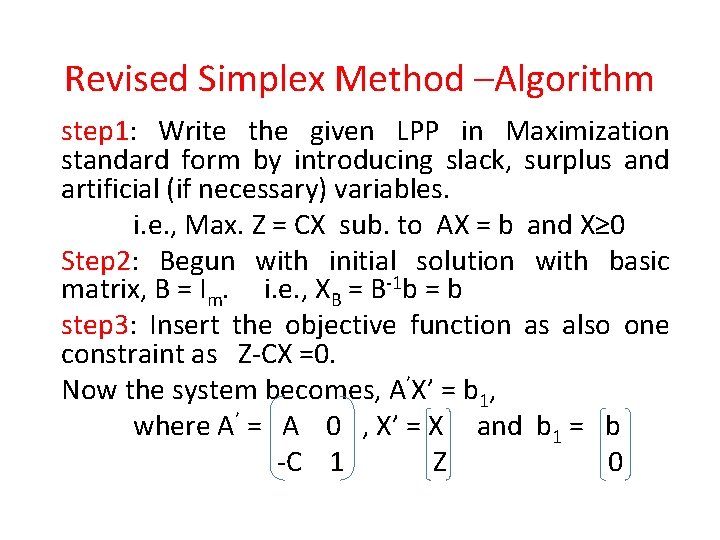
Revised Simplex Method –Algorithm step 1: Write the given LPP in Maximization standard form by introducing slack, surplus and artificial (if necessary) variables. i. e. , Max. Z = CX sub. to AX = b and X≥ 0 Step 2: Begun with initial solution with basic matrix, B = Im. i. e. , XB = B-1 b = b step 3: Insert the objective function as also one constraint as Z-CX =0. Now the system becomes, A’X’ = b 1, where A’ = A 0 , X’ = X and b 1 = b -C 1 Z 0
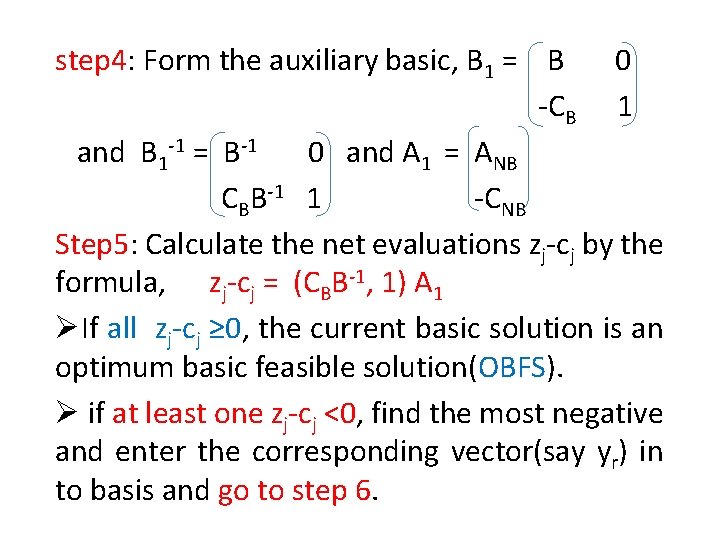
step 4: Form the auxiliary basic, B 1 = B 0 -CB 1 and B 1 -1 = B-1 0 and A 1 = ANB CBB-1 1 -CNB Step 5: Calculate the net evaluations zj-cj by the formula, zj-cj = (CBB-1, 1) A 1 ØIf all zj-cj ≥ 0, the current basic solution is an optimum basic feasible solution(OBFS). Ø if at least one zj-cj <0, find the most negative and enter the corresponding vector(say yr) in to basis and go to step 6.
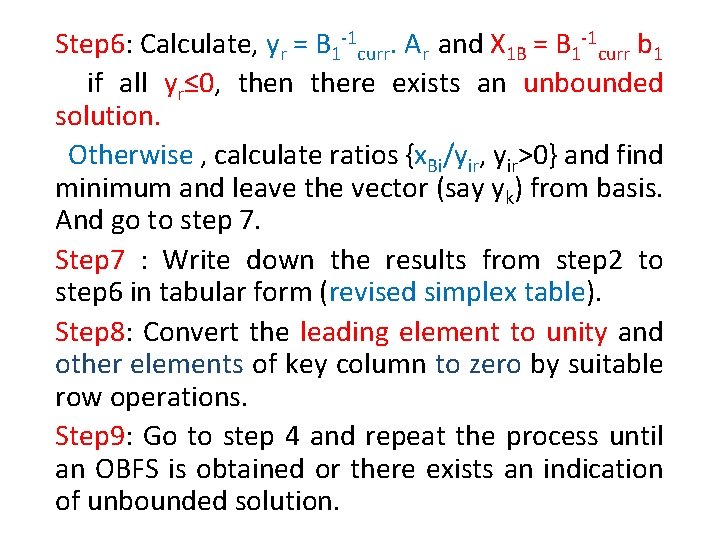
Step 6: Calculate, yr = B 1 -1 curr. Ar and X 1 B = B 1 -1 curr b 1 if all yr≤ 0, then there exists an unbounded solution. Otherwise , calculate ratios {x. Bi/yir, yir>0} and find minimum and leave the vector (say yk) from basis. And go to step 7. Step 7 : Write down the results from step 2 to step 6 in tabular form (revised simplex table). Step 8: Convert the leading element to unity and other elements of key column to zero by suitable row operations. Step 9: Go to step 4 and repeat the process until an OBFS is obtained or there exists an indication of unbounded solution.
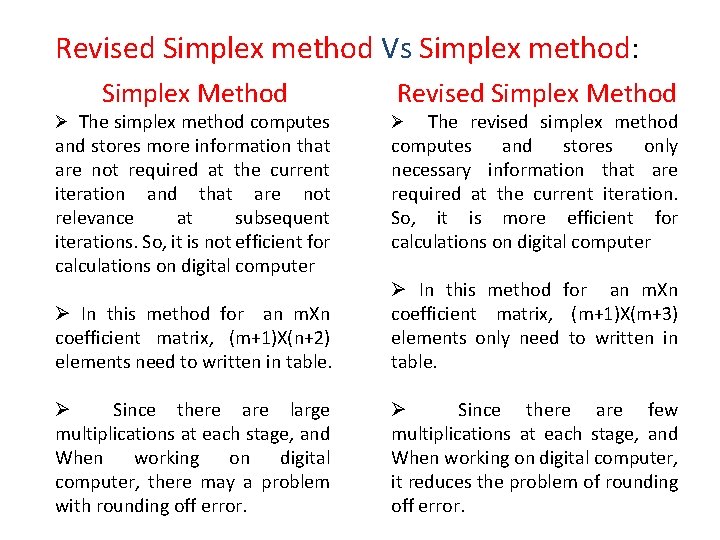
Revised Simplex method Vs Simplex method: Simplex Method Revised Simplex Method Ø The simplex method computes Ø Ø In this method for an m. Xn coefficient matrix, (m+1)X(n+2) elements need to written in table. Ø In this method for an m. Xn coefficient matrix, (m+1)X(m+3) elements only need to written in table. Ø Since there are large multiplications at each stage, and When working on digital computer, there may a problem with rounding off error. Ø Since there are few multiplications at each stage, and When working on digital computer, it reduces the problem of rounding off error. and stores more information that are not required at the current iteration and that are not relevance at subsequent iterations. So, it is not efficient for calculations on digital computer The revised simplex method computes and stores only necessary information that are required at the current iteration. So, it is more efficient for calculations on digital computer
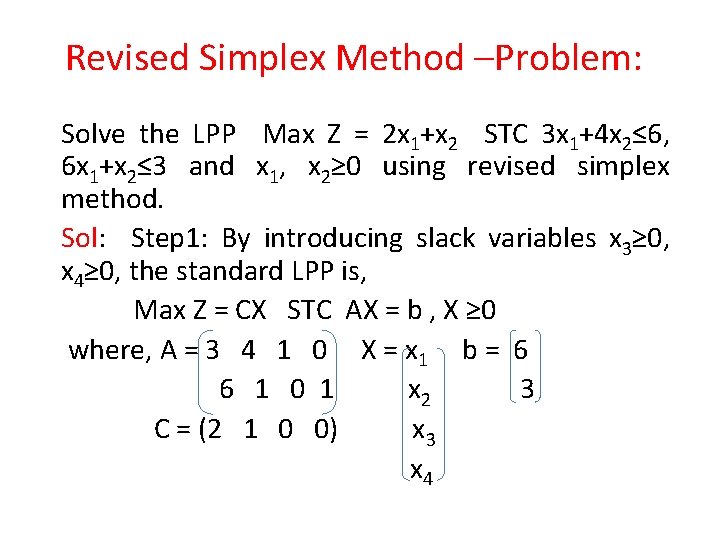
Revised Simplex Method –Problem: Solve the LPP Max Z = 2 x 1+x 2 STC 3 x 1+4 x 2≤ 6, 6 x 1+x 2≤ 3 and x 1, x 2≥ 0 using revised simplex method. Sol: Step 1: By introducing slack variables x 3≥ 0, x 4≥ 0, the standard LPP is, Max Z = CX STC AX = b , X ≥ 0 where, A = 3 4 1 0 X = x 1 b = 6 6 1 0 1 x 2 3 C = (2 1 0 0) x 3 x 4
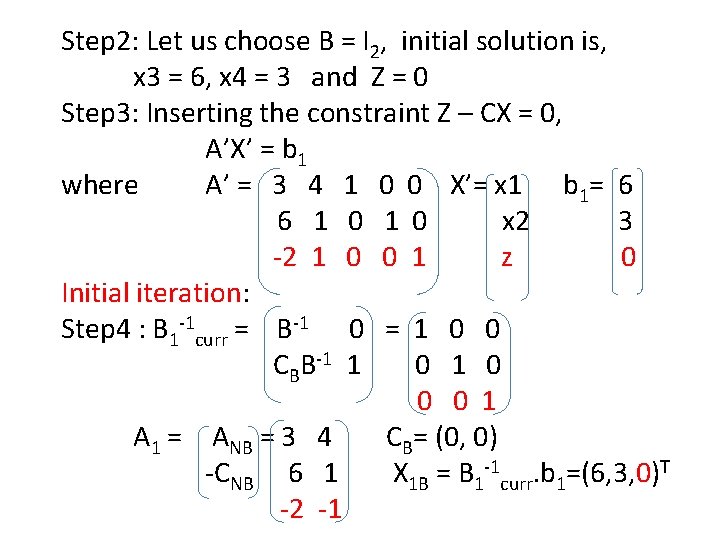
Step 2: Let us choose B = I 2, initial solution is, x 3 = 6, x 4 = 3 and Z = 0 Step 3: Inserting the constraint Z – CX = 0, A’X’ = b 1 where A’ = 3 4 1 0 0 X’= x 1 b 1= 6 6 1 0 x 2 3 -2 1 0 0 1 z 0 Initial iteration: Step 4 : B 1 -1 curr = B-1 0 = 1 0 0 CBB-1 1 0 0 0 1 A 1 = ANB = 3 4 CB= (0, 0) -CNB 6 1 X 1 B = B 1 -1 curr. b 1=(6, 3, 0)T -2 -1
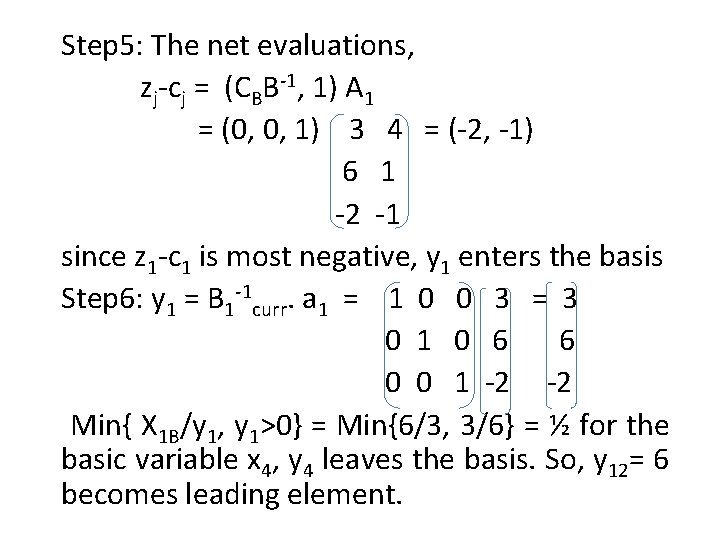
Step 5: The net evaluations, zj-cj = (CBB-1, 1) A 1 = (0, 0, 1) 3 4 = (-2, -1) 6 1 -2 -1 since z 1 -c 1 is most negative, y 1 enters the basis Step 6: y 1 = B 1 -1 curr. a 1 = 1 0 0 3 = 3 0 1 0 6 6 0 0 1 -2 -2 Min{ X 1 B/y 1, y 1>0} = Min{6/3, 3/6} = ½ for the basic variable x 4, y 4 leaves the basis. So, y 12= 6 becomes leading element.
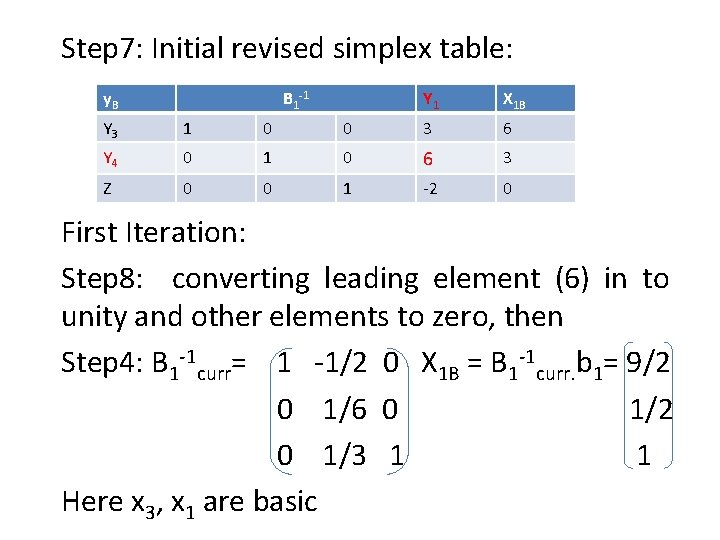
Step 7: Initial revised simplex table: y. B B 1 -1 Y 1 X 1 B Y 3 1 0 0 3 6 Y 4 0 1 0 6 3 Z 0 0 1 -2 0 First Iteration: Step 8: converting leading element (6) in to unity and other elements to zero, then Step 4: B 1 -1 curr= 1 -1/2 0 X 1 B = B 1 -1 curr. b 1= 9/2 0 1/6 0 1/2 0 1/3 1 1 Here x 3, x 1 are basic
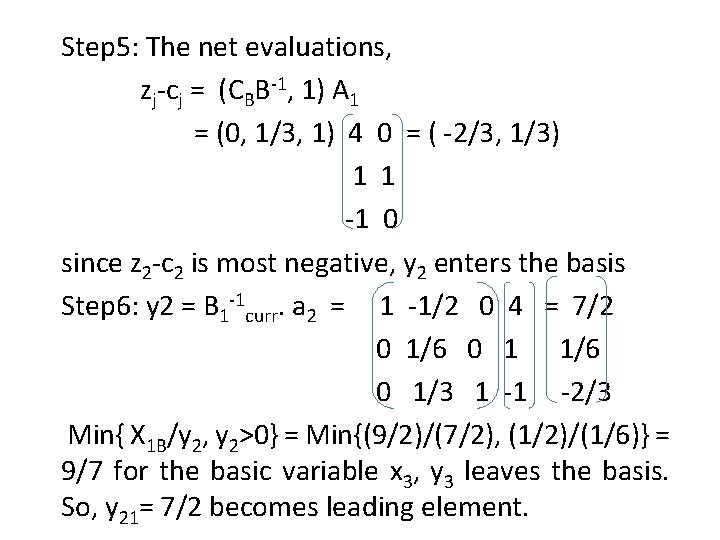
Step 5: The net evaluations, zj-cj = (CBB-1, 1) A 1 = (0, 1/3, 1) 4 0 = ( -2/3, 1/3) 1 1 -1 0 since z 2 -c 2 is most negative, y 2 enters the basis Step 6: y 2 = B 1 -1 curr. a 2 = 1 -1/2 0 4 = 7/2 0 1/6 0 1/3 1 -1 -2/3 Min{ X 1 B/y 2, y 2>0} = Min{(9/2)/(7/2), (1/2)/(1/6)} = 9/7 for the basic variable x 3, y 3 leaves the basis. So, y 21= 7/2 becomes leading element.
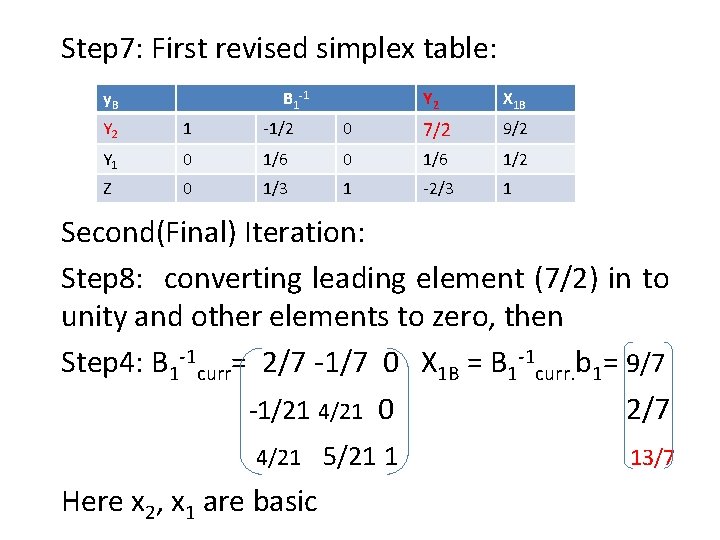
Step 7: First revised simplex table: y. B B 1 -1 Y 2 X 1 B Y 2 1 -1/2 0 7/2 9/2 Y 1 0 1/6 1/2 Z 0 1/3 1 -2/3 1 Second(Final) Iteration: Step 8: converting leading element (7/2) in to unity and other elements to zero, then Step 4: B 1 -1 curr= 2/7 -1/7 0 X 1 B = B 1 -1 curr. b 1= 9/7 -1/21 4/21 0 2/7 4/21 5/21 1 Here x 2, x 1 are basic 13/7
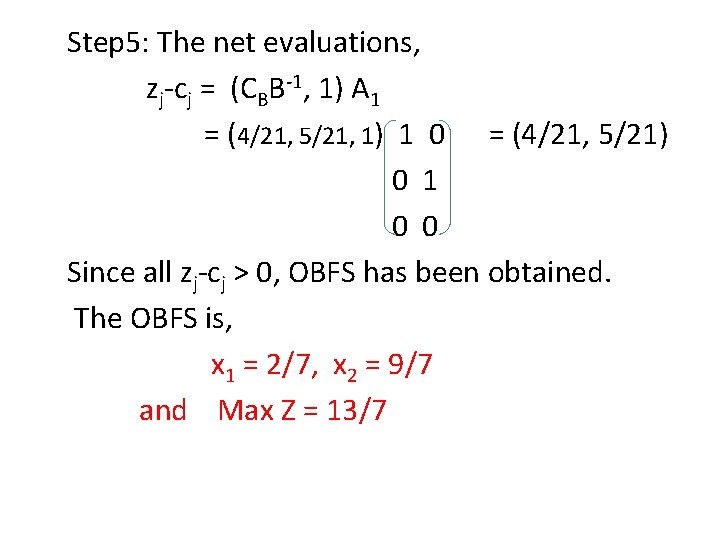
Step 5: The net evaluations, zj-cj = (CBB-1, 1) A 1 = (4/21, 5/21, 1) 1 0 = (4/21, 5/21) 0 1 0 0 Since all zj-cj > 0, OBFS has been obtained. The OBFS is, x 1 = 2/7, x 2 = 9/7 and Max Z = 13/7
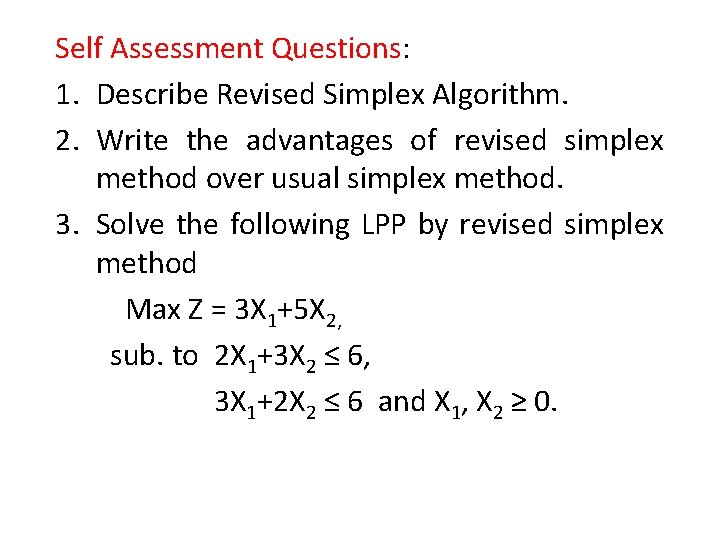
Self Assessment Questions: 1. Describe Revised Simplex Algorithm. 2. Write the advantages of revised simplex method over usual simplex method. 3. Solve the following LPP by revised simplex method Max Z = 3 X 1+5 X 2, sub. to 2 X 1+3 X 2 ≤ 6, 3 X 1+2 X 2 ≤ 6 and X 1, X 2 ≥ 0.