
Operations on the arrayvector data structures Linear and







- Slides: 51
Operations on the array/vector data structures Linear and binary search Recursive and Iterative Algorithms Five sorting algorithms Heap data structure Function template Callback functions Basic Searching and Sorting
Agenda • Linear and binary search – Recursive and iterative algorithms • Sorting – – Insertion sort Selection sort Merge sort Quick sort and randomized quick sort • The heap data structure – Heap Sort – Priority queues • Experimenting with the 5 sorting algorithms 10/30/2021 CSE 250, Fall 2012, SUNY Buffalo, (C) Hung Q. Ngo 1
Search for a key in a given vector/array LINEAR AND BINARY SEARCH 10/30/2021 CSE 250, Fall 2012, SUNY Buffalo, (C) Hung Q. Ngo 2
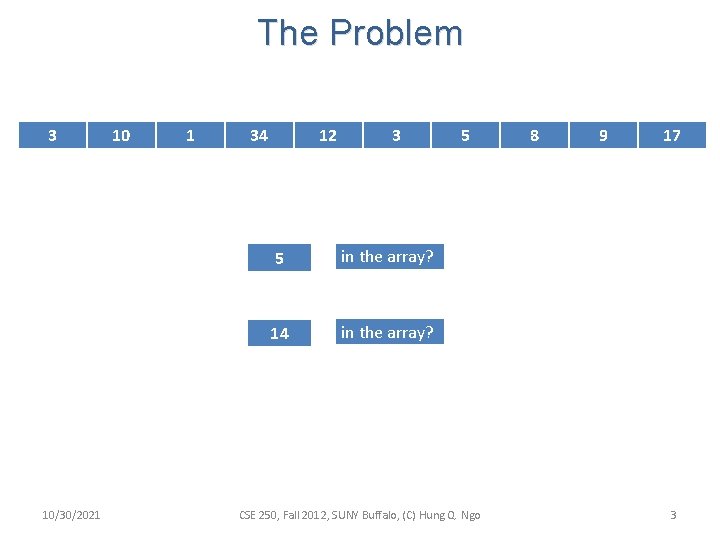
The Problem 3 10/30/2021 10 1 34 12 3 5 in the array? 14 in the array? 5 CSE 250, Fall 2012, SUNY Buffalo, (C) Hung Q. Ngo 8 9 17 3
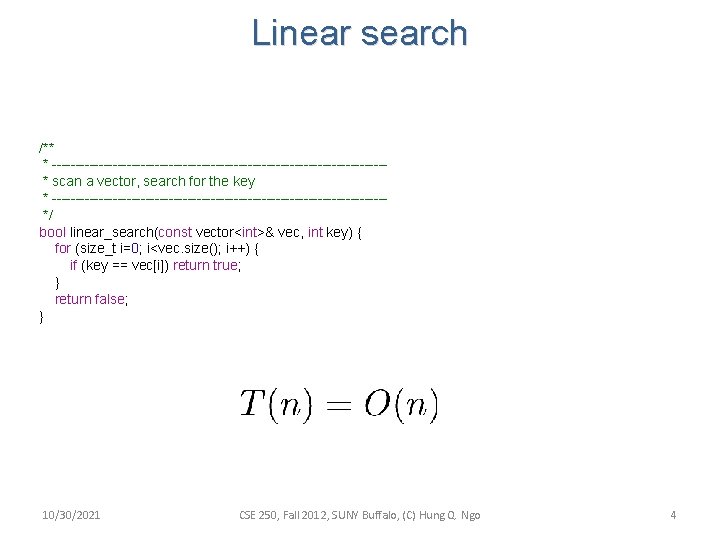
Linear search /** * ------------------------------------* scan a vector, search for the key * ------------------------------------*/ bool linear_search(const vector<int>& vec, int key) { for (size_t i=0; i<vec. size(); i++) { if (key == vec[i]) return true; } return false; } 10/30/2021 CSE 250, Fall 2012, SUNY Buffalo, (C) Hung Q. Ngo 4
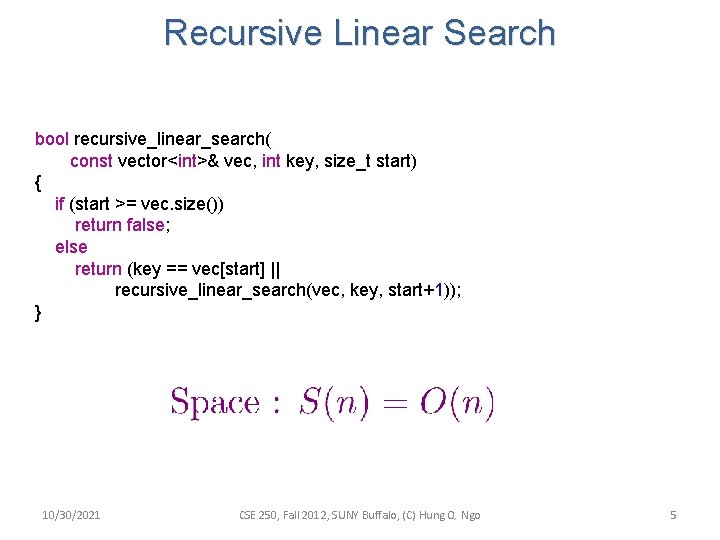
Recursive Linear Search bool recursive_linear_search( const vector<int>& vec, int key, size_t start) { if (start >= vec. size()) return false; else return (key == vec[start] || recursive_linear_search(vec, key, start+1)); } 10/30/2021 CSE 250, Fall 2012, SUNY Buffalo, (C) Hung Q. Ngo 5
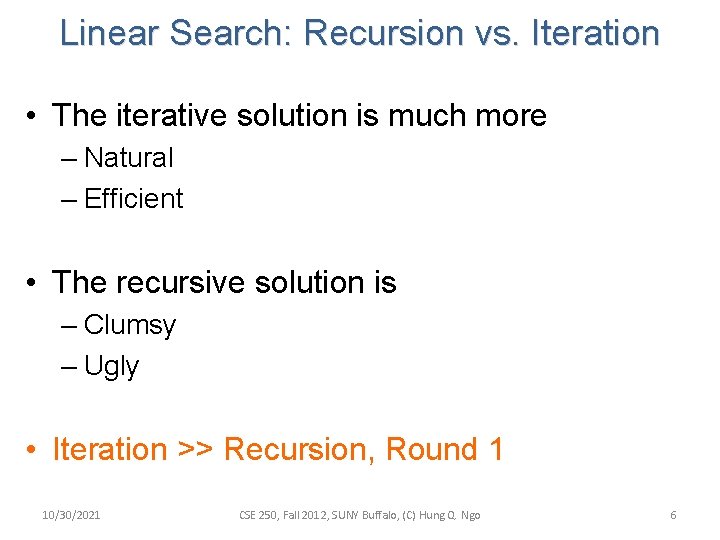
Linear Search: Recursion vs. Iteration • The iterative solution is much more – Natural – Efficient • The recursive solution is – Clumsy – Ugly • Iteration >> Recursion, Round 1 10/30/2021 CSE 250, Fall 2012, SUNY Buffalo, (C) Hung Q. Ngo 6
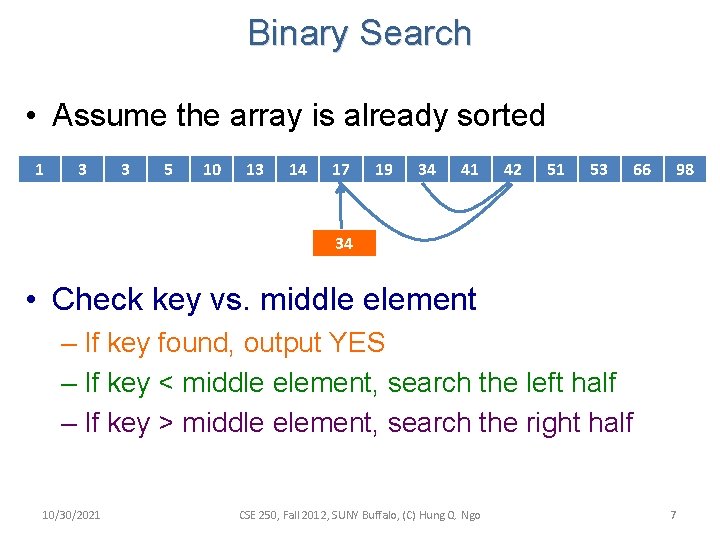
Binary Search • Assume the array is already sorted 1 3 3 5 10 13 14 17 19 34 41 42 51 53 66 98 34 • Check key vs. middle element – If key found, output YES – If key < middle element, search the left half – If key > middle element, search the right half 10/30/2021 CSE 250, Fall 2012, SUNY Buffalo, (C) Hung Q. Ngo 7
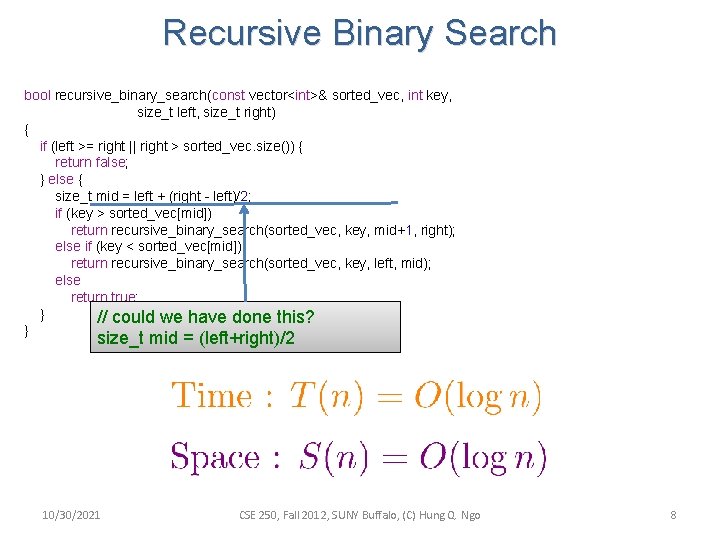
Recursive Binary Search bool recursive_binary_search(const vector<int>& sorted_vec, int key, size_t left, size_t right) { if (left >= right || right > sorted_vec. size()) { return false; } else { size_t mid = left + (right - left)/2; if (key > sorted_vec[mid]) return recursive_binary_search(sorted_vec, key, mid+1, right); else if (key < sorted_vec[mid]) return recursive_binary_search(sorted_vec, key, left, mid); else return true; } // could we have done this? } size_t mid = (left+right)/2 10/30/2021 CSE 250, Fall 2012, SUNY Buffalo, (C) Hung Q. Ngo 8
Iterative Binary search bool binary_search(const vector<int>& sorted_vec, int key) { size_t mid, left = 0, right = sorted_vec. size(); while (left < right) { // mid = (left+right)/2 is problematic // due to potential integer overflow mid = left + (right - left)/2; if (key > sorted_vec[mid]) left = mid+1; else if (key < sorted_vec[mid]) right = mid; else return true; } return false; } 10/30/2021 CSE 250, Fall 2012, SUNY Buffalo, (C) Hung Q. Ngo 9
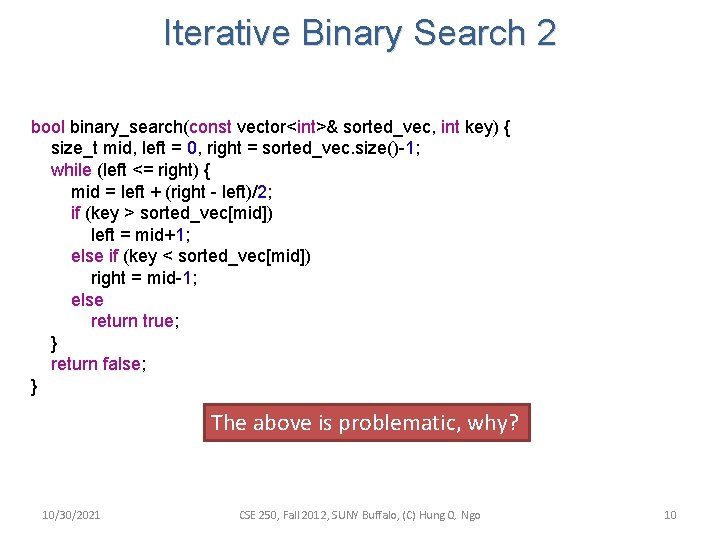
Iterative Binary Search 2 bool binary_search(const vector<int>& sorted_vec, int key) { size_t mid, left = 0, right = sorted_vec. size()-1; while (left <= right) { mid = left + (right - left)/2; if (key > sorted_vec[mid]) left = mid+1; else if (key < sorted_vec[mid]) right = mid-1; else return true; } return false; } The above is problematic, why? 10/30/2021 CSE 250, Fall 2012, SUNY Buffalo, (C) Hung Q. Ngo 10
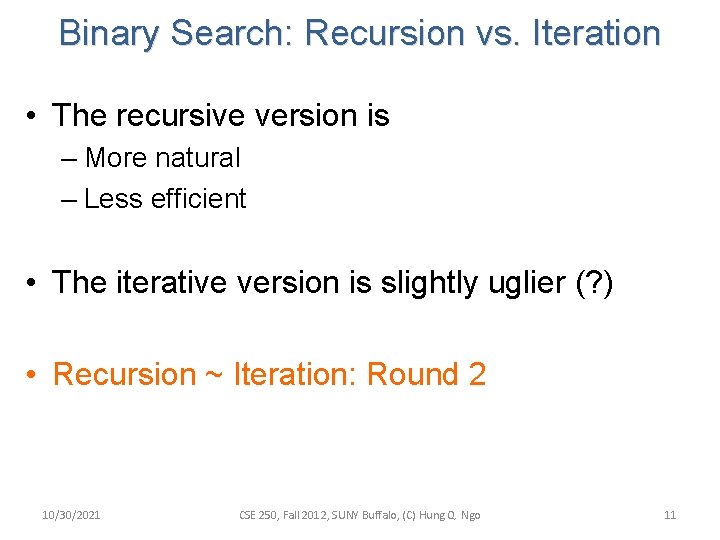
Binary Search: Recursion vs. Iteration • The recursive version is – More natural – Less efficient • The iterative version is slightly uglier (? ) • Recursion ~ Iteration: Round 2 10/30/2021 CSE 250, Fall 2012, SUNY Buffalo, (C) Hung Q. Ngo 11
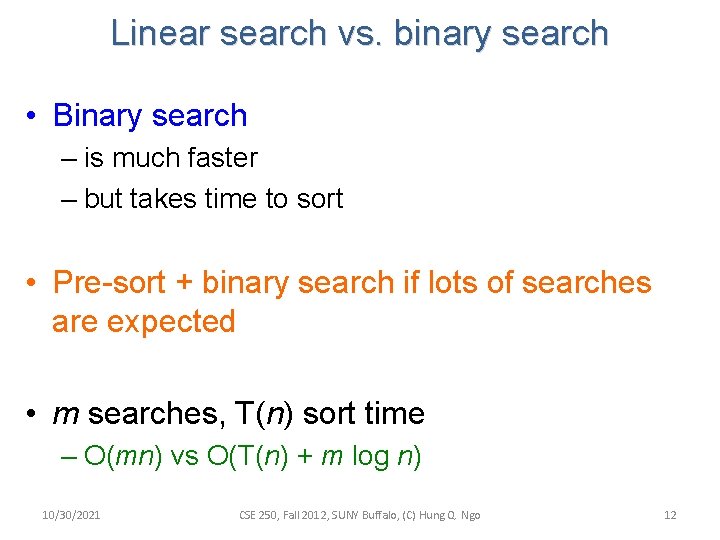
Linear search vs. binary search • Binary search – is much faster – but takes time to sort • Pre-sort + binary search if lots of searches are expected • m searches, T(n) sort time – O(mn) vs O(T(n) + m log n) 10/30/2021 CSE 250, Fall 2012, SUNY Buffalo, (C) Hung Q. Ngo 12
Insertion sort Selection sort Merge sort Quick sort Randomized quick sort http: //www. sorting-algorithms. com/ SORTING ALGORITHMS 10/30/2021 CSE 250, Fall 2012, SUNY Buffalo, (C) Hung Q. Ngo 13
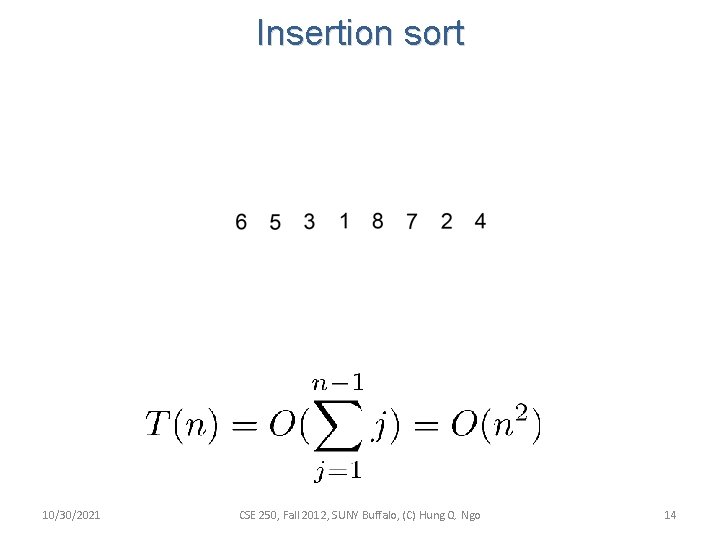
Insertion sort 10/30/2021 CSE 250, Fall 2012, SUNY Buffalo, (C) Hung Q. Ngo 14
Insertion sort void insertion_sort(vector<int> &vec) { int temp, j; for (int i=1; i<vec. size(); i++) { temp = vec[i]; j = i-1; while (j >= 0 && vec[j] > temp) { vec[j+1] = vec[j]; j--; } vec[j+1] = temp; } } 10/30/2021 CSE 250, Fall 2012, SUNY Buffalo, (C) Hung Q. Ngo 15
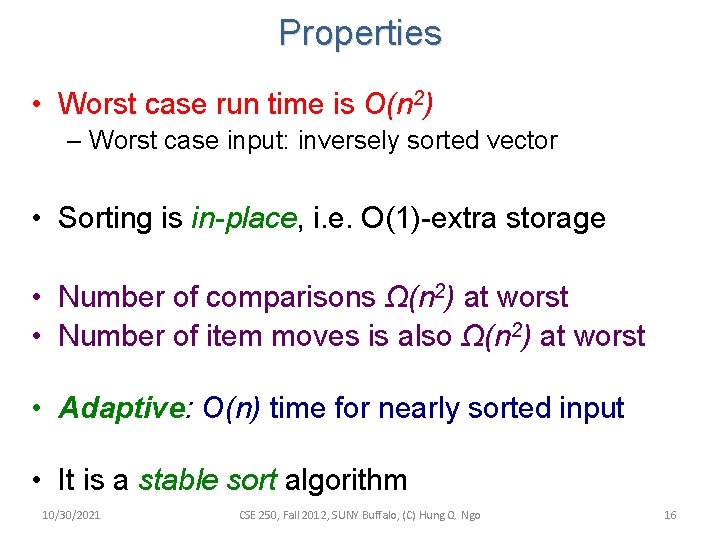
Properties • Worst case run time is O(n 2) – Worst case input: inversely sorted vector • Sorting is in-place, i. e. O(1)-extra storage • Number of comparisons Ω(n 2) at worst • Number of item moves is also Ω(n 2) at worst • Adaptive: O(n) time for nearly sorted input • It is a stable sort algorithm 10/30/2021 CSE 250, Fall 2012, SUNY Buffalo, (C) Hung Q. Ngo 16
Selection sort void selection_sort(vector<int> &vec) { int i, j, k; for (i=0; i<vec. size()-1; i++) { j=i; for (k=i+1; k<vec. size(); k++) if (vec[k] < vec[j]) j=k; if (j!=i) swap(vec[i], vec[j]); } } 10/30/2021 CSE 250, Fall 2012, SUNY Buffalo, (C) Hung Q. Ngo 17
Properties • Number of comparisons & run-time Ω(n 2) – Even when the input is already sorted, thus not adaptive • Sorting is in-place, i. e. O(1)-extra storage • Number of data movements is always O(n): nice! – Important for some applications (relational database) where we want to move memory/disk blocks • We do not always have to move data! – Sort pointers to data • Not stable (why? ) – Can be made stable at the cost of O(n 2) moves 10/30/2021 CSE 250, Fall 2012, SUNY Buffalo, (C) Hung Q. Ngo 18
Merge sort A classic divide-and-conquer algorithm 10/30/2021 CSE 250, Fall 2012, SUNY Buffalo, (C) Hung Q. Ngo 19
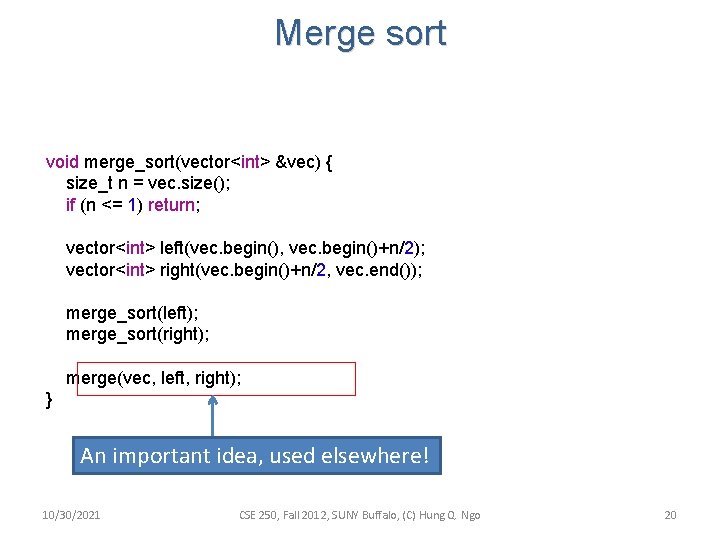
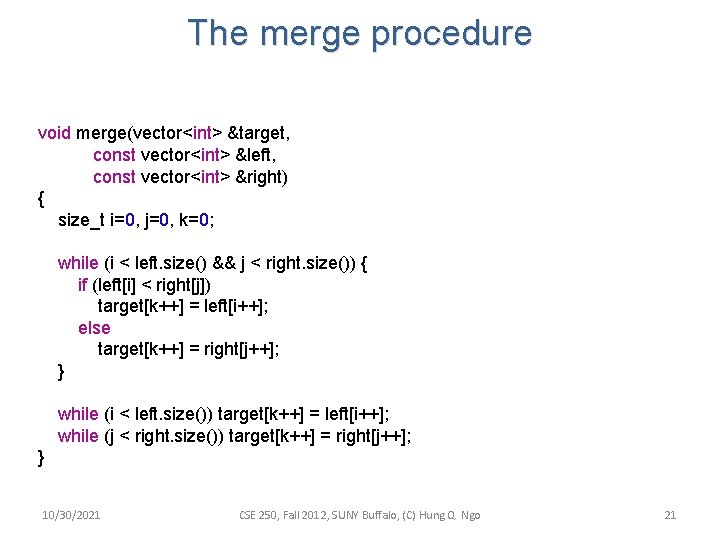
Merge sort void merge_sort(vector<int> &vec) { size_t n = vec. size(); if (n <= 1) return; vector<int> left(vec. begin(), vec. begin()+n/2); vector<int> right(vec. begin()+n/2, vec. end()); merge_sort(left); merge_sort(right); merge(vec, left, right); } An important idea, used elsewhere! 10/30/2021 CSE 250, Fall 2012, SUNY Buffalo, (C) Hung Q. Ngo 20
The merge procedure void merge(vector<int> &target, const vector<int> &left, const vector<int> &right) { size_t i=0, j=0, k=0; while (i < left. size() && j < right. size()) { if (left[i] < right[j]) target[k++] = left[i++]; else target[k++] = right[j++]; } while (i < left. size()) target[k++] = left[i++]; while (j < right. size()) target[k++] = right[j++]; } 10/30/2021 CSE 250, Fall 2012, SUNY Buffalo, (C) Hung Q. Ngo 21
Recurrence tree 10/30/2021 CSE 250, Fall 2012, SUNY Buffalo, (C) Hung Q. Ngo 22
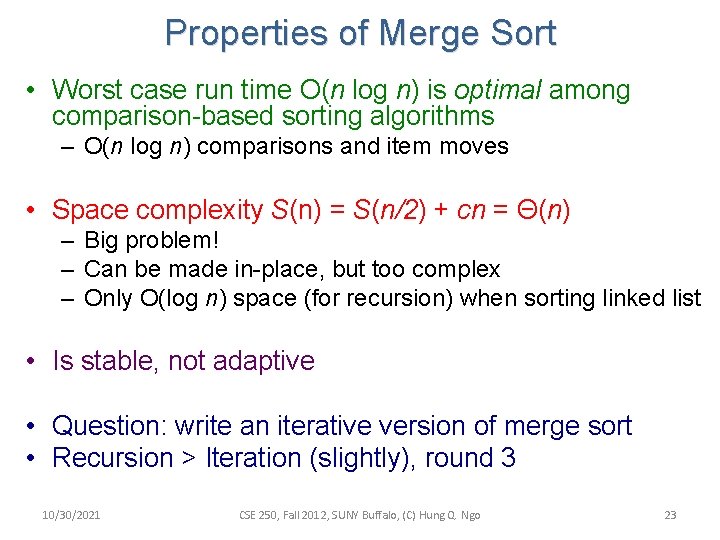
Properties of Merge Sort • Worst case run time O(n log n) is optimal among comparison-based sorting algorithms – O(n log n) comparisons and item moves • Space complexity S(n) = S(n/2) + cn = Θ(n) – Big problem! – Can be made in-place, but too complex – Only O(log n) space (for recursion) when sorting linked list • Is stable, not adaptive • Question: write an iterative version of merge sort • Recursion > Iteration (slightly), round 3 10/30/2021 CSE 250, Fall 2012, SUNY Buffalo, (C) Hung Q. Ngo 23
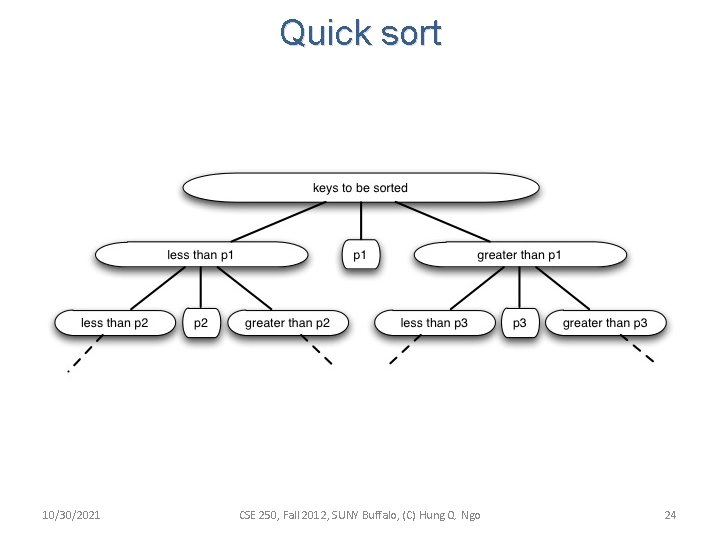
Quick sort 10/30/2021 CSE 250, Fall 2012, SUNY Buffalo, (C) Hung Q. Ngo 24
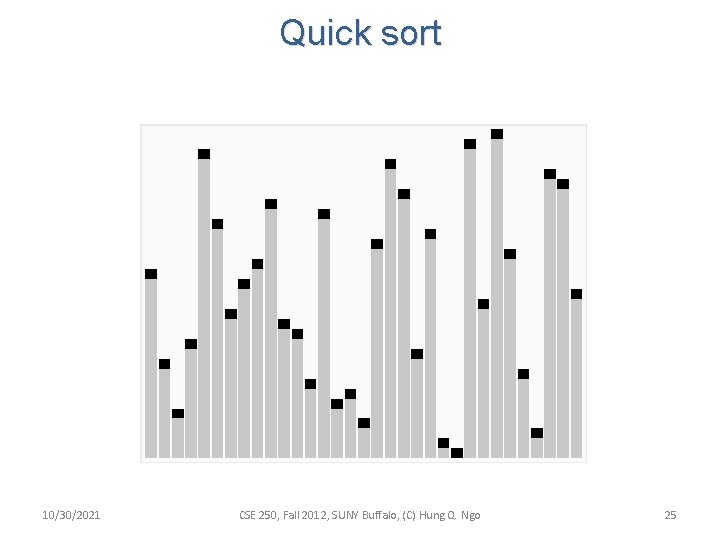
Quick sort 10/30/2021 CSE 250, Fall 2012, SUNY Buffalo, (C) Hung Q. Ngo 25
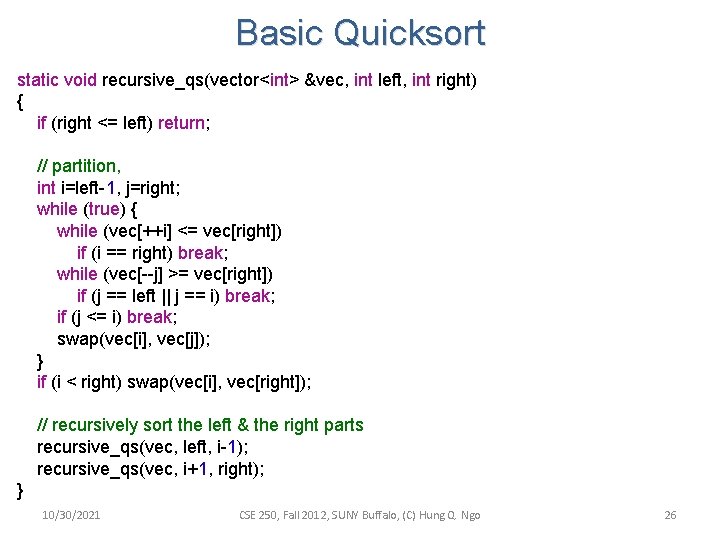
Basic Quicksort static void recursive_qs(vector<int> &vec, int left, int right) { if (right <= left) return; // partition, int i=left-1, j=right; while (true) { while (vec[++i] <= vec[right]) if (i == right) break; while (vec[--j] >= vec[right]) if (j == left || j == i) break; if (j <= i) break; swap(vec[i], vec[j]); } if (i < right) swap(vec[i], vec[right]); // recursively sort the left & the right parts recursive_qs(vec, left, i-1); recursive_qs(vec, i+1, right); } 10/30/2021 CSE 250, Fall 2012, SUNY Buffalo, (C) Hung Q. Ngo 26
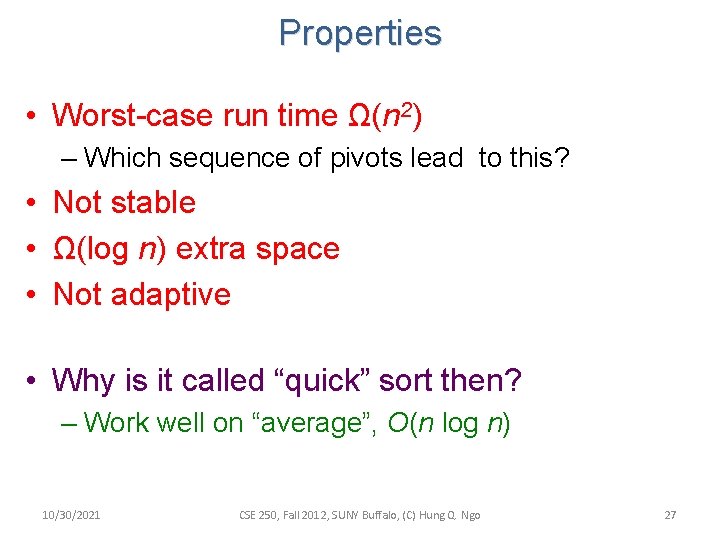
Properties • Worst-case run time Ω(n 2) – Which sequence of pivots lead to this? • Not stable • Ω(log n) extra space • Not adaptive • Why is it called “quick” sort then? – Work well on “average”, O(n log n) 10/30/2021 CSE 250, Fall 2012, SUNY Buffalo, (C) Hung Q. Ngo 27
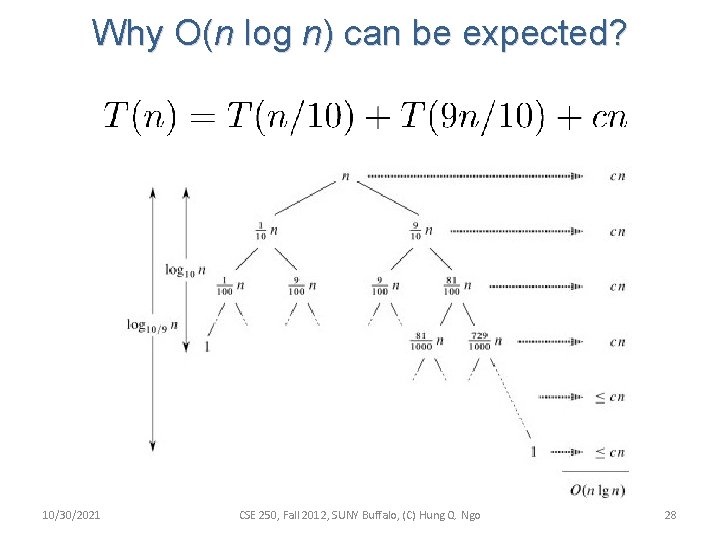
Why O(n log n) can be expected? 10/30/2021 CSE 250, Fall 2012, SUNY Buffalo, (C) Hung Q. Ngo 28
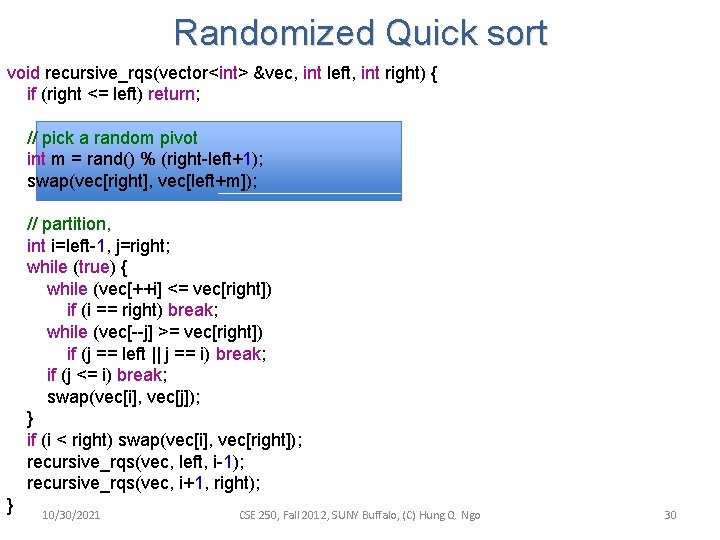
Making Quicksort Quick • We can make it more likely to work well by randomizing the pivot!!! – Las Vegas algorithm – Randomization is an extremely important idea! • It is very slow on almost-equal inputs – Randomization can fix that too! 10/30/2021 CSE 250, Fall 2012, SUNY Buffalo, (C) Hung Q. Ngo 29
Randomized Quick sort void recursive_rqs(vector<int> &vec, int left, int right) { if (right <= left) return; // pick a random pivot int m = rand() % (right-left+1); swap(vec[right], vec[left+m]); // partition, int i=left-1, j=right; while (true) { while (vec[++i] <= vec[right]) if (i == right) break; while (vec[--j] >= vec[right]) if (j == left || j == i) break; if (j <= i) break; swap(vec[i], vec[j]); } if (i < right) swap(vec[i], vec[right]); recursive_rqs(vec, left, i-1); recursive_rqs(vec, i+1, right); } 10/30/2021 CSE 250, Fall 2012, SUNY Buffalo, (C) Hung Q. Ngo 30
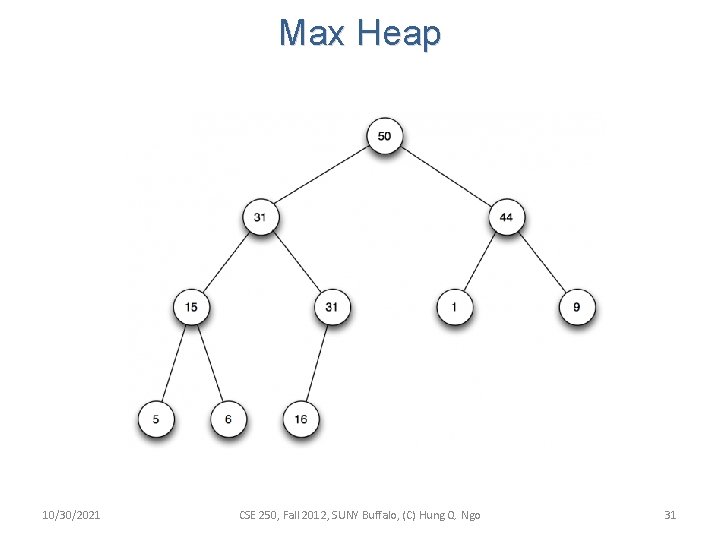
Max Heap 10/30/2021 CSE 250, Fall 2012, SUNY Buffalo, (C) Hung Q. Ngo 31
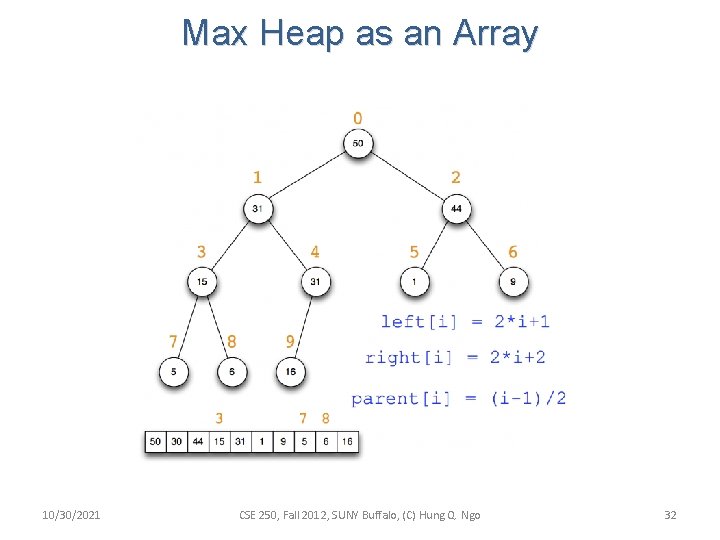
Max Heap as an Array 10/30/2021 CSE 250, Fall 2012, SUNY Buffalo, (C) Hung Q. Ngo 32
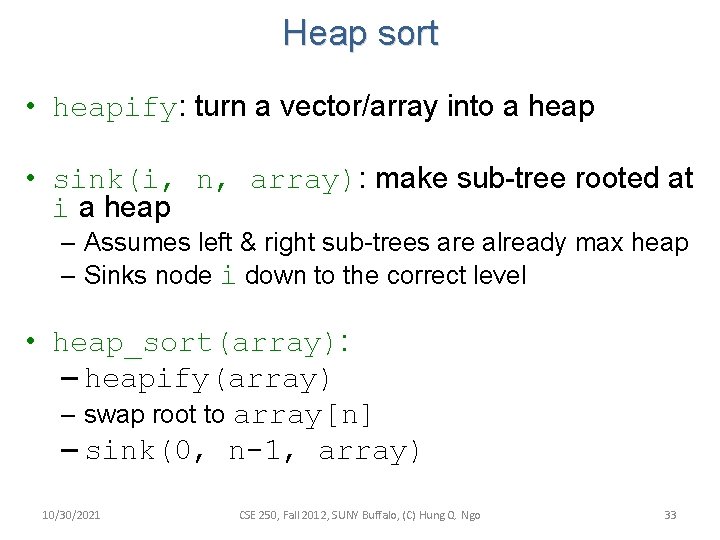
Heap sort • heapify: turn a vector/array into a heap • sink(i, n, array): make sub-tree rooted at i a heap – Assumes left & right sub-trees are already max heap – Sinks node i down to the correct level • heap_sort(array): – heapify(array) – swap root to array[n] – sink(0, n-1, array) 10/30/2021 CSE 250, Fall 2012, SUNY Buffalo, (C) Hung Q. Ngo 33
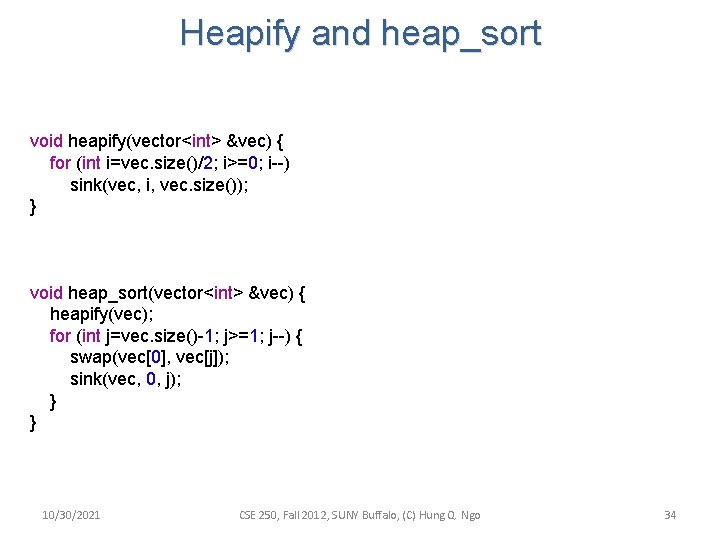
Heapify and heap_sort void heapify(vector<int> &vec) { for (int i=vec. size()/2; i>=0; i--) sink(vec, i, vec. size()); } void heap_sort(vector<int> &vec) { heapify(vec); for (int j=vec. size()-1; j>=1; j--) { swap(vec[0], vec[j]); sink(vec, 0, j); } } 10/30/2021 CSE 250, Fall 2012, SUNY Buffalo, (C) Hung Q. Ngo 34
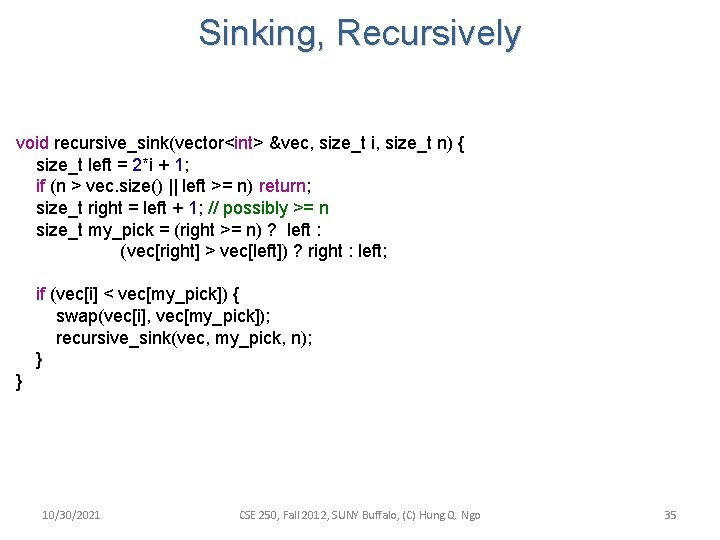
Sinking, Recursively void recursive_sink(vector<int> &vec, size_t i, size_t n) { size_t left = 2*i + 1; if (n > vec. size() || left >= n) return; size_t right = left + 1; // possibly >= n size_t my_pick = (right >= n) ? left : (vec[right] > vec[left]) ? right : left; if (vec[i] < vec[my_pick]) { swap(vec[i], vec[my_pick]); recursive_sink(vec, my_pick, n); } } 10/30/2021 CSE 250, Fall 2012, SUNY Buffalo, (C) Hung Q. Ngo 35
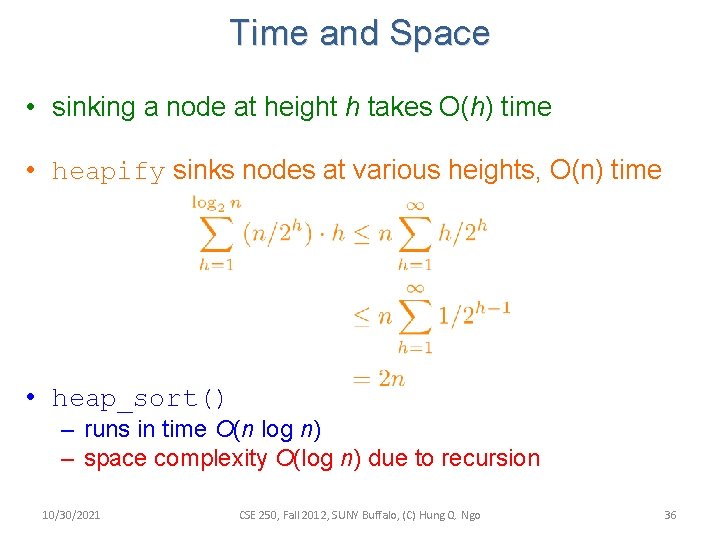
Time and Space • sinking a node at height h takes O(h) time • heapify sinks nodes at various heights, O(n) time • heap_sort() – runs in time O(n log n) – space complexity O(log n) due to recursion 10/30/2021 CSE 250, Fall 2012, SUNY Buffalo, (C) Hung Q. Ngo 36
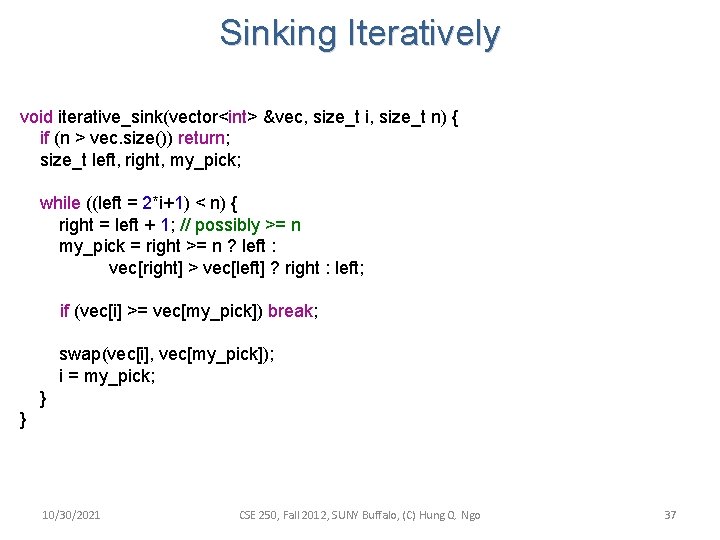
Sinking Iteratively void iterative_sink(vector<int> &vec, size_t i, size_t n) { if (n > vec. size()) return; size_t left, right, my_pick; while ((left = 2*i+1) < n) { right = left + 1; // possibly >= n my_pick = right >= n ? left : vec[right] > vec[left] ? right : left; if (vec[i] >= vec[my_pick]) break; swap(vec[i], vec[my_pick]); i = my_pick; } } 10/30/2021 CSE 250, Fall 2012, SUNY Buffalo, (C) Hung Q. Ngo 37
Binary Heap as Priority Queue • Insert new key takes O(log n) • Delete key takes O(log n) • Drawback: search takes a long time • Used in Dijkstra’s algorithm – Link state routing protocol! 10/30/2021 CSE 250, Fall 2012, SUNY Buffalo, (C) Hung Q. Ngo 38
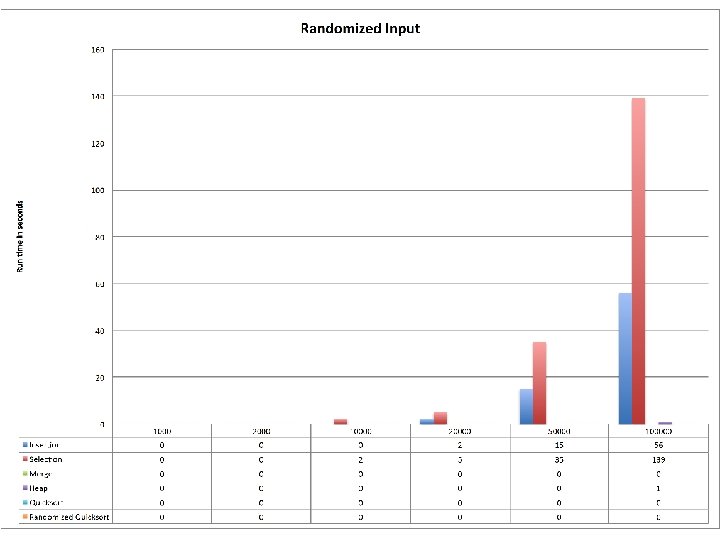
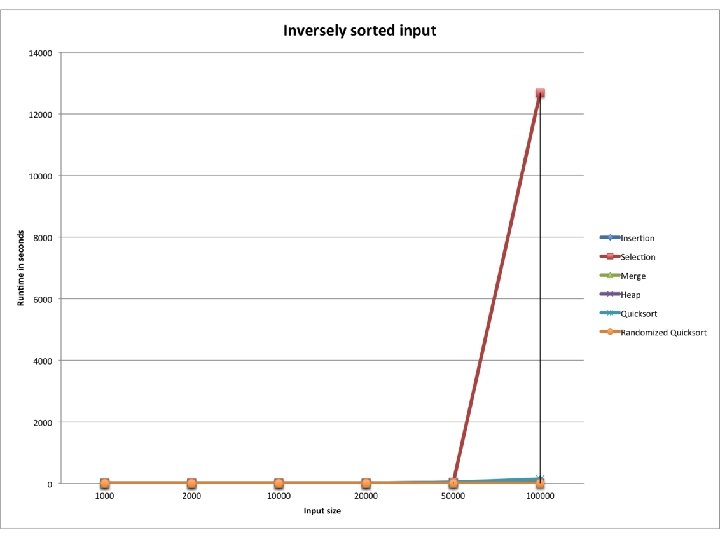
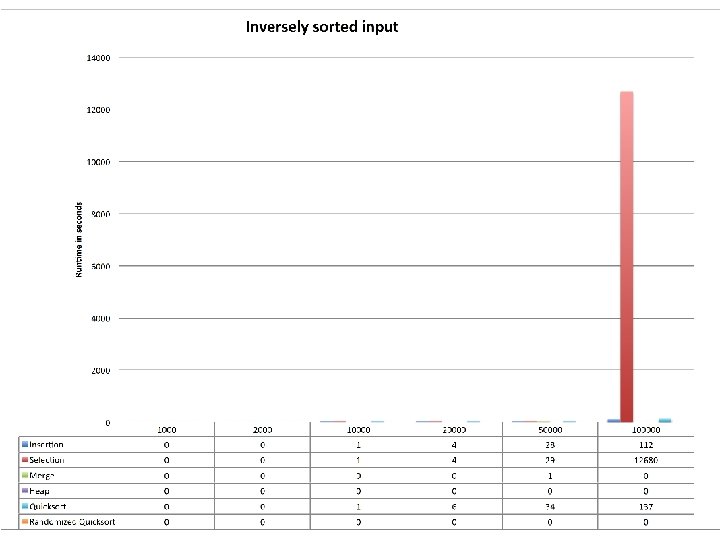
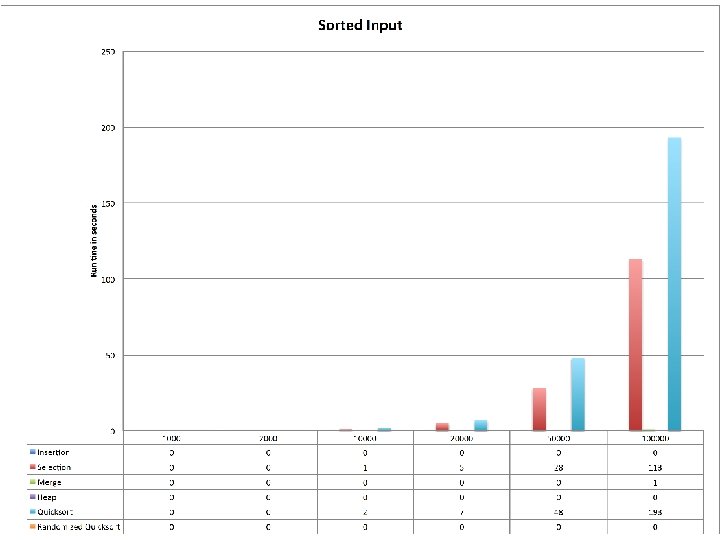
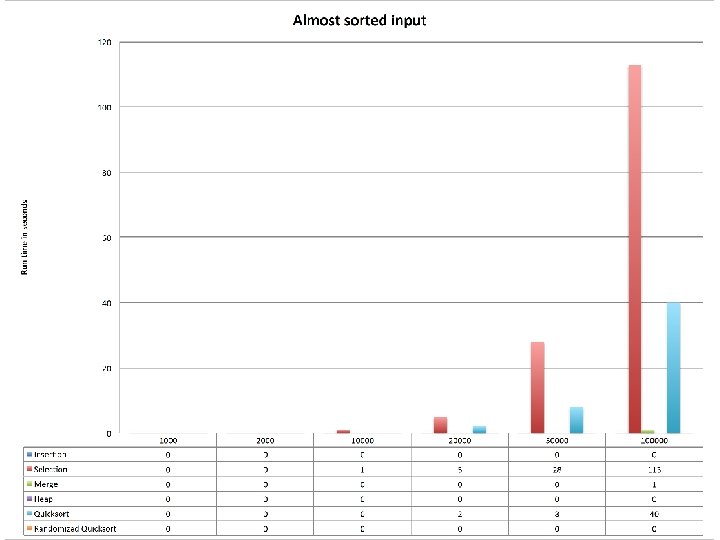
Random input Sorted input Inversedly sorted input EXPERIMENTS WITH SORTING 10/30/2021 CSE 250, Fall 2012, SUNY Buffalo, (C) Hung Q. Ngo 39
10/30/2021 CSE 250, Fall 2012, SUNY Buffalo, (C) Hung Q. Ngo 40
10/30/2021 CSE 250, Fall 2012, SUNY Buffalo, (C) Hung Q. Ngo 41
10/30/2021 CSE 250, Fall 2012, SUNY Buffalo, (C) Hung Q. Ngo 42
10/30/2021 CSE 250, Fall 2012, SUNY Buffalo, (C) Hung Q. Ngo 43
10/30/2021 CSE 250, Fall 2012, SUNY Buffalo, (C) Hung Q. Ngo 44
Function templates Call back functions GENERIC SORTING ROUTINES 10/30/2021 CSE 250, Fall 2012, SUNY Buffalo, (C) Hung Q. Ngo 45
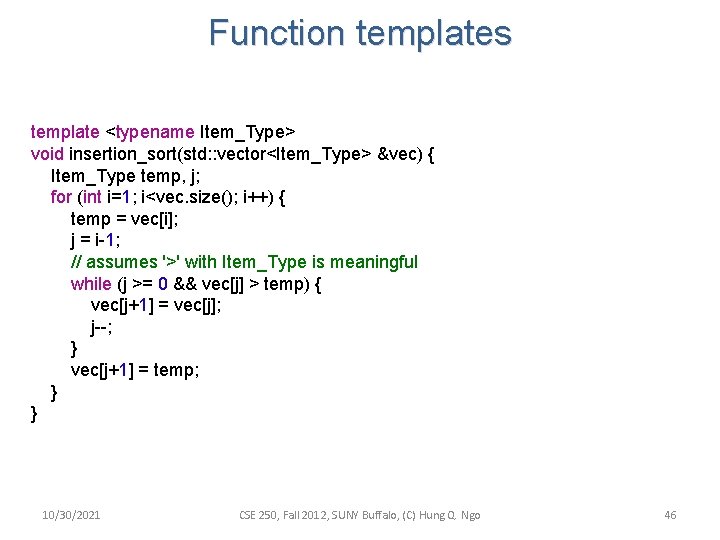
Function templates template <typename Item_Type> void insertion_sort(std: : vector<Item_Type> &vec) { Item_Type temp, j; for (int i=1; i<vec. size(); i++) { temp = vec[i]; j = i-1; // assumes '>' with Item_Type is meaningful while (j >= 0 && vec[j] > temp) { vec[j+1] = vec[j]; j--; } vec[j+1] = temp; } } 10/30/2021 CSE 250, Fall 2012, SUNY Buffalo, (C) Hung Q. Ngo 46
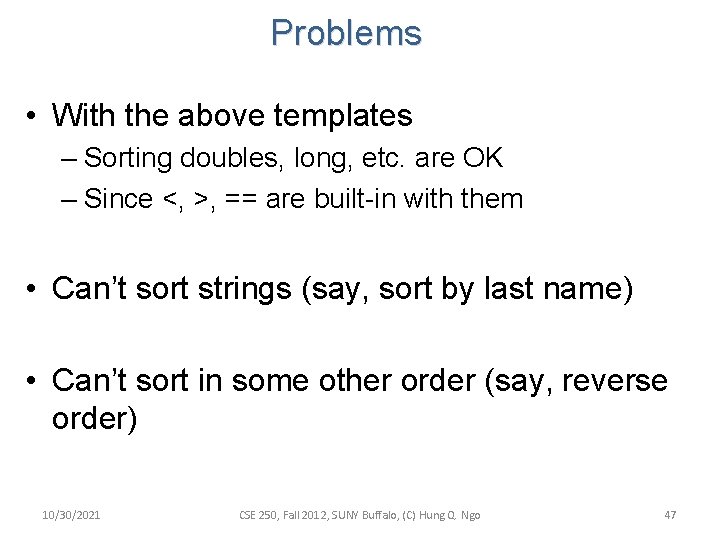
Problems • With the above templates – Sorting doubles, long, etc. are OK – Since <, >, == are built-in with them • Can’t sort strings (say, sort by last name) • Can’t sort in some other order (say, reverse order) 10/30/2021 CSE 250, Fall 2012, SUNY Buffalo, (C) Hung Q. Ngo 47
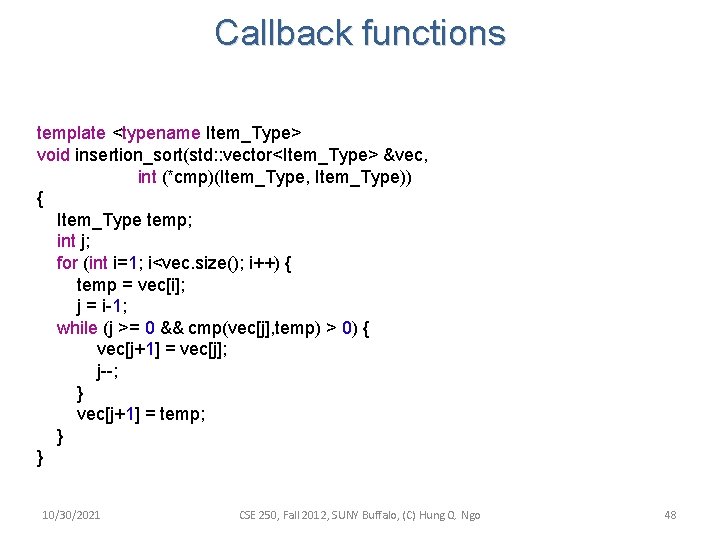
Callback functions template <typename Item_Type> void insertion_sort(std: : vector<Item_Type> &vec, int (*cmp)(Item_Type, Item_Type)) { Item_Type temp; int j; for (int i=1; i<vec. size(); i++) { temp = vec[i]; j = i-1; while (j >= 0 && cmp(vec[j], temp) > 0) { vec[j+1] = vec[j]; j--; } vec[j+1] = temp; } } 10/30/2021 CSE 250, Fall 2012, SUNY Buffalo, (C) Hung Q. Ngo 48
Problems, Still • Users always have to specify a callback function, even for primitive types 10/30/2021 CSE 250, Fall 2012, SUNY Buffalo, (C) Hung Q. Ngo 49
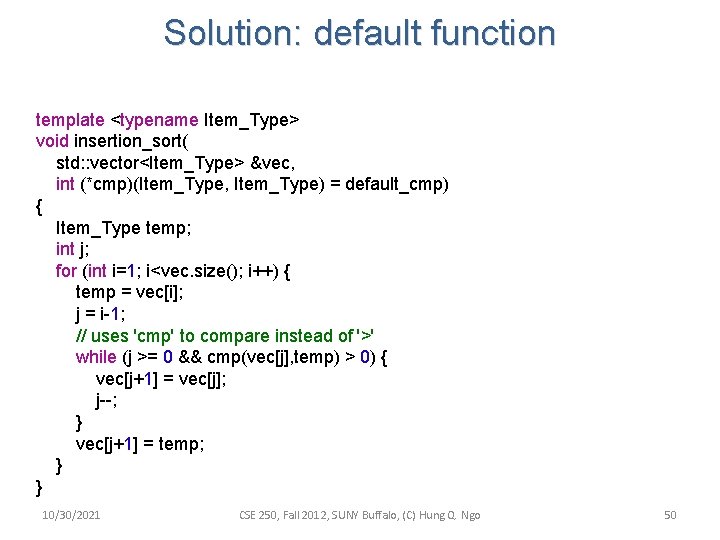
Solution: default function template <typename Item_Type> void insertion_sort( std: : vector<Item_Type> &vec, int (*cmp)(Item_Type, Item_Type) = default_cmp) { Item_Type temp; int j; for (int i=1; i<vec. size(); i++) { temp = vec[i]; j = i-1; // uses 'cmp' to compare instead of '>' while (j >= 0 && cmp(vec[j], temp) > 0) { vec[j+1] = vec[j]; j--; } vec[j+1] = temp; } } 10/30/2021 CSE 250, Fall 2012, SUNY Buffalo, (C) Hung Q. Ngo 50