
Operations Management Waiting Lines Example A Deterministic System
- Slides: 28
Operations Management Waiting Lines
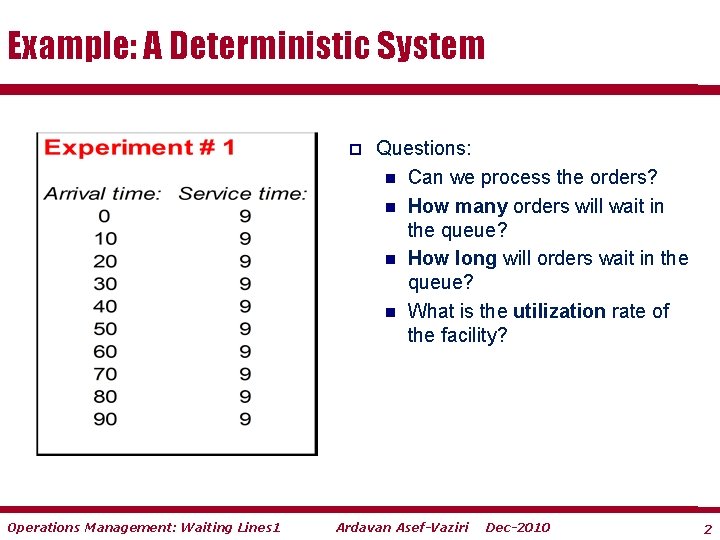
Example: A Deterministic System p Operations Management: Waiting Lines 1 Questions: n Can we process the orders? n How many orders will wait in the queue? n How long will orders wait in the queue? n What is the utilization rate of the facility? Ardavan Asef-Vaziri Dec-2010 2
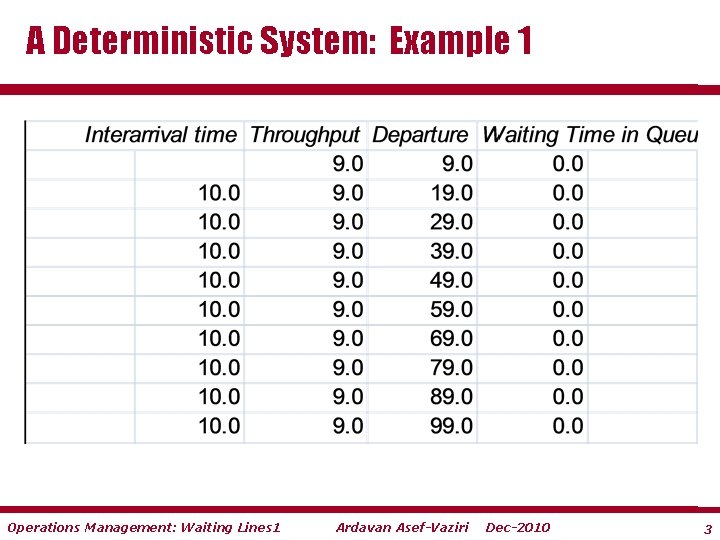
A Deterministic System: Example 1 Operations Management: Waiting Lines 1 Ardavan Asef-Vaziri Dec-2010 3
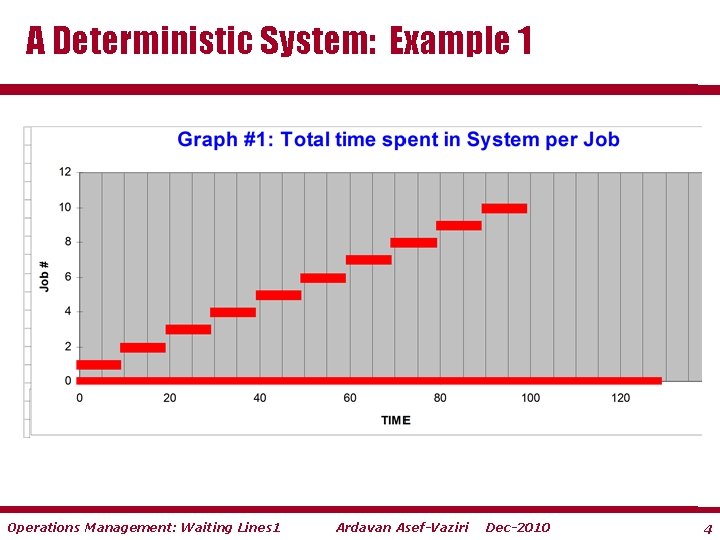
A Deterministic System: Example 1 Operations Management: Waiting Lines 1 Ardavan Asef-Vaziri Dec-2010 4
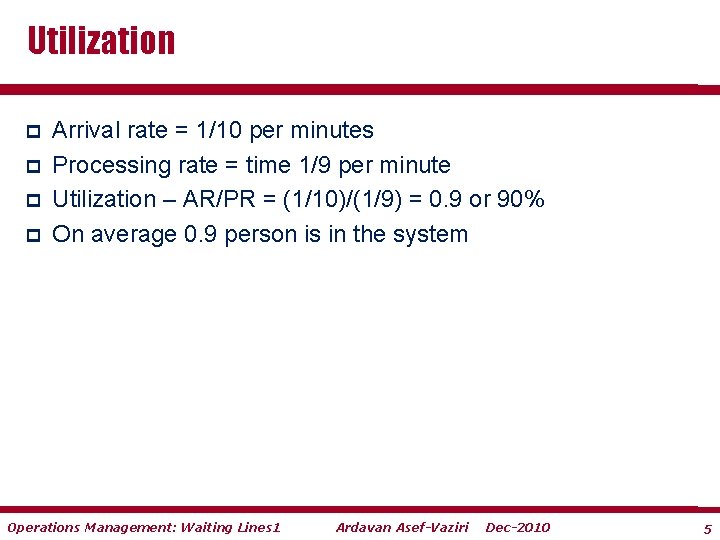
Utilization p p Arrival rate = 1/10 per minutes Processing rate = time 1/9 per minute Utilization – AR/PR = (1/10)/(1/9) = 0. 9 or 90% On average 0. 9 person is in the system Operations Management: Waiting Lines 1 Ardavan Asef-Vaziri Dec-2010 5
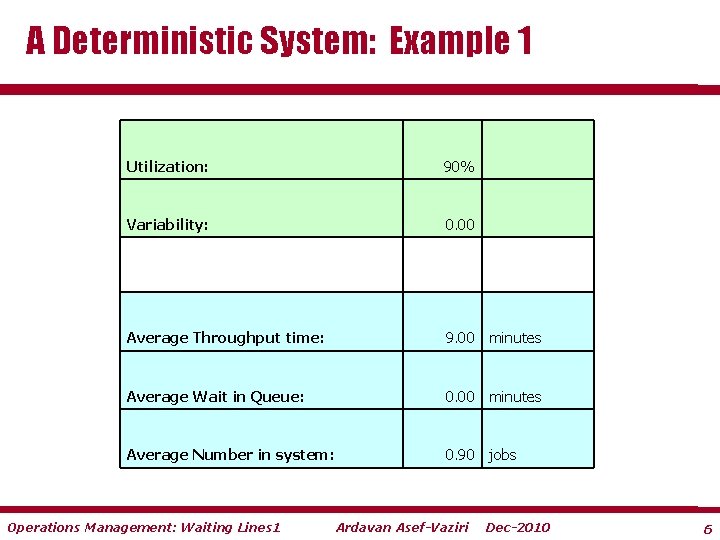
A Deterministic System: Example 1 Utilization: 90% Variability: 0. 00 Average Throughput time: 9. 00 minutes Average Wait in Queue: 0. 00 minutes Average Number in system: 0. 90 jobs Operations Management: Waiting Lines 1 Ardavan Asef-Vaziri Dec-2010 6
Known but Uneven Demand: Example 2 p p What if arrivals are not exactly every 10 minutes? Let’s open the spreadsheet. Operations Management: Waiting Lines 1 Ardavan Asef-Vaziri Dec-2010 7
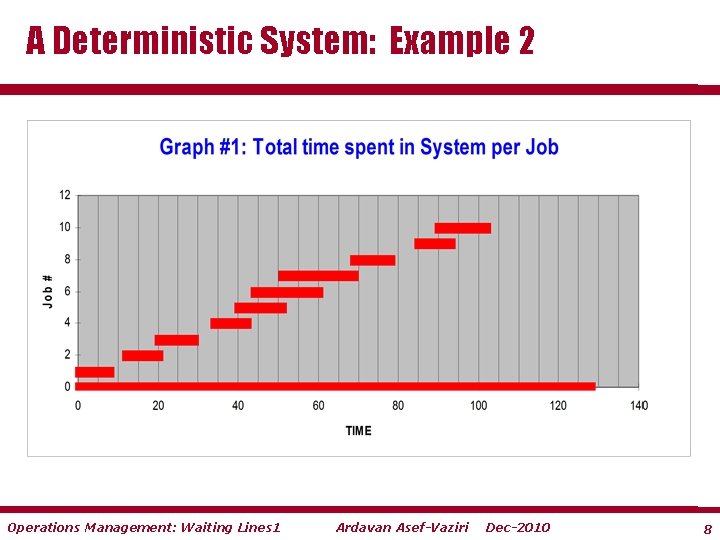
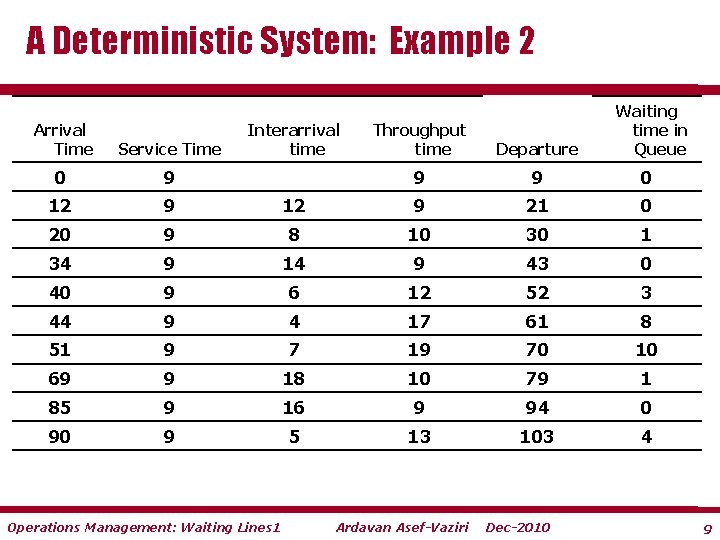
A Deterministic System: Example 2 Operations Management: Waiting Lines 1 Ardavan Asef-Vaziri Dec-2010 8
A Deterministic System: Example 2 Arrival Time Service Time 0 9 12 9 20 Interarrival time Waiting time in Queue Throughput time Departure 9 9 0 12 9 21 0 9 8 10 30 1 34 9 14 9 43 0 40 9 6 12 52 3 44 9 4 17 61 8 51 9 7 19 70 10 69 9 18 10 79 1 85 9 16 9 94 0 90 9 5 13 103 4 Operations Management: Waiting Lines 1 Ardavan Asef-Vaziri Dec-2010 9
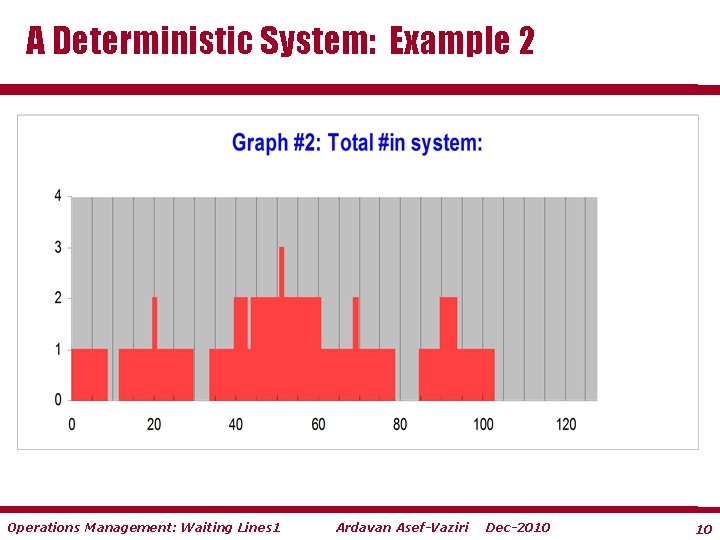
A Deterministic System: Example 2 Operations Management: Waiting Lines 1 Ardavan Asef-Vaziri Dec-2010 10
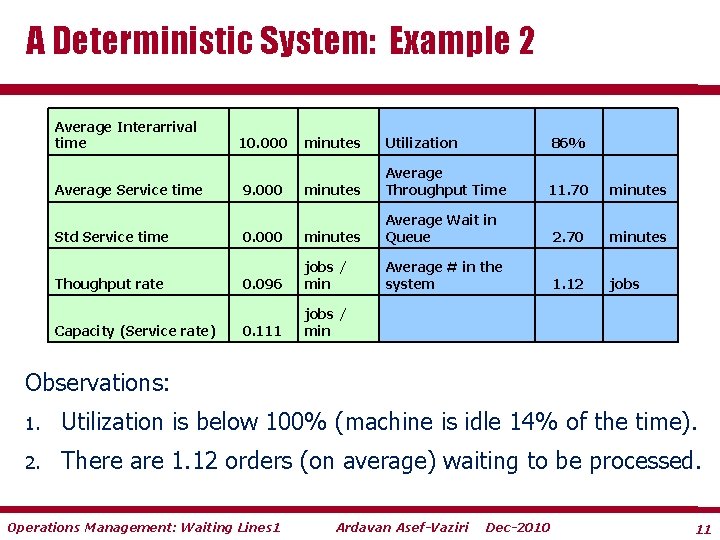
A Deterministic System: Example 2 Average Interarrival time Average Service time Std Service time Thoughput rate Capacity (Service rate) 10. 000 minutes Utilization 86% minutes Average Throughput Time 11. 70 minutes 0. 000 minutes Average Wait in Queue 2. 70 minutes 0. 096 jobs / min Average # in the system 1. 12 jobs 0. 111 jobs / min 9. 000 Observations: 1. Utilization is below 100% (machine is idle 14% of the time). 2. There are 1. 12 orders (on average) waiting to be processed. Operations Management: Waiting Lines 1 Ardavan Asef-Vaziri Dec-2010 11
A Deterministic System: Example 2 p p Why do we have idleness (low utilization) and at the same time orders are waiting to be processed? Answer: Variability Operations Management: Waiting Lines 1 Ardavan Asef-Vaziri Dec-2010 12
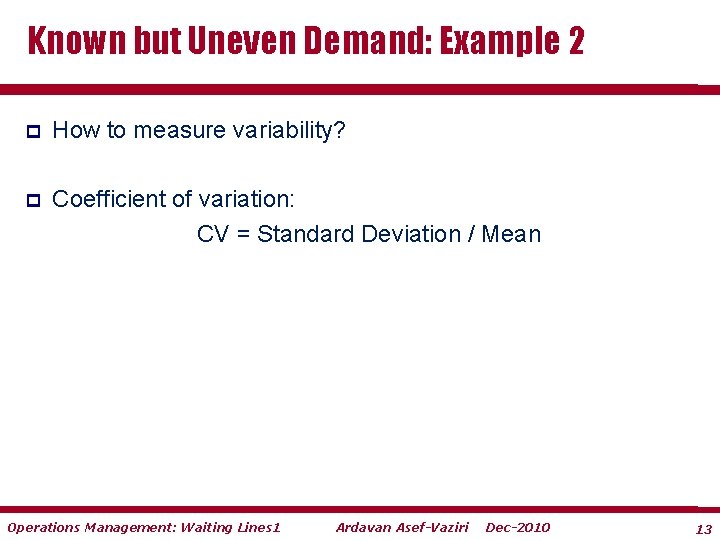
Known but Uneven Demand: Example 2 p How to measure variability? p Coefficient of variation: CV = Standard Deviation / Mean Operations Management: Waiting Lines 1 Ardavan Asef-Vaziri Dec-2010 13
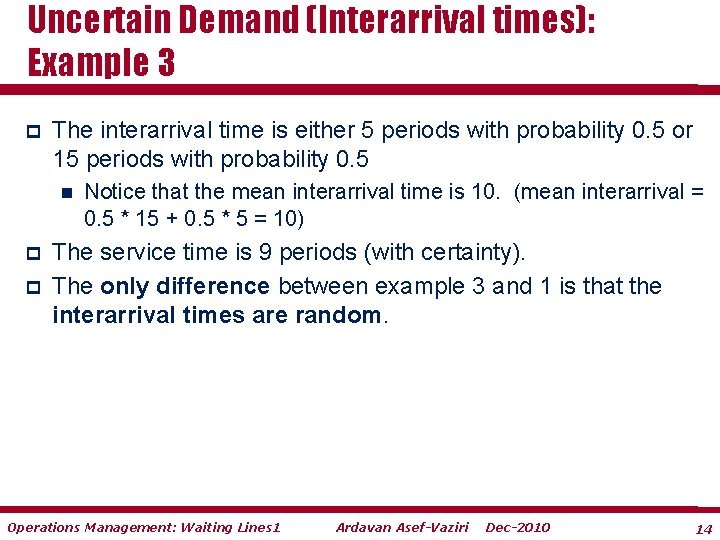
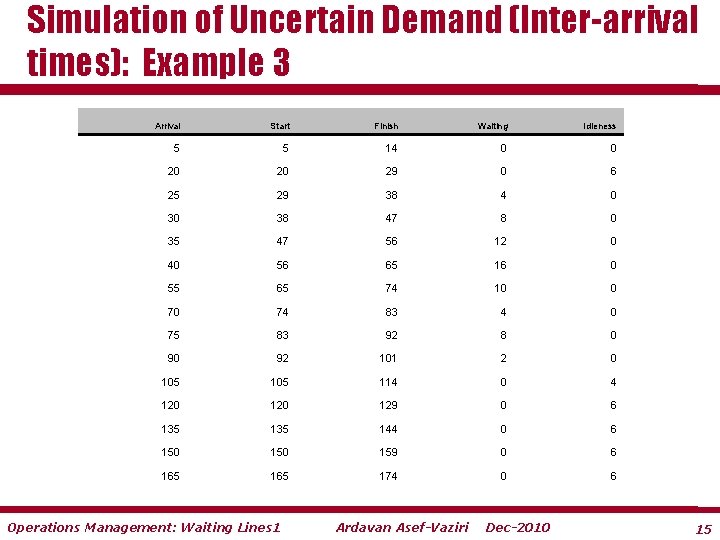
Uncertain Demand (Interarrival times): Example 3 p The interarrival time is either 5 periods with probability 0. 5 or 15 periods with probability 0. 5 n p p Notice that the mean interarrival time is 10. (mean interarrival = 0. 5 * 15 + 0. 5 * 5 = 10) The service time is 9 periods (with certainty). The only difference between example 3 and 1 is that the interarrival times are random. Operations Management: Waiting Lines 1 Ardavan Asef-Vaziri Dec-2010 14
Simulation of Uncertain Demand (Inter-arrival times): Example 3 Arrival Start Finish Waiting Idleness 5 5 14 0 0 20 20 29 0 6 25 29 38 4 0 30 38 47 8 0 35 47 56 12 0 40 56 65 16 0 55 65 74 10 0 70 74 83 4 0 75 83 92 8 0 90 92 101 2 0 105 114 0 4 120 129 0 6 135 144 0 6 150 159 0 6 165 174 0 6 Operations Management: Waiting Lines 1 Ardavan Asef-Vaziri Dec-2010 15
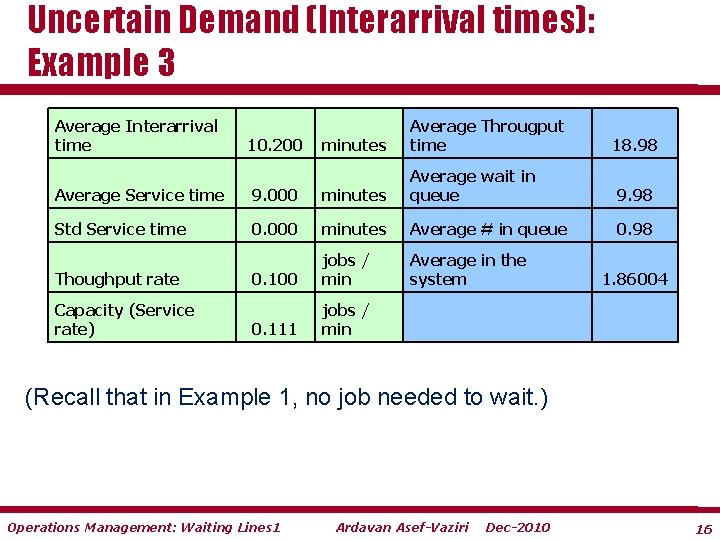
Uncertain Demand (Interarrival times): Example 3 Average Interarrival time 10. 200 minutes Average Througput time 9. 98 0. 98 Average Service time 9. 000 minutes Average wait in queue Std Service time 0. 000 minutes Average # in queue 0. 100 jobs / min Average in the system 0. 111 jobs / min Thoughput rate Capacity (Service rate) 18. 98 1. 86004 (Recall that in Example 1, no job needed to wait. ) Operations Management: Waiting Lines 1 Ardavan Asef-Vaziri Dec-2010 16
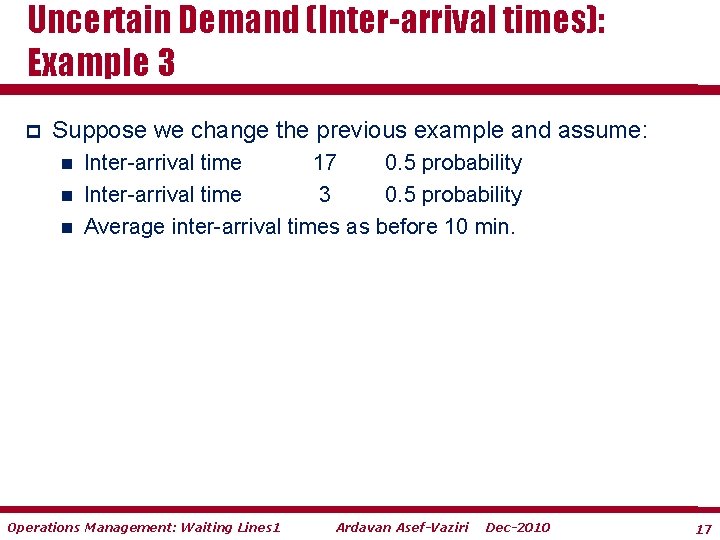
Uncertain Demand (Inter-arrival times): Example 3 p Suppose we change the previous example and assume: n n n Inter-arrival time 17 0. 5 probability Inter-arrival time 3 0. 5 probability Average inter-arrival times as before 10 min. Operations Management: Waiting Lines 1 Ardavan Asef-Vaziri Dec-2010 17
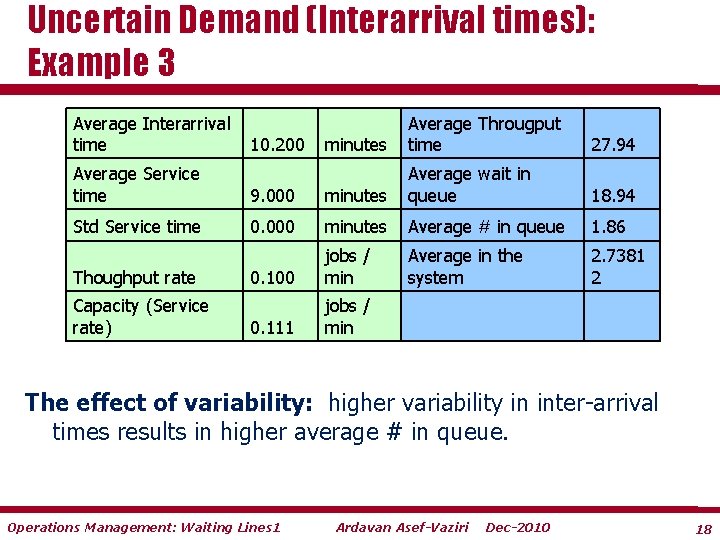
Uncertain Demand (Interarrival times): Example 3 Average Interarrival time 10. 200 minutes Average Througput time 27. 94 18. 94 Average Service time 9. 000 minutes Average wait in queue Std Service time 0. 000 minutes Average # in queue 1. 86 0. 100 jobs / min Average in the system 2. 7381 2 0. 111 jobs / min Thoughput rate Capacity (Service rate) The effect of variability: higher variability in inter-arrival times results in higher average # in queue. Operations Management: Waiting Lines 1 Ardavan Asef-Vaziri Dec-2010 18
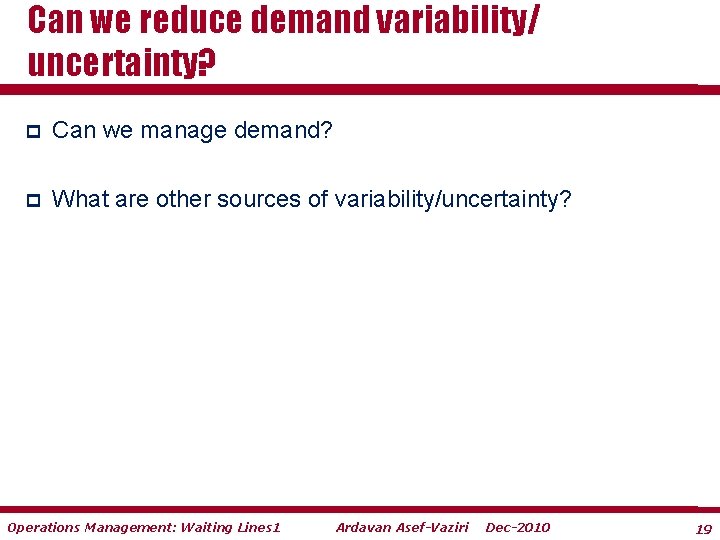
Can we reduce demand variability/ uncertainty? p Can we manage demand? p What are other sources of variability/uncertainty? Operations Management: Waiting Lines 1 Ardavan Asef-Vaziri Dec-2010 19
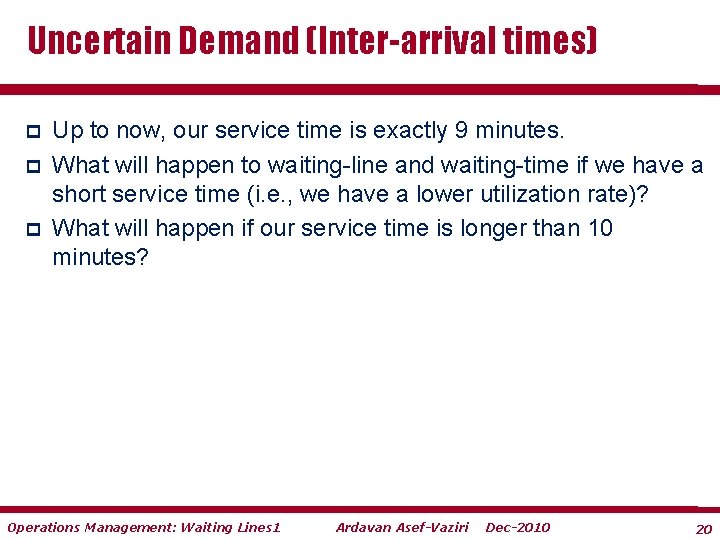
Uncertain Demand (Inter-arrival times) p p p Up to now, our service time is exactly 9 minutes. What will happen to waiting-line and waiting-time if we have a short service time (i. e. , we have a lower utilization rate)? What will happen if our service time is longer than 10 minutes? Operations Management: Waiting Lines 1 Ardavan Asef-Vaziri Dec-2010 20
Key Concepts and Issues p The factors that determine the performance of the waiting lines: n Variability n Utilization rate n Risk pooling effect Operations Management: Waiting Lines 1 Ardavan Asef-Vaziri Dec-2010 21
Rule 1 p In general, if the variability, or the uncertainty, of the demand (arrival) or service process is large, the queue length and the waiting time are also large. Operations Management: Waiting Lines 1 Ardavan Asef-Vaziri Dec-2010 22
Rule 2 p As the utilization increases the waiting time and the number of orders in the queue increases exponentially. Operations Management: Waiting Lines 1 Ardavan Asef-Vaziri Dec-2010 23
Rule 3 p In general, pooling the demand (customers) into one common line improves the performance of the system. Operations Management: Waiting Lines 1 Ardavan Asef-Vaziri Dec-2010 24
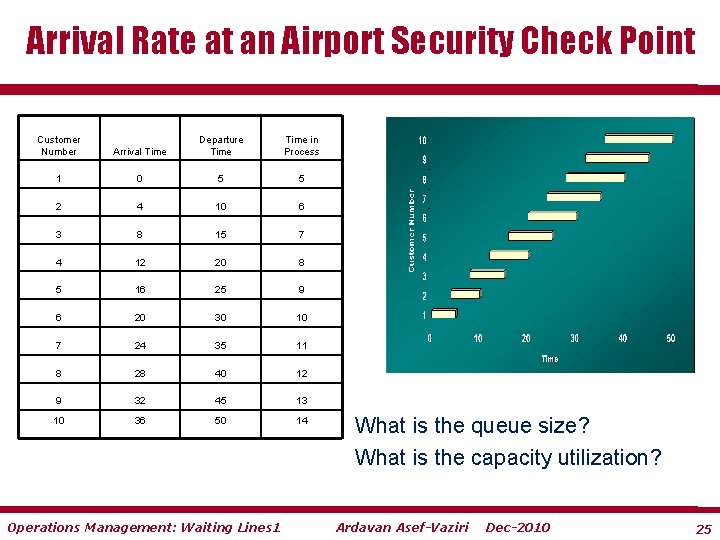
Arrival Rate at an Airport Security Check Point Customer Number Arrival Time Departure Time in Process 1 0 5 5 2 4 10 6 3 8 15 7 4 12 20 8 5 16 25 9 6 20 30 10 7 24 35 11 8 28 40 12 9 32 45 13 10 36 50 14 Operations Management: Waiting Lines 1 What is the queue size? What is the capacity utilization? Ardavan Asef-Vaziri Dec-2010 25
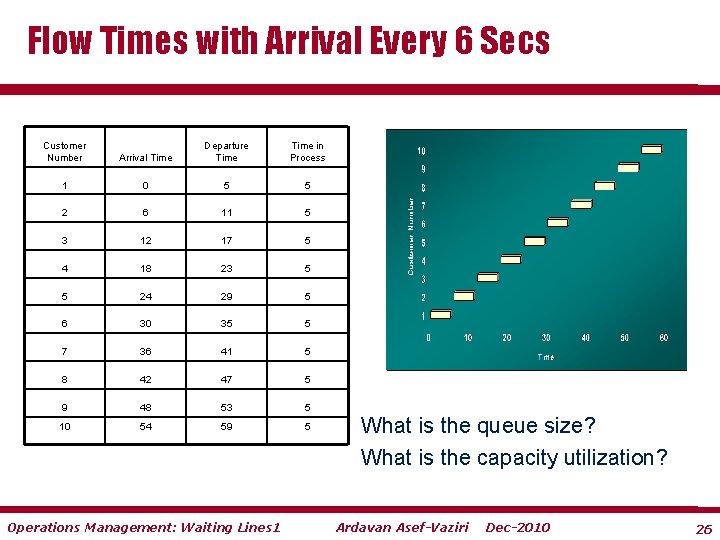
Flow Times with Arrival Every 6 Secs Customer Number Arrival Time Departure Time in Process 1 0 5 5 2 6 11 5 3 12 17 5 4 18 23 5 5 24 29 5 6 30 35 5 7 36 41 5 8 42 47 5 9 48 53 5 10 54 59 5 Operations Management: Waiting Lines 1 What is the queue size? What is the capacity utilization? Ardavan Asef-Vaziri Dec-2010 26
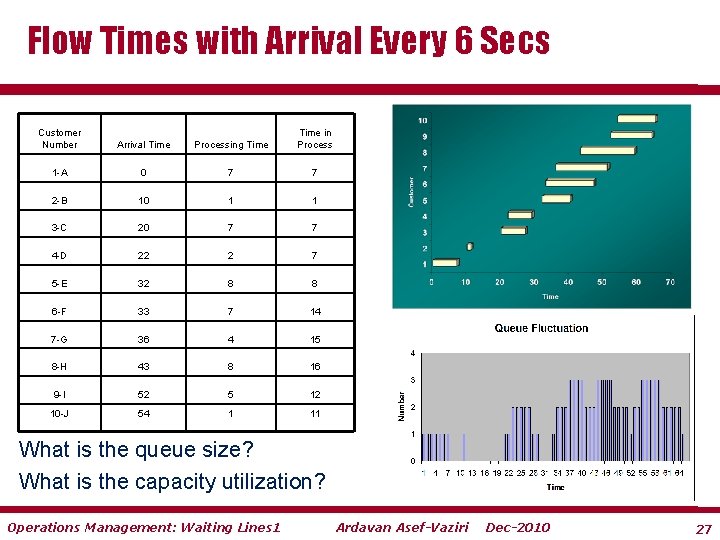
Flow Times with Arrival Every 6 Secs Customer Number Arrival Time Processing Time in Process 1 -A 0 7 7 2 -B 10 1 1 3 -C 20 7 7 4 -D 22 2 7 5 -E 32 8 8 6 -F 33 7 14 7 -G 36 4 15 8 -H 43 8 16 9 -I 52 5 12 10 -J 54 1 11 What is the queue size? What is the capacity utilization? Operations Management: Waiting Lines 1 Ardavan Asef-Vaziri Dec-2010 27
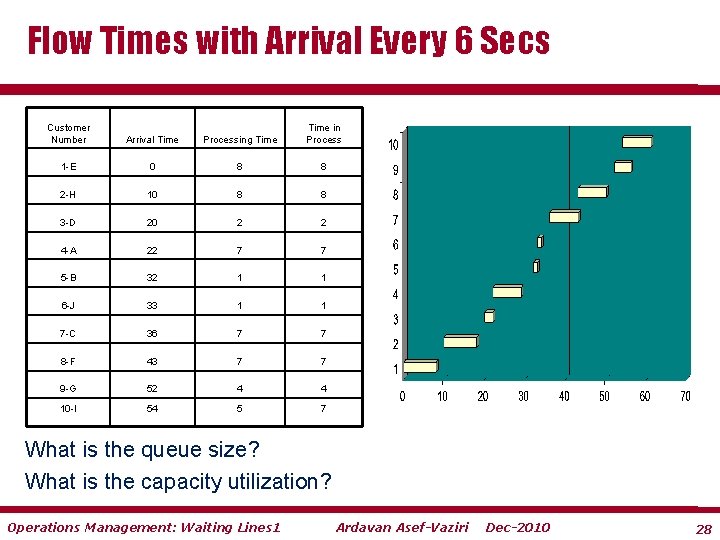
Flow Times with Arrival Every 6 Secs Customer Number Arrival Time Processing Time in Process 1 -E 0 8 8 2 -H 10 8 8 3 -D 20 2 2 4 -A 22 7 7 5 -B 32 1 1 6 -J 33 1 1 7 -C 36 7 7 8 -F 43 7 7 9 -G 52 4 4 10 -I 54 5 7 What is the queue size? What is the capacity utilization? Operations Management: Waiting Lines 1 Ardavan Asef-Vaziri Dec-2010 28